
First, it puts out a really tall “chick.”

Let’s zoom in on the top of that rosette.
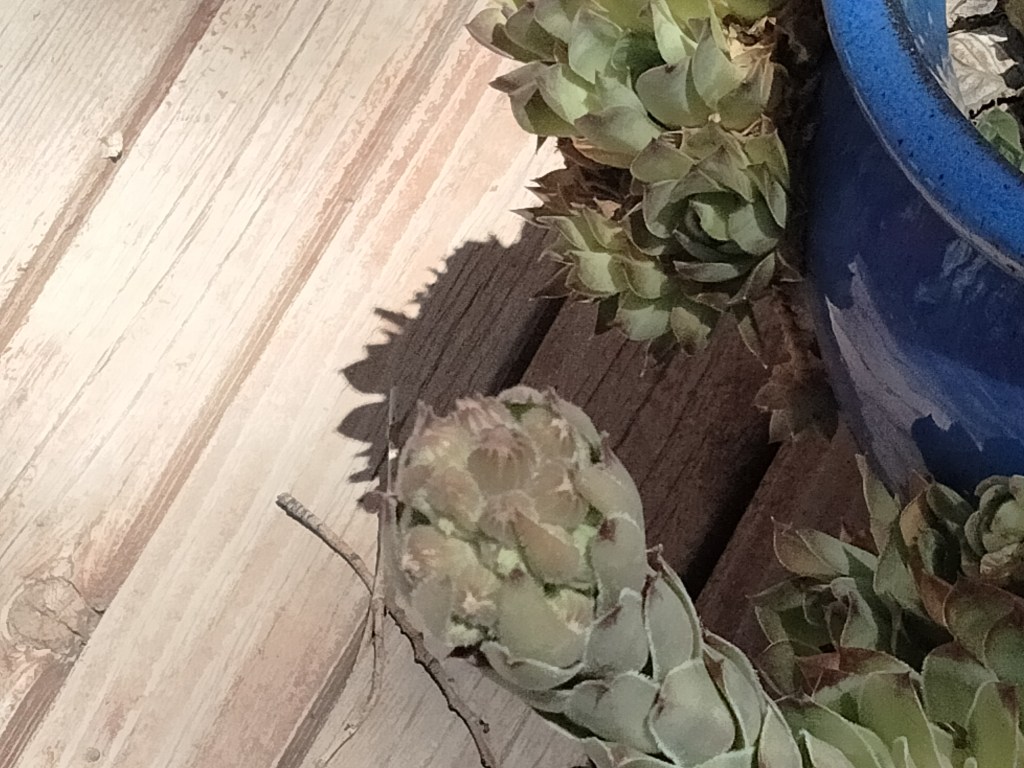
It seems to be packed with waiting flowers.

Update: it now looks like this. Terrifying. Maybe Sigourney Weaver could help me with this.

First, it puts out a really tall “chick.”
Let’s zoom in on the top of that rosette.
It seems to be packed with waiting flowers.
Update: it now looks like this. Terrifying. Maybe Sigourney Weaver could help me with this.

I photographed this stuff growing, as you see, in/near a stream near the Hiawatha Bike Trail in northern Idaho. N.b.: the taller, thicker plants in the immediate foreground are not the same ones I am talking about. I am focused on the feathery, jointed ones near the stream.
Using my Central Rocky Mountain Wildflowers guidebook and the Internet, here is a list of possible identifications I considered:
Then I broke down and asked Google to examine the photo, which means, like it or not, I was enlisting the help of AI. Here were Google’s two suggestions:
Bassia scoparia is our best candidate, and here’s why. It can be found in “riparian areas,” according to the article that I linked. “It naturalizes and self-seed easily.” “This plant is a noxious weed in several states.”
Edit: Beth has suggested it may be “horsetail,” Equisetum arvense. I looked it up, and Horsetail is the most likely candidate yet! According to Wikipedia,
Equisetum arvense, the field horsetail or common horsetail, is an herbaceous perennial plant in the Equisetidae (horsetails) sub-class, native throughout the arctic and temperate regions of the Northern Hemisphere. … Many species of horsetail have been described and subsequently synonymized with E. arvense. One of these is E. calderi, a small form described from Arctic North America.
Northern Idaho isn’t exactly Arctic, but it’s gettin’ close.

Oh. It’s Lupine again.
5. All other pines besides Ponderosa. Especially creosote.
4. Ponderosa pines. They have a sweet smell that’s natural and can’t be faked.
3. Trees in the aspen/poplar/cottonwood family. They have a slightly spicy smell that lets you know you are outside.
2. Sycamore trees. They have wide-spaced branches and flaky bark that make them terrible for climbing, and their foliage isn’t particularly beautiful, but their smell …? Amazing. Instantly calms me whenever I am near them.
Notice that none of the trees on this list grow in the tropics. Sorry, tropical jungle! I have lived there, and while the tropical jungle may have much to recommend it (it is certainly better than the tropical city!), I am sorry to say that it does not smell good. Its trees and bugs are generally weird-smelling or stinky. And don’t get me started on the odor of unprocessed rubber!

This post is about how we got our Christmas trees. For the record, I would probably still have a Christmas tree in the house even if it they were pagan in origin. (I’ll explain why in a different post, drawing on G.K. Chesterton.) But Christmas trees aren’t pagan. At least, not entirely.
Yes, I had barbarian ancestors, in Ireland, England, Friesland, and probably among the other Germanic tribes as well. Some of them were headhunters, if you go back far enough. (For example, pre-Roman Celts were.) All of us had barbarian ancestors, right? And we love them.
St. Boniface was a missionary during the 700s to pagan Germanic tribes such as the Hessians. At that time, oak trees were an important part of pagan worship all across Europe. You can trace this among the Greeks, for example, and, on the other side of the continent, among the Druids. These trees were felt to be mystical, were sacred to the more important local gods, whichever those were, and were the site of animal and in some cases human sacrifice.
St. Boniface famously cut down a huge oak tree on Mt. Gudenberg, which the Hessians held as sacred to Thor.
Now, I would like to note that marching in and destroying a culture’s most sacred symbol is not commonly accepted as good missionary practice. It is not generally the way to win hearts and minds, you might say.
The more preferred method is the one Paul took in the Areopagus, where he noticed that the Athenians had an altar “to an unknown god,” and began to talk to them about this unknown god as someone he could make known, even quoting their own poets to them (Acts 17:16 – 34). In other words, he understood the culture, knew how to speak to people in their own terms, and in these terms was able to explain the Gospel. In fact, a city clerk was able to testify, “These men have neither robbed temples nor blasphemed our goddess” (Acts 19:37). Later (for example, in Ephesus) we see pagan Greeks voluntarily burning their own spellbooks and magic charms when they convert to Christ (Acts 19:17 – 20). This is, in general, a much better way. (Although note that later in the chapter, it causes pushback from those who were losing money in the charm-and-idol trade.)
However, occasionally it is appropriate for a representative of the living God to challenge a local god directly. This is called a power encounter. Elijah, a prophet of ancient Israel, staged a power encounter when he challenged 450 priests of the pagan god Baal to get Baal to bring down fire on an animal sacrifice that had been prepared for him. When no fire came after they had chanted, prayed, and cut themselves all day, Elijah prayed to the God of Israel, who immediately sent fire that burned up not only the sacrifice that had been prepared for Him, but also the stones of the altar (I Kings chapter 18). So, there are times when a power encounter is called for.
A wise missionary who had traveled and talked to Christians all over the world once told me, during a class on the subject, that power encounters tend to be successful in the sense of winning people’s hearts only when they arise naturally. If an outsider comes in and tries to force a power encounter, “It usually just damages relationships.” But people are ready when, say, there had been disagreement in the village or nation about which god to follow, and someone in authority says, “O.K. We are going to settle this once and for all.”
That appears to be the kind of power encounter that Elijah had. Israel was ostensibly supposed to be serving their God, but the king, Ahab, had married a pagan princess and was serving her gods as well. In fact, Ahab had been waffling for years. There had been a drought (which Ahab knew that Elijah — read God — was causing). Everyone was sick of the starvation and the uncertainty. Before calling down the fire, Elijah prays, “Answer me, O LORD, answer me, so these people will know that you, O LORD, are God, and that you are turning their hearts back again.” (I Kings 18:37)
Similar circumstances appear to have been behind Boniface’s decision to cut down the great oak tree. In one of the sources I cite below, Boniface is surrounded by a crowd of bearded, long-haired Hessian chiefs and warriors, who are watching him cut down the oak and waiting for Thor to strike him down. When he is able successfully to cut down the oak, they are shaken. “If our gods are powerless to protect their own holy places, then they are nothing” (Hannula p. 62). Clearly, Boniface had been among them for some time, and the Hessians were already beginning to have doubts and questions, before the oak was felled.
Also note that, just as with Elijah, Boniface was not a colonizer coming in with superior technological power to bulldoze the Hessians’ culture. They could have killed him, just as Ahab could have had Elijah killed. A colonizer coming in with gunboats to destroy a sacred site is not a good look, and it’s not really a power encounter either, because what is being brought to bear in such a case is man’s power and not God’s.
In some versions of this story, Boniface “gives” the Hessians a fir tree to replace the oak he cut down. (In some versions, it miraculously sprouts from the spot.) Instead of celebrating Winter Solstice at the oak tree, they would now celebrate Christ-mass (during Winter Solstice, because everyone needs a holiday around that time) at the fir tree. So, yes, it’s a Christian symbol.
Now, every holiday tradition, laden with symbols and accretions, draws from all kinds of streams. So let me hasten to say that St. Boniface was not the only contributor to the Christmas tree. People have been using trees as objects of decoration, celebration, and well-placed or mis-placed worship, all through history. Some of our Christmas traditions, such as decorating our houses with evergreen and holly boughs, giving gifts, and even pointed red caps, come from the Roman festival of Saturnalia. This is what holidays are like. This is what symbols are like. This is what it is like to be human.
Still, I’d like to say thanks to St. Boniface for getting some of my ancestors started on the tradition of the Christmas tree.
... in a YouTube comments section with a Hebraic-roots Christian who was insisting that Christmas is a “pagan” holiday:
So, as we can see, the evergreen tree is a Christian symbol, not a pagan one, and has been from the very beginning of its usage. St. Boniface cut down the tree that was sacred to Thor, and that was an oak tree, not a Christmas tree. Sacred oaks are pagan. Christmas trees, which incidentally are not actually considered sacred, are Christian.
Yes, I am aware, as are most Christians, that Jesus was probably not actually born on Dec. 25th. Yes, I am aware that Yule was originally a pagan feast time.
But let’s look at the symbolism, shall we?
For those of us who live in northern climes, and especially before the industrial revolution, the winter solstice is the scariest time of the year. The light is getting less and less, and the weather is getting worse and worse, and all in all, this is the time of year when winter officially declares war on humanity. Winter comes around every year. It kills the sick and weak. It makes important activities like travel and agriculture impossible. It makes even basic activities, like getting water, washing things, bathing, and going to the bathroom anywhere from inconvenient to actually dangerous to do without freezing to death. If winter never went away, then we would all surely die. That is a grim but undeniable fact. Read To Build A Fire by Jack London, and tremble.
Thus, people’s vulnerability before winter is both an instance and a symbol of our vulnerable position before all the hardships and dangers in this fallen world, including the biggie, death. And including, because of death, grief and sorrow.
Yule is a time of dealing with these realities and of waiting for them to back off for another year. After the solstice, the days slowly start getting longer again. The light is coming back. Eventually, it will bring warmth with it. Eventually, life.
Thus, it is entirely appropriate that when the Germanic tribes became Christians, they picked the winter solstice as the time to celebrate Jesus’ birth. He is, after all, the light of the world. A little, tiny light – a small beginning – had come into the bitter winter of the sad, dark world, and it was the promise of life to come. The light shines in the darkness, and the darkness has not overcome it. All this biblical, very Hebrew symbolism answers beautifully the question raised by the European pagans’ concern with the sun coming back.
Our ancestors were not “worshipping pagan gods” at Christmas. They were welcoming Christ (who is the God of Abraham, Isaac, and Jacob) into the heart of their culture. They were recognizing that He was the light, using terms they knew, which were Germanic terms, and this is not surprising because they were Germans.
So, if you want to make the case that no holidays are lawful for Christians except those prescribed in the Old Testament for Israel, be my guest. Try to find some Scriptures to back that up. And maybe you can. But you cannot make that case by accusing people who put up a Christmas tree of worshipping pagan gods. All you’ll do then is reveal yourself to be historically ignorant.
BBC, “Devon Myths and Legends,” http://www.bbc.co.uk/devon/content/articles/2005/12/05/st_boniface_christmas_tree_feature
Foster, Genevieve, Augustus Caesar’s World: 44 BC to AD 14, Beautiful Feet Books, 1947, 1975, Saturnalia on p. 56 ff.
Hannula, Richard, Trial and Triumph: Stories from church history, Canon Press, 1999. Boniface in chapter 9, pp. 61 – 64.
Puiu, Tibi, “The origin and history of the Christmas tree: from paganism to modern ubiquity,” ZME Science, https://www.zmescience.com/science/history-science/origin-christmas-tree-pagan/
A few hours’ drive from my house, in the mountains of southern Idaho, we have a hot springs attraction. The pools are tucked into a niche between the town on one side and the highway on the other.

The photograph above was taken from the east end of the little canyon. Behind me, as I took this photograph, was something called “The Grotto.” It consists of paths and small garden areas winding along the lava-rock hillside. The rocks are basalt, but covered with mineral deposits from the days when the springs gushed out over here.
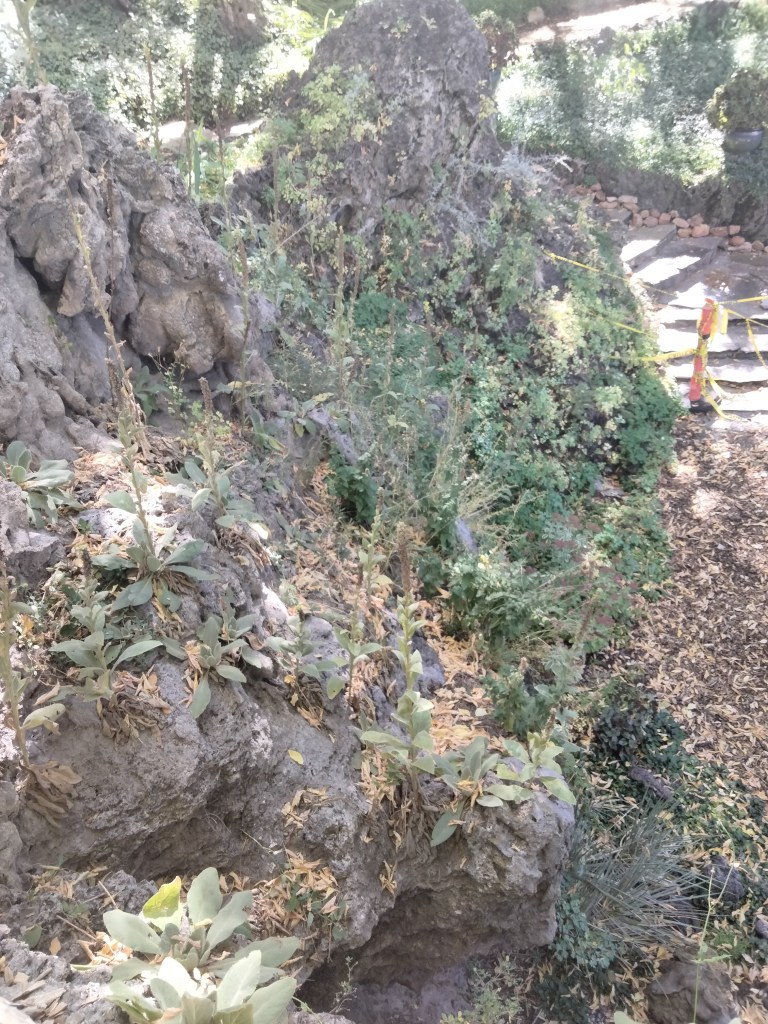
My husband and I went to the town of Lava, which is very touristy and has a lot of old-timey, cowboy-themed restos and hotels, back in September. I had never walked in The Grotto before. (Usually, I’m just either going in the hot springs or not going in the hot springs.)
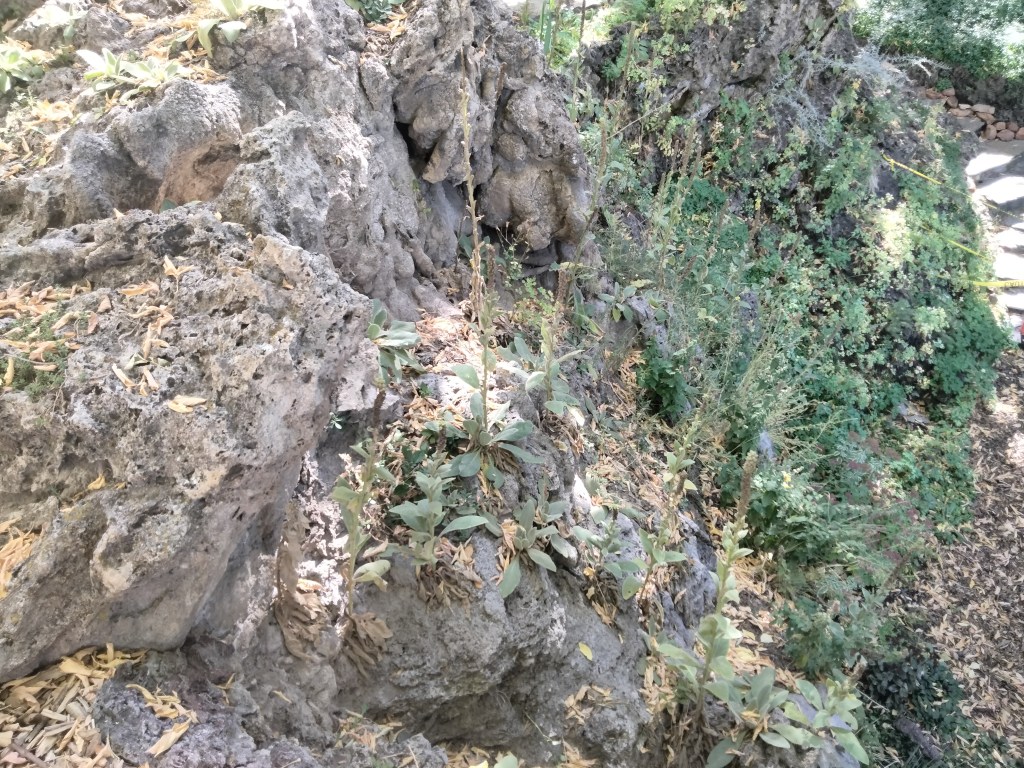
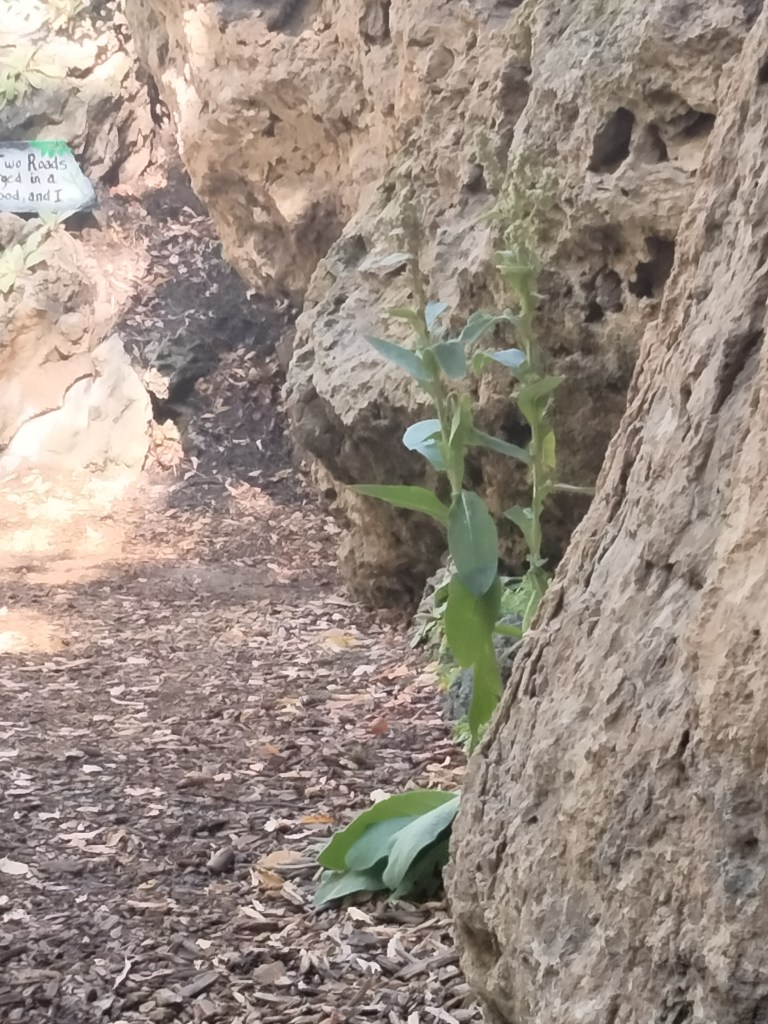
But on this particular September, The Grotto was simply alive with the most Wooly Mullein I had ever seen in one place! Wooly Mullein are those plants you see with broad, pale-green, pillowy-looking basal leaves and (in some cases, not all) a tall spike of a flower.

I blogged about these plants a few years ago, when I had photographed one growing in a farmer’s field near my house. According to Central Rocky Mountain Wildflowers, “They are biennial plants, growing the first year as a round cluster of large radiating basal leaves covered with thick, woolly hair. The second year, they rapidly grow a 1 – 6′ tall stalk, crowded with yellow flowers in a spike arrangement. Then, with all its energy expended, the plant dies.” (p. 157)

“This introduced weed colonizes disturbed places from the valleys and plains to montane forests.” (ibid) Look at how many of them there are! They must love the dry climate.

But Wooly Mullein is not just a weed. “Dioscorides, the Greek physician to the Roman armies in the first century, used mullein to treat coughs, scorpion stings, eye problems, tonsillitis, and toothache. Today, herbalists value it as a medicinal herb for asthma, bronchitis, coughs, throat inflammation, earache, and various other respiratory complaints.” (ibid) My copy of Prepper’s Natural Medicine confirms this.
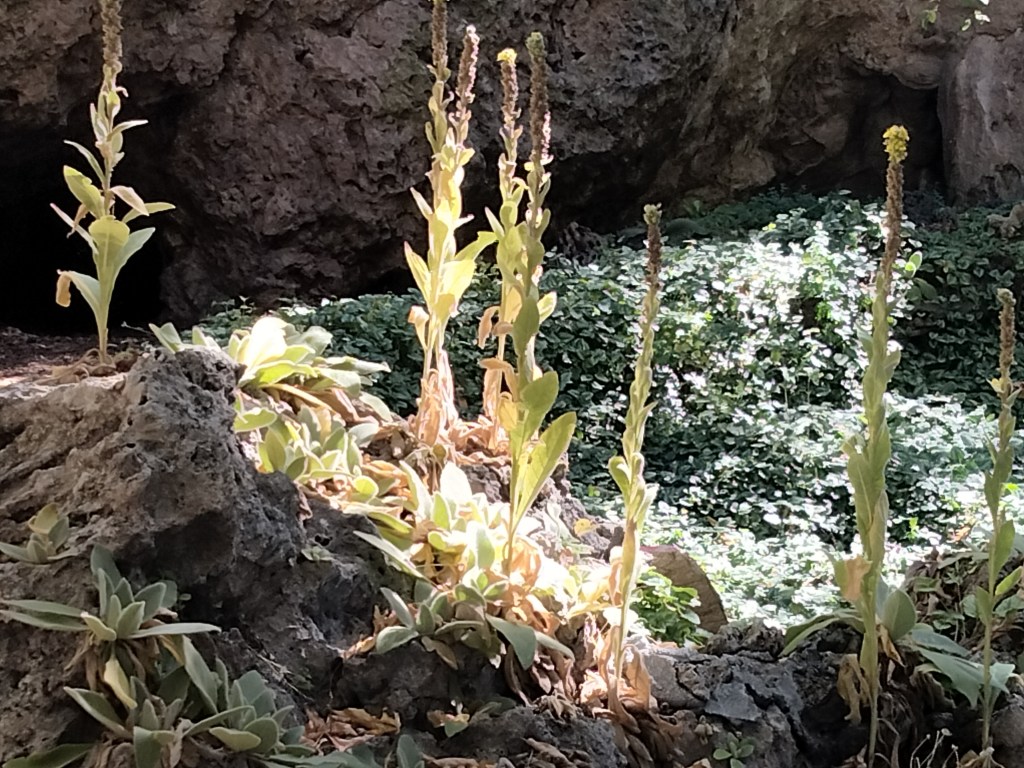
Hence, Lava is really the place to come if you’re ill in apocalypse situation! The Shoshoni Indians would bathe in and drink the hot-spring water to cure illnesses, plus there is all this mullein here. Still, it might be better to plan ahead.
I walked down this path and sat on a bench set into the rock wall. Lo and behold, up in a niche was Spiderman watching over me! Lava truly does have everything you might need!


This is, obviously, a picture left over from my Summer 2024 period.
It’s not for sale, unfortunately. I already know who I’m going to give it to.
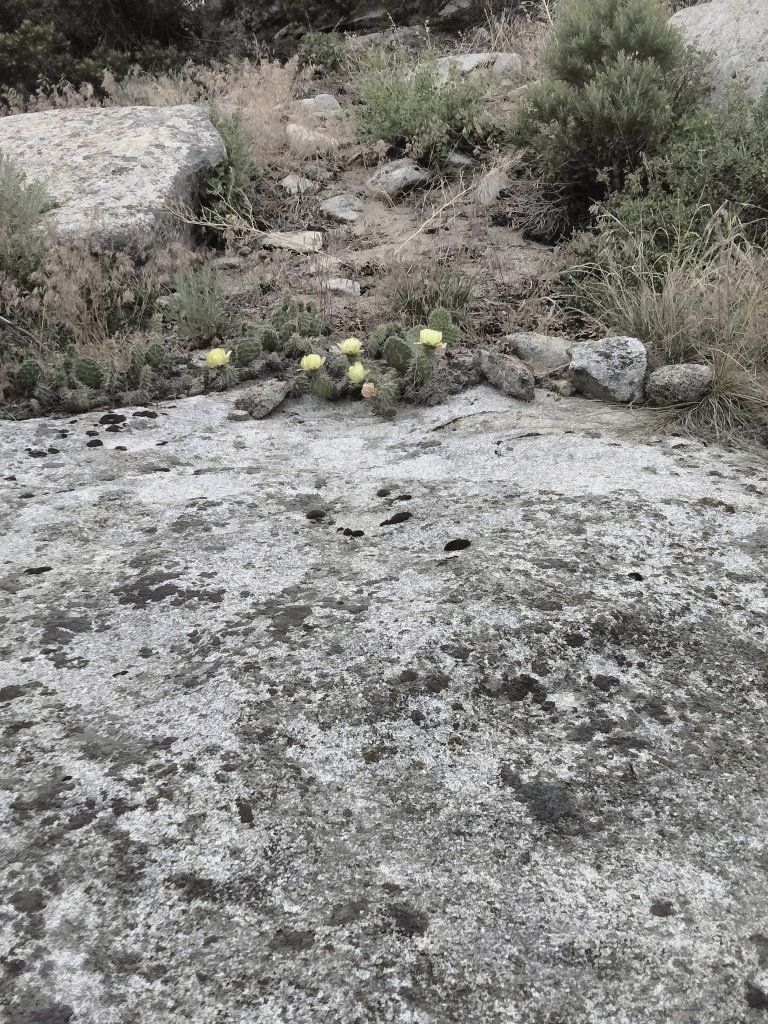


I know I’ve blogged about these plants before, but please enjoy these pictures of them as seen at Citadel of Rocks.
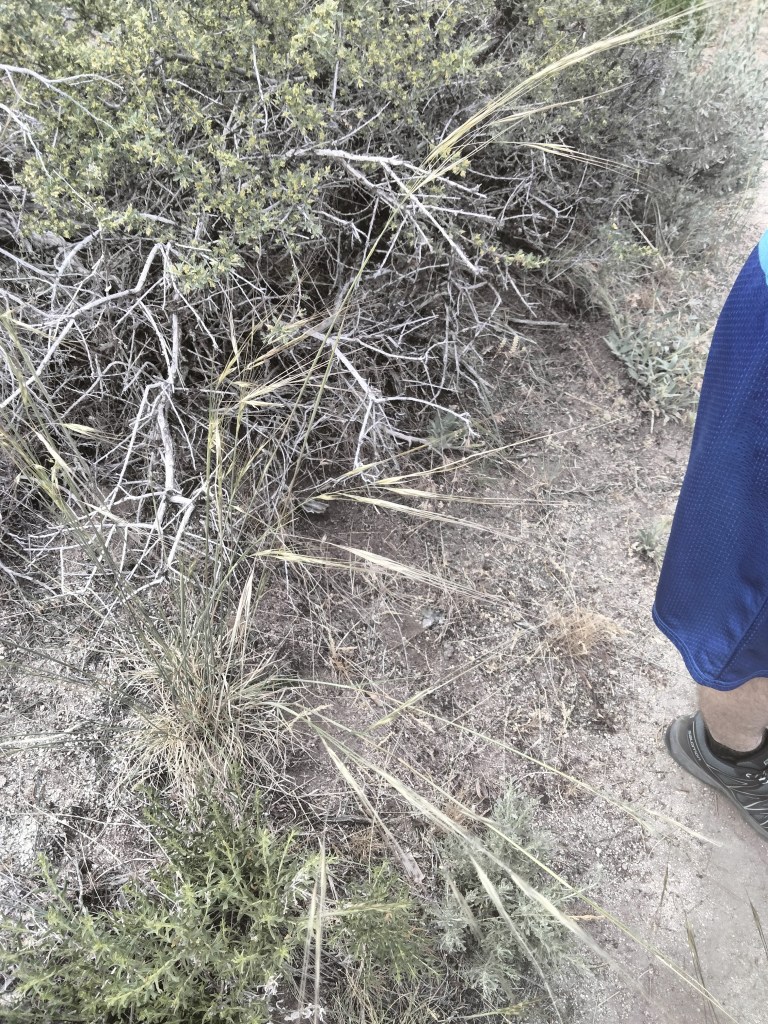
I did not need to look this up in my Falcon Guide to Central Rocky Mountain Wildflowers. Husband identified it, and kids immediately started throwing it at each other.
 Out of Babel Books