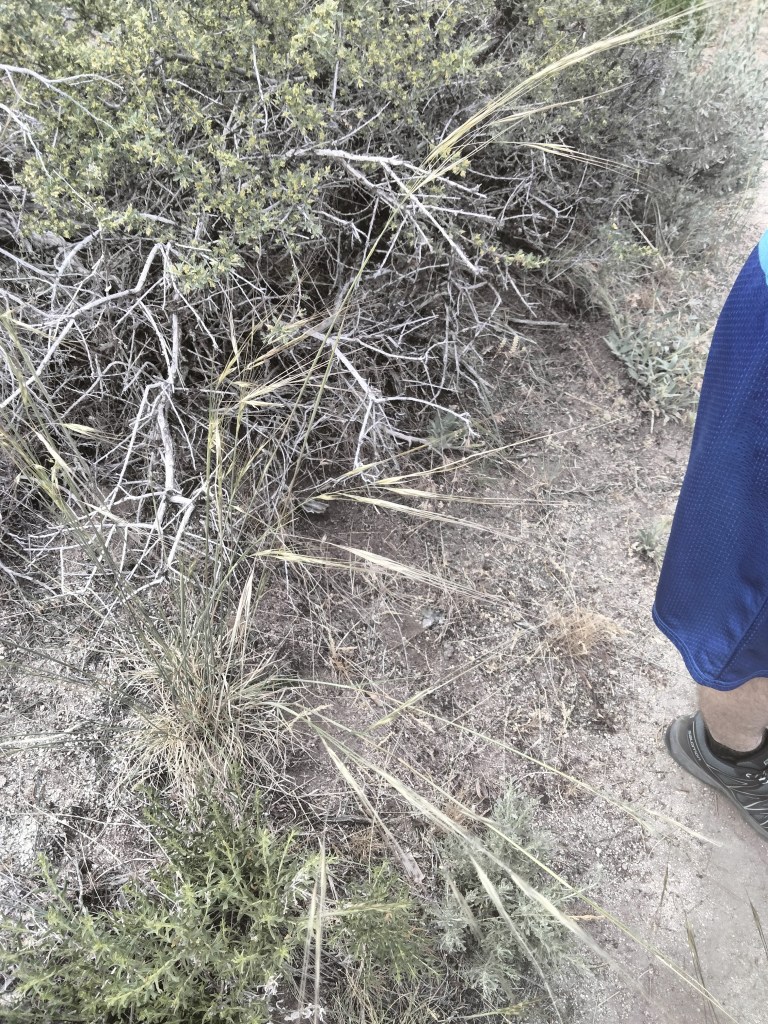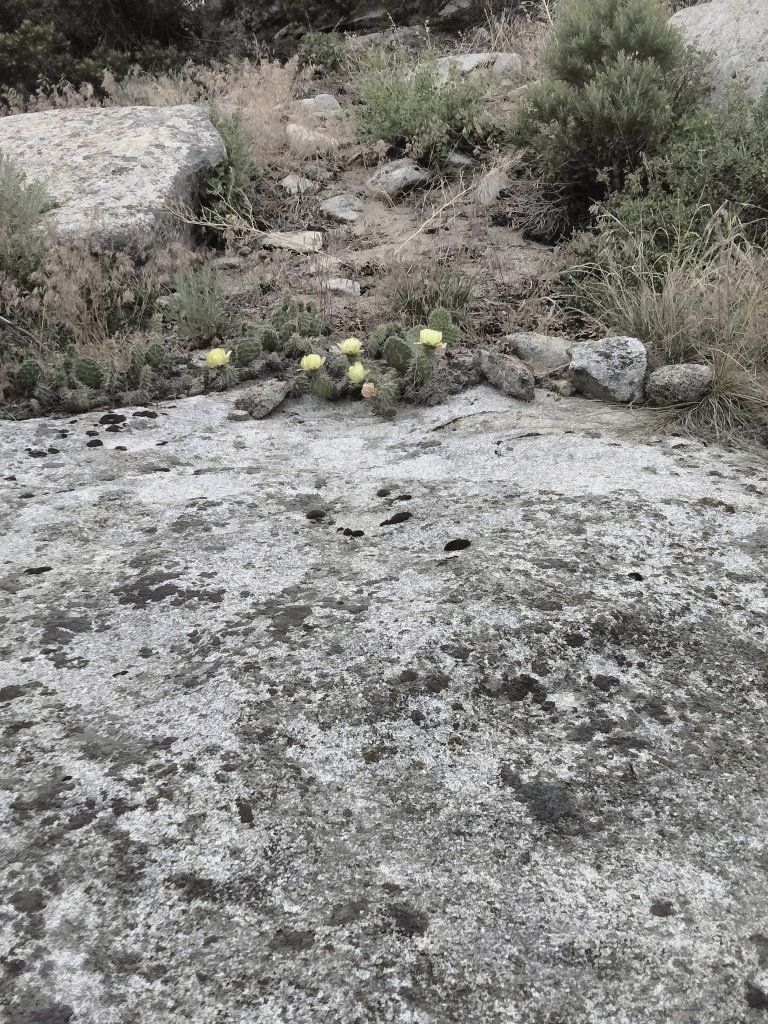
Idaho Wildflowers headscratcher: Silvery Lupine?

I first assumed this was a yucca, but the leaves are all wrong.
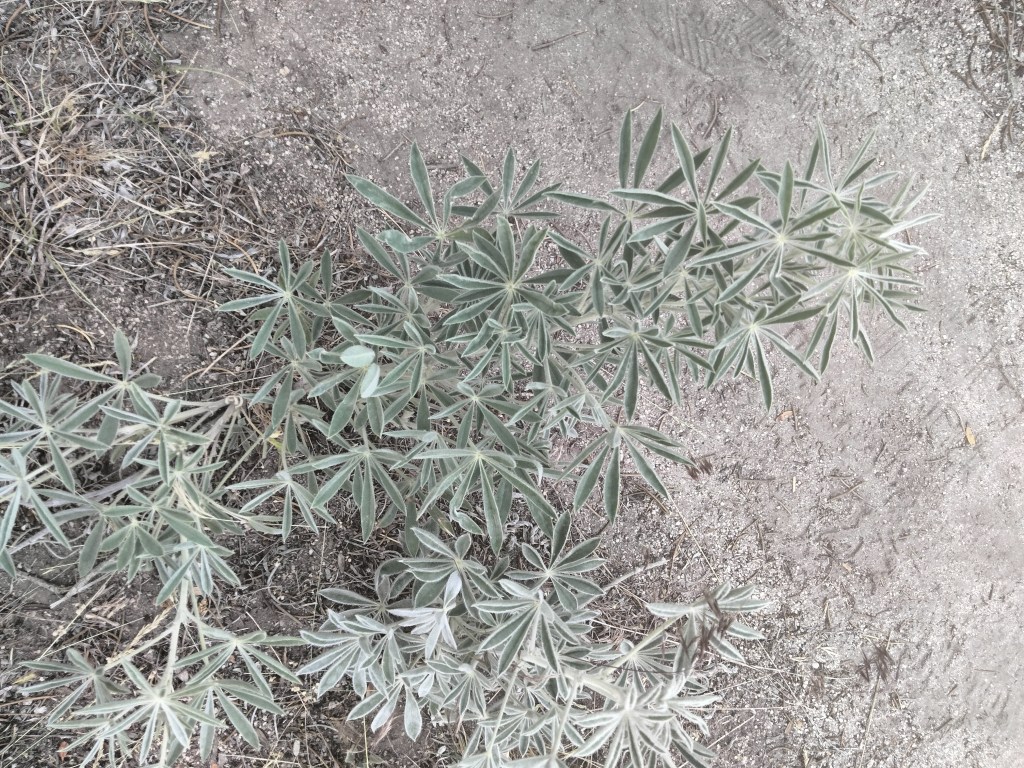
I looked up these leaves with the help of the Google machine, and it suggested Silvery Lupine.

Sure enough, here’s a more typical-looking example of the flower from the same trip.

I can only conclude that the freakishly tall and white silvery lupine is an unholy hybrid of lupine and yucca.
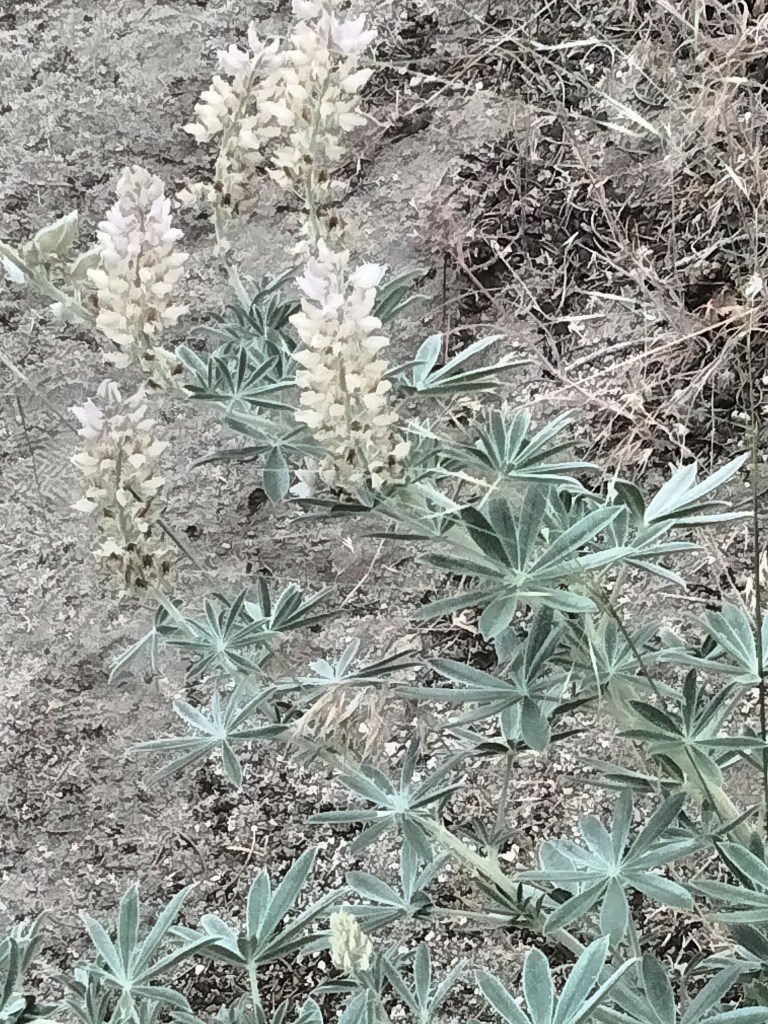
Here’s an in-between-looking specimen.

Botany is hard.
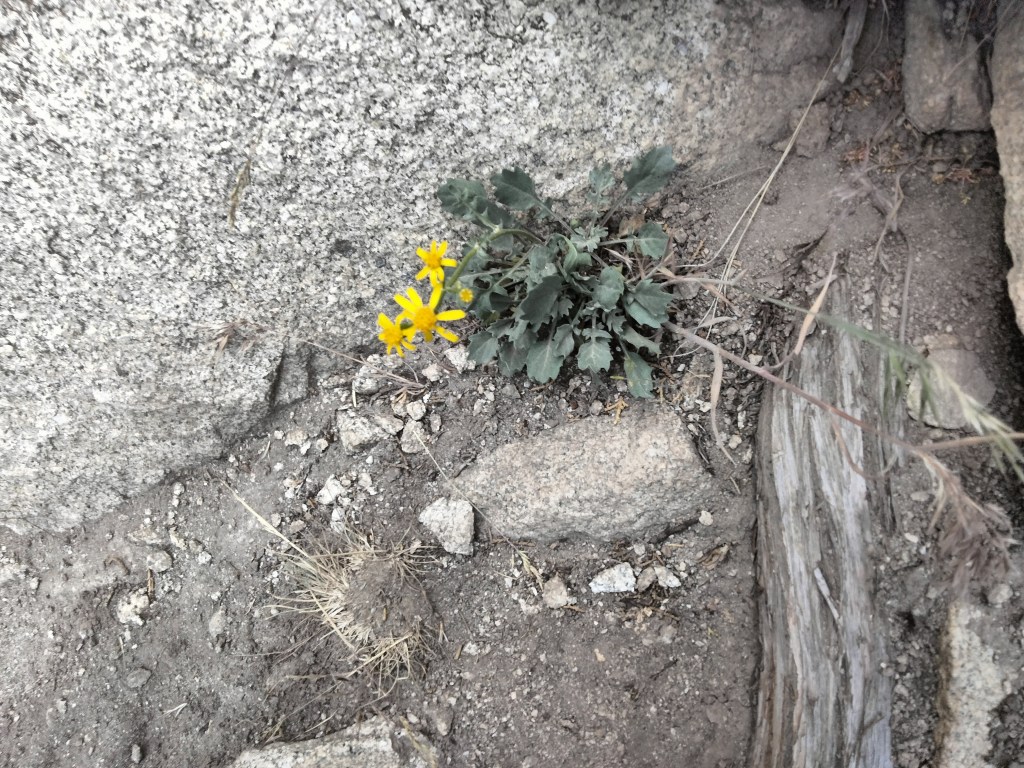
Idaho Wildflowers : Oregon Sunshine

(Why, you ask, is Oregon so greedy with the plant names? Well, remember that at one time, Idaho was part of Oregon Territory. The name Idaho was made up and used later.)

“The leaves may be entire, lobed, or deeply cleft into several narrow segments. Open, dry places, valleys and plains to alpine zones. Meriwether Lewis collected a specimen of this species on June 6, 1806, along the high uplands of the ‘Kooskooskee’ (Clearwater) River, near ‘Camp Chopunnish,’ or present-day Kamiah, Idaho.” (Falcon Guide, p. 108)

Idaho Wildflowers: Creeping Oregongrape

“The bright yellow flowers give way to a grapelike cluster of purple berries with whitish coating. In the fall, some of the leaves often turn bright red, orange, or bronze.

“The tart berries make a refreshing, lemonade-like drink and fine jelly or wine. The yellow inner bark was used by Native Americans as a yellow dye and as a medicine with many applications.”

(Falcon Guide, p. 121)
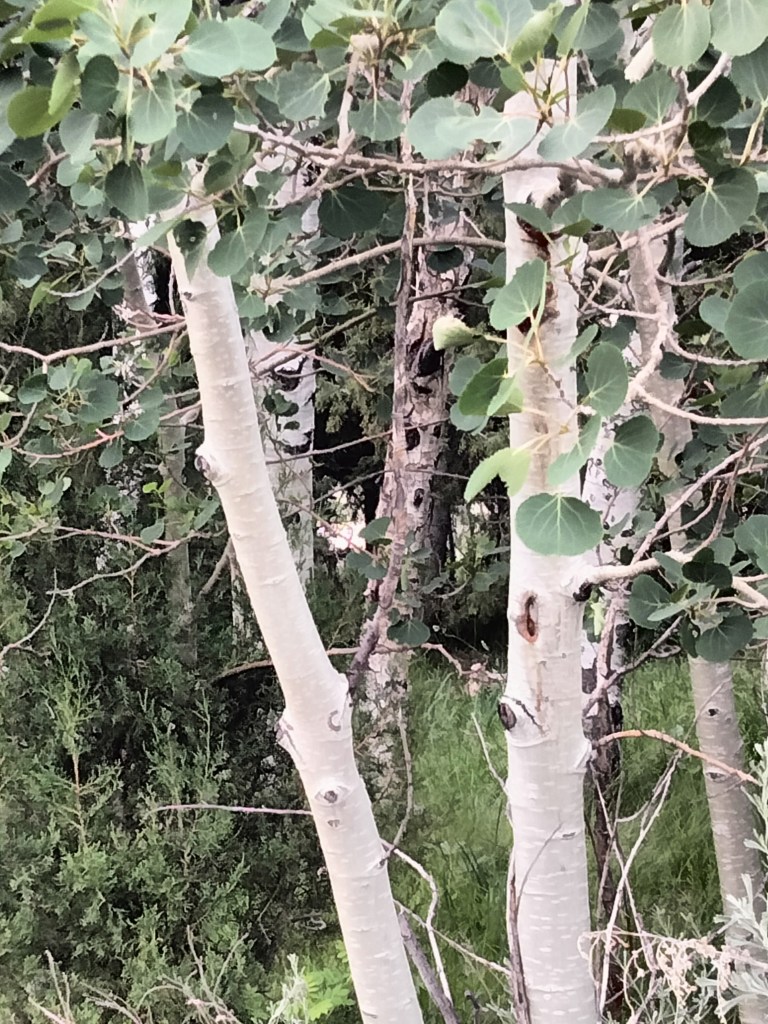
Idaho Wildflowers: Aspen

It may seem strange to call the aspen tree a flower, but it does appear in my Falcon Guide Central Rocky Mountain Wildflowers.
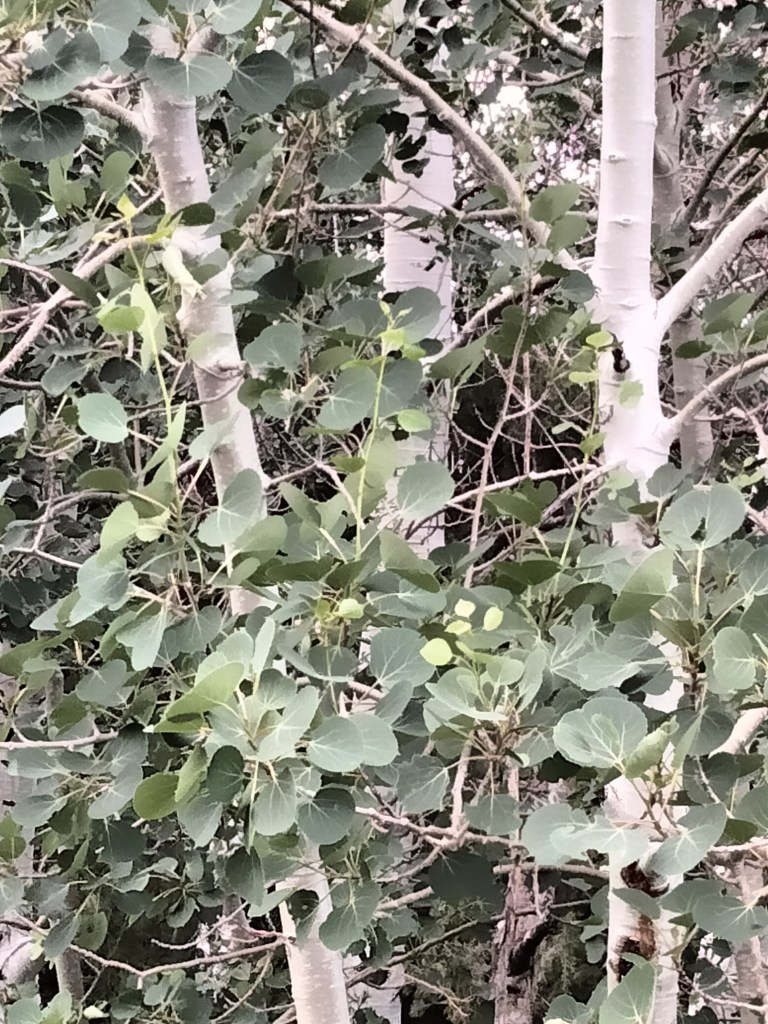
“Aspen’s leaves (as distinct from birches’) are rounded or heart-shaped in outline, with vertically flattened pettioles (leaf stalks) that are responsible for their distinctive trembling, rotating action in the slightest breeze.

“Aspen is a colonial tree that spreads by shallow underground stems. Patches of aspen trees are often just vertical stems (clones) of a single genetic individual. The borders of the clone patches are often obvious in the spring and fall, when the genetic differences in leafing out and fall coloration are expressed between clone patches. The underground stems enable aspen to survive forest fires with ease. Aspen twigs are a favorite food for browsing deer, elk, and moose, especially in winter.” (page 246)

Here’s a path leading past Silver Sage into an aspen grove (clone patch? Or between clone patches? I’m sticking with grove – sounds less disturbing).
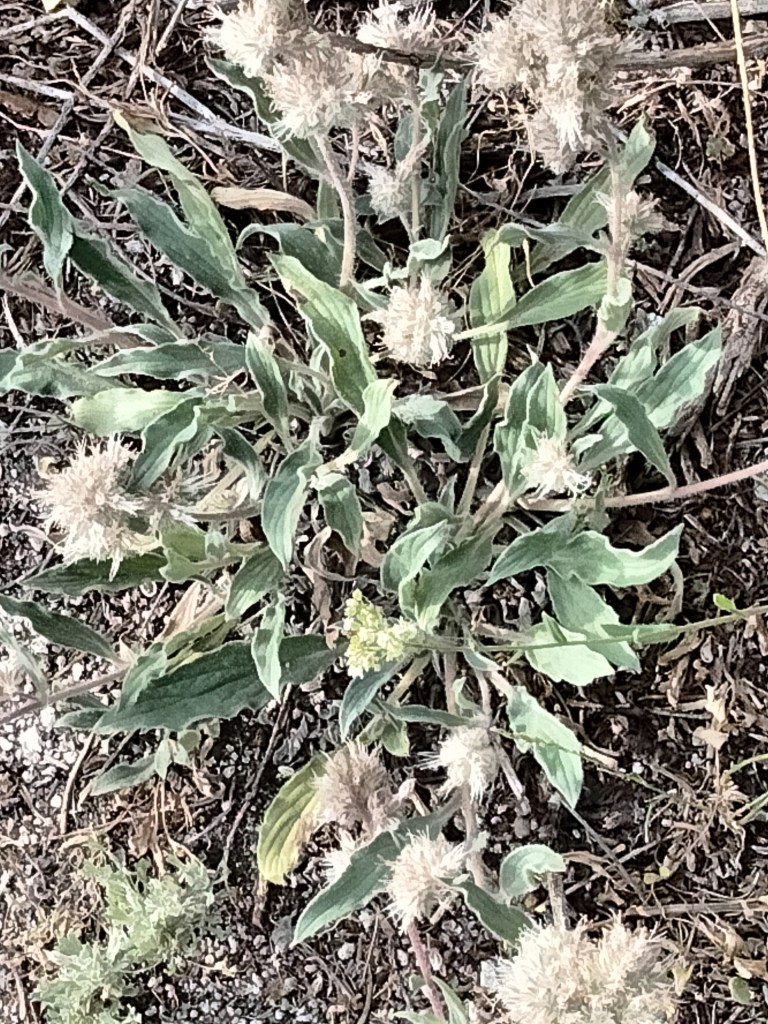
Idaho Wildflowers: White Frasera

I think I may have managed to photograph a flower that is “endemic to this area and found nowhere else in the world.”

White Frasera, according to my Falcon Guide, is “found in the montane forests of central and west-central ID” (page 209). Citadel of Rocks, where I found this, doesn’t technically fit the bill, since it is in the southern part of the state. Other possible candidates are Black Elderberry and Edible Tobacco Root.
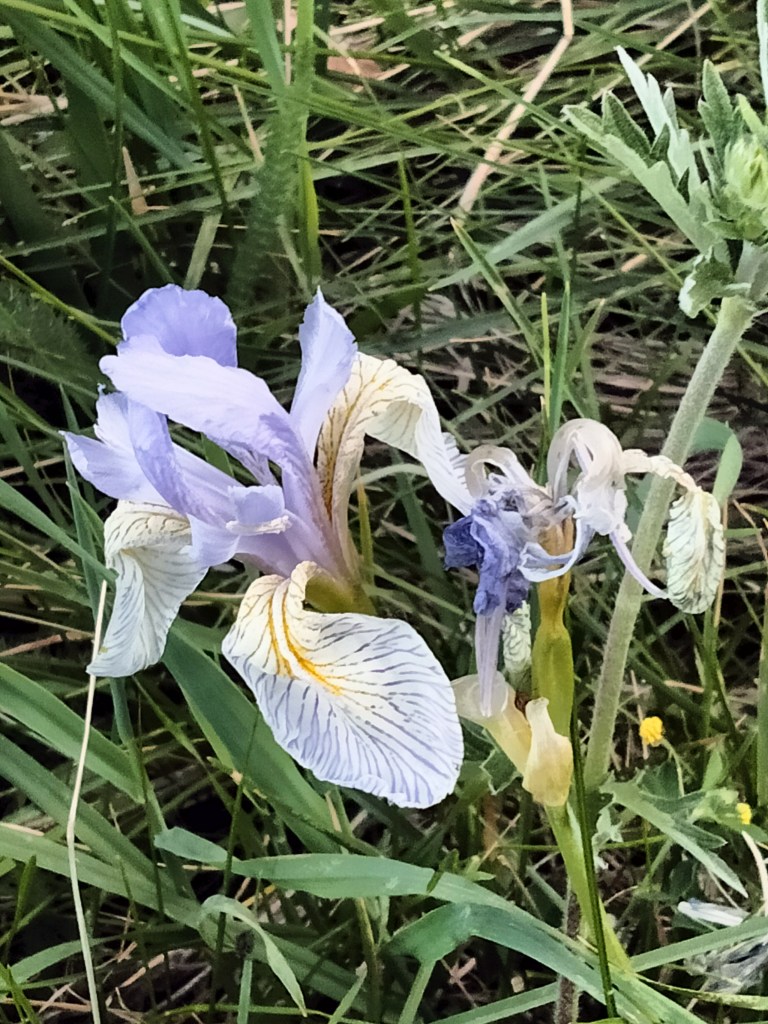
Rocky Mountain Iris

Also known as Missouri Iris. Photographed at Citadel of Rocks.

“This is the Central Rocky Mountains’ only native iris … Iris, or fleur-de-lis, is the national flower and emblem of France and the state flower of Tennessee. Iris is both a dangerous poisonous plant and a valuable medicinal herb.” (Central Rocky Mountain Wildflowers Falcon Guide, p. 37)

Idaho Wildflowers : Scarlet Globe Mallow

Sphaeralcea coccinea, Greek for “scarlet sphere mallow.”

Grows in the “dry prairies of the valleys and plains and foothills zones as far as the Bitterroot Valley, MT; Bannock County, ID; and parts of OR.”

“Scarlet globe mallow has slimy, viscous sap that can stick to skin or mucous membranes and thus provide a protective coating. The native Dakota people chewed the plant and applied it to inflamed sores and wounds as a salve. It was said to cool inflammation and promote healing.”

I can’t believe the first two wildflowers I chose to blog about this year both turned out to be medicinal. But there ya go, God puts ’em in the ground for us to find! Once again, the Falcon Guide Central Rocky Mountain Wildflowers has shown its usefulness. All in the information in this post, except the photographs, came from page 93. I took the photographs at Citadel of Rocks, where the sphaeralcea was obediently growing exactly where described.

Idaho Wildflowers Are Back!

I think this is White Geranium. According to the Central Rocky Mountain Wildflowers Falcon Guide, it is a medicinal herb that can be used to treat diarrhea, dysentery, ulcers, and hemorrhoids, and to stop bleeding (211). It’s found in shady woodlands, plains, valleys, montane, and lower subalpine zones. This is exactly where I found it! This, and the flowers that will follow, were photographed on a weekend trip to Citadel of Rocks, Idaho.

Cactus Painting in Progress

I’ve been waiting to share this one with you guys because it was a special surprise for someone who likes botanical paintings. So, I had to wait until the special occasion had passed and the gift had been delivered.

I prefer painting landscapes, which means capturing a moment… but it is nice to paint something that holds still.

First, I did a dappled background in taupes. Then, I added the grey square, which is going to be the “white” planter. Then, dark green for the cactus and a strip of terra cotta around it. Each of these steps inspired terror in me, for fear of ruining the previous one.

Next, I made the planter 3D by adding dark shadows and white highlights.

Each cluster of spines on the cactus has white fuzz around its base, so I added fuzz nodules. These will guide me when I start the slow work of adding spines. I’m working from a photograph, but the cactus in my painting is turning out to be a larger plant than the original, with more rows of spines.

And now, we start adding spines. Each node has five long ones. When they get really long, they curve over each other and make a thicket.

Spines completed. I used a tiny little brush for them. The key is to draw each line with confidence. It was soothing; I listened to a Haunted Cosmos podcast while I worked, because what accompanies a nice botanical painting better than terrifying exorcism stories?

Note that the mature clusters also have reddish-brown spines.

I’ll need to add more spines as finishing touches after I add the flowers.

Now, here come the blossoms…

When I had done a few of them successfully, the terror decreased.

On the photograph, some were barely visible buds, so I had to make them bigger. I wanted eight.

And, here’s the finished product! The flowers are nestled in spines, so I had to add more to conceal the base of some of them.

Thank You, St. Boniface: A Repost About Christmas

This post is about how we got our Christmas trees. For the record, I would probably still have a Christmas tree in the house even if it they were pagan in origin. (I’ll explain why in a different post, drawing on G.K. Chesterton.) But Christmas trees aren’t pagan. At least, not entirely.

My Barbarian Ancestors

Yes, I had barbarian ancestors, in Ireland, England, Friesland, and probably among the other Germanic tribes as well. Some of them were headhunters, if you go back far enough. (For example, pre-Roman Celts were.) All of us had barbarian ancestors, right? And we love them.

St. Boniface was a missionary during the 700s to pagan Germanic tribes such as the Hessians. At that time, oak trees were an important part of pagan worship all across Europe. You can trace this among the Greeks, for example, and, on the other side of the continent, among the Druids. These trees were felt to be mystical, were sacred to the more important local gods, whichever those were, and were the site of animal and in some cases human sacrifice.

God versus the false gods

St. Boniface famously cut down a huge oak tree on Mt. Gudenberg, which the Hessians held as sacred to Thor.

Now, I would like to note that marching in and destroying a culture’s most sacred symbol is not commonly accepted as good missionary practice. It is not generally the way to win hearts and minds, you might say.

The more preferred method is the one Paul took in the Areopagus, where he noticed that the Athenians had an altar “to an unknown god,” and began to talk to them about this unknown god as someone he could make known, even quoting their own poets to them (Acts 17:16 – 34). In other words, he understood the culture, knew how to speak to people in their own terms, and in these terms was able to explain the Gospel. In fact, a city clerk was able to testify, “These men have neither robbed temples nor blasphemed our goddess” (Acts 19:37). Later (for example, in Ephesus) we see pagan Greeks voluntarily burning their own spellbooks and magic charms when they convert to Christ (Acts 19:17 – 20). This is, in general, a much better way. (Although note that later in the chapter, it causes pushback from those who were losing money in the charm-and-idol trade.)

However, occasionally it is appropriate for a representative of the living God to challenge a local god directly. This is called a power encounter. Elijah, a prophet of ancient Israel, staged a power encounter when he challenged 450 priests of the pagan god Baal to get Baal to bring down fire on an animal sacrifice that had been prepared for him. When no fire came after they had chanted, prayed, and cut themselves all day, Elijah prayed to the God of Israel, who immediately sent fire that burned up not only the sacrifice that had been prepared for Him, but also the stones of the altar (I Kings chapter 18). So, there are times when a power encounter is called for.

A wise missionary who had traveled and talked to Christians all over the world once told me, during a class on the subject, that power encounters tend to be successful in the sense of winning people’s hearts only when they arise naturally. If an outsider comes in and tries to force a power encounter, “It usually just damages relationships.” But people are ready when, say, there had been disagreement in the village or nation about which god to follow, and someone in authority says, “O.K. We are going to settle this once and for all.”

That appears to be the kind of power encounter that Elijah had. Israel was ostensibly supposed to be serving their God, but the king, Ahab, had married a pagan princess and was serving her gods as well. In fact, Ahab had been waffling for years. There had been a drought (which Ahab knew that Elijah — read God — was causing). Everyone was sick of the starvation and the uncertainty. Before calling down the fire, Elijah prays, “Answer me, O LORD, answer me, so these people will know that you, O LORD, are God, and that you are turning their hearts back again.” (I Kings 18:37)

Similar circumstances appear to have been behind Boniface’s decision to cut down the great oak tree. In one of the sources I cite below, Boniface is surrounded by a crowd of bearded, long-haired Hessian chiefs and warriors, who are watching him cut down the oak and waiting for Thor to strike him down. When he is able successfully to cut down the oak, they are shaken. “If our gods are powerless to protect their own holy places, then they are nothing” (Hannula p. 62). Clearly, Boniface had been among them for some time, and the Hessians were already beginning to have doubts and questions, before the oak was felled.

Also note that, just as with Elijah, Boniface was not a colonizer coming in with superior technological power to bulldoze the Hessians’ culture. They could have killed him, just as Ahab could have had Elijah killed. A colonizer coming in with gunboats to destroy a sacred site is not a good look, and it’s not really a power encounter either, because what is being brought to bear in such a case is man’s power and not God’s.

And, Voila! a Christmas Tree

In some versions of this story, Boniface “gives” the Hessians a fir tree to replace the oak he cut down. (In some versions, it miraculously sprouts from the spot.) Instead of celebrating Winter Solstice at the oak tree, they would now celebrate Christ-mass (during Winter Solstice, because everyone needs a holiday around that time) at the fir tree. So, yes, it’s a Christian symbol.

Now, every holiday tradition, laden with symbols and accretions, draws from all kinds of streams. So let me hasten to say that St. Boniface was not the only contributor to the Christmas tree. People have been using trees as objects of decoration, celebration, and well-placed or mis-placed worship, all through history. Some of our Christmas traditions, such as decorating our houses with evergreen and holly boughs, giving gifts, and even pointed red caps, come from the Roman festival of Saturnalia. This is what holidays are like. This is what symbols are like. This is what it is like to be human.

Still, I’d like to say thanks to St. Boniface for getting some of my ancestors started on the tradition of the Christmas tree.

Bonus rant, adapted from a discussion I had …

... in a YouTube comments section with a Hebraic-roots Christian who was insisting that Christmas is a “pagan” holiday:

So, as we can see, the evergreen tree is a Christian symbol, not a pagan one, and has been from the very beginning of its usage. St. Boniface cut down the tree that was sacred to Thor, and that was an oak tree, not a Christmas tree. Sacred oaks are pagan. Christmas trees, which incidentally are not actually considered sacred, are Christian.

Yes, I am aware, as are most Christians, that Jesus was probably not actually born on Dec. 25th. Yes, I am aware that Yule was originally a pagan feast time.

But let’s look at the symbolism, shall we?

For those of us who live in northern climes, and especially before the industrial revolution, the winter solstice is the scariest time of the year. The light is getting less and less, and the weather is getting worse and worse, and all in all, this is the time of year when winter officially declares war on humanity. Winter comes around every year. It kills the sick and weak. It makes important activities like travel and agriculture impossible. It makes even basic activities, like getting water, washing things, bathing, and going to the bathroom anywhere from inconvenient to actually dangerous to do without freezing to death. If winter never went away, then we would all surely die. That is a grim but undeniable fact. Read To Build A Fire by Jack London, and tremble.

Thus, people’s vulnerability before winter is both an instance and a symbol of our vulnerable position before all the hardships and dangers in this fallen world, including the biggie, death. And including, because of death, grief and sorrow.

Yule is a time of dealing with these realities and of waiting for them to back off for another year. After the solstice, the days slowly start getting longer again. The light is coming back. Eventually, it will bring warmth with it. Eventually, life.

Thus, it is entirely appropriate that when the Germanic tribes became Christians, they picked the winter solstice as the time to celebrate Jesus’ birth. He is, after all, the light of the world. A little, tiny light – a small beginning – had come into the bitter winter of the sad, dark world, and it was the promise of life to come. The light shines in the darkness, and the darkness has not overcome it. All this biblical, very Hebrew symbolism answers beautifully the question raised by the European pagans’ concern with the sun coming back.

Our ancestors were not “worshipping pagan gods” at Christmas. They were welcoming Christ (who is the God of Abraham, Isaac, and Jacob) into the heart of their culture. They were recognizing that He was the light, using terms they knew, which were Germanic terms, and this is not surprising because they were Germans.

So, if you want to make the case that no holidays are lawful for Christians except those prescribed in the Old Testament for Israel, be my guest. Try to find some Scriptures to back that up. And maybe you can. But you cannot make that case by accusing people who put up a Christmas tree of worshipping pagan gods. All you’ll do then is reveal yourself to be historically ignorant.

Sources

BBC, “Devon Myths and Legends,” http://www.bbc.co.uk/devon/content/articles/2005/12/05/st_boniface_christmas_tree_feature

Foster, Genevieve, Augustus Caesar’s World: 44 BC to AD 14, Beautiful Feet Books, 1947, 1975, Saturnalia on p. 56 ff.

Hannula, Richard, Trial and Triumph: Stories from church history, Canon Press, 1999. Boniface in chapter 9, pp. 61 – 64.

Puiu, Tibi, “The origin and history of the Christmas tree: from paganism to modern ubiquity,” ZME Science, https://www.zmescience.com/science/history-science/origin-christmas-tree-pagan/