This is not the cover of the book. It’s just a photograph of a young Black Elk.
This review was recently posted in shorter and sloppier form on Goodreads.
I give Black Elk in Paris (2006) by Kate Horsley five stars for its amazing historical research, French-doctor voice, and dynamic characters.
A few years ago, I stumbled across a children’s book about Lakota medicine man Black Elk. My response to him was pretty much the same as that of this book’s fictional heroine, Madeline: I was fascinated. (I mean, look at him!) At the age of nine, Black Elk had a troubling vision that encouraged his tribe to choose life rather than bitterness. (They were going to need this later.) At age 15, he was present at the battle of Little Bighorn. Later, he went to England with Buffalo Bill Cody’s Wild West show.
None of that is in this book.
Apparently, Buffalo Bill accidentally stranded Black Elk and one other Lakota guy in England. They took up with a character called Mexican Joe, who was running a knockoff Wild West show, and toured Europe with him. Black Elk ended up in Paris, where he stayed with a Parisian woman and her family until eventually he was able to get back to his homeland.
This book imagines the effect that Black Elk had on the Parisian woman, her family, and her doctor friend, Philippe Normand. It so happens that the period the Lakota warrior was in Paris coincided with the building of the Eiffel Tower in preparation for the Universal Exhibition (the Paris world’s fair). The tower is mentioned frequently in the book as the characters watch it grow menacingly over their usual haunts. They never call it the Eiffel Tower. It’s usually “the metal tower, looking like a dead tree” or something like that. An ongoing theme in the book is the tension between the apparent triumph of colonialism, including modern science and medicine, with the appeal of Black Elk’s way of life.
My hope had been that we would get to see Paris from Black Elk’s point of view, but alas, he is not the point-of-view character in this story. Perhaps it was wise of the author to create a little distance from Black Elk, not to presume to speak in his voice, which has been well documented. Instead, she writes in the voice of Normand. The 19th-century French tone is spot on, right down to the navel-gazing, romanticism, and cynical asides about human nature. The writing honestly comes off as if it were translated from French, and in fact, each chapter opens with its first sentence in French, then in English.
Normand is on the cutting edge of medical developments. He is friends with many famous historical doctors and goes to their weekly meetings where they argue theory, banter, tease each other, and engage in petty backbiting and politics. Normand honestly wants to relieve human suffering with medicine, but is frustrated by the limitations on what he can accomplish. And over the few years that the book covers, he begins to see some problems with the arrogant and intellectualized attitude taken by French doctors and psychologists of the day. At one point, he complains that he has witnessed doctors not trust the patient to report on his or her own symptoms!
Consequently, though Black Elk does change Normand and Madeline, this book is more about Paris of that time than about the Lakota. My first impression, as a reader who was eager to get to the part with Black Elk, was what awful people these 19th-century Parisians are. (They are snobs! They do recreational drugs! They sleep around! They say the most horrible things to their friends and family!) I definitely did not like Normand at first. I think I was going through culture shock. Normand changes, however, and as he grew and I got used to him, he became as much a hero of this story as Black Elk.
Horsley has, in this book, pulled off the accomplishment that I aim for in my books. She has examined a cross-cultural relationship sensitively, without romanticizing or demonizing either culture. She has also written in an authentic voice from one culture, but told the story in such a way that we can gather some of Black Elk’s perspective as well. The story does not tie things up in a neat little bows, but it is more about connections (however tenuous) that the characters make, rather than about an inability to connect. Also, kudos to her for noticing these two very different worlds touching each other at an actual point in history and making us notice it. To the extent that the book ultimately comes down on the universal human condition rather than on cynicism, it validates both Black Elk’s spiritual values and Normand’s ideals. Not every book set in Paris does this. Nor does every book about colonialism.
Read this if you are interested in the French or, to a lesser extent, the Lakota.
So, within about the past month, I’ve watched two different psychological thrillers on Netflix. And they are both the same damn movie. (And I use damn advisedly.) In both, the viewer knows only what the point of view character knows. And he (it’s a he in both movies) is uncovering a conspiracy. Until, at the very end, it turns out that he’s delusional. Many of the major events in the movie, which were shown to the viewer as if in good faith, were actually happening only in his mind. Actual events were quite different. The interpretation he was putting on everything was completely wrong. In one of the movies, the point of view character is brought to realize this, at least briefly. In the other, it is made plain to the viewer only.
I am pretty ticked at both of these movies. Especially at them both being on Netflix at the same time.
On the one hand, they are well-written, well-plotted, well-filmed and well-acted. Tense as heck. They are an immersive experience that helps the viewer understand what it feels like to be delusional. (In both cases, the break with reality was brought on by trauma. In both cases, actually, involving the death of a child.) So, they are very good.
But this strength comes at a pretty steep cost. Namely, they can make you doubt yourself something fierce. I think that the reveal at the end of each movie was that the person was delusional. But who really knows? Maybe I am misinterpreting what the director was trying to say. Maybe I did not even watch the danged movies. Maybe there is no such thing as reality.
This has to be intentional, right? Two movies, running concurrently, aimed at people who like psychological thrillers, both of them trying to tell you that you can’t really know what is real. I mean, God help you if you’ve got dissociative disorder. (And I use God help you advisedly.)
I’m with G.K. Chesterton on this. Or rather, he is there, throwing me a lifeline. GKC believed strongly that we have a moral obligation to believe in reality and to trust our own perceptions of it. I don’t have any of the quotes in front of me, but I do remember that he said something like, “Every day you can hear an educated man utter the heretical statement that he may be wrong.” He also tells a long story, elsewhere, about how he spent an evening at a friend’s house where they had a brisk philosophical debate. GKC was maintaining that reality exists and can be known. His friend was maintaining the opposite. Having vigorously defended reality, GKC got into a taxi and, when he arrived at his destination, had one of those confusing conversations with the cab driver that make you feel as if you’ve fallen through a portal. The cab driver remembered picking up GKC at some other location, and remembered GKC having said something to him that he didn’t say. GKC argued with the man for several minutes, and after just a few minutes was starting to doubt himself and, thus, reality. Then, just when GKC was beginning to waver, the cabman got on his face a look of sudden revelation as he realized that he was remembering a different customer.
You might think that someone like GKC, who believes that “I might be wrong” is a heresy, would be arrogant and impossible to convince of anything. But that’s not necessarily true. If you believe in reality and trust your perceptions of it, then you can be presented with evidence. And if the evidence is good, you can change your mind. If you don’t have the baseline trust in your own mind, then no amount of evidence is going to convince you.
One more, equally sinister, aspect of all this. Traditionally, Hollywood likes to give us messages that we should not trust authority. The cops are on the take. The conspiracy goes all the way to the top. The experts don’t know everything. We are “sleeping with the enemy.” The two movies I watched recently give the opposite message. They play on our expectations that experts and authority figures in movies will turn out to be villains. In both of these particular cases, it is doctors (medical doctors in one; psychologists in another) who appear to be concealing the truth. They appear to want to treat the protagonist like he’s crazy, or else frame him for being crazy. There is bureaucracy and gaslighting and all the stuff we find in dystopias. But in this case, they turn out to be right. What to do you know? He actually is crazy. If only he had listened to them. Lives could have been saved.
I think both of these movies were made before you-know-what, so it’s probably a coincidence. Still, I’m not super comfortable when two pieces of well-done art say to me in stereo, “Trust us. We know what reality is and you don’t. We know best.”
Plurals are cute, don’t you agree? There is something charming about a plural, because of what it implies. It implies that these things, whatever they are, belong to a category of things, that in some important sense they are all the same kind of thing. Plurals tell us a lot about the human mind.
English has a charming feature where certain animals, when referred to as a group, have a specific term for the group that has to be used. I guess you could call these animal-specific noun classifiers, but they mostly show up, in English, in animal plurals. (You also get them for vehicles.) Some are well-known:
a school of fish
a flock of sheep/birds
a herd of cattle/elephants
a pride of lions
a pack of dogs
But they get more obscure, and hence more fun:
a pod of whales
a smuck of jellyfish
a gaggle of geese
a gang of turkeys
an exaltation of larks
a murder of crows
a troop of monkeys
a mischief of raccoons
a colony of ants
a gluttony of bears
a brood of vipers
One of these is made up.
Add your own below, in the comments.
These group classes can be used of people if you want to imply that the group of people resembles the group of animals in some way: “A gaggle of middle-schoolers.” And I love it when Sting, in one of his songs, refers to two priests “fussing and flapping in priestly black like a murder of crows.” The two of them (already plural, but barely) somehow resemble a large plural of crows.
Indonesian Noun Classes
Indonesian (bahasa Indonesia) is an Austronesian language closely related to Malaysian. Indonesian does not have lot of grammatical morphology. For verbs, it handles past and future tense mostly by context, and by the use of words such as “already” (sudah) and “not-yet” (belum). It doesn’t have grammatical genders, and in fact the pronoun for he, she, or it, dia, doesn’t indicate sex. (Tellingly, although you cannot indicate the person’s sex with a third person pronoun, there is an alternate third person singular pronoun which you can use if you wish to be more respectful: beliau. There are also more and less respectful ways to say I and you.)
But despite not having grammatical gender, Indonesian has noun classes. These show up when you want to say how many of something there are (our old friend plurals again!), or when you want to use the indefinite article (a/an).
Sebuah is the classifier for most inanimate things. For example, “sebuah meja” means “a table.” (Literally, “one-thing table”).
You can also say semacam, which means “some kind of.” “Semacam proyek” = “some kind of project.”
For people, the classifier is “orang,” which means person. “Seorang perempuan” means “a woman.” (Literally, “one-person woman”).
For animals, the classifier is “ekor,” which means “tail.” “Seekor kucing” = “a cat.”
For fruit, it’s “biji,” which means “seed.”
“Sehelai rambut” = “one [strand of] hair.”
There are plenty of others, but these are the main ones that I remember. I think batang (“trunk”) is used for trees, and there are probably specialized terms for boats and other vehicles. Not all of them are used all the time. Learning them all is sort of like learning specialized terms in English. As someone once said, “Never call a rifle a gun, a line a rope, or a ship a boat.”
For plurals and to ask how many, the classifier word is separated from the number.
“Dia mempunyai dua orang anak” = “He has two children” (“two person child“).
Evolutionary researchers are still not positive that having a grandmother around is physically good for moms and babies. But they are bumbling towards proving it. And we all know it’s true.
Miss Mary had been able to draw a map of the United States from memory, known the entire periodic table by heart, taught school in a one-room schoolhouse, brewed healing teas, and sold what she called fitness powders her entire life. Dime by dime, dollar by dollar, she’d put her sons through college, then put Carter through medical school. Now she wore diapers and couldn’t follow a story about gardening in the Post and Courier.
Grady Hendrix, The Southern Book Club’s Guide to Slaying Vampires, p. 60
Hello everyone! To my American readers, I hope your holiday weekend was restful. I hope it went fantastic. (Mine did.)
But perhaps your holiday weekend didn’t “go fantastic.” Perhaps it went horrible.
Thanksgiving has betrayed me just enough times that I get nervous around it. I can think of three or four past Thanksgivings where there emerged, on that very weekend, a crisis of life-and-death proportions. I’m not sure why, but holidays and other non-ordinary times seem to attract these things.
In my upcoming book, The Strange Land, the tribal chief notes ruefully that moving days are subject to the same phenomenon:
Enmer had seen this time and again. If anyone was going to get sick, if anyone was going to get pregnant, if anyone was going to miscarry or commit a petty crime or simply snap under the pressure of survival, they were more likely to do it at the exact moment of transition. These in-between times [when the tribe was getting ready to move] were dangerous.
Enmer had given this a lot of thought and had concluded that though he could — and did — blame his people for their actual actions, he could not blame them for their bad timing. Things happened with horrible timing. That was the way of the world.
The Strange Land, chapter 10
I hope this Thanksgiving was kind to each of you, though. See you next time!
To summarize, there is apparently some kind of genetic link between cuter facial features and domesticity in animals. When foxes, for example, are bred for friendly and compliant personalities, over generations their snouts get shorter, their ears floppier, their tails shorter and curlier.
The linked article suggests there might be a similar kind of genetic linkage in humans. It relies partly on a genetic study of human beings with Williams-Beuren syndrome, “a disorder linked to cognitive impairments, smaller skulls, elfinlike facial features, and extreme friendliness.”
Extrapolating from this, and using studies of Neanderthal and Denisovan DNA, the suggestion is that humans “domesticated ourselves” by preferring mates who were friendlier and less aggressive. As sexual selection decreased the aggressive tendencies in our species, so too the related genes determining facial features gradually made our features smaller and less coarse.
So, I have some thoughts. Bear with me, because I’m tapping this post out the night before it goes up, so it might not be the best organized or best-written.
I’m not going to question that even in humans, there might be some genetic linkage between elfin facial features and lack of natural aggressiveness. W-B syndrome, and Down Syndrome, both seem to suggest this. It may be that this linkage is so subtle and complex that it only becomes obvious in extreme cases, like with these syndromes. It’s similar to how there is evidence that people with fair or red hair are more likely to be “Highly Sensitive People,” highly sensitive to stimuli of all kinds including social stimuli, sound, and pain.
Both of these suggestions (I’m not going to call them findings because they are too complex) also dovetail with traditional stereotypes. The quick-tempered redhead, the fine-featured child who cries easily, and the “low-browed” criminal are all types that go way back. Stereotypes do not apply across the board, but they often tell us something about people’s observations of the world.
But that is also a danger. People, it turns out, have a strong tendency to judge others by their physical appearance. Ugly or unattractive people are interpreted through a grid that assumes they are stupid, aggressive, or unstable compared to more attractive people. I just finished reading an interview, here, with a person who explains from personal experience how we tend to interpret someone without sex appeal as a menace.
So if people did selectively marry in a way that weeded out Neanderthal facial features, it’s just as likely they were selecting for looks as for lack of aggression.
And obviously, making judgments about someone’s abilities and character based on their facial features and body shape is not only unjust, it’s usually likely to be mistaken. It would be great if we could tell everything we needed to know about someone just by looking at them, but we can’t. If we try to do so — and resist changing our opinion — we are going to be walking around with a lot of bad information. This strategy will not work well for us.
This should tell us that there is something missing from the thesis about smaller facial features being associated with less aggressive behavior.
What’s missing is the fact that human beings are human beings, not just two-legged animals. Our behavior is not just determined by whether we have genetic tendencies to aggression.
Rather, we are made in the image of God. Thus, we have language, an innate moral sense, and an innate need to be in a family and culture with other human beings. This, not our genetics, is what makes us “domestic.”
That’s why, as I have pointed out before, you will often meet people in modern times with features reminiscent of Neanderthals, and these people are neither stupid, nor aggressive, nor even particularly ugly. (I mean, just look at the Neanderthal reconstruction at the top of the linked article. Is he not adorable?)
Also, friendliness is not the only desirable trait in a human being. “Extreme friendliness,” particularly when coupled with cognitive impairments, will not equip a person to survive on their own in the world. What we need is natural aggressiveness, appropriately controlled and directed by our mind, moral sense, and culture. So, completely breeding aggressive tendencies out of our population would not be desirable, even if it were possible.
Ergo, if the Neanderthals and Denisovans were actually human beings (which I believe they were), we can assume that they were much like us in that they had aggressive tendencies, but they also had all the other standard human equipment that allowed them to control and direct these tendencies. We already know that they enjoyed seafood, intermarried with so-called “modern humans,” and made art.
OK, that’s it from me. I continue my campaign for Neanderthal Human Rights!
Today I am posting a video of a song by the incomparable Jamie Soles.
A couple of warnings: I recommend you just listen to the audio. Don’t look at the screen, because the words pulse in a way that is likely to give you a seizure. I apologize; this was the only YouTube version of the song I could find.
Secondly: This song will make you bawl, particularly if you are a parent.
The back story goes as follows. The relationship between King David and his adult son Absalom had deteriorated badly. The story of that is also tragic, but too long to tell here. It’s in 2 Samuel 13 – 14. Eventually Absalom, having lost all respect for David, stages a coup (2 Sam. 15). David actually has to flee Jerusalem. Eventually, his men fight Absalom’s in a bloody battle in the forest. 20,000 men die (2 Sam. 18). Absalom, as he rides his mule through the woods, gets his head (possibly his long, luxuriant hair?) caught in the branches of an oak tree. His mule runs off and Absalom is left dangling there. David’s bloodthirsty general, Joab, finds him, stabs him in the heart with three javelins, and buries him unceremoniously in a pit. (2 Sam. 18:6 – 17) This even though David, who at first had wanted to go out himself into the battle, had instructed his generals, “Deal gently with the young man Absalom for my sake.”
Word comes to David that Absalom is dead before his victorious army returns to the city. When they come back, they can hear David in the small room over the city gate (the “judgment seat”), weeply loudly and saying over and over again, “Oh, Absalom, my son, my son, if only I had died instead of you!” The army sneaks into the city in shame, like defeated men.
Joab goes up into the room and berates David for not honoring his soldiers. “You love those who hate you and hate those who love you. You have made it clear today that … you would be pleased if Absalom were alive today and all of us were dead.” (2 Sam. 19:6)
This is not true, of course. No way this situation could have gone would have made David happy. But Joab just doesn’t get it.
I kind of hate that this story is in the Bible, because I wish the whole thing had never happened. It’s one of those slo-mo tragedies where, just when you think that every single thing has already gone wrong, the situation unspools some dismaying new tentacle of horror.
On the other hand, given that it did happen, I am glad this story is in the Bible. Clearly, this is not some slappy-happy, naive, “everything-will-be-great-if-we-all-just-believe-in-our-hearts” kind of document. This document was written by and for people who live in the actual world, where each of us, by the time we are adults, has witnessed or experienced this very kind of thing: complicated, tragic, stupid, seems like it could have been prevented at any point along the way. God is aware of these situations and of how stupid and futile and tragic they are. He is a God for people who find themselves in those situations.
Ahem. OK, sermon over. I guess I got carried away. Here’s the song.
To-day all our novels and newspapers will be found swarming with allusions to a popular character called a Cave-Man. So far as I can understand, his chief occupation in life was knocking his wife about …
In fact, people have been interested in everything about the cave-man except what he did in the cave. Now there does happen to be some real evidence of what he did in the cave. What was found in the cave was not the horrible, gory club notched with the number of women it had knocked on the head. [It was] drawings or paintings of animals; and they were drawn or painted not only by a man but by an artist. They showed the experimental and adventurous spirit of the artist, the spirit that does not avoid but attempts difficult things; as where the draughtsman had represented the action of the stag when he swings his head clean round and noses towards his tail. In this and twenty other details it is clear that the artist had watched animals with a certain interest and presumably a certain pleasure. [I]t would seem that he was not only an artist but a naturalist.
When novelists and educationists and psychologists of all sorts talk about the cave-man, they never conceive him in connection with anything that is really in the cave. When the realist of the sex novel writes, ‘Red sparks danced in Dagmar Doubledick’s brain; he felt the spirit of the cave-man rising within him,’ the novelist’s readers would be very much disappointed if Dagmar only went off and drew large pictures of cows on the drawing-room wall.
G.K. Chesterton, The Everlasting Man (orig. ed. published 1925), pp. 27 – 30
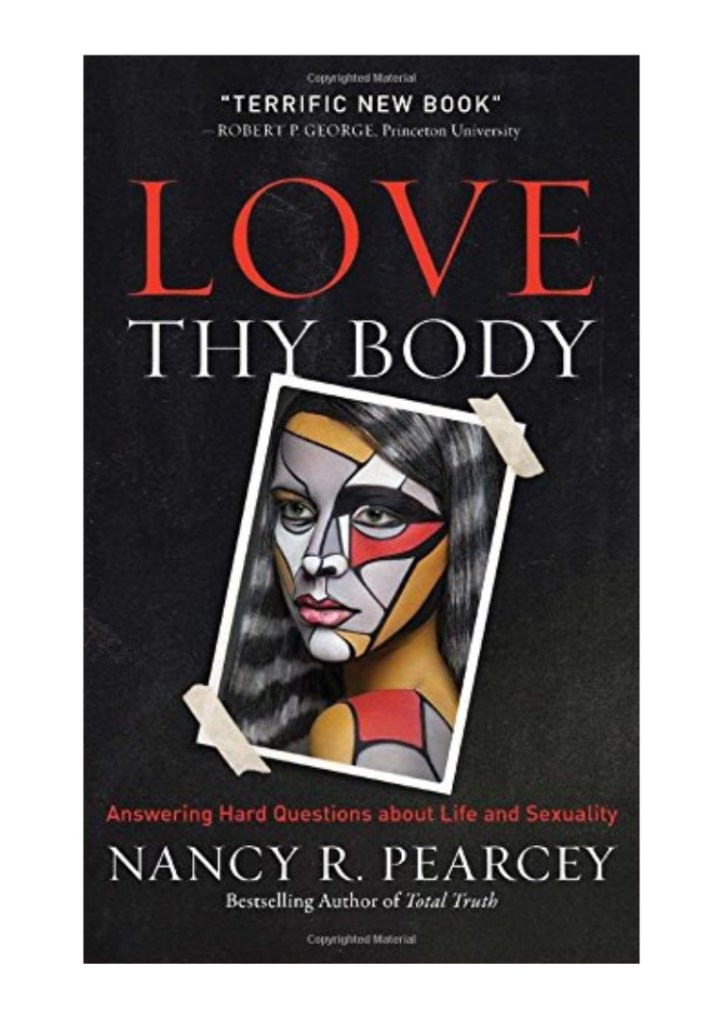
Many people have trouble loving their bodies. Not everyone struggles with this, but many do. “The outside does not match the inside.” We are given a body, and our body continues to be a stubborn fact that cannot be overlooked, and as we grow our body continues presenting us with a steady stream of stubborn facts about what sort of person we were designed to be.
So naturally, I figured Love Thy Body was going to be a healing, affirming sort of book that helps readers along the road to accepting and even celebrating the set of stubborn facts that is our particular body.
And I guess it could still do that, but you’d have to dig deep. Because mostly what this book is, is a terrifying ride through a dystopian nightmare not terribly different from Brave New World, except this one is true and is happening to us. I started to binge on this book (late at night, appropriately), but finally I couldn’t take it any more and had to start skimming. I really can’t think of a scarier book to present you with, as we approach Hallowe’en.
The two-story divide
The author, Nancy Pearcey, who is described on the jacket (and, apparently, by The Economist) as “America’s pre-eminent evangelical Protestant female intellectual,” dives right in to the philosophical developments that have served to sever human beings from their bodies. This divide goes all the way back to ancient Greek (and also Hindu) contempt for the material world and veneration of the spiritual or intellectual world. The Greeks actually taught that the creation of the physical universe was a huge mistake and was carried out by a lesser, evil, deity.
This philosophy has been with us, waxing and waning, ever since and has led to all kinds of dichotomies that even today dominate most people’s thinking:
Values vs. Facts
Morality vs. Science
Postmodernism vs. Modernism
Sacred vs. Secular
Each of these dichotomies can be diagrammed using the same “two-story” image. The immaterial thing is on top. The physical, or “real,” thing is on the bottom. The first “story” of the house (Science, say) is furnished with public, verifiable facts that anyone can access. The second story is home to all the immaterial stuff. In some of these dichotomies, the lower story is considered superior (facts; science). Some people even consider the lower story to be the only one that really exists. Thus, we are encouraged to keep our upper story “private” and not impose it on others. In other dichotomies, the upper story is given more importance. For example, in the evangelical world, “sacred” jobs are considered more spiritual than “secular” ones and this is supposed to be a good thing. Postmodernism, with its suspicion of materialism and reason, was a reaction against Modernism, which considered physical objects and reason to be all that existed; and, not surprisingly, was felt by the Postmodernists to be dehumanizing. The Postmodernists were right to stop devaluing the immaterial, but unfortunately they went in the direction of rejecting the entire lower story, leaving the sharp dividing wall in place.
The problem for human beings with this sharp divide between spirit and matter is that is splits us right in two. We are embodied spirits. But the prevailing philosophy of the last several centuries has tried to tell us that our bodies are not, in fact, really us. They are just a tool we manipulate, a machine that we drive. Our spirits are the “real” us.
I’ve never liked the phrase “the ghost in the machine.” It is supposed to describe what a human being is, but instead of capturing what it feels like to be a human being with a body, it does the opposite. It gives a spooky, lonely feeling. I imagine the poor ghost wandering the circuits of the computer, unable to make it do anything.
And that is the effect of splitting people off from their bodies. You make the spirit a mere ghost and the body a mere machine, and suddenly they can barely even influence each other.
This is “Personhood Theory,” and it is the foundation for all the horrors in the rest of the book. Personhood theory, like a good dichotomy, shows the Person in the upper story and the Body in the lower story (diagram on page 19). The Person has legal and moral standing, but unfortunately, according to personhood theory, just because you have a body doesn’t necessarily mean you are a person.
You must earn the right to live and/or have children
The most obvious example of beings who are inarguably biologically human, but yet are not considered to be persons, in our modern society are unborn babies.
“By sheer logic, in accepting abortion, we implicitly adopt some form of body/person dualism, even if we do not use those terms. Out actions can imply ideas that we have not clearly thought through. Of course, when people are making a decision about whether to have an abortion, their choice is often based on personal reasons … In discussing personhood theory, however, we are not talking about people’s personal reasons but about the logic inherent in supporting abortion.” (page 52)
“The most obvious problem for [personhood] theory is that no one can agree on how to define personhood. If it is not equated with being biologically human, then what is it? And when does it begin? Every bioethicist has a different answer. Fletcher proposes fifteen qualities to determine when human life is worthy of respect and protection (such as intelligence, self-awareness, self-control, a sense of time, concern for others, communication, curiosity, and neocortical function).” (page 53)
It should be obvious that this is a very, very slippery slope. I am sure that, as you read Fletcher’s list, examples sprang to your mind of adults who seem to lack these qualities in greater or lesser measure. It would be funny if this wasn’t a life-and-death topic. Obviously, these qualities are not present (as far as we can tell … and, honestly, how the hell would we know?), in newborns. Thus, bioethicists (and was there ever a more ironic job description?) are already deciding that newborns do not make the cut. Waston & Crick feel that newborns should not be “declared human” for three days after birth because some genetic conditions do not show up until then. So-called bioethicist (and the irony deepens each time I type that word) Peter Singer says “a three-year-old is a grey case.” (page 54)
But the difficulties in earning their humanity presented to babies and toddlers are just the tip of the iceberg. Qualities like self-awareness and a sense of time can be lost to conditions like dementia, brain injury, severe mental illness, and the list goes on. If someone who has previously been acknowledged as a person loses these qualities, does it then become moral to kill them? Personhood theory presents no logical impediment to their being “declared” nonpersons by whatever authority once declared them persons in the first place.
The qualification that is most frightening to me is “intelligence.” What the heck does that mean? Who determines it? When I read excerpts from eugenicist Margaret Sanger (founder of Planned Parenthood), I get the impression that her ideal society would give everyone an IQ test and sterilize, not just the lowest scorers, but everyone who scored average or below. Every time, I can’t help but wonder whether I would meet her criteria for sufficient intelligence to be allowed to reproduce. Probably not … after all, how intelligent could I be when there are several major points on which I disagree with Margaret Sanger?
You don’t get to say what kind of being you are
Once we have thoroughly severed personhood (upper story) from the body (lower story), it follows that our body is not at all a part of who we “really” are (the only “real” things being the upper story — our experience, thoughts, and feelings). This concept is applied consistently by the transgender narrative, which “completely dissociates gender from biological sex” (p. 197).
Because the trans narrative insists that the body does not matter — that it is not the “the real you” — some transgender people do not even bother to change their bodily appearance. A friend introduced me to a local musician who identifies as genderqueer. He appears completely masculine except that he wears eyeliner and sometimes a woman’s blouse or skirt. Yet he insists on being referred to as “she” and her.”
Ibid, p. 200
This man is not pushing the envelope. He is a person who sees clearly the logical implications of the trans world view and is following them (almost) all the way to their conclusion.
(And, by the way, that’s convenient for him, because one of the lousiest things about being a biological woman is female hormones, and I think it’s a little unfair that a person should be able to call himself a woman and not experience the joys of those, but I digress.)
“So,” you say, “What’s the problem? It’s all about personal choice. The individual should not be bound — repressed — oppressed — by his or her body and society’s response to that body.”
Pearcey understands the emotional appeal of this motivation:
The goal is complete freedom to declare oneself a man or a woman or both or neither.
The sovereign self will not tolerate having its options limited by anything it did not choose — even its own body.
Ibid, p. 210
Of course, having a body, having that body be an important part of your identity, and being among other people who have a certain response to the total package … all of these are important elements of what it means, and has always meant, to be human. But no matter. Individuals may fairly say that they don’t like what it is to be human, that it is a rotten experience, and that they think they have figured out how to fix it by completely denying the reality of their bodies. Onward! How can this be a problem for anyone who values individual autonomy?
The problem arises thusly. By seizing the ability to declare ourselves whatever we may want to be, we have created an awesome new power. And awesome new powers seldom remain diffuse, in the hands of every individual. When an awesome new power arises, so will a supervillain to try and monopolize it.
These legal changes [Sexual Orientation and Gender Identity laws] do not affect only homosexual or transgender people. In the eyes of the law, no one has a natural or biological sex now; all citizens are defined not by their bodies but by their inner states and feelings. Your basic identity … no longer follows metaphysically from your body but must be determined by an act of will.
But whose will? Ultimately, it will come down to who has the most power — which means the state. “It does not matter what you or I mean by the word ‘gender,’ explains Daniel Moody. “The only opinion that counts is that of the state … In law, our gender identity is defined without reference to our body.”
By rejecting the biological basis of gender identity, SOGI laws empower the state to define everyone’s identity.
Ibid, p. 214
If that’s not the scariest thing you’ve ever heard, I don’t know what is.
If the state can legally declare a man to be a woman because he says he is, it could, in theory, legally come to my house and declare me not a woman, even though I’ve borne three children.
“Oh, come on. No one is going to do that.”
It is already happening. Not to me personally, but to much more vulnerable people.
Perhaps you’ve heard of the case in Texas where a father and mother are locked in a custody battle over their school-aged son. The mother insists the son is transgender, though he seems perfectly happy to identify as a boy when he’s with his dad. The courts have, so far, sided with the mother. This is just so tragic I don’t know where to start … but the big question is, In what sense is the little boy in this story making any kind of choice at all?
There are no such things as mothers and fathers
Until now, the family was seen as natural and pre-political, with natural rights. That means it existed prior to the state, and the state merely recognized its rights. But if the law no longer recognizes natural sex, then it no longer recognizes natural families or natural parents, only legal parents. That means parents have no natural rights, only legal rights. You, as a mother or father, have only the rights the state chooses to grant you.
Ibid, p. 213
This, of course, is a tyrant’s dream.
I am sure you have heard people make serious arguments along these lines: “Some people should not be allowed to have children” (by whom?); “There is no such thing as other people’s children”; “It takes a village to raise a child.” (I agree with that last one, but only when the village is an organic social unit, made up of lots of nuclear and extended families. When Hillary Clinton says “a village,” the village she has in mind is the national government.)
The people making these arguments wish to build a society-wide utopia. In other words, they are budding totalitarians.
The ideology of choice [being the only determining factor in forming a family] has ominous political implications. For if children must be chosen, if they do not belong to their biological parents as gifts from God, to whom do they belong? Answer: the state. If you read scholars like Ted Peters carefully, you consistently find statism lurking as an underlying assumption. In one passage, Peters writes, “Society places its children in the care of rearing parents as a trust.”
Stop right there: Society gives us children? Society gives us its children? This view reduces both parents and children to atomistic dependents on the state.
The totalitarian regimes of the twentieth century all sought tight state control of education, down to the earliest years, to inculcate unquestioning acceptance of the regime’s ideology.
History shows clearly that when biological bonds are downplayed in favor of choice, individuals end up forfeiting choice to the state. Demanding freedom from natural relationships means losing freedom to the state.
Ibid, p. 231
I would have to call that an unexpected outcome, wouldn’t you?
Yes, some natural families do really stink to grow up in.
All bureaucratic group homes for children would stink to grow up in.
Now that Pearcey has pointed this out, though, I can see this theme of a totalitarian utopian state undermining natural family bonds in all kinds of dystopias. Brave New World is the most obvious, where people are encouraged to sleep around, babies are grown in a lab, and the terms mother and father are considered obscene. But there is also The Giver, the YA book by Lois Lowry, in which babies are assigned handpicked parents after they leave their “birth mother” (which is a low-status role in their society … sound familiar?), and babies who are not thriving are euthanized.
This theme even surfaces in 1984. In that book, Winston’s neighbor is a rather simple-minded man who is enthusiastically in support of the Party. When Winston ends up in the Ministry of Love, there to be re-educated (sound familiar?), he is shocked to see his neighbor also there. The man has been turned in by his children, who claimed that in his sleep he would mutter, “Down with Big Brother.”
So, yeah, I recognize this theme from dystopian literature. I just didn’t realize, until I read this book, that legally and philosophically we were quite so far down that road.


 Out of Babel Books