A Roundup of Atlantis Theories

Photo by Pixabay on Pexels.com

Too many Atlantises. An embarrassment of Atlantises. One Atlantis, two Atlantis, red Atlantis, blue Atlantis …

Atlantis is Now Off the Coast of Cuba

This article describes an intact granite city, with pyramids, discovered off the West coast of Cuba, about 2,000 feet down, in December of 2001. As our old friend KFM, of Bad Archaeology, points out, the city would be unlikely to survive intact like this if it actually dropped dramatically from what is now sea level, as Plato seems to describe. The article points out that there is another city, the Yonaguni Monument, off the coast of Japan, and Graham Hancock in his book, Underworld, points out that there are submerged megalithic cities in many places around the world, including off the coast of India. (Hancock has cycled through seriously advancing a number of different Atlantis theories, so he will be sort of the workhorse of this post.)

It seems to me that the city off the coast of Cuba is part of a worldwide phenomenon where sea levels were once much lower. We can include in this phenomenon Doggerland (which will make another appearance later in this post), and the land bridges known to have once connected Asia to the Americas and the Indonesian islands to the mainland.

If you are an old-earth believer and have to juggle millions of years, multiple cooling and warming periods, slow but somehow effective continental drift, and some confusing archeological indications that humans were perhaps around well before they should have been … good luck. As someone who believes that the history of the earth is measured in thousands or tens of thousands, but not millions or billions of years, my guess is that this period of low sea levels plus advanced civilization came right after the Great Flood.

You would have a much colder, rainier climate as the earth adjusted to the recent cataclysm (about this more in a minute). You would have had frequent snow and rain storms, with all this precipitation getting frozen in the rapidly forming ice sheets, causing Earth’s water supply to be greatly reduced. Meanwhile, you would have Noah’s children and grandchildren branching out as quickly as possible, building megalithic cities wherever they went, still remembering the techniques and technology (and possibly still assisted by the giants and gods) that they had seen pre-Flood. This period of low sea levels would have had to last long enough for people to disperse and to build, but it need not have been very long. It could have a been a matter of a few hundred to a thousand years. As the climate stabilized, you would have had floods covering settlements and civilizations in different parts of the world. This, I believe, is the reason we have an embarrassment of Atlantises.

There have also been assertions that the reason for the Bermuda Triangle phenomenon is that Atlantis lies underneath it. (Note that the west coast of Cuba is outside of the Bermuda Triangle.) This theory certainly appeals to those who are interested in the potential paranormal effects of the lost city, but I do not know of any actual submerged city found in the Bermuda Triangle area. (If you do, please enlighten me in the comments. I’m always looking for another Atlantis to add to my collection.) This article discusses how ocean-floor mapping technology can create lines that look like city streets.

Atlantis as Antarctica

Graham Hancock makes the case for this in his book Fingerprints of the Gods. He posits that the evidence points to an ancient, advanced civilization which was destroyed by a cataclysm, and asserts that the refugees from it seeded their scientific knowledge, in code form, by creating new religious cults all around the world that featured certain sacred numbers.

If you’ve been reading Out of Babel for a while, you know my assessment of all of this is that it’s right, but not in the way that Hancock thinks it is. Among other things, his scientific materialism and evolutionary beliefs make it impossible for him to imagine that people groups like the Maya, for example, would have come up with advanced mathematics on their own, so he needs to posit a more “advanced” civilization bringing these things from without.

Anyway. For his advanced ancient civilization, Hancock realizes he needs a continent-sized homeland (because, again, his evolutionary beliefs about man require that such a civilization develop gradually, over millennia, from hunter-gatherers to farmers and so on). Antarctica is a good candidate because it’s an entire continent; there is some evidence that it was mapped before it was quite so covered in ice; its general pre-ice outline corresponds roughly to Plato’s description of Atlantis; and there is a theory available for how it could have gone from being in a temperate part of the Atlantic, to being at the South Pole, in a relatively short amount of time. Hancock calls this “earth crust slippage” and posits that it happened about 20,000 B.C.

Now for the version I find more plausible: Creation scientist Dr. Kurt Wise presents his team’s model for “continental sprint” in this video. I find Dr. Wise’s model persuasive as a model of the Great Flood, and as we will discuss, it could explain the Atlantis legend wherever in the world Atlantis proves to have been. However, even if you buy into “continental sprint,” it does not follow that Plato was describing Antarctica when he wrote about Atlantis. If all the land on the earth were breaking up, the ultimate fate of that portion that later became Antarctica would seem like a minor detail.

Atlantis as North America

This one was put forward by Graham Hancock, after he abandoned his Antarctica theory, in his book America Before, a review of which I react to here. Although weak, the theory relies on the fact that there are large structures, either megalithic or earthworks, which align to different astronomical features and/or function as observatories, all around the world, including in North America. For example, the pyramid complex at Teotihuacan appears to be a model of the solar system; the Giza Plateau appears to be a model of Orion, and Serpent Mound in Ohio, which sites towards the sunrise at solstices, may be according to Hancock a model of the constellation Draco.

All that to say, anywhere you can find a large astronomical structure, you can make a case for Atlantis, and Hancock has made that case for North America.

Atlantis as the Cyclades Plateau in the Aegean

This article, which I posted last summer, asserts that Plato’s descriptions of Atlantis are admirably matched by the Cyclades Plateau (now the Cyclades islands), which would have existed when sea levels were 400 feet lower than they are now. The Cyclades Plateau is a rather large formation right in the middle of the Aegean. (If we consider that lower sea levels would have also expanded the coastlines of the rest of Greece, then it would have been even closer to the mainland.) This is an attractive theory in terms of its being what Plato was actually talking about (since he makes Atlantis contemporary with Athens), but it does depend upon this:

Recently, a four year study that included a thorough analysis of Plato’s work established that serious errors by early translators allowed for the mixed messages in the translated document.

Atlantis as Part of Doggerland

Yet another underwater location that used to be inhabited when sea levels were lower, Doggerland was a vast region that stretched between England, France, Holland, and Scandanavia, and is now the relatively shallow southern part of the North Sea. Archaeological discoveries have handily established that this area was once inhabited, here and here among others. As with other now-submerged human habitations, the reader’s preconceptions will determine how long ago you believe it was inhabited, and for how long.

This article describes an entire book which puts forth a detailed theory Plato was describing Doggerland. Apparently, Atlantis had a large, roughly rectangular plain surrounded by “ditches,” which the author thinks could also be translated “dikes.” He imagines the inhabitants of AtlantiDoggerland using these dikes to keep the sea back from a certain region of Doggerland for a period of time. Without some very expensive underwater archeological expeditions (in a notoriously dangerous sea), there is no way to confirm whether the ruins of a large city lie where this theory would predict. The maps are well worth looking at.

Atlantis as the Richat Structure

The Richat Structure, of the “Eye of the Sahara,” is a large (c. 40 km) formation of concentric rings of stone located in present-day Mauritania. Because of its size and remote location, it is hard to spot except from orbit.

Depending upon how you calculate, the structure matches the recorded dimensions of Atlantis quite well. There are also, of course, explanations about how this structure could have formed geologically. I’m not enough of an expert to assess these, but I am more skeptical of geological explanations than I used to be, now that I’ve seen “mountains” that turned out to be pyramids with insides, and geologists’ attempts to explain how a single fossilized tree could cross-cut millions of years’ worth of sedimentary rock layers. In other words, could go either way.

For the Richat structure to be Atlantis, we have to imagine that it was once nearer to coast and was inundated by a tsunami or something of that nature. This theory actually works fairly well with the geological model that Dr. Kurt Wise presents above. “Continental sprint” would have included many earthquakes and resultant tsunamis. Africa, in the model, does not move as much as the other pieces of Pangea, but it would still have undergone earthquakes and, possibly, some uplift.

On this theory, with his tale of Atlantis Plato somehow retained a memory of a pre-Flood incident (and read Athens back into it?). Below is a video of Pastor Joel Webbon discussing the theory with Brian Suave and Ben Garrett of Haunted Cosmos. They get into local lore around the Richat structure, how this dovetails with Greek legends about Atlantis, and how this all could have been plausible in a pre-Flood world haunted by gods and nephilim.

Conclusion

When I first started composing this post, I thought I was going to come out in support of the Richat Structure. Now, I just don’t know. The Haunted Cosmos guys make it sound very plausible, but a few of the other candidates are also plausible (some less so). There does not seem to be any way to “find” Atlantis without sacrificing at least some of what Plato has to say about it. (For example, Athens existed before the Flood? Before there was a Europe?) This makes it really difficult to favor any one theory (although we can probably discard others). What is clear, is that the prehistoric world had many sophisticated cities, lots of things built with megaliths, pyramids on almost every continent, and that there was a period when many human settlements were submerged as sea levels rose. The details are a matter of speculation, of the kind suitable for someone writing a novel.

A Retired French Mining CEO and His Theory that Doggerland was Atlantis

Some day, we are going to have to do a long post about Doggerland. Right now is a busy time of year, so I don’t have the time for that at the moment, but long story short, Doggerland has everything.

Doggerland was an area that you probably know as “the bottom of the North Sea.” Apparently, there is a shallow area there, with evidence that when sea levels were lower, it was once not only exposed but inhabited. This vast area of land would have joined England and Ireland to what is now Holland and Denmark. The proximity to Holland, plus the theory that Doggerland is the setting for The Lord of the Rings, are what I mean when I say this place has everything.

For now, let’s put a pin in this article. Jean Deruelle, the French guy with the theory, has detailed ideas about exactly what the inhabitants of Doggerland got up to. He assumes (reasonably, I think) that they were part of the Old European megalithic culture. The article also includes lots of cool speculative maps of Doggerland in various stages of submersion by the sea. We can argue about the exact timing of it all, later.

Yay Neanderthals!

What’s the most entertaining thing about this story? Is it …

  • the neat little tidbits about Neanderthal genetics?
  • the big reveal that Neanderthals, Denisovans, and so-called “modern humans” are all actually the same species?
  • the total blindness to the way this fact contradicts the evolutionary narrative?
  • the researchers’ discovering that close kin used to intermarry in the distant past, just like we’re told in Genesis?
  • their attempts to minimize this same fact?

The “Oldest Dutch Art”

… is zigzags carved onto a possibly 13,500-year-old bison bone retrieved from Doggerland.

Retrieved by Dutch fishermen.

“The oldest Dutch art,” haha, get it?

Doggerland was a fertile area inhabited by people when sea levels were much lower. It lay under what is now the North Sea. Unlike the map in the linked article, some maps show it being a vast lowland area essentially joining England with what is today Scandanavia. These maps also often show England joined to France and Ireland. Europe’s current rivers are just the headwaters of a larger river system. Of course, no one knows exactly what it would have looked like, but it’s fun to speculate.

On an evolutionary timescale, Doggerland was inhabited over millennia, millennia ago. On a young earth/catastrophic flood timescale, it could have been settled over decades or centuries by people dispersing after the flood, when the climate was cool and rainy, large glaciers formed rapidly, and sea levels were consequently much lower, exposing land bridges all over the world that facilitated humanity’s dispersion. There could have been a relatively short period of time (a few centuries?) before the climate stabilized, the glaciers melted, and sea levels rose, marooning people wherever they had ended up.

As a Dutch person myself, I think it’s incredibly clever that they call this the “oldest Dutch work of art.” I mean, given that the Dutch have reclaimed a good part of their country from the sea, why don’t we just go ahead and let them have as much of Doggerland as they can manage?

However, I disagree with some of the experts in the article that the only possible use we can imagine for zigzags is artistic or “ritual.” Following Richard M. Rudgley, other possible are uses are a calendar, music, or some other kind of scientific notation.

Altai Throat Singing

The Altai mountains are in central Asia, north of the Himalayas, around the area where countries such as China, Mongolia, Russia, and Kazakstan meet. They are not too far from the stompin’ grounds of the horse-riding Central Asian tribes such as the Scythians and Parthians, part of the same culture area that gave rise to the early Indo-Europeans with their kurgans, before they moved west into Europe proper. That’s why these guys look sort of European and sort of Asian. People who live here have looked like this for thousands of years.

The Altai mountains are an old range of mountains (left over from Pangea?), not created by whatever event caused the Himalayas. Hence, they are low and rolling. I had to (lightly) research this part of the world when I went to write The Long Guest. My characters called them the Gentle Mountains. They had a lodge there for some years before moving on to the Gobi desert (which possibly didn’t actually exist in the immediate post-flood years in which my story is set, but we will ignore that. Onward!)

I thought this was a perfect video to share on a winter’s day. Are these people cool or what? I love how he warms up for throat singing by making horse noises.

As with many cultures, my imagination is very attracted to their way of life, but I would probably hate it if I had to actually live that way, not being tough enough.

Another Candidate for Atlantis

Photo by Ray Bilcliff on Pexels.com

https://www.ancient-origins.net/opinion-guest-authors/atlantis-revealed-platos-cautionary-tale-was-based-real-setting-003224

There have been a number of proposed sites for Atlantis. Graham Hancock has proposed Antarctica, North America, and probably some other places that I don’t know about. I’ve also heard rumors that the sunken continent could be in the Bahamas area and could explain the Bermuda Triangle phenomenon. The Disney movie Atlantis locates it off the coast of Iceland, and I have also heard people advocate the Eye of the Sahara in Mauritania. (The idea being that, before continental uplift, this site was closer to the coast, and it could have been inundated by a tsunami or something like that.) Well, the article above makes what strikes me as the most likely proposal yet.

The super-island of the Cyclades Plateau (Plato’s Atlantis) was drowned by the sea at around 8000 BC, during the rapid rise of the Mediterranean and just prior to the flooding of the Black Sea (see UNESCO study, 2009.) Incidentally, around this time, Lake Agassiz, a gigantic glacial lake in North America, also burst open and began to drain into the Atlantic. It is worth noting that Lake Agassiz covered an area larger than all the Great Lakes combined (440,000 Km 2) and at times, it contained more fresh water than all the lakes in the world today. The total fresh water outflow from this lake alone was so immense, scientists believe it raised the oceans worldwide by as much as nine feet and further produced the 8.2 kilo-year event that followed, a mini ice age that lasted 400 years! This global cataclysm at the end of the last Ice Age, which ultimately raised sea levels by 400 feet, not only erased our early history, but this could also be the event we all inadvertently refer to as the “Great Flood.”

ibid

Proposing the Cyclades Plateau as the site of Atlantis ties its inundation to a known rise in sea levels that happened right around the date that Plato says Atlantis was submerged. The article shows maps of what the plateau would have looked like and how it roughly matches Plato’s description of Atlantis (though the scale is slightly off). Of course, in my integrated version of ancient history, it went like this:

  • Pangea
  • Continental Sprint, involving cataclysmic earthquakes and also tsunamis. This is the Great Flood
  • A cold, rainy period after the Flood, leading to the Ice Age, which meant lower sea levels, coinciding with human dispersion across the newly shaped continents
  • As the Ice Age ended, we get sea levels rising and large but not worldwide local floods like those described above.

The article also suggests that this civilization was part of a larger pan-Mediterranean civilization:

Finally, a 10,000 year old Mediterranean civilization, may help explain more archaeological oddities in this region. Recent erosion and seismic tests at the Giza Plateau, indicated that the Great Sphinx may be much older structure than previously thought, and along with the site of Gobekli Tepe in Turkey, both seem to coincide with Plato’s story of Atlantis. Is it possible that Gobekli Tepe and the monument of The Great Sphinx could be remnants of the same advanced civilization Plato referenced in his story, one that was aggressively advancing against its neighbors in Africa and the Middle East, or do those belong to another culture? And what about the advanced proto-Euphratean people who descended upon the Mesopotamia around 7000 BC, from a region “unknown.” Could these enigmatic people be the refugees of the same culture who fled the Mediterranean basin and moved eastwards to escape the inundation? Undoubtedly, they could have brought with them the story of the great flood as well as the skills and technology to incite yet another great civilization, like that of ancient Sumer (just as the survivors around the Cyclades and neighboring islands may have ultimately contributed to the rise of the Minoans).

ibid

This sort of thing is catnip to me.

Finally, for the reconstructive genetics nerds among us (raises hand), the article offers bonus evidence that the residents of this Aegean Atlantis may have island-hopped their way to North America, which would explain why Haplogroup X is concentrated most heavily in the eastern Mediterranean and around the Great Lakes. (Bonus: the Great Lakes area was also the source of a particular type of copper that was used in the Mediterranean during the Bronze Age.)

The Human Impulse to Make Stone Spheres for Some Reason

A while back, I blogged about decorative, marble-sized clay spheres that were found at the Poverty Point archaeological site (“Poverty Point objects”), which turned out to have been used for cooking.

That’s what I thought I had stumbled upon when I first saw this headline about the larger, billiard-ball sized stone spheres that have been found in association with recumbent stone circles in Scotland.

But these spheres turn out to be, if possible, more sophisticated than the Poverty Point objects. In this and the follow-up article, there are a number of theories about the possible purpose of the spheres:

  • Projectiles for hunting or war. However, the spheres don’t appear to have taken any damage from being thrown.
  • Perhaps the small spheres were used to roll the megaliths, though again, if they are not damaged this seems unlikely (and for the record, I think this is a dumb theory).
  • Fishing weights
  • Weights and measures for other purposes, since some of them seem very standardized.
  • Divination, by rolling them on the ground.
  • The stones were used to roll around in a bowl of sand and produce interesting sand art. (Hmmm.)
  • Representations of pollen, or of atoms. (See my post that points out that the caduceus may be a representation of a DNA molecule.)
  • The spheres may have been a “portfolio” made by skilled stoneworkers in order to demonstrate what they were capable of. (Now we are getting somewhere!) In connection with this, the author of the article mentions that he has seen at least one stone sphere (and spirals) reminiscent of those in Scotland, while on a trip to a pyramid site in Bolivia. He asks, “Did the megalithic Scottish stonemasons really make their way to South America in prehistory?” That is certainly possible, but I think it could simply speak to a worldwide, pre-Flood or immediately post-Flood culture of megaliths, pyramids, and advanced knowledge of astronomy.
  • The spheres could be models of the Platonic Solids. “What we have are objects clearly indicative of a degree of mathematical ability so far denied to Neolithic man by any archaeologist or mathematical historian.”
  • Given their sophisticated geometry, the author of the article favors the idea that these spheres were used in the study of spherical geometry. This leads on to the suggestion that they could have been models used to study the geometry of the earth, perhaps for navigation, astronomy, or detecting ley lines. Regarding navigation, see the Out of Babel posts on the Antikythera Mechanism, and possible ancient maps. Regarding astronomy, recall that in the more recent ancient world, the celestial equator, equinoxes, and the procession of the stars were conceived of as a structure of intersecting hoops surrounding the earth.
  • Finally, there’s a theory that the spheres were used as “energy channels” to focus magnetic properties either into fields for increased soil fertility, or into human bodies for healing. This one seems to me a little weird and unnecessary because I like the spherical geometry thought … but I hesitate to mock it too hard, because quite a few very weird ideas that I would at first dismiss, have turned out to have been at least widely accepted in the ancient world, if not actually functional in the ancient world though not in the modern world.

Long story short, add one more tick mark to the column “ancient people were not only much smarter than we think, but also much smarter than we are now” … which has been a constant drum beat on this blog.

I started out studying the ancient world so that I could write fiction about it. I still enjoy doing that, but the more I learn, the more I realize that my fiction is going to be very inaccurate because I truly have no idea what those people were getting up to back then, and it seems that even if I had been present, I would hardly have been capable of understanding it.

But buy my books anyway.

The “This Is Your Story” Book Tag

I shamelessly stole this tag from Bookstooge and The Orangutan Librarian … oh wait, it looks like TOL actually did tag me. Technically. Thanks to  Sheri Dye for creating this fab tag!

The Rules

  • Link back to the creator @ReadBetwixtWords
  • Answer each question by using your favorite (or TBR) book covers, characters, and stories
  • Tag a friend or two
  • And have fun with it!

QUESTIONS

Here they come:

AUTHOR – WHO’S WRITING YOUR STORY?

Andrew Klavan. He writes older female characters pretty well, plus he totally adores women, so he will make me seem like a much better person than I actually am finally give me the credit I’m due!

On the down side, his stories tend to be rather dark and violent, so buckle up.

WORLD – WHAT LITERARY WORLD IS YOUR STORY PART OF?

It’s a paranormal portal fantasy where I go to an archaeological site to research a book, unwisely step along a ley line, and end up in Atlantis.

Mixed with a Miss Marple mystery.

ROMANCE – WHO WILL BE YOUR LOVE-INTEREST?

I’m a married woman, and besides I’m too old for romance. The romances will take place among secondary characters, the way they always do in Brother Cadfael mysteries. My grown sons will each get married in the course of the book, plus there will be at least one secondary romance in Atlantis, but it will end tragically.

APPEARANCE – WHAT WILL YOUR CHARACTER LOOK LIKE?

Myself, but about 20 years older. I’ll be a spry little old lady with wild, flyaway hair. Sort of a Good Witch look. Also, my nose will be bigger than current.

SIDEKICK – WHAT CHARACTER/CREATURE WOULD YOU HAVE BY YOUR SIDE?

My niece, a very cool person who just happened to meet up with me at Newgrange because she was on a study program in England.

I have a lot of nieces. I won’t say which one I have in mind, but she knows who she is.

GOOD, EVIL, OR GRAY – WHERE DOES YOUR CHARACTER STAND?

Twenty years from now, I will be so sanctified and refined by the sufferings of life that I am the goodest of the good, hidden underneath a thick layer of Old Lady bitterness and cynicism.

DESIGNATION – WHAT WILL YOU BE? (HUMAN, FAIRY, PIRATE, PRINCESS, ETC..)

Wait a minute … we have options other than human? Why wasn’t this mentioned earlier???

OPPOSITION – WHO WILL BE YOUR NEMESIS?

Since this is an Andrew Klavan novel, there will be two nemesises (nemesi?). In this world, it will be Klaus Schwab. In Atlantis, it will be a being of light that is going to help bring humanity to a higher plane. Later, it turns out that Schwab is working for the being of light.

THE ENDING – HOW DOES YOUR STORY END? SPOILER ALERT!

Like they all end: I die.

But not before I make it back to the 21st century in time to help expose Klaus Schwab (working together with my niece and an unlikely band of misfits that includes James Lindsey, Andrew Klavan, and my pastor. Klavan will be about 100 years old at this point, unless he has also engaged in time travel).

And, we all know what happens to Atlantis.

(What’s that you say?

Plotholes, schmotholes!)

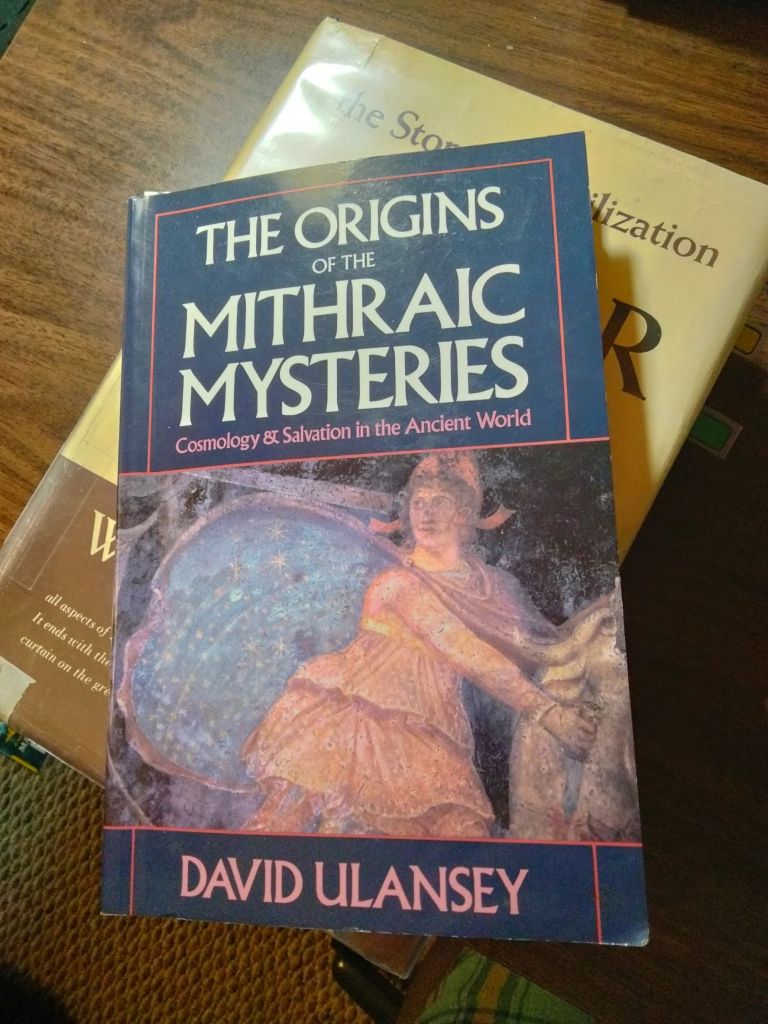
Book Review: The Origins of the Mithraic Mysteries by David Ulansey

I thought you should know that this book exists.

I don’t even remember where I got it. I have a feeling I got it at a used book store or a library sale, or maybe I stole it from my dad’s library. I know it’s been sitting around my study for a few years, waiting for me to get to it. It was published in 1989.

This is a good, accessible piece of scholarly work that first explains what the cult of Mithros was, then traces the history of scholarly thinking about it, and then advances Ulansey’s theory about what was really behind the cult.

What Is Mithraism

Mithraism began to spread throughout the Roman Empire in the first century C.E., reached its peak in the third century, and finally succumbed to Christianity at the end of the fourth century. At the cult’s height mithraea could be found from one end of the empire to the other, “from the banks of the Black Sea to the mountains of Scotland and to the borders of the great Sahara Desert,” as one authority puts it.

ibid, p. 4

As a result, many of the underground Mithraic temples whose iconography Ulansey shows pictures of are found in Germany or in Italy, although this is a cult that had its origins in Tarsus, in southern Turkey.

For a long time, the accepted theory among scholars was that the god Mithras got his start as the Iranian god Mithra, because they happen to share a name. However, the attributes of Mithras don’t line up very well with those of Mithra, which leaves the door open to other explanations.

The cult was apparently based on a story where Mithras slaughters a bull, and from the bull’s body sprang all the plants that man finds useful, such as wheat, grapes, etc. Because it was a mystery cult, nothing was ever written down about the secret meaning of this story, nor of the levels through which the neophyte progresses as he is initiated deeper and deeper into the mysteries. But in all Mithraic temples, there is consistent iconography. This includes a picture of Mithras slaying the bull, with wheat coming out of the wound. Mithras is typically looking away from the bull (though this is “corrected” in some reconstructions), wearing a distinctive hat which was associated with Persia and with Perseus in the ancient world. Around him are placed other figures which will prove to have significance in unravelling the meaning of the cult. Sometimes, the whole scene is placed under an arch or inside a circle that shows the zodiac. Sometimes, Mithras is also portrayed as standing inside a circle or hoop lined with star symbols.

A Brief Tour of the Ancient Mediterranean, Near East, and Europe

In unfolding his theory, Ulansey takes us on a fascinating tour of the ancient world. For example, he spends a lot of time establishing how and why Mithras came to be associated with (based on?) Perseus, who was the founder and hero of the city of Tarsus and, in fact, the local god of that whole region. (Mithras’ hat — a “Phrygian cap” — was originally worn by Perseus, and Ulansey contends that he looks away from the bull as he slaughters it because Perseus looked away from Medusa as he slaughtered her.) He gets into the fact that the cult may have originated with pirates of Cicilia, which lies just off the coast from Tarsus:

[T]he Cicilian pirates were far more than a mere band of thieves. Rather, the pirates, who numbered at least twenty thousand, formed what amounted to a small nation which at its height controlled the entire Mediterranean Sea.

ibid, p. 88

Ulansey then quotes Plutarch from Life of Pompey:

“The power of the pirates had its seat in Cicilia at first … then, while the Romans were embroiled in civil wars, the sea was left unguarded … until they no longer attacked navigators only, but also laid waste islands and maritime cities … There were also fortified roadsteads and signal-stations for piratical craft in many places … more annoying than the fear [the pirate fleets] inspired was the odious extravagance of their equipment, with their gilded sails, and purple awnings, and silvered oars … For you see, the ships of the pirates numbered more than a thousand, and the cities captured by them four hundred … Presently men whose wealth gave them power, and those whose lineage was illustrious, and those who laid claim to superior intelligence, began to embark on piratical craft and share their enterprises.”

ibid, p. 88

There are plenty of other fascinating historical nooks in this edifice, such as the figure of a lion-headed man, entwined by a snake, standing on a sphere; the idea of Mithras being born out of the rock; the exact nature of the Gorgon, and many, many others. Every single one makes sense when it comes up in context. That said, there were certainly some bizarre ideas floating around in the ancient world.

The Zodiac

So, to get right down to it, Ulansey’s case is that the Mithraic mysteries were a way of encoding astronomical knowledge. Because this is the ancient world we are talking about, this knowledge could equally be considered scientific, cosmological, and religious, as will become clear shortly.

Lately, I’ve been studying the zodiac in a desultory fashion. Don’t worry, I am not planning to take up astrology. Astrology is specifically forbidden to faithful Jews, and to children-of-Abraham-by-faith like myself. But it is of interest to me, because it was so important to the people of the ancient world. They worked it into their monuments and their mythology. The signs of the zodiac, and other constellations, were associated with the gods, and a good case could be made that this association started in pre-Flood days.

The other thing that fascinates me about the zodiac is that it’s so hard to observe. Now that I keep chickens and also work outside the home, I’ve been obliged to get up before dawn to let the chickens out. I live in a rural area with relatively dry weather, so you’d think it would be easy for me to take a quick glance at the horizon while I’m out there, and be able to tell which constellation is in the east, right where the sun is going to rise in an hour or two. As it turns out, it’s not so easy as all that. You not only have to know which direction is due east, you also have to have something that helps you sight where the sun is going to rise … and it moves. Then you have to be able to recognize the constellations. To really figure out the whole zodiac, you’d have to be making these observations daily, throughout all the seasons of the year, until you noticed that the constellations of the zodiac make a notional belt around the earth, and that at different times of year, they take turns “housing” the sunrise. This is already difficult enough that you’d have to have a pretty strong motivation to pursue it. (Stronger than mine is right now.) Ancient people thought this was so worthwhile that they managed to master the very difficult science of astronomy. Many ancient monuments, in fact, were built as observatories, from Stonehenge to many structures in the Americas.

Why were they so motivated to study the stars? That’s a discussion for another time.

According to Ulansey, the Mithraic iconography (and probably the whole cult) was designed to encode the secret of Equinoctal Precession. This is a really complicated phenomenon, so if you don’t know what it is, I’ll let you look it up. Basically, because of an irregularity in the earth’s rotation, the zodiac sign that “houses” the sunrise on the equinox will stay the same for 2,160 years, by which time the sunrise has migrated back to the previous zodiacal sign (hence, precession). (Also, incidentally, Polaris has not always been the the pole star.) Precession has been discovered at different times in the past by different civilizations. Graham Hancock makes a pretty good case that it was known by somebody, before conventional history began. But due to the difficulty of observing it, it has not been known at all times by all peoples. Around the time that the cult of Mithras apparently started, it had recently been discovered, and begun to be talked about, in the vicinity of Tarsus, in the same intellectual circles that were also providing aristocratic pirates.

Breaking Hoops and Wheels and Mills

Now, to you and me, equinoctal precession might fall into the category of “Oh, that’s interesting.” Not so for the ancients. For one thing, this cult probably started among pirates, who use the stars to navigate. The idea that the stars were once different and are not the same all the time would be earth-shattering to them. But this news gets even more ominous when we understand ancient cosmology.

(And when I say “ancient” here, I am talking about the cultures of the Mediterranean, Ancient Near East, and parts of Europe. Though, not to keep mentioning Graham Hancock, but in his book Fingerprints of the Gods he finds similar cosmology in ancient India, Central America, and Scandanavia. So a case could be made that this cosmology was once worldwide.)

This ancient cosmology, then, conceived of the heavens as a huge machine, constructed of two or more intersecting hoops (the zodiac, the celestial equator, and, essentially, the prime meridian/international date line projected into the sky). Sometimes the heavenly machinery is portrayed more as a big edifice with four pillars supporting it. Sometimes it’s a “mill” that turns. Probably some ancient people took this more literally than others; some understood it was notional, but represented something real.

Now, imagine that you think of the universe as a big, finely tuned machine, where the constellations always end up in the place they are supposed to be. If the whole hoop has moved out of its place, this could be conceived of as “breaking” the machine. This is why cycles of a certain number of years (not everyone got the precessional intervals right) were thought to bring cataclysms upon the world. So, we get myths worldwide about a mill being broken, and this causing the stars to fall from their places, the sky to become dark, fire and floods to sweep over the earth, etc. Again, read Hancock to find out more about this than you ever wanted to know.

But the point is, whether the Cicilian pirates thought that precession caused a cataclysm, or whether it just meant the universe was less stable than they had imagined, this would have been a revolution in their scientific, cosmological, and religious thought. (Religious because, in ancient times, science and cosmology and religion were really all a part of one system, especially when you consider that the stars and other heavenly bodies were thought to metaphysically influence events on earth.) So, whether you count it as belonging to three, two, or just one unified field of knowledge, this was a big enough discovery to be kept secret (a “mystery”) and passed on to initiates in a whole new cult religion.