
Do You Get “Culture Crushes”?
I admit it: I get “culture crushes.”
My earliest and most enduring culture crush has been on Native American culture. This started very early, perhaps by the time I was five. By the time I could read on my own, I was on a sharp lookout for any book with an Indian on the cover. That was all it took to make me pick up the book and devour it.
Here are some of the books I’ve discovered … as a kid, and then later, as an adult.
This is an incomplete list on two counts. First of all, there are obviously many fine books out there, by Native and non-Native people alike, that I have yet to discover and read. Secondly, this isn’t even a complete list of all the books I’ve read on this topic. I can think of at least six seven eight twelve other books that I remember vividly, but can’t remember enough about the titles to track them down.
As A Kid

- North American Indians, by Marie and Douglas Gorsline, Random House, 1977. This book was the introduction to Native American tribes and their lifestyles for my siblings and me. It’s a good overview of the different cultural regions of North America, including a map at the beginning of the book. For each region, it names one or two of the best-known tribes and gives a few pages of details about their lifestyle, beautifully illustrated. The last page of the book is about sign language, which it says functioned as a lingua franca for the different Plains tribes. It includes a number of illustrations of the different signs. What could be more fun?
- Runner for the King by Rowena Bastin Bennett, 1962. I must have been seven years old when I read this book. It featured my two favorite things: Indians, and the word “king.” It takes place in the ancient Incan kingdom, but I didn’t know that at the time. All I knew was that it did not disappoint. The boy on the front cover runs through rugged mountain landscapes. He encounters a fellow runner who has been beaten and tied up by enemies, so the boy must run the next messenger’s leg of the journey as well as his own. He has to climb over a rock slide. At last, he makes it to the king with his message and is personally honored by the king. I now realize, looking at the drawing, that the boy’s face on this cover does not look particularly Incan. It looks more like Peter Pan colored reddish brown. But at the time, this boy – particularly this picture on the cover – instantly became my standard for fitness and beauty.
- Little House on the Prairie by Laura Ingalls Wilder, Scholastic, Inc., 1935, 1953, 1963. This is the Little House book in which the Ingalls family go into “Indian country,” homestead there for less than a year, and then are moved out by changing government policy, not too long after the same government has forced the Indians to leave. This book has been called racist, but that is a foul slander. It portrays a lot of complexity in the Ingalls family’s experience with the Indians. Charles Ingalls, Laura’s “Pa,” in particular clearly respects the Indians. He gently rebukes some other settlers when they speak of the Indians in a dehumanizing way, and he talks with enthusiasm about a buffalo hunt: “Now that’s something I’d like to see!” There is also a scene where Pa has been hunting a wildcat that he knows is hanging around the creek. He needs to find and kill it so that it doesn’t attack his family. He meets an Indian man, who gives him to understand with signs that three days ago he found the very cat and shot it out of a tree.
- Squanto, Friend of the Pilgrims by Clyde Robert Bulla, illustrated by Peter Buchard, Scholastic. Squanto’s story is truly an incredible one. The scene I remember best from this book is that of Squanto trying to sleep on his first night in a British room. The bed is too soft and uncomfortable. Finally he sleeps on the floor.
- The Sign of the Beaver by Elizabeth George Speare. An Indian boy and his father befriend a white boy who has been left on his own to manage the family’s new cabin until the rest of his family can join him. The Indian boy teaches the white boy wood lore and such things as the signs that the different clans leave on trees. The white boy teaches the Indian boy to read. The Indian boy is really offended by the role of Friday in Robinson Crusoe, which rocks his new friend’s world.
- Island of the Blue Dolphins by Scott O’Dell. I don’t remember this one very well, but I think my second-grade teacher read it aloud to us. It’s the story of an incredibly tough and resourceful girl surviving on her own on an island.
- Caddie Woodlawn by Carol Ryrie Brink, illustrated by Trina Schart Hyman. Trina Schart Hyman is one of my favorite illustrators, which just makes this book all the better. This book is not primarily about Indians, but they do play an increasingly big role as the book progresses. Caddie befriends them and then ends up sneaking across the river to visit them and head off a conflict.
- Indian in the Cupboard by Lynne Reid Banks. Omri owns a small metal medicine cupboard that can bring his plastic toys to life. When it does, he discovers that they are not toys but have actual lives and personalities of their own. This series is one of the most poignant I’ve ever read.
- I Heard the Owl Call My Name by Margaret Craven, Dell Publishing, 1973. This one barely makes it into the “childhood” category. I read it in seventh grade, in a year when we read many books set in other cultures (such as The Good Earth and Things Fall Apart). And I Heard the Owl definitely belongs in that august company. It rises to the level of literature. Owl tells the story of Mark, a young priest who goes to serve a small Indian community in remote British Columbia. My favorite scene is the one in which he suddenly realizes that some of the women are talking about him, in front of him, and protests that they’ve got their facts wrong. He has acquired a passive knowledge of the language without really trying. He must have quite a gift for languages indeed, because those coastal Native languages are really complex.

As An Adult
- The Joe Leaphorn and Jim Chee series by Tony Hillerman. Joe Leaphorn and Jim Chee both work for the Navajo Tribal Police. Joe is a tough old cynic. Jim is a young visionary. “Tony Hillerman was the former president of Mystery Writers of America and received its Edgar and Grand Master awards. His other honors include the Center for the American Indian’s Ambassador Award, the Silver Spur Award for best novel set in the West, and the Navajo Tribe’s Special Friend Award. He lived with his wife in Albuquerque, New Mexico.” — From the jacket of A Thief of Time, Harper, 1988, 1990, 2000, 2009. Update: Tony Hillerman’s daughter, Anne Hillerman, is now continuing the Leaphorn and Chee series. I just finished Cave of Bones (2018) by her. It’s really good. Chee has married a fellow Navajo police officer, and Leaphorn is living with a white woman since his wife died of cancer earlier in the series. Anne Hillerman incorporates even more Navajo terms into the books than her father did, and the greeting (Ya’at’eeh) is now spelled with even more diacritic marks.
- The Grieving Indian by Arthur H. and George McPeek, 1988. Arthur H. is a Native pastor, recovering alcoholic, and boarding school survivor. He has many excellent insights about unresolved grief, which he believes is the root cause of most of the problems facing Native individuals, families, and communities.
- Bruchko by Bruce Olson, Charisma House, 1978, 2006. Bruce Olson goes to live among the Motilone Indians of Colombia. After much fruitless struggle to integrate, he is befriended by a remarkable young man his own age who tells Bruce his “heart name.” In time, Christ comes to the Motlione in a way that is very organic to their culture. This book is filled with goosebump-raising moments.
- Black Elk’s Vision: A Lakota Story by S.D. Nelson, Abrams Books for Young Readers, 2010. Black Elk grew up in the Lakota tribe. At the age of nine, he was given a troubling vision that essentially invited his tribe to choose life rather than bitterness. He did not share this vision with anyone for several years. He was present at the battle of Little Bighorn, and later traveled to England as a dancer in Buffalo Bill Cody’s Wild West Show. Besides the illustrations done by the author, the book includes a historical drawing done by Red Horse and many authentic black and white photographs.
- Windigo Island by William Kent Krueger, 2014. Girls are disappearing from the Ojibwe reservation. Cork O’Connor goes off to find one of them, and ends up in North Dakota.
- Thunderhead by Lincoln Child and Douglas Preston. A team of archaeologists discovers a lost Anasazi city and figures out what wiped the Anasazi out. There are no modern-day Indians among the main characters in this book, but near the end, one does play a key role.
Children’s Books Discovered As An Adult
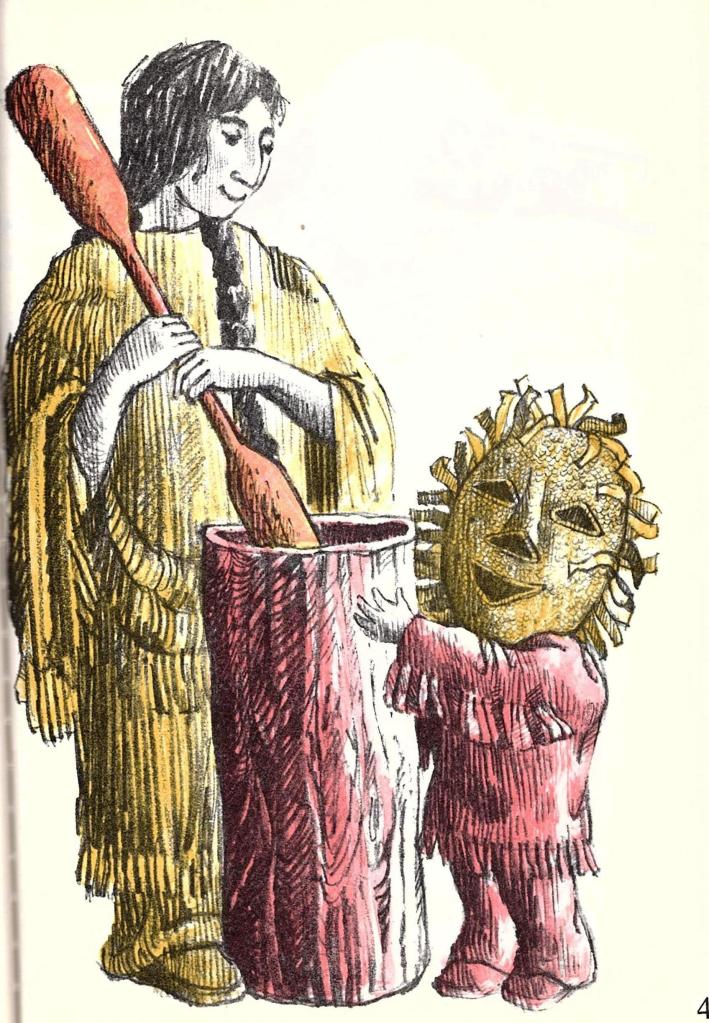
- Little Runner of the Longhouse by Betty Baker, pictures by Arnold Lobel, an I Can Read Book by Harper & Row Publishers, New York & Evanston, 1962. Little Runner is an extremely relatable Iroquois boy whose main goal in life is to get some maple sugar.
- Rabbit’s Snow Dance by James & Joseph Bruchac, illustrated by Jeff Newman, 2012. This legend explains why rabbit, who started out with a long, beautiful tail, now has a short, fuzzy one. It also explains why cottonwood trees are full of “cotton.” Like many Native legends, it contains a not-so-subtle warning about being proud, wanting our own way, and not listening to warnings from our elders. “I will make it snow! A-zi-ka-na-po!”
- A Salmon for Simon by Betty Waterton, illustrated by Ann Blades, copyright 1978, first Meadow Mouse edition 1990, first revised Meadow Mouse edition 1996, reprinted 1998. A Meadow Mouse Paperback, Groundwood Books/Douglas & McIntyre, Toronto, Ontario. Simon, who lives in a village on the Pacific coast of Canada, has been trying all day to catch a salmon. When he sees one drop from an eagle’s talons, he has to decide whether to eat it or save it.


