This is a brief review of the book Black Rednecks and White Liberals, by Thomas Sowell. Full disclosure: I am writing the review before I’m finished with the book. But given that it’s a series of historical essays rather than a novel, I doubt there’s going to be a twist at the end.
Contrary to what you might expect, not the entire book is about Black Rednecks and White Liberals. The book consists of five essays:
Black Rednecks and White Liberals
Are Jews Generic?
The Real History of Slavery
Germans and History
Black Education: Achievements, Myths and Tragedies
History versus Visions
As you can see from the titles, Sowell pokes directly at the eyes of all the sacred cows he can find. Like every Sowell book I’ve read so far, the essays in this book destroy popular misconceptions with facts and logic. But by “facts and logic” I don’t just mean bon mots and statistics from the last ten years. These essays offer detailed history lessons that cover social phenomena from around the world. As someone with an interest in anthropology, I am finding them fascinating. Sowell has drawn from the literature (he has 63 pages of endnotes), but he had also done some research in person. At one point, he mentions in passing something someone said to him “When I was traveling to research the economic conditions of different ethnic groups around the world.”
I’m not going to get in to the political and economic implications of these essays. Instead, I’m going to come at this like a fiction author.
I really recommend that anyone who wants to do worldbuilding for a fictional society read some or all of the essays in this book.
For example, the essay “Are Jews Generic?”. Kind of a weird title, but it turns out that what the piece is about, is economic middlemen. Sowell starts out talking about how, in WWII P.O.W. camps, a black market would immediately spring up around goods that people had saved from their Red Cross packages, such as cigarettes, jam, etc. Some people consumed these right away; others didn’t. Some people were nonsmokers. They needed to be able to barter things. And, just as quickly, up sprang economic middlemen. They knew who had what, and they could help the parties communicate and broker trades. And, they took their cut, which led the other prisoners to look on them as parasites who weren’t producing anything of value, even though they were clearly providing a service that was needed.
It turns out that there have been people, and groups, that fill this economic role in many places in the world throughout history. The Milesians in the ancient Levant, the Armenians in the Ottoman Empire, the Lebanese in Sierra Leone, the Igbo in Nigeria, the Chinese in Southeast Asia, Koreans in inner-city America … and the Jews in Eastern Europe.
Middleman groups have a lot in common. They tend to be more enterprising than the population around them; they start small, in businesses that don’t require a lot of initial capital, and work their way up; they make great sacrifices to get their children educated; they tend to be clannish, as they must be in order to maintain the distinctive cultural characteristics that make them so well suited for the middleman role. They also tend to be hated: accused of corruption (often true, especially in countries where one must be corrupt to survive in business) and of extortion and hogging resources (often not true, as usually they started out very poor and rose to middle class). Interestingly, middlemen tend to be most hated in economic situations where their role is most vital. Sometimes they are driven out or genocided, which then causes the local economy to suffer because that vital middleman role is not being filled, or is being filled poorly.
Hence, the title “Are Jews Generic?” asks the question whether Jews are hated because they are Jews, or because they are, in a way, the ultimate example of an economic middleman ethnic group, whose intelligence, diligence, and drive tend to arouse the envy of others.
If all this isn’t useful for worldbuilding, I don’t know what is.
Readers will also benefit from this historical perspective. If a fantasy writer includes an economic middleman character who is clannish, a sharp bargainer, and very frugal, for example, it does not follow that the writer is employing a transparent stereotype of a Jew and that the book or movie is therefore anti-Semitic. There have been characters like this all over the world and all throughout history. It is good for readers and viewers to be aware of this.
As always, Thomas Sowell comes highly recommended.
Or, if you are a dedicated book blogger who wants to read and review it, e-mail me your mailing address through the contact button and I will send you an Advance Review Copy.
Here are the back cover and spine, just for fun:
The Long Guest started out in the sunny Fertile Crescent and carried the tribe across Asia to the Pacific coast.
The Strange Land took them across Beringia (the Land Bridge) and ended with the tribe poised to traverse the rapidly melting corridor between glaciers that led into North America.
The Great Snake takes them into warmer climes again, as they pass through the corridor of ice and eventually explore subtropical regions along the Mississippi River.
Of course, that’s just the geography of the trilogy. It doesn’t tell you anything about what happens among the people.
You can read The Great Snake as a stand-alone if you wish, because it is written for people who may or may not have read the previous two books.
Teal Veyre is really interesting thinker whose blog I’ve been following for a few years now. (She’s the angry bespectacled cartoon gal on the left.) In this episode of her Viridescent Storms book podcast, she and I talk about dinosaurs, giants, utilitarianism, worldbuilding, and of course, The Lord of the Rings. Many of the topics are ones that faithful Out of Babel-ites will recognize, but with Teal’s unique perspective, it’s all fresh! Plus, you get to hear our voices. The interview with me takes up about the first 30 minutes, and then the Storms offer a tutorial on a program called Notion and how it can be used by indie authors.
I notice that so far, the video has only one like, which is of course disgraceful. Get over there and like it and club some sense into those YouTube algorithms!
“There are no real cowboys anymore, just a lot of pickup drivin’ wanna-be’s.” He shrugged. “Me, I love the wilderness, horses, and saddle leather. They just sorta come together out here.” He removed his hat and stared at it. “This is just functional gear that goes with it all I suppose.”
White Out, by Robert Marcum, p. 24
… by which I mean it is practical for sunny, windy environments. Not that I have horses like he does.
This review will bring a number of threads together, but it won’t give you a comprehensive sense of everything discussed in this book, because it is a long, complex book with lots of things to chew on.
The Unseen Realm is a theological book written at a popular level, but with lots of footnotes. I would say it is for serious lay students of the Bible. It frequently refers to the Septuagint (the Greek Translation of the Old Testament that was in popular use in New Testament Times), and to other different ancient manuscripts of various Bible passages, some of which have slightly different wording that can be key for Heiser’s arguments. The scholarship on the many topics that this book encompasses is voluminous, so much so that there is a companion web site with additional articles for all the things that this book can’t get into in detail.
All of that said, it is not boring, at least not if you are interested in its main idea, which is that of a divine council of “gods” being present not only in other ancient mythologies but throughout the pages of the Bible. I came to this book for my research into future fiction projects that I may or may not be working on (ooo so mysterious!). I found out less detail than I had hoped to about the divine council, but even when we don’t learn something, we learn something. In this case, I learned that the Bible does not give us a lot of detail about this divine council, its members, or how it supposedly operates. We can assume this is on purpose.
The Main Idea: the Divine Council
It was very common in the Ancient Near East to believe that there was a council of gods or divine beings which would meet, typically on a mountain far away, and decide the affairs of men. That’s why you will often hear the title “Most High God.” Heiser’s contention is that the ancient Israelites shared this view, and that in fact the Bible endorses it. It starts very early, with God saying, “Let us make man in our image.” Though some people see this as evidence for the Trinity, Heiser contends that what is being evoked here is that God is addressing a group of beings which have already been made in His image, but are not humans. God then, all by Himself, makes man in His image, with the other beings presumably just watching.
The flagship Bible passages for Heiser’s thesis are Psalm 82 and Deuteronomy 32:8 – 9. In the latter, it asserts that God “divided up mankind [and] fixed the borders of the peoples according the number of the sons of God. But the LORD’s portion is His people, Jacob his inheritance.” The idea is that God assigned each “son of God” (divine being) a nation to rule over, but He took the Israelites as His own nation. Psalm 82 shows God reaming out the gods for not having done a good job ruling over the nations, promising them that “they will die like mere men” and that “all the nations” will become God’s inheritance.
These are the two most obvious passages that indicate this idea, and even they are often translated to so as to hide the fact that the original authors assumed that divine beings existed and ruled over the nations. My NIV, for example, translates Deut. 32:8 as “… according to the number of the sons of Israel.” It also puts scare quotes around the word “gods” in Ps. 82.
Ugarit
Ugaritic is the ancient Semitic language most closely related to Hebrew. In Ugaritic cosmology, the chief deity was El. He had a divine council that met in a lush garden or on a mountain. He had seventy “sons of El” who made up his council, and he had a coruler, Baal (which means “lord”). Much of the imagery, vocabulary, and cosmology of Ugarit is echoed or riffed off of in the Old Testament, always making the point that Yahweh is the true Most High God, the one who sits on a throne over what looks like a sea of glass, that His garden is the true garden and His mountain is the true mountain. The Israelites, though, did not quarrel with the idea that there were seventy lesser divine beings who served God. This seems to have been accepted cosmology, sort of like we accept heliocentrism. The Bible does not come out and say this directly, because it was common background knowledge in the Ancient Near East.
The Table of Nations, in Genesis 10, shows 70 nations branching off from Noah’s three sons. The idea was that subsequent to Babel, each of these nations was assigned to a son of El – a lesser god. The Most High was done with them. He would no longer be their God directly. Of course, some day the lesser gods, who did not do a good job with their people, would be demoted. Yahweh had plans to bring all the nations of the earth back and make them His own people once again.
The Divine Council in the Redemption Story
Heiser spends the rest of the book tracing this idea of the divine council, of Yahweh as the true God, and of the disinheritance and re-gathering of the nations, throughout the Bible, seeing how it plays in to the big redemption story. He gets into discussions about whether idols are nothing at all or whether they represent something more, and whether the word demon (shadim) means just a supernatural being or something evil. He gets to the giants. He gets to Jesus putting the local gods on notice when He starts crashing around Galilee. He visits the miracle of the tongues of fire at Pentecost. It’s all really interesting, really intricate, with a lot of scholarship.
Some of the ideas in this book were truly mind-blowing. For example, I had never before heard the term Monotheistic Binitarianism. (Wild!!!) “The startling reality is that long before Jesus and the New Testament, careful readers of the Old Testament would not have been troubled by the notion of, essentially, two Yahwehs — one invisible and in heaven, the other manifest on earth in a variety of visible forms, including that of a man. In some instances the two Yahweh figures are found together in the same scene. In this and the chapter that follows, we’ll see that the ‘Word’ was just one expression of a visible Yahweh in human form” (page 134). This is a consequence of mysterious Old Testament passages where Yahweh will appear to, say, Abraham in human form … but sometimes there are two or even three human figures, and the passages seem to be intentionally ambiguous about their identity or how many are there at any given time. There are not just a few of these instances either. Heiser says that this idea of “two powers in heaven” was “endorsed within Judaism until the second century A.D.” (135, footnote). It was the background to the famous passage in John 1: “In the beginning was the Word, and the Word was with God, and the Word was God. He was with God in the beginning …”
Other ideas, if I may venture, were less mind-blowing than Heiser seemed to expect them to be. Perhaps this is because I have been studying what you might call the weirder aspects of the Old Testament for some time, but even for someone who had never heard this idea, I sometimes got the feeling that Heiser was writing to a straw man. For example, he has a whole chapter about how God’s plan for a Messiah was hidden in the Old Testament, in hints that couldn’t be pieced together beforehand, but only made sense in retrospect, types and shadows. This is pretty standard Christian teaching, at least in the Reformed circles I move in, but Heiser seems to think that his readers have been given the impression that God’s whole plan of salvation was spelled out super clearly in the Old Testament. “Chances are good that you’ve heard the New Testament mistakenly read back into the Old hundreds of times. Therefore you might be surprised to hear me say that the Old Testament profile of the Messiah was deliberately veiled” (241). In the rest of the chapter, he proceeds to read the New Testament back into the Old. “It couldn’t be emblazoned across the Old Testament in transparent statements.” Yes, we know. After Jesus rose, He said, “These are my words that I spoke to you while I was still with you, that everything that is written about me in the law of Moses and the prophets and psalms must be fulfilled.” Then he opened their minds to understand the scriptures. (Luke 24:44 – 45, quoted by Heiser on page 242) Yes, we know. The New Testament Christians could not see the significance of the Old Testament passages until Jesus (and, later the Holy Spirit) opened their eyes to see it. In fact, they spent the rest of their lives making “So that’s what that was about!” discoveries. Perhaps some modern Christians don’t realize this, but I think most people do who have spent years doing Bible study. In fact, many of the doctrines that we take for granted had to be worked out by the church through history.
Similarly, Heiser has a whole chapter about why God’s plan included making beings with free will and how this necessitated evil and how He couldn’t just erase everything and start over as soon as we messed up. Heiser is not a fan of Calvinism. Like most Arminian arguments, he seems to have a shallow understanding of what “free will” means and a shallow understanding of Calvinism as a sort of dystopian vision wherein people (and gods) are mere sock puppets directly controlled by God. I am willing to accept that God is sovereign, and that beings other than Him exist in the universe (human and supernatural), which make real choices that are in some sense free. I get that these two things should not go together, but that we have good evidence for both. So it is a paradox. I don’t need to choose between sovereignty or free will to understand the idea of a divine council.
What We’re Not Told
After reading Heiser, I am convinced that it is a biblical idea that there are spiritual “divine” beings that exist in an unseen realm. (Heiser points out that the word for these beings, elohim, is a place-of-residence word. They live in the unseen realm, therefore they are elohim. The word itself says nothing about their moral status.) Their existence plays a role, though I would still say not the major role, in God’s plan of salvation for humankind. In some ways, they are relevant, especially in their role as rogue gods of the nations. In other ways, a lot of what goes on in the unseen realm is none of humankind’s business.
Perhaps this is why the Bible does not tell us — and thus, Heiser does not tell us — the sort of details about the elohim that a researching novelist would naturally want to know. Here are a few unanswered questions:
Are there really only seventy of them? What happened when the seventy nations multiplied into many more?
There appears to be a hierarchy in the unseen realm, but what is it like? How many levels?
Are the beings on the different levels different species/different in appearance (if that question even means anything)? Does the unseen realm have the equivalent of animals?
We know some elohim rebelled against God, but how many? When? Was there more than one rebellion? Are all the rebel spirits organized under Satan, or are there rogues and factions?
How does or did this divine council even work? In almost all of the glimpses we are given of it, it’s basically just God announcing His intentions and the council members just watching.
There is a well-established association between the gods and the stars or constellations, but how does this work? Are they the same or symbolic? Is it a one-to-one correspondence?
This is the kind of thing that a really good novelist would get all nailed down before writing a book like, say, This Present Darkness … but it’s impossible to nail down because we are not told this stuff. Again, this is probably because it is none of our business. So if you are going to write a novel that includes gods, I would recommend you just delve into the mythology of one particular nation (Ugarit, say, or Greece as many authors have done to great success), accepting that you are riffing off of one particular nation’s interpretation of all of this, an interpretation that is based on something real, but is definitely not going to be accurate in all its details.
I recently got the third book in my trilogy, The Great Snake, back from my editor. The next step for me is to go through it, noting all her comments, making all the changes that are called for.
I am having a grand old time. I was really unsure about this book during, and even after, writing it, perhaps because, to paraphrase Jordan Peterson, “The artist should not know exactly what it is that he is doing.” Now, reading through it with fresh eyes after an absence of several months, things are clicking in to place. I feel that what this book has done is right.
I think you all are going to like it.
Meanwhile, we have a brand-new war raging somewhere in the world. Women my age, with children the age of my children, are being forced to flee their homes or hunker down in their basements. Grandmothers are preparing to do first aid. War-fever is sweeping my own country. People are going bananas with demonizing the bad guys, and talking about WWIII.
That doesn’t count the crises we have long been praying about, which still have not abated, notably the Uyghurs being imprisoned in concentration camps, but there are a lot of others too.
Real life is a horror story.
Which raises the question: Do I have any right to enjoy myself reading over my little story of fictional horrors? Do I have any right to post about it, and about paintings and sunsets, or about anything at all except the current crisis?
It is time for me to pull out again C.S. Lewis’s wonderful speech “Learning In War-Time,” which addresses these very questions. I posted a quote from it, and a link to it, almost exactly two years ago. Here they are again:
[We] must ask [ourselves] how it is right, or even psychologically possible, for creatures who are every moment advancing either to heaven or to hell, to spend any fraction of the little time allowed them in this world on such comparative trivialities as literature or art, mathematics or biology. If human culture can stand up to that, it can stand up to anything. To admit that we can retain our interest in learning under the shadow of these eternal issues, but not under the shadow of a European war, would be to admit that our ears are closed to the voice of reason and very wide open to the voice of our nerves and our mass emotions.
I think it important to try to see the present calamity in a true perspective. The war creates no absolutely new situation: it simply aggravates the permanent human situation so that we can no longer ignore it. Human life has always been lived on the edge of a precipice. Human culture has always had to exist under the shadow of something infinitely more important than itself. If men had postponed the search for knowledge and beauty until they were secure, the search would never have begun. We are mistaken when we compare war with “normal life.” Life has never been normal.
The insects have chosen a different line: they have sought first the material welfare and security of the hive, and presumably they have their reward. Men are different. They propound mathematical theorems in beleaguered cities, conduct metaphysical arguments in condemned cells, make jokes on the scaffold, discuss the last new poem while advancing to the walls of Quebec, and comb their hair at Thermopylae. This is not panache; it is our nature.
C.S. Lewis, “Learning in War-time,” a speech given in Oxford in autumn of 1939
Long story short? You bet I have a right to post about art and literature and knitting and all the rest of it. Because when you get right down to it, all my posts are in some sense posts about Jesus. And He is exactly what we need, in this current crisis and in every crisis. He is wonderful. He really is.
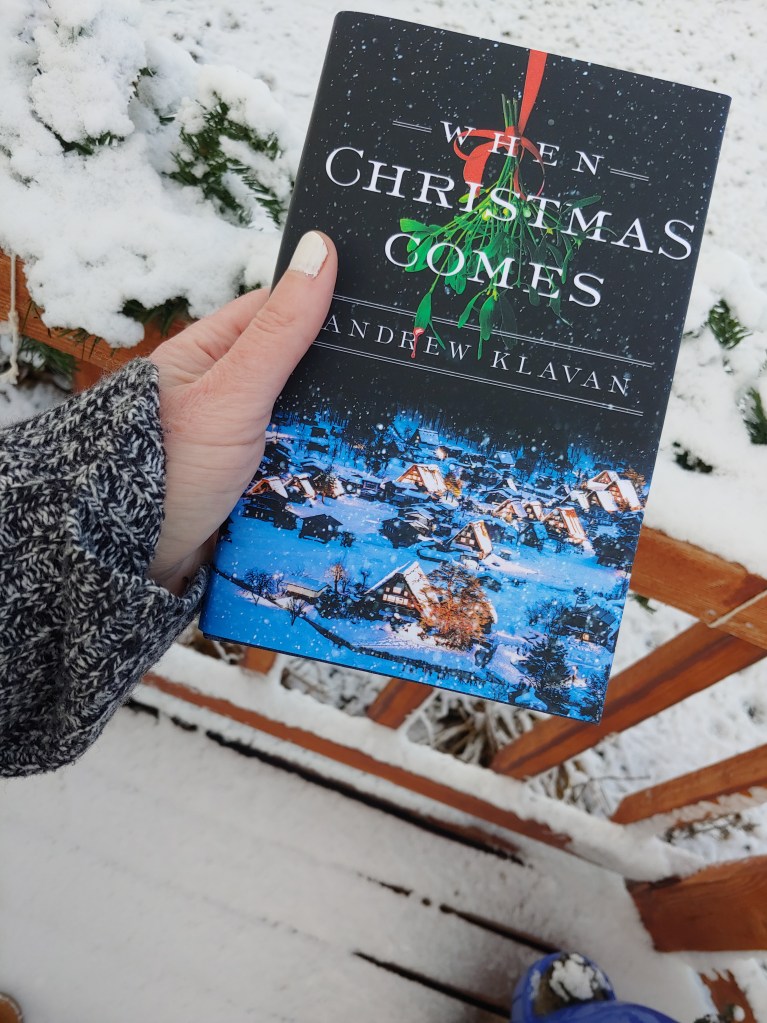
Andrew Klavan brought this novel out in time for Christmas. I got it for a loved one, and of course I had to pre-read it.
The first thing I noticed was the texture. The jacket, and the book cover beneath it, both have a unique velvety feel that makes you want to pet them. I refrained from petting, and in fact tried to touch the book as little as possible. It is supposed to be a gift, after all.
On to the contents.
This is not the best Andrew Klavan novel I’ve read, but it is still very professional … and very Christmassy.
Klavan introduces a new sleuth, Cameron Winter: handsome, lonely, etc., etc., with a tragic back story that is only partly revealed in this book. Winter is a former (spy?), now an English Lit professor. Is Klavan trying to push the buttons on the female reading population or what? On the plus side, it does allow him to put in as many literary references as he wants, without straining credibility. I also learned some new words, like “homunculus.”
I get the impression Klavan is planning to turn out a Winter series. Also, I might have heard him hint at something like this on air. He’s said that he never before invented a sleuth who seemed to have enough depth to carry a series, but now he thinks he has one.
Of course, Winter’s name makes for many thematic puns in this volume. It was a little hard for me to relate to Winter (too perfect?). He does have that intuitive, beneath-the-surface-of-the-mind method of solving crimes that I love because it’s similar to my own thought processes, and that some of Klavan’s other sleuths have also had. But it’s hard to believe of him, because the rest of him seems too Tortured Golden Boy. For example, one of Klavan’s other sleuths who had this intuitive method was a portly, aging, kindhearted private detective with vices. Lots and lots of vices. His shambling presence made his intuitive methods seem more believable, and also made his sharp mind gleam out like a bright jewel in a dark setting. Not so with Winter. But perhaps Winter will grow on me as the series progresses. Yes, I will give him at least one more book to do so.
I also think that I figured out the setting for this book! Sweet Haven is a little town surrounded by wooded hills, set near a large lake. It is within driving distance of the Big City, which is ALSO set near a large lake … which is, in turn, within driving distance of “the capitol,” which is where the university is where Winter teaches English Lit. At one point, Winter goes to Chicago, so Chicago must be sort of nearby but can’t be the Big City. Throughout the book, the skies are dull and grey, the temps are low, and there is plenty of snow, so we’re probably not in the South.
So, after getting about a quarter of the way through the book, I decided that it is set in Michigan. I think the Big City is Detroit. I pictured Sweet Haven set some way up the coast from Detroit, on the shores of Lake Huron. That would make the capitol Lansing. So naturally I assumed that Winter is a professor at MSU, and the MSU campus is where I pictured him going, including having the awesome fight scene in his tiny on-campus office. Setting this book in Michigan, and especially at MSU, will make it even more of a personal gift for its intended recipient.
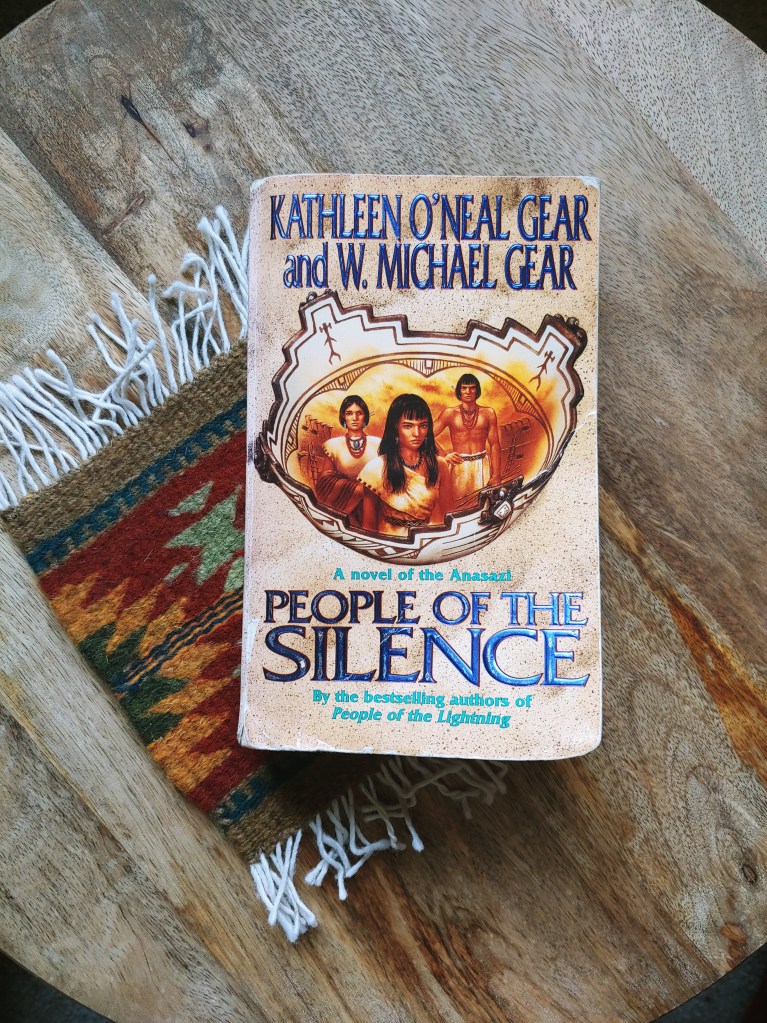
Husband-and-wife team W. Michael Gear and Kathleen O’Neal Gear write thoroughly researched novels about the different people groups living in North America in pre-Columbian times. This one, about the Anasazi or Pueblo Indian ancestors, is actually set in about 1150 A.D. This culture is “prehistoric” only in the sense that we don’t have a formal, written record of everything that went down, although there is plenty of archaeological evidence and oral tradition.
A Ceremonial City
This book comes with three maps. (I love me some maps!) The first shows North America with the general locations of the people groups who will come into play in the novel: “The Tower Builders,” “The Straight Path People,” the Mogollon, and the Hohokam. A second shows the Four Corners region, including Mesa Verde and Chaco Canyon, New Mexico, where most of the action in this book takes place, including the Great South Road built by the Anasazi and the Straight Path People’s names for all the surrounding features. I flipped back to this map many times throughout the course of the book. A third map shows a closeup of Chaco Canyon, or as the characters call it, Straight Path Wash. It shows the locations of the towns there. These can still be seen today, but the authors have given them names that the ancient Pueblo Indians might have used, such as Talon Town, Starburst Town, etc.
Talon Town (the book’s name for what is now called Pueblo Bonito in Chaco Canyon) is the capital of the Straight Path people’s civilization. It is occupied by their priest/king, the Blessed Sun; his wife, the nation’s Matron; a seer, the Sunwatcher; the nation’s War Chief; a number of warriors; and numerous slaves, mostly people captured from neighboring groups such as the Hohokam, who are there to serve these aristocrats. Talon Town produces almost no goods of its own. Food, clothing, blankets, shells, turquoise, etc. are brought in as tribute from surrounding villages over quite a wide area, or are obtained through trade. This is what the archaeological record seems to show us.
Talon Town has two large plazas, each with a kiva in it, so that it can host religious gatherings such as solstice ceremonies and funerals for important people. Here is the authors’ description of what it might have looked like inside one of the Great Kivas as a young apprentice prepares the Blessed Sun’s body for burial:
Thlatsina [=kachina] masks hung over the small wall crypts, glittering with precious stones. Thirty-six in all, they wore brilliantly colored headdresses of blue, yellow, red, and deep black feathers. Tufts of pure white eagle down crowned many masks. Neck ruffs of buffalo, badger, rabbit, and other hides gave the appearance of beards. But Poor Singer’s eyes lingered on the sharp fangs and polished beaks that glinted in the fire’s amber glow.
The circular kiva stretched at least a hundred hands across, supported by four red masonry pillars and encircled by three bench levels. Each bench had its own sacred color, yellow, red, and blue topped by white walls.
Another body rested on the opposite foot drum, covered completely by a beautiful Death Blanket. Poor Singer couldn’t guess who it might be.
People of the Silence, p. 416
Now, the Plot
Here is the review of People of the Silence I posted on Goodreads a month ago.
Some historical novels or speculative novels set in ancient times seem to cut-and-paste modern concerns onto those supposedly ancient characters. The Gears definitely don’t do that. That is one of my top concerns in historical fiction, so props to them.
It did take me a looong time to finish this. The novel starts with a steep climb through a lot of info dumps about Anasazi cosmology, including an extended vision that happens to a young man whom we haven’t gotten to know yet. All during the vision, I kept trying to figure out what the different elements in the vision represented in the cosmological scheme that had just been presented. Later, it turned out that we weren’t supposed to totally understand the vision at the time, and it would be revealed later. Perhaps, if I had read any other books by the Gears, I would have realized this sooner, but as this was my first one, I didn’t at first have that confidence.
The steep climb continues, as we are introduced to a large cast of characters. For about the first half of the novel, it wasn’t clear to me which characters, if any, I was supposed to sympathize with. In the book, the Anasazi have a brutal caste system based on “First People” and “Made People,” and slaves captured in raids on other tribes. Some of the First People later turn out to be sympathetic characters, but you don’t find that out until about halfway through the novel. Also, some characters who are supposed to be sympathetic are seen committing atrocities when we first meet them. Eventually it becomes clear that this is a very brutal society, and the prevalence and unavoidability of violence is part of the point of the novel; but again, the violence does make it hard to figure out who we are meant be to rooting for.
After the steep climb, which lasts about half the novel, we have a long plateau (a mesa top, if you will) where we are getting to know the characters and the intricate machinations taking place in their dying society. Wheels within wheels! The whole novel also includes a lot of beautiful, lyrical descriptions of the Four Corners landscape. The Gears do a great job giving you a sense of what time of day it is, what the weather and background look like, and details of what people are eating and wearing, and how they are wearing their hair. Almost every dialogue tag comes with a one-sentence description of what the character looks like at the moment (e.g. “Her greying black hair had come loose around her beautiful triangular face, which was covered in smears of reddish dust”). Stephen King would hate this, but I don’t mind it. It helps you keep track of the different characters by forming mental images of them, and it gives that much-coveted visual glimpse into what the Anasazi looked like. (For example, they dressed in bright colors, and their royalty decorated themselves with copper bells and macaw feathers.)
Finally, having scaled and then trekked across the mesa, once you are comfortable in the world and familiar with all the power dynamics, the last hundred or so pages take you on a mad, roller-coaster rush down the other side, as secrets are revealed, violence explodes, and desperate, last-minute measures are tried. This book even turned out to be a rather creepy murder mystery, with an unexpected but satisfying reveal of the murderer.
After the novel, there is an extensive bibliography of all the archaeological and anthropological sources the Gears consulted.
If you liked my book The Long Guest, you will probably like People of the Silence, and vice versa.
Left to right: Broken Top, South Sister, North Sister
There is a trio of mountains in Oregon called the Three Sisters. In fact, the town of Sisters, OR, is named for them. In this picture, you can only see two of the them (the third is hiding behind).
I use this picture for my illustration because, while there is a lot of great art portraying the Three Fates, it’s a little hard to find a picture that I can use without copyright infringement.
I recently read, with my kids, The Black Cauldron. My imagination was captured by the three swamp-dwelling little old ladies (if human?) who guard the Cauldron: Orddu, Orwen, and Orgoch. As far as I can tell, Lloyd Alexander made up these ladies and imported them into his story. Though triple goddesses are a recurring feature in Celtic mythology, they are not really the same as the three fates and it’s even a falsehood that they always came in the form of maiden, mother, and crone, as you will see if you read the scathing 1-star reviews of the book The White Goddess by Robert Graves.
The Greek fates are named Clotho, Lachesis, and Atropos. Clotho spins the thread of a mortal’s life, Lachesis measures out its predetermined length, and Atropos cuts it. Norse cosmology also has fates, called the Norns … in some versions three, named Past, Present and Future; in some versions a large but unknown number, according to this article. Evidently the idea of fate personified as three or more women (or woman-like beings) goes way back in Indo-European cosmology. It shows up as late as Macbeth’s three witches.
I had ignored the Fates for some time (as one does); but reading The Black Cauldron made me wonder whether you can write a fantasy that draws on Indo-European cosmology and not at least tip your hat to them.
By their very nature, the Fates are creepy. Lloyd Alexander does a great job of making this feeling come through when he introduces Orddu, Orwen, and Orgoch. The heroes of the book, on first seeing the fates’ house (and by the way, the word ‘fates’ is not used), think it is abandoned because it looks so run-down and blends so well into the swamp shrubberies. There’s a loom set up inside the house, on which is a tangled mess of a weaving. (Don’t touch!) Then the ladies show up. Rather like Tom Bombadil in The Lord of the Rings, they seem cavalier about things that ordinary people regard as matters of life and death. Orddu keeps offering to turn the travelers into toads (“You’ll grow to like it”). Orgoch is excited about this because if they were toads, it’s implied she could eat them. Orgoch, the only one of the three who is clad in a black cowl, seems to want to eat everything. As Orddu says, “It’s hard to keep pets with Orgoch around.”
The three ladies light up when they hear that the travelers know Dallben, who it transpires they discovered as a foundling and raised. They refer to him as “little Dallben.” (Dallben is over 300 years old.)
The travelers stay the night in an outbuilding belonging to the three ladies. Taran, the main character, wakes up in the middle of the night and sneaks up to the window of the dilapidated cottage, which is now alight. He returns, reporting, “They’re not the same ones!” Orwen, Orddu and Orgoch now look young and beautiful, and they spend all night working on their weaving. The next morning, however, they appear looking just as they did before, and with the same apparent disregard for human life.
Lloyd Alexander has set a really high bar with this fictional, Welsh version of the fates, and I’m not even sure I could approach it. Here is an article that dives more deeply into an analysis of the fates and of all of Prydain, the fantasy world in which the book is set. Be warned, the article assumes you are familiar with the whole series.





 Out of Babel Books