First, the basics: wallet, lip gloss and lipstick, reading glasses, key fob with a little Minnetonka moccasin.
Now, the walking pharmacy: Two kinds of Aleve, two kinds of Claritin, Tums I forgot I had, Kleenex, dental floss picks, hand lotion, and a loose lipstick that is probably twenty years old, but I can’t bring myself to throw away. The Claritin is generally for my kids, not me.
Finally … air fresheners from the oil change place, Band-Aids and antibiotic ointment, tabs for when I simply must flag a passage in a book, business cards in case I need to give one out, and, oh, look! A pair of earrings that needs to go back to my jewelry box.
No, I don’t carry a brush. I have curly hair. One does not brush curly hair; the results are unfortunate.
I occasionally carry a comb in case one of my sons needs it, but they are getting older and starting to comb their own hair before they leave the house.
Other things that might, from time to time, get thrown on top of these: a hand-knitted hat or bonnet, a hair band, clip, or pin that I have taken off, a book that I want to have with me. And of course, the phone.
In the only episode of Black Mirror that I ever watched (“Nosedive “), everyone can rate their interactions with everyone else on a scale of one to five, using an ocular implant that shows them a screen in their field of vision. Citizens’ jobs, housing opportunities, and so forth all depend directly on their composite rating. Of course this episode portrayed a dystopia, and I have no wish to live there. But this week, for the first time, I found myself wishing I could give strangers “five stars” from a distance, just to boost their morale. You know, what the old-timers used to call a compliment, but without the human interaction that makes it weird.
I guess this post will have to do. So, if you were at Silverwood amusement park in mid-June, know that I gave you five stars.
First, to all the beautiful young ladies in bikinis, short jean shorts, and summer dresses. You are lovely. Five stars.
Then, to all the deeply tanned grannies and the middle-aged ladies wearing racerback swimsuits. To the slender elderly ladies in linen pants and hiking shoes, and to the tough-looking older woman with the very short haircut. I want to be you. Five stars.
To the, possibly Mennonite, girls doing the park in long braids and even longer jean skirts, I love your outfits. I love your outfit, woman with a blue polka dot tiered skirt that echoed the shape of your short, pink-tipped ringlets. Five stars.
Now, about hair. I award five stars to all the ladies wearing intricate braids, hippy braids, or beachy buns. Five stars to the lady with the glossy black curls up in a high bun, and to the girl with touseled, Molly-Ringwald style short bob. Skinny girl with amazing natural hair who looks like Zendaya — five stars to you for keeping your hair in that condition. Redheads, young and old, I love your color. I love your hair, chubby American Indian kid with a true-black ponytail so long you can sit on it. Sikh family, your daughter’s forehead bun is awesome. Five stars.
People with tattoos, two stars. Some of you look cool.
Hairy guy with the nipple piercings … um, three stars. Ouch.
I love you, grandpa with the huge smile riding the scooter. Family applying sunscreen to your developmentally delayed adult son, five stars. He is adorable, because you are taking such good care of him. Five stars to your sweet-faced baby passed out in your arms, and to your excited baby with the very expressive feet. And even five stars to the baby who had HAD ENOUGH on the train ride. I hope you got cooled down or whatever you needed.
Five stars to your curly-headed toddler, and to your toddler in a life vest holding your hand. Five stars to the adorable couple where he was big and freckled, and she was slight, sweet, tanned, and Asian. And to the couple where he was big and dark and had dred locs, and she was short and pale and ginger. Five stars to the pregnant woman in a swim suit who looked like the Mona Lisa.
Five stars to mothers and daughters who look exactly alike, especially those who walk through the park holding hands. Five stars to the cool, bespectacled brunette who sold us tickets to the barbeque tent. And five stars to the tanned and muscled guy with his baby on his shoulders, who was dancing to the classic rock played over the speaker system.
And let’s not forget the beards. The guy with the white, squared-off, excuse-me-miss-my-eyes-are-up-here beard gets five stars. So does the guy who looks like he got up that morning as a starved mountain man, took a bath, and put on a T-shirt and some Bermuda shorts.
The following article appeared in my local hometown newspaper a few weeks ago. It has everything you could possibly want in a bear story:
Recently a local family had the experience of finding a bear in the woods. Those woods happened to be on the [redacted] property four miles north of [town name]. Apparently she sniffed out the bee hives near the [family name] place and found herself in the trees.
After observing the trails cams, [the family] found her among the trees sitting on the ground and called Fish and Game to come take her to a safe place so she would not be killed. The Fish and Game were able to dart her as she was sitting on the ground. She apparently was not aggressive and seemed content where she was.
They said according to the biologist she was an older black bear by the wear on her teeth. They thought at first she may have been a grizzly cub because of her unusual blond coloring … The biologist was also excited about the coloring of her fur because it was so blonde, being a black bear.
The Fish and Game have no idea where she may have come from, but speculated over by Sun Valley, and it is not uncommon to have bears on the desert when the water becomes scarce in the mountains.
The bear was tranquilized and put in a transport cage and taken away, but not before everyone involved had a photo-op with the “sleeping bear.” The bear was transported to the Bear Lake area.
Our hometown paper, vol. 27
Really, I can’t add anything to this. The last line says it all.
We’ve all heard the urban legends about someone’s hair turning grey or white overnight as a result of an intensely stressful event. I’m still looking for any documentation about this … or any scientific explanation of how it could happen. But I’ve heard enough anecdotal stories that I actually put this phenomenon into The Long Guest.
This article won’t tell you about that … but it does confirm that hair changes back and forth in response to your psychological state, as it grows slowly out of your head.
Please share in the comments if you have witnessed someone’s hair turning grey overnight … either from personal experience, or at one remove.
This is my second post about non-stereotypical hair. See my first one here.
If I were to ask you to draw an Ancient Egyptian, you would probably draw someone with gold, reddish, or dark skin, long dark eyes, and black hair. Red hair would probably not appear in your drawing. However, there has been a red-haired strain in Egyptian genetics apparently from time immemorial.
Ramses II, 90 years old when he died, was tall, thin, and by the time of his death he was stooped and had a tooth abscess. He also had red-gold hair. “Specialists who examined the strands under a microscope found that it had been dyed with henna and in all likelihood had been auburn in Ramses’ youth” (Time-Life, p. 153). Tall, thin, red-haired and hook-nosed, Ramses II does not match my mental picture of a typical Egyptian.
But he is not the only one. A number of red-haired Egyptian mummies have been found. Archaeologists used to assume that the hair was once dark and had been bleached out by the embalming process. But a recent study treated hair samples with the natron salts similar to those the Egyptians used, and found that the process did not change the color of the hair. Apparently these were actually redheads.
When I was taught Egyptian mythology in school, I was told that Seth, the villain of the story of Isis and Osiris, was red-haired. He was also Osiris’ brother. I found this intriguing, and it reminded me of the Semitic story of Jacob and Esau, who were twins one of whom was a dark-haired (?), “smooth” man, and one of whom was “hairy” and “red.”
Now I find out that Seth, as his legend later developed, was a trickster god, usually portrayed as a composite of different animals, with red hair or fur. Also, red was a symbolic color that could represent vitality or anger (no surprise there). So it’s possible that Seth was an entirely invented character and that his unusual hair color was picked to match his personality and symbolism. But, since this is an ancient origin myth, I can’t shake the possibility that there once was actually a founding pair of brothers, one of whom was dark-haired and one of whom was red. (Also, shades of the original Thor, a quick-tempered, red-haired, trickster god!)
If Red Hair is Native to Egypt, Does This Mean that Ancient Egyptians were Indo-Europeans?
No.
It just means that, as for most people groups worldwide, their genetics were more complex than the layperson would first imagine.
The ethnicity of the ancient Egyptians has been a hugely contested topic. Their civilization is so intriguing that everyone wants to claim them. Eurocentrists have tried to claim that the Egyptians were actually “Mediterranean” (specifically the Hellenistic, European-style Mediterranean), because this supports their dogma that Europeans have been the only source of civilization and there has never been a high civilization to come out of Africa. Afrocentrists have countered by claiming the ancient Egyptians were not only not white, but were truly black, the ancestors of the modern-day sub-Saharan Africans. The world’s first high civilizations were African, and everyone else has stolen their ideas!
Both groups are wrong about the ethnicity of the ancient Egyptians. Genetic studies of mummies are difficult to do, and this is truer the older the mummies are, but so far, they have concluded that Egyptians have more or less always been … Egyptian. Uniquely themselves, more closely related to the peoples of the Levant than to any others, and genetically, more or less just like the Egyptians of today.
Also, Could We Stop the Tug-of-War?
And may I just add, this is stupid, human race? Could we please (and when I say we, I mean you, human race) stop all this “I started civilization” “No, I did”?
First of all, Egypt was not the world’s first civilization. Contemporary with them, we have the Sumerians, who though they did not live in Africa were probably also black, and the little-known Balkan civilization that gave us the Vinca signs. And there are good indications that many civilizations existed just as advanced as, and prior to, these. See all my posts about The Lost Civilizations of the Stone Age by Richard Rudgley.
The Afrocentrists are closer to being right than the Eurocentrists. Arthur C. Custance makes the case,
One does not think of Africa as particularly inventive. As a matter of fact, however, so many new things came from that great continent during Roman times that they had a proverb, “Ex Africa semper aliquid,” which freely translated means, “There is always something new coming out of Africa.”
It is true to say that whatever inventiveness [Indo-Europeans] have shown in the past three or four centuries has almost always resulted from stimulation from non-Indo-Europeans. Our chief glory has been the ability to improve upon and perfect the inventions of others, often to such an extent that they appear to be original developments … [I]t does not seem proper to call a people “inventive” who once in a while do invent something, but who 99% of the time merely adapt the inventions of others to new ends.
Custance, Noah’s Three Sons, pp. 199, 215
That said, the idea that any one nationality can claim to have founded civilization is … stupid, human race. Human beings are really smart and civilization springs up wherever they go. Lots of people have invented civilization, many times.
(Furthermore, even if your ancestors did build the Parthenon or the Pyramids or Notre Dame, you didn’t build them personally, did you? Do you really want to start taking credit for amazing stuff that people who share your genetics did 3,000 years ago? Are you also going to take credit for all the atrocities they committed? Human race, you are too smart for this stupid idea.)
Egyptian Red Hair Makes an Appearance in The Long Guest
Nimri, the anti-hero of my novel The Long Guest, is a Cushite, who per Genesis is related to “Egypt.” Mid-novel, after being separated from his own people and dragged off on a journey over the Asia steppes, he observes some red-haired Indo-Europeans.
When I first saw that redhaired fellow I was reminded of my relative Mizra. He had red –gold hair and bright burnished skin like my own – only even more ruddy, just a shade darker than his hair. He was tall and thin, with a long thin arrogant face. Between that and his unusual coloring, he was a very striking-looking man. He used to stalk around the architects’ complex like a very god … how we all admired him, and wanted to be like him! But no one could compare to Mizra.
The Long Guest, Chapter 13
The Hebrew word for Egypt is Mizraim, which is actually plural: “Egypts.” Rather than making Nimri’s relative’s name plural, I have simply called him Mizra.
Nimri never manages to tell anyone about Mizra, because he cannot yet communicate at this stage in the story. But I can tell you. In case you didn’t know, I’ll whisper it in your ear: Some Egyptians had red hair.
Custance, Arthur C. Noah’s Three Sons, The Doorway Papers series vol. 1, Zondervan, 1975. pp. 155 – 216 discuss “The [Technological] Inventiveness of the Hamitic Peoples.” Or you can read the chapter here.
Ramses II: Magnificence on the Nile, by the editors of Time-Life books, Time-Life Books, Alexandria, Virginia, 1993. p. 153 shows the red-gold hair on the mummy of Ramses II.
I am Dutch-American. What I got out of it was good bone structure, “Kraklen” cookies (sogood!), a fondness for black licorice, a few mild swear words such as swatakat (translation: “black cat”), curly hair (more on that later), and the phrase, “If you’re not Dutch, you’re not much.”
That last one is tongue-in-cheek, of course. After all, we are Dutch American. But if you look at history, it does neatly encapsulate the national attitude.
One Cheer for the Dutch
The Dutch had their national moment, as it were, during the seventeenth century (1600s). They provided a refuge of religious freedom for the Pilgrims, mostly because at that time the Dutch didn’t care about separatism nearly as much as King James did.
In North America, they set up a trading post at New Amsterdam (Manhattan Island), but made the mistake of fixing upon a feudal-style system where only Dutch West India Company members could own land, and their serfs were forbidden by law from leaving. This did not encourage growth, and the place struggled until the English conquered it, re-named it New York, and allowed English things like local control of government, free immigration and trade, and land ownership for everyone. After that it really took off, and … well, you see it today.
Meanwhile,
the Dutch East India Company was distinguishing itself in
Indonesia, where in order to ensure its own access to spices, it
would eventually become a harsh colonial power and rule for
centuries, until its grip was weakened by Japan (on-site) and Hitler
(back home).
While
in Indonesia, the Dutch did manage to get a monkey named after them.
The Indonesians called the proboscis monkey kera Belanda, i.e.
“Dutch monkey,” because of its big nose and reddish skin.
Photo by Pixabay on Pexels.com Good bone structure!
I
don’t think the Dutch sent their nicest people to Indonesia. Or to
Manhattan. But, during this same period, Holland did have some
amazing citizens. For example, they had Rembrandt.
“Rembrandt van Rijn was born in Leyden, Holland [the same city where the Pilgrims took refuge] in 1606. He was one of nine children and the son of a miller [and so they probably had a windmill!]. His family was Calvinist by faith … Rembrandt married Saskia, a Dutch woman whom he dearly loved. For a short period they enjoyed a life of happiness and prosperity and many were acclaiming him to be the greatest artist of the century. But Rembrandt never displayed an exalted opinion of himself… During the early years of success, he obtained a studio in the ghetto where he spent much of his time painting the impoverished people of Amsterdam. The ghetto was where he found his characters for biblical paintings, such as Abraham, Isaac, and many of the old prophets. Meanwhile, Saskia enjoyed the luxury that came with her husband’s success. Unfortunately, all this was short lived.
“They
would have two daughters who died during infancy. Then, there was
good news as they gave birth to a healthy son whom they named Titus.
Shortly thereafter, Saskia fell ill and died. Rembrandt was greatly
grieved by these family losses, and never remarried. It wasn’t long
after these tragedies that he had to declare bankruptcy, losing
everything he owned, including his great art collection. All that was
spared him were his paints and brushes. Then, one year before his own
death, the only remaining member of his family, Titus, died at the
age of 27.
“Truly Rembrandt was a man of sorrows. But none of his emotions or energy went for naught, as he continued to paint with all the fervor of his youth. During his deep moments of suffering, he would always revert back to doing paintings of Jesus Christ. These biblical stories were done more for his own satisfaction [than for sale], as there were over seventy biblical paintings in his possession just a few years before his death.” (God & the History of Art, pp. 65 – 68)
Rembrandt’s Self-Portraits
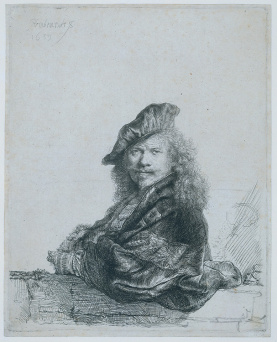
Rembrandt did approximately 100 self-portraits, which brings me to what this Dutch-American blogger has in common with him besides the national origin and, of course, the crazy talent. If you want to see a few of them (and they are delightful), follow this link to the Human Pages site.
Of course there are so many things to love about these portraits, especially the Impressionist-looking one where an aged Rembrandt is smiling at the camera. (That must have been fun to paint.) But one thing that struck me about them was the curly hair. Look at that curly hair! In the very young self-portrait, it shades his face in a hood of frizz. Perhaps he had just washed it.
I have hair of about the same texture. When treated well (i.e. not washed for while), it settles into loose curls. When treated poorly, it frizzes. I got this curly hair from my Dutch American grandfather. Never got to see it on his head, because he went bald before I was born, so I didn’t know what was coming. But the hair lives on in me and in several other members of my family. It wasn’t until I saw these self-portraits of Rembrandt that I realized these are genuine, trademark Dutch curls.
Every nationality has things to be ashamed of and things to be proud of. I am proud of Rembrandt (though I can’t take any credit for him), and I am happy to share, if nothing else, his hair.
Sources
DeMar,
Gary, et. al. Building a City on a Hill. American Vision,
Inc., 1997, rev. ed. 2005. Chapter 25: “New Netherland Becomes New
York,” p. 289 ff.
Stebbing,
Barry. God & the History of Art I, 2nd ed. How
Great Thou ART publications, 2001.