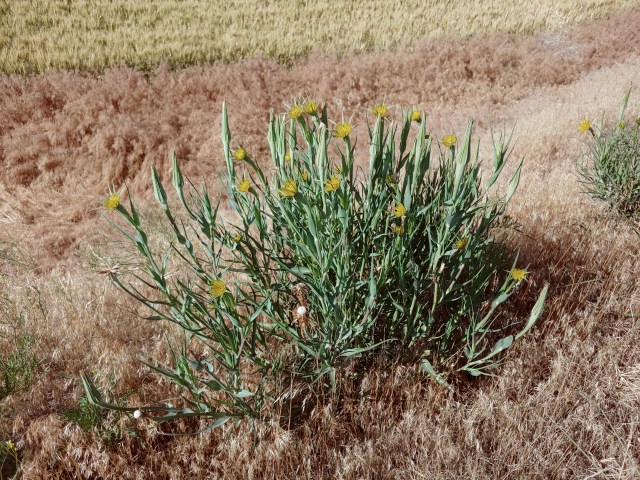
On my walks along the country lanes of Idaho, this wildflower is one of the most handsome and prominent. As you can see, it looks like a giant dandelion but with a more sculpted-looking stem. During the morning, the striking yellow flowers open and face the sun. Later in the day they close up into those very pointy-looking buds again. Eventually, they turn into large puffballs, like a dandelion but about three times as big.
Here is some growing in front of Silver Sage, which was our last featured wildflower.
Naturally I assumed these things must be native to the Intermountain West. They seem so at home here. But I could find them nowhere in my Central Rocky Mountain Wildflowers guidebook. So, after Googling things like “yellow chicory images” and “looks like a giant dandelion images,” I at last discovered … it’sYellow Salsify. Native to Eastern Europe, according to one web site. Yet another distinctive “Idaho” wildflower that is actually introduced! But look at how well it is getting on with that silver sage!
By the way, when I Googled “salsify” just now, I discovered that there is a purple variety and that the taproot is edible. This somewhat ameliorates my disappointment at finding out that it’s not a yellow variety of chicory as I had first hoped, and that there are, in fact, no yellow varieties of chicory. So, if you are into foraging, send me your salsify recipes!
The fam and I went on a hike. A steep hike. The mountainside looked barren from the valley below, but when we were in among it, we were passing through thickets of trees and meadows (near vertical meadows, mind you) of tall grasses. And wildflowers. So many wildflowers.
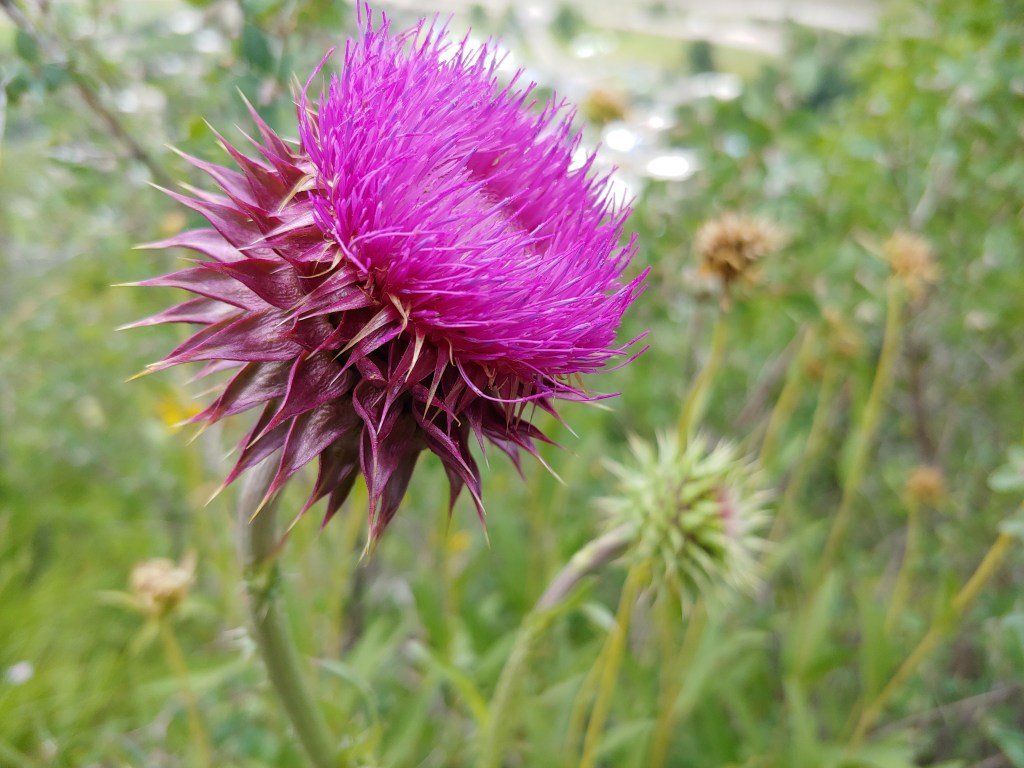
This is the only wildflower picture that actually came from that hike. Obviously some kind of thistle, though it does not appear in the guidebook.
Every one of them was very distinctive looking, as if a person who knew what they were about would be able to identify them at a glance. I realized it was a disgrace that I didn’t know any of their names. (OK, Indian Paintbrush, but that was it!)
Black Sheep (who has apparently dropped off the Internet!) was aiming to have a Big Year with bird watching. I am not up to that, but perhaps I can start watching wildflowers. At least they hold still!
Having bought and looked through the book, I now know at the very least that I saw Lupine. The others have fled my memory. But here are a few found around our house, with my best shots at identifying them.
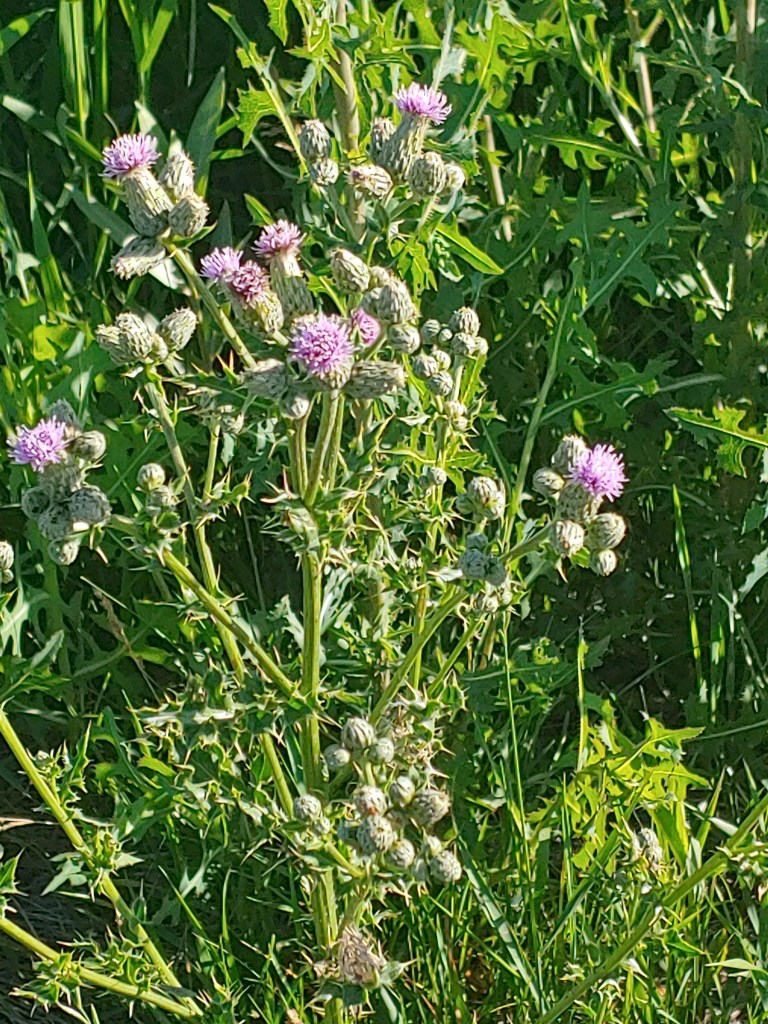
Wavy-Leaved Thistle. Much easier to find, but less spectacular, than the (thistle?) above.
Volunteer Yellow Columbine growing right in my flowerbed.
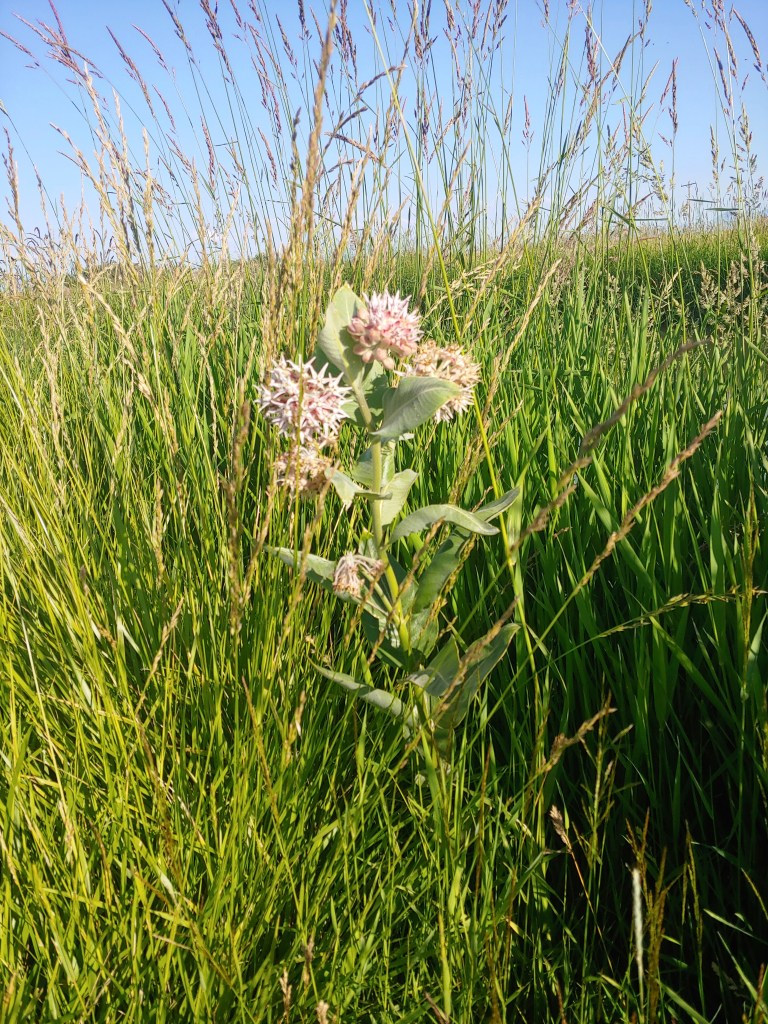
Showy Milkweed.
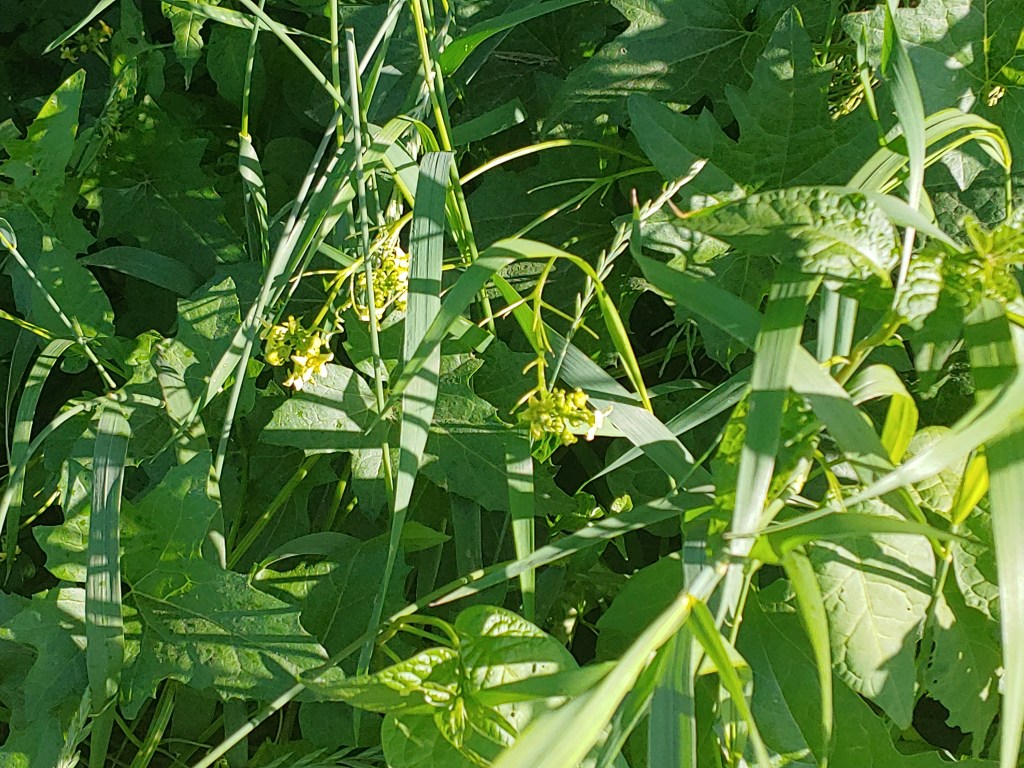
The things with yellow flowers are Leafy Spurge.
“This introduced noxious weed grows in disturbed soils along roadsides and fields. It is vigorously colonial, spreading laterally and forming dense communities, often excluding other plants. Twelve native species of spurges occur in the Pacific Northwest. Leafy spurges and other Euphorbias are known to be poisonous. Cattle and horses seem to be affected by the toxic properties of spurge more than sheep, which readily eat leafy spurge.” (page 133)
The hanging-down ones are Wild Lily of the Valley.
“This common native wildflower was named for its resemblance to the introduced garden lily of the valley flower … The garden plants have dangerously poisonous compounds that are purgative and have a digitalis-like effect on the heart … The native wild lily-of-the-valley has edible berries, although they are not very tasty, and eating too many will unleash their laxative properties. It is sometimes called starry Solomon’s seal.” (page 219)
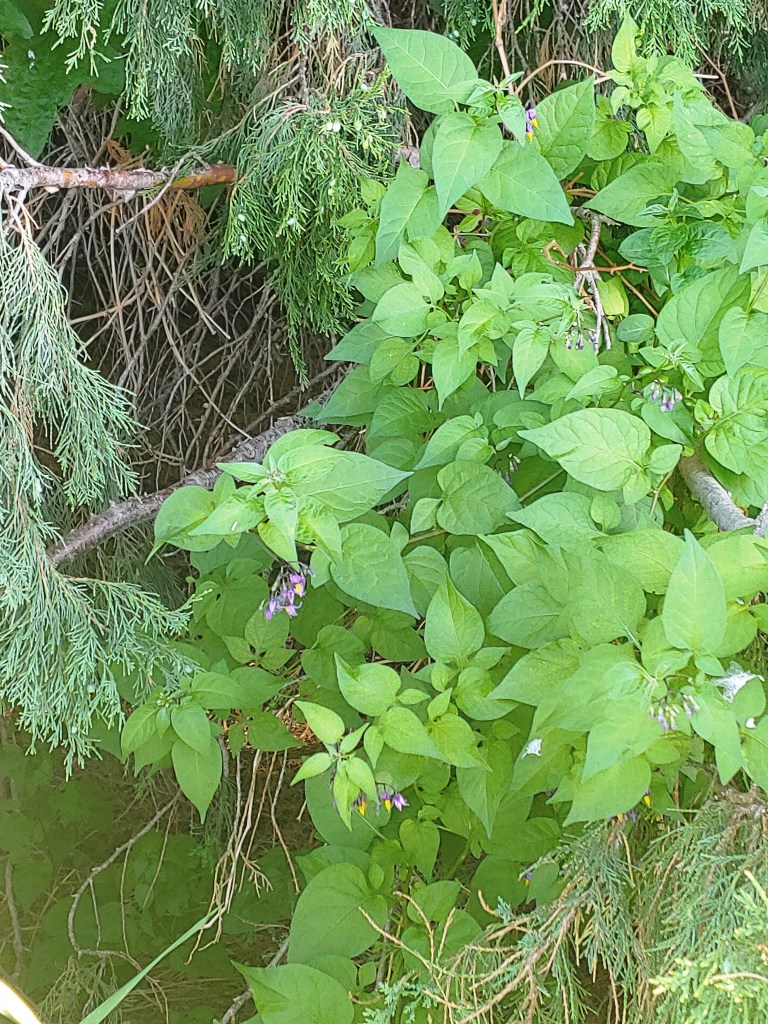
And, climbing on a juniper tree, Climbing Nightshade.
“Climbing nightshade is an introduced vine [in the Rockies] … The plants scramble over shrubs and other vegetation for support, sometimes robbing them of the light needed to survive. Solanum is one of the larger genera worldwide, but it is concentrated in tropical and subtropical America. It includes the common potato (!). Many species of Solanum contain poisonous alkaloids, and grazing of climbing nightshade foliage has caused livestock deaths. … The bright red berries of climbing nightshade are very attractive and tempting, but they are poisonous and should not be eaten.” (page 62)
This instance of climbing nightshade is on our neighbor’s juniper, but we also have it in our raspberry patch!
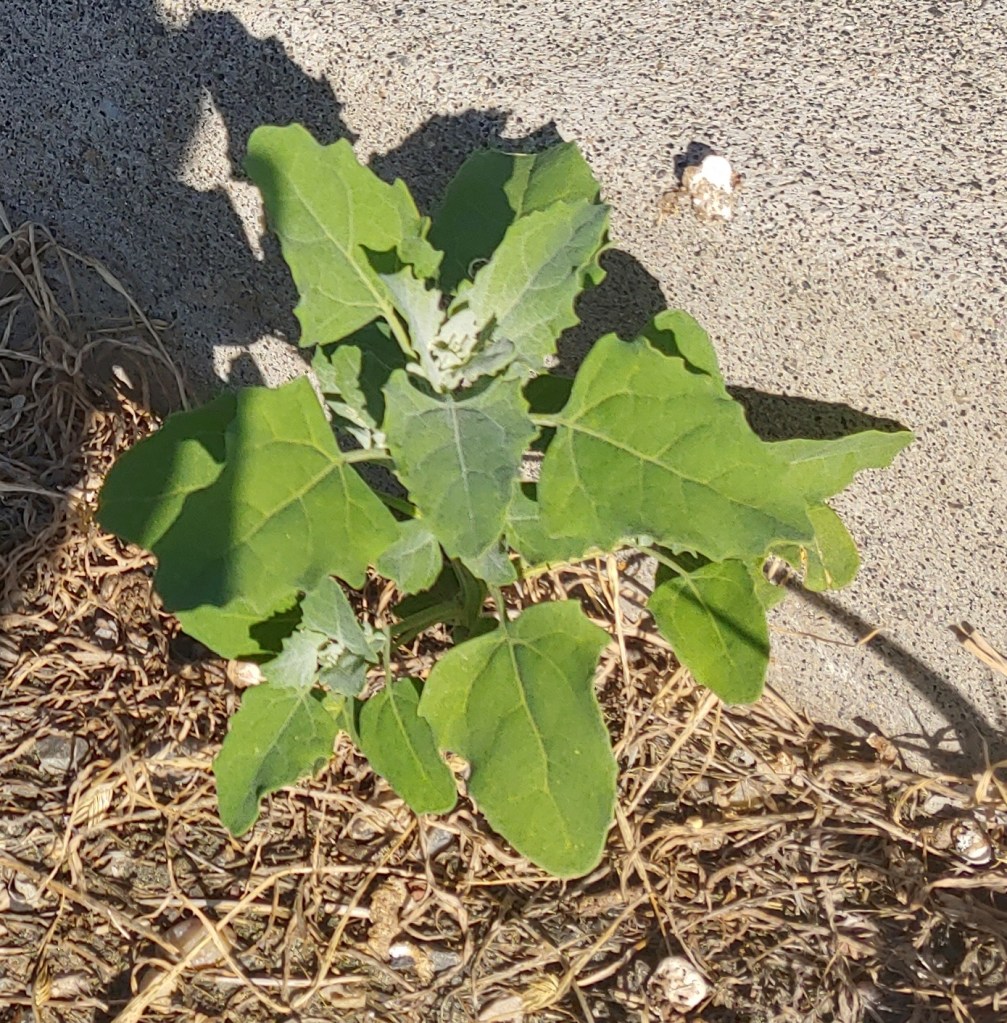
And, finally, an old friend …
Lamb’s Quarter. This isn’t in the guidebook, as far as I can tell, but I include it because is is one of my favorite weeds. Yes, it used to be my job to classify weeds for agriculture scientists and I always kind of liked Lamb’s Quarter because the silvery power hidden in the top of it was something I found romantic. I would imagine a group of adventurers (very tiny ones, of course) climbing to the top of one of these things and being surprised by what they found there.
This post is a tribute to Bookstooge’s post Lord Bookstooge versus the No-Internet, which is much funnier than this post is likely to get.
Well, hello, everyone! This weekend, while the world burned, the Neanderthal family in their remote location were going through something that was much less distressing and had fewer long-term implications, though it felt like a crisis at the time. It did result in Neanderthal woman having no access to her blog from Saturday through Tuesday.
On Saturday, Neanderthal woman spent a little time mixing fertilizer into her garden with a rudimentary digging stick. Then the Neanderthal family went on an arduous journey to a distant place. They returned right around the time of sunset. Rain clouds were ringed about their abode, but were only spitting a little and emitting bursts of wind which are not unusual in this particular Neanderthal family’s habitat.
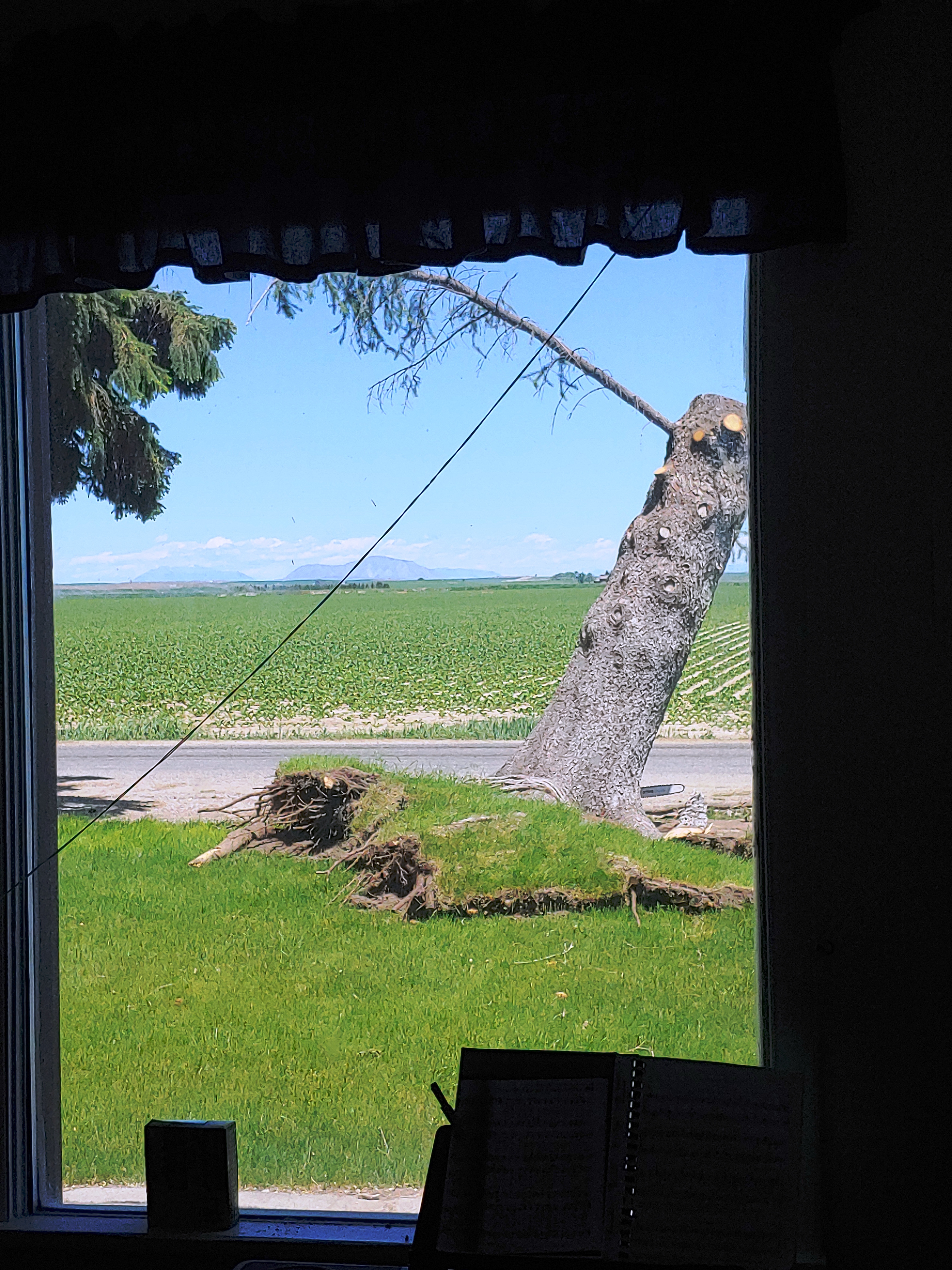
However, at some point the winds became very strong and the woman was forced to close the windows, which she had opened in order to air out the cave. It wasn’t until the torches went out and the Neanderthals glanced into the front yard, that they realized the winds had been very strong and had in fact blown down a spruce tree, completely blocking their road.
Neanderthal woman texted her cave landlords to inform them of this development. They immediately arrived and, using mysteriously advanced technology, cleared the spruce tree from the road. This took them until about midnight.
Meanwhile, the Neanderthal kids were quite freaked out. The Neanderthal woman spent the night comforting them as they huddled together.
It later turned out that the winds (called a “microburst”) had knocked down power poles for about a mile to the West of the cave. It would take some time, even with advanced technology, to restore the fire of the gods.
It also turned out that cave’s well is accessed by an electric pump, which meant that until the fire was restored, the cave would have no water. The Neanderthal family was forced to go back to the ways of their ancestors, hauling buckets of water from a nearby stream in order to flush toilets and brushing their teeth using water they had reserved in 2-liter bottles. They ate cold food, being unwilling to fire up the wood-burning stove. Unwashed dishes piled up, but this was not too different from ordinary life so the Neanderthal family hardly noticed it.
The Neanderthal children missed their Netflix and their online games, but they had fun playing at a friend’s house. Meanwhile, the bearers of advanced technology were working their high, Cro-Magnon-style foreheads off and by Monday night, the fire of the gods was restored. The Neanderthal family eagerly dived back into their highly electricity-dependent life, resolving from now on to store more than six liters of water in the basement.
This man, his wife, their 2-year-old and their 6-month-old baby survived a tornado that took their entire house … except the concrete room where they were sheltering … which room they had recently bought the house for.
They had been in the house with the safe room mere weeks.
The dad had been in the safe room 20 seconds before the tornado hit.
“I’m just going to let the insurance handle it and trust in the good Lord,” says Andrew Philips.
You may be a prepper, but you’ll never be a prepper like this guy.
“chicken noodle soup” using Ramen noodles and canned chicken
chocolate chip cookies (3 4 batches!)
almond strip cookies (1 batch so far)
pies: pumpkin, chocolate pudding, banana pudding
brownies
lemon poppyseed muffins
biscuits (No, not the things the British call biscuits. Those are cookies. I mean those things that are made with flour, shortening, and buttermilk) (Lost count of the number of batches I’ve made. Son keeps requesting them)
Do I detect a theme here? Sounds pretty carb-heavy, no? We even managed to run out of white sugar. But rest easy, because I also made …
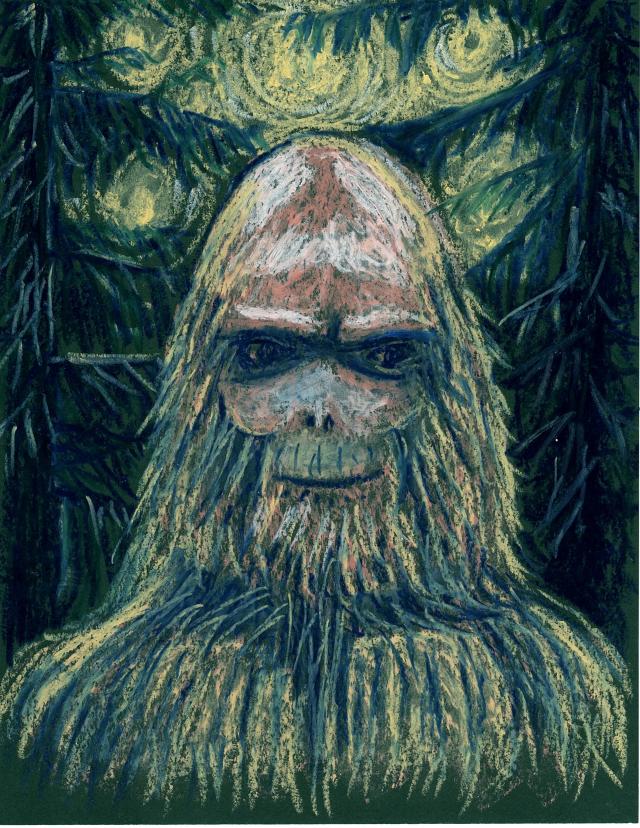
You all remember this pastel sketch of Sasquatch, which was inspired by Starry Night …
Note the evergreens, because Sasquatch lives in the Northwest. (And yes, I know that not every evergreen is a pine! There are spruces, hemlocks, etc.)
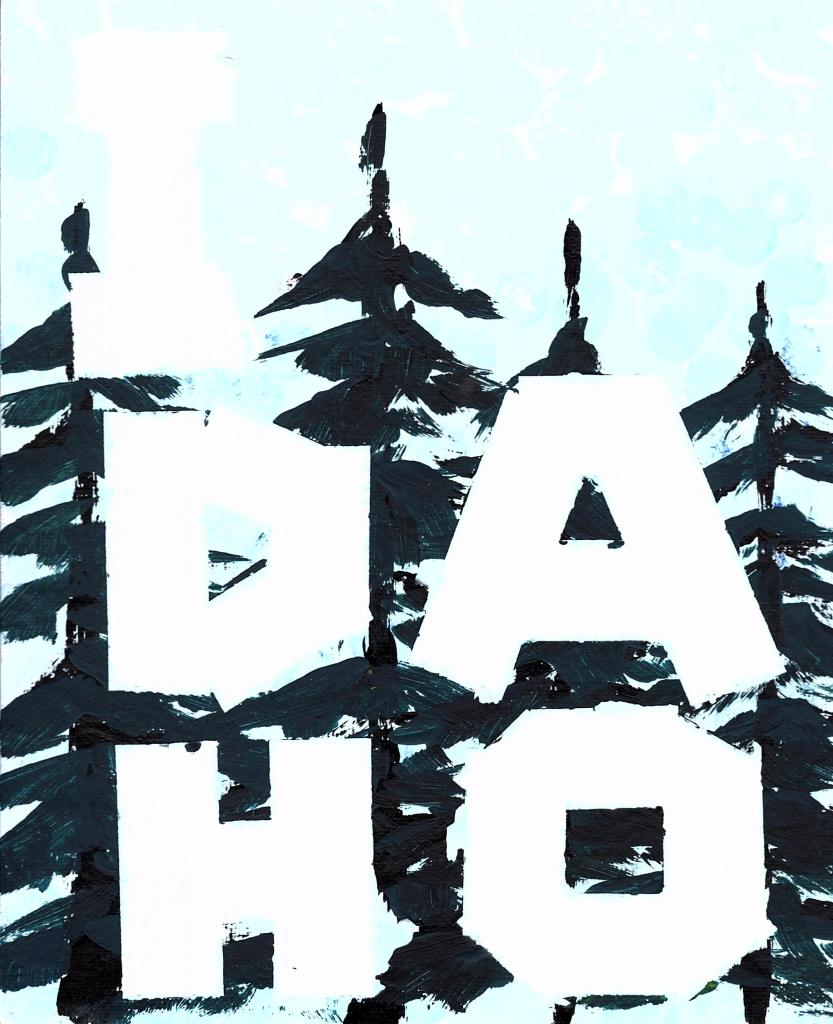
I just like adding conifers (maybe we should call them that) when it seems called for. They are easier to paint than deciduous trees, though harder and less advisable to hug.
When I did this quick sketch of a certain little boy, he posed for me indoors. But I decided to add some conifers and some golden light to make it look as if he was standing in a Northern paradise.
Come to Idaho! We have trees. Happy little trees.
Just call me Bob Ross.
Addendum:
What can I say? Curly hair and artistic talent just go together …
The topic below is complex and wide-ranging. Discussing it will require defining some terms, but also making some generalizations. I’ll do my best to honor the nuances of this topic, but it’s not going to be possible for me to cover every subtlety. So please bear with me, assume good intentions, and if I fail to make something sufficiently clear, we can discuss it in the comments.
Defining “Conservative”
This blog (much to my delight) has readers from around the world. That’s a problem for this post, because I will be using the social/political term “conservative,” which means different things in different countries. Because I am posting about attitudes in the United States, I will be using “conservative” in an American sense.
In most places (so I’m told), “conservative” roughly means aristocratic. Conservatives are assumed to be in favor of existing power structures, and that could include a class system or a monarchy.
American conservatism is a bit different because America, from its founding, was anti-royalist and in fact deeply suspicious of all governmental power. America was also populist relative to the rest of the world. Not that we didn’t have wealthy landowners, but one of our basic values was that anyone ought to be able to buy land and live virtually without interference from any kind of overlord. We also didn’t think there ought to be a national religion, and strove to set up barriers to keep governments from interfering with churches.
In other words, in the United States, the term “conservative” basically means those same values that in the 18th and 19th centuries were called “liberal.” This is why some American conservatives call themselves “classical liberals.”
Political conservatism, as I will be using the term, is the belief that national government is very limited in the range of its legitimate authority. It’s basically limited to law and order, national defense, and a few big public works projects such as national highways. Everything else, including religion, health care, commerce, and education, is outside its purview.
Social conservatism means a belief in what used to be called (before the term was mocked out of existence) “family values.” Social conservatives value clean living (no drugs or alcoholism) and traditional sexual morality (an emphasis on intact families and a disapproval of the sexual revolution of the 1960s). They also tend to value community structures such as churches, synagogues, and local clubs and organizations.
Social conservatives may or may not believe that laws are the way to promote all these good things they value. Increasingly, they are realizing that “politics is downstream of culture,” and that the way to promote all these good things is simply to live them.
I happen to be both politically and socially conservative, so I’ll be using the term to mean both. But you will occasionally meet people who are one but not the other. Libertarians, in particular, are often politically conservative but socially liberal. They believe government should be very limited, and this includes not outlawing alcohol, drugs, or any dangerous sexual behavior that does not rise to the level of assault.
OK, I hope that is clear enough to go forward.
Defining Bookish and Outdoorsy
I am bookish. Like many fellow book lovers, I started life socially awkward and found a refuge in fiction. I also have an academic bent. While fiction is my favorite, I enjoy reading just about anything (theology, psychology, philosophy, history, memoir … even popular-level science books, though I am somewhat retarded when it comes to science, especially the more esoteric theoretical stuff). I got this bookishness from my dad, who is a true egghead and reads four languages. Our house growing up was an extremely print-rich environment.
There are millions out there like me.
I am also a little bit outdoorsy. Not athletic, so I’m not a hard-core skier, rafter, or even hiker and camper. But I enjoy being out of doors. I like taking walks (another gift from my dad). In principle, if not perfectly in practice, I approve of living simply: gardening, keeping chickens, being frugal. Not keeping up with the Joneses. Some of this is forced on me by a low budget. OK, I admit it. I am kind of a tightwad. I got this from my Dutch mom, and it too is a gift.
Also millions of people like this out there.
Now, This Is Where It Gets Strange
According to the preponderance of American books, TV, and movies … people like me do not exist. You never, never see the possibility entertained that a person could be bookish, outdoorsy, and also conservative.
You will sometimes see rural conservatives portrayed who like to hunt and fish, but these people are not represented as educated or even, in some cases, literate.
When conservatives are portrayed who are not rednecks, they are typically shown as wealthy businesspeople or heirs and heiresses of the kind who might star in a soap opera. The men wear suits, the women get plastic surgery and wear a ton of makeup. They are less likely to go to the library and more likely to go to the mall or the spa. You would certainly never see them put on old clogs, a kerchief on their head, and go out to weed the garden.
But yet, in real life, I know quite a few conservatives who do just that. They are educated. They aren’t overly concerned with looking like Barbie or with getting a new outfit of clothes every season. They garden. They pinch pennies. They might not even own a TV (rarer these days). I was raised among people like this. Quite a few of them were farmers; others were academics.
Public libraries in the U.S. still haven’t gotten this memo. Based on the activities they offer, the things they post on their bulletin boards, and the types of books they feature prominently, it’s pretty clear that their assumption is, if you’re bookish enough and frugal enough to be coming to the library, you must be a leftist. By which I mean, you are probably in favor of a big, extremely involved “nanny state” style national government. You may be Marxist. You probably approve of the sexual revolution and all its fruits, including the LGBTQ revolution. You might be in to the New Age, but you certainly hate “organized religion” (because what educated person wouldn’t?).
Wendell Berry is a good example of this attitude. He’s a writer and a farmer. A few years ago somebody gave me a book of essays by him (because, hey, he’s a writer and a farmer!). He writes beautifully about farming, about the earth, about the relationship of people to the earth and the spiritual aspects of farming. And then he goes on to assume that his readers are leftists and would vote for leftist candidates.
One Partial Explanation
I’m sure there are plenty of reasons for this widespread assumption that people who are educated and fond of a simple lifestyle are leftist. As I said above, this post touches on several spheres, all of which are complex and can’t be discussed exhaustively. I’m just going to focus on one possible explanation: the conflation of capitalism with consumerism.
Capitalism, as I understand it, has two components. The first is private property. On a socialist or Marxist philosophy, nobody ought to own anything. Everything belongs to everybody, which in practice means everything belongs to the government and if you try to “hoard” something of your own they will take it. Capitalists, on the other hand, are big on private property. So, if you buy some land, it’s your land. If you buy or build a house, it’s your house. You can’t be forced to share or give your house or land to someone else, because it is yours. People tend to take better care of things when they own them. They tend to work harder at a job when they know that its fruits will not be capriciously taken from them.
The second component of capitalism is the free market. This just means that if I want to sell you (let’s take a really woodsy example) a cord of wood off my land, no third party is going to step in and say “You are charging too much” or “You have to give me a percentage of the sale” or “You don’t have a license to sell that.” If I agree to sell it and you agree to buy it, the wood and the money can change hands, and everybody’s happy.
Now, it should be clear from my explanation that neither of these principles has any quarrel with the simple life. Quite the opposite. Farming works better when private property rights exist. So do gardening, making art, selling your work, or building up a personal library.
However, in many people’s minds when they hear capitalism they immediately think of consumerism. They don’t think of private property and unregulated sales for the small farmer, shopkeeper, or artist. They think of huge corporations. They think of advertising, overspending, jockeying for social status by virtue of our possessions. They think of consumerism.
Hence, if they write a book that combats consumerism, such as a book about how to live a simple life, they assume that they must necessarily combat capitalism as well.
I would argue that these people have thrown the baby out with the bathwater. Consumerism is certainly one possible result of capitalism. But it’s really kind of a separate problem. Capitalism might make a consumerist culture possible (any other system prevents the kind of wealth that allows widespread consumerism), but if a culture is very consumerist, it’s really because of other cultural values that they hold. It’s not because somebody told them they could have private property. Private property and a free market, as I have shown, are just as a friendly to a simple, quiet lifestyle as they are to consumerism. And if we stamp out private property in an attempt to get rid of consumerism, we will end up getting rid of quite a few other things as well.
We Are Invisible to Each Other
It’s weird to me when people assume that the wealthy, consumerist lifestyle is characteristically conservative. I was raised by conservatives who lived a simple, bookish lifestyle. All the new clothes and cars, the plastic surgery, the materialist beliefs that I saw were coming from the people I saw in the movies and on TV, who were consumerist and leftist. I figured those two things went together. But apparently … not always. Apparently there were a bunch of leftists out there who were living simple, bookish lifestyles, but because they were not on TV I could not see them, just as they could not see me.
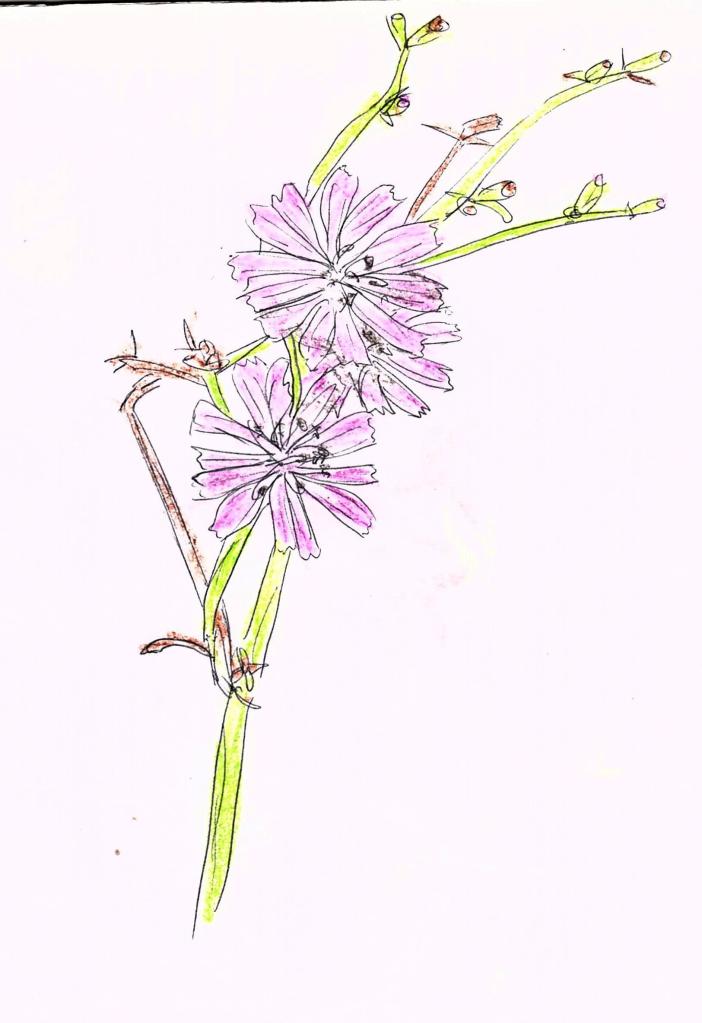
My own sketch of the wildflower chicory, done in pen and crayon
When I think about The End of the
World as We Know It, one thing I worry about is the availability of coffee.
I am sure this is a concern of
yours as well. Assuming that you get
through the Zombie Apocalypse, the EMP, the Rising Sea Levels, or whatever your
personal big fear is, and find yourself among a group of scrappy survivors, I
guarantee you some of them are going to want coffee. It might even become a hot commodity. Worth its weight in gold.
The Inspiration for this Project
The Change series is also known as the Emberverse series.
The project documented in this post
was inspired by S.M. Stirling’s The Change series. In the first book, Dies the Fire, the world of the 1990s is interrupted when all
electronics, engines, and gunpowder suddenly cease to function. At that point the series becomes alternate
history. The series migrates toward Game
of Thrones style fantasy the longer it goes on, but the first few books
especially are more in the post-apocalyptic genre, about people surviving and
starting to rebuild society in the Northwest and in Northern California. And once they get a steady food supply going,
their coffee substitute is “roasted, ground chicory roots.”
I could probably find chicory
coffee at a co-op type food store, but I want to try to make it myself. That’s the only way I can learn about the process
and find out if such a thing would be feasible.
Let’s go!
Lessons from the Chicory Experiment
Chicory is a wildflower that grows
all along the highways in our region at certain times of year. Though there is an abundant supply of it on
the medians, that’s not the safest place to gather it in this pre-apocalyptic world
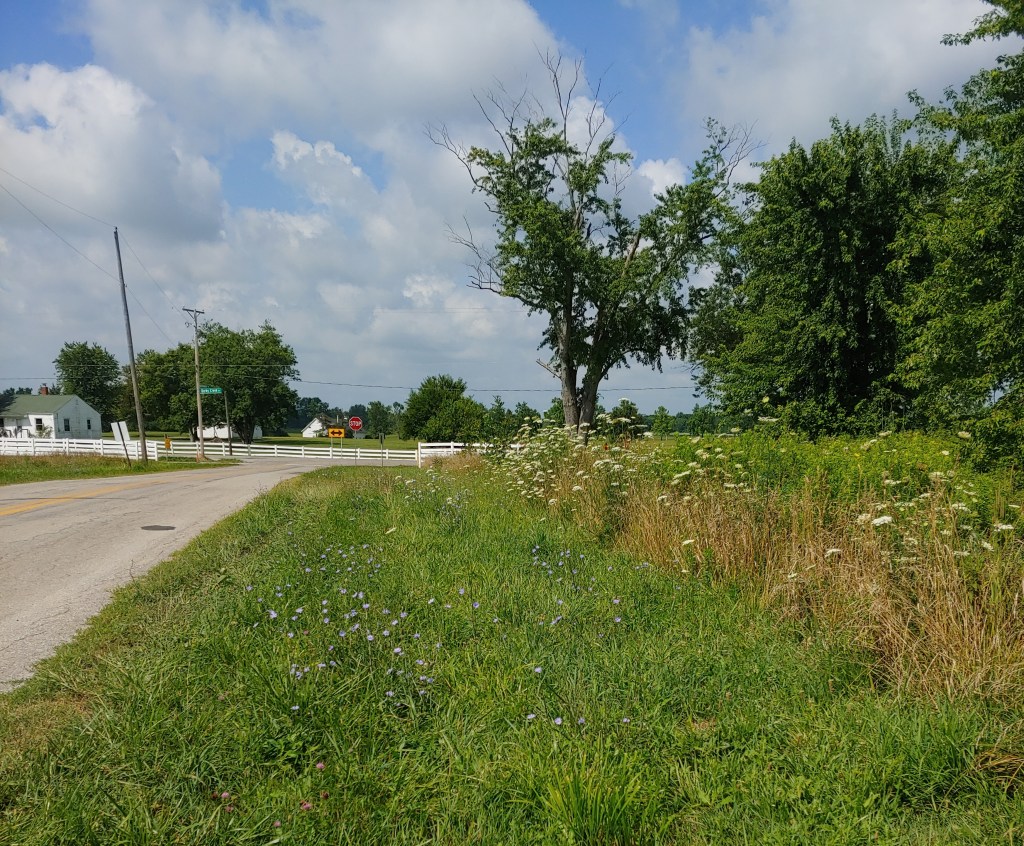
where vehicles of all kinds are still whizzing by. So I had to seek chicory on a back road. In this picture, the plants with lavender
colored flowers are chicory and the ones with white flowers are Queen Anne’s
Lace.
Today’s weather is very humid, and it’s so hot that there is a heat advisory. Also, it turns out that chicory grows surrounded by thistles and extremely sharp-bladed grass.
Lesson 1: Gather chicory in the early morning, before the day gets hot. Wear cowboy boots, not flip flops.
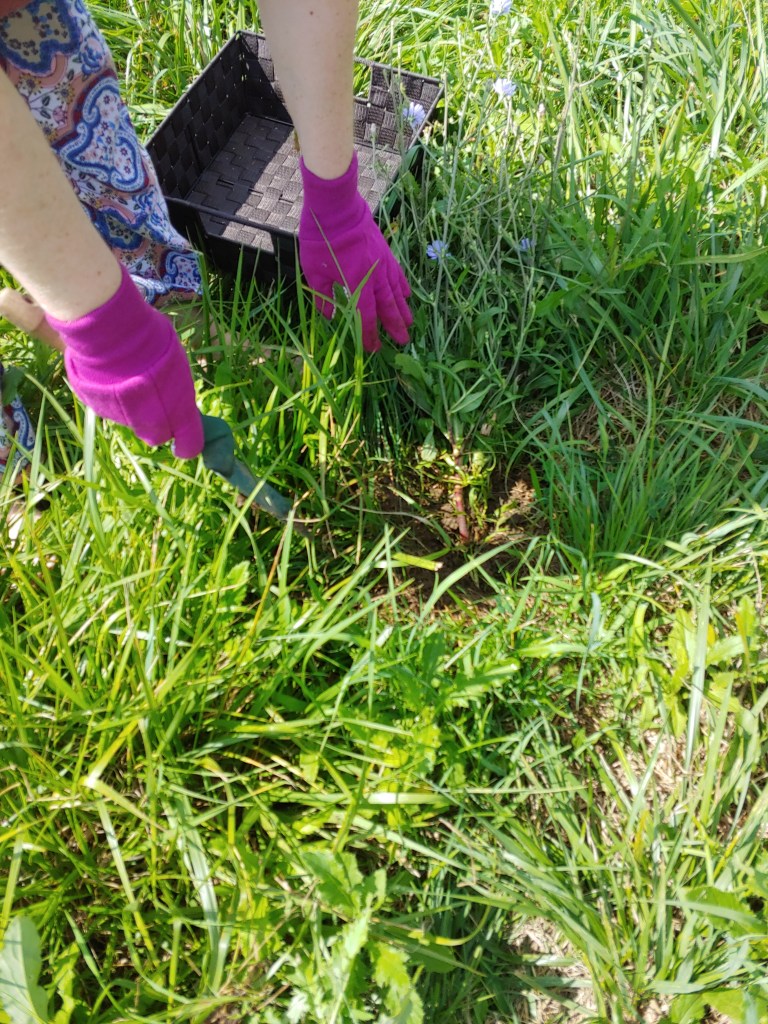
I assumed that chicory would have a
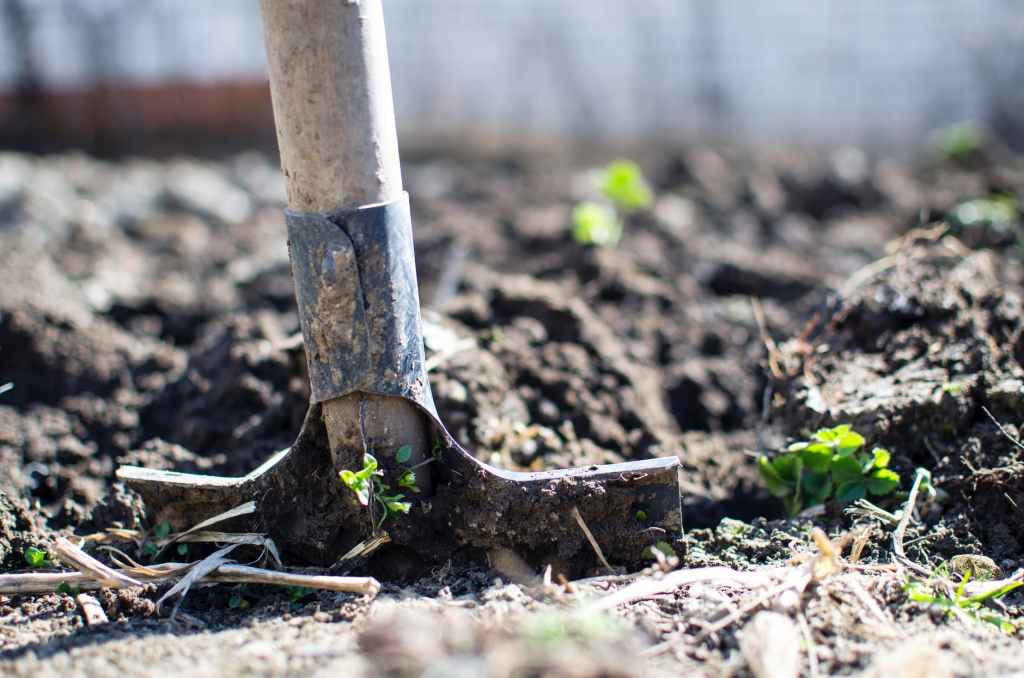
taproot similar to a dandelion’s, so I brought a small trowel. I couldn’t find my dandelion picking tool, so
I brought a large screwdriver, which is almost as good for digging down beside
the taproot to loosen the soil.
It turns out that chicory roots are similar to dandelion’s, but much larger, deeper, and woodier.
Lesson 2: I probably could have brought a regular garden shovel instead.
Here is the chicory I
gathered. I have no idea how much
“coffee” this quantity will make, but I’m hoping it will be enough for one
cup. Finding out is part of the purpose
of this experiment. I don’t have the
time or energy to dig more due to having come at the wrong time of day. Clearly, I have a lot to learn as a
hunter/gatherer.
Next step. Google the process just to make sure I don’t accidentally poison myself by skipping a step. (We won’t be able to Google stuff after the apocalypse, which is all the more reason to do it now.) The search takes me here. Hank Shaw is a “hunter, angler, gardener, forager, and cook” and he seems to know what he’s talking about. Uh-oh, he says you need to harvest chicory in the fall. But he seems to have harvested some in the summer with no ill effects. Onward.
Here are the roots after being washed. I need to cut them into thin slices, dry them for two or three days in the sunshine, and then roast them as directed. Cutting them yields mixed results. Some have a woody core so tough that I have to saw it, with dirt trapped between this core and the outer, soft layer. Others are softer, solid and cuttable all the way through, more like cutting a carrot. My guess is that Hank’s nice, plump “root chicory” is more like this.
Lesson 3: Wild chicory might not be the way to go. It might be smarter
to cultivate it.
My roots have yielded this measly tray of chicory slices. Following the expert, I sun them on the back of my vehicle. They dry out for a few hours, and then promptly get rained on. I sop them up with a paper towel and move the tray to our sun porch.
Lesson 4: Obvious.
After two days of drying on our sun porch, the chicory slices had visibly shrunk and felt dry. I put them in a 350 degree oven for about an hour and a half. During this time, the house filled with a curious warm malty smell, as predicted on Hank Shaw’s web site. This was reassuring, because it meant that I was in fact roasting the right kind of root. On the other hand, my family complained about the smell.
Lesson 5: There is going to be a lot of complaining around our house after the apocalypse. But I kind of knew that already.
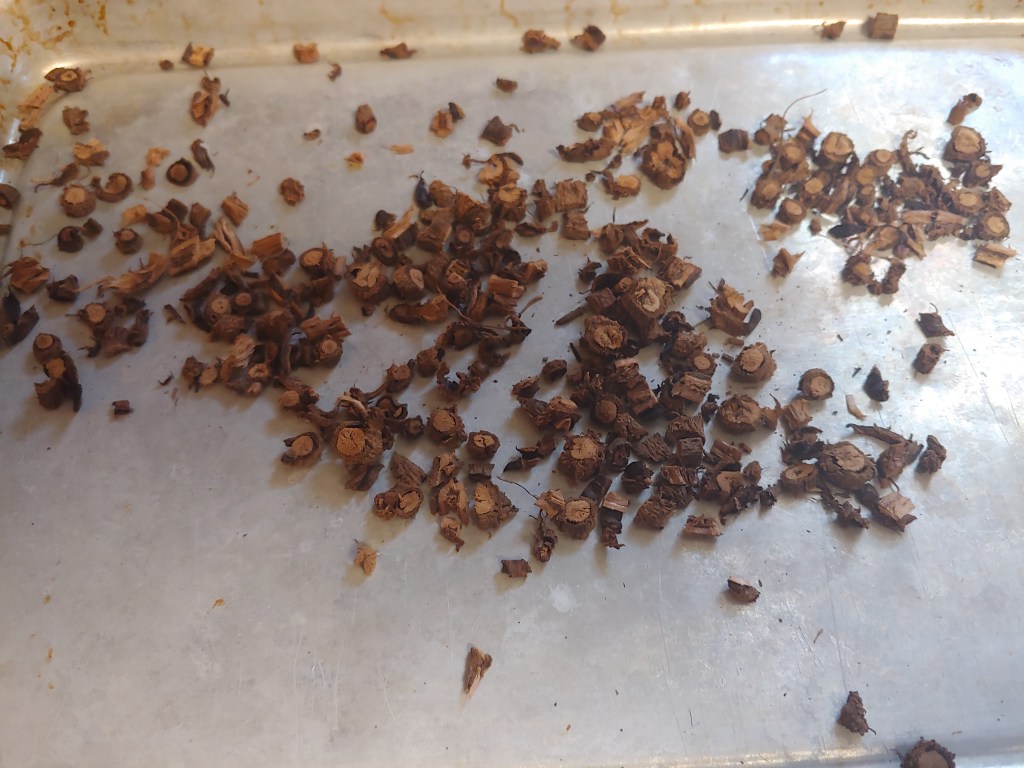
This is what the chicory roots
looked like after about 90 minutes. They
look done.
Next, I ground the chicory in a food processor …
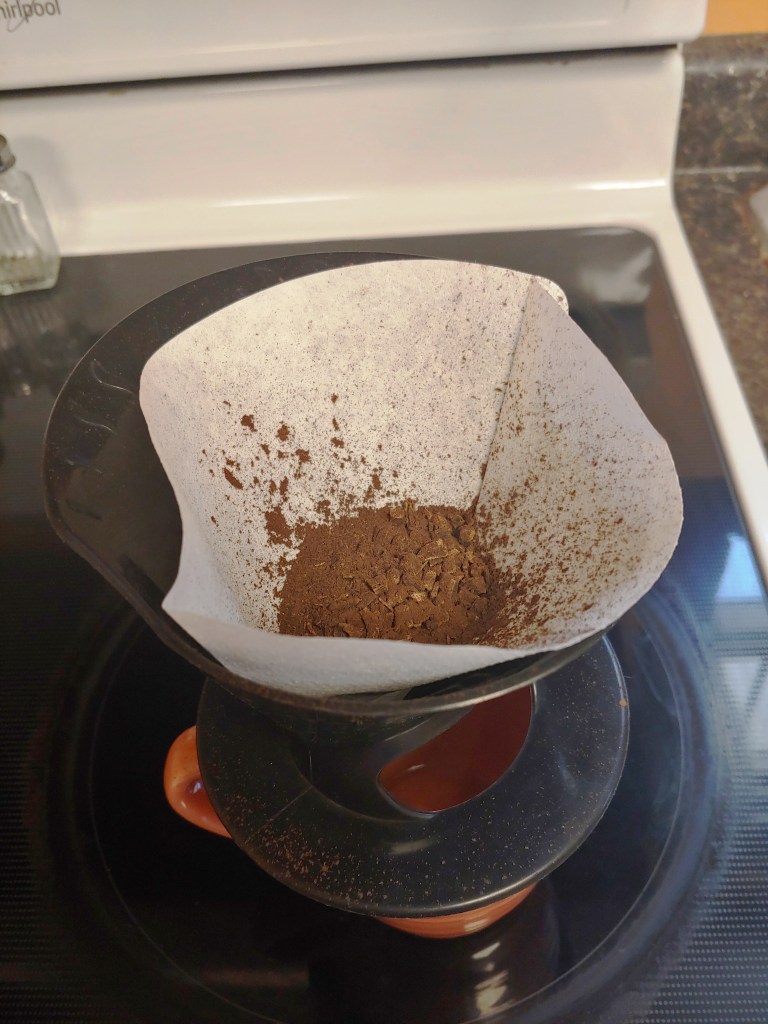
… And put it in a one-cup coffee filter. As I had hoped, it was just the right amount for one mug.
As you can see, the roots don’t
grind up nice and even like coffee grounds.
There are some bigger chunks, and then there’s some powder that’s as
fine as French Press coffee or even baking powder or something. Perhaps I could have gotten the chunks
chopped up further if I’d been willing to grind them for longer, but as I was
grinding, fine dust kept escaping from the food processor and coating the
surrounding counter. I stopped when I
figured the grounds would be sufficient.
If you were grinding roast chicory in large quantities, there’d be
certain to be a lot of dust.
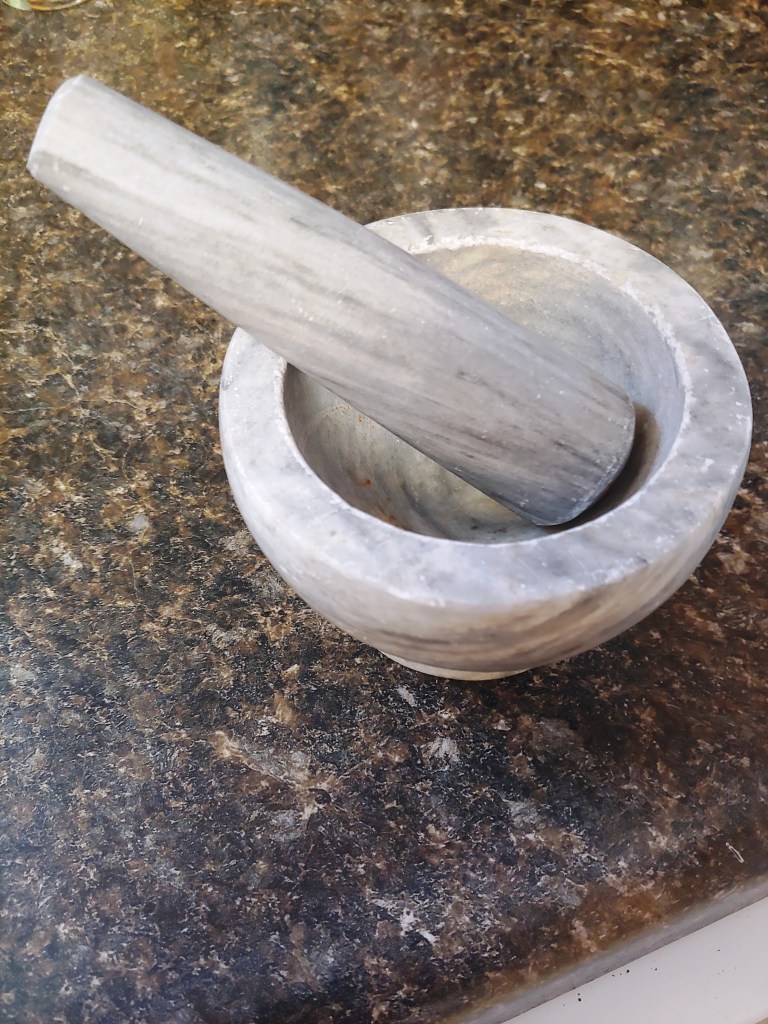
If there were no electricity, I guess I’d be forced to crush it in my marble mortar:
I poured hot water over the
grounds, and it worked great! A very
creditable cup of something that looks exactly like coffee.
The wet grounds, and the liquid
itself, smell very smoky. I’m going to try it black first, because after
the apocalypse there is unlikely to be spare milk, let alone hazelnut creamer.
It tastes exactly as Hank Shaw describes it: “a brighter acidity than coffee and … ‘earthy.'”
I give a sip of it to my trucker
husband, who ought to know about mediocre coffee.
Me: Does it taste like truck stop
coffee?
Him: Truck stops couldn’t sell
coffee if it tasted like this.
Well, it tastes OK to me. But I might be slightly invested, seeing as how I made it.
I add milk and continue to drink. It tastes most coffee-like when hot. As it cools, it begins to taste more and more like … smoke. Now I realize I’ve had this before. I think it was called “smoke tea.” It must have been chicory. I like the flavor, but I realize it wouldn’t be for everybody.
But the bottom line is: I did it! I did it! I dug up a common wildflower and forced it to yield a coffeelike substance. It was a bit of a project, but not hugely inconvenient and actually took less processing than I’ve heard real coffee takes.
Lesson 6: It is possible to make a coffee substitute from chicory, even
if you have little previous knowledge or skills.
As you can see in the video below, Dave Rubin did an off-the-grid August last year. (He starts talking about it at 1:57). I heard him say he was going to do the same this year, and invite all of us to join him.
I thought that was a great idea, as August is also the month that I’m going to be moving to an undisclosed location. (Yep, that picture above. That is exactly where I’m going to be living.)
Unlike Dave Rubin, I have not pre-taped episodes of this blog to play throughout August in my absence. I will not be posting until September.













 Out of Babel Books