This all started because I wanted a hat that would cover my ears.
Most hats, like berets, slouches, and beanies, only protect your ears from the wind if they are pulled way way down so as to cover your eyebrows. That’s not necessarily bad (especially in truly Arctic conditions), but we don’t always need it. Also, such hats tend to have tightish bands that don’t play well with most hairstyles.
It occurred to me that, for covering the ears and gracefully skimming over a bun or whatever, a bonnet might be just the thing. I checked Pinterest for bonnet patterns was immediately drawn into a whole new, magical world. Many of the patterns are for little girls or babies, and, well … swoon. Others are elfin-looking (swoon again). Plus, it turns out that women as far back as the Iron Age were wearing knitted or crocheted looking hair nets, and these can be found intact on bog bodies in Denmark, but I digress.
After one false start that involved purchasing a darling pattern that was way too small for me, I remembered this pattern.
It was in this book, which was the first-ever knitting book I tried to do a pattern from. It was actually too advanced for me, but I didn’t realize that at the time. I had found it in our local library when I lived in the Midwest, and interestingly, it’s also in our local library here in rural Idaho! I guess the book’s marketing team is really good with libraries, or maybe it has something to do with the gorgeous photographs. Anyway, I checked it out yet again, and looking at all the patterns and the photography was quite a trip down memory lane. I remembered that there was a bonnet pattern in this book, and it turns out that it’s a really useful and basic one.
Here’s what the bonnet looks like on the model in the book. As you can see, she has taken it in a more punk direction. I didn’t realize that putting my own spin on the bonnet – and then wearing it – would make me look like a close-up of a Millet painting, but I’m pleased with the results.
Here’s my version from the side so that you can compare them. I’m not sure why my edge is rolling in and hers isn’t. Theories: different yarn; my tassels have less weight than her long i-cord ties; they blocked their bonnet and/or pulled it straight right before the photographer snapped the picture.
I made mine with ivory-colored wool which I had left over, until I ran out; then I used ivory-colored acrylic that was also in my stash. (Did you know that if yarn sits around your house for several years, it becomes free?) Other changes: I cast on with dark green wool. I knit an extra inch of length before joining the hat in the round, because I have a big head. As you can see, the bonnet hits me right where it hits the model, even with the extra inch. Finally, I used tassels hung from a short crochet chain rather than long i-cords with “flowers” on the end for accents.
The bonnet does OK keeping my ears warm in windy subzero conditions, and it hasn’t blown off my head yet. If I were going to do a serious outdoor version, I’d want to line it with flannel or something and make sure it could tie under the chin. But this is fine for looking like a peasant and not getting rained or winded on while running to the car.
This post might be a little … rambling. A poorly thought-out combination of recent events in my life, vague political implications, and nostalgic revisiting of old favorite fantasy novels. You know, the way blogs used to be back in the day. Because I am just so dedicated to bringing you, my faithful Internet friends, content, even if it is crummy content.
Over the past few weeks, I’ve done a couple of knitting marathons (about which, more in the near future). I like having something to watch while knitting, and the least repellant thing on Netflix was The Lord of the Rings, so I have recently watched through all three movies. I enjoyed the movies mostly because they reminded me of the books, which I haven’t read in a long time. Yeah, I’m a purist. I couldn’t believe they left out Old Man Willow, Tom Bombadil, the Barrow Wights, and they completely messed up the scene in Bree, and they Hollywooded up Gandalf’s confrontation with Saruman and with Theoden, and they destroyed Faramir … but even so, even so, they kept enough of the original plot that watching the movies was edifying.
The theme that jumped out to me this time — well, there were a couple. One was the way that every single member of the party pays a high cost in the service of the quest. Even people with fairly minor roles, such as Merry and Pippin, suffer greatly – Merry from stabbing the Witch King, and Pippin has to deal with Denethor’s madness. Multiple people had to be willing to pour out their lives. Not just Gandalf, and not just Frodo. This rings true to me. Whether we are fighting the good fight by building a family, a school, or a local church, everyone feels like they are giving 110%, and then the job just barely gets done.
The other theme that I noticed this time was that of despair. Denethor succumbs to despair, kills himself, and nearly kills Faramir. Well before that, he essentially abandoned his duty to the people of Minas Tirith because he believed the cause was lost. And it turns out, this was a stratagem of the enemy, who had been showing him misleading things in the Palantir.
Meanwhile, over in Rohan, Wormtongue has gotten Theoden to abandon his duties to his people by convincing him that he’s old and tired and the heroic age has ended. Wormtongue gets inside Eowyn’s head, getting her to see Edoras, the glorious hall of her ancestors, as a stupid redneck hovel, and her own role in it as boring and stultifying. She ends up, essentially, suicidal, but luckily the presence of Aragorn has turned her suicidal impulses in the direction of brave self-sacrifice, rather than foolish action like Denethor’s. But this is another case where despair doesn’t just happen, it is a direct, intentional action of the enemy.
Other characters suffer feelings of, or temptations to, despair, pretty much in direct proportion as they come in contact with the enemy. Physical contact with the Ringwraiths pulls a personal partially into their world, as happens to Frodo at Weathertop, and the Eowyn and to Merry, who says to Pippin, “Are you going to bury me?” Victims don’t just despair of victory, but they doubt their own judgment, their own senses, even their own existence. It’s at times like these that we need the shoulder of a friend.
James Lindsay has posted recently about how modern-day deceivers will try to induce despair by robbing us of epistemic authority (“you don’t know what you are talking about.” “Do you have a degree?”), psychological authority (“you are crazy/phobic”), and moral authority (“you are a bigot/oppressor” “It’s so heartless/insensitive to say that”). The goal is to get their interlocutor to stop trusting their own mind and conscience, and just accept the new system of thought they are being offered. Perhaps this podcast of his was the thing that caused me to notice this dynamic happening in Middle Earth.
Anyway, you can make your own applications. Don’t despair. Your mind is probably working OK. You are probably not a crazy bigot oppressor who doesn’t have a working conscience. You are not the only one who has questions. There are friendly shoulders to lean on.
I was going to call this post “Don’t Despair,” but I thought that would sound too cliched and I wasn’t sure I could follow through on the promise of such a title.
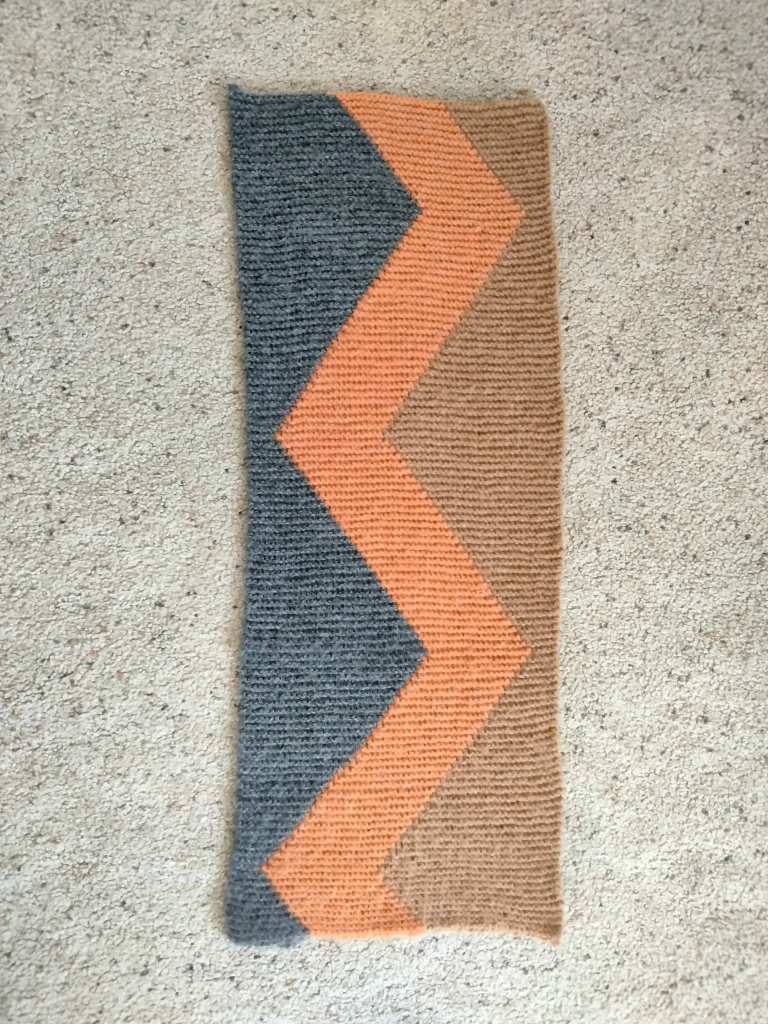
You may recall that a while back, I accidentally discovered that if you make zigzag stripes on a poncho in a gradient of colors, it looks like mountains receding into the distance. I’ve been wanting to make one for myself, for some time.
I discovered this nice, affordable yarn that is something like 90% acrylic, 10% alpaca. I could have done the poncho in shades of grey, and that would have looked awesome, but I already own a grey poncho and I “needed” one that was more in the orange family. So, these mountains are going to have a cloudy sky in the background, alpenglow on the upper peaks, dun lower peaks.
When I have two long rectangles, I’ll sew them together to make a poncho.
I worked on this all summer. It took a long time, because it’s oversized. I planned this project mainly to showcase the variety of coordinating colors, which were sold as a group at the yarn store. The color palette matched several items of clothing I already had. It can be worn with grey, green, gold, orange, or camel. Basically anything in the warm or cool neutral families. I ended up having to buy the coordinating yarn sets three times.
For the dimensions, I referred to a pattern for a bulky sweater with sleeves and a shawl collar, but just left those off. I began by knitting granny squares and then sewing them together, but as the work progressed, I found I had to pick up stitches on the end of finished squares and then just sew the sides together. I added a few rows of ribbing at the arm holes and neck, and a few more rows of ribbing along the bottom.
Here it is from the front. (This picture was taken on Halloween, hence the cave woman hairdo.)
Even with the ribbing, the sides and arm openings tend to roll in.
If only, before I began, I had come across this Pinterest video:
This is such a simple but brilliant way to join knitted squares.
In the West today, we are living under decadent, pre-totalitarian conditions. Social atomization, widespread loneliness, the rise of ideology, widespread loss of faith in institutions, and other factors leave society vulnerable to the totalitarian temptation to which both Russia and Germany succumbed in the previous century.
Furthermore, intellectual, cultural, academic, and corporate elites are under the sway of a left-wing political cult built around social justice. It is a militantly illiberal ideology that shares alarming commonalities with Bolshevism, including dividing humanity between the Good and the Evil. This pseudoreligion appears to meet a need for meaning and moral purpose in a post-Christian society and seeks to build a just society by demonizing, excluding, and even persecuting all who resist its harsh dogmas.
Finally, Big Business’s embrace and promotion of progressive social values and the emergence of “surveillance capitalism” — the sales-directed mining of individual data gathered by electronic devices — is preparing the West to accept a version of China’s social credit system. We are being conditioned to surrender privacy and liberties for the sake of comfort, convenience, and an artificially imposed social harmony.
This is the brave new world of the twenty-first century. It is coming, and it is coming fast. How should we resist it?
Live Not by Lies, by Rod Dreher (2020), pp. 93 – 94
A Scary Book for October
I saved this book review for October, because over here at Out of Babel we have a tradition of talking about scary things all month. Of course, this isn’t the spooky sort of scary that you might expect around Halloween. (We will get to that later, and plenty of it.) This is more realistic-scary.
Soft Totalitarianism
The main thing that scared me was the first part of Dreher’s book, titled “Soft Totalitarianism.” Dreher explains that the impetus for the book was his interviews of older folks, now living in America, who survived the Communist states in Eastern Europe. They are very concerned about the social trends they see in America, because things look familiar. They are also, of course, madly frustrated with Americans for not wanting to listen to their warnings. Nobody likes to be Cassandra. Dreher wrote the book because he thinks there is a lot we can learn from them, and from others who engaged in resistance in these countries (Dreher also traveled to Hungary, Russia, and some other former Soviet republics while doing research for this book). There are valuable lessons these folks have learned, but the learning curve is steep, and we have a limited amount of time to start putting their advice into practice.
In Chapter Two, “Our Pre-Totalitarian Culture,” Dreher gives a brief history of social conditions in Russia right before the Revolution. This includes not just former peasants who had come to the cities and were now isolated from their churches and communities, but also the idealistic, utopian thinking that was popular among intellectuals. “It was only toward the middle of the twentieth century that the inhabitants of many European countries came, in general unpleasantly, to the realization that their fate could be influenced directly by intricate and abstruse books of philosophy” (pp. 41 – 42).
Chapter 3 is called “Progressivism as Religion” and Chapter 4 is about the surveillance state.
I didn’t find all this scary because it was a new thought. I have read quite a bit of socialist, utopian, and progressive literature (it’s hard to avoid), either directly myself or indirectly by hearing such people as James Lindsay read it out loud and analyze it in podcasts. And I’ve read Animal Farm and The Gulag Archipelago (abridged), and Brave New World and The Giver and The Hiding Place. I know that attempts at utopia never go well, because they run contrary to human nature. This is not my first rodeo.
Except that, in a way, it is, because I’ve never actually had to live under totalitarianism, whether the hard kind or the soft kind, until quite recently. My country is sliding rapidly into soft totalitarianism, and knowing all the things I boasted of knowing in the previous paragraph is not helping one little bit to stop it. That is what is depressing (or scary, if you like), and that is what the first part of Dreher’s book forces you to look at in some detail.
It is even scarier if you have read, say in The Gulag Archipelago, about some of the extremely creative tortures that the Soviets would subject prisoners to in order to break their minds. That’s why Part 2 of Dreher’s book, “How to Live in the Truth,” ends with Chapter 10, “The Gift of Suffering.”
I Do Have One Critique
This critique should not be understood to detract from the value of Dreher’s book. I mean, five stars, absolutely. But I think it is important enough to mention because Dreher seems to confuse the meaning of a key word, which is not a good mistake to make when you are fighting propagandists.
Tamas Salyi, the Budapest teacher, says that Hungarians survived German occupation and a Soviet puppet regime, but thirty years of freedom has destroyed more cultural memory than the previous eras. “What neither Nazism or Communism could do, victorious liberal capitalism has done,” he muses.
The idea that the past and its traditions, including religion, is an intolerable burden on individual liberty has been poison for Hungarians, he believes. About progressives today, Salyi says, “I think they really believe that if they erase all memory of the past … they can write whatever they want on the blank slate. It’s not so easy to manipulate people who know who they are, rooted in tradition.”
pp. 116 – 177
See what Dreher did there? “Capitalism” is identified as “the idea that the past and its traditions, including religion, is an intolerable burden on individual liberty.”
That is not what capitalism is. Capitalism is the idea that every person ought to be able to own private property, charge for their own products or labor, and buy and sell freely. How do I know this? Because according to Marx, “Communism can be summed up in one sentence: the abolition of private property.”
I have written beforeabout how belief in private property and free markets does not imply belief in a vast, radically individualistic, consumerist culture. In fact, if you want to have a humble, grounded life, one that remembers the past, honors traditions, works the land, etc., then private property is absolutely essential.
Of course, we live in a fallen world, so no matter what legal and economic system is in place, there will arise corruption and abuses within it. That does not (necessarily) mean that it is an evil totalitarian system, nor that its laws are inherently unjust. However, what I’ve noticed is that when the average person, speaking or writing casually, says “capitalism,” it usually carries negative connotations, meaning either:
corruption
consumerism
unjust practices
… or, in this case, radical individualism
In fact, “capitalism” is used in exactly this equivocal way by people who want to abolish private property. They use it to imply that all the human ills don’t just occur in a system with private property, but are actually the result of it, and that getting rid of private property would also get rid of corruption, consumerism, etc.
When you conflate capitalism with something else, like radical individualism, it leads to sloppy thinking, as in Dreher’s paragraph above, where one second, he is blaming capitalism for causing Hungarians to forget their traditions, and a few sentences later it’s “progressives today,” who are in fact all the sworn enemies of capitalism.
This is too important a word to give up, and I’m disappointed that Dreher hasn’t taken the time to define his terms more carefully. However, despite that minor-yet-important complaint, this is a helpful book. Researching it cannot have been enjoyable, and it contains vital information about what previous generations have learned from living under totalitarian regimes … information that it might be just as well to have a hard copy of, so that it doesn’t go down the memory hole.
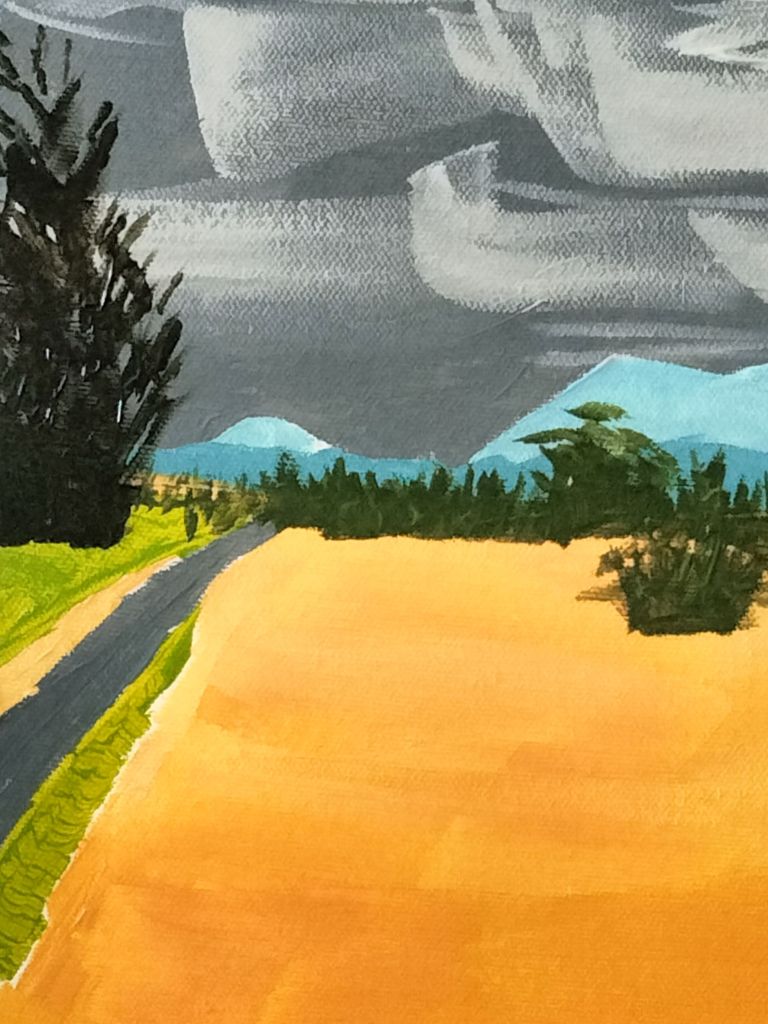
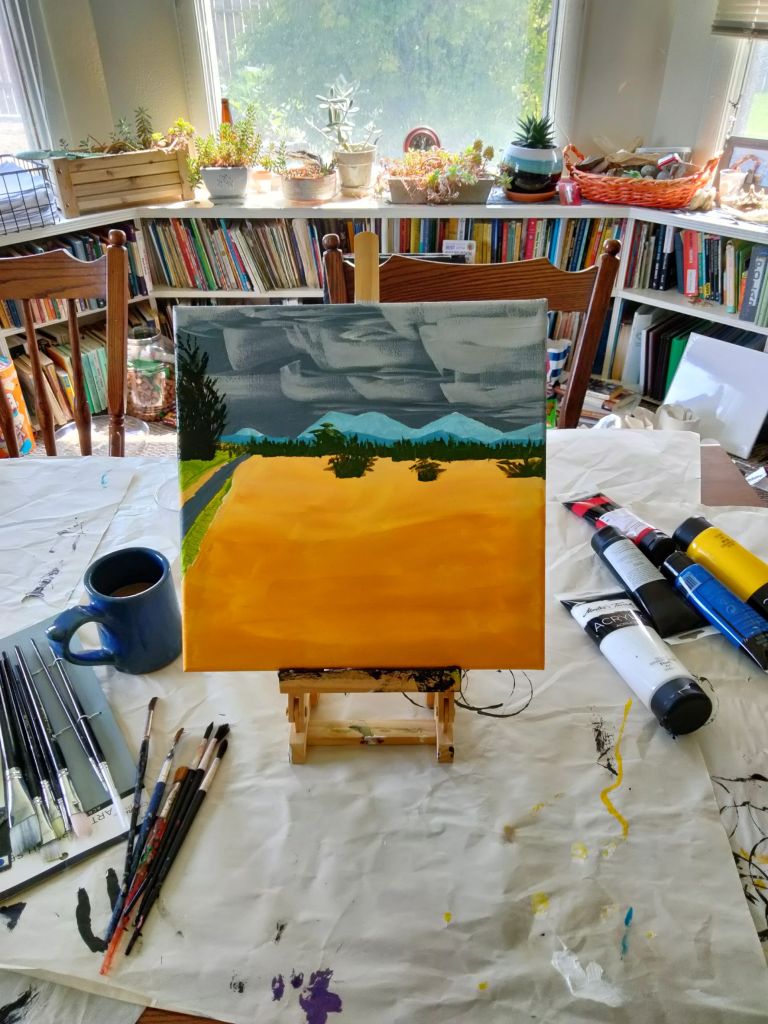
I made it quickly, in just two days, on a small square canvas, intending to sell it at a local summer festival. But as of drafting this post, we haven’t had the festival yet, so I don’t know whether it’s going to sell.
It’s basically just the scene from my dining room window, done in a blocky, hurried style. I figure it’s the kind of thing that you would hang in your farm-house-themed kitchen, mostly choosing it for the colors and theme. Its lack of detail means that it wouldn’t overwhelm a decorating scheme. I hope.
Here it is in my studio.
As far as I’m concerned, the scene above is pretty close to paradise … natural light, painting supplies, plants, books, and a cup of coffee.












 Out of Babel Books