Book Review: The New Trail of Tears by Naomi Schaefer Riley

Life is very bad on our American Indian reservations.

People on the reservations experience rates of corruption, unemployment, depression, drug addiction, sexual assault and child abuse that are as high or higher than any other place in the nation.

But why?

Those with overly simplistic views of American Indians tend to oversimplify in one of two ways: your average American Indian is seen either as Wise Noble Victim, or Worthless Lazy Drunk. My instincts have always put me in the Wise Noble Victim camp, but I recognize that neither of these oversimplifications explains conditions on the rez. American Indians are people, which means they are sinful but not worthless. As Schaefer Riley puts it, “Indians, just like all people, respond to the economic incentives and political conditions around them” (page 178).

I have occasionally spoken with people who seem to resent all that American Indians receive from the government. Tribal governments are “sovereign.” Tribes have the right to operate casinos on their land (in most states no one else can), and in many cases, tribal governments or even individuals receive direct payments of federal dollars. None of this is false, but what has been the effect of it? It has not led to a cushy life for tribe members; quite the opposite.

The Incentives

Here’s my quick summary of the “economic incentives and political conditions” created by the way the federal government has handled the tribes:

  • Law enforcement on the rez is a nightmare. Since Indians are not considered as being under the jurisdiction of the state in which they live, if there is a serious crime, it is considered a federal crime, and you could have three or four agencies involved. “He became especially concerned ‘with the lack of coordination between the tribal police and the Bureau of Indian Affairs and the FBI and the Justice Department.'” (page 164) Often, other law enforcement agencies defer to the tribal police, who often, because of nepotism, don’t prosecute. This creates a lawless situation on the rez, with high crime. It gives victims the impression that nothing will be done.
  • It is difficult for Indians to own land; or, if they happen to own some, to develop or sell it. Most land is not individually owned, but belongs to the tribe. A combination of tribal politics, environmental concerns, and federal red tape tends to block any attempts at development. This means that it is very hard to create or find jobs on the reservation … except jobs in tribal government.
  • While casinos provide some jobs, the linking of the casinos with tribal membership has introduced all kinds of corruption. Some tribal governments run their casinos essentially as cartels. The effect is that tribal membership is “commodified.” A common political move against a rival would be to get them declared no longer a member of the tribe.
  • Schools on the rez tend to be as bad as the worst inner-city schools. Schaefer Riley profiles a few schools that have bucked this trend, at least for a few years. One is a Catholic school. There are also Teach for American volunteers who are very motivated to give Indian kids a better education. But these people are usually met with mistrust and actively undermined or driven out because they are outsiders and because of the bad experiences that the older generation had with residential schools trying to forcibly assimilate them.
  • While it is important for Indian kids to learn about their traditional language and culture, “this is not a good first step.” Schaefer Riley points out that those tribes that have done the most to preserve their language and culture are those that have done the best economically. When no longer just struggling to survive, they use the money and the energy they now have to create museums and cultural centers.

In short, massive amounts of government money and regulations have had the same effects on the Indian reservations that they always have elsewhere. The red tape is at least tripled compared to the red tape faced by other Americans, which pretty much brings any kind of enterprise to a grinding halt. The infusion of government money through the tribal government incentivizes corruption. The lack of private property and actual employment makes people depressed. The white guilt (and the red tape) have made a lost cause of law enforcement.

Possible Solutions

Schaefer Riley ends with a call for American Indians to be treated like all other American citizens. She points out that American Indians have had very high rates of serving in the military.

Indeed, despite centuries of broken promises from the federal government, despite the bitterness that often pervades Indian communities, and despite years of being told by their own leaders and by Washington’s that they must remain a people apart, American Indians largely see themselves as Americans.

pp. 175 – 176

There has to be a way to ensure that Indian crime victims have the same rights under law as other crime victims … that Indians can own land and start businesses as individuals, not just as members of the tribe … that Indian families have access to a choice of schools that will prepare their kids to succeed. It has been suggested that the larger reservations be made into their own states. Then the people who live there would be considered full citizens who happen to reside in that state. This might not be feasible politically (although I think it would be really cool), but there are a few bands in Canada who are trying to get their tribal lands incorporated as cities. This would allow them to do development that they can’t do now, and the tribal leaders would be like city governments. Failing all this, a good step would be to drastically reform (or, ideally, eliminate) the Bureau of Indian Affairs, which is known for being the one of the most corrupt and inefficient government agencies in a field where the competition is stiff.

I sincerely hope that Schaefer Riley’s book catalyzes a move in this direction. It should, of course, be read by anyone with the slightest interest in American Indians’ living conditions in these modern times. But it should also be read by anyone who is concerned about the effect of government micromanaging of citizens’ lives.

A Cautionary Tale

I see at least three ways in which the federal government’s treatment of Indians serves as a sample of what it would like to do with all citizens:

  • It’s coming from good – or at least utopian – intentions. In the case of the Indians, many people feel that the government owes them lots and lots of money and special rights because of the ways that same government mistreated them in the past. (Turns out, the money and “rights” are a new kind of mistreatment.) There is also an assumption that less development is better, because we don’t want to impact the environment at all. In the same way, there is a strong movement to put all citizens in the same position: “You will own nothing, and you will be happy.” Putting the most charitable interpretation on it, the idealists believe that this would bring about a utopia in which everyone has a high (but more importantly, “equal”) standard of living … there is no family loyalty or private property to cause conflicts … and everyone’s lifestyle is perfectly “green.”
  • It features forced assimilation. Schaefer Riley points out that Indians are in fact assimilating culturally to the United States, but forced assimilation is a very different story. A few generations ago, Indian children were forcibly removed from their homes and sent to boarding schools where they were not allowed to speak their own language. This idea that, if the parents don’t share the government’s value system, the government has a right to separate children from their parents and re-educate them, has not died away. The idealists have not yet gained enough power to practice forced assimilation on all American children, but they are trying.
  • It is collectivist. The degree to which Indians have been denied private property and individual initiative is the exact degree to which they have been brought to poverty and despair. In their case, this has been brought about partly from a sort of Rousseauian “noble-savage” myth about the way the Indians lived before Columbus (spoiler: they weren’t collectivists then either). In the case of other Americans, there has been an attempt to demonize private property, small business, and intact families as the problem with humanity. In fact, these things are key to human flourishing. Sin certainly shows up in them, but that is because it is present in human nature and shows up in whatever humans do.

Link: “Don’t Count on a Garden to Save Your Life”

I get regular e-mails from The Survival Mom. Learning to prep is a steep curve, and I have definitely not reached the pinnacle (and, after all, who has?). But I got this very relevant e-mail from her last week (copy-pasted below), and I think she is absolutely right.

The E-mail:

Hi there, ,

After being in the survival and prepping niche for more than 12 years, I’ve heard just about every survival strategy and tactic there is.

One of the most popular is this, “Learn how to grow your own food.”

And more recently, “Better get a garden started right now!”

That isn’t a bad idea, but for the vast majority of people — like 75% or more — it’s not only unrealistic but foolish to think you can grow enough food in a garden to sustain life. 

“How much did you say I have to grow???”

Just to maintain average health, the average adult needs anywhere from 1600 calories to 2000 or more per day. The most popular and easiest to grow vegetables, like tomatoes, zucchini, and cabbage, have around 20 calories per serving. Clearly, the typical vegetable garden is not going to save anyone’s life

Let’s take a look at potatoes. They’re a lot higher in calories (160 for a medium potato), very versatile, and they can store for long periods of time. To live on nothing but potatoes, you would need to grow around 6000 potatoes per person per year. This can be done, but you’ll need at least an acre of land, growing nothing but potatoes, not to mention optimal growing conditions, farming equipment, fairly high level skills, and knowledge.

You’ll get the calories you need from those potatoes, but is that any way to live? For a year?

Have you ever tried to farm even just one acre? I never have, but I imagine it takes more effort than a few Square Foot Gardening boxes!

Growing one or two other high-calorie crops will provide more variety, but you’ll also need more land. No one really wants to survive on just potatoes and maybe some corn or beans, so raising chickens, some rabbits, and maybe a few goats seems like the way to go — but have you ever done that before? And maintained a couple of acres of crops at the same time?

How will you preserve all the food you grow, and maintain healthy soil so it keeps producing? The depletion of nutrients from soil is a significant issue, so to keep your multi-acre garden producing enough food to keep from starving, you’ll need to factor in the right types and amounts of fertilizer.

There are hidden expenses in all these endeavors that you usually won’t learn about until they suddenly become urgent!

What a garden is good for

Depending on a garden for survival is unrealistic for nearly everyone. An old farmer once told me, “It takes about 10 years to get to know your land,” and even if all you’ve ever done is some container gardening, you’ve probably learned the truth in that statement!

A more realistic plan for integrating a garden with your prepping plans might include:

  • Use it primarily to grow herbs and seasonings. These can easily be dehydrated and would be one less thing to purchase and stock.
  • Use it to grow seasonal vegetables and extend your growing season with a greenhouse, the use of cold frames, and/or indoor garden with grow lights. Do what you can and enjoy the process.
  • Focus on the easiest and fastest-growing vegetables for your zone, grow as much as you can, and then preserve with canning, pickling, and/or dehydrating. These will add fiber and nutrients to your other stored food.
  • Learn how to grow anything that has the highest calories, and experiment with different crops until you find the one that is the best fit for your growing zone, the amount of land you have, and your specific growing conditions. This might take a while.
  • If you live in an area prone to drought, take this into consideration! There are some food crops that require less water and smart techniques for using the water you do have.
  • Use it to teach gardening and the love of nature to your kids and grandkids.

Personally, I use my garden as an excuse to get outside and into nature every single day, and for me, that’s reason enough to always have some type of garden. I just don’t have any expectations that it will someday save my life with its bounty, or lack of, depending on the year!

I’m not trying to discourage you or mock your plans for survival

The plans we make ahead of difficult times and worst-case scenarios need to be made with the least amount of emotion and the clearest view of reality.

I cannot stress that enough.

Gardening can be incredibly expensive, and in a time of inflation and unpredictable product shortages, this isn’t the time to pour money into something you hope will be life-sustaining only to find out how impractical and difficult it really is.

We’ve all heard stories about the $45 tomato — or maybe you’ve grown one of those yourself!

Calories count. Nutrients and micronutrients are vital, but if there’s anything susceptible to the whims of Mother Nature, it’s growing food.

So what is Plan B?

Keep working on your garden and improve your skills and knowledge each season and with each seed planted — if you’re enjoying the process and have the time, money, energy, and manpower to continue. Expand your garden. Try new crops, but also integrate some of these into your plans and routines:

  • Learn to forage in your area.
  • Continue building your food storage, “stack it high and deep.” The plain truth is that 10 cans of pinto beans will always be cheaper for the average person than trying to grow your own and a heck of a lot easier and faster.
  • Work towards a well-balanced food storage pantryMinimum goal: 90 days worth of food.
  • Learn gardening skills through your county’s Master Gardener program. If your county doesn’t have one, then find a county in a similar climate and growing zone, and see if you can take their course. Many courses are now online. Do a search for your county’s name + Master Gardener.
  • Might there be a community garden near you where you can rent a small piece of land to grow more food or volunteer in exchange for a share of the harvest?
  • Take a look at this list of places to find free or nearly free food. Focus on what you can later preserve by canning, pickling, or dehydrating.
  • Visit a farmer’s market and see what crops and varieties they’re selling for ideas about what grows best in your area.
  • Get family and close friends involved. The more you all learn and cooperate together, the better the chances are that you can grow much, much bigger amounts of food.

Survival is more than just “get a garden started”

I really do wish it were that easy! However, you’ve probably learned by now that “survival” is never a one-size-fits-all and there are always multiple layers for your plans and preps to be effective.

All the best,

Lisa

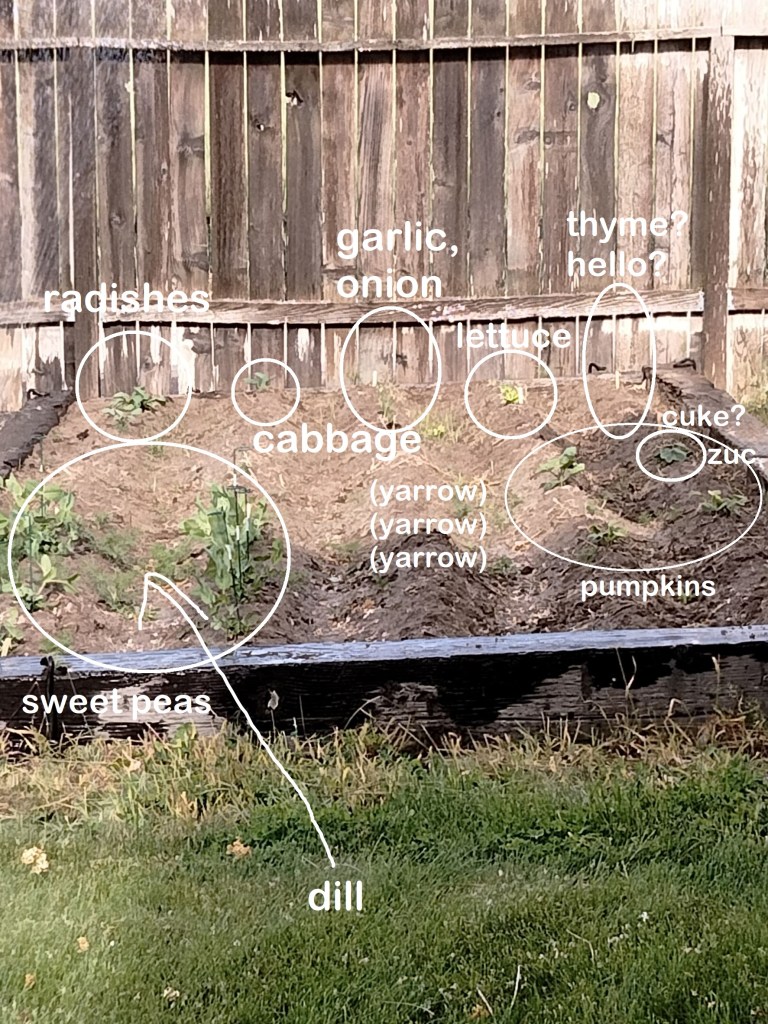
How Does Your Garden Grow?

Really slow.

We had a cold, late Spring, and some things aren’t even up yet.

Meanwhile, I planted dill and yarrow seeds on the actual rows (both plants are supposed to repel pests and support the growth of other veggies), but with the strong winds we had around here, they apparently got carried into the furrows and that is where they are coming up.

I’m just a beginner.

More (Possible) Ancient Surgery

Photo by Renato Danyi on Pexels.com

Not for the squeamish.

Ancient surgical implant or modern-day fake? Peru skull leaves mystery.

Just a few (more) thoughts about ancient surgery.

I am fascinated, in theory, by what people are able to do with various kinds of technology. My upcoming book, The Great Snake, features a character who has spent the entire trilogy being called upon to do emergency surgeries on her extended family whenever something comes up. She has dealt with gouged eyes, lacerations, severe burns, miscarriages and C-sections, plus of course numerous births.

I can research and figure out what she would probably have had to do with the best of them.

In real life? Forget it.

A loved one recently had some emergency surgery without which she would probably have bled to death or worse. (Congratulations on your baby, Rachael!) Thank God we have medical professionals who know what they are doing. I would NOT know what to do in that situation. I wouldn’t know what to look for, or what I was looking at, and I would probably be petrified by the fact that someone’s life was in my hands and be totally unable to make any decisions. That’s if I didn’t faint. Again, thank God for cooler heads when we need them!

Tagging this “I’m a Luddite” … but am I really?

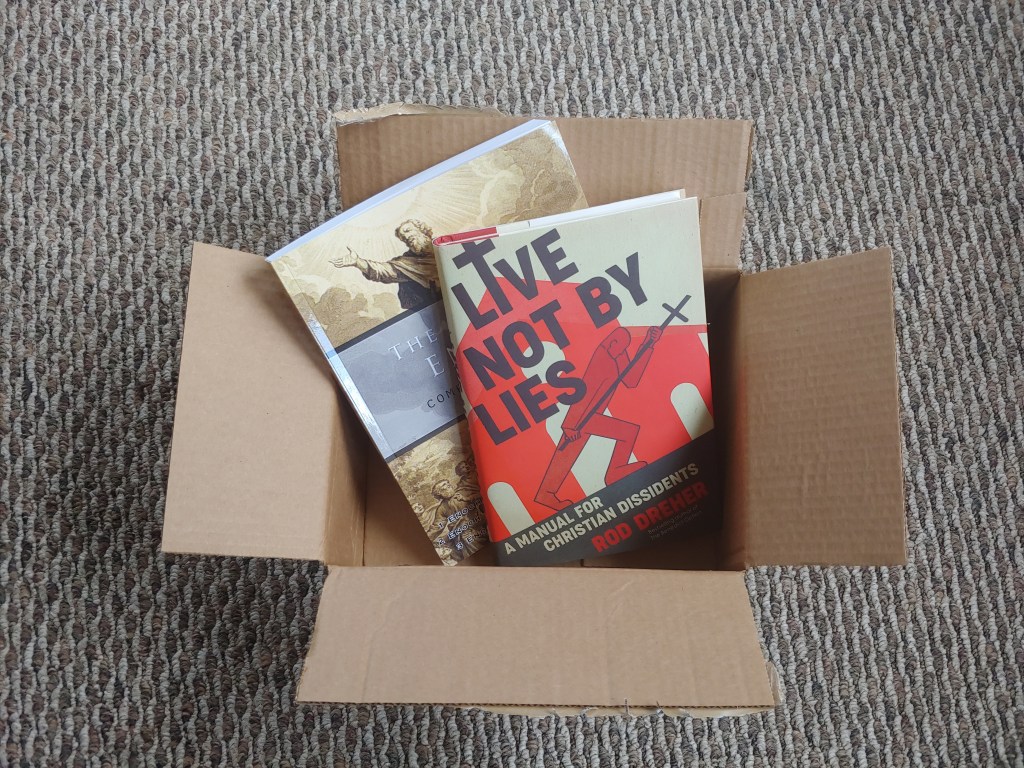
Amazon Unboxing

Yes, I know I am a bad girl for using Amazon.

I had … shall we say a number … of books I wanted to buy. I checked out prices on B&N. I would have been paying a lot more than on Amazon. Like, a lot more. And I’m Dutch-American and kind of cheap, what can I say?

The books are coming in several shipments. This is the first.

Live Not By Lies is one I’ve seen several people recommend. The books of Enoch keep showing up as primary sources in the reading I’ve been doing in secondary sources about giants and elohim and so forth, so I figured it might be just as well to own a copy.

Painting Inspired by Knitting

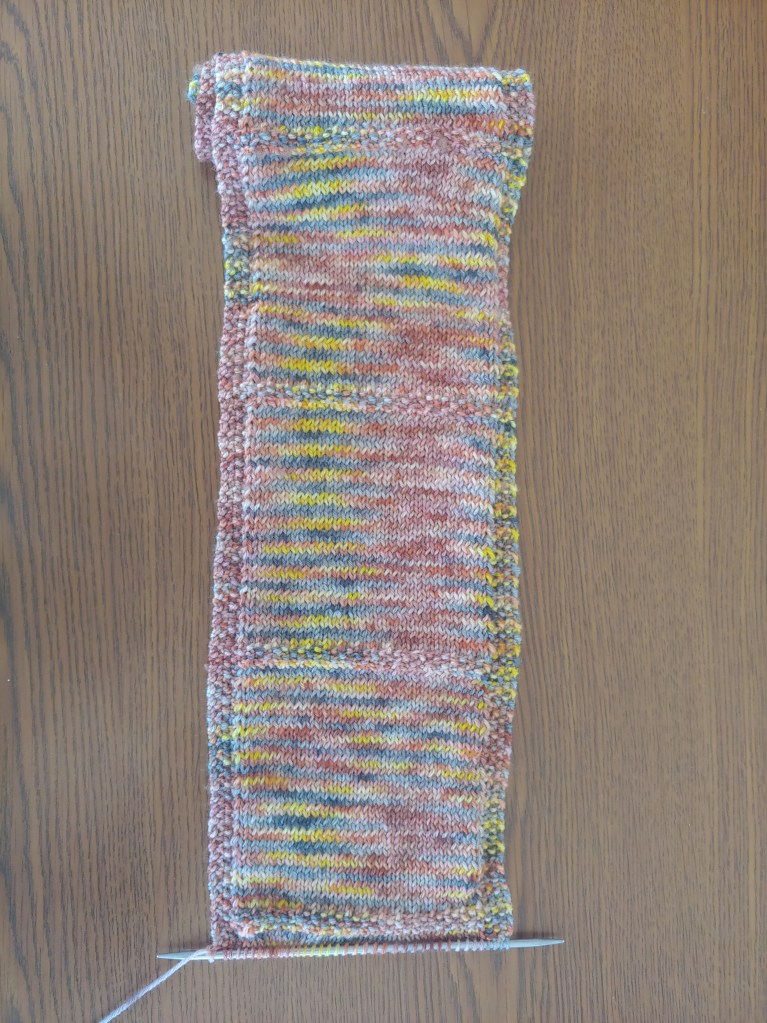
I’m in the process of knitting the scarf for a specific person. I picked the colors of the hand-dyed wool based on the intended beneficiary’s coloring, and the colors of the clothing they usually wear. Little did I know that when it knit up, it would portray a futuristic, sci-fi-book-cover type of scene.

Don’t see it? Look closer …

Now zoom out a little …

… and, all the way out …

There it is.

“Misty Mountains” Poncho

This was a complete coincidence.

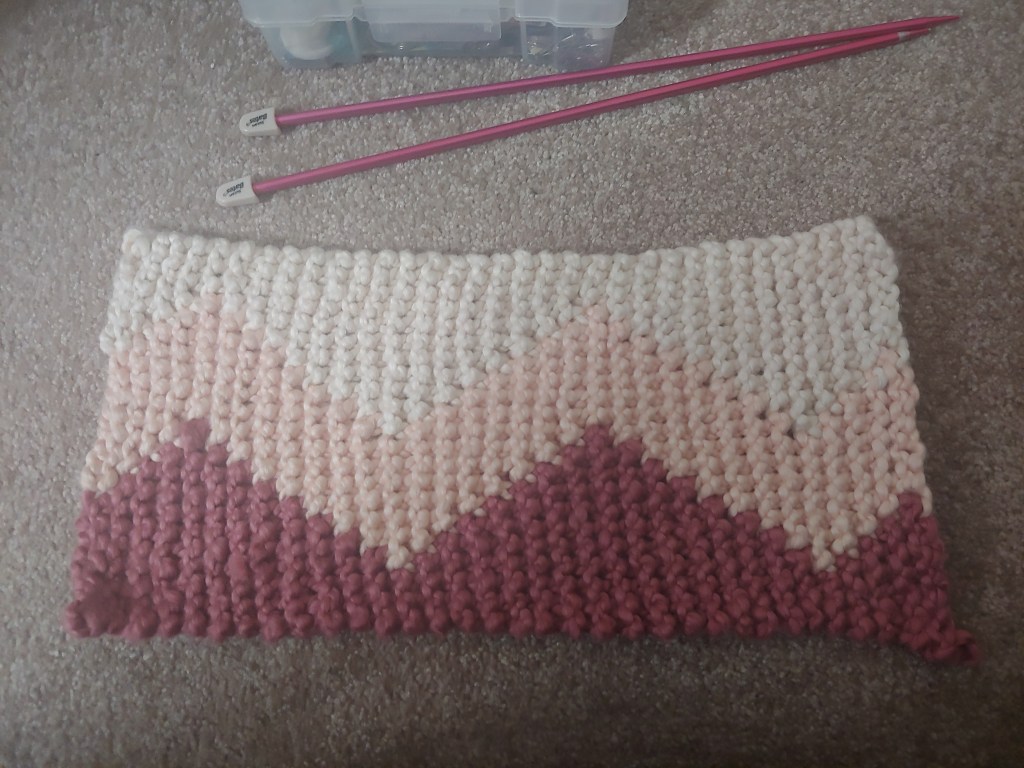
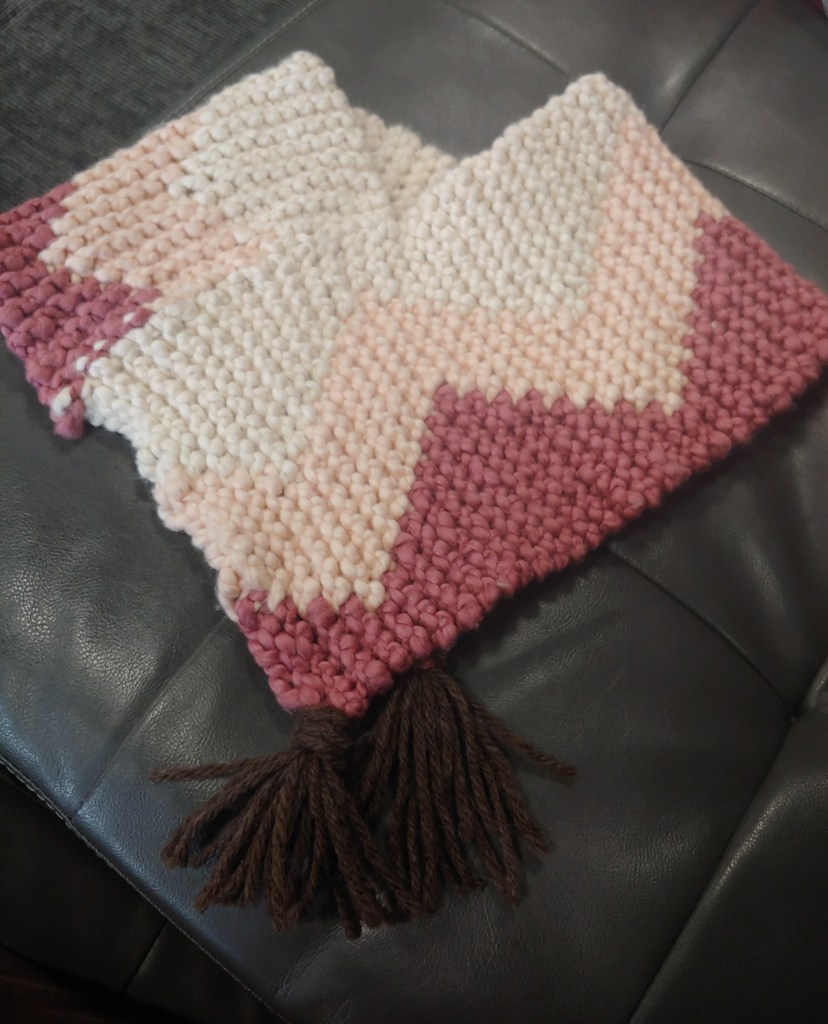
We bought yarn in the colors the little girl liked. I had wanted to try a zigzag pattern on the next poncho I made. Turns out, when you do a modified zigzag using colors with an ombre-type fade, it looks like mountains receding into the distance! Who knew?

The picture above is one half of the poncho. I made the other half identical, sewed them together corner to corner, and added a brown tassel:

I like this mountain-y look so much, I am tempted to make one for myself some day. But that’s off in (you might say) the misty future, as I have a few other projects to get to plus a nerve injury in one arm to baby.