
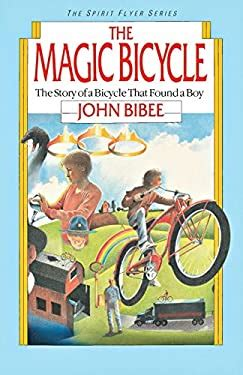
The Magic Bicycle by John Bibee
This is a throwback review.
I remembered that, when I was a kid or a tween, my family got ahold of this series, the Spirit Flyer series. This is the first one. It was published by InterVarsity Press, in 1983. You can see that the cover art style is very 80s. It’s reminiscent of the Choose Your Own Adventure books, which I also loved. The kid’s hair is late 70s/early 80s American hair. The art style is realistic, not exaggerated to make the characters look like elves or superheroes or something. The elements in the scene sort of float randomly around in it, a barrage of impressions, like of the old school pictures they used to sell our parents where there was an in-focus view of the kid smiling at the camera, and in the background, a large, soft-focus view of the kid staring wistfully off into the middle distance.

This is not me, but it might as well be.
Anyway.
I remembered that this series was really good. It was written from a Christian perspective, but not nicey-nice Christian. There was a sense of menace that grew from book to book, as a town was taken over by some kind of evil organization. I remembered it being almost like That Hideous Strength for kids.
Recently, whilst at my parents’ house looking for a different book, I saw this and decided to give it a re-read. Long story short, it’s as good as I remembered. It is an earnest book. The action unfolds slowly at first. In the first few chapters, John (the main character’s name — this book doesn’t shy away from cliches) trash-picks an old bicycle at the dump and fixes it up. He’s an 80s kid, which means he seems very independent and capable to us today. The process of fixing up the old bike over a period of about two days is described methodically. Meanwhile, John is dealing with a best friend; neighborhood bullies; and a stepfamily with whom he lives after his parents died in a car wreck: a strict, no-nonsense uncle, a self-effacing aunt, and three girl cousins, the oldest of whom is very kind.
When bad things start happening, the symbolism is super obvious, but the narrative is unapologetic. There is a huge black snake apparition with red eyes. There is a human villain, seemingly nice but possessed of a creepy grin, who later shows up with “the face of someone dead–a pale shriveled mask of a face with its teeth bared, snarling like a rabid dog.” (131) A strong smell of something dead often accompanies them.
As you can see from the quote above, the writing is earnest too. The Magic Bicycle is written simply, as appropriate for middle grade, but not fatuously. Bibee isn’t afraid to use time-worn phrases (“like a rabid dog”), but they do not come off as lazy because he has something to say and his story is going somewhere. His book reminds me of C.S. Lewis pointing out to young writers that “if you just say what you want to say, without caring twopence about how often it has been said before, nine times of ten you will find yourself becoming original without really trying.”

