C’mon, Spidey, let’s go up to the Celestial City!
–one of my kids to the other, years ago
That’s when I knew I was doing it right.

C’mon, Spidey, let’s go up to the Celestial City!
–one of my kids to the other, years ago
That’s when I knew I was doing it right.

This is why I love home schooling. I learn so much.
I can’t say the 1600s (also known as the Seventeenth Century) were covered very well in my own education. I heard, dimly, of one or two events, like the First Thanksgiving and the Salem Witch Trials (which took place near the end of the century, 1692). I was exposed to a kids’ version of Pilgrim’s Progress. In other contexts, unconnected from history lessons, I heard the names of a few notables from the century such as Bach, and saw a picture of a Cavalier or two. But all these things were floating around without any context. I had no idea of how they were connected to each other, or even that they were happening around the same time. They were, frankly, all mixed up with things from the following century.
Now [this post written in 2019], studying it in chronological order with my kids, I have to say that I like learning about the 1600s. A lot of really horrible things happened, like the beginnings of colonization and of the Atlantic slave trade. But many really interesting things were happening too. Some of them, like the English Civil War, I had barely heard of. Also, this was an amazing century for music and art.
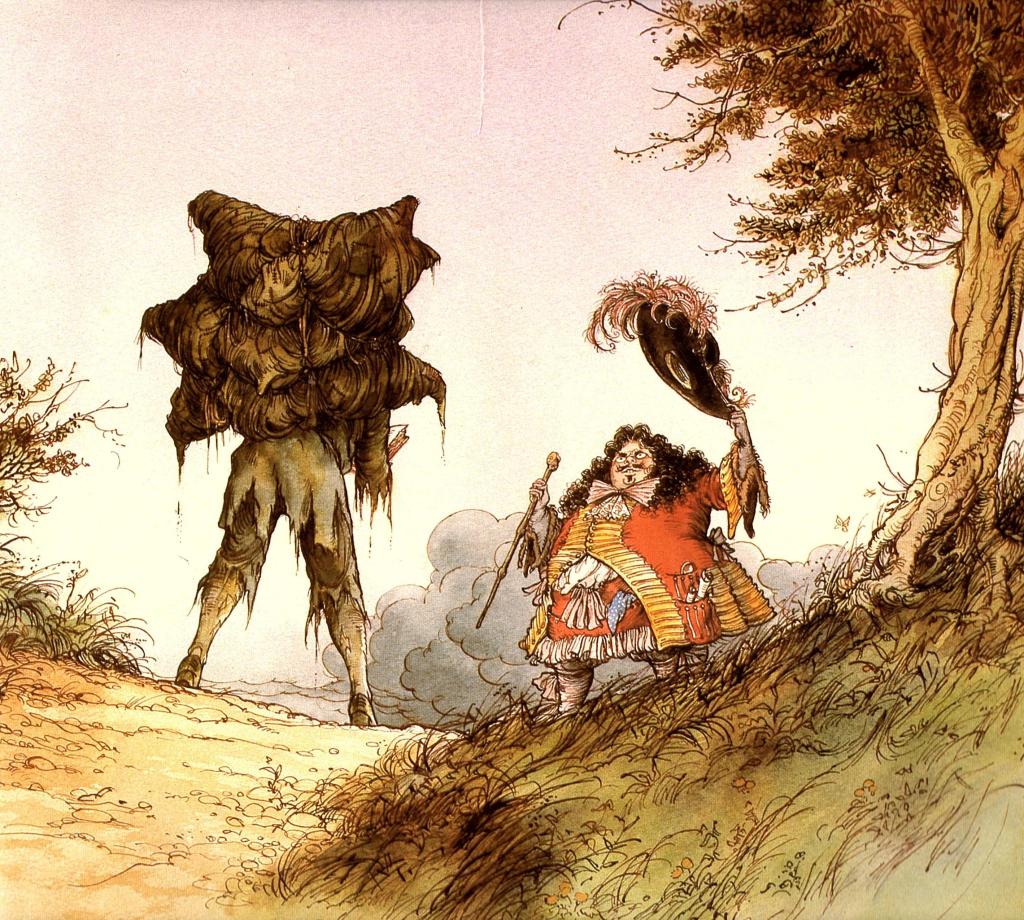
And the clothes. My goodness, the clothes! Long curly wigs, big white collars, hundreds of buttons! They must have been so inconvenient to wear (and to wash. Especially in brackish water. After you’d been on the Mayflower and hadn’t washed for three months). But they look so cool, so dignified, in illustrations! And there is the contrast between the colorful, swashbuckling Cavalier look and the restrained, clean-lined, monochromatic Puritan Sunday best.
The pictures in this post are taken from Alan Parry’s 1985 illustrations of Pilgrim’s Progress in the children’s book Dangerous Journey. I love the 17th-century clothing and the way that the illustrations suggest etchings, which were being done in the 17th century by the likes of Rembrandt.
Bauer, Susan Wise. The Story of the World: History for the Classical Child, vol. 3: Early Modern Times: from Elizabeth the First to the Forty-Niners. Well-Trained Mind Press, 2004.
Demar, Gary, et. al. Building a City on a Hill. American Vision, 1997, 2005.
Hannula, Richard. Trial and Triumph: Stories from Church History. Canon Press, 1999. “Chapter 30: John Bunyan,” p. 181 ff.
Hunkin, Oliver, ed., & Alan Parry, illustrator. Dangerous Journey. Text copyright 1985 Yorkshire Television Ltd.. Worldwide coedition by Lion Hudson plc, Mayfield House, Oxford. US edition by Eerdmans, Grand Rapids, MI, 2012.
Stebbing, Barry. God & the History of Art I. How Great Thou ART Publications. “Rembrandt van Rijn: A Man of Sorrows,” p. 65 ff.
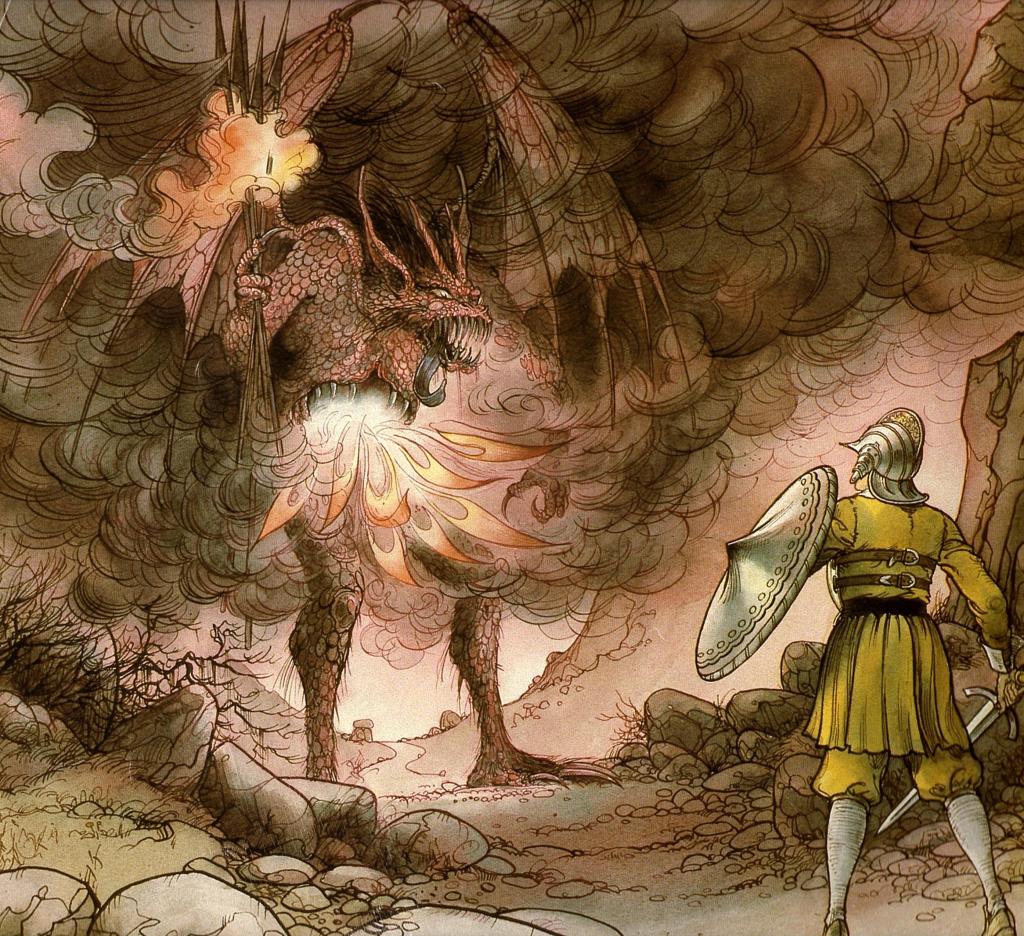
Apollyon: Where have you come from?
Christian: From the City of Destruction.
Apollyon: By this I perceive that you are one of my subjects. For I am the Prince of that city. Why then are you running away from your prince?
Christian: I was indeed born in your dominions. But I have given my allegiance to another, who is the King of Princes. How can I now, with fairness, go back on this? … Besides, to tell you the truth, I like his service better than yours.
Apollyon: You have already been unfaithful to him. You fell in the Slough of Despond. You slept, and let fall your parchment. And in all you say and do, you are inwardly desirous of vain-glory.
Christian: Too well I know it. Yet the King whom I serve is merciful and ready to forgive.
Apollyon: I am the enemy of this King. I hate his person, his laws and his people. Give him the slip, and work for me, and your wages shall be doubled.
Christian: I know your wages, you destroying Apollyon. They are not such as a man can live on.
Adapted from Dangerous Journey, US. ed., Eerdmans, 2012
This is why I love home schooling. I learn so much.
I can’t say the 1600s (also known as the Seventeenth Century) were covered very well in my own education. I heard, dimly, of one or two events, like the First Thanksgiving and the Salem Witch Trials (which took place near the end of the century, 1692). I was exposed to a kids’ version of Pilgrim’s Progress. In other contexts, unconnected from history lessons, I heard the names of a few notables from the century such as Bach, and saw a picture of a Cavalier or two. But all these things were floating around without any context. I had no idea of how they were connected to each other, or even that they were happening around the same time. They were, frankly, all mixed up with things from the following century.
Now, studying it in chronological order with my kids, I have to say that I like learning about the 1600s. A lot of really horrible things happened, like the beginnings of colonization and of the Atlantic slave trade. (That’s extremely hard to read about.) But many really interesting things were happening too. Some of them, like the English Civil War, I had barely heard of. Also, this was an amazing century for music and art.
And the clothes. My goodness, the clothes! Long curly wigs, big white collars, hundreds of buttons! They must have been extremely inconvenient to wear (and to wash. Especially in brackish water. After you’d been on the Mayflower and hadn’t washed for three months). But they look so cool, so dignified, in illustrations! And there is the contrast between the colorful, swashbuckling Cavalier look and the restrained, clean-lined, monochromatic Puritan Sunday best.
The pictures in this post are taken from Alan Parry’s 1985 illustrations of Pilgrim’s Progress in the children’s book Dangerous Journey. I love the 17th-century clothing and the way that the illustrations suggest etchings, which were being done in the 17th century by the likes of Rembrandt.
Bauer, Susan Wise. The Story of the World: History for the Classical Child, vol. 3: Early Modern Times: from Elizabeth the First to the Forty-Niners. Well-Trained Mind Press, 2004.
Demar, Gary, et. al. Building a City on a Hill. American Vision, 1997, 2005.
Hannula, Richard. Trial and Triumph: Stories from Church History. Canon Press, 1999. “Chapter 30: John Bunyan,” p. 181 ff.
Hunkin, Oliver, ed., & Alan Parry, illustrator. Dangerous Journey. Text copyright 1985 Yorkshire Television Ltd.. Worldwide coedition by Lion Hudson plc, Mayfield House, Oxford. US edition by Eerdmans, Grand Rapids, MI, 2012.
Stebbing, Barry. God & the History of Art I. How Great Thou ART Publications. “Rembrandt van Rijn: A Man of Sorrows,” p. 65 ff.

