… oppida sua omnia, numero ad duodecim, vicos ad quadringentos, reliqua privata aedificia incendunt; frumentum omne, praeter quod secum portaturi erant, comburunt …
“All their towns, in number about twelve, and their villages, about four hundred, and the remaining private buildings, they burned. All their grain, except what was meant to be carried with them, they burned …”
… ut domum reditionis spe sublata paratiores ad omnia pericula subenda essent …
“… that they might be ready to undergo all dangers after destroying the hope of returning home.”
Yikes!
Taken from The Gallic Wars, trans. Franz Ruedele, pp. 12 – 13
murder — Murder has to have the following components: direct killing, of a human being, intentional, and unlawful. Therefore, the following things are not murder: Executing someone who has committed a capital crime (lawful). Killing an enemy soldier in war (lawful). Accidentally killing civilians in war (unintentional). Shooting in self-defense (unintentional, and in the case of a firefight, indirect). Killing an animal, even a highly sentient animal (not human). Being unable to provide prompt medical care for someone who is OD’ing while in your custody (not direct or intentional, and also not actually killing).
genocide — direct, intentional, systematic killing of an entire ethnic group, with the express purpose of wiping them out. Not genocide: a war that has a devastating impact upon a particular ethnic group, unless all the abovementioned components of genocide are present. Invasion and conquest. Intermarriage. Taking captives. Poverty. Death of a culture because of any of these causes or because of urbanization. All of these are tragic things that have happened to many, many ethnic groups throughout history, but they are not genocide. Definitely not genocide: natural cultural change that happens because of the spread of an innovation like the written word, or a new religion.
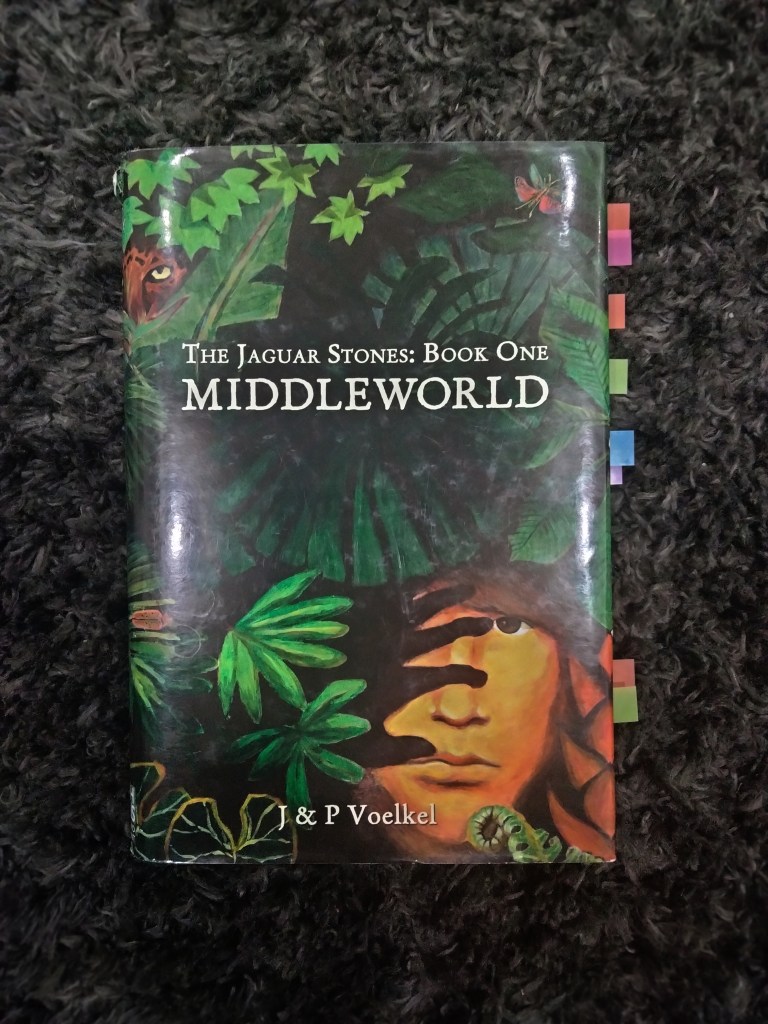
We continue our journey through darkest Jen’s TBR Pile with this book, which I picked up in an Idaho Falls thrift store several years ago and has been waiting patiently, like a pyramid under jungle cover but more durable, to be excavated.
One week ago, Max Murphy’s biggest problem was deciding which pizza to order. Now he’s lost in the perilous rainforest and running for his life with Lola, a modern Maya girl. Their terrifying journey will take them into the heart of an ancient evil and awaken powers that have slept for a thousand years. For fate has delivered an epic challenge to this pampered city boy. From now on, only one thing is for sure: Max Murphy won’t be eating pizza again any time soon.
from the dust cover
This book is the perfect YA Maya adventure. It starts with Max in Boston. His parents are archaeologists. They have to be gone a lot for their work. Max believes they “care more about the Maya than about him,” and he has learned to leverage this guilt into all the video games and snacks, and other luxuries his heart desires. This beginning is presumably there to ease the book’s target audience (American teens) into the Mayan context without a steep learning curve. They aren’t just thrown in; they find out things as Max does.
“Did anyone ever tell you that you’re bossy?” said Max.
“Did anyone ever tell you that you’re lazy?” said Lola.
“Yes,” said Max proudly, “all the time.”
“In the rainforest, lazy boys get eaten by jaguars.”
p. 150
But the book doesn’t stay in boring Boston for long. By Chapter 2, Max is in the fictional country of San Xavier (based on Belize). There is an excellent description of a nightmarish 3rd-world backcountry bus ride, a chapter or two at Max’s estranged uncle’s mansion, and then, he’s off into the jungle.
Behold this perfect author photo. Apparently, Jon grew up in Central America. Note also that the endpapers have a map of San Xavier. The map includes the Monkey River, Villa Isabella (Max’s uncle’s estate), and the five pyramids of Maya cosmology. If a place appears on this map, be sure we will visit it, either in this book or in a sequel.
Middleworld is an excellent introduction to the Maya cosmology, which is incorporated into a very lively adventure. As Max and Lola visit the different pyramids, they discover the purposes of the still-preserved machines within them: controlling the weather, time, etc., and even opening portals to Xibalba, the Maya underworld, into which Max’s parents have disappeared when they jumped into a cenote.
The overall adventure story is a good blend of actual Maya mythology and fictional or fictionalized characters. Lord Six Rabbit, who comes into the story, is a fictional ancient Maya king. The gods and demons we encounter are taken from actual Maya myths. Friar Diego DeLanda, an actual historical person who burned the majority of the Maya codices, makes an appearance. And because the intricate Maya calendar played such a large role in their cosmology, so it does in the events of this book. An Appendix contains an explanation of the interlocking calendar cycles and of how to read Mayan date glyphs, which are quite complex. Other appendices show a diagram of the Mayan cosmos; how to read Mayan numbers; and a glossary of characters and terms which appear in the book. By the time a reader gets to the end of the book, he or she might be interested enough to actually read this material.
It’s clear that the authors love Mayan culture, but they don’t shy away from the fact that many things about it were horrifying. Most of the rituals described call for blood, but the archaeologists have figured out that the blood doesn’t necessarily have to be from a human sacrifice — or even, necessarily, human:
[The archaeologist] Hermanjilio sighed. “Give me a break, will you? I don’t think there’s a precise science to these rituals. As I understand it, they’re more about showing swagger and confidence than following any particular steps. The Maya gods are like children. They like costumes, special effects, and plenty of action. We just have to put on a good show.”
“So you’re going to bluff it?” said Max.
“In a manner of speaking.”
pp. 244 – 245
For example, here is an entry from the glossary:
LORDS OF DEATH: The Maya underworld, Xibalba, is ruled by the twelve Lords of Death. According to the POPOL VUH … their names are One Death, Seven Death, Scab Stripper, Blood Gatherer, Wing, Demon of Pus, Demon of Jaundice, Bone Scepter, Skull Scepter, Demon of Filth, Demon of Woe, and Packstrap [???]. They are usually depicted as skeletons or bloated corpses. It’s their job to inflict sickness, pain, starvation, fear, destitution, and death … Luckily for us, they’re usually far too busy gambling and playing childish pranks on each other to get much work done.
p. 371
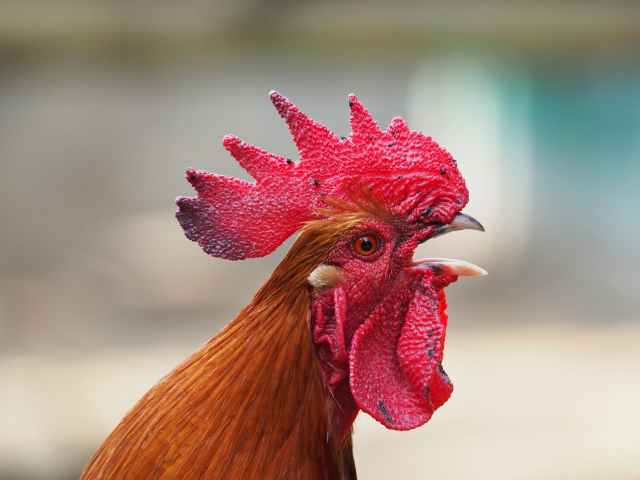
Given that everything in the Maya cosmos is simultaneously gross, horrifying, and (at least in this book) funny, it’s not surprising that Max and Lola are able to convince the Lord Six Rabbit and his mother that their chicken is a fearsome beast much more dangerous than its size would predict.
“Now tell them the bad news,” sighed Lady Coco. “Tell them what we heard!”
“What? What was it?” asked the others anxiously.
“The Chee Ken of Death,” said Lord Six-Rabbit. “We did not see it, but we heard its infernal crowing. It seemed to come from behind the cooking hut. I doubt my sleeping draught will work on that scaly devil.”
“Don’t worry, Lord Six-Rabbit,” said Hermanjilio. “I believe I am more than a match for this Chee Ken.”
This book, apparently the first in a series, strikes a good balance between a satisfying end to the adventure, and leaving some significant unfinished business open for later books. Near the end, Max strikes a deal with the Lords of Death in exchange for “a small favor” that they will ask of him in the future. That can’t be good.
My only complaint with this book is that there’s very little publication information on it. I can’t find the year it was published or the titles of the other books in the series. I guess I’ll have to go online to find out more. I will definitely seek to acquire the other Jaguar Stones books if the opportunity arises.
Edit: According to FictionDB, there are four books in the series:
… et regno occupato per tres potentissimos ac firmissimos populos totius Galliae sese potiri posse sperant.
Here’s the English translation given in the book:
“… and hope that, when they have seized the sovereignty, they will, by means of the three most powerful and valiant nations, be enabled to obtain possession of the whole of Gaul.”
Here’s my bumbling translation:
”… and having seized the kingdom, through three most powerful and brave peoples, they hoped to be able to be made able to all of Gaul … um … ones.”
Let’s zoom in on the phrase I am having trouble with:
sese potiri posse sperant
Now, this looks to me like “they hope [sperant] … to be able [posse] … to be MADE able [potiri] … ones [sese].”
Is it really “they hope to be able to be made able”? That’s just a ridiculous amount of helping verbs. It reminds me of the man quoted by Dave Barry, who allegedly said to his wife after she couldn’t get a ride, “If I’d a’ known you’d a’ wanted to went, I’d a seed you’d a’ got to get to go.”
But let’s look up potiri. I think it’s the passive infinitive of posse “to be able,” but maybe it’s something else.
[Duck-Duck-Go]
Ah-ha! It’s a different verb.
potior, potiris, potiri I, potitus sum (Dep.)Verb
user edited
Translations
to obtain, to acquire, to grasp, to attain, to reach (goal), to come by (experiences)
Well, it’s that time of year again: the long, long weeks of post-Christmas winter, when we grit our teeth and read the books that are not fun but are good for us. I think it was this time of year, a few years ago, that I read The Gulag Archipelago by Aleksandr Solzehenitsyn. This is similar.
The poison of class war
First, some background. I don’t like Marxism. I don’t like anything that has even the faintest hint of class war in it, in fact.
I was a sensitive, easily guilt-tripped child, and I grew up in a “Christian” denomination that had an intermediate-to-advanced case of marxist infection in its Sunday School materials. They would take verses like “blessed are the poor” and “how hard it is for the rich to enter the kingdom of God!” and use them to make it clear to me that being an American, with a high standard of living relative to the rest of the world, was not only a sin, but a very special sin, in a category all its own, because this was one sin which you could not repent of and to which the blood of Jesus did not apply. I was the “evil rich,” and there was nothing I could do about it. Also, because of this, I was morally guilty for any suffering that happened anywhere in the world, provided that the United States was somehow involved or the people suffering were “poorer” than I was. And I swallowed all this. I felt guilty, not grateful, for every little purchase or luxury. And eventually, I felt defensive about them.
I now know, based upon what I have learned since, that marxian systems by their nature do not include repentance or grace. These are Christian concepts. We cannot expect them from a system that works by designating a villain class, then constantly expanding that class. I had already figured out, simply from applying common sense, that the “logic” of class-war thinking is illogical, years before Lindsay came on the scene, but once I started reading him, it became even clearer.
As a simple piece of first advice for pushing back against Critical Race Theory, stop assuming it has good intentions. Individual people pushing Critical Race Theory might have good intentions, but the Theory they are applying does not. For liberals, this is a tough pill to swallow. Critical Race Theory ideas are not liberal ideas, and they cannot be considered on liberal terms. They are viruses meant to infect the liberal order. Assuming the ideas must mean something more reasonable than it seems or that activists won’t equivocate between meanings in a strategic way to seize power will cause you to lose every single time.
ibid, pp. 254 – 255, emphasis in original
There is no redemption in a marxian system. The only way you, as a dirty resource hog, could possibly redeem yourself would be to fix all the problems and all the suffering in the world. Since you can’t do that, you will probably die in the Revolution. Sorry not sorry. And you’ll deserve it.
It still baffles me when well-meaning people (usually women, TBH) try to “comfort” me by telling me something along the lines of “It’s not your fault. It’s the fault of Capitalism. You are the oppressed. The System needs to change.” (“It” could be anything from the difficulty of navigating the health insurance system, to eating healthy.) I just want to shake their shoulders and say, “Are you kidding? We are the ‘capitalists.’ We are the ones they hate and blame. If you blame ‘capitalism,’ you are blaming me and saying I should not have any private property.”
This sounds kind of self-pitying, so let me hasten to add that I fully realize that being guilt-tripped, blamed, and messed up in the head over your class status is by far the least harmful outcome for anyone exposed to Marxist ideas. For millions of people who were more directly affected, it cost them their very lives. However, my little story does illustrate how the only fruit of class-war rhetoric is to divide people from one another and give them hang-ups. It never makes relationships better.
O.K., so that’s bit of background #1. Me and Marx – not good buddies. No, indeed.
A challenging book to read
Second bit of background: over the past several years, I have listened to many, many hours of lectures by James Lindsay. It was a fellow Daily Wire reader who first pointed me to Lindsay’s website, New Discourses. (Fun fact: one of my kids for several years thought the site was called Nudist Courses.) Anyway, Lindsay’s podcasts quickly became a regular feature of my listening-during-chores lineup. I would do dishes, pick berries, paint, or fold laundry while listening to his dry, mathematician’s voice punctuated by occasional naughty words when the stupidity of the ideas he was describing provoked him really, really bad.
I listened to Lindsay talk about the Grievance Studies Project that he carried off with Peter Boghossian and Helen Pluckrose. I listened to him read and analyze essays by Herbert Marcuse, Kimberle Crenshaw, Derrick Bell, bell hooks, Robin DiAngelo, Jacques Derrida, and Paolo Freire. As I was listening, Lindsay was also learning. He traced modern identity politics back through the postmodernists, back to Marx. Marx’s ideas he traced back to Hegel, as he did long episodes about Hegel’s extremely convoluted philosophy and how Marx tried to remove Hegel’s mysticism. Eventually, he uncovered the occult roots of Hegel and other German philosophers. It was from Lindsay that I first heard the term Hermeticism (although I was listening to a lecture on Gnosticism by Michael Heiser around the same time).
Lindsay started out in the New Atheist movement, with a special interest in the psychology of cults. He then disassociated himself from the New Atheists when he noticed they were behaving, as a group, rather like fundamentalists. His views on religion have matured over the years. He now realizes that not all religions are equally cultlike or equally bad for society. And, after much research, he has correctly identified modern identity politics as a reboot of the ancient Gnostic/Hermetic mystery religions, complete with secret knowledge, sexual initiation rituals, and the promise to transform human nature itself into something greater. “Ye shall be as gods.”
If all of this sounds hard to believe, you can find all these lectures on the New Discourses website and most of them on YouTube as well.
I go on at such length about this in order to convey to you just how well oriented I was when I picked up Race Marxism. I had already heard Lindsay lecture on the thinkers he mentions in the book, many of them multiple times. (And for many of them, it takes multiple times to actually retain their concepts, because they are intentionally complex. Not to speak of the way they love to invent words, flex on their readers, equivocate, and even undermine language itself.)
I was really well oriented, baby.
And even so — even so — I found Race Marxism to be a slog.
I honestly don’t think this is Lindsay’s fault. He’s trying to give us the history of a concept (“Critical Race Theory”) that is intentionally obscure. Many different streams of thought have gone into it, and the Theory’s proponents take advantage of this to toggle back and forth between the different meanings of the concepts in their theory. In fact, they use the Theory’s slipperiness as a sort of shibboleth. That way, if someone says something negative about the Theory, disagrees, or even simply states the theory in terms they don’t like at the moment, they can claim that this person has not really understood it.
Critical Theories exploit this confusion by focusing virtually entirely on “systems,” which are almost impossible to pin down or describe accurately, not least since these “systems” really are stand-in descriptions for “everything that happens in any domain human beings are involved in, and how.” That is, when a Critical Theory calls something “systemic,” what it really means is that it has an all-encompassing Marxian conspiracy theory about that thing. When people don’t think that way, Theorists then accuse them of not understanding systemic thought, or, more simply, of being stupid and intellectually unsophisticated. This little trick is very useful to activists because it allows them to call everyone who disagrees with them too stupid to disagree with them and generally tricks “educated” onlookers into thinking the plain-sense folks must be missing something important, nuanced, and complex.
ibid, p. 233
Any book that tries to engage with, pin down, and define a thought system that uses these tactics is going to be a slog. Lindsay has to trace several different lines of thought, so he’s coming at the same concept from a different angle in chapter after chapter. It’s all one big tapestry, so there’s not a clear, natural place to start. The first few chapters feel as if we are going in circles a bit. Lindsay has to quote CRT authors at some length, and they are not good writers. Additionally, because their entire philosophy is based upon envy and hate, even when they are somewhat clear they are unpleasant to read. But he is not going to make a claim about CRT and then not back it up. So, we get things like, “No, CRT is not simply anti-white-people; instead…” [twenty pages later] “… and that’s how CRT manages to be anti-most -white-people while denying the reality of race.”
The book picks up towards the end, when with much blood, sweat, and tears, the basic claims of CRT have been established beyond a doubt and Lindsay can move on to how it affects organizations and what can be done about it.
What will your experience be like reading this book?
I’m not sure.
It depends upon how familiar you are with these concepts already, and how quick of a study you are. It might also help if you do your reading from this book at a time of day when you are fresh. I think part of my problem is that I was slogging through it, often when tired or otherwise unwell. It’s not really the sort of book that you can take to an event, or dip into in a waiting room.
If these concepts are totally new to you, and you are a very quick study, you might come out of this book with the experience of “mind blown!” However, it’s more likely that you will grasp some things on the first go-round, but will understand more each time you re-read a given chapter. (That’s actually my experience with most non-fiction books.)
It is the nature of Critical Race Theory to have a whole bunch of academic, intimidating-sounding terms to describe just a couple of ideas that, when you get down to it, are fairly simple and also stupid. So the learning curve is steep at first, but quickly flattens out if you know what I mean.
I bought this book primarily to have on hand as a resource. I had to read it cover to cover at least once, so that I know where to find things in it. I probably won’t do that again. But I will certainly dip into it, because it documents painstakingly all the ridiculous, counterintuitive, antihuman, incredibly damaging claims that have been made in this theory, and who made them, when and where in what publication. That is an invaluable resource to have on hand, because there will be new terms and new claims soon, and the Theorists will deny that anyone ever made the old ones.
So, I bought this book more as a reference book than anything. I hope that you will, too. Lindsay has done a fantastic job compiling all this stuff and sorting it all out in some kind of order. Perhaps, if he had spent more years on it, he could have polished the prose and made it more pleasant to read, but that wasn’t the priority. The priority was to get this book out there in time to undeceive as many people as possible about this insidious theory. It doesn’t have to be pretty. It just has to exist.
This abbreviation stands for Extraverted, INtuitive (grasping things with a quick impression instead of looking at every detail), Feeling, and Perceiving (going with the flow instead of planning a lot).
According to the website 16personalities.com:
When something sparks their imagination, ENFPs show an enthusiasm that is nothing short of infectious. These personalities can’t help but to radiate a positive energy that draws other people in. Consequently, they might find themselves being held up by their peers as a leader or guru. However, once their initial bloom of inspiration wears off, ENFPs can struggle with self-discipline and consistency, losing steam on projects that once meant so much to them.
Even in moments of fun, ENFPs want to connect emotionally with others. Few things matter more to these personalities than having genuine, heartfelt conversations with the people they cherish. …
ENFPs need to be careful, however. Their intuition may lead them to read far too much into other people’s actions and behaviors. Instead of simply asking for an explanation, they may end up puzzling over someone else’s desires or intentions.
My Particular ENFP
As it happens, I am married to an ENFP, so I can tell you all about them. I can say with confidence that anything done by my ENFP is, reliably, done by every other ENFP out there. You can rely on me for guidance to this type.
And what I can tell you is that ENFPs make puns.
Puns are my ENFP’s daily bread. When he gets on a roll, he makes them a-grain and a-grain. They are a lot butter than these ones I am making, dough.
Few things are a bigger treat than to have a front-row seat when an ENFP and another type that likes to pun get into a pun volley. I have been witness to a few of these, where they not only stayed on the facial topic, but also kept the puns within the same theme. This kind of art is so ephemeral, I have forgotten all the puns they made.
ENFPs are funny with language. They might have favorite big words:
Chick flicks are films that are lugubrious. I don’t like getting all lugubrious.
They tend to give things funny names. See if you recognize these restaurants:
Burger Death
Dead Lobster
Taco Gehenna
Taco Jaundice
Unterweg
Little Squeezer’s
Dead Robin
Other nicknames are not suitable for a public blog.
Speaking of which, ENFPs (again, this is based on my extensive expertise) are so into building good relationships that will use mock attacks to do so. For example, my ENFP has occasionally been known to cry out, “Lies!” while a friend is speaking. He once asked me whether I thought he ought to sucker-punch another guy in the lobby at church, because they were friends. (He ended up faking a punch.) Often, these play fights become in-jokes, another category of relationship/humor that the ENFP loves. Once something has a silly nickname, or someone has been accused of something ridiculous, it stays that way forever, or at least until a better in-joke comes up.
My ENFP loves insults that sound unanswerable, for example:
If we aren’t supposed to eat animals, how come they are made of meat?
If you have a little more time, I have a few more pearls to cast.
Neither of these is original to him, but he uses them frequently.
But as a counterpoint to all the linguistic virtuosity, you get utterances like this:
Did you load the one thing? (the dishwasher)
Have you seen that one kid? (that’s your son, sir)
We need to get the thingy. (You got me on this one. The taxes? The lotto ticket? Another chicken coop? I don’t know, but it’s urgent.)
ENFPs are the type most likely to use words like whatsit, thingamagig, dealybob, and doohickey. They are very smart, but they can’t always slow down to locate the precise term. In Southeast Asia, we learned the term ano, which can literally replace any part of speech. My ENFP still uses it occasionally.
ENFP’s gifts make him the perfect trip planner. He is great at throwing together a spontaneous weekend jaunt to go on a hike or see a local (or not-so-local) site … and get eight people to join him. And he will be punning all the way.
“God from God, light from light” *(these are direct objects, so the subject and verb are coming up)
Gestant puellae viscera
“A girls’ innards carry” (the subject and verb, and by far my favorite line)
Deum verum
“True God” (and still the direct object)
genitum non factum
“Begotten, not made”
Refrain: Venite adoremus, Dominum “O come, let us adore/The Lord”
Cantet nunc io, chorus angelorum
“Sing it now, chorus of angels”
Cantet nunc aula caelestium
“Sing now, heavenly court”
Gloria, gloria in excelsis Deo
“Glory, glory to God in the highest”
Refrain: “O come, let us adore/The Lord”
Ergo qui natus die hodierna
“Therefore, who is born on the day of today”
Jesu, tibi sit gloria
“Jesus, to you be glory”
Patris aeterni Verbum caro factum
“Word of the eternal Father made flesh”
Refrain
See how the Latin is actually more direct/efficient than the English? Kind of shockingly so?
I think because the original Latin version had so many syllables, to translate the lines into English, additional words had to be added, and sometimes even new ideas such as “Yea, Lord, we greet thee,” which is how the fourth verse begins in English and is one of my favorite lines in that version.



 Out of Babel Books