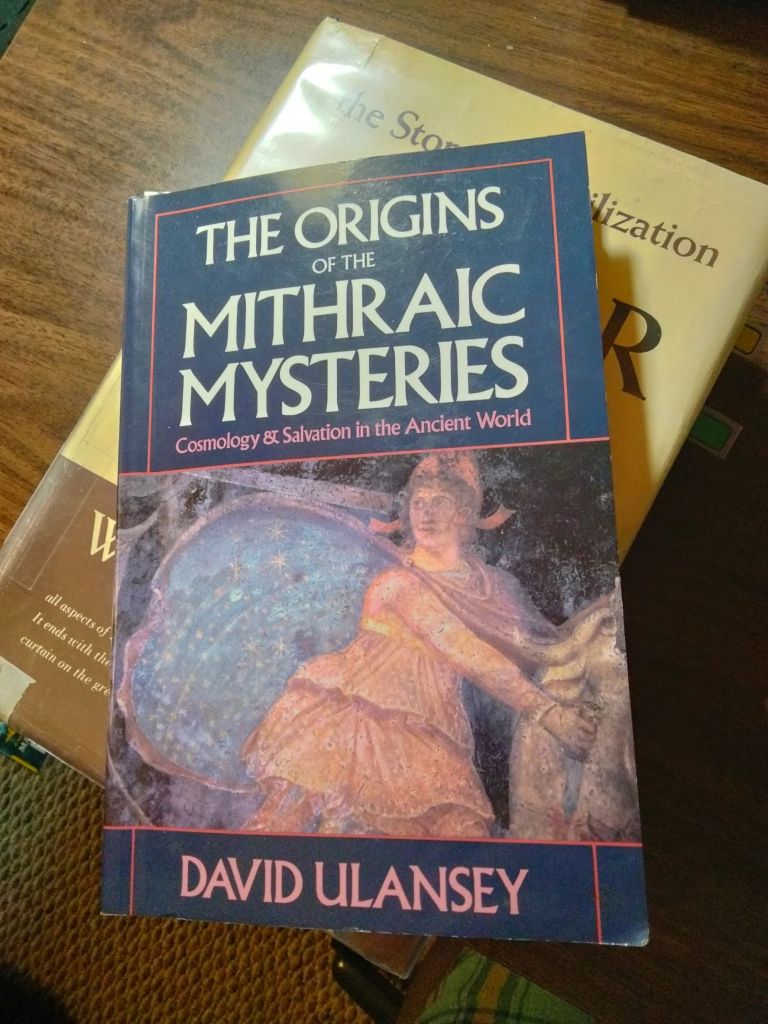
Book Review: The Origins of the Mithraic Mysteries by David Ulansey

I thought you should know that this book exists.

I don’t even remember where I got it. I have a feeling I got it at a used book store or a library sale, or maybe I stole it from my dad’s library. I know it’s been sitting around my study for a few years, waiting for me to get to it. It was published in 1989.

This is a good, accessible piece of scholarly work that first explains what the cult of Mithros was, then traces the history of scholarly thinking about it, and then advances Ulansey’s theory about what was really behind the cult.

What Is Mithraism

Mithraism began to spread throughout the Roman Empire in the first century C.E., reached its peak in the third century, and finally succumbed to Christianity at the end of the fourth century. At the cult’s height mithraea could be found from one end of the empire to the other, “from the banks of the Black Sea to the mountains of Scotland and to the borders of the great Sahara Desert,” as one authority puts it.

ibid, p. 4

As a result, many of the underground Mithraic temples whose iconography Ulansey shows pictures of are found in Germany or in Italy, although this is a cult that had its origins in Tarsus, in southern Turkey.

For a long time, the accepted theory among scholars was that the god Mithras got his start as the Iranian god Mithra, because they happen to share a name. However, the attributes of Mithras don’t line up very well with those of Mithra, which leaves the door open to other explanations.

The cult was apparently based on a story where Mithras slaughters a bull, and from the bull’s body sprang all the plants that man finds useful, such as wheat, grapes, etc. Because it was a mystery cult, nothing was ever written down about the secret meaning of this story, nor of the levels through which the neophyte progresses as he is initiated deeper and deeper into the mysteries. But in all Mithraic temples, there is consistent iconography. This includes a picture of Mithras slaying the bull, with wheat coming out of the wound. Mithras is typically looking away from the bull (though this is “corrected” in some reconstructions), wearing a distinctive hat which was associated with Persia and with Perseus in the ancient world. Around him are placed other figures which will prove to have significance in unravelling the meaning of the cult. Sometimes, the whole scene is placed under an arch or inside a circle that shows the zodiac. Sometimes, Mithras is also portrayed as standing inside a circle or hoop lined with star symbols.

A Brief Tour of the Ancient Mediterranean, Near East, and Europe

In unfolding his theory, Ulansey takes us on a fascinating tour of the ancient world. For example, he spends a lot of time establishing how and why Mithras came to be associated with (based on?) Perseus, who was the founder and hero of the city of Tarsus and, in fact, the local god of that whole region. (Mithras’ hat — a “Phrygian cap” — was originally worn by Perseus, and Ulansey contends that he looks away from the bull as he slaughters it because Perseus looked away from Medusa as he slaughtered her.) He gets into the fact that the cult may have originated with pirates of Cicilia, which lies just off the coast from Tarsus:

[T]he Cicilian pirates were far more than a mere band of thieves. Rather, the pirates, who numbered at least twenty thousand, formed what amounted to a small nation which at its height controlled the entire Mediterranean Sea.

ibid, p. 88

Ulansey then quotes Plutarch from Life of Pompey:

“The power of the pirates had its seat in Cicilia at first … then, while the Romans were embroiled in civil wars, the sea was left unguarded … until they no longer attacked navigators only, but also laid waste islands and maritime cities … There were also fortified roadsteads and signal-stations for piratical craft in many places … more annoying than the fear [the pirate fleets] inspired was the odious extravagance of their equipment, with their gilded sails, and purple awnings, and silvered oars … For you see, the ships of the pirates numbered more than a thousand, and the cities captured by them four hundred … Presently men whose wealth gave them power, and those whose lineage was illustrious, and those who laid claim to superior intelligence, began to embark on piratical craft and share their enterprises.”

ibid, p. 88

There are plenty of other fascinating historical nooks in this edifice, such as the figure of a lion-headed man, entwined by a snake, standing on a sphere; the idea of Mithras being born out of the rock; the exact nature of the Gorgon, and many, many others. Every single one makes sense when it comes up in context. That said, there were certainly some bizarre ideas floating around in the ancient world.

The Zodiac

So, to get right down to it, Ulansey’s case is that the Mithraic mysteries were a way of encoding astronomical knowledge. Because this is the ancient world we are talking about, this knowledge could equally be considered scientific, cosmological, and religious, as will become clear shortly.

Lately, I’ve been studying the zodiac in a desultory fashion. Don’t worry, I am not planning to take up astrology. Astrology is specifically forbidden to faithful Jews, and to children-of-Abraham-by-faith like myself. But it is of interest to me, because it was so important to the people of the ancient world. They worked it into their monuments and their mythology. The signs of the zodiac, and other constellations, were associated with the gods, and a good case could be made that this association started in pre-Flood days.

The other thing that fascinates me about the zodiac is that it’s so hard to observe. Now that I keep chickens and also work outside the home, I’ve been obliged to get up before dawn to let the chickens out. I live in a rural area with relatively dry weather, so you’d think it would be easy for me to take a quick glance at the horizon while I’m out there, and be able to tell which constellation is in the east, right where the sun is going to rise in an hour or two. As it turns out, it’s not so easy as all that. You not only have to know which direction is due east, you also have to have something that helps you sight where the sun is going to rise … and it moves. Then you have to be able to recognize the constellations. To really figure out the whole zodiac, you’d have to be making these observations daily, throughout all the seasons of the year, until you noticed that the constellations of the zodiac make a notional belt around the earth, and that at different times of year, they take turns “housing” the sunrise. This is already difficult enough that you’d have to have a pretty strong motivation to pursue it. (Stronger than mine is right now.) Ancient people thought this was so worthwhile that they managed to master the very difficult science of astronomy. Many ancient monuments, in fact, were built as observatories, from Stonehenge to many structures in the Americas.

Why were they so motivated to study the stars? That’s a discussion for another time.

According to Ulansey, the Mithraic iconography (and probably the whole cult) was designed to encode the secret of Equinoctal Precession. This is a really complicated phenomenon, so if you don’t know what it is, I’ll let you look it up. Basically, because of an irregularity in the earth’s rotation, the zodiac sign that “houses” the sunrise on the equinox will stay the same for 2,160 years, by which time the sunrise has migrated back to the previous zodiacal sign (hence, precession). (Also, incidentally, Polaris has not always been the the pole star.) Precession has been discovered at different times in the past by different civilizations. Graham Hancock makes a pretty good case that it was known by somebody, before conventional history began. But due to the difficulty of observing it, it has not been known at all times by all peoples. Around the time that the cult of Mithras apparently started, it had recently been discovered, and begun to be talked about, in the vicinity of Tarsus, in the same intellectual circles that were also providing aristocratic pirates.

Breaking Hoops and Wheels and Mills

Now, to you and me, equinoctal precession might fall into the category of “Oh, that’s interesting.” Not so for the ancients. For one thing, this cult probably started among pirates, who use the stars to navigate. The idea that the stars were once different and are not the same all the time would be earth-shattering to them. But this news gets even more ominous when we understand ancient cosmology.

(And when I say “ancient” here, I am talking about the cultures of the Mediterranean, Ancient Near East, and parts of Europe. Though, not to keep mentioning Graham Hancock, but in his book Fingerprints of the Gods he finds similar cosmology in ancient India, Central America, and Scandanavia. So a case could be made that this cosmology was once worldwide.)

This ancient cosmology, then, conceived of the heavens as a huge machine, constructed of two or more intersecting hoops (the zodiac, the celestial equator, and, essentially, the prime meridian/international date line projected into the sky). Sometimes the heavenly machinery is portrayed more as a big edifice with four pillars supporting it. Sometimes it’s a “mill” that turns. Probably some ancient people took this more literally than others; some understood it was notional, but represented something real.

Now, imagine that you think of the universe as a big, finely tuned machine, where the constellations always end up in the place they are supposed to be. If the whole hoop has moved out of its place, this could be conceived of as “breaking” the machine. This is why cycles of a certain number of years (not everyone got the precessional intervals right) were thought to bring cataclysms upon the world. So, we get myths worldwide about a mill being broken, and this causing the stars to fall from their places, the sky to become dark, fire and floods to sweep over the earth, etc. Again, read Hancock to find out more about this than you ever wanted to know.

But the point is, whether the Cicilian pirates thought that precession caused a cataclysm, or whether it just meant the universe was less stable than they had imagined, this would have been a revolution in their scientific, cosmological, and religious thought. (Religious because, in ancient times, science and cosmology and religion were really all a part of one system, especially when you consider that the stars and other heavenly bodies were thought to metaphysically influence events on earth.) So, whether you count it as belonging to three, two, or just one unified field of knowledge, this was a big enough discovery to be kept secret (a “mystery”) and passed on to initiates in a whole new cult religion.

The Unseen Realm by Michael S. Heiser

Photo by sk on Pexels.com

This review will bring a number of threads together, but it won’t give you a comprehensive sense of everything discussed in this book, because it is a long, complex book with lots of things to chew on.

The Unseen Realm is a theological book written at a popular level, but with lots of footnotes. I would say it is for serious lay students of the Bible. It frequently refers to the Septuagint (the Greek Translation of the Old Testament that was in popular use in New Testament Times), and to other different ancient manuscripts of various Bible passages, some of which have slightly different wording that can be key for Heiser’s arguments. The scholarship on the many topics that this book encompasses is voluminous, so much so that there is a companion web site with additional articles for all the things that this book can’t get into in detail.

All of that said, it is not boring, at least not if you are interested in its main idea, which is that of a divine council of “gods” being present not only in other ancient mythologies but throughout the pages of the Bible. I came to this book for my research into future fiction projects that I may or may not be working on (ooo so mysterious!). I found out less detail than I had hoped to about the divine council, but even when we don’t learn something, we learn something. In this case, I learned that the Bible does not give us a lot of detail about this divine council, its members, or how it supposedly operates. We can assume this is on purpose.

The Main Idea: the Divine Council

It was very common in the Ancient Near East to believe that there was a council of gods or divine beings which would meet, typically on a mountain far away, and decide the affairs of men. That’s why you will often hear the title “Most High God.” Heiser’s contention is that the ancient Israelites shared this view, and that in fact the Bible endorses it. It starts very early, with God saying, “Let us make man in our image.” Though some people see this as evidence for the Trinity, Heiser contends that what is being evoked here is that God is addressing a group of beings which have already been made in His image, but are not humans. God then, all by Himself, makes man in His image, with the other beings presumably just watching.

The flagship Bible passages for Heiser’s thesis are Psalm 82 and Deuteronomy 32:8 – 9. In the latter, it asserts that God “divided up mankind [and] fixed the borders of the peoples according the number of the sons of God. But the LORD’s portion is His people, Jacob his inheritance.” The idea is that God assigned each “son of God” (divine being) a nation to rule over, but He took the Israelites as His own nation. Psalm 82 shows God reaming out the gods for not having done a good job ruling over the nations, promising them that “they will die like mere men” and that “all the nations” will become God’s inheritance.

These are the two most obvious passages that indicate this idea, and even they are often translated to so as to hide the fact that the original authors assumed that divine beings existed and ruled over the nations. My NIV, for example, translates Deut. 32:8 as “… according to the number of the sons of Israel.” It also puts scare quotes around the word “gods” in Ps. 82.

Ugarit

Ugaritic is the ancient Semitic language most closely related to Hebrew. In Ugaritic cosmology, the chief deity was El. He had a divine council that met in a lush garden or on a mountain. He had seventy “sons of El” who made up his council, and he had a coruler, Baal (which means “lord”). Much of the imagery, vocabulary, and cosmology of Ugarit is echoed or riffed off of in the Old Testament, always making the point that Yahweh is the true Most High God, the one who sits on a throne over what looks like a sea of glass, that His garden is the true garden and His mountain is the true mountain. The Israelites, though, did not quarrel with the idea that there were seventy lesser divine beings who served God. This seems to have been accepted cosmology, sort of like we accept heliocentrism. The Bible does not come out and say this directly, because it was common background knowledge in the Ancient Near East.

The Table of Nations, in Genesis 10, shows 70 nations branching off from Noah’s three sons. The idea was that subsequent to Babel, each of these nations was assigned to a son of El – a lesser god. The Most High was done with them. He would no longer be their God directly. Of course, some day the lesser gods, who did not do a good job with their people, would be demoted. Yahweh had plans to bring all the nations of the earth back and make them His own people once again.

The Divine Council in the Redemption Story

Heiser spends the rest of the book tracing this idea of the divine council, of Yahweh as the true God, and of the disinheritance and re-gathering of the nations, throughout the Bible, seeing how it plays in to the big redemption story. He gets into discussions about whether idols are nothing at all or whether they represent something more, and whether the word demon (shadim) means just a supernatural being or something evil. He gets to the giants. He gets to Jesus putting the local gods on notice when He starts crashing around Galilee. He visits the miracle of the tongues of fire at Pentecost. It’s all really interesting, really intricate, with a lot of scholarship.

Some of the ideas in this book were truly mind-blowing. For example, I had never before heard the term Monotheistic Binitarianism. (Wild!!!) “The startling reality is that long before Jesus and the New Testament, careful readers of the Old Testament would not have been troubled by the notion of, essentially, two Yahwehs — one invisible and in heaven, the other manifest on earth in a variety of visible forms, including that of a man. In some instances the two Yahweh figures are found together in the same scene. In this and the chapter that follows, we’ll see that the ‘Word’ was just one expression of a visible Yahweh in human form” (page 134). This is a consequence of mysterious Old Testament passages where Yahweh will appear to, say, Abraham in human form … but sometimes there are two or even three human figures, and the passages seem to be intentionally ambiguous about their identity or how many are there at any given time. There are not just a few of these instances either. Heiser says that this idea of “two powers in heaven” was “endorsed within Judaism until the second century A.D.” (135, footnote). It was the background to the famous passage in John 1: “In the beginning was the Word, and the Word was with God, and the Word was God. He was with God in the beginning …”

Other ideas, if I may venture, were less mind-blowing than Heiser seemed to expect them to be. Perhaps this is because I have been studying what you might call the weirder aspects of the Old Testament for some time, but even for someone who had never heard this idea, I sometimes got the feeling that Heiser was writing to a straw man. For example, he has a whole chapter about how God’s plan for a Messiah was hidden in the Old Testament, in hints that couldn’t be pieced together beforehand, but only made sense in retrospect, types and shadows. This is pretty standard Christian teaching, at least in the Reformed circles I move in, but Heiser seems to think that his readers have been given the impression that God’s whole plan of salvation was spelled out super clearly in the Old Testament. “Chances are good that you’ve heard the New Testament mistakenly read back into the Old hundreds of times. Therefore you might be surprised to hear me say that the Old Testament profile of the Messiah was deliberately veiled” (241). In the rest of the chapter, he proceeds to read the New Testament back into the Old. “It couldn’t be emblazoned across the Old Testament in transparent statements.” Yes, we know. After Jesus rose, He said, “These are my words that I spoke to you while I was still with you, that everything that is written about me in the law of Moses and the prophets and psalms must be fulfilled.” Then he opened their minds to understand the scriptures. (Luke 24:44 – 45, quoted by Heiser on page 242) Yes, we know. The New Testament Christians could not see the significance of the Old Testament passages until Jesus (and, later the Holy Spirit) opened their eyes to see it. In fact, they spent the rest of their lives making “So that’s what that was about!” discoveries. Perhaps some modern Christians don’t realize this, but I think most people do who have spent years doing Bible study. In fact, many of the doctrines that we take for granted had to be worked out by the church through history.

Similarly, Heiser has a whole chapter about why God’s plan included making beings with free will and how this necessitated evil and how He couldn’t just erase everything and start over as soon as we messed up. Heiser is not a fan of Calvinism. Like most Arminian arguments, he seems to have a shallow understanding of what “free will” means and a shallow understanding of Calvinism as a sort of dystopian vision wherein people (and gods) are mere sock puppets directly controlled by God. I am willing to accept that God is sovereign, and that beings other than Him exist in the universe (human and supernatural), which make real choices that are in some sense free. I get that these two things should not go together, but that we have good evidence for both. So it is a paradox. I don’t need to choose between sovereignty or free will to understand the idea of a divine council.

What We’re Not Told

After reading Heiser, I am convinced that it is a biblical idea that there are spiritual “divine” beings that exist in an unseen realm. (Heiser points out that the word for these beings, elohim, is a place-of-residence word. They live in the unseen realm, therefore they are elohim. The word itself says nothing about their moral status.) Their existence plays a role, though I would still say not the major role, in God’s plan of salvation for humankind. In some ways, they are relevant, especially in their role as rogue gods of the nations. In other ways, a lot of what goes on in the unseen realm is none of humankind’s business.

Perhaps this is why the Bible does not tell us — and thus, Heiser does not tell us — the sort of details about the elohim that a researching novelist would naturally want to know. Here are a few unanswered questions:

  • Are there really only seventy of them? What happened when the seventy nations multiplied into many more?
  • There appears to be a hierarchy in the unseen realm, but what is it like? How many levels?
  • Are the beings on the different levels different species/different in appearance (if that question even means anything)? Does the unseen realm have the equivalent of animals?
  • We know some elohim rebelled against God, but how many? When? Was there more than one rebellion? Are all the rebel spirits organized under Satan, or are there rogues and factions?
  • How does or did this divine council even work? In almost all of the glimpses we are given of it, it’s basically just God announcing His intentions and the council members just watching.
  • There is a well-established association between the gods and the stars or constellations, but how does this work? Are they the same or symbolic? Is it a one-to-one correspondence?

This is the kind of thing that a really good novelist would get all nailed down before writing a book like, say, This Present Darkness … but it’s impossible to nail down because we are not told this stuff. Again, this is probably because it is none of our business. So if you are going to write a novel that includes gods, I would recommend you just delve into the mythology of one particular nation (Ugarit, say, or Greece as many authors have done to great success), accepting that you are riffing off of one particular nation’s interpretation of all of this, an interpretation that is based on something real, but is definitely not going to be accurate in all its details.