Cooking with Clay Beads

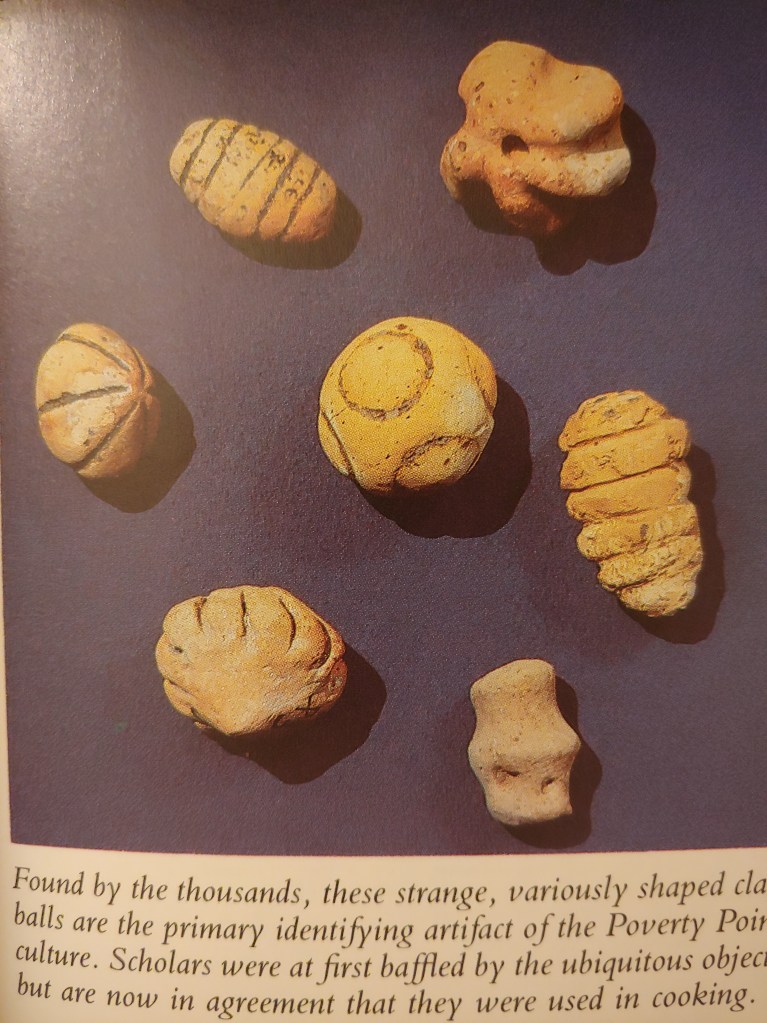
Clay “cooking balls” of the kind used in the Poverty Point culture in what in now Louisiana

Original title: “Cooking with Balls.” I didn’t have the … you know, courage … to go through with that one. But it’s not my fault! “Cooking Balls” is, I promise you, what they are called in the source material.

Although we know little about the Poverty Point people and their extraordinary center on Bayou Macon, we do know a great deal about their cooking habits. The most typical of all the artifacts is — surprisingly enough — a small baked clay ball, only one to two inches in diameter and two to three ounces in weight. The odd-looking balls, most often molded in melon, oblong, cylindrical, spiral, and biconical shapes, were used in cooking. Thousands of them have been unearthed so far. Indeed, so ubiquitous are these tiny finds that they are simply called Poverty Point objects.

The Poverty Point people used them not only more intensively than others [who cooked with heated stones], but also more innovatively, for a new style of cooking: pit-oven baking.

Mysteries of the Ancients Americas, The Reader’s Digest Asscn, Inc., pp. 113 – 114

The Poverty Point people, reconstructers think, would wrap fish, meat, or potatoes in wet leaves, place them on a bed of hot coals, and then cover them with a layer of hot clay balls. You know, they basically made what at camp we used to call a “hobo dinner.” Except we were always eating our hobo dinners half-raw, because we were not as patient as the people at Poverty Point.

In the Out of Babel blog tradition of writing about some ancient practice and then pretending that we are still doing it, I would like to show you my own cooking beads.
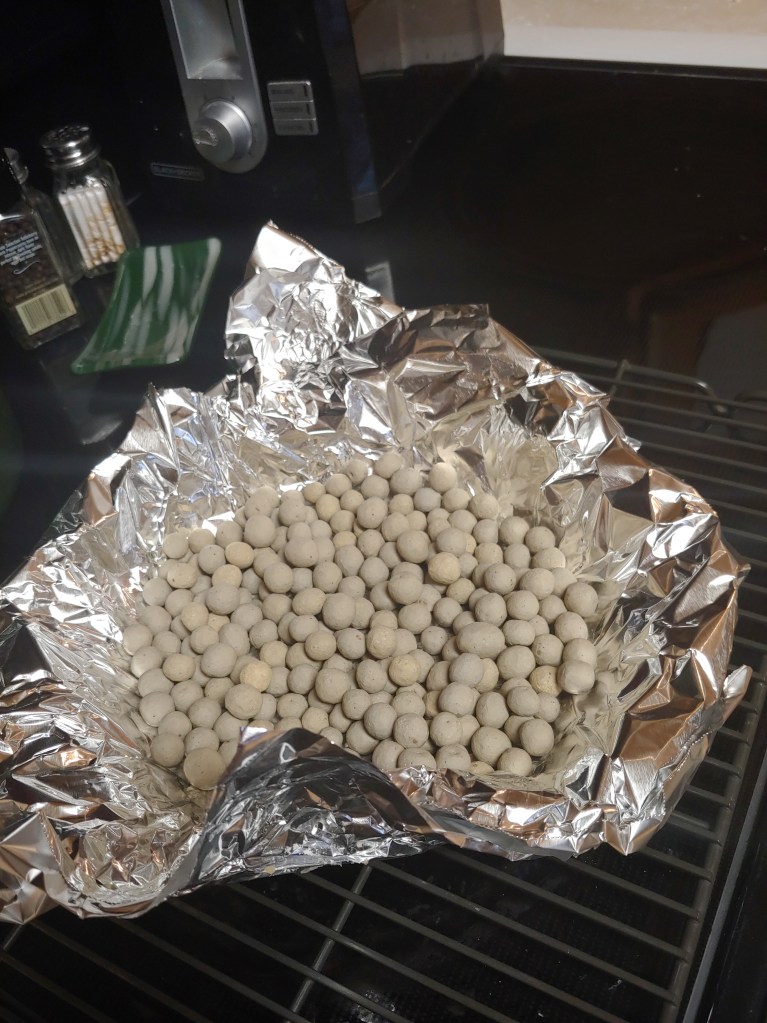
“Cooking balls” of the kind used by the modern mom

Not the greatest lighting on this photograph, but here they are, sitting in a nest of aluminum foil, on my ultramodern, convenient electric stove. The only modern use of clay cooking balls that I am aware of, is to make baked pie crust shells. If you bake the pie crust with nothing in it, it bubbles up, warps, and then it can’t hold the instant pudding later. You have to weight it down with something. You can use just two layers of aluminum foil, but heavier is better. For a while I was using uncooked lentils (per Martha Stewart). They worked OK, but they had a certain legume-y smell when baking and besides, clay cooking balls are so much cooler. I suppose that in a pinch, I could use them for pit cooking. Let’s hope it never comes to that.

According to archaeologists, the Poverty Point cooking balls “could be used about 10 times before they cracked apart.” And yet, they put so much effort into them, making pretty designs and everything! I can imagine that making these little items was a creative outlet as well as a chore. Whereas, my cooking beads are completely plain (and still look like they were a hassle to make in such quantity), and I expect them to last for years. Of course, I don’t use them daily, and certainly not for the two hours it apparently takes to pit-cook food.

10,800-year-old Gardens in Amazonia

10,800 years ago, Early Humans Planted Forest Islands in Amazonia’s Grasslands

Much in this article is speculation, like the idea that there was an 8,000-year gap between people planting gardens and “full-blown agriculture” (whatever that is). Also, as always, the exact dates.

But this does seem to support the general picture that has been building … namely, that people got to the Americas a very long time ago, traversed them very quickly, and started gardening almost immediately … or perhaps already knew about agriculture before they got there, even if they had abandoned it for a generation or two while traveling. Or, as we like to say around here … (drumroll) … ancient people were already very sophisticated in the earliest records we find of them.

Yes, Virginia, There Is A … Wyoming

Ready for the latest fun conspiracy theory?

Wyoming doesn’t exist.

This theory uses the simple but brilliant logic that unless you have first- or second-hand experience with a thing (in this case, a state), then you cannot really accept it as proved. First-hand experience is demanded in the question: “Have you ever been to Wyoming?” Second-hand experience: “Do you know anyone from Wyoming?”

Delightfully, “One definition of Wyoming in the online Urban Dictionary says the Cowboy State is a fictional place and that people who try to drive north over the border will find themselves mysteriously transported to Canada, confused and sans clothing” (ibid). So, it’s a sort of Wyoming Triangle. This tickles me even more because, What about Montana? Montana is between Wyoming and the Canadian border. Do the conspirators not realize this? Is Montana so obscure that it doesn’t even get its own conspiracy?

Well, I am happy to tell you kids, that Wyoming does exist. I know because I live in its equally obscure neighboring state of Idaho. Wyoming is actually only a few hours from me, and if I drive an hour north, I can see the mountains on the border.

For further proof, here are myself and Mr. Mugrage (cropped out for privacy) standing in Wyoming, overlooking Jackson Hole (note the sign), on a big anniversary recently. The whole picture is in Wyoming, but for those who need extra proof, I have an added an arrow that helpfully points to Wyoming.

It’s cooold in Wyoming!

Finally, here is a trailer for a movie that is set in Wyoming:

At last, a conspiracy theory that I can personally put to rest. This might be the first (and, possibly, last) one.

Misanthropic Quote of the Week, from MawMaw

Teenaged J.D. goes to see his beloved grandmother, MawMaw, in the hospital where she has pneumonia. J.D. knows that older people often die of pneumonia.

J.D.: Are you going to die?

MawMaw: I don’t know.

[repeat several times]

J.D.: Just tell me. Are you going to die in here?

MawMaw: I don’t goddamn know.

J.D.: People know. Some people do.

MawMaw: No they don’t.

J.D.: Native Americans.

MawMaw: They’re called Indians, like the Cleveland Indians. And they don’t know, any more than other people. They’re not magic, just ’cause they don’t have microwaves.

from Hillbilly Elegy, on Netflix

Scary Thing: Bears

A Terrifying Bear Attack

So, this month I finally watched The Revenant. (It’s been out since 2015.)

The way the movie usually gets summarized is, “Leonardo DiCaprio’s character gets mauled by a bear, and his companions leave him for dead.”

Well, they don’t exactly leave him for dead. There is a lot of back and forth. There is money involved, and racial tensions, plus the difficulty of carrying a grievously injured man through rough country on a litter. But yes, basically, he does end up getting left for dead at some point, after efforts have been made to save him (and other efforts to finish him off).

Anyway, after watching, the big question in my mind was the same as in everyone else’s after seeing the movie: How in the world did they film the scene where he gets mauled by a bear?

It looks really real. I have embedded a YouTube clip of it at the end of this section, which you can watch if you have the stomach for it. At one point, the bear steps on the supine man’s head, stretches its neck forward, and snuffles directly at the camera. The glass fogs up from its breath.

Please tell me they didn’t use a real bear.

The first step, of course, was to study the credits carefully. Let’s see … Native American and First Nations acting agency … thanks to the Pawnee and Arikara nations … cultural consultants …. this stuff is fascinating. (One thing I loved about the movie was that subtitles, not dubbing, were used whenever characters were speaking Arikara, Pawnee, or French.) Oh, here it is. Animal wranglers. Wolves supplied by. Horses supplied by. Eagle supplied by. Hmm. There were no actual bears mentioned, but there were “animal puppeteers” and tons of animators.

It looks like it wasn’t a real bear.

Next step: Google. I found this article, where I learned that no, it wasn’t a real bear. It was a man in a blue suit. Even so, it took them four days just to shoot the six-minute scene, and then the bear’s muscles, skin, and fur had to be animated in separate layers.

The other disturbing thing was this: the only reason they didn’t use a real bear, was that captive bears nowadays are all too fat to be realistic.

I think that was a good move on their part.

Watch it if you dare.

Yes, in some ways the violent and unscrupulous humans are scarier, but actually … no. They are not. The scariest thing is the bear.

Euphemisms for Bear

It may surprise you to learn that the English word bear is not actually the original Indo-European word. It is a euphemism. The word used by the Indo-European ancestors, on the Ukrainian plains, was something like hrtko. My Indo-European dictionary explains in a sidebar:

The Proto-Indo-European word for “bear,” rtko-, was inherited in Hittite hartaggash, Sanskrit rksah, Greek arktos, Latin ursus, and Old Irish art.

But in the northern branches [of the Indo-European language family], the word has undergone taboo replacement. The names of wild animals are often taboo to hunters … Among the new expressions for “bear” were “the good calf” in Irish, “honey pig” in Welsh, “honey eater” in Russian, and “the licker” in Lithuanian. English “bear” and its other German cognates are also the result of taboo replacement, as etymologically they mean “the brown one.” (see bher-)

The American Heritage dictionary of Indo-European Roots, p. 74

(In case any linguistics purists are reading this, I should note that important diacritic marks are missing from the Indo-European, Hittite, and Sanskrit words in this quote.)

We can imagine that there were a number of terrifying attacks behind this taboo replacement. Or perhaps there was just one, well- (or horribly-) timed one, early in the northern Indo-Europeans’ journey towards their eventual homelands.

So, here are some euphemisms for bear:

  • bear/bruin (“the brown one”)
  • Beowulf (“bee-wolf”)
  • Medved (“honey eater”) (honey = mead)

In my books, the family ends up calling bears “the bad one.”

I like bears. But only as an idea. As actual creatures, they have earned their place on this October’s list of … Scary Things.

Weed of the Week

(Sounds better than Wildflower of the Week, don’t you think?)

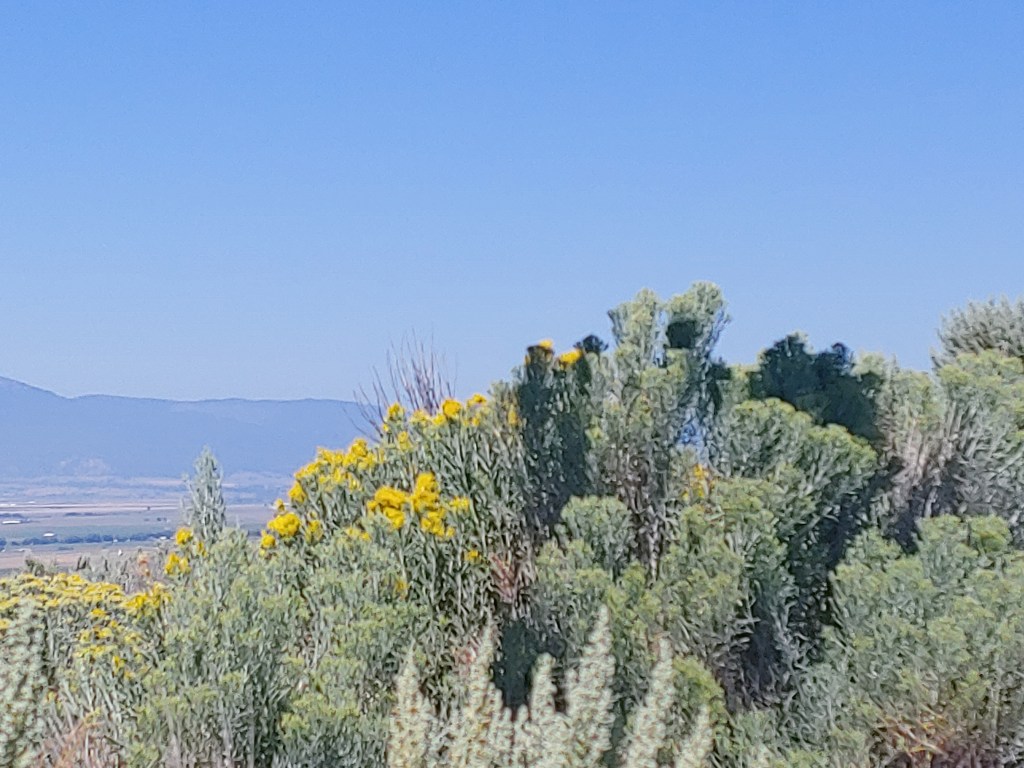
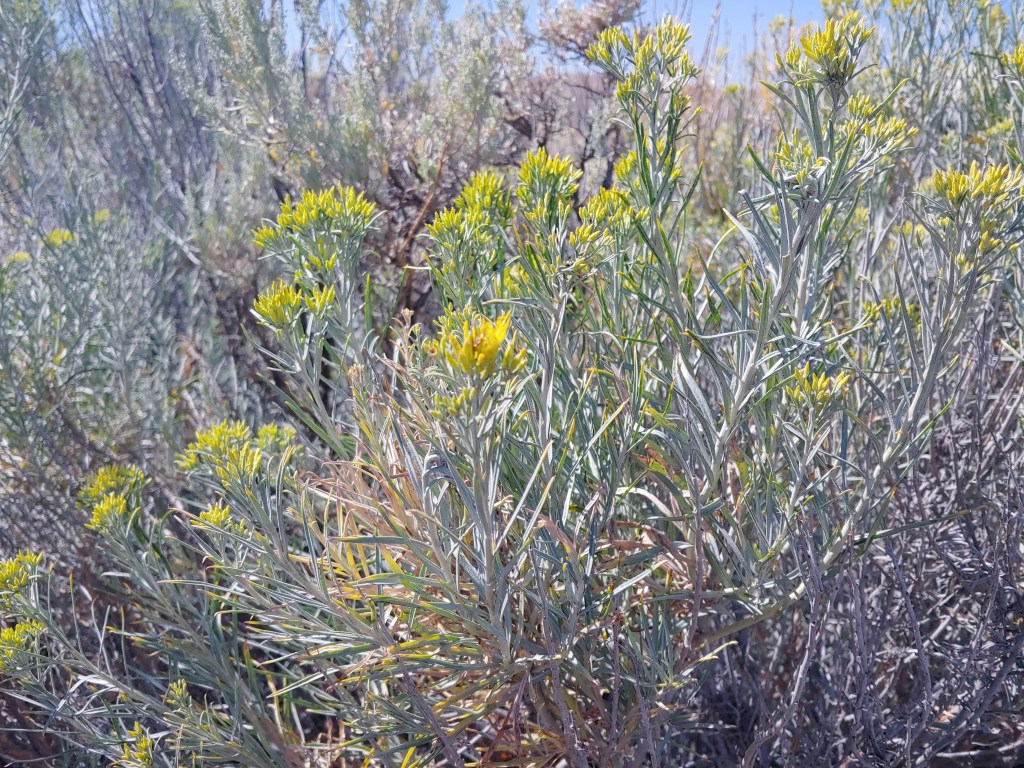
This … is Rubber Rabbitbrush. Or, as I like to call it, “False Yellow Sage.” Or maybe, “Not Actually Yellow Sage, Dummy.” (I am getting the hang of this botany thing. You can just make up any descriptive name, pretty much.)

When I first started noticing this species, I naturally assumed it was some yellow-flowered variety of sagebrush. Reason: it is the same general size, shape, and even color as Silver Sagebrush, and it grows everywhere that Silver Sagebrush does.

Observe:

Here it is growing happily interspersed with Silver Sagebrush, overlooking the spectacular views of Baker, Oregon. But it doesn’t only do this in Baker. It does it in Idaho as well. I see it doing this sneaky little trick everywhere.

Assuming, as I did, that this was some kind of sagebrush, I was completely stymied when I could find it nowhere in my trusty Central Rocky Mountain Wildflowers guide, by the illustrious H. Wayne Phillips. Not under Sage or Yellow Sage. Not even in the “yellow flowers” section (the guide is arranged by color). There was no way, I thought, that it wasn’t native to the area. Look at how deserty it looks!

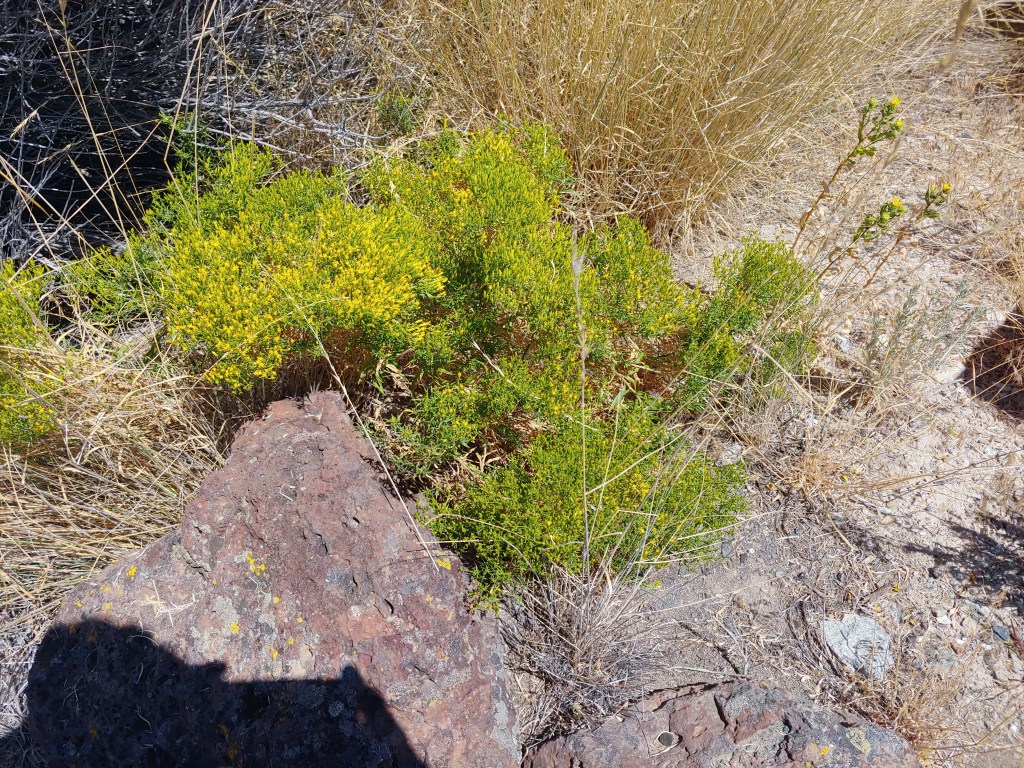
Anyway. long story short, it’s Rabbitbrush. And here is a partial excuse for why I couldn’t identify it until after my trip to Baker. The photograph in the guide shows the leaves looking very grey, as in the first picture above. But most of the Rabbitbrushes that grow around my house look much more green. I had to go to the Oregon Trail Museum in Baker and see, growing around it, an awful lot of different individuals of these plants, in all stages of growth, before I could understand what I was looking at.

For example, here it is when very young.

By the time it is dying, it just looks like hairy brown sticks with dry yellow puffballs on top.

The guidebook says,

Ericameria nauseosa, Aster family. Previously known as Chrysothamnus nauseous. Nauseosus implies that the plant produces sickness or nausea. Jackrabbits often hide under the cover of rabbitbrush to conceal themselves from the watchful eyes of golden eagles soaring overhead. The Shoshone people of Nevada use the plant to stop diarrhea and as a remedy for coughs and colds. The Cheyenne used it to relieve itching and treat smallpox.

Central Rocky Mountain Wildflowers, p. 107

“Don’t Eat My Family”

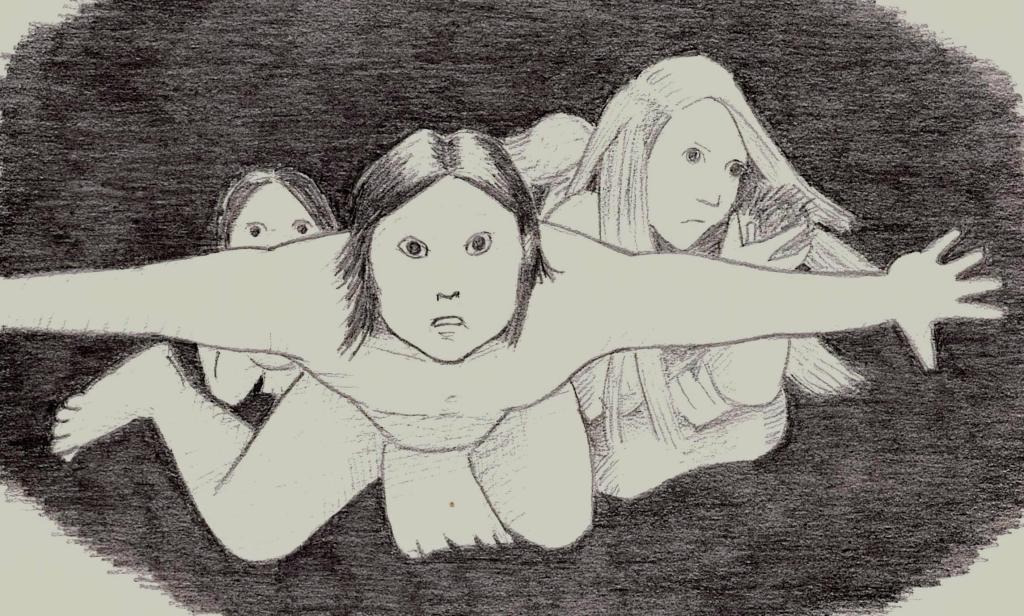
Here is Ikash, who was a teenager when he was the protagonist of my novel The Strange Land. Now he is a husband and father, and he is doing what husbands and fathers do … trying to protect his family from the scary things in the world. (Of course Hyuna could help with this too, but as you can see, she recently had a baby, so she needs him to do the heavy lifting.)

This exact scene does not happen in my third book (at least not yet!), but it does illustrate his basic stance throughout that novel.

The black and white drawing did not scan great … a lot of detail was lost … but I needed something to post.

Are you perhaps feeling like this right now?

Betataki Cliff Dwelling, Nestled in Its Valley

Betataki 4
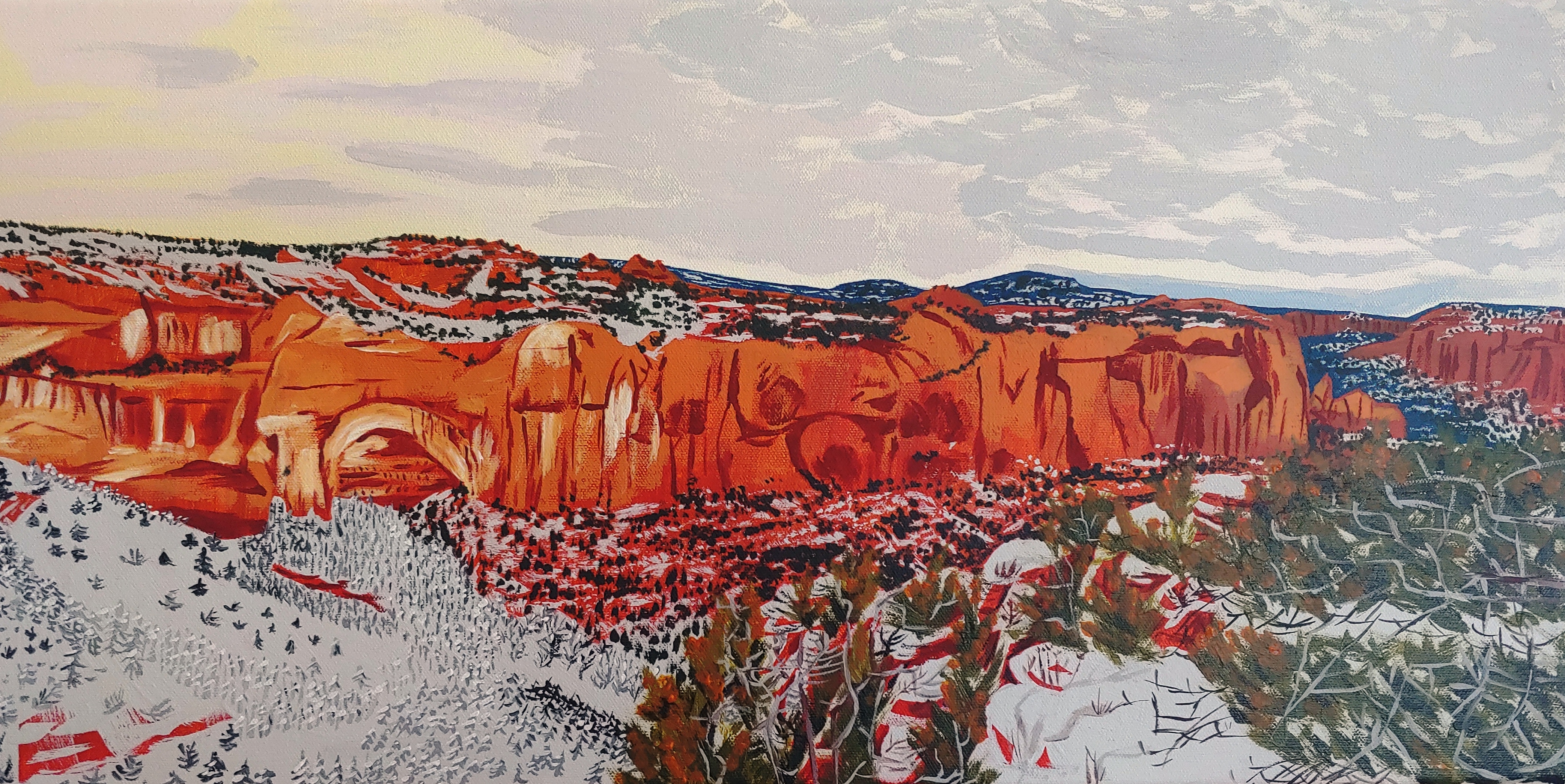
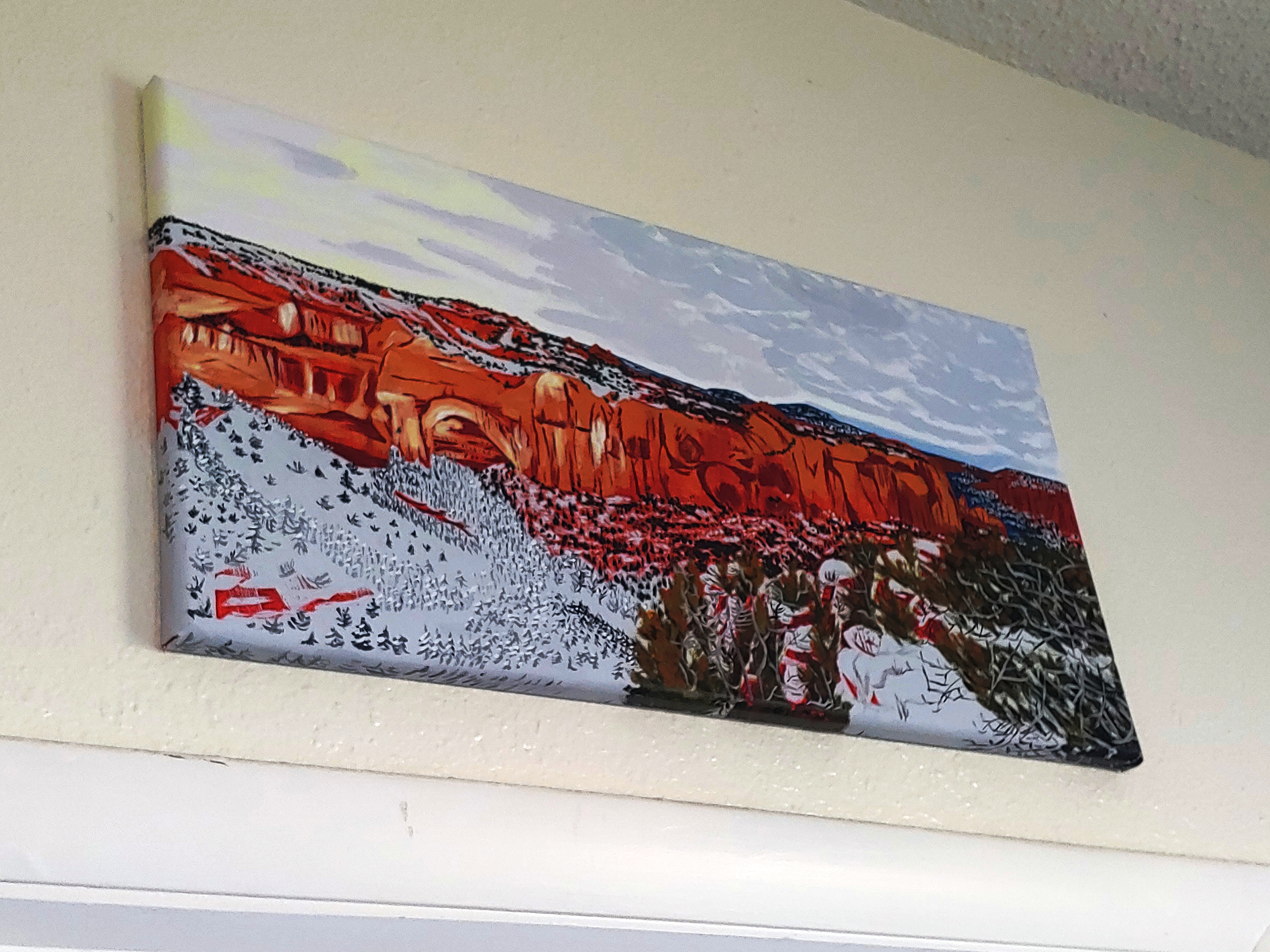
Here is the painting.

Betataki 2
Here is what it looks like on the wall. It is 12×24″.

Betataki Cliff Dwelling is located at what is now the Navajo National Monument. Rand McNally, who kindly alerted me to its presence, won’t allow me to post a copy of a page from their atlas. However, if you want to find this somewhat out-of-the-way place, head north from Phoenix on I-17. Continue north as the highway becomes 89, then get off at the turnoff for 160, signs for Tuba City. 160 cuts northeast across Navajo country. About 75 miles past Tuba City (and just before Kayenta), you’ll see signs for the Navajo National Monument. It’s on the north side of the road. Like every good national park, there is a small museum/gift shop/information center, where you can obtain maps for walking the various trails.

The trail to Betataki is a short, easy hike: about an hour round trip to and from the overlook. You cannot approach the cliff dwelling itself, but there is a viewing platform that allows you to look across the canyon. When you do, this painting is roughly what you will see.

Navajo 4 Pueblo

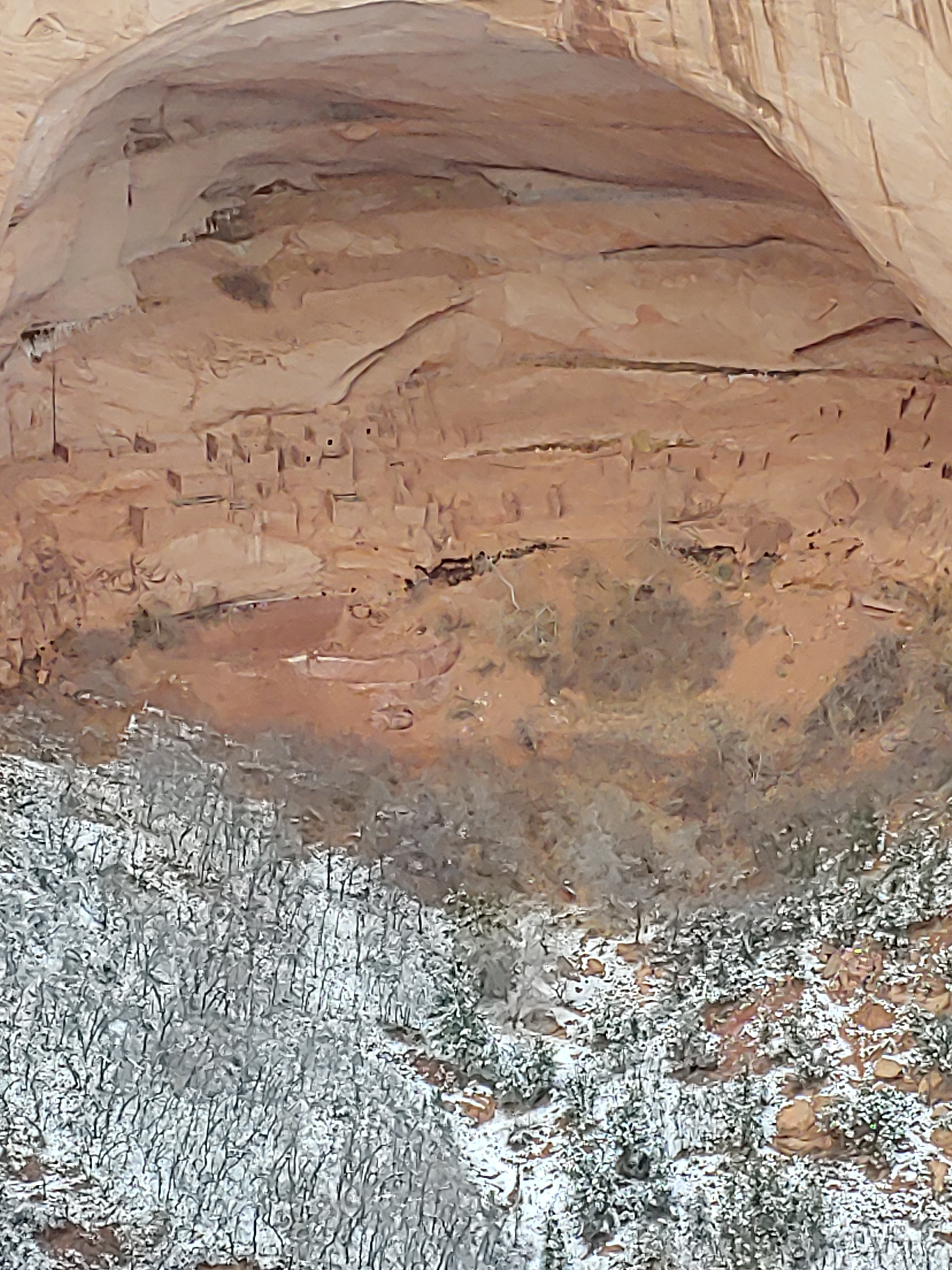
Here is a crude, cell-phone-picture close-up of the cliff dwelling. As you can see, it’s under the large arch on the left side of the painting.

We were there on a grey, snowy day. I didn’t plan it this way, but I love the contrast the snow and the cold grey colors of sky and vegetation make with the red-rock desert.

For those keeping track, Kachina Bridge is about one day’s drive north of Betataki. It’s in Natural Bridges National Monument in southeastern Utah.  This is simply a huge culture area.

Finally Read This

TBR Naya Nuki
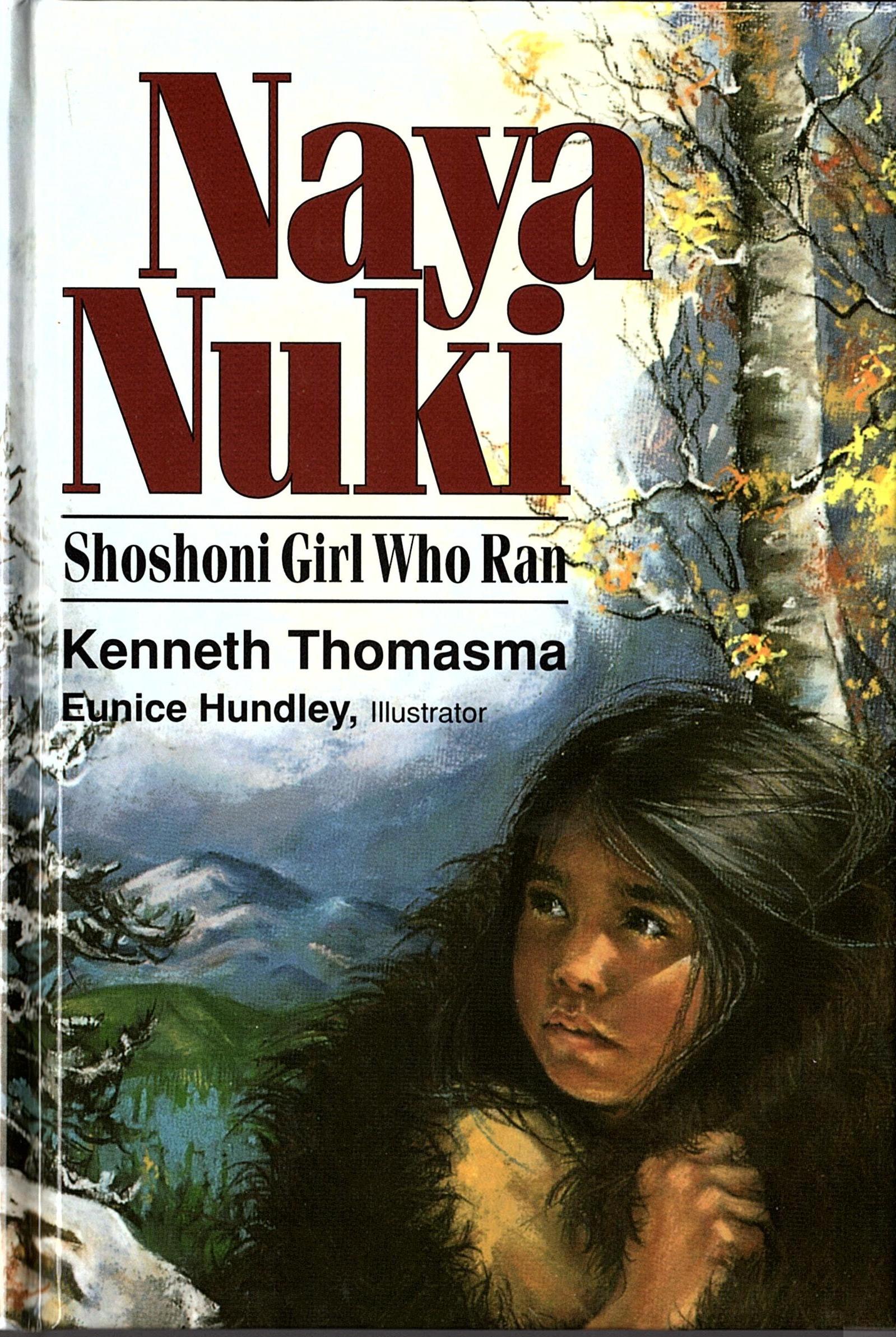
Naya Nuki by Kenneth Thomasma, Grandview Publishing Co., Jackson, Wyoming, 1983

This children’s book is based on actual events. At the age of eleven, Naya Nuki and her friend Sacajawea (yes, that Sacajawea) were kidnapped during a raid and marched about 1,000 miles to the east, into what is now North Dakota, to serve as slaves of the more prosperous Minnetare.

Naya Nuki determines to escape. She begins preparing before the outbound journey is even over, memorizing landmarks and so on. (Luckily, in order to get back to her home country, she basically just has to follow the Missouri River.) She then busies herself being a model prisoner, while also obtaining and hiding the things she will need for her journey, such as a buffalo robe (basically, a winter coat/sleeping bag), moccasins, extra food, and even a knife.

Sacajawea isn’t interested in trying to escape, being fairly sure that the girls will be quickly run down and killed by their captors. Shortly before Naya Nuki’s escape, Sacajawea tells her that she has been sold to a white man. (I knew Sacajawea was married to a Frenchman, and I’d always wondered whether it was a romantic interracial love match. Turns out, not so much.)

Naya Nuki cleverly waits for a stormy night to escape. She travels by night at first in case she is being tracked and continues to think like a fugitive throughout her journey. Once she gets well out of range of her captors, she then “only” has to deal with things like illness, snowstorms, and even a grizzly bear.

This little eleven-year-old girl walks all the way back to her people. She seems so capable throughout most of the book. It’s not until the end, when she and her mother are crying and embracing, that she seems like a little girl again. Her people change her name to Naya Nuki, which means Girl Who Ran. We don’t know what her name was before that, so Thomasma calls her Naya Nuki throughout the book.

Four years later, Sacajawea shows up at the Shoshoni camp again, this time in the company of the Lewis and Clark Expedition, and carrying the baby she had with her French husband, Charbonneau.

I’ve always admired Sacajawea for making that journey with a baby, but Naya Nuki … wow.

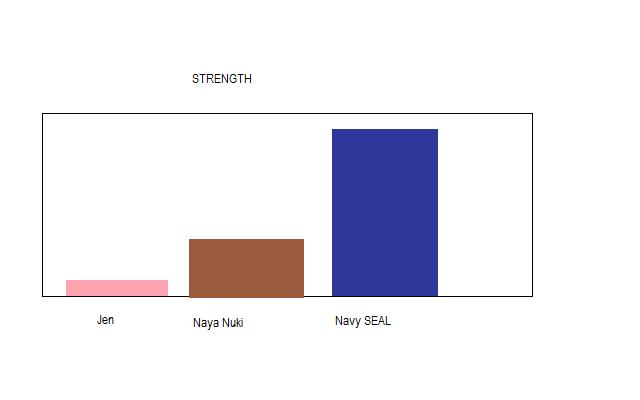
Here are some charts I’ve created to illustrate my reaction to this true story.

Strength Chart

Naya Nuki, while a lot physically stronger than yours truly, is still an eleven-year-old girl, not a grown man. She doesn’t have unlimited strength, speed, or endurance.

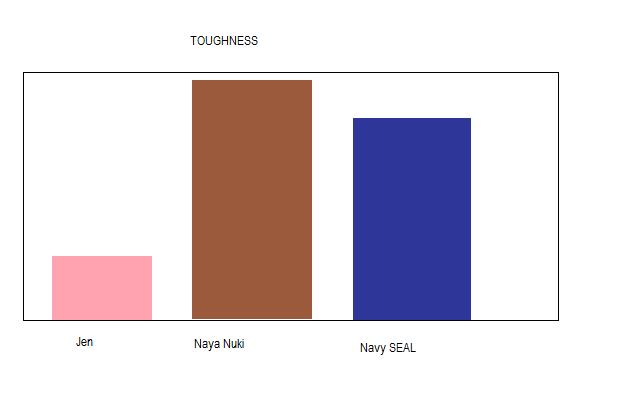
Toughness Chart

But her mental toughness knows no bounds.

Amazing Person of the Week

All night Naya Nuki ran at a steady pace, with short periods of walking that served as rest periods. At every stream she drank small amounts of water. She ate no food and would go without food as long as possible. As a Shoshoni Indian, she was used to having only three or four meals a week when times were hard. Now Naya Nuki would call on all her past experiences to help her survive her long and difficult journey back to her people.

Naya Nuki, Shoshoni Girl Who Ran, by Kenneth Thomasma, p. 61