Here’s the setting for my second book: Beringia circa 10,000 BC.
As you can see, at this time the sea levels were lower (coastlines are a guess). Volcanoes were active in what is now the Kamchatka Peninsula.
The area that is now the Bering Strait is believed to have been a vast plain that somehow, despite being so far North, supported a great variety of game, including different varieties of mammoth.
Meanwhile, weirdly, North America was still covered in ice sheets. No one knows why this should be, but here is a guess. Anyway, the ice sheets were beginning to melt, creating an ice-free corridor down into the Americas. When exactly this corridor became passable is up for debate. There may also have been a coastal way to access North America (not shown on this map). Meanwhile, there could also have been people migrating to America from Africa via the Atlantic, and from Asia via Polynesia.
The corridor could also have been the route that Gigantopithecus took to get to America.
Late in the book, my characters discover mountains of ice. The ice is south of them and lies between them and the sea. They are just as confused by this as you are.
Bigfoot is a cryptid, which means “hidden animal,” i.e. an animal whose existence has not been proved. Cryptid is a big category. Some cryptids, when researched, turn out not to exist (for example the Loch Ness Monster, as far as we can tell). Others eventually get moved from the category of cryptid to that of actual animal. (Europeans did not believe in the existence of gorillas until the corpse of one was brought to Europe.) Other cryptids are 100% hoax (the Fiji mermaid, constructed by sewing a preserved monkey torso onto the preserved tail of a large fish). This post will argue that Bigfoot is in the gorilla category. In fact, he is almost exactly like a gorilla: a large, elusive primate native to the deep forests of North America.
My Sources
Obviously I did not research all
this stuff myself. My source is the research done by Jeff Meldrum, Ph.D.,
associate professor of anatomy and anthropology at Idaho State
University. He has
written a lot of stuff, but the source I am using is his book Sasquatch: Legend Meets Science (Tom
Doherty Associates, 2006).
By the way, I had already read the
book, but last month I got to attend a Bigfoot conference in Pocatello
(home of Idaho State University)
and hear Meldrum give a talk. Turns out he’s a very nice guy, with none of that
defensiveness that we might expect from a cryptid researcher. The pictures in
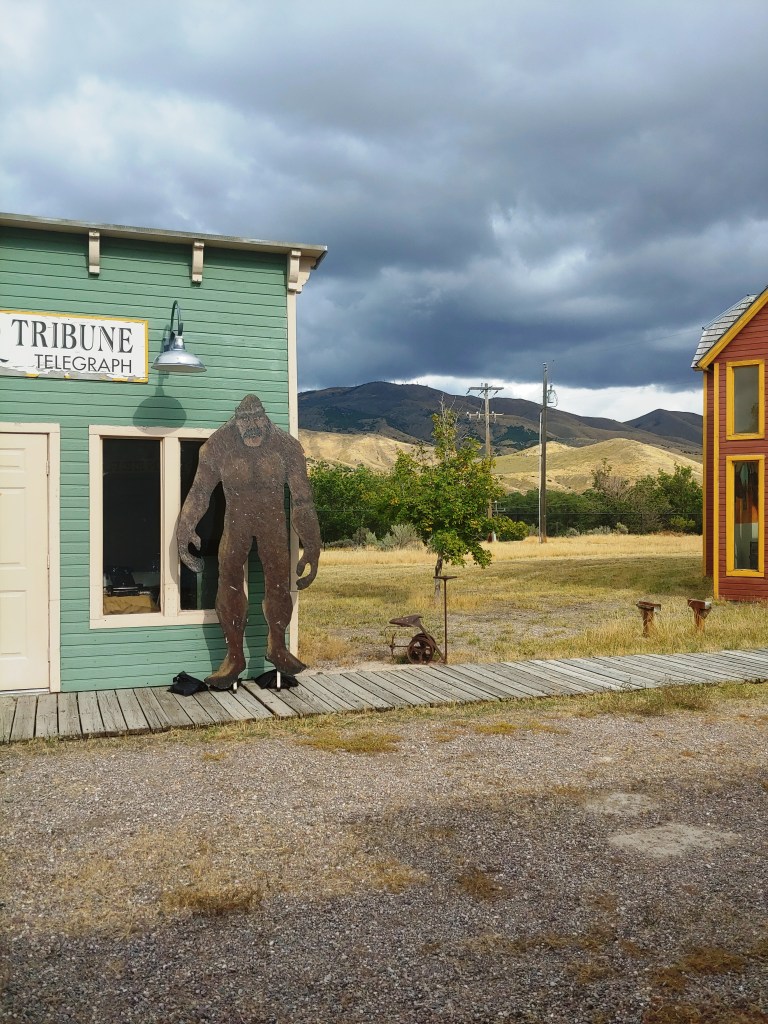
this post are from that event.
It’s hard for a blog post adequately to cover a scientific topic like this one. (And yes it is scientific: detailed analysis of footprint casts, human and primate gaits, fossils, local legends, and more.) I’ll just try to summarize some of Meldrum’s main arguments, but obviously, if you want to delve deeper, you can buy the book yourself.
Many Casts of Prints
Bigfoot is often reported in places
that are conducive to taking casts of footprints, such as a muddy forest floor
at a logging site. Many casts have been taken of footprints in such places.
Some are up to 17 inches long. None of
them match the stiff, narrow, 15-inch wooden fake feet supposedly used by Ray
Wallace and his family to fake all(!) of the Bigfoot tracks in the Northwest.
Some have a step length of 50 – 60 inches and a depth that indicates whatever
made them weighed more than 800 pounds (Sasquatch
chapter 2). There is even an instance of
a very large club foot (page 238), a few knuckle and hand prints (105 – 111),
and a hilarious butt print where the sasquatach apparently sat in the mud, then
leaned on its left forearm to reach for a fruit (111 – 115).
Large, deep tracks with a 65 – 70 inch stride have also been photographed in the sand on the Oregon coast, after a sighting the previous evening (190).
“Patty,” the Lady Bigfoot
The famous October 1967 Patterson
film “was shot during the day, in full sunlight, out in the open on 16mm
film. Independent researchers examined
the location immediately after the encounter, and footprint casts and countless
measurements and photos were taken … and yet this film remains controversial,
written off as an obvious hoax by
many” (134 – 135).
Not surprisingly, the star of the
video, dubbed “Patty,” has had everything about her analyzed, from her gait, to
her saggital crest, to the speed of the film, to the color of the soles of her
feet. The book covers this in more detail over several chapters. The upshot is that experts, when asked to
view the Patterson film, tend to be very impressed at first, then panic, back
off, and start thinking the film is a fake is because if it isn’t, they would
have to “believe” in Bigfoot. One typical protest is that this film is suspect
because it was shot by someone who was specifically looking for evidence of
Bigfoot. It’s hard to imagine, though,
how we could get such a film from anyone else.
It’s also hard to imagine how the
creature on the film could have been faked. Consider:
The Bigfoot in the Patterson film appears to have breasts, and as it walks, you can see its muscles moving underneath the hair. An experienced Hollywood costume designer who has designed many ape costumes opined that it does not look like a man in a suit. He felt that instead of a suit it would have to have been a minimum ten-hour makeup job in which the hair was glued directly to the actor’s skin (158). (The actor would then have to have been delivered to the film site and just as quickly spirited away, without leaving any vehicle tracks.) A computer graphics animator adds that “the boundaries of the human form do not even fit within the form of the creature” (176). Six-foot men have tried to re-create “Patty’s” walk in the same spot, and have found it difficult to match her stride and impossible to make footprints as deep as the ones she made.
Native American Knowledge of Bigfoot
Many Native American tribes, all
over the continent, have Bigfoot legends. This is particularly true in the
Northwest, where you can see stylized carved stone heads, masks, and statues of
the buk’wus (a Kwakiutl word), or his
female counterpart, the dsonoqua.
Their faces look ape-like and distinct from similar carvings of bears. (In
the picture below, some of the souvenirs are adapted versions of this native
art.) The Northwestern tribes seem to have more zoological detail in their
legends about Bigfoot and have testimonies of sightings right down to the
present day. They also, of course, ascribe spiritual qualities to the creature,
as they do to other animals.
The earrings, which do not look like Native art, are based on “Patty” from the Patterson film.
As we move farther East, Bigfoot
becomes a more purely spirit-like figure.
This may imply that the creatures died in out first in the eastern part
of the continent, where they are remembered only as a myth.
On Painted Rock, in central California, there is a
large (2.6 meter high) pictograph of Hairy Man with tears streaming from his
eyes. According to the local creation story, Hairy Man is crying because people
are afraid and run away from him.
At any rate, these legends definitely pre-date Ray Wallace, who supposedly “created” Bigfoot all by himself. The descriptions of Bigfoot’s behavior in the Northwestern native traditional knowledge match well with what has been reported in sightings and surmised from the behavior of other great apes.
Great Ape Behavior
Much of the Bigfoot behavior that is sometimes reported in sightings has parallels in the intimidation behavior of other primates. This includes grimacing, throwing things, banging wood on trees, pushing snags of dead branches at an intruder, hair bristling, emitting a pungent stink when agitated (male mountain gorillas do this), and vocalizing (chapters 9 and 10). There are also behaviors that resemble that of other primates but are not intimidation behaviors, such as making sleeping nests from branches. Of known primates, the one that Bigfoot most seems to resemble is Gigantopithecus (89 ff).
But Isn’t It Really Just a Bear?
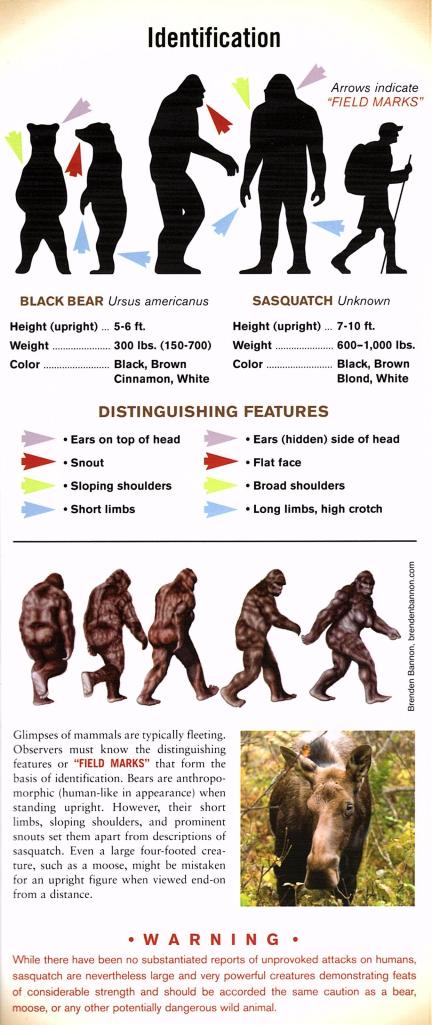
A page from Meldrum’s “Sasquatch field guide,” showing differences between Bigfoot and bears
Bigfoot’s range, as determined by footprints
and reported sightings, overlaps almost perfectly with the range of the
bear. To a believer, this means the two
animals share a similar habitat: temperate forests and rainforests. To a
skeptic, this means that all “Bigfoot” sightings are actually bears.
This was the subject of the lecture
by Jeff Meldrum that I attended. It is
certainly true that photographs of black bears have been put forward as
photographs of Bigfoot, only to be exposed later. Meldrum showed a series of
bear photos which, at first glance, can look surprisingly humanoid, especially
if the animal is skinny and is standing on its hind legs. However, he went on to point out, telling the
difference between a bear and a huge, bipedal ape “isn’t rocket science.” Bears do not have a clavicle, so when
standing, they don’t have protruding shoulders. Their legs are much shorter in
proportion to their body. And, of course, there are the prominent round ears.
Bear tracks don’t resemble Bigfoot
tracks at all, except in cases of multiple, overlapping, unclear bear tracks. A bear’s inside toe is its shortest, their
feet are shorter and very narrow at the back, and they leave claw marks. Their stride is, of course, very different,
although when a bear is walking quickly its footprints can overlap, “giving an
impression of elongated footprints spaced in a two-footed pattern.”
Skeptics have also raised the
question of whether two large animals can fill the same niche. Bigfoot, if it
exists, is probably a fructivore like the other large primates and like Gigantopithecus,
whose jaw and teeth are designed for grinding, not for predation. Bears, while
also ominivores, have a very different shaped set of chompers. So even if the
two animals share a range, they would not be occupying exactly the same
ecological niche.
(Fun near-fact: based on his estimate of how many Sasquatch compared to bears a given region of wilderness can support, Meldrum estimates there could be as many as 175 individual Bigfoot in the state of Idaho.)
Bigfoot Outside the Great Northwest
It turns out that, despite usually having much less wilderness than the Great Northwest, nearly every state in the Union has its own version of the Bigfoot legend. I’ll let you make up your mind about these on a case-by-case basis. In Ohio, until recently my home state, we have “the Grassman.” Here is a Hubpages article about him. If you follow the link and read the comments, you will no doubt see many personal testimonies about Grassman sightings.
Update: another WordPress blogger, The Traveling Maiden, had an experience while camping in the Great Northwest that may have been Bigfoot. Read about it here.
Today is Columbus Day, and also Native American Day. I know this because I have a wall calendar that was sent to me by St. Joseph’s Indian School in Chamberlain, SD. If it’s Native American Day, they ought to know.
So, thanks to them – and the kids who attend the school – for this post.
Since we are honoring Native Americans today, let’s return to a common theme on this blog: ancient people were a lot smarter than we think.
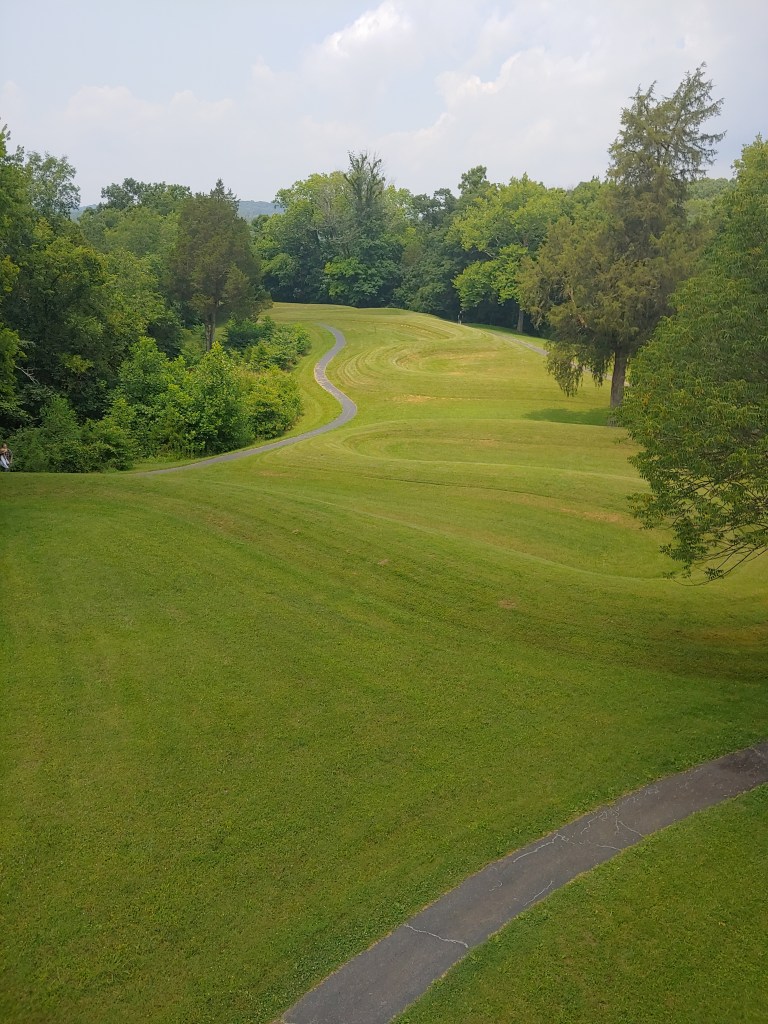
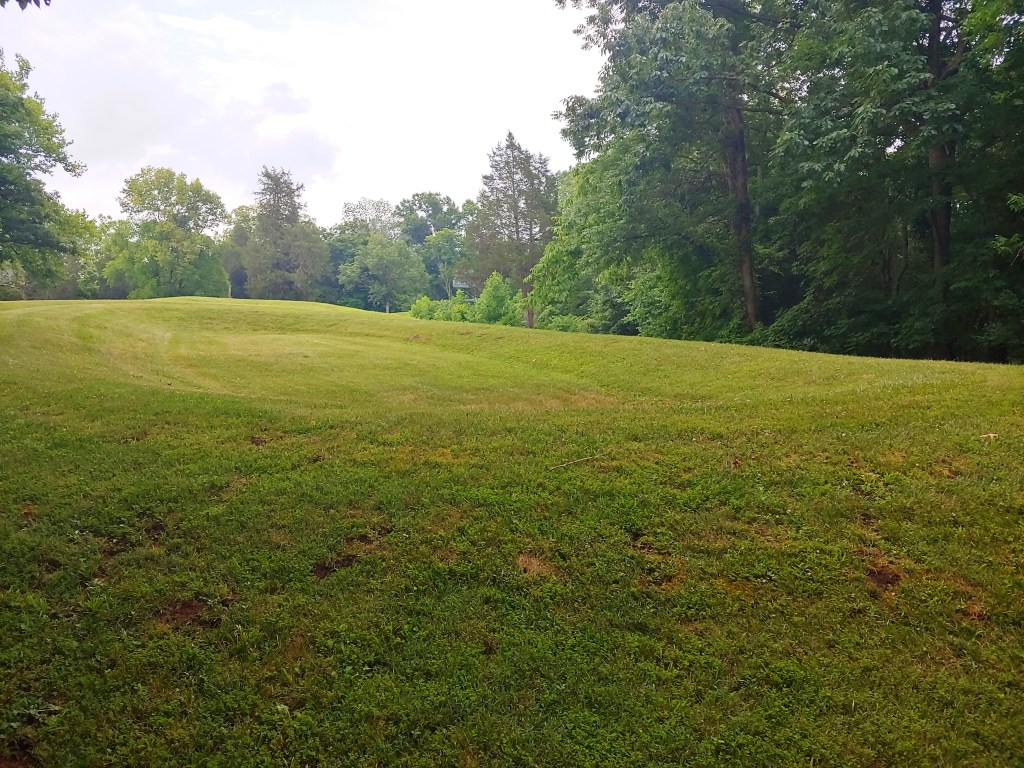
Body of the serpent seen from the viewing tower, looking North
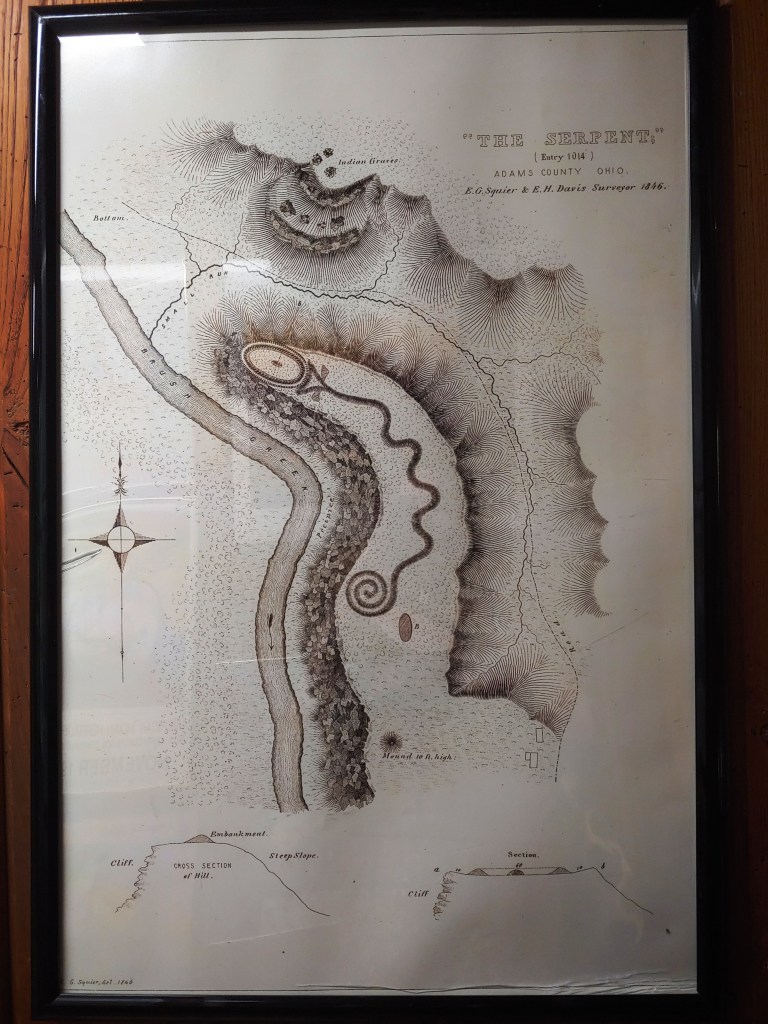
Ohio’s serpent mound was first discovered by
white people in about 1846. It was
difficult to survey or even to find due to being covered in trees and brush. When the brush was partly cleared, it became
obvious that the mound, perched on a cliff at the confluence of a creek (which
cliff itself resembles the head of a serpent), was a really remarkable
earthwork and was designed to be visible from the nearby valley.
The following article will draw on the book The Serpent Mound by E.O. Randall, published in 1905, which is a compilation of maps, surveys, and speculation about the mound by archaeologists of the time; and on my own visit to the mound. One advantage in using these older sources is that we get a variety of voices, we can learn what the Mound looked like when it was first (re)-discovered, and we get an archaeological perspective that is different from the modern one. For example, one source in Randall’s book says the mound appears to be “not more than 1,000 years old, nor less than 350 years” (p.50). This is not very precise, but I actually prefer it to a super-confident proclamation about the mound’s age based on dating methods and assumptions that might be suspect. In fact, the uncertainty of this early source is echoed by the informational video in the mound’s museum. It features an archaeologist saying that we could get “a million different carbon dates” from the mound because the earth was that used to build it was already old and had been through multiple forest fires, etc. He adds that it’s basically impossible to carbon-date earthworks.
On the Road to Serpent Mound
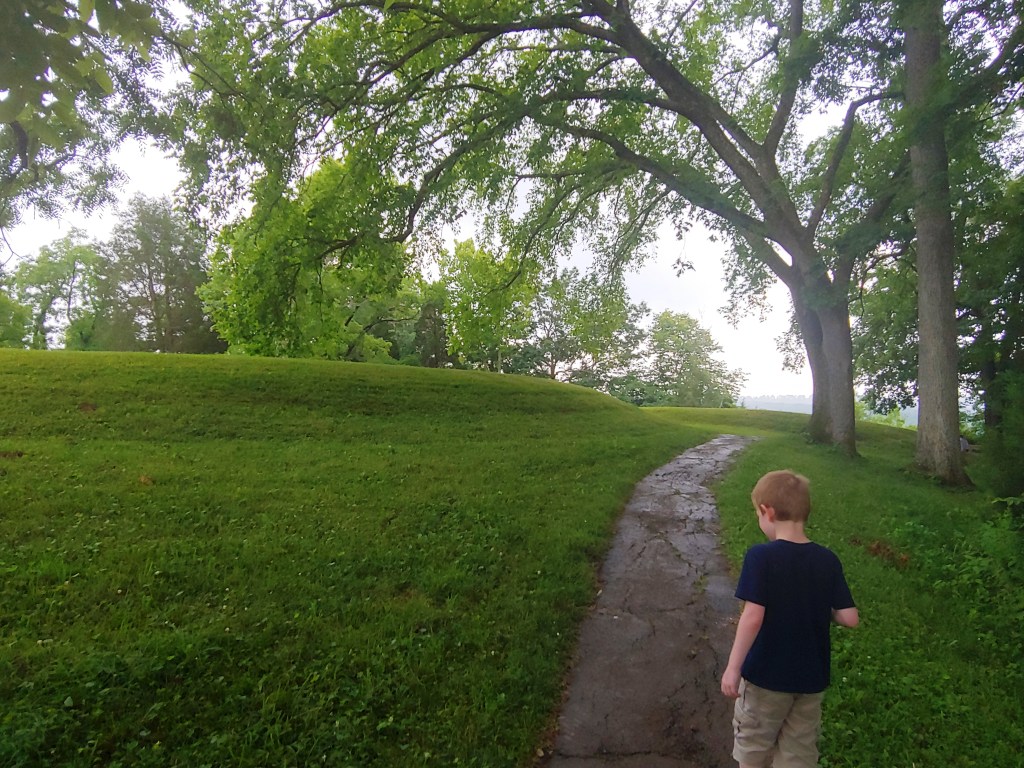
Walking south along the serpent (viewing tower in background)
To get to Serpent Mound (at least
from where we are), you get in your car and head south over the Ohio highways. You leave behind the urban build-up and
progress into farm country. Eventually, the
landscape becomes less Midwestern and more Appalachian. Hills and hollers take
the place of open farmland. Finally,
after hopping from one rural route to another, you find yourself winding
through thickly wooded hills in southern Ohio. You approach the Mound from the South. Though it stands on a bluff overlooking Brush
Creek, the area is so heavily wooded that you can’t catch a glimpse of the
Mound on your way in.
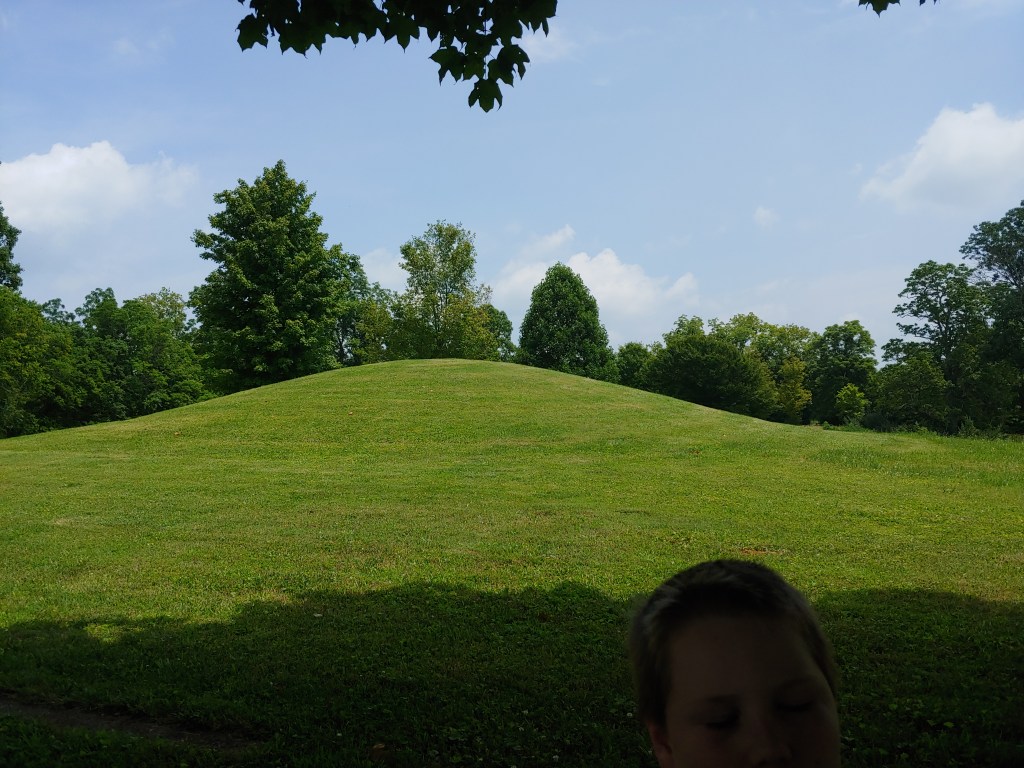
Large burial mound some ways south of the serpent
This land was purchased in
1885. At that time, the land was owned
by a farmer and the Mound was “in a very neglected and deplorable condition”
(Randall 106). To save the Mound from “inevitable
destruction,” a Prof. F.W. Putnam arranged to have it bought by the Trustees of
the Peabody Museum,
Cambridge,
where he was Chief of the Ethnological and Archaeological Department. Putnam later worked to have a law protecting
it passed in Ohio, the first law of its kind
in the United States
(Randall 108). Today the Mound is a
National Historical Landmark. Besides
the Serpent itself, the area includes some additional burial mounds, a picnic
shelter, and a tiny, log-cabin-style museum.
You disembark in the parking lot. The heat, the humidity, the strong sweetish green smells, and the variety of insect life remind you of your Appalachian childhood. They also remind you why you are planning to move out West.
The Serpent Mound Itself
An old drawing of the serpent as it would look if there were no trees around it (Randall p. 8)
Serpent Mound is difficult to
describe in words, so please see the associated maps and photographs. It is 1335 feet long (winding over an area of
about 500 feet), varies from three to six feet high, and slopes downward from
the spiral tail to the jaws and egg which stand on the tip of the
overlook. The head faces West towards
the sunset at Summer Solstice. The body
includes three bends which may sight towards the sunrises at Summer Solstice,
Equinox, and Winter Solstice (short lines of sight and the gentle curves of the
Serpent make it difficult to tell whether these alignments were intended for
astronomical viewing).
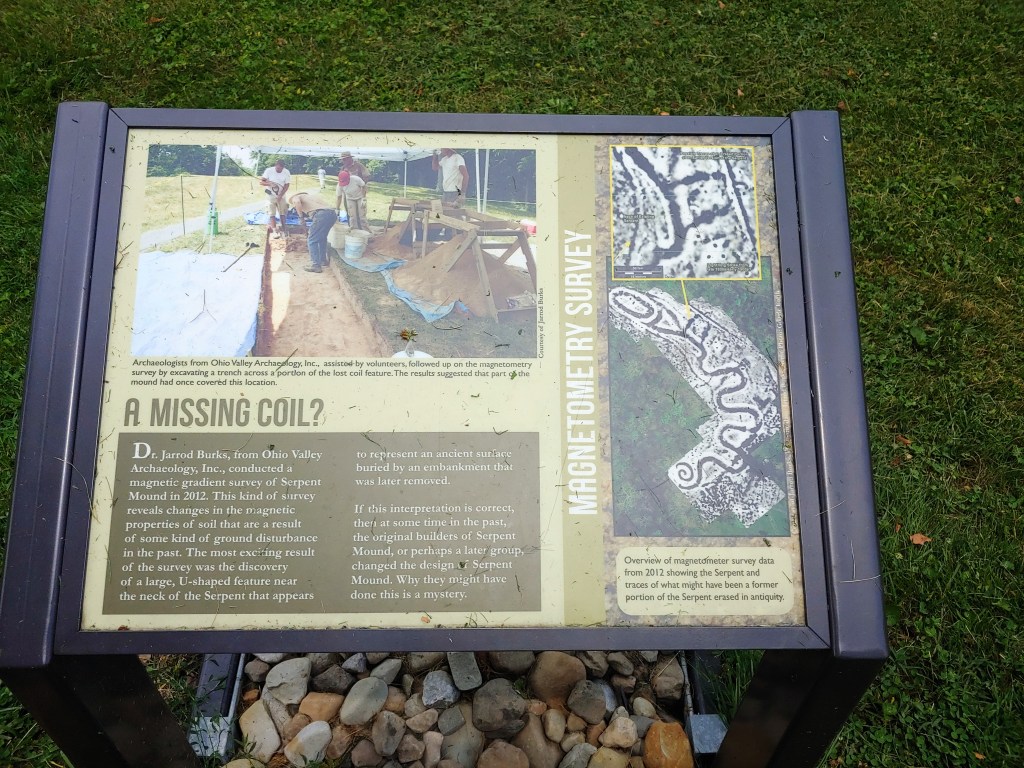
Archaeologists have discovered the serpent once had a fourth coil near the head, which was deliberately dismantled.
It was made apparently by hand on a
base of clay, followed by rocks, more clay, dirt, and then sod. Though it cannot be carbon-dated, there is
evidence that it is not as ancient as some megaliths elsewhere in the world. The bluff it sits on and the creeks that
surround it cannot be older than the retreat of the glaciers. The
burials near it date to the Adena period, which runs 600 B.C. to 100 A.D., though
there is no way to tell if the burials are contemporaneous with the Serpent or
were added later. There has even been
speculation that the Mound could have been built by the Fort Ancient
culture, which flourished around 1000 A.D.
The “egg” which the Serpent
contains in its jaws (or, the Serpent’s eye) used to have in its center a stone
altar which bore traces of fire. (In the
largest burial, too, the corpse was placed on a bed of hot coals and then
covered with clay while the coals were still smoldering.) We
assume, then, that the Serpent was the site of ceremonies, but we have no way
of knowing anything about their nature.
A close up view of the oval “egg.” It once contained an altar.
The Serpent, despite its name, does
not give a spooky or “wrong” feeling. The
scale of it is very human and does not overwhelm. The shapes and proportions of the curves are
pleasing and give a sense of calm and beauty.
The Serpent is, in fact, inviting to walk on. One is tempted to walk along the curves,
climb down into the oval of the egg, step into the middle of the spiral tail. One cannot do this, of course, as it is
strictly forbidden.
The only problem with Serpent aesthetically (if this is a problem) is that it’s impossible to view it all at once. This is mostly because of the bend in the tail. In modern times an understated observation tower has been placed next to the Serpent, right near the tailmost curve. But even from the top of this tower it is impossible to take in the entire Serpent with either eye or cellphone camera. Looking to the left, we get a view of the spiral tail. Looking to the right, we see the undulations stretching off into the distance and falling away with the slope of the hill, but even then we cannot see the entire head because it takes its own slight curve and is blocked by trees.
Approaching the tail spiral. In the background, the cliff drops away into a wooded vista.
I can’t help but think this effect
is intentional. This monument is not
designed to be taken in all at once, looking along a line of sight, and to
overwhelm the viewer. Instead, it’s
apparently designed to draw us on, tantalizingly offering small charming vista
after small charming vista. There is no
one best place to view it. Perhaps the
architects among us can explain what this says about the minds and intentions
of the people who designed it.
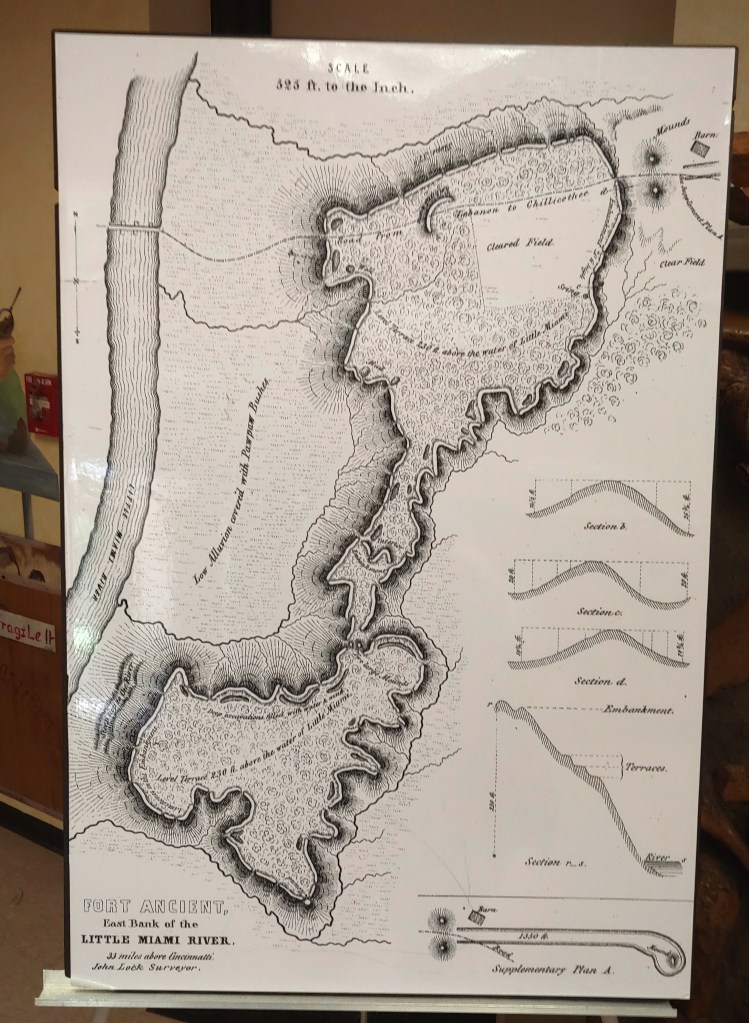
Fort Ancient, another hill-and-plateau complex in southern Ohio, is also sprawling, hard to view, and offers the same “please explore me” effect.
Fort Ancient is a plateau surrounded by man-made hills with gaps in them, overlooking the Little Miami River, Ohio. It has man-made mounds on it as well.
“Effigy Mounds” in North America
The Serpent is definitely not the
only large animal-shaped mound in North America. There are many of them, called by
archaeologists “effigy mounds” (not the usual meaning of the term effigy).
“The effigy mounds appear … in
various parts of … the Mississippi
Valley. They are found in many of the southern
states; many appear in Illinois, but Wisconsin seems to have
been their peculiar field. Hundreds of
them were discovered in that state … In Wisconsin they represent innumerable
animal forms: the moose, buffalo, bear, fox, deer, frog, eagle, hawk, panther,
elephant, and various fishes, birds and even men and women. In a few instances, a snake. In Wisconsin
the effigies were usually situated on high ridges along the rivers or on the
elevated shores of the lake. Very few
effigy mounds have been found in Ohio
– though it is by far the richest field in other forms of mounds.” (Randall
31)
There are, of course, large animal-shaped terraforms in other parts of the world, such as the Uffington and Westbury White Horses in Britain and the Nazca Lines in Peru.
So Ohio’s serpent mound is not unique. It is, however, impressive and well-done, and tends to strike people as mysterious and significant.
The Serpent Mound is a Giant Rorschach Blot
Map of the serpent found in the museum
Whatever else it might be, the Serpent Mound reliably functions as a giant Rorschach blot. It appears significant but ambiguous. Everyone who is not content to admit that we don’t know its purpose tends to bring their own interpretation.
Here are four examples.
One example, roundly mocked in
Randall’s book, is the “amusing and ridiculous” “Garden of Eden fancy” (p. 93).
This theory, put forward by a Baptist minister of the day, is that the
Mound was built by God Himself to commemorate the eating of the forbidden fruit
and to warn mankind against the Serpent.
The oval object, which many people take to be an egg, is on this view the
forbidden fruit itself, which the Serpent is taking in its jaws as if to eat or
offer. Furthermore, the three streams
that come together nearby represent the Father, the Son, and the Holy
Spirit. “Pain and death are shown by the
convolutions of the serpent, just as a living animal would portray pain and
death’s agony … America is, in fact, the land in which Eden was located” (pp
99, 101).
Now, here’s another interpretation,
based on the accepted anthropology of the day: “Students of anthropology,
ethnology and archaeology seem to agree that among the earliest of religious
beliefs is that of animism or nature worship.
Next to this in the rising scale is animal worship and following it is
sun worship. Animism is the religion of
the savage and wilder races, who are generally wanderers. Animal worship is more peculiarly the
religion of the sedentary tribes … Sun worship is the religion of the village
tribes and is peculiar to the stage which borders upon the civilized. ‘Now judging from the circumstances and
signs,’ says Dr. Peet, ‘we should say that the
emblematic mound builders were in a transition state between the conditions of
savagery and barbarism and that they had reached the point where animal
worship is very prevalent’” (pp. 37 – 38).
This theory of the slow development
of man’s religion as they rise out of “savagery” into “barbarism” and finally
into “civilization” is reported with much more respect than the Baptist
pastor’s theory, but it is in fact just as fanciful. It is based on an overly neat-and-tidy and,
frankly, snobby view of the history of religion that was popular for many years
but that actual history does not support.
But, again, Rorschach blot.
Many other observors have linked
the Mound with its oval to the “egg and
serpent” origin mythology that crops up in many places in the world,
including Greece and India.
This theory receives many pages in Randall’s book.
We got rained on while at Serpent Mound. Coincidence? I think not!
To take just one more out of many other examples, on this very blog we learned from a book review that Graham Hancock’s latest book prominently features the Serpent Mound as part of his latest theory that North America is, in fact, the source of the Atlantis legends. He believes that the Mound is meant to represent the constellation Draco and was built during an era when Draco was ascendant. Or something like that.
I, too, have taken the Serpent Mound Rorschach test and here is what I see. I see more evidence that serpent mythology (with or without eggs) and the strong motivation to build large, long-lasting religious monuments are both universal in human culture. I personally think that these things didn’t arise independently in every corner of the world but were carried distributively and that they represent distant memories of certain events in human history, which are hinted at but not fleshed out in the early chapters of Genesis. However, I am not fool enough to think that the existence of Serpent Mound “proves” any of this. It is, as I said, a Rorschach blot.
Other Serpent Mounds Around the World
Otonabee Serpent Mound sits on the
north shore of Rice
Lake, not far from the city of Toronto, Ontario (Randall 114). It
is 189 feet long. The head faces “a few degrees north of east,” with an oval
burial mound in front of the head which could represent an egg (115).
In Scotland, there is the stone
serpent of Loch Nell:
“The mound is situated on a grassy
plain. The tail of the serpent rests
near the shore of Loch Nell, and the mound gradually rises seventeen to twenty
feet in height and is continued for 300 feet, ‘forming a double curve like the
letter S’ … the head lies at the western end [and] forms a circular cairn, on
which [in 1871] there still remained some trace of an altar, which has since
wholly disappeared, thanks to the cattle and herd boys. … The mound has been formed in such a
position that worshippers, standing at the altar, would naturally look eastward,
directly along the whole length of the great reptile, and across the dark lake
to the triple peaks of Ben Chruachan. This position must have been carefully
selected, as from no other point are the three peaks visible. General Forlong … says, ‘Here we have an
earth-formed snake, emerging in the usual manner from dark water, at the base,
as it were, of a triple cone – Scotland’s Mount Hermon, – just as we so
frequently meet snakes and their shrines in the East.’” (Randall pp. 121 – 122)
Speaking of Mount Hermon. This large, lone mountain sits at the northern end of the Golan Heights in Israel. It is so high that it is home to a winter ski resort. In ancient times, this region was called Bashan. It was known for its large and vigorous animals (the “bulls of Bashan”), and for its humanoid giants. Down to Hellenistic times, Bashan was a center for pagan worship (the Greek god Pan had a sacred site there). And guess what else it has? A serpent mound.
“The serpent mound of Bashan has ruins on its head and tail. The ruins are square (altars?) on top of small circular mounds” (Van Dorn 144).
The Ohio serpent’s spiral tail, which evokes a stone circle. Viewing tower in the background.
This serpent mound is less than mile from a stone circle called Gilgal Rephaim (“Wheel of the Giants”). (Stone circles, as sacred sites, are also found throughout the world.) “The Wheel contains some 42,000 tons of partly worked stone, built into a circle 156 meters in diameter and 8 feet high on the outer wall. It is aligned to the summer solstice. The area is littered with burial chambers … If you go due North of the Wheel, [sighting] through the serpentine mound [and proceed] for 28 miles, you will run straight into the summit of Mt. Hermon” (Van Dorn 145).
Serpent, altar, circle, and sacred mountain. I don’t know about you, but the site in Golan sounds a lot scarier to me than Ohio’s Serpent Mound. However, it also makes me wonder whether people in Ohio – and Scotland – were trying to re-create this arrangement.
Sources
Giants:
Sons of the gods by Douglas Van Dorn, Waters of Creation Publishing, Erie, Colorado,
2013.
The
Serpent Mound: Adams County, Ohio:
Mystery of the Mound and History of the Serpent: Various Theories of the Effigy
Mounds and the Mound Builders, by E.O. Randall (L.L., M., Secretary Ohio
State Archeological and Historical
Society; Reporter Ohio Supreme Court), Coachwhip
Publications, Greenville Ohio, 2013.
First published 1905. This book
is a compilation: “The effort has been made not merely to give a description,
indeed several descriptions, of Serpent Mound, but also to set forth a summary
of the literature concerning the worship of the serpent. … It is hoped that
this volume, while it may not solve the problem of the origin and purpose of
the Serpent Mound, will at least add to its interest and give the reader such
information as it is possible to obtain.” (page 5)
My earliest and most enduring culture crush has been on Native American culture. This started very early, perhaps by the time I was five. By the time I could read on my own, I was on a sharp lookout for any book with an Indian on the cover. That was all it took to make me pick up the book and devour it.
Here are some of the books I’ve discovered … as a kid, and
then later, as an adult.
This is an incomplete list on two counts. First of all, there are obviously many fine books out there, by Native and non-Native people alike, that I have yet to discover and read. Secondly, this isn’t even a complete list of all the books I’ve read on this topic. I can think of at least sixseveneight twelve other books that I remember vividly, but can’t remember enough about the titles to track them down.
As A Kid
North American Indians, by Marie and Douglas Gorsline, Random House, 1977. This book was the introduction to Native American tribes and their lifestyles for my siblings and me. It’s a good overview of the different cultural regions of North America, including a map at the beginning of the book. For each region, it names one or two of the best-known tribes and gives a few pages of details about their lifestyle, beautifully illustrated. The last page of the book is about sign language, which it says functioned as a lingua franca for the different Plains tribes. It includes a number of illustrations of the different signs. What could be more fun?
Runner for the King by Rowena Bastin Bennett, 1962. I must have been seven years old when I read this book. It featured my two favorite things: Indians, and the word “king.” It takes place in the ancient Incan kingdom, but I didn’t know that at the time. All I knew was that it did not disappoint. The boy on the front cover runs through rugged mountain landscapes. He encounters a fellow runner who has been beaten and tied up by enemies, so the boy must run the next messenger’s leg of the journey as well as his own. He has to climb over a rock slide. At last, he makes it to the king with his message and is personally honored by the king. I now realize, looking at the drawing, that the boy’s face on this cover does not look particularly Incan. It looks more like Peter Pan colored reddish brown. But at the time, this boy – particularly this picture on the cover – instantly became my standard for fitness and beauty.
Little House on the Prairie by Laura Ingalls Wilder, Scholastic, Inc., 1935, 1953, 1963. This is the Little House book in which the Ingalls family go into “Indian country,” homestead there for less than a year, and then are moved out by changing government policy, not too long after the same government has forced the Indians to leave. This book has been called racist, but that is a foul slander. It portrays a lot of complexity in the Ingalls family’s experience with the Indians. Charles Ingalls, Laura’s “Pa,” in particular clearly respects the Indians. He gently rebukes some other settlers when they speak of the Indians in a dehumanizing way, and he talks with enthusiasm about a buffalo hunt: “Now that’s something I’d like to see!” There is also a scene where Pa has been hunting a wildcat that he knows is hanging around the creek. He needs to find and kill it so that it doesn’t attack his family. He meets an Indian man, who gives him to understand with signs that three days ago he found the very cat and shot it out of a tree.
Squanto, Friend of the Pilgrims by Clyde Robert Bulla, illustrated by Peter Buchard, Scholastic. Squanto’s story is truly an incredible one. The scene I remember best from this book is that of Squanto trying to sleep on his first night in a British room. The bed is too soft and uncomfortable. Finally he sleeps on the floor.
The Sign of the Beaver by Elizabeth George Speare. An Indian boy and his father befriend a white boy who has been left on his own to manage the family’s new cabin until the rest of his family can join him. The Indian boy teaches the white boy wood lore and such things as the signs that the different clans leave on trees. The white boy teaches the Indian boy to read. The Indian boy is really offended by the role of Friday in Robinson Crusoe, which rocks his new friend’s world.
Island of the Blue Dolphins by Scott O’Dell. I don’t remember this one very well, but I think my second-grade teacher read it aloud to us. It’s the story of an incredibly tough and resourceful girl surviving on her own on an island.
Caddie Woodlawn by Carol Ryrie Brink, illustrated by Trina Schart Hyman. Trina Schart Hyman is one of my favorite illustrators, which just makes this book all the better. This book is not primarily about Indians, but they do play an increasingly big role as the book progresses. Caddie befriends them and then ends up sneaking across the river to visit them and head off a conflict.
Indian in the Cupboard by Lynne Reid Banks. Omri owns a small metal medicine cupboard that can bring his plastic toys to life. When it does, he discovers that they are not toys but have actual lives and personalities of their own. This series is one of the most poignant I’ve ever read.
I Heard the Owl Call My Name by Margaret Craven, Dell Publishing, 1973. This one barely makes it into the “childhood” category. I read it in seventh grade, in a year when we read many books set in other cultures (such as The Good Earth and Things Fall Apart). And I Heard the Owl definitely belongs in that august company. It rises to the level of literature. Owl tells the story of Mark, a young priest who goes to serve a small Indian community in remote British Columbia. My favorite scene is the one in which he suddenly realizes that some of the women are talking about him, in front of him, and protests that they’ve got their facts wrong. He has acquired a passive knowledge of the language without really trying. He must have quite a gift for languages indeed, because those coastal Native languages are really complex.
As An Adult
The Joe Leaphorn and Jim Chee series by Tony Hillerman. Joe Leaphorn and Jim Chee both work for the Navajo Tribal Police. Joe is a tough old cynic. Jim is a young visionary. “Tony Hillerman was the former president of Mystery Writers of America and received its Edgar and Grand Master awards. His other honors include the Center for the American Indian’s Ambassador Award, the Silver Spur Award for best novel set in the West, and the Navajo Tribe’s Special Friend Award. He lived with his wife in Albuquerque, New Mexico.” — From the jacket of A Thief of Time, Harper, 1988, 1990, 2000, 2009. Update: Tony Hillerman’s daughter, Anne Hillerman, is now continuing the Leaphorn and Chee series. I just finished Cave of Bones (2018) by her. It’s really good. Chee has married a fellow Navajo police officer, and Leaphorn is living with a white woman since his wife died of cancer earlier in the series. Anne Hillerman incorporates even more Navajo terms into the books than her father did, and the greeting (Ya’at’eeh) is now spelled with even more diacritic marks.
The Grieving Indian by Arthur H. and George McPeek, 1988. Arthur H. is a Native pastor, recovering alcoholic, and boarding school survivor. He has many excellent insights about unresolved grief, which he believes is the root cause of most of the problems facing Native individuals, families, and communities.
Bruchko by Bruce Olson, Charisma House, 1978, 2006. Bruce Olson goes to live among the Motilone Indians of Colombia. After much fruitless struggle to integrate, he is befriended by a remarkable young man his own age who tells Bruce his “heart name.” In time, Christ comes to the Motlione in a way that is very organic to their culture. This book is filled with goosebump-raising moments.
Black Elk’s Vision: A Lakota Story by S.D. Nelson, Abrams Books for Young Readers, 2010. Black Elk grew up in the Lakota tribe. At the age of nine, he was given a troubling vision that essentially invited his tribe to choose life rather than bitterness. He did not share this vision with anyone for several years. He was present at the battle of Little Bighorn, and later traveled to England as a dancer in Buffalo Bill Cody’s Wild West Show. Besides the illustrations done by the author, the book includes a historical drawing done by Red Horse and many authentic black and white photographs.
Windigo Island by William Kent Krueger, 2014. Girls are disappearing from the Ojibwe reservation. Cork O’Connor goes off to find one of them, and ends up in North Dakota.
Thunderhead by Lincoln Child and Douglas Preston. A team of archaeologists discovers a lost Anasazi city and figures out what wiped the Anasazi out. There are no modern-day Indians among the main characters in this book, but near the end, one does play a key role.
Children’s Books Discovered As An Adult
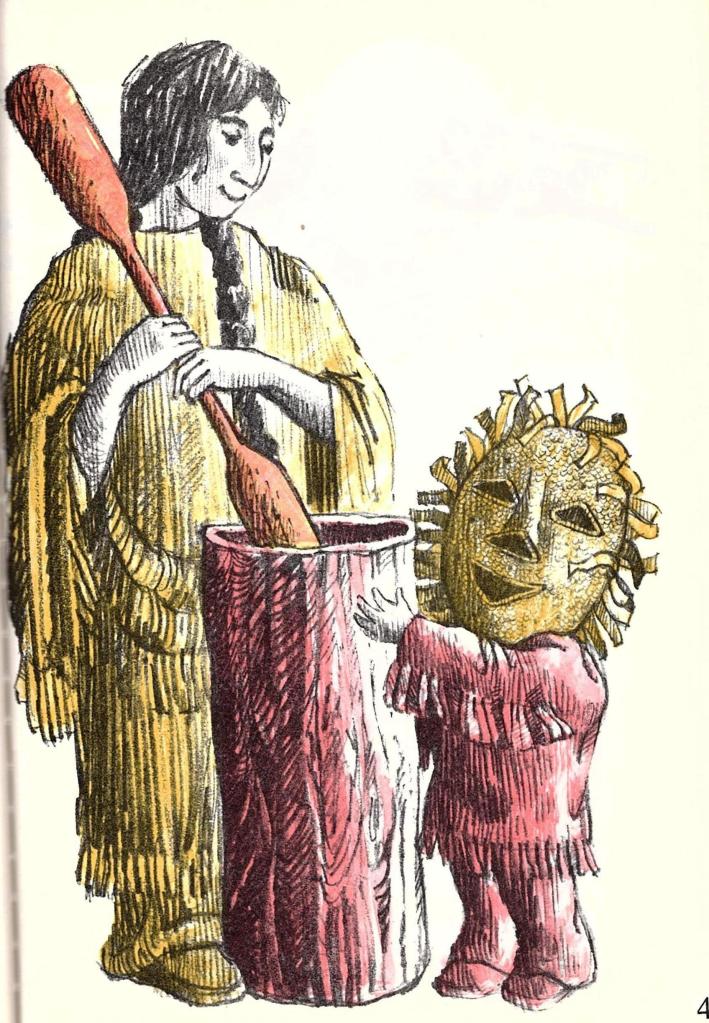
I also love Little Runner’s mom.
Little Runner of the Longhouse by Betty Baker, pictures by Arnold Lobel, an I Can Read Book by Harper & Row Publishers, New York & Evanston, 1962. Little Runner is an extremely relatable Iroquois boy whose main goal in life is to get some maple sugar.
Rabbit’s Snow Dance by James & Joseph Bruchac, illustrated by Jeff Newman, 2012. This legend explains why rabbit, who started out with a long, beautiful tail, now has a short, fuzzy one. It also explains why cottonwood trees are full of “cotton.” Like many Native legends, it contains a not-so-subtle warning about being proud, wanting our own way, and not listening to warnings from our elders. “I will make it snow! A-zi-ka-na-po!”
A Salmon for Simon by Betty Waterton, illustrated by Ann Blades, copyright 1978, first Meadow Mouse edition 1990, first revised Meadow Mouse edition 1996, reprinted 1998. A Meadow Mouse Paperback, Groundwood Books/Douglas & McIntyre, Toronto, Ontario. Simon, who lives in a village on the Pacific coast of Canada, has been trying all day to catch a salmon. When he sees one drop from an eagle’s talons, he has to decide whether to eat it or save it.
Genetic evidence about ancient populations is cool. Sometimes it tells you things that are fairly intuitive, like that the early Native Americans peopled the continent very quickly, and that at some point they got a visit from some Pacific populations.
At other times, genetic evidence (or the way it is interpreted) tells us some things that make sense and others that don’t. Take this article for example:
On the one hand, the genetic evidence presented here is said to indicate that there was once a lot more genetic diversity among humans than there is now. That makes a ton of sense, especially if you believe in a bottleneck such as the Flood.
On the other hand, this article also asks us to believe that these distinct human populations stayed away from each other for up to 700,000 years (!) and then met up again and interbred. That is really hard to swallow. How in the world did they manage not to bump into each other for that long? The world isn’t that big, is it?
One of the human (or “vaguely human-like,” as the article so flatteringly puts it) populations mentioned in the article above is the Denisovians, apparently a very hearty Central Asia population that was well adapted to high altitudes. For those who believe historical evidence that giants once walked the earth, the following article might be suggestive:
The “fun fact” has now become a “confusing fact.” Waitaminit! If that is true … then genetic analysis tells us basically nothing about the nature of a thing … then all of this is … worthless?
No, not really. It has helped me to remember that genes are not words or sentences, they are libraries. It is easy to imagine two vast libraries which have a 50% overlap (encyclopedias, dictionaries, and the like) but diverge wildly in the other 50% (one is all philosophy and ancient history; the other is all Dave Barry). That helps. Some. But it’s also a reminder that even the experts have “read” only a few volumes from any given library.
Sometimes genetic evidence tells a different story than that told by archaeology (with its many assumptions) or linguistics.
Here (at Skeptic.com) is a review of Graham Hancock’s latest book, America Before.
It’s a interesting review, touching on some of the themes we’ve been talking about here on OutofBabel, such as the Younger Dryas Impact Hypothesis and possible lost settlements (even cities?) in Amazonia.
Of course, Hancock, being Hancock, puts those two suggestive ideas (plus a lot of other ones) together into something much bigger. He has apparently fallen off the New Age cliff entirely. According to the review, America Before is full of non sequiters, speculation, noble savage myths, and angry rants against the profession of archaeology as a whole, descending at the end of the book into the liberal use of caps and boldface type.
I have not read America Before, but my impression is that this review represents it accurately. I have two reasons. The first is that it is (believe it or not) a sympathetic review. The reviewer, Jason Colavito, knows and likes Hancock and is clearly familiar with the body of Hancock’s work.
In his early books on ancient mysteries, such as The Sign and the Seal(1992) and Fingerprints of the Gods (1995), Hancock wove a compelling narrative from sparse facts and heady speculation. These books were written as adventures in which Hancock cast himself in the role of a tweedier Indiana Jones, traveling the world in search of evidence of the impossible. Regardless of the conclusions he drew, the personal narrative of discovery created a compelling through-line that made these books engaging even for those who disagreed with the author’s ideas. But with each successive book, Hancock seemed to anticipate that his audience is increasingly people who have read his earlier work. … Since Hancock is no longer an innocent questing for truth but a self-styled advocate of “alternative archaeology,” his books have taken on the tone of jeremiads, their sense of wonder and discovery replaced with righteous indignation …
“American Atlantis,” by Jason Colavito
And that is the second reason that I find this review believable. The weaknesses that Colavito identifies in America Before are characteristic weaknesses. I recognize them from Fingerprints of the Gods, but apparently in the intervening years they have gotten worse and not better.
In other words, the writer that Colavito describes definitely sounds like the Graham Hancock I know and love … or loved when he wrote Fingerprints. Maybe not so much now. It does not surprise me either that Hancock has gone full New Age in the years since writing Fingerprints. That’s because I read one of his fiction books, called Entangled: Eater of Souls. (It was a “fiction novel.” That’s what we experts in the publishing industry call them.) Entangled had soul guides, telepathic Neanderthals, hallucinogenic drugs, and everything.
I still think (as Hancock thinks, but for different reasons) that complex human civilization is much older than commonly believed. I even have some sympathy for Hancock’s frustration with archaeological assumptions and blind spots. But I don’t think there’s any organized scholarly conspiracy at work and I have no desire to read a book that amounts to an angry rant against those archaeologists working in North and South America. Nor do I think, should we discover (or, should I say, when we discover) ever more advanced civilizations in ancient North and South America, that a New Age type of explanation will be necessary.
So, goodbye, Mr. Hancock. I really enjoyed Fingerprints of the Gods. It presented some intriguing ideas and started me down my own speculative paths. But I don’t think I’ll be reading your latest offering.
Guess when they are believed to have settled there? 10,000 years ago!
Follow the link, if not to read the article, then at least to see the panoramic picture at the top of the article that shows the region where these settlements were found.
On my shelf is a 2009 book called First Peoples in a New World by
archaeologist David J. Meltzer. I have learned many things from this book, not
least of which is that North American archaeology is really, really contentious. (I may post about this later.)
On pages 55 – 58, right in the
middle of a discussion of the causes of the Younger Dryas, is a long callout
box in which Meltzer goes on a delightful rant:
In 2001 the Mammoth Trumpet, a newsletter for a lay audience … carried an unusually long, highly technical article declaring there’d been a Pleistocene doomsday. A supernova-caused neutron bombardment centered over the Great Lakes had fried the earth 12,500 years ago … heated the atmosphere to over 1,800˚ Fahrenheit, and radiated plants and animals at the equivalent dose of “a 5-megawatt reactor for more than 100 seconds” … and so spiked atmospheric radiocarbon concentrations that ages on Paleoindian sites were thrown off by up to 40,000 years. … [In 2007] the supposed Pleistocene extraterrestrial catastrophe was hyped as fact from FOX News to The Economist.
Meltzer pp 55 – 56
The Younger Dryas Impact Hypothesis
This claim is now called the Younger Dryas Impact Hypothesis. The supposed comet impact or impacts are alleged to explain a number of phenomena:
Just as the last Ice Age was ending, right in the middle of a warming period, the climate unaccountably got cooler again for about 1000 years. This glacial encore is called the Younger Dryas. The idea is that a comet impact could have caused a bunch of glacial ice and water suddenly to be dumped into the North Atlantic, cooling temperatures there and interrupting the warming cycle.
The approximate date for the impact is around the same time that North America’s megafauna (mammoths, giant sloths) were dying out. Paleontologists are not sure why they died out, because it’s very difficult to get an accurate sense of numbers or of how quickly the extinctions happened. But if there was a comet impact, that would obviously be the #1 suspect in their demise.
Also around this time (about 10,800 BC) there is a geologic layer called the Black Mat, a carbon-rich layer that might be burned organic material or might be peat, as from the bottom of a pond. In some places, it contains nanodiamonds and other unique mineral things that are usually only formed with high heat and pressure.
This is also the time period in which some archaeologists think the Clovis culture (of humans) was dying out in North America, though this die-off too is controversial.
Impact, Schmimpact
Meltzer, in his 2009 book, is scathing: “The claim was so far out literally and figuratively … it was met with bemusement, or simply ignored.” He finds all kinds of evidentiary problems with the Younger Dryas Impact Hypothesis. He doesn’t think an asteroid impact is required to explain the Younger Dryas, for one thing. (The cooling cycle could have been kicked off by meltwater from the North American glaciers even without a super-hot space rock, since the glaciers were already melting.) Furthermore, Black Mat evidence is inconsistent. So is Clovis evidence. So is evidence about the megafauna. And, the biggest problem of all, in 2009 when his book was published, no one had found an impact crater.
Well, that has changed. A 31-kilometer-wide impact crater was recently discovered under Hiawatha Glacier in Greenland. And the proponents of the YDIH have also discovered what they say is additional evidence of impacts as far away as Chile. (See the links below for more information.)
In Conclusion, We Are Not Sure the World Actually Ended
So, did a huge comet – or multiple pieces of a comet – really hit earth about 12,800 years ago? Nobody really knows. But – and this is the only point of this article – how can we not know this? How can we not be sure whether an apocalyptic, species-killing, continent-setting-on-fire event even happened?
The fact there can be controversy about such a hard-to-miss event just illustrates how difficult it is to figure out anything that happened even a mere 12,000 years ago. Pause for a moment and allow your jaw to drop, as mine did when I first read this, over all … that we don’t … know.
Sources
Fernandez, Sonia. “The Day the World Burned: Geologic and paleontological evidence unearthed in southern Chile supports the theory that a major cosmic impact event occurred approximately 12,800 years ago” posted Friday, March 8, 2019 on UC Santa Barbara, https://www.news.ucsb.edu/2019/019375/day-world-burned
Haynes, C. Vance, Jr.“Younger Dryas ‘black mats’ and the Rancholabrean termination in North America” Proceedings of the National Academcy of Sciences of the United States of America, published online 2008 April 24, https://www.ncbi.nlm.nih.gov/pmc/articles/PMC2373324/









 Out of Babel Books