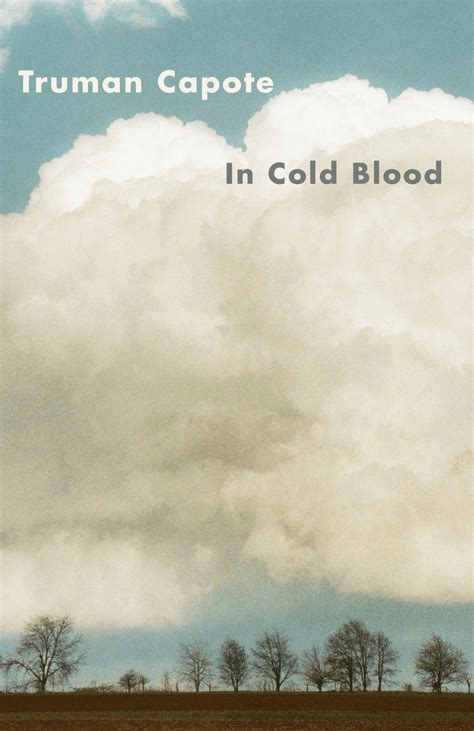
Left to right: Dick Hickcock and Perry Smith, killers of the Clutter family; In Cold Blood by Truman Capote; The Strange Land by Jennifer Mugrage; “Don’t Eat My Family” by Jennifer Mugrage.
I hope this image gallery shows up right. I’ve never tried to make one before.
It’s unfortunate that I couldn’t find an image of either Perry or Ikash alone, but in some ways it’s fitting that the image I found for Perry features a mugshot and the image of Ikash shows him protecting his family.
This post will contain spoilers for The Strange Land, which has been out since 2021, and In Cold Blood, which has been out since 1966. This will be a rambling comparison between two character studies. Come along if you like that sort of thing.
It may seem — and O.K., it is — pretentious to compare a book of my own to Truman Capote’s masterpiece. My reasons for comparing the two characters will become clear, but to belabor the obvious, I am not comparing myself to Capote as a writer. It’s my blog, so I can be a little bit pretentious if I want, right? Shall we?
What the two lost boys have in common
The character of Perry Smith has a great deal in common, on a superficial level, with Ikash, the focus of my coming-of-age story The Strange Land. The similarities were strong enough to disturb me when I read Capote’s classic. After all, Perry drifts through the world aimlessly and then commits a senseless murder, whereas Ikash remains kind and courageous and goes on to become the shaman of his people. Perry is real, Ikash is fictional. Does this mean that I had fatally romanticized my character Ikash, a person who would not be nearly so noble in real life?
I do have a tendency to romanticize the sensitive, artistic guys, and ladies, if you share this tendency, it is something you need to watch. Just because a guy is not harsh, does not necessarily mean he is kind. As Jordan Peterson has said, “If you think strong men do a lot of damage, wait ’til you see the damage weak men will do!”
To start at the most superficial level, Smith and Ikash kind of look alike. Both are short and stocky (Smith had underdeveloped legs and feet), with wide faces, fine features, and dark eyes and hair. In fact, both are American Indian, though they are so far removed in time that this fact has no relevance for anything except their appearance. Smith’s father was John “Tex” Smith, an Irishman, and his mother was Florence Buckskin, a Cherokee. Ikash is a fictional character but was supposed to come from a tribe that was ancestral to the American Indians.
Both grew up in rough circumstances and eventually suffered the breakup of their families. Smith’s parents were both drunks. His mother left his father when he was small, and he turned to crime, lived in a series of orphanages, then on the Alaskan frontier with his father as a teenager. He eventually joined the Navy, then proceeded to drift from friend’s house to friend’s house to park bench to jail, not really having a place to go home to. His shrimpy stature was probably from malnutrition as a young child.
Ikash (again, fictional) had it slightly better. He did not suffer from hunger, because the tribe’s Beringian environment provided for them abundantly. However, his father was abusive to mother, leading eventually to her suicide, and periodically to his sons as well. After his mother’s suicide, Ikash’s family essentially broke up, and he and his brother lived together as bachelors. He was a bit of a pariah in the tribe because of his family’s reputation.
Both men are quiet, sensitive types. Both play the guitar (lute, in Ikash’s case) and sing. Both think of themselves as spiritual. In Perry’s case, he has occasional premonitions, visions, and, as he gets more beat up by the world, what appear to be dissociative episodes.
“I could give you a hundred examples. I don’t care if you believe me or not. For instance, right before I had my motorcycle accident I saw the whole thing happen: saw it in my mind–the rain, the skid tracks, me lying there bleeding and my legs broken. That’s what I’ve got now. A premonition.”
… “About that premonition stuff. Tell me this: If you were so damn sure you were gonna crack up, why didn’t you call it quits? It wouldn’t have happened if you’d stayed off your bike–right?”
That was a riddle that Perry had pondered. He felt he’d solved it, but the solution, while simple, was also somewhat hazy: “No. Because once a thing is set to happen, all you can do is hope it won’t. Or will–depending. As long as you live, there’s always something waiting, and even if it’s bad, and you know it’s bad, what can you do? You can’t stop living. Like my dream. Since I was a kid, I’ve had this same dream … What it comes down to is, [in my dream] I want the diamonds more than I’m afraid of the snake. So I go to pick one, I have the diamond in my hand, I’m pulling at it, when the snake lands on top of me… he starts to swallow me. Feet first. Like going down in quicksand.”
Perry hesitated. He could not help noticing that Dick was uninterested in his dream.
Dick said, “So? The snake swallows you? Or what?”
“Never mind. It’s not important.” (But it was! The finale was of great importance, a source of private joy. [It was a] towering bird, the yellow “sort of parrot” … which had first flown into his dreams when he was seven years old, a hated, hating half-breed child living in the California orphanage run by nuns–shrouded disciplinarians who whipped him for wetting his bed. It was after one of these beatings, one he could never forget, that the parrot appeared, arrived while he slept, a bird “taller than Jesus, yellow like a sunflower,” a warrior-angel who blinded the nuns with its beak, fed upon their eyes, slaughtered them as they “pleaded for mercy,” then so gently lifted him, enfolded him, winged him away to “paradise.”
As the years went by, the particular torments from which the bird delivered him altered, but the parrot remained, a hovering avenger.
pp. 90, 92 – 93
Perry has no outlet for his artistic nature and believes that no one appreciates his depth and intelligence.
Ikash, for his part, wants to have visions like his cousin Ki-Ki who is the tribal shaman, and eventually does have visions, but then worries that they are endangering his loved ones.
Ikash can spend a lot of time alone, thinking or praying. Smith travels with a box full of books, papers, maps, and magazines, even when homeless, which is a habit that endeared him to me before I heard more details about the murder he committed.
Ikash, as has been mentioned, moves into a protective role towards members of his tribe. Smith, despite being an unstable character in some other ways, several times protects girls and young women from the predations of his partner in crime, Dick Hickcock.
he had “no respect for people who can’t control themselves sexually,” especially when the lack of control involved what he called “pervertiness”–“bothering kids,” “queer stuff,” rape. And he had thought he had made his views obvious to Dick; indeed, hadn’t they almost had a fist fight when quite recently he had prevented Dick from raping a terrified young girl?
page 202
Finally, another burden these two young men have in common is chronic, or recurring, pain. Smith’s legs were smashed up in his motorcycle crash and appear not to have healed properly. There’s a memorable scene in In Cold Blood where the two criminals, on the way to their heist, stop at a gas station. Perry goes into the bathroom and stays in there for so long that both Dick and the gas station attendant are filled with disgust and impatience. In fact, Perry is first sitting on the toilet, then trying to rise to a standing position, with his legs hurting so badly that he’s holding onto the sink, sweating, and shaking. Ikash has periodic recurring pain from some old broken bones (collarbone, ribs), and also suffers periodic “phantom” pains in other parts of his body, that while short-lived, are severe enough to be temporarily debilitating. Ikash believes that these episodes represent instances of his “bearing” the actual sufferings of other members of his tribe, for them. They can also be understood as the lingering effects of trauma and grief, stored in the body. As can Smith’s health problems.
So what accounts for the different outcomes between these two lost boys?
Easy, you might say. You made Ikash up, so you can make him turn out however you like. Perry Smith lived in the real world, where there are no happy endings.
Well, O.K. I did not write a nihilistic book where characters are trapped by their abusive pasts, character flaws, and poor decisions by themselves and others, because I don’t believe that the world is, ultimately, a nihilistic place. But if you’re going to write hope into a book, it has to come from somewhere. It can’t be deus ex machina hope; it has to be Deus ex caelo, or should I say credo in unum Deum, Patrem Omnipotentem, Factorem caeli et terrae.
Some reviewers of my book said they found the scenes of domestic abuse difficult to read. Actually, I kept them as minimal as I could and still convey the problem, and there is much that I spared Ikash, as can be seen when we compare him to Perry Smith, who had it much worse.
Smith was the youngest in his family, so he was very small when things got chaotic between his mother and father. His mother would bring strange men home and fornicate with them in view of the children, something Ikash’s mother Sari definitely would not do. One of these episodes led to a fight “in which a bullwhip, hot water, and gas lamp were used as weapons.” After the breakup of the family, Perry ended up in orphanages where the nuns would shame and beat him for bedwetting. Ikash was also a bedwetter, as is not uncommon among little boys. Perry Smith had even more reason for it given the instability in his home. This problem continued into adulthood. He believed that his kidneys had been ruined by a childhood diet of bread dipped in sweetened condensed milk, which during the Smith family’s nomadic days was often all they had for supper.
Ikash’s family, though unhappy, remained intact until he was fifteen.
When Smith joined the Merchant Marine, Capote strongly implies that he had another horrible experience which Ikash escaped.
“But I never would have joined [the Merchant Marine] if I’d known what I was going up against,” Perry once said. “I never minded the work, and I liked being a sailor–seaports, and all that. But the queens on the ship wouldn’t leave me alone. A sixteen-year-old kid, and a small kid. I could handle myself, sure. But a lot of queens aren’t effeminate, you know. Hell, I’ve known queens could toss a pool table out a window. And the piano after it. Those kind of girls, they can give you an evil time, especially when there’s a couple of them, they get together and gang up on you, and you’re just a kid. It can make you practically want to kill yourself.”
pp. 133 – 134
Apparently, Smith was the victim of homosexual predators while he was at sea. This kind of violation, arguably the ultimate in horror, is not something I’ve ever felt up to subjecting my characters to. It is, sadly, quite common in the world (especially the ancient world), and I am not saying it’s something that a person cannot come back from. The grace of God is enough to redeem and restore anyone, no matter what they have been through (see The Sparrow.) But I have never had the slightest ability nor desire to put my male characters through this. Real life, on the other hand, is not so merciful.
Ultimately, though, it’s not Perry’s additional bad experiences that left his character to turn sour; instead, it’s relationships that he lacked and Ikash had.
Like Perry, Ikash’s immediate family was not great. His father and his older brothers bullied him. Unlike Perry, Ikash lived in a tribal situation where there were, close at hand, uncles and aunts, cousins, and a grandmother. This kind of situation is not automatically good, of course; tribes can be hotbeds of gossip and social pressure. And indeed, Ikash’s early experiences do cause him to mistrust older relatives who might otherwise be helpful to him. But he is fortunate to have quite a number of kind people in his life who wish to aid him and his mother. Grandmother Zillah does her best to provide breaks for Sari; cousin Ki-Ki mentors Ikash, and a model of a healthy marriage is provided by his father’s sister Ninna and her husband. Even with all these good helpers and models, it is barely enough.
Perry does not seem to have had anything like this kind of potentially beneficial community. His father and mother were itinerant, having met on the rodeo circuit. They don’t seem to live near any extended family. Perry does form connections with friends who he believes understand him, but because of his vagrant lifestyle, the connections are not lasting. At one point, he travels across the entire United States hoping to stay with an old Army buddy, only to find to his dismay that the buddy has moved and left no forwarding address. These kinds of near misses are the story of Perry Smith’s life. What might be called his last friend, Dick Hickock, is a cellmate who wants to use him to pull off a heist, and ultimately puts him in a situation that leads to the moral ruination, and then the death, of both of them. Dick does not understand Perry, nor does he have any concern for the best interests of Perry, the Clutter family–or anyone but himself.
In a counterintuitive dynamic, Perry’s very isolation tends to make him not only lonely, but also increasingly conceited. Having no long-term relationships means there is no check on his delusions. With no one to praise, appreciate and love him properly, there is also no one whose critiques he can take to heart. He’s left to his own assessment of himself, and not able to develop strength of character or clarity of mind. Ultimately, when he cuts Mr. Clutter’s throat, he does it without intending to. “I didn’t want to harm the man. I thought he was a very nice gentleman. Soft-spoken. I thought so right up to the moment I cut his throat.” (p. 244)
Ikash, on the other hand, is surrounded by judgmental relatives who have known him since he was small, who can love on, scold, praise, and criticize him.
Without Hope and Without God in the World
At fourteen, Ikash begs his older cousin Ki-Ki, the tribal shaman, to teach him how to have a vision.
Ki-Ki, the shaman, seemed to be in love with the world and with the many specific things in it. He was in love with his dogs, for example, with the horses, with the wild animals, in love with his wife, in love with God. It was this quality that drew Ikash to him. Ikash would love to approach the world like that. But he had never felt such love for anything, except when it was stirred in him for a few moments by some story or song of Ki-Ki’s. He longed to live in the world of the stories, but he had never been able to manufacture such love inside himself.
p. 93
Ki-Ki is uncertain this will work, or that is even viable (as he says, “visions are dangerous“), but he is willing to give it a try.
They sat, cross-legged, each with his back against a tree. Upstream, there was a view of the grey top of a mountain.
The atmosphere seemed somewhat lacking to Ikash. He looked at his older cousin and muttered, “Aren’t you going to beat a drum or something?”
Ki-Ki grinned whitely. “Then you wouldn’t be sure it was real,” he said. “Besides, God is everywhere. We need no drum to talk to God.”
As soon as he said the word “God” for the second time, a presence was felt in the gully. It was so palpable that Ikash actually gasped.
Ki-Ki apparently felt it too, for he reached out a large, hard hand and grasped Ikash firmly around the wrist as if to keep him from being swept away.
Immediately Ikash knew what his cousin had meant about danger that was not a physical danger. He felt no threat, nor any hostility, such as he had often felt from his father. But the presence was overwhelming, crowding, as of something too huge for the valley to contain.
This was not the sort of vision he had hoped for.
He heard Ki-Ki speak. “It’s too much for him,” he said, and for a second it was as if some great face had turned its terrible eyes towards Ikash … and then, oh thank goodness, the presence was gone suddenly.
pp. 100 – 102
In other words, Ki-Ki, without really trying to, functions as an intermediary to introduce Ikash to God. Later, when quite a few other tragedies have happened and Ki-Ki has been taken from Ikash, the young man has a vision of his own that he can only describe as “a father.”
“A father?” [his brother] Sha blinked, completely thrown.
“A good father.” Ikash was staring earnestly at his brother, as if willing him to grasp this difficult concept. “It gave me a sense of a really good father, the kind we’ve always wanted but never known.”
“What did it look like?” asked [cousin] Mut. He was picturing a bigger, two-eyed version of his own father.
“I told you, it wasn’t visual. I didn’t see anything except the cloud. But I felt the Father. … We have a father.” He made a slight sweeping gesture with his hand that took in himself and, somehow, the entire camp as well. “That’s what makes us able to bear the loss of all the others.”
pp. 512 – 514
A perceptive reader has pointed out that the definition of a horror story is all the bad stuff in the world that happens, minus God. God is what keeps Ikash’s story from remaining one of unremitting horror. This was the horror–the horror of other people’s sins against him, the horror of a complete lack of adequate love, the horror of his own increasingly weak mind, and eventually, his own grievous sins against others–that Perry Smith lived.
Before Smith and Hickock committed their planned robbery, to which Hickock insisted they leave “no witnesses,” they stopped by a Catholic hospital. Perry Smith knew that nuns were guaranteed to have black nylons, and he wanted Hickock to obtain some so the two could cover their faces when they went to rob the Clutter family. Perhaps, if the two had managed to do this, they would not have ended up killing the Clutters. Dick, however, came out of the hospital without having tried to get any nylons (“it was a pukey idea”). Perry was not willing to go in. He believed that nuns were bad luck.
After Smith and Hickock’s arrest, Perry Smith was kept in a cell in the home of the town undersheriff and his wife, a cell that until then had been reserved for female prisoners. (The reason was a desire to keep the two culprits separated.) Sherriff and Mrs. Meier were “deeply Catholic.”
Mrs. Meier had been rebuffed by Perry when she had suggested a consultation with Father Goubeaux, a local priest. (Perry said, “Priests and nuns have had their chance with me. I’m still wearing the scars to prove it.”)
pp. 288 – 289
Now, of course, “nuns and priests” are not necessarily the only way to find out about the redemption offered to us by the God who gives life to the dead, and calls things that are not as though they were. They might not even be the best way. My only point is that unfortunately, for Perry Smith, the only people in his life whom he associated with God, were also people who were abusive to him. He never had a chance to be introduced to the concept of God by anyone he loved and trusted. This is the opposite of the case with Ikash.
Later, in jail, Perry did make friends with a former pastor, now a fellow inmate, who was mystical and simpatico with Perry. This man, however, seemed to be a bit of an apostate, and by that time Smith had already hardened against the whole idea of God. God, certainly, can overcome stories this sad and sadder, but in this case, for whatever reason, He didn’t.
We don’t know whether Perry Smith had a deathbed conversion in the last few seconds before being hung, but tragically, from all appearances, it doesn’t appear so. Neither did Dick Hickcock. That, plus the apparent senselessness of the fate of the Clutters, is what makes In Cold Blood such a tragedy. It underlines how much Smith and Hickock–and indeed all of us–need Jesus, and that is what makes this unedifying event such an appropriate topic for this Easter season.