I had … shall we say a number … of books I wanted to buy. I checked out prices on B&N. I would have been paying a lot more than on Amazon. Like, a lot more. And I’m Dutch-American and kind of cheap, what can I say?
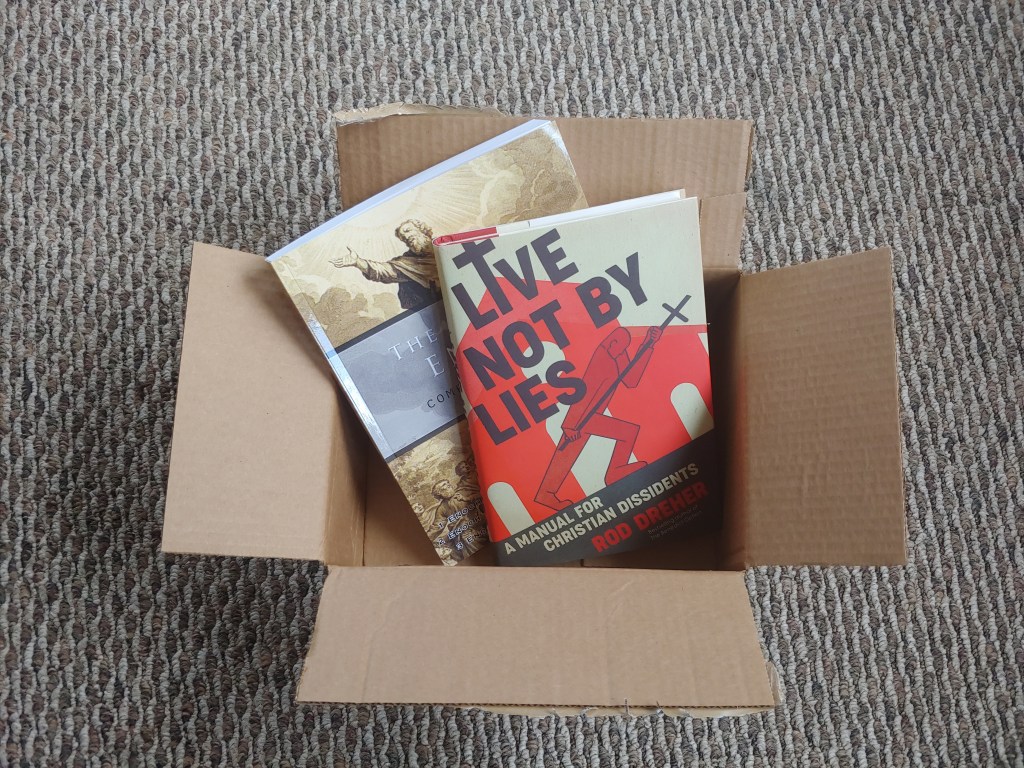
The books are coming in several shipments. This is the first.
Live Not By Lies is one I’ve seen several people recommend. The books of Enoch keep showing up as primary sources in the reading I’ve been doing in secondary sources about giants and elohim and so forth, so I figured it might be just as well to own a copy.
The book is Before the Ruins, 2020, by Victoria Gosling.
It’s been a while since I binged a book, but I finished this one in just a few days. It is so well-written that it’s almost like unrhymed poetry. Almost every page has something quotable, even when the quotes are ones I disagree with, like the following …
I remember Peter’s father in the church telling the story of Jesus and Pilate, and jesting Pilate asking Jesus what the truth was but then not staying for an answer, and so we never got to find out, not any of us, not ever. I was so disappointed and on our way back to the vicarage, hell-bent on my share of the roast dinner — chicken, chicken, let it be chicken! — I pestered the vicar, “But why didn’t the disciples ask him instead? There he was on the cross, it’s not like he was going anywhere. Why didn’t they ask him?” With his hand on the gate, he turned. A watery smile. “Sometimes, Andy, I think you are the only one who is listening.” Which, of course, was no answer at all.
Nor was there anything in the Gospels that shed light on what Jesus would have said about [my abuser]. I don’t remember anywhere in the Bible Jesus meeting a truly wicked man.
Before the Ruins, p. 114
*pinches brow*
No, Jesus never met a truly wicked man … except the ones who hunted, slandered, gaslit, and betrayed Him. And then tortured Him to death. Except the majority of people he met. Except those.
He never said anything about child abusers … though there were certain passages about the sea and millstones and whitewashed graves and the fires of hell.
His disciples never asked Him “What is truth?” … except all those times they did, and He said “I am the truth,” and the time Philip said to Him, “Show us the Father,” and Jesus said, “Don’t you know me, Philip, even after I have been with you for such a long time? Anyone who has seen me, has seen the Father.”
It’s interesting, because a big theme of Before the Ruins is how difficult it is to really know people, even people you love very much. And how difficult it is to let people know you, even if you really want to.
When not on the subject of the Gospels, the book has a lot of insight and achingly evocative passages about childhood and growing up. Passages like that will break your heart. Passages like this one:
It made me aware of how dormant I was most of the time. How my life — my job, my screens — made it easy to be occupied every waking moment, hurrying, distracted, and equally, on some level almost entirely asleep, comforted by dreams of effortless transformation.
But I was not Cinderella. Instead, there was another story Peter and I had often found in the books of our childhood. It came in different disguises. It was the one about the traveler who arrives at an island, or a castle, or a secret door into the side of a mountain. There, welcomed, the traveler stays, perhaps against their instincts. Often they eat or drink — strange fruit, or wine from a goblet. There is always something they should be doing, an important task for them to fulfill, but they forget it, they are waylaid, and if they ever remember, their companions, if there are any, distract them with promises, or songs, or riddles to ponder.
Often the traveler sleeps, sometimes they dream, always they are nagged by the sense that there is something they are forgetting, something they must do. Their true love is waiting, or their aged parents. There is a sick child they must bring herbs to, a kingdom for them to inherit. But they do nothing; they are paralyzed. And when they wake, if they ever get away, once back in the world they find that centuries have passed, that they are too late, too late for everything, and that all that they loved, everything that truly mattered, is lost forever.
To sleep on? Or to wake? This was the question facing me. To sleep, or to wake and face the reckoning, to find out what had been lost.
Originally posted this in July of 2020. Now it has become relevant again.
More than one side can be the bad guys at once.
“What I know about Mendoza,” Palmer said slowly after a while, “is that he’s a petty gangster who enjoys pushing people around. I’ve already told you what I think of Cobar: a psycho killer.”
“But in his book –“
“I know,” Palmer said, lifting a hand. “But a killer who writes a book is still a killer — even if it’s a book about peace and justice. A thug with a lot of high-blown political ideas is still just a thug in the end.”
“But he’s at war with a brutal government …”
“Gangsters get in wars with each other all the time,” said Palmer. “That doesn’t make one side good and the other bad. And it doesn’t mean I have to care which bunch of bullies and thugs wins the day. You think the people in this village will be any better off when it’s Cobar’s government murdering them instead of the government they had before? The only one who’ll feel better about it is you, because you’ll think it’s all for some higher cause — fairness or justice or whatever they’re calling it nowadays. Whatever they do call it, it always translates to the same thing in the end: obey the man with the gun or he’ll kill you. The truth is, Professor, there’s only one higher cause I know of. That’s the right of every man to go his own way and spend his own money and speak his own mind and find his own salvation. You show me the side that stands for that and I’ll fight for them.”
If We Survive, YA book by Andrew Klavan, pp. 218 – 219
General consensus is that the steppe-dwelling kurgan builders were the ancestors of the Indo-Europeans. (They later moved west into Europe and east into India.) So I could call her Grandma.
But, the specific group this burial is thought to be from, lived there from 800 B.C. to 300 A.D. That’s well after the dispersal of the Indo-Europeans to Europe, though some of them were still apparently hanging around in central Asia.
Hence, “auntie.”
Other things to love about this article …
She’s an older woman, about 50, buried with a toddler. Could have been Zillah from my books!
Her crescent pendant shows that archaeologists don’t know squat, and the headlines are even worse. The subheader says “a 50-year-old woman was buried with a unique ‘male’ pendant.” Reading down in the article, we find that “She was buried with this artifact that we had believed to be a sign of male burials,” because similarly shaped pendants had previously been found in men’s burials in kurgans in southern Siberia. So, because we had never found this type of pendant buried with a woman, we assumed it was a male artifact. We should be careful about making extrapolations based on what we haven’t yet found. And then putting them into headlines.
The Scythians are cool! Many of them were red-haired. When living in Asia, they made very tall hats out of felt (you can find reconstructions on Pinterest). Bill Cooper, in his book After the Flood, shows that the ancient Irish believed themselves to be descended from the Scythians, and that the word Scot comes from the same root (pp. 110 – 111).
I recently got the third book in my trilogy, The Great Snake, back from my editor. The next step for me is to go through it, noting all her comments, making all the changes that are called for.
I am having a grand old time. I was really unsure about this book during, and even after, writing it, perhaps because, to paraphrase Jordan Peterson, “The artist should not know exactly what it is that he is doing.” Now, reading through it with fresh eyes after an absence of several months, things are clicking in to place. I feel that what this book has done is right.
I think you all are going to like it.
Meanwhile, we have a brand-new war raging somewhere in the world. Women my age, with children the age of my children, are being forced to flee their homes or hunker down in their basements. Grandmothers are preparing to do first aid. War-fever is sweeping my own country. People are going bananas with demonizing the bad guys, and talking about WWIII.
That doesn’t count the crises we have long been praying about, which still have not abated, notably the Uyghurs being imprisoned in concentration camps, but there are a lot of others too.
Real life is a horror story.
Which raises the question: Do I have any right to enjoy myself reading over my little story of fictional horrors? Do I have any right to post about it, and about paintings and sunsets, or about anything at all except the current crisis?
It is time for me to pull out again C.S. Lewis’s wonderful speech “Learning In War-Time,” which addresses these very questions. I posted a quote from it, and a link to it, almost exactly two years ago. Here they are again:
[We] must ask [ourselves] how it is right, or even psychologically possible, for creatures who are every moment advancing either to heaven or to hell, to spend any fraction of the little time allowed them in this world on such comparative trivialities as literature or art, mathematics or biology. If human culture can stand up to that, it can stand up to anything. To admit that we can retain our interest in learning under the shadow of these eternal issues, but not under the shadow of a European war, would be to admit that our ears are closed to the voice of reason and very wide open to the voice of our nerves and our mass emotions.
I think it important to try to see the present calamity in a true perspective. The war creates no absolutely new situation: it simply aggravates the permanent human situation so that we can no longer ignore it. Human life has always been lived on the edge of a precipice. Human culture has always had to exist under the shadow of something infinitely more important than itself. If men had postponed the search for knowledge and beauty until they were secure, the search would never have begun. We are mistaken when we compare war with “normal life.” Life has never been normal.
The insects have chosen a different line: they have sought first the material welfare and security of the hive, and presumably they have their reward. Men are different. They propound mathematical theorems in beleaguered cities, conduct metaphysical arguments in condemned cells, make jokes on the scaffold, discuss the last new poem while advancing to the walls of Quebec, and comb their hair at Thermopylae. This is not panache; it is our nature.
C.S. Lewis, “Learning in War-time,” a speech given in Oxford in autumn of 1939
Long story short? You bet I have a right to post about art and literature and knitting and all the rest of it. Because when you get right down to it, all my posts are in some sense posts about Jesus. And He is exactly what we need, in this current crisis and in every crisis. He is wonderful. He really is.
“Evolution” in the Darwinist usage implies a completely naturalistic metaphysical system, in which matter evolved to its present state of organized complexity without any participation by a Creator. But “evolution” also refers to much more modest concepts, such as microevolution and biological relationship. The tendency of dark moths to preponderate in a population when background trees are dark therefore demonstrates evolution — and also demonstrates, by semantic transformation, the naturalistic descent of human beings from bacteria.
If critics are sophisticated enough to see that population variations have nothing to do with major transformations, Darwinists can disavow the argument from microevolution and point to relationship as the “fact of evolution.” Or they can turn to biogeography, and point out that species on offshore islands closely resemble those on the nearby mainland. Because “evolution” means so many different things, almost any example will do. The trick is always to prove one of the modest meanings of the term, and treat it as proof of the complete metaphysical system.
In the following quote, Fiver, a sensitive rabbit, has just heard an evocative poem recited by another rabbit, in an underground hall.
They followed Fiver up the run and overtook him at the entrance. Before either of them could say a word, he turned and began to speak as though they had asked him a question.
“You felt it, then? And you want to know whether I did? Of course I did. That’s the worst part of it. There isn’t any trick. He speaks the truth. So as long as he speaks the truth it can’t be folly — that’s what you’re going to say, isn’t it? I’m not blaming you, Hazel. I felt myself moving toward him like one cloud drifting into another. But then at the last moment I drifted wide. Did I say the roof of the hall was made of bones? No! It’s like a great mist of folly that covers the whole sky: and we shall never see to go by Frith’s light any more. Oh, what will become of us? A thing can be true and still be desperate folly, Hazel.”
I saw this tag onEmily Hurricane’s blog and I guess we are of the same generation, roughly, because there was a time when I watched the X-Files religiously, much to the annoyance of the people who lived with me. (I was a bad roommate. But that’s a story for another day.)
What can I say? I like aliens, dimly lit sets, interminable subplots, attractive actors, and Scully’s intelligent, sardonic mumble. And red hair. And … aliens.
Here are the rules for this tag: • Take out your fake FBI badge and answer the questions • You can link back to Book Princess Reviews if you wish • Keep the alien love alive and tag any and all X-Files fans you know…or just other people. (I myself will be tagging aliens only. So if you get tagged, I’m on to you …)
Fox Mulder
Mulder is known to have some “out there” beliefs, so name a book that you believe in despite everyone/ratings/reviews tell you perhaps isn’t that great.
Easy: the Bible. The more I read it, the more convinced I am that it’s the most amazing, epic, big, composite history book ever. But for people who have an issue with it, often one of their first complaints is that it’s not historical.
Dana Scully
Just like the resident FBI skeptic, name a book that you’re skeptical of (because of hype, sketchy cover, etc.)
Any book that offers a one-factor explanation for all the problems in the world, be that factor evolution, industrialization, racism, intolerance, capitalism, lack of faith in yourself and the universe, cholesterol, sugar, or whatever. Unfortunately, one-factor explanations are always popular. Which ones are most popular cycle through, and when an explanation is enjoying its moment in the sun, it seems to generate multiple books every year.
I Want To Believe
What book do you believe, just like the famous tagline, will be your next 5 star/crown read off of your TBR?
I hope this isn’t cheating, because I already started it just today: The Unseen Realm by Michael Hieser. (cue spooky X-Files music) I think this is going to be my go-to reference as I plan my next novel. I am borrowing it from a loved one, and let’s just say I hope he is not planning to use it any time soon.
Name a book on your TBR that is from a genre that seems out from another book world to you but still sounds super good.
When I attempted to enter a reading challenge at my local library last year, I read my very first Jack Reacher novel. I don’t usually enjoy spy stories or military stories, because I have sometimes found them hard to relate to. (Sometimes the people’s personalities disappear among all the high tech, action, or the inhuman-seeming military culture.) Not so with Jack Reacher. I will be coming back.
Name a book that comes along with an epic team just like these three hacking men.
My rabbit-obsessed child and I just finished reading Watership Down together, and … talk about an epic team! Of rabbits! It starts with Fiver, a small, seemingly barely functional Cassandra of a rabbit who sees visions of the future. Then add Hazel, the only rabbit who believes Fiver when he says something terrible is coming. Then Bigwig, a large warrior rabbit who gets his rough edges sanded off, and Blackberry, clever enough to understand foreign concepts like boats, and Dandelion, the storyteller …
This is an amazing book, and I will definitely be saying more about it in the future.
Walter Skinner
Skinner is the boss that forever teeters on the edge of good and evil, so name a conflicting character for you (whether the character is just conflicted or you’re conflicted about your feelings for them).
(Hey, doesn’t every boss forever teeter on the edge of good and evil? Leadership is hard. You find out when you have to do it. If you manage not to mess up royally and ruin lives, you deserve a medal.)
Hope this isn’t cheating, but there is a very conflicted character at the center of my book The Great Snake, due to come out this spring. Klee has good intentions, but she’s mad at the world (and at her family). She has good reasons, but her harsh judgement of them leads her into some bad decisions. They, meanwhile, are also conflicted. They did let her down, but it was in the process of trying to navigate a messy situation that didn’t offer good solutions.
Cigarette-Smoking Man
Name the worst book villain you can think of just like this smoking fiend who refuses to stay dead.
Last year I read The Gulag Archipelago (abridged) by Aleksandr Solzhenitsyn. So I would have to say Stalin. Stalin did die, finally, but only after setting up systems that would continue making things worse and worse long after he was gone.
What do you think? Do you have books for these categories? Are you an X-files nerd? If you are an alien, shapeshifter, cave dweller, or a Bigfoot, please join the tag! All others may comment below.
Unrelieved grey, above & below? … Look closer, there’s a treat in the middle!
So, just as a personal update here, it’s been an odd six weeks since Christmas. First of all, there was … you know … Christmas, with all that implies when you are the mom and in charge of the festivities. Right before Christmas, I injured my shoulder doing a pushup (don’t laugh … I’ve injured myself by sleeping wrong), and that resulted in several weeks of nerve pain. Then around the time the shoulder/arm injury was becoming less intrusive, I got some sort of bug that wiped me out for about two weeks. Added to all this, it’s been really dark and cold, as it tends to be in the dead of winter. Even with our modern conveniences … heated car, warm house, plenty of groceries, etc., that deep chill can really make it seem like life is against you. (Honestly, how did our ancestors ever survive the Dark Ages? Imagine being sick, and having sick kids, in a hut where it’s not warm if you don’t keep building up the fire.)
With all of this, I haven’t exactly been tearing through the reading material. I do have a sizeable TBR of nonfiction … but even some of that, I wasn’t ready to face. I have a couple of nonfiction books about American Indians that promise to be eye-opening but depressing.
So I punted.
My nonfiction this past six weeks has been a reread, a book about the writing process (which is like candy!), and a journalistic book that goes down easy. Here they are.
The Mind of the Maker by Dorothy Sayers
A fantastic book about how the structure of the Trinity is reflected in the creative process. See my review here.
Rigged by Mollie Hemingway
A journalistic book that documents the various things that were done to ensure that T—- was not re-elected in 2020, including things like burying very incriminating evidence of B—–‘s corruption, changing (or ignoring) election laws in Pennsylvania, etc. I actually remember a lot of this stuff happening, because I get my news from the Daily Wire, although of course this book has more details, inside information, sources, etc. If you don’t get your news from the Daily Wire or a similar off-narrative outlet, it’s possible that the contents of this book might shock you. For me, it’s more of an entertaining ride, plus explanations of local election laws that a layperson can understand, plus just seeing that all this stuff is documented for posterity before it gets memory-holed.
I will probably give this book to someone as a gift later, but as per tradition, I must pre-read it first. (I haven’t decided who I will give it to, so if you clamor loudly, there’s chance that person could be you!)
Darwin on Trial by Philip Johnson
Here is the review I posted on Goodreads this week:
This is a reread. The first edition was published in 1991. I’ve read it a number of times over the years. This time, I got it out because my students are getting to the age when we are going to have to start wading in to these debates.
Johnson is a lawyer, so he has a sharp eye for spotting equivocations, ad hominems, and the unexamined philosophical assumptions behind even honestly made arguments. His writing is a pleasure to read. It’s a course in logic as well as a survey of the neo-Darwinian synthesis, or as he calls it, the Blind Watchmaker thesis. Now, on my third or fourth reading, I realize that I missed a lot on previous readings because there is just so much going on in this book. Also, perhaps, because when we are accustomed to hearing a debate framed in one way, it can be difficult to follow, on first reading, when someone frames it differently.
Scientific discoveries have changed a lot since Johnson wrote this book. The changes have not provided more evidence for the Blind Watchmaker thesis; quite the opposite. Soft tissue has been discovered in dinosaur fossils, for example. More and more “hominem” species that were thought to be sub-human have been discovered to have been, in fact, simply human. Stephen Meyer has published his books about the Cambrian explosion and the challenges it poses to the Blind Watchmaker thesis. Genetics gets more, not less, intricate the more closely it is studied. More “living fossils” have been found. However, the amazing thing is that none of this matters much to the thesis of Darwin on Trial. Johnson’s argument is that the Blind Watchmaker thesis is not an empirical claim that its adherents set out to test, but rather a philosophical position: a logical deduction from naturalism, or from strict materialism. To true believers in the Blind Watchmaker thesis, none of the discoveries I have mentioned will look like disconfirming evidence.
In case you are, or know someone who, struggles with obesity, and have noticed that durable weight loss is a lot more difficult than most people realize, and are looking for vindication, look no farther than …
Here is an article which very briefly mentions how in obese people, fat cells stop doing their jobs, which means among other things that the person suffers from inflammation and insulin resistance. Which two factors, of course, would make it far more difficult to lose and/or stop gaining weight.
There might be a chicken and egg thing going on here. In other words, did the person become obese in part because their existing fat cells stopped regulating insulin properly, and stubbornly refused to hand over the energy they were storing? Creating a death spiral where, the fatter the person got, the hungrier and more fatigued they felt? In other words, is obesity partly a biochemical problem, and is it perhaps true that the more biochemical, the less of a character issue it is?
If you want to learn more about the biochemistry of obesity, check out the book Good Calories, Bad Calories byGary Taubes.






 Out of Babel Books