
“You’re not a ‘medical’ doctor, sir?” asked Morse [of the suspect].
“No. I just wrote a Ph.D. thesis –you know how these things are.”
“On?”
“Promise not to laugh?”
“Try me.”
“‘The comparative body-weight of the great tit within the variable habitats of its North European distribution.'”
Morse didn’t laugh.
“Original research, was that?”
“No other kind, as far as I know.”
“And you were examined in this?”
“You don’t get a doctorate otherwise.”
“But the person who examined you — well, he couldn’t know as much as you, could he? By definition, surely?”
“She, actually. It’s the — well, they say it is — the way you go about it — your research.”
Colin Dexter, The Way Through the Woods: An Inspector Morse Mystery, 1992, pp. 173 – 174
Tag: rants
Yes, Virginia, There Is A … Wyoming
Ready for the latest fun conspiracy theory?
This theory uses the simple but brilliant logic that unless you have first- or second-hand experience with a thing (in this case, a state), then you cannot really accept it as proved. First-hand experience is demanded in the question: “Have you ever been to Wyoming?” Second-hand experience: “Do you know anyone from Wyoming?”
Delightfully, “One definition of Wyoming in the online Urban Dictionary says the Cowboy State is a fictional place and that people who try to drive north over the border will find themselves mysteriously transported to Canada, confused and sans clothing” (ibid). So, it’s a sort of Wyoming Triangle. This tickles me even more because, What about Montana? Montana is between Wyoming and the Canadian border. Do the conspirators not realize this? Is Montana so obscure that it doesn’t even get its own conspiracy?
Well, I am happy to tell you kids, that Wyoming does exist. I know because I live in its equally obscure neighboring state of Idaho. Wyoming is actually only a few hours from me, and if I drive an hour north, I can see the mountains on the border.
For further proof, here are myself and Mr. Mugrage (cropped out for privacy) standing in Wyoming, overlooking Jackson Hole (note the sign), on a big anniversary recently. The whole picture is in Wyoming, but for those who need extra proof, I have an added an arrow that helpfully points to Wyoming.

Finally, here is a trailer for a movie that is set in Wyoming:
At last, a conspiracy theory that I can personally put to rest. This might be the first (and, possibly, last) one.
Christmas Tree Rant II
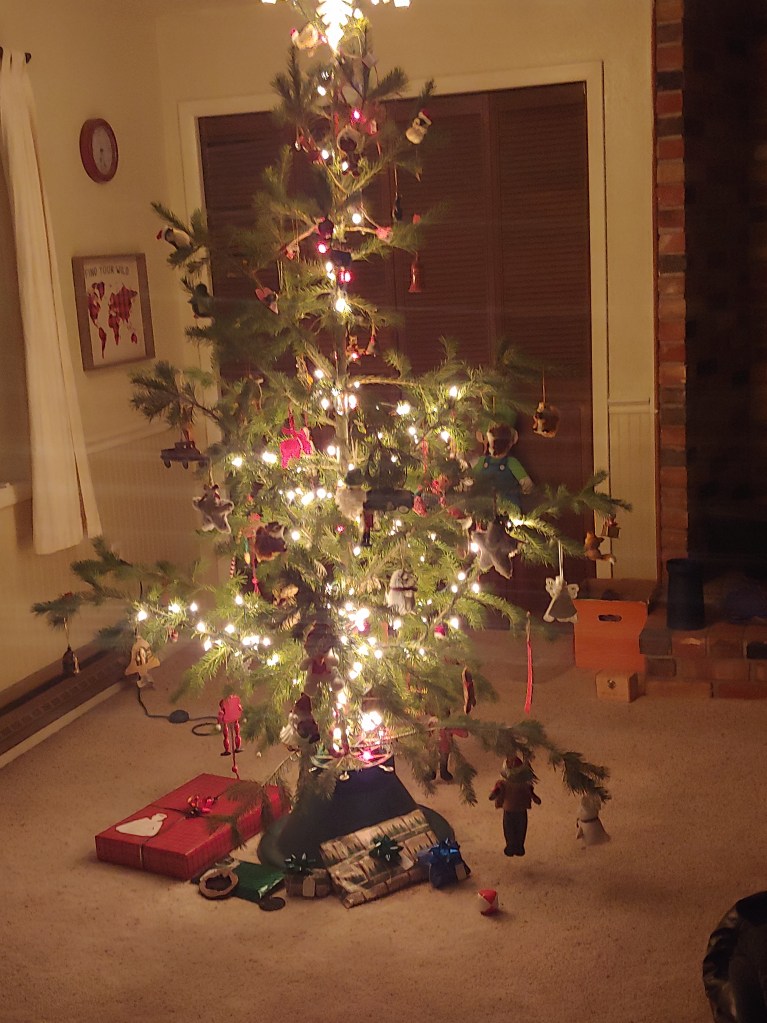
I hope you are not tired of hearing me rant about pagan cultures and why Christians should not think of pagan cultural practices a contaminating substance. This topic may be starting to seem as if it’s relevant only to anthropology geeks like myself, who use their spare time to write anthropology-heavy novels about people who were pagan by default because they lived in a time when there was no other way to be.
But, on the contrary, I think it is very relevant to everyone. There are modern-day tribal people who would like to follow Christ without giving up their entire cultural identity. There are neo-pagans who, living in our technological, post-Christian world, turn to the religions of their ancestors (or a personalized version thereof) because they are looking for something that it appears neither secularism nor the modern evangelical church can offer.
There are Christians who, because of an incomplete understanding of these issues, put stumbling blocks in the path of both the aforesaid groups and in the path of their fellow believers who would like to have a whole, rounded culture. And finally, there are enemies of Christ who would like nothing better than to portray His followers as puritanical, culturally vacuous, colonizing Western imperialists. And who knows, perhaps they actually believe that they are.
All of these people could benefit from a deeper understanding of how formerly pagan practices carry meaning in the modern day. That’s why I have said that, although Christmas trees are not actually pagan, I would still have one if they were. And I will go farther. My kids and I make jack-o-lanterns too. Call, and raise you Hallowe’en. Also, I bake Christmas cookies, hide Easter eggs (!), say “bless you” when someone sneezes, and had bridesmaids at my wedding.
The following is a re-working of a book review I once wrote, which I hope will help to clarify some of the issues. Enjoy! Then go out and kiss under the mistletoe!
Review of Pagan Christianity? Exploring the Roots of Our Church Practices

This book examines a variety of common church practices. It really needs to be reviewed chapter by chapter, because some of the chapters raise good questions about complex topics (for example the one about baptism), while others are just laughable (for example the one about why it’s a sin to dress up for church). But lacking the space for such a detailed approach, I would like to focus on a particular assumption that underlies this book and its scare-mongering cover: the idea that anything that started out as a pagan practice is unlawful for Christians. (The key word here is “started out.”)
In the acknowledgements, Frank Viola tells us the origin of this book: “I left the institutional church … I sought to understand how the Christian church ended up in its present state. For years I tried to get my hands on a documented book that traced the origin of every nonbiblical practice we Christians observe every week.” (xiii) Notice, Viola had already decided that institutional Christianity was thoroughly broken. He “knew” that most things most churches were doing, were unbiblical (they may be too, but not in the way Voila thinks). If these practices did not originate in the Bible, they must have come from somewhere else. Since Viola could not find the book he was looking for, he researched and wrote it himself. To his credit, he acknowledges the limits of his research and hopes that true scholars will pick up where he left off.
Viola’s experience is re-created within each chapter. First, we are told that whatever practice the chapter is treating (church buildings, sermons, etc.) is unbiblical. Then, there follows a brief historical survey of how such a practice developed from paganism. Then, we are given the real reasons the authors dislike the practice: arguments that it is undemocratic, unbiblical, or both. These later arguments are real arguments and deserve to be answered. But they are irrelevant to whether a given practice is pagan. If Jesus commands us to do something that the pagans also do (e.g., be shrewd in dealing with people – Luke 16:8 – 9), then that practice is biblical, right? A practice should stand or fall on its own merits, regardless of what it resembles or what it developed from. But in the authors’ minds, if they can show that something developed from a similar thing that was pagan, they have got at least halfway to proving it is unbiblical. And I fear that many American Christians would agree with them.
Interestingly, modern neopagans share this assumption. (You can find their articles on the Internet.) They delight in pointing out the similarities between Christian and pagan practices, and especially the borrowings. They assume that by pointing these out, they have proved that Christianity is not unique.
G.K. Chesterton, in his book The Everlasting Man, has blown this argument apart. He argues that human beings were created by God to do certain things. Human beings, wherever they live and whatever their religion, will do these things. They will have festivals and parties at certain times of the year. They will pray. They will make beautiful clothes and dress up sometimes. When circumstances permit, they will bake cakes. All this is part of the creation order and the cultural mandate, in addition to being lots of fun. The tragedy of pagans, Chesterton continues, is that they do not really have anything or anyone to do these things to or about. They are forever in search of an entity and an event that matches their huge, God-given, distinctively human capacity for celebration and worship. Eventually, it all falls through and degenerates into violence, or superstitious fear, or a sexual free for all.
But God does not command us to stop doing legitimate and lawful things when we leave the pagan gods to worship Christ. He redeems these things! For the first time, we do them for a good reason. So once, we baked hot cross buns unto the Spring Equinox. Now, we bake them unto Christ, and eat with even more joy in our hearts. Once we sang songs and made art unto our pagan gods. Now we sing and make them unto Christ!
Let me hasten to add that of course some pagan practices cannot be carried over into the Christian life. Worshipping other gods is out. So is temple prostitution, consulting the dead, divination, practicing magic, and making images to be worshipped. All of these are explicitly forbidden in the Bible, so we do not need to discuss their origins to see that they are unbiblical. Oh, and don’t let me forget a really big one: sacrificing our children to our gods, whatever those gods might be.
But there are a host of human activities that are not unlawful in themselves, are not condemned in Scripture, yet were certainly done by pagans before they were done by Christians (or even Jews). What I think the authors fail to realize (and what many of us in this modern age fail to realize) is that every human activity, good or bad, was originally done by pagans. Think about the wide range of things this encompasses. It includes cooking, medicine, self-defense, pregnancy and childbirth, coming of age, wedding ceremonies, engineering and construction. It is going to be awfully difficult to find one of these life passages that is not marked by practices that were once pagan.
Pagans are human beings, and they do everything that human beings do. So, art, formal clothing, dancing, and yes, sacred buildings, priests, and sermons are not necessarily forbidden to us just because pagans do them. We will have to find stronger arguments if we want to get rid of these things. What we cannot do is strengthen a weak argument against a practice by tacking the word “pagan” on it. This is dishonest, and frankly it is unfair to pagans. Why blame them for the fact that you don’t like liturgical robes?
Link Plus Rant, Coming Up!
The Link
“Is anyone on earth not an immigrant?”
(Someone sent me this link because the article’s reference to migrations reminded them of my book The Long Guest. I’m flattered.)
The Rant
If you think about this question for two seconds, the obvious answer is “no.” If people dispersed from wherever they arose (or were created), then we are all “immigrants” in the sense that our ancestors have moved from place to place. A lot.
Two thoughts about this.
- I have never thought of the term “immigrant” as derogatory. The title of this article seems to imply that it is usually used derogatorily, and that the article is going to subvert that. And I have heard others speak as though “immigrant” is a slur. For the record, I have never thought of it as a slur and that is not how I use the word. In fourth grade, a school I attended did a whole unit on “immigrants.” It was a historical unit about the 19th- and 20th-century waves of immigration to America, first from Ireland and Italy, and then from Eastern Europe. I did a report about my Dutch ancestors emigrating to the United States. They are the ones I first think of when I hear the word “immigrant.” It’s a term of pride, encouraging us to think about our distinctive national origins, our families’ stories of assimilation, and how great it is that we can live in the United States and be Americans, while still retaining some of the distinctive traditions from our ancestors of two, three, or four generations back. I am also happy to think that the United States has often been a place for refugees to flee to. The prime example of this is people fleeing Europe during the 30s and 40s, but there are many more recent examples. Of course we cannot take in an infinite number of people, instantly and without limitations, just as no family, no matter how hospitable, can simultaneously host an unlimited number of house guests. But this does not mean I am “anti-immigration.” It is, in general, a positive thing. To new immigrants, my response would be along the lines of “welcome” and “I know assimilation is hard, but eventually I hope you like it here as much as I do.”
- As the article points out, the history of humanity is a history of exploration and people movements. This means that it has also been a history of people assimilating, intermarrying, displacing, and engaging in conquest of other peoples. (I put that on a scale from least to most disruptive.) Obviously, the details of how this worked out in each case depended upon a lot of things, like the numbers involved, the natural resources possessed by one side or the other, cultural matches and clashes, technology, and other kinds of power. (See Thomas Sowell’s excellent Discrimination and Disparities for more on this.) But the point is, everybody’s ancestors were driven out of somewhere, and everybody’s ancestors at some point conquered or colonized somebody. Therefore, it makes no sense to go to people whose ancestors were recently (say, within the last few centuries) colonizers, and to tell them that they are living on stolen land. Nearly everyone is living on stolen land. Also, where are the former conquerors going to go when they vacate this land? Back to the place their ancestors came from? I think it’s a tad crowded now and they wouldn’t be welcome there either. Also, what about the many, many (probably the majority) of people in whose veins flows the blood of both conqueror and conquered, native and newcomer? It just doesn’t make sense.
Thank you. This has been a public service announcement.
Neanderthals, Again
Here is an article sent to me by a helpful blog reader and friend.
To summarize, there is apparently some kind of genetic link between cuter facial features and domesticity in animals. When foxes, for example, are bred for friendly and compliant personalities, over generations their snouts get shorter, their ears floppier, their tails shorter and curlier.
The linked article suggests there might be a similar kind of genetic linkage in humans. It relies partly on a genetic study of human beings with Williams-Beuren syndrome, “a disorder linked to cognitive impairments, smaller skulls, elfinlike facial features, and extreme friendliness.”
Extrapolating from this, and using studies of Neanderthal and Denisovan DNA, the suggestion is that humans “domesticated ourselves” by preferring mates who were friendlier and less aggressive. As sexual selection decreased the aggressive tendencies in our species, so too the related genes determining facial features gradually made our features smaller and less coarse.
So, I have some thoughts. Bear with me, because I’m tapping this post out the night before it goes up, so it might not be the best organized or best-written.
- I’m not going to question that even in humans, there might be some genetic linkage between elfin facial features and lack of natural aggressiveness. W-B syndrome, and Down Syndrome, both seem to suggest this. It may be that this linkage is so subtle and complex that it only becomes obvious in extreme cases, like with these syndromes. It’s similar to how there is evidence that people with fair or red hair are more likely to be “Highly Sensitive People,” highly sensitive to stimuli of all kinds including social stimuli, sound, and pain.
- Both of these suggestions (I’m not going to call them findings because they are too complex) also dovetail with traditional stereotypes. The quick-tempered redhead, the fine-featured child who cries easily, and the “low-browed” criminal are all types that go way back. Stereotypes do not apply across the board, but they often tell us something about people’s observations of the world.
- But that is also a danger. People, it turns out, have a strong tendency to judge others by their physical appearance. Ugly or unattractive people are interpreted through a grid that assumes they are stupid, aggressive, or unstable compared to more attractive people. I just finished reading an interview, here, with a person who explains from personal experience how we tend to interpret someone without sex appeal as a menace.
- So if people did selectively marry in a way that weeded out Neanderthal facial features, it’s just as likely they were selecting for looks as for lack of aggression.
- And obviously, making judgments about someone’s abilities and character based on their facial features and body shape is not only unjust, it’s usually likely to be mistaken. It would be great if we could tell everything we needed to know about someone just by looking at them, but we can’t. If we try to do so — and resist changing our opinion — we are going to be walking around with a lot of bad information. This strategy will not work well for us.
- This should tell us that there is something missing from the thesis about smaller facial features being associated with less aggressive behavior.
- What’s missing is the fact that human beings are human beings, not just two-legged animals. Our behavior is not just determined by whether we have genetic tendencies to aggression.
- Rather, we are made in the image of God. Thus, we have language, an innate moral sense, and an innate need to be in a family and culture with other human beings. This, not our genetics, is what makes us “domestic.”
- That’s why, as I have pointed out before, you will often meet people in modern times with features reminiscent of Neanderthals, and these people are neither stupid, nor aggressive, nor even particularly ugly. (I mean, just look at the Neanderthal reconstruction at the top of the linked article. Is he not adorable?)
- Also, friendliness is not the only desirable trait in a human being. “Extreme friendliness,” particularly when coupled with cognitive impairments, will not equip a person to survive on their own in the world. What we need is natural aggressiveness, appropriately controlled and directed by our mind, moral sense, and culture. So, completely breeding aggressive tendencies out of our population would not be desirable, even if it were possible.
- Ergo, if the Neanderthals and Denisovans were actually human beings (which I believe they were), we can assume that they were much like us in that they had aggressive tendencies, but they also had all the other standard human equipment that allowed them to control and direct these tendencies. We already know that they enjoyed seafood, intermarried with so-called “modern humans,” and made art.
OK, that’s it from me. I continue my campaign for Neanderthal Human Rights!
Now, go out there, club something, and eat it!
Quote of the Week from Anne Lamott
As a reminder, I am posting this purely in fun.
I remember one year my friend Carpenter and I had books out on the same day. We talked about it all summer. We each pretended to have modest expectations. I had modest expectations for his book; he had modest expectations for mine. The week before, we talked almost every morning about how excited we were and what a long time we had waited, and how it was just like being a little kid waiting for Christmas Eve. Finally the big day arrived and I woke up happy, embarrassed in advance by all the praise and attention that would be forthcoming. I made coffee and practiced digging my toe in the dirt, and called Pammy and a few friends to let them congratulate me. Then I waited for the phone to ring. the phone did not know its part. It sat there silent as death with a head cold. By noon the noise of it not ringing began to wear badly on my nerves. Luckily, though, by noon it was time for the first beer of the day. I sat by the phone like a loyal dog, waiting for it to ring. Finally, finally it rang at four. I picked up the phone and heard Carpenter laughing hysterically, like some serial killer, and then I became hysterical, and eventually we both had to be sedated.
Anne Lamott, Bird by Bird, p. 213
You Think You Are Hamlet …
… But you’re actually Polonius.
My Wish for You: A Welcome Distraction
So, tomorrow is election day in the United States. It’s going to be hell for everyone.
But don’t be sad, because The Long Guest goes on sale today!
So, strap on your face mask and your riot gear, venture out and vote … and then come home and curl up with a hot beverage and a book about an apocalypse you can enjoy. Leave everything else in the hands of God.
Dreams: A Tired Trope?
I stop reading any sentence that starts with “Last night I dreamt …” unless it ends with “… I went to Manderley again.”
Kelsey Miller, “Big Girl,” p. 201
Scary Things: The World, The Flesh, and The Devil
They are distinct and should not all be collapsed into the category of Resistance.
Today, we will be responding to this book: The War of Art, by Steven Pressfield.
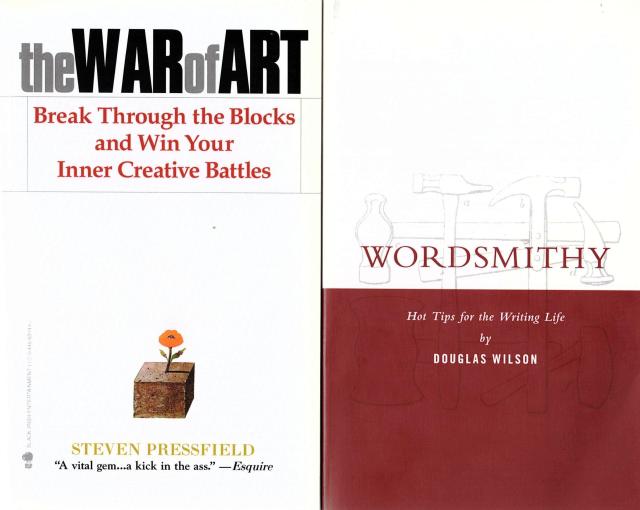
I mentioned TWOA in another post on writing-related books. Later, The Orangutan Librarian hilariously dressed the book down in her review. Today, I will get into the book’s flaws (which bothered me but not as much as they bothered her), and that discussion will lead us to talking about some entities that are definitely scary, namely the three baddies of this post’s title.
The War of Art started out swimmingly
Pressfield starts out discussing how, whenever people go to follow their calling, they experience something called Resistance. He mentions endeavors like starting a business, parenting, charitable work, or “taking any principled stand in the face of adversity” as activities that evoke Resistance, but if you read the rest of the book, it’s clear that the main type of calling he has in mind is becoming a writer or an artist. I frankly think this narrow focus is more helpful, because with some activities (such as parenting or fighting evil), the reasons that people run into difficulties are obvious and expected. This is not the case with, say, landscape painting or novel writing. Those look easy until you try to do them, and there is no obvious reason why a person who has talent in these areas should find life grindingly difficult while pursuing them.
Yet, they do.
Resistance cannot be seen, touched, heard, or smelled. But it can be felt. We experience it as an energy field radiating from work-in-potential. It’s a repelling force. It’s negative. Its aim is to shove us away, distract us, prevent us from doing our work. (p.7)
Resistance is not out to get you personally. It doesn’t know who you are and it doesn’t care. Resistance is a force of nature. It acts objectively. Though it feels malevolent, Resistance in fact operates with the indifference of rain and transits the heavens by the same laws as the stars. (p.11)
Like a magnetized needle floating on a surface of oil, Resistance will unfailingly point to true North — meaning that calling or action it most wants to stop us from doing. Rule of thumb: The more important a call or action is to our soul’s evolution, the more Resistance we will feel toward pursuing it. (p.12)
The danger is greatest when the finish line is in sight. At this point, Resistance knows we’re about to beat it. It hits the panic button. It marshals one last assault and slams us with everything it’s got. The professional must be alert for this counterattack. Be wary at the end. (p.18)
What does Resistance feel like? First, unhappiness. We feel like hell. A low-grade misery pervades everything. We’re bored, we’re restless. There’s guilt but we can’t put our finger on the source. We want to go back to bed; we want to get up and party. We feel unloved and unlovable. We’re disgusted. We hate our lives. We hate ourselves. Unalleviated, Resistance mounts to a pitch that becomes unendurable. At this point the vices kick in. Dope, adultery, web surfing. (p.31)
Resistance is directly proportional to love. If you’re feeling massive Resistance, the good news is, it means there’s tremendous love there too. If you didn’t love the project that is terrifying you, you wouldn’t feel anything. (p.42)
quotes from The War of Art by Steven Pressfield
All of this is perfectly true and I think it’s a fantastic description. I’ll bet that everyone reading has had these experiences a short way in to a new enterprise. Besides writing, people commonly describe this kind of phenomenon coming midway through a weight-loss regimen, or hitting a few weeks in to their attempt to live in another country. If you haven’t experienced this stuff, I guarantee you’ve read a memoir or watched a documentary about someone who has.
Then it starts to trivialize Resistance … and everything else
It isn’t long, however, before TWOA’s diagnosis of our troubles starts to go a little bit off the rails:
Resistance seems to come from outside ourselves. We locate it in spouses, jobs, bosses, kids. “Peripheral opponents,” as Pat Riley used to say when he coached the Los Angeles Lakers. Resistance is not a peripheral opponent. Resistance arises from within. It is self-generated and self-perpetuated. Resistance is the enemy within. (p.8)
Resistance has no strength of its own. Every ounce of juice it possesses comes from us. We feed it with power by our fear of it. Master that fear and conquer Resistance. (p.16)
Ibid
Well, OK, that is partly true. Resistance as fear, self-sabotage, rationalization and procrastination is a very important part of the picture. That even may be its main characteristic in many cases. (More about this in a sec.) But, for someone who appeared to be taking Resistance so seriously as a real force, I’m a little disappointed that Pressfield is locating it entirely inside ourselves. And this problem is going to get worse, when the book goes way off the rails:
We get ourselves into trouble because it’s a cheap way to get attention. Trouble is a faux form of fame. Ill health is a form of trouble, as are alcoholism and drug addiction, all neurosis including compulsive screwing up, jealousy, chronic lateness … (p.24)
Creating soap opera in our lives is a symptom of Resistance. Why put in years of work designing a new software interface when you can get just as much attention by bringing home a boyfriend with a prison record? Sometimes entire families participate unconsciously in a culture of self-dramatization. If the level of drama drops below a certain threshold, someone jumps in to amp it up. Dad gets drunk, Mom gets sick, Janie shows up for church with an Oakland Raiders tattoo. It’s more fun than a movie. And it works: nobody gets a damn thing done. (p.25)
Ibid
OK, this is bad enough. Pressfield has just attributed every one of our character flaws, as well as family drama (which, let me note, is other peoples’ behavior) to Resistance. But, surely, this can’t all be the same thing as the psychological phenomenon where we get scared and antsy when we start to succeed in our creative work, can it? Surely, this is too broad?
But then, he really lost me:
Doctors estimate that seventy to eighty percent of their business is non-health-related. People aren’t sick, they’re self-dramatizing. The acquisition of a condition lends significance to one’s existence. An illness, a cross to bear … Some people go from condition to condition … The condition becomes a work of art in itself … A victim act is a form of passive aggression.
The War of Art. p.27
OK.
This paragraph was obviously written by someone who has never had a real, serious health problem.
“Doctors” estimate this, do they? First of all … I doubt it. Secondly, “doctors” tend to be fairly healthy themselves (or they wouldn’t have made it through medical school). Yes, they can tend to disbelieve people about their own condition. Many people with rare or hard-to-diagnose conditions, such as Lyme Disease, Polycystic Ovary Syndrome, obesity, Irritable Bowel Syndrome, chronic pain, or less-typical forms of any disease, have horror stories of how hard it was to get a diagnosis or even get their complaints taken seriously. I’ll bet you know at least one such person whom you could name right off the top of your head. I’ll bet that with a little thinking, you could come up with more names.
So let’s dispense with this nonsense.
If buckling down to your calling was all it took to cure a host of chronic conditions, I assure you, Mr. Pressfield, people would do it.
So, then, does Resistance mean anything at all?
Pressfield has just completely discredited his own thesis by attributing to Resistance literally every bad thing that happens to anyone, whether or not they caused it. It tempting, at this point, to chuck the book contemptuously over our shoulder and be done with it. That is exactly what The Orangutan Librarian did, and I can’t blame her.
But this created some serious cognitive dissonance in me, because there are passages in this book that I don’t want to chuck out. For the first several pages, it seemed to me that Pressfield was describing a real phenomenon, and describing it better than I’ve heard it described before.
So what’s going on here? How can these two things coexist?
Resistance Means Three Things
The problem, revealed in the second half of the book, is that Pressfield is a Jungian. This means, as far as I can tell, that in his world view, all of the important stuff happens inside the person, in our internal world. In fact, your mind and subconscious might be the location not just of the only important stuff, but of all the stuff. The outside world, basically, doesn’t exist at all.
Any world view that takes this as its postulate is naturally going to lose some explanatory power.
Yes, the mind is real, but it’s not the only real thing. The world exists. Physical stuff exists. Other selves exist. Furthermore, it’s a fallen world, and so, sometimes, bad stuff is going to happen that has its origin in that fallen, hybrid-spiritual-and-physical world, and not on our own almighty psyches.
Christianity, by the way, does a great job of this. Full disclosure, I’m a Christian. One thing that gives the Judeo-Christian world view its awesome explanatory power is that it takes seriously both mind and body. What Pressfield calls Resistance (and is forced, by his world view, to locate entirely inside the sufferer), Christianity breaks out into three things: The World, The Flesh, and The Devil.
The World
You may have noticed that Pressfield starts out by saying that we tend to locate Resistance in our spouses, bosses, etc., but that it’s actually internal. But then later, he mentions that “entire families” will help each other engage in Resistance. Elsewhere he talks about how people will try to sabotage each other’s hard work and success. And he mentions that there are entire industries that make money off distracting people from their duties.
So perhaps other people, and the greater culture, do have some effect on us after all.
Of course they do. This is what theologians call The World. In extreme cases, other people’s sin can stop us in our tracks, completely crushing our ability to focus on anything else, either temporarily or long-term (though not, thankfully, eternally). Examples of this would be an abusive parent, spouse, boss, or (in the ancient world) mistress or master; rape, mobs, warfare, and associated atrocities. All of these things are aspects of the world being fallen. They are not the fault of person they happen to, but they can certainly knock the person off-track from any other calling they might have had, forcing them to deal with the atrocity instead.
Because we live in physical bodies in a physical world, populated by other selves, and because that world is fallen, it is therefore possible (and, indeed, common) that bad things happen to us that do not have their source in us. Go and read the book of Job. It is absolutely not true that “no one can make you feel inferior without your consent.”
The Flesh
The phenomenon that Pressfield does such a great job describing, before he gets off-track, is what used to be called The Flesh. This means our own character, with all its temptations, vices, fears, flaws, and weaknesses. Often, we need nothing more than this to cause us to crash after we have started out doing well. I’m not going to spend as much space on this one, because it is described pretty well above and because it’s the challenge that most of us are probably the most familiar with. The Flesh is, indeed, a formidable foe. Conquering it might not be a sufficient condition for success in our calling, but it’s certainly a necessary one.
The Devil
Now we get to the scariest of the troika, and also the most controversial. This post has already turned into a really long rant, so I’m not going to make a bunch of theological arguments that the devil exists. I’ll just explain the relationship that he bears, in my thinking, to Resistance.
Pressfield describes Resistance as a force that is:
- real
- malevolent, yet impersonal
- dedicated to keeping people from “evolving their soul” – i.e. becoming productive, courageous, and virtuous
- spiritual: invisible, non-physical
Clearly, this is an exact description of Satan as he appears in traditional Christianity.
Unfortunately, Pressfield’s world view doesn’t allow for the existence of an invisible, but real, spiritual entity that is not just the artist’s shadow side or something like that. So, having personified Resistance to such vivid effect, he is then forced to back off and explain that it has no reality outside ourselves, really. Because he’s Jungian, this doesn’t register as a problem, because all of the universe is inside ourselves. But, I find it unsatisfying.
I think Pressfield was describing more than he knew.
Why is Resistance “protean,” deceptive, “always lying and always full of shit”? (p.9) Because the devil is a liar.
Why is Resistance always perfectly timed to interfere with our work? We live in a fallen world, where pipes burst, bacon burns, where people get sick and have family drama. But why do these things seem to happen, not at random, but perfectly timed to interfere with us doing good things (shortly after we begin a new enterprise, or when the finish line is in sight)?
Andrew Klavan says that shortly after he finished the first draft of Another Kingdom, his house suffered an invasion of caterpillars. Every time he hit another milestone with the project, something “dreadful” would happen.
You can’t tell me that caterpillars coming into your house is caused by your subconscious desire to create drama. Neither is your toilet flooding, your car breaking down, your aging parent taking a fall, or, say … a plague hitting the nation.
No, I’m not saying that all of these things are the devil directly trying to sabotage you. At least, I don’t think so. Again, we live in a fallen world and sometimes stuff just happens. But sometimes, I have to say, the timing is extremely suspicious. And I am not just making this stuff up. In the New Testament, Satan is clearly credited with sometimes causing sickness. Ironically, believing that comes out sounding a lot more humane than “70 – 80% of people with symptoms aren’t really sick.”
In the video below, Andrew Klavan talks about Another Kingdom. At 7:03 he tells the caterpillar story.
 Out of Babel Books