
… but this apocalyptic song has been running through my head lately.
Tag: rants
Quote of the Week: The Soul Who Sins is the One who will Die
The word of the Lord came to me: “What do you people mean by quoting this proverb:
‘The fathers eat sour grapes/and the children’s teeth are set on edge’?
“As surely as I live, declares the Sovereign Lord, you will not longer quote this proverb in Israel. For every living soul belongs to Me, the father as well as the son — both alike belong to Me. The soul who sins is the one who will die.
“Suppose there is righteous man who does what is just and right. … Suppose he has a violent son, who sheds blood or does any of these other things (though the father had done none of them) … Will such a man live? He will not! Because he has done all these things, [the son] will surely be put to death and his blood will be on his own head.
“But suppose this son has a son who sees all the sins his father commits, and though he sees them, he does do not such things. He will not die for his father’s sin; he will surely live. But his father will die for his own sin, because he practiced extortion, robbed his brother and did what was wrong among his people.
“Yet you ask, ‘Why does the son not share the guilt of his father?’ Since the son has done what is just and right and has been careful to keep all my decrees, he will surely live. The soul who sins is the one who will die. The son will not share the guilt of the father, nor will the father share the guilt of the son. The righteousness of the righteous man will be credited to him, and the wickedness of the wicked will be charged against him.
“Yet you say, ‘The way of the Lord is not just.’ Hear, O house of Israel: Is it not your ways that are unjust?”
Ezekiel 18, most of the chapter
But These Mosquitoes Deserve It!
Ordinarily, I’m leery of genetically engineering animals, let alone releasing them into the wild. But in the case of dengue- and Zika- bearing mosquitoes, I’ll make an exception.
“750 million genetically engineered mosquitoes approved for release in the Florida Keys“
Papa Eagle and Mama Eagle

This pair lives near our house. Like, in our yard somewhere I think (possibly in the surviving spruce tree?). This photo was taken from my dining room window.
I kid you not … we move to the West, and in the very first year, a pair of eagles moves in? How lucky are we?
They are not shy. Earlier in the summer, about once a day one of them would swoop across our yard, screaming. I even saw one sitting on a telephone pole (as above), screaming, notice me, and calmly go back to screaming. I get no respect.
Watch, Papa Eagle is about to give you eye contact …
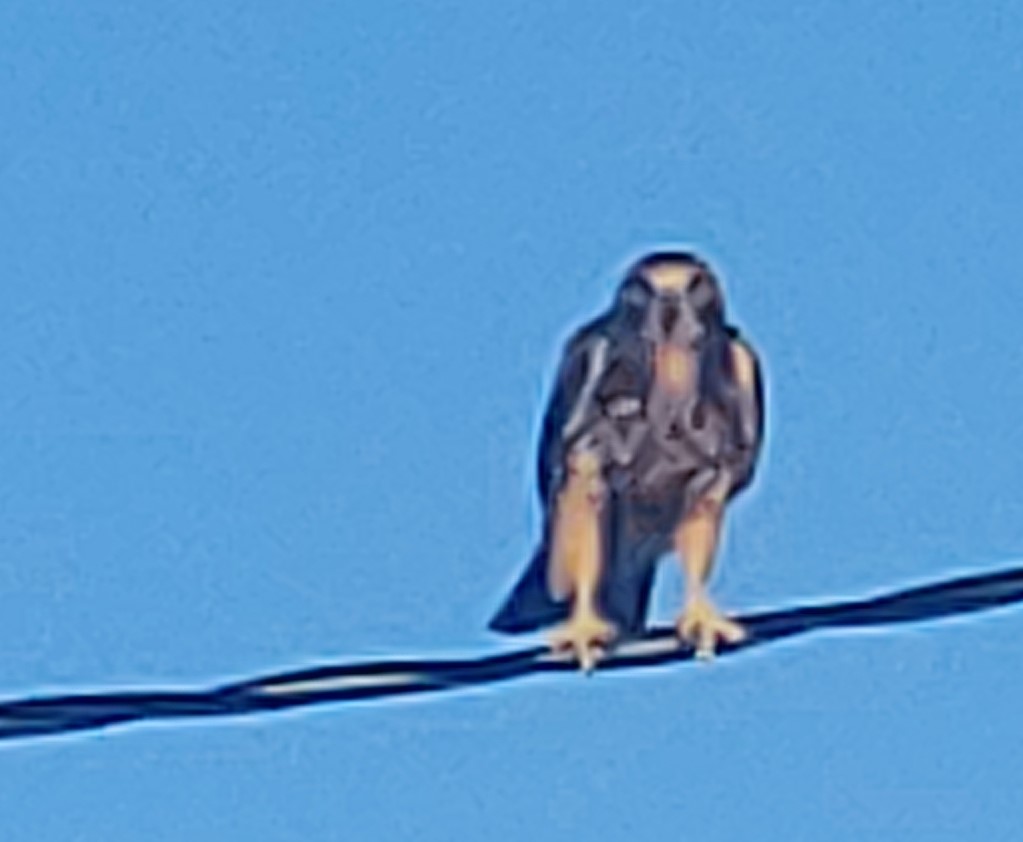
What do you mean, smile? He is smiling.
Quote of the Week: “Darkling”
Ah love, let us be true
To one another! for the world, which seems
To lie before us like a land of dreams,
So various, so beautiful, so new,
Hath really neither joy, nor love, nor light,
Nor certitude, nor peace, nor help for pain;
And we are here as on a darkling plain
Swept with confused alarms of struggle and flight,
Where ignorant armies clash by night.
from Dover Beach, by Matthew Arnold
The “Never Have I Ever” Tag for Writers
How appropriate that just as I am starting to do a bunch of posts about publishing, the orangutan librarian should tag me with this bunch of questions about the writing process! The original idea was created by the Long Voyage- so definitely check out the original here!
This tag asks writers about whether they have ever engaged in a number of (mostly disreputable) behaviors. The headings will say the behavior, and then I’ll comment about whether it applies to me.
“Never Have I Ever …“
. . . started a novel that I did not finish.
I have started, and not finished, a number of novels. You know that whole idea that an artist can create a complete work in his or her head and then it’s irrelevant whether they ever put it on paper or canvas or whatever? That’s baloney. The actual process of enfleshing the work forces you to include so much more detail than you do in your head when you see the end from the beginning.
. . . written a story completely by hand.
(gets dreamy look)
As teenagers, my BFF and I used to write stories together. We would pass a notebook back and forth. Each of us controlled certain characters. We would write notes to each other and argue with each other in the margins.
My parts of those particular stories were the worst tripe ever written. We all have to write our awful tripe on the way to becoming writers.
. . . changed tenses midway through a story.
What?
. . . not researched anything before starting a story.
It’s never possible to do enough research.
But the experts don’t agree.
Also, if you research too long, you can end up talking yourself out of the premise for your story, at which point you’ve ripped out its heart.
So far, my stories have been inspired by cool theories (“research”) about the ancient world. So, I take the premise from the research. (See the ‘ancient world’ tag on my blog for all the stuff that interests me.) I have, so far, avoided setting my stories in really well-documented periods of ancient history (such as Rome) because of the sheer amount of research that would be required so as not to make glaring errors about the details of daily life.
Anyway, see the Bibliography page of this blog for a constantly slightly outdated, constantly growing tally of my sources.
. . . changed my protagonist’s name halfway through a draft.
I like stories that feature someone assimilating to a foreign culture. A total or partial name change is often part of this. So my protagonist Nimri starts out being called Nimri, which is basically Sumerian, but as they get to know him, the people around him eventually start calling him Nirri and that’s how he finishes the story. This is kind of an inconvenient feature, actually, because it makes it difficult to refer to him in summaries.
As for changing a name completely, just for the heck of it, I haven’t done so yet. But Find & Replace will make it easy to do if someone ever comes to me and says, “This name means [dirty word] in [major world language].”
. . . written a story in a month or less.
Short stories, yes.
. . . fallen asleep while writing.
What?
. . . corrected someone’s grammar irl / online.
Scene: Husband and I have been married less than a year, visiting a friend of his.
Friend: I need to go get some groceries. [Names several cleaning supplies, none of which are edible]
Me: Those things are not normally included in the core definition of ‘groceries.’
Friend: Well, excuuuuse me!
Me: (laughing) You are talking to a linguist.
Friend: That’s not the word that I thought of.
. . . yelled in all caps at myself in the middle of a novel.
No.
. . . used “I’m writing” as an excuse.
More like finding other tasks as an excuse not to write.
. . . killed a character who was based on someone I know in real life.
Mmm sooo …. I used to create characters based on my crushes and then kill them off. Yes, I was a sick puppy. Putting the best possible construction on it, I had figured out that killing off a character was the most poignant thing you can do in a story and I was overusing that tool sort of like a kid constantly dropping a new vocabulary word.
. . . used pop culture references in a story.
I avoid these because I am certain to use them clumsily, plus they will soon become dated. It’s part of the reason that my novels are set in the distant past, and that I may never try a “contemporary” novel.
. . . written between the hours of 1am and 6am.
Only at university, when finishing a paper due the next day. (Fun fact: if I stay up all night, I throw up!)
. . . drank an entire pot of coffee while writing.
While writing papers in college, yes, remembering that my “pot” only made two or three cups at a time. Also, vending machine brownies. Good times!
. . . written down dreams to use in potential novels.
Only once, age eleven.
. . . published an unedited story on the internet / Wattpad / blog.
No, but I have turned in a crummy first draft of a devotional essay to a church magazine. I believe the editor used his discretion and didn’t run it.
. . . procrastinated homework because I wanted to write.
Well, this gets into the whole topic of my work habits, which I’d rather not discuss …
. . . typed so long that my wrists hurt.
Not that I recall. I tend to take pauses for thinking.
. . . spilled a drink on my laptop while writing.
No, but that’s probably just dumb luck. I don’t take care of my equipment nearly as well as I should.
. . . forgotten to save my work / draft.
No, and I have even been known to send copies of Word documents to relatives so that copies exist out there in case my house burns down.
. . . finished a novel.
Two and counting.
. . . laughed like an evil villain while writing a scene.
… Um … I don’t think so? Not aware of the sounds I make while writing. Possibly grunts.
. . . cried while writing a scene.
Even in real life I am more likely to cry when angry, frustrated, or humiliated, rather than when sad. I’m not sure what that says about me. Nothing good, probably.
But I have certainly given myself the sads with my writing.
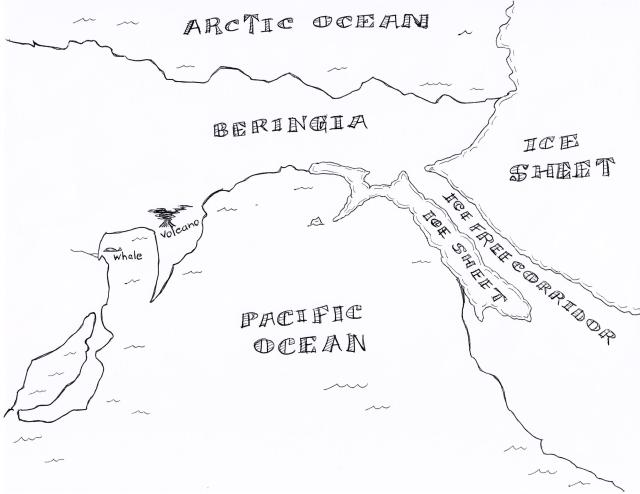
. . . created maps of my fictional worlds.

. . . researched something shady for a novel.
Giants and chimeras in history
horrible pagan practices of the ancient world
abusive husbands
what happens when a person falls into a super-hot sulpherous pool, as at Yellowstone National Park
All equally terrifying.
Now, Your Turn
In the comments section, tell me all your writerly habits! Or, judge mine!
Pray for the Uighur People
They are having atrocities perpetrated upon them.
Chinese Official Confronted with Disturbing ‘Detainment’ Footage, Deflects
Raymond Chandler Quote of the Week
He held his hand out. I shook hands with him, but not as if I had been longing for the moment to arrive.
from The Little Sister, 1949, by Raymond Chandler
Hardboiled P.I. + Grammar = Instant Cuteness
The [hotel] clerk snapped at Degarmo’s back like a terrier.
“One moment, please. Whom did you wish to see?”
Degarmo spun on his heel and looked at me wonderingly. “Did he say ‘whom’?”
“Yeah, but don’t hit him,” I said. “There is such a word.”
Degarmo licked his lips. “I knew there was,” he said. “I often wondered where they kept it.”
from The Lady in the Lake, 1943, by Raymond Chandler
The + Unexpected Plural = Instant Cuteness
I’m sure you’ve all heard the phrase “CLEAN ALL THE THINGS!” from one of the great blog posts of the Internet, by Allie Brosh.
But recently, I have come across some even funnier uses of “the” + plural.
For example, “on the Interwebs.”
Dave Rubin says this all the time. Why? I don’t know. It makes him sound like a savvy, spiffy, suspender-clad octogenarian who is learning to use the Internet because he’s sharp as heck but doesn’t yet know what to call it. Dave Rubin is a commentator whose entire job is “on the Interwebs.” He’s mid-40s, my age. What is he trying to say with this? “Look, I know what I’m doing, but I’m too old to keep up with the terminology the kids are using these days”? Whatever he means to communicate by it, I think it gives him a fun, retro vibe.
And just this week, Ben Shapiro said the following: “Usually when you go camping, the purpose is to enjoy the natures.”
The Natures. This made my week.
But why? Is this some linguistic trend that I haven’t been informed of? It strikes me as a way to sound self-deprecating, but I honestly don’t know.
Have the blog readers heard any other examples of this construction?
 Out of Babel Books