
Tag: research
That Awkward Feeling …
… when a drought reveals an ancient palace, you begin to excavate it, and then the waters rise and cover it up again.
Neolithic People Were Really Smart
“Scottish Crannogs Dated to Neolithic Period” in Archaeology
“Diver’s 5,500-year-old Discovery Hauls History of Scottish Crannogs Into Question” in Ancient Origins (By the way, see what they did there? The discovery was hauled up out of the water, and it hauls the history into question …?)
What is a crannog and would you like to live on one?
Turns out a crannog is a small artificial island made by piling rocks in a loch (that’s lake to you non-Scots), on which people lived.
These things are really widespread. Check out the map in the Ancient Origins article that shows their locations all around Scotland and the outer Hebrides. And apparently they exist in Ireland too.
According to the two articles above, crannogs once were thought to date to the Iron Age or even to medieval times. Now a few of them have been dated to the Neolithic era. I am a dating skeptic, but given what we suspect about the brilliant engineering capabilities of ancient man, the Neolithic idea sounds as plausible as any.
And if they are indeed Neolithic, the crannogs were probably built by pre-Celtic people. If we follow Arthur C. Custance, it’s likely the builders were Hamite. Imagine the engineering ability that it would take to create a livable artificial island that is still around thousands of years later.
I can’t imagine what would make people think they needed to live on these tiny, inconvenient islands, but it can’t have been good.
Serpent Mound, Ohio

Ohio’s serpent mound was first discovered by white people in about 1846. It was difficult to survey or even to find due to being covered in trees and brush. When the brush was partly cleared, it became obvious that the mound, perched on a cliff at the confluence of a creek (which cliff itself resembles the head of a serpent), was a really remarkable earthwork and was designed to be visible from the nearby valley.
The following article will draw on the book The Serpent Mound by E.O. Randall, published in 1905, which is a compilation of maps, surveys, and speculation about the mound by archaeologists of the time; and on my own visit to the mound. One advantage in using these older sources is that we get a variety of voices, we can learn what the Mound looked like when it was first (re)-discovered, and we get an archaeological perspective that is different from the modern one. For example, one source in Randall’s book says the mound appears to be “not more than 1,000 years old, nor less than 350 years” (p.50). This is not very precise, but I actually prefer it to a super-confident proclamation about the mound’s age based on dating methods and assumptions that might be suspect. In fact, the uncertainty of this early source is echoed by the informational video in the mound’s museum. It features an archaeologist saying that we could get “a million different carbon dates” from the mound because the earth was that used to build it was already old and had been through multiple forest fires, etc. He adds that it’s basically impossible to carbon-date earthworks.
On the Road to Serpent Mound

To get to Serpent Mound (at least from where we are), you get in your car and head south over the Ohio highways. You leave behind the urban build-up and progress into farm country. Eventually, the landscape becomes less Midwestern and more Appalachian. Hills and hollers take the place of open farmland. Finally, after hopping from one rural route to another, you find yourself winding through thickly wooded hills in southern Ohio. You approach the Mound from the South. Though it stands on a bluff overlooking Brush Creek, the area is so heavily wooded that you can’t catch a glimpse of the Mound on your way in.

This land was purchased in 1885. At that time, the land was owned by a farmer and the Mound was “in a very neglected and deplorable condition” (Randall 106). To save the Mound from “inevitable destruction,” a Prof. F.W. Putnam arranged to have it bought by the Trustees of the Peabody Museum, Cambridge, where he was Chief of the Ethnological and Archaeological Department. Putnam later worked to have a law protecting it passed in Ohio, the first law of its kind in the United States (Randall 108). Today the Mound is a National Historical Landmark. Besides the Serpent itself, the area includes some additional burial mounds, a picnic shelter, and a tiny, log-cabin-style museum.
You disembark in the parking lot. The heat, the humidity, the strong sweetish green smells, and the variety of insect life remind you of your Appalachian childhood. They also remind you why you are planning to move out West.
The Serpent Mound Itself

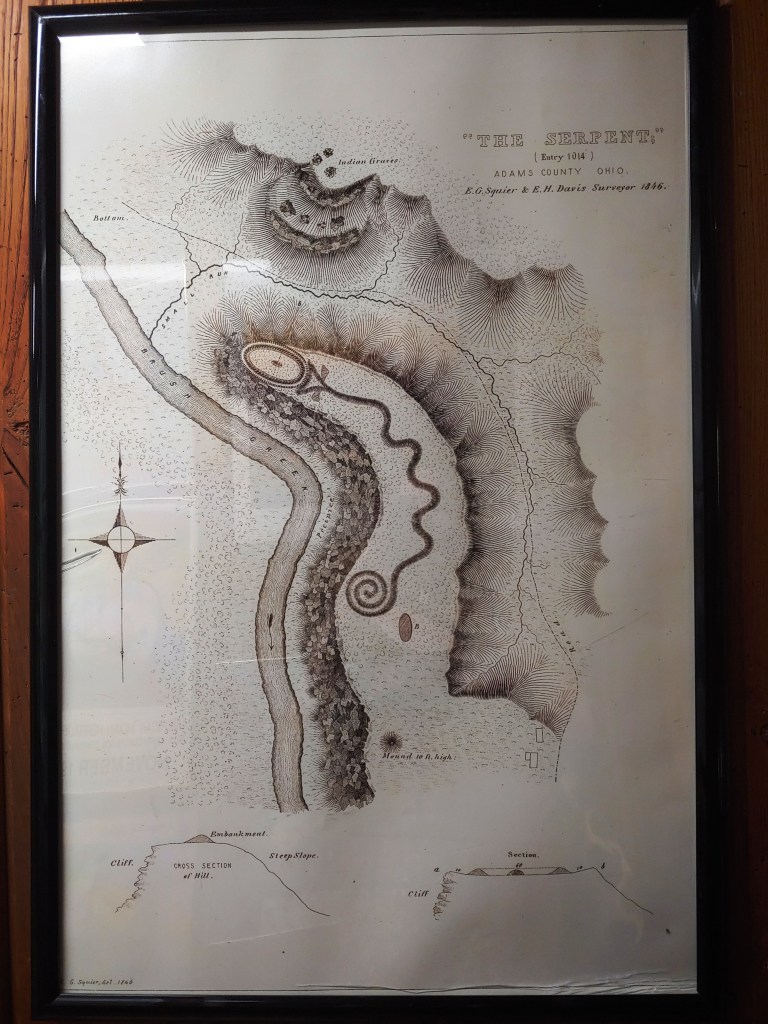
Serpent Mound is difficult to describe in words, so please see the associated maps and photographs. It is 1335 feet long (winding over an area of about 500 feet), varies from three to six feet high, and slopes downward from the spiral tail to the jaws and egg which stand on the tip of the overlook. The head faces West towards the sunset at Summer Solstice. The body includes three bends which may sight towards the sunrises at Summer Solstice, Equinox, and Winter Solstice (short lines of sight and the gentle curves of the Serpent make it difficult to tell whether these alignments were intended for astronomical viewing).
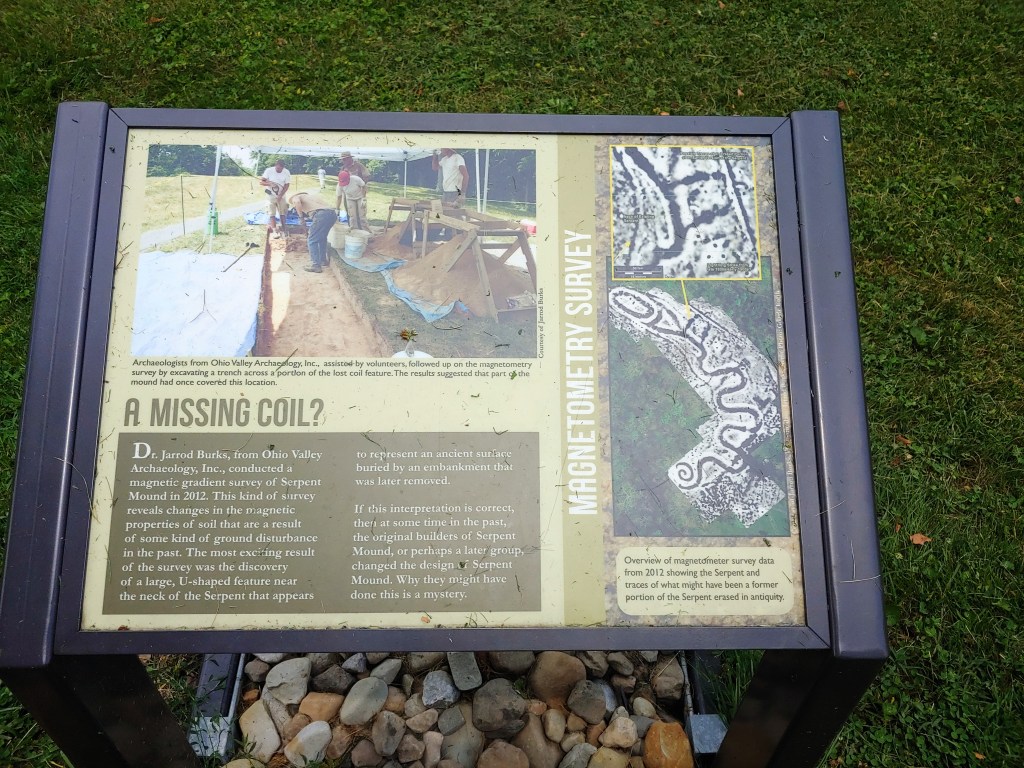
It was made apparently by hand on a base of clay, followed by rocks, more clay, dirt, and then sod. Though it cannot be carbon-dated, there is evidence that it is not as ancient as some megaliths elsewhere in the world. The bluff it sits on and the creeks that surround it cannot be older than the retreat of the glaciers. The burials near it date to the Adena period, which runs 600 B.C. to 100 A.D., though there is no way to tell if the burials are contemporaneous with the Serpent or were added later. There has even been speculation that the Mound could have been built by the Fort Ancient culture, which flourished around 1000 A.D.
The “egg” which the Serpent contains in its jaws (or, the Serpent’s eye) used to have in its center a stone altar which bore traces of fire. (In the largest burial, too, the corpse was placed on a bed of hot coals and then covered with clay while the coals were still smoldering.) We assume, then, that the Serpent was the site of ceremonies, but we have no way of knowing anything about their nature.

The Serpent, despite its name, does not give a spooky or “wrong” feeling. The scale of it is very human and does not overwhelm. The shapes and proportions of the curves are pleasing and give a sense of calm and beauty. The Serpent is, in fact, inviting to walk on. One is tempted to walk along the curves, climb down into the oval of the egg, step into the middle of the spiral tail. One cannot do this, of course, as it is strictly forbidden.
The only problem with Serpent aesthetically (if this is a problem) is that it’s impossible to view it all at once. This is mostly because of the bend in the tail. In modern times an understated observation tower has been placed next to the Serpent, right near the tailmost curve. But even from the top of this tower it is impossible to take in the entire Serpent with either eye or cellphone camera. Looking to the left, we get a view of the spiral tail. Looking to the right, we see the undulations stretching off into the distance and falling away with the slope of the hill, but even then we cannot see the entire head because it takes its own slight curve and is blocked by trees.

I can’t help but think this effect is intentional. This monument is not designed to be taken in all at once, looking along a line of sight, and to overwhelm the viewer. Instead, it’s apparently designed to draw us on, tantalizingly offering small charming vista after small charming vista. There is no one best place to view it. Perhaps the architects among us can explain what this says about the minds and intentions of the people who designed it.
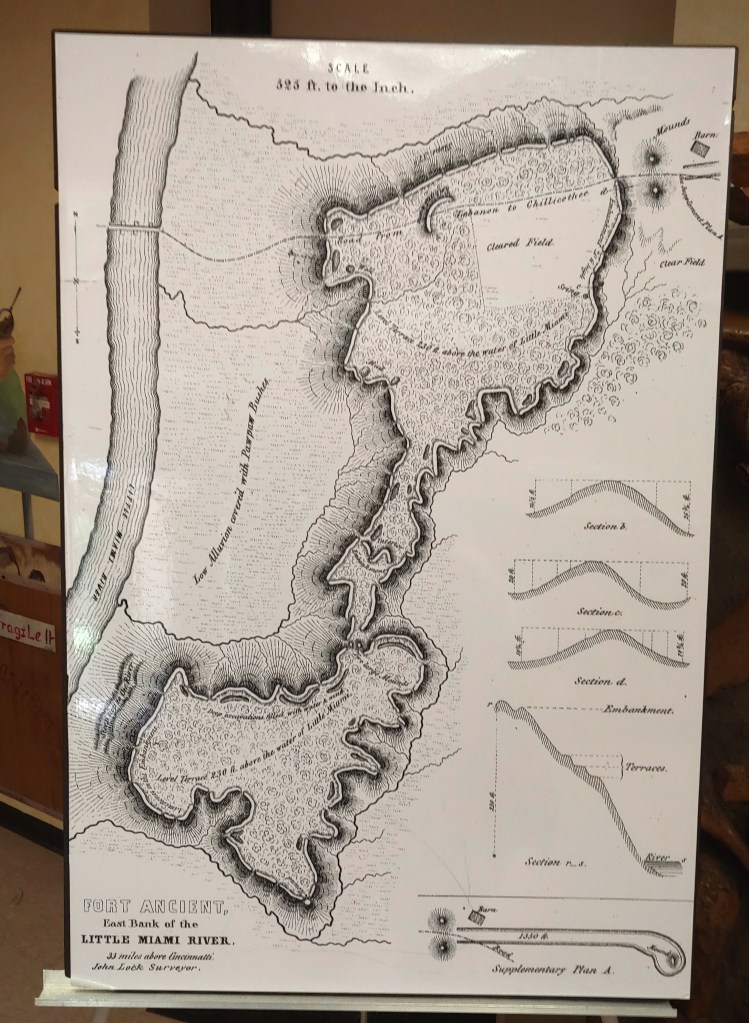
Fort Ancient, another hill-and-plateau complex in southern Ohio, is also sprawling, hard to view, and offers the same “please explore me” effect.
“Effigy Mounds” in North America
The Serpent is definitely not the only large animal-shaped mound in North America. There are many of them, called by archaeologists “effigy mounds” (not the usual meaning of the term effigy).
“The effigy mounds appear … in various parts of … the Mississippi Valley. They are found in many of the southern states; many appear in Illinois, but Wisconsin seems to have been their peculiar field. Hundreds of them were discovered in that state … In Wisconsin they represent innumerable animal forms: the moose, buffalo, bear, fox, deer, frog, eagle, hawk, panther, elephant, and various fishes, birds and even men and women. In a few instances, a snake. In Wisconsin the effigies were usually situated on high ridges along the rivers or on the elevated shores of the lake. Very few effigy mounds have been found in Ohio – though it is by far the richest field in other forms of mounds.” (Randall 31)
There are, of course, large animal-shaped terraforms in other parts of the world, such as the Uffington and Westbury White Horses in Britain and the Nazca Lines in Peru.
So Ohio’s serpent mound is not unique. It is, however, impressive and well-done, and tends to strike people as mysterious and significant.
The Serpent Mound is a Giant Rorschach Blot
Whatever else it might be, the Serpent Mound reliably functions as a giant Rorschach blot. It appears significant but ambiguous. Everyone who is not content to admit that we don’t know its purpose tends to bring their own interpretation.
Here are four examples.
One example, roundly mocked in Randall’s book, is the “amusing and ridiculous” “Garden of Eden fancy” (p. 93). This theory, put forward by a Baptist minister of the day, is that the Mound was built by God Himself to commemorate the eating of the forbidden fruit and to warn mankind against the Serpent. The oval object, which many people take to be an egg, is on this view the forbidden fruit itself, which the Serpent is taking in its jaws as if to eat or offer. Furthermore, the three streams that come together nearby represent the Father, the Son, and the Holy Spirit. “Pain and death are shown by the convolutions of the serpent, just as a living animal would portray pain and death’s agony … America is, in fact, the land in which Eden was located” (pp 99, 101).
Now, here’s another interpretation, based on the accepted anthropology of the day: “Students of anthropology, ethnology and archaeology seem to agree that among the earliest of religious beliefs is that of animism or nature worship. Next to this in the rising scale is animal worship and following it is sun worship. Animism is the religion of the savage and wilder races, who are generally wanderers. Animal worship is more peculiarly the religion of the sedentary tribes … Sun worship is the religion of the village tribes and is peculiar to the stage which borders upon the civilized. ‘Now judging from the circumstances and signs,’ says Dr. Peet, ‘we should say that the emblematic mound builders were in a transition state between the conditions of savagery and barbarism and that they had reached the point where animal worship is very prevalent’” (pp. 37 – 38).
This theory of the slow development of man’s religion as they rise out of “savagery” into “barbarism” and finally into “civilization” is reported with much more respect than the Baptist pastor’s theory, but it is in fact just as fanciful. It is based on an overly neat-and-tidy and, frankly, snobby view of the history of religion that was popular for many years but that actual history does not support. But, again, Rorschach blot.
Many other observors have linked the Mound with its oval to the “egg and serpent” origin mythology that crops up in many places in the world, including Greece and India. This theory receives many pages in Randall’s book.

To take just one more out of many other examples, on this very blog we learned from a book review that Graham Hancock’s latest book prominently features the Serpent Mound as part of his latest theory that North America is, in fact, the source of the Atlantis legends. He believes that the Mound is meant to represent the constellation Draco and was built during an era when Draco was ascendant. Or something like that.
I, too, have taken the Serpent Mound Rorschach test and here is what I see. I see more evidence that serpent mythology (with or without eggs) and the strong motivation to build large, long-lasting religious monuments are both universal in human culture. I personally think that these things didn’t arise independently in every corner of the world but were carried distributively and that they represent distant memories of certain events in human history, which are hinted at but not fleshed out in the early chapters of Genesis. However, I am not fool enough to think that the existence of Serpent Mound “proves” any of this. It is, as I said, a Rorschach blot.
Other Serpent Mounds Around the World
Otonabee Serpent Mound sits on the north shore of Rice Lake, not far from the city of Toronto, Ontario (Randall 114). It is 189 feet long. The head faces “a few degrees north of east,” with an oval burial mound in front of the head which could represent an egg (115).
In Scotland, there is the stone serpent of Loch Nell:
“The mound is situated on a grassy plain. The tail of the serpent rests near the shore of Loch Nell, and the mound gradually rises seventeen to twenty feet in height and is continued for 300 feet, ‘forming a double curve like the letter S’ … the head lies at the western end [and] forms a circular cairn, on which [in 1871] there still remained some trace of an altar, which has since wholly disappeared, thanks to the cattle and herd boys. … The mound has been formed in such a position that worshippers, standing at the altar, would naturally look eastward, directly along the whole length of the great reptile, and across the dark lake to the triple peaks of Ben Chruachan. This position must have been carefully selected, as from no other point are the three peaks visible. General Forlong … says, ‘Here we have an earth-formed snake, emerging in the usual manner from dark water, at the base, as it were, of a triple cone – Scotland’s Mount Hermon, – just as we so frequently meet snakes and their shrines in the East.’” (Randall pp. 121 – 122)
Speaking of Mount Hermon. This large, lone mountain sits at the northern end of the Golan Heights in Israel. It is so high that it is home to a winter ski resort. In ancient times, this region was called Bashan. It was known for its large and vigorous animals (the “bulls of Bashan”), and for its humanoid giants. Down to Hellenistic times, Bashan was a center for pagan worship (the Greek god Pan had a sacred site there). And guess what else it has? A serpent mound.
“The serpent mound of Bashan has ruins on its head and tail. The ruins are square (altars?) on top of small circular mounds” (Van Dorn 144).

This serpent mound is less than mile from a stone circle called Gilgal Rephaim (“Wheel of the Giants”). (Stone circles, as sacred sites, are also found throughout the world.) “The Wheel contains some 42,000 tons of partly worked stone, built into a circle 156 meters in diameter and 8 feet high on the outer wall. It is aligned to the summer solstice. The area is littered with burial chambers … If you go due North of the Wheel, [sighting] through the serpentine mound [and proceed] for 28 miles, you will run straight into the summit of Mt. Hermon” (Van Dorn 145).
Serpent, altar, circle, and sacred mountain. I don’t know about you, but the site in Golan sounds a lot scarier to me than Ohio’s Serpent Mound. However, it also makes me wonder whether people in Ohio – and Scotland – were trying to re-create this arrangement.
Sources
Giants: Sons of the gods by Douglas Van Dorn, Waters of Creation Publishing, Erie, Colorado, 2013.
The Serpent Mound: Adams County, Ohio: Mystery of the Mound and History of the Serpent: Various Theories of the Effigy Mounds and the Mound Builders, by E.O. Randall (L.L., M., Secretary Ohio State Archeological and Historical Society; Reporter Ohio Supreme Court), Coachwhip Publications, Greenville Ohio, 2013. First published 1905. This book is a compilation: “The effort has been made not merely to give a description, indeed several descriptions, of Serpent Mound, but also to set forth a summary of the literature concerning the worship of the serpent. … It is hoped that this volume, while it may not solve the problem of the origin and purpose of the Serpent Mound, will at least add to its interest and give the reader such information as it is possible to obtain.” (page 5)
Oh Look, A Severed Wolf’s Head from the Ice Age
“40,000-year-old severed wolf’s head discovered in Siberia”
Click on the link if you dare.
Who wouldn’t want to look at a 40,000-year-old severed wolf’s head?
Actually, it’s kind of gross.
But it certainly doesn’t look 40,000 years old.
Maybe it isn’t. After all, we know nothing.
Flat Earth Anyone?
On this blog, we examine some wild geological and historical theories. Some of them turn out not to be true. Others are inconclusive. We engage in a healthy skepticism about overconfident scientific pronouncements about everything from the human mind to the dating of human history.
Despite this healthy skepticism, we do try to use sound reasoning and pay attention to evidence. For this reason, there are certain wild historical theories that I’ve never felt the need to engage with. One of these is the flat-earth theory.
Luckily for us, someone has already done the work for us.
“Reflections on the Flat-Earth Movement” by Dr. Danny R. Faulkner
Faulkner got interested enough in the flat-earth movement to study it. In this short piece, he gives a handy overview of the movement and a critique of its reasoning. The reasoning appears to depend on a radical skepticism not just about things that have earned some skepticism like social science and carbon dating, but about any and every kind of research or scholarship.
Two Views on the Sons of Noah

For those who take the early chapters of Genesis seriously as a history of the human race (albeit a not very detailed one), here are two different interpretations of the sons of Noah.
The sons of Noah are listed in Genesis 9:18 – 19 as “Shem, Ham and Japheth.” Though they are always listed in that order, this is not necessarily their birth order. Genesis is focused with laser precision on redemptive history. Thus, it foregrounds Shem, from whom the nation of Israel would later be descended. We are given a lot more detail about Shem than about the tribes descended from the other brothers. It’s possible that Ham was actually the oldest son.
It’s also worth noting that the Table of Nations (Genesis chapter 10) gives a list of the tribes known to be descended from each brother as of that writing. This means that some tribes are listed who were later lost to history. Others are mentioned but are not followed all the way to where they eventually settled centuries later. When we are told where they lived, most of the locations are in and around the Ancient Near East, even for tribes that we know later ended up in Africa (for example Mizraim = Egypt and Cush = Ethiopia). If we take the account of Babel as true (which my novels do), then the human race first clustered around the Tigris and Euphrates Rivers and tried to build a centralized civilization. Only later did they end up migrating to the ends of the earth. So, for a time, you had the descendants of Shem, Ham, and Japheth living right on top of each other.
Here are the two theories. I will spend more time on the second one, because it is the more novel and interesting one.
The Traditional Theory: Most of the World is Japhethite
This is the theory that I was taught when I studied Old Testament Backgrounds. It has been the majority interpretation of the Table of Nations (which is, admittedly, hard to interpret). On this view, Shem was the father of all the nations that traditionally speak Semitic languages: basically, the Hebrews and the inhabitants of the Arabian peninsula. (Yes, Arabs and Jews are related.) Ham was the father of all the nations of Africa, including the Egyptians, Ethiopians and all the subSaharan nations. And Japheth was the father of the Indo-Europeans, East Asians, Pacific Islanders and (via the Land Bridge) the Native Americans.
This view isn’t perfect, because no broad explanation of human distribution is perfect. That said, it does make some intuitive sense. This is the interpretation that I used when writing my novels, because it was the only one that I was aware of at the time. So the family that my story follows are, in the novel, all descendants of Japheth. One of them, Hur, has fair skin and hazel eyes, and his mother was blond. The others all have straight dark hair and more or less East Asian features, in some cases shading towards Native American. The books are set during a time that was pre-race. People knew each other by their extended families.
I now kind of regret that I used this theory for my novels, because the one that is coming up is so much cooler.
Arthur C. Custance Says Most of the World is Hamite
Only after I was well committed to my series did I discover the web site of Arthur C. Custance, where you can read a wide selection of essays and booklets by him. Here is his big theory. Like many sweeping, alternative theories of history, it takes some getting used to, but seems to make more sense the longer you look at it, if you are willing to look at it.
Arthur C. Custance believes the Table of Nations should be interpreted as follows. Shem was the father of the Semitic peoples, as above. Japheth, whose name probably means “fair” in Hebrew, was the father of just the Indo-Europeans. Ham was the father of everyone else: not just the African nations, but all the indigenous peoples of Asia, Polynesia, and the Americas. Basically, anyone who doesn’t have a historical tradition of being descended from Shem or else a freakily white complexion like us Indo-Europeans.
The Gifts of the Peoples per Custance
Custance’s theory is not just about physical descent. He also believes that each of these broad groupings of humanity have a gift to give the human race as a whole: some cultural feature that they are especially good at.
For Semites, it’s spiritual insight. Semitic groups have “gods that are gods of righteousness.” The Hebrews, obviously, received the revelations of God and gave an up until then very oppressive world the gift of ethical monotheism. The Arabs, also, have managed to found a monotheistic religion that is focused on righteousness and is a force to be reckoned with. In both cases, their main cultural focus is religion to a much greater degree than in most cultures.
The Japhethites’ gift is intellect. Their gods tend to be “gods of enlightenment.” Japhethite peoples, according to Custance, as a culture are basically the absentminded professor type. They excel at building elaborate intellectual systems of thought that may or may not have any connection to the real world. So, the Greeks gave us philosophy, but their natural sciences consisted of speculating about ideal plants and animals rather than doing fieldwork. The elaborate Hindu systems of philosophy were developed by the Aryans, an Indo-European group that invaded India from the North. The Germanic peoples gave us Freud and Nietzsche. (Thanks, guys.)
Japhethites, per Custance, are not, as a culture, good at practical matters. That is the special gift of the Hamites.
Now, here is where it gets cool. The Hamite gods tend to be “gods of power.” What the Hamite peoples excel at is innovation in the multitude of practical disciplines that make life in this world possible. This includes (to name just a few of them in alphabetical order), administration, agriculture, architecture, arithmetic, arts and crafts, botany, city planning, mechanical engineering, medicine, metal smithing, mining, music, navigation, pottery, stoneworking, textiles, weapons innovations, and basically every other type of technology.
Custance argues that nearly every major urban civilization was founded by Hamites. This includes Egypt, Sumer, Babylon, Assyria, ancient China, and the great cities of the Americas. It also includes the urban civilization of India, which was developed by the dark-skinned Dravidians before India was taken over by the Aryans, at which point, argues Custance, technological innovation in India basically stopped.
Furthermore, on this view the Hamites were the first to colonize the world. With their extreme practical survival skills, they made it all the way across Asia, the Americas, and Polynesia while the Semites were hanging out in the Middle East and the Indo-Europeans were still building kurgans on the plains of the Ukraine. This explains why almost anywhere people have gone in recorded history, they find that there are already dark-skinned people living there (for example, Australia, Papua New Guinea, the Negritos of the Philippines, possibly the Etruscans in Italy, and the dark-haired, pre-Celtic inhabitants of Europe).
Finally, Custance argues that beautiful things happen when the children of the sons of Shem, Ham, and Japheth get together. Semitic spirituality plus Japhethite intellectualism results in theology. Japhethite intellectualism plus Hamitic technical know-how gives us modern science.
The Picture is Complex
Now, I realize this is a broad brush. Obviously, every nation has some kind of tech and some kind of religion (philosophical systems come later and Custance argues that they are the least important of the three). And it’s not as though the nations of the earth have lived hermetically sealed lives. There has been plenty of migration, intermarriage, and spread of ideas, even starting in very ancient times. Custance’s idea is that when we trace the sources of ideas and innovations, we tend to find technological innovation coming from Ham, intellectual systems coming from Japheth, and spiritual insight coming from Shem.
I need hardly say that none of these gifts is “the best.” We need them all.
Custance also notes a pattern where Japhethite peoples tend to take over territory from Hamitic peoples and then adapt, benefit from, and often take credit for Hamite innovations and discoveries. Clearly this has happened in modern times, but there are examples that come from well before the modern age of European colonialism, such as the Aryans taking over India and the Greeks getting elements of their civilization from Egypt and Ethiopia. That said, because of the nature of the case there have necessarily also been many instances of Hamite peoples migrating into other Hamite peoples’ territory, such as the Austronesians migrating into the Philippines to find the Negritos already there. World history is complicated.
If you are intrigued by these ideas, I encourage you to visit Custance’s web site via one of the many links in this article.
If I had followed Custance’s theory when writing my books, Zillah and her children should have been Hamite, and Hur should not have been able to speak their language. He could not have stayed with them or eventually married into their family. So unfortunately, I can’t rewrite my entire series to follow Custance. Bummer.
But here is a song about when all the children of Noah worship together.
My Love-Hate Relationship with Genetic Evidence
Genetic evidence about ancient populations is cool. Sometimes it tells you things that are fairly intuitive, like that the early Native Americans peopled the continent very quickly, and that at some point they got a visit from some Pacific populations.
The Extremely Fast Peopling of the Americas
Were There Two Routes into North America?
At other times, genetic evidence (or the way it is interpreted) tells us some things that make sense and others that don’t. Take this article for example:
Traces of Mystery Ancient Humans Found Lurking in Our Genomes
On the one hand, the genetic evidence presented here is said to indicate that there was once a lot more genetic diversity among humans than there is now. That makes a ton of sense, especially if you believe in a bottleneck such as the Flood.
On the other hand, this article also asks us to believe that these distinct human populations stayed away from each other for up to 700,000 years (!) and then met up again and interbred. That is really hard to swallow. How in the world did they manage not to bump into each other for that long? The world isn’t that big, is it?
One of the human (or “vaguely human-like,” as the article so flatteringly puts it) populations mentioned in the article above is the Denisovians, apparently a very hearty Central Asia population that was well adapted to high altitudes. For those who believe historical evidence that giants once walked the earth, the following article might be suggestive:
‘Spectacular’ Jawbone Discovery Sheds Light on Ancient Denisovians
But, back to my ambivalent relationship with genetic evidence. Every once in a while, your world gets rocked by a “fun fact” like this one:
“We share 50% of our genes with bananas.”
The “fun fact” has now become a “confusing fact.” Waitaminit! If that is true … then genetic analysis tells us basically nothing about the nature of a thing … then all of this is … worthless?
No, not really. It has helped me to remember that genes are not words or sentences, they are libraries. It is easy to imagine two vast libraries which have a 50% overlap (encyclopedias, dictionaries, and the like) but diverge wildly in the other 50% (one is all philosophy and ancient history; the other is all Dave Barry). That helps. Some. But it’s also a reminder that even the experts have “read” only a few volumes from any given library.
Sometimes genetic evidence tells a different story than that told by archaeology (with its many assumptions) or linguistics.
Divided by DNA: The Uneasy Relationship Between Archaeology and Ancient Genomes
I am not the only one troubled by this.
I guess it’s just one more reminder of just how much we don’t know.
Why Everyone Should Be Educated about the Ancient Near East
Here is a representative New Atheist argument from Richard Dawkins:
“The God of the Old Testament is arguably the most unpleasant character in all fiction: jealous and proud of it; a petty, unjust, unforgiving control-freak; a vindictive, bloodthirsty ethnic cleanser; a misogynistic, homophobic, racist, infanticidal, genocidal, filicidal, pestilential, megalomaniacal, sadomasochistic, capriciously malevolent bully.”
Richard Dawkins, The God Delusion, page 31
Of course, each of these epithets could be backed up with an example from Scripture in which God calls Himself ‘jealous’ (not bothering to investigate what was meant by this), or appears to condone – or at least appears in the vicinity of – one of the crimes mentioned.
On its surface, this argument sounds really convincing and even damning … as long as you know nothing about the Ancient Near East. It basically blames God for all the pre-existing features of the cultures into which He was speaking.
Description Is Not Prescription
First off, let’s dispense with a very basic misunderstanding that nevertheless seems to be widespread.
Just because an incident is recorded in the Bible does not mean that the Old Testament God endorses, let alone prescribes it. Much of the Bible is not prescriptive but is straightforward history. The Ancient Near East was a horrible place, and any history set there will contain horrors. In Genesis 19 there is an attempted homosexual gang rape. In Judges 19 there is a horrific, fatal gang rape, followed by a bloody clan war, followed by a mass kidnapping. In 2 Kings 6 there is cannibalism. And so on. It makes no more sense to blame God for these events than it does to blame a historian for the atrocities he documents.
God Commanded Animal Sacrifice, Holy War, Theocracy
But, let’s move on to the more difficult stuff. It is true that in the Old Testament, God commands His people to establish a theocracy by force. Furthermore, His worship involves animal sacrifice (which seems mild by comparison, but some people have a problem with this too). To modern eyes, all of this is very very bad. If God were really good, He would never have set up a theocracy.
I would like to ask the Richard Dawkinses of the world: What kind of society, exactly, do you think the ancient Israelites found themselves in at the time that God gave them all these laws?
Apparently, before the mean ol’ God of Israel came stomping through the Ancient Near East, all the other peoples there were living in a state of secular, egalitarian innocence. Everything found in the Old Testament was completely new to them. They had no gods, no priest-kings, no temples in their city-states. They did not offer animal or human sacrifices. They had no war, no rape, no slavery. They did not even eat meat. They were all vegans and went around with Coexist bumper stickers on their camels.
No, no, no. Come on. That picture is the exact opposite of the truth. There was no such thing as an egalitarian, secular society back then, and would not be for millennia.
The Actual Conditions in the Ancient Near East

When God began speaking to the Israelites, here are the historical and cultural conditions that He had to work with:
In the Ancient Near East, literally every kingdom was a theocracy. If you wanted to live in civilization, that meant that you lived in, or were a farmer attached to, a city-state. At the center of your city would be the temple of that city’s god. Typically the king was also the high priest of said god and was considered his or her representative on earth. So, the god was ruling you through the king. Every citizen of the city-state owed the king absolute obedience and the god service and sacrifice. And how was that religion practiced? Typically with animal sacrifice. This is pretty normal for cultures in which livestock represent wealth. But actually, animal sacrifice was the least of it. Temple prostitution (which could include ritual rape) was a frequent feature of fertility cults. Human sacrifice, even child sacrifice, was also not unheard-of and in some places it was common.

In other words, every single person in the ancient world lived in, not to mince words, a brutal theocracy. All of these kingdoms were far more authoritarian than the system set up by God for the Israelites. The power of the ruling class was considered absolute. Being enslaved was routine: because of your own debts, or your parents’, or because your city had been conquered, or because someone fancied you or because you had somehow annoyed the king. There was no concept of the lower classes having natural rights; and, in many cases, no sense of the rule of law. Nobody can be a snob or tyrant like an Ancient Near Eastern god-king.
For most people in the Ancient Near East, life was a horror show.
It Wasn’t the Bible World, It Was the Whole World

Actually, this highly centralized kind of politico-religious system was not confined to the Ancient Near East. The early civilizations of the Indus Valley had a very similar system to that of ancient Sumer, even down to the temples and city layouts looking almost identical. The Indian style of centralized religious system can be spotted in Cambodia and Indonesia. Meanwhile, back in the Ancient Near East, this kind of system persisted, in the centuries following the giving of the Old Testament law, in the civilizations of Crete, Greece, the Hittites, Babylon, Assyria, and Persia. Thousands of years later, we see similar arrangements in Mayan, Aztec, and Incan culture. In fact, it is not too big of a stretch to say that until very recent times, a centralized, stratified, bureaucratic theocracy has been the norm, at least among major civilizations, throughout human history.

But that kind of world is strange to us now. We are accustomed to a very different kind of society: relatively open, free, and secular, with lots of social mobility (and no animal sacrifices whatsoever). For many people, their first encounter with this once-familiar style of centralized theocracy comes when they open the Bible. They then attribute all this stuff to the God of Israel, as if He had commanded all of this. But no, He was not instituting theocracy, animal sacrifice, arranged marriage, slavery, or any of the rest of it. Those things were already universal. He was, instead, speaking in to cultures for which these things were already the norm. He spoke to them in their terms, but at the same time transformed the terms to be more in line with His character.
Well, Why Didn’t God Just Fix It?
You might say, “Well, then, why didn’t He tell them to stop having theocracies, sacrifice, and slavery, and to become a modern secular state?” This would, of course, have made no sense to them. They would have been completely unable to understand the message. If they had nevertheless tried to implement it, it would have led to a French Revolution-style Terror and a complete breakdown of their societies. You cannot completely and instantly transform a society without breaking it. But He did begin to transform those Ancient Near Eastern cultures by giving them a model of a good theocracy.
Suddenly, people had available to them the option to live in a land where the local god was not represented by a statue (this was unbelievably counterintuitive) and where instead of being arbitrary, He was “righteous” … where His worship did not allow human sacrifice or temple prostitution, but only carefully regulated animal sacrifice … where the behavior of priests was regulated and limited by the law … where institutions like slavery and arranged marriage were, again, limited by relatively humane laws … where each family was supposed to own their own land … where, for many years, there was no king.
If you wanted to set up a sane society in the midst of the Ancient Near East, I don’t know how else you would possibly go about it.
Sources
Richard Dawkins, The God Delusion (Boston: Houghton Mifflin, 2006)
Public domain images in this post come from the pages of Streams of Civilization, Vol. 1, 3rd ed., edited by Albert Hyma and Mary Stanton. (Christian Liberty Press, Arlington Heights, Illinois, 2016)
Information about life in the Ancient Near East, Cambodia, Indonesia, and the American civilizations comes from Streams of Civilization and from many, many other sources.
Another Argument for Design
In this article, luminary Marcos Eberlin makes a case for intelligent design … but for some reason, he doesn’t call it that.
Gold Rush of Discovery Points Beyond Blind Evolutionary Process — to Foresight
 Out of Babel Books