Conversion: A Book Review

My vision is crowded with whispers and movement and strange shapes narrowing in. I feel my heart thudding in my chest, the sweat flowing freely in my hair, under my arms.

Something inside me breaks. I close my eyes and open my mouth, and a piercing scream tears out of me. The scream relieves the pressure in my head, and it feels so good that I scream again.

“It’s there!” I jabber, lurching in my seat. “I see it there! Goody Corey’s yellow bird sits on Reverend Lawson’s hat! I see it plain as day, the Devil’s yellow bird sits on the Reverend’s hat!”

Conversion, p. 362 – 363

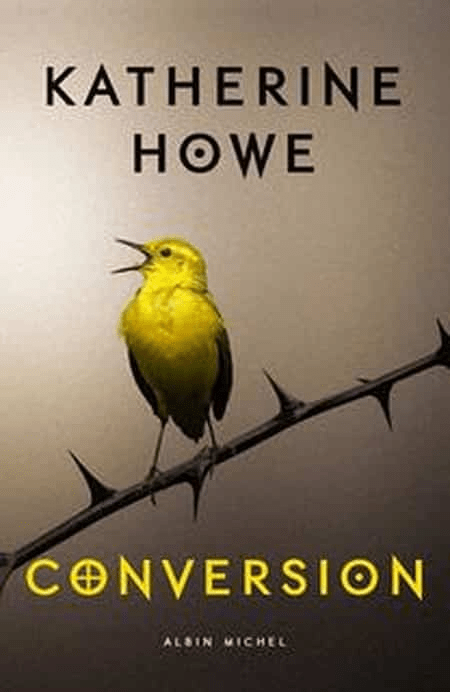
I picked up this book from the public library, among a few others, to have fiction to read over Christmas break. After one false start (a high-school drama that was unable to hold my attention), I cracked open Conversion, and it was a winner.

Here’s the blurb from Howe’s website:

A chilling mystery based on true events, from New York Times bestselling author Katherine Howe.

It’s senior year, and St. Joan’s Academy is a pressure cooker. Grades, college applications, boys’ texts: Through it all, Colleen Rowley and her friends keep it together. Until the school’s queen bee suddenly falls into uncontrollable tics in the middle of class. 

The mystery illness spreads to the school’s popular clique, then more students and symptoms follow: seizures, hair loss, violent coughing fits. St. Joan’s buzzes with rumor; rumor erupts into full-blown panic.

Everyone scrambles to find something, or someone, to blame. Pollution? Stress? Are the girls faking? Only Colleen—who’s been reading The Crucible for extra credit—comes to realize what nobody else has: Danvers was once Salem Village, where another group of girls suffered from a similarly bizarre epidemic three centuries ago . . .

Inspired by true events—from seventeenth-century colonial life to the halls of a modern-day high school—Conversion casts a spell. 

The story goes back and forth between modern St. Joan’s and 17th-century Salem. The excerpts from Salem are fairly long. I would say they take up a quarter to a third of the book. The Salem storyline is told from the perspective of Ann Putnam, one of the “afflicted” girls who, years later, made a public apology which stated that she now thought the people accused of witchcraft had been innocent.

Coming into this, I wasn’t sure I would finish it. Books about the Salem witch frenzy, after all, can easily go sideways into facile Christianity / patriarchy bashing. And at first, it did look like Howe was implying that: It’s suh-sigh-uh-tee! These girls had no pow-er! Some of them were servants! The first person they accused was a slave! However, Howe never veered into caricatures. She painted a fairly complex picture, held the girls also responsible, and the writing was good enough that I ended up finishing the book.

I do think Howe’s interpretation of what went down would be more feminist than my own. In the Salem scenes, the men are, to a person, cold, harsh, and uncaring as fathers. (Also, the women can’t read.) However, in the Danvers scenes, Colleen has loving, involved parents who are still married, a kindly younger brother, an apparently goodhearted boyfriend, and a priest at her school who seems like a good egg. The pressure on the Danvers girls comes more in the form of an academically competitive environment where they are all hoping to get into Ivy League colleges. In fact, the fact that none of the girls’ parents seem to be divorced is striking.

Spoiler Town

Howe’s diagnosis of the St. Joan’s girls – and, apparently, of the Salem girls also – is a medical phenomenon called conversion, whereby intense mental stress is “converted” into bizarre physical symptoms.

In the case of the Salem girls, as Howe tells it, it begins with one little girl who genuinely takes sick with what used to be called a nervous breakdown. It’s implied, but never drawn out, that she has been abused by her father. The phenomenon is then taken up by a servant girl living in the same house who is clearly faking at first, for attention and to get out of being worked hard. She even bites herself on the arm to manifest mysterious wounds. The phenomenon then spreads through a combination of this particular girl enjoying the attention; other girls being unwilling to speak up but just saying what they think the adults want to hear; possible suggestion as the girls work themselves into a genuine state; and simmering resentments in the town, as the girls and their parents use the trials to get revenge on those they envy.

In the case of the St. Joan’s girls, Howe is able to offer medical explanations for even the most bizarre physical phenomena. For example, one girl who has been coughing up pins turns out to have pica (a mineral deficiency that causes a compulsion to eat things that are not food, such as dirt). You see, there is a medical explanation for everything!

This book was published in 2014 and the modern-day story is set in 2012. Now, since the Plandemic, Howe’s trust of the medical establishment struck me as naive and dated. The Department of Public Health is the voice of sanity in the St. Joan’s hysteria, and it’s they who figure out that conversion (not the HPV vaccine or environmental pollution) is what’s causing it. Near the end of the book, when the phenomenon has been taken care of by these experts, Colleen narrates that “We are all on the same antidepressant.” This is a red flag to anyone who’s familiar with the research about how harmful behavioral meds can be to kids and teenagers, and how they have been chronically overprescribed, often for way too long at a time, and what a huge moneymaker they are for pharmaceutical companies. I have only a very basic, passing familiarity with this stuff, and even I was concerned. But Howe seems to believe in The Science just as firmly as the Puritains believed in The Devil.

Nevertheless, Howe draws back from explaining away the strange phenomena completely. There’s an odd scene near the end of the book when Colleen’s best friend’s mother, who is always described as pale blonde, ghostly, suffering from migraines, and almost never leaving her house, pulls Colleen into a dark corner and whispers creepily that her daughter is “like me.”

“She’s prone to spells. But it can be managed. Helps to have the family close by. I’m only telling you so you don’t have to worry.”

My mouth went dry.

“But how did you –” I stopped, because it almost seemed as though her eyes were glowing faintly red.

“Anyhow,” Mrs. Blackburn said, her smile widening, a tooth glinting in the darkness under the stairs, “They said what caused it, in the news. Didn’t they.”

“Y — yes.” I swallowed.

“Good. So there’s no problem.”

The hand released my wrist.

ibid, p. 393

I’m not sure what the purpose of this creepy scene is. Is Howe trying to buy back the “mystery” element of her book, even though by that point in the story, all the explanations have been offered? If she is trying to keep the story somewhat paranormal, I’d say the attempt is not successful. Nothing else that happens in the book, not even the scenes in Salem, hint that any actual paranormal activity might be going on. It is all just the girls’ minds deteriorating. Or is Howe trying to imply that Mrs. Blackburn is displaying Munchhausen by Proxy and is somehow making her own daughter sick? If that’s the theory, it’s way too late in the novel to introduce it, and it never gets further explored. There does seem to be a longer version of this book (“not condensed”) out there. Perhaps the Mystery of Mrs. Blackburn is explained in the longer version, but in the book I read, it just comes off like the author wants to add complexity even though she clearly believes the Harmless Medical/Societal Pressure Explanation.

When Witchcraft Was a Thing

I do not know enough about the Salem witch trials — or witch trials in general — or even the Puritains, although I have read some of them — to speak authoritatively about the degree to which Howe’s explanations are correct. Howe has done a lot of research about the Salem trials, and even includes long excerpts from the transcripts in her novel. It’s not clear, however, whether she has done much research about other witch trials in New England (or Old England), or about Puritan theological beliefs.

Fortunately, I have a book by someone who has.

When you read a lot, serendipities sometimes happen. I bought this book many, many years ago, at a used book shop in Kansas City, when I was there for a vacation with extended family. My dad has Used Bookstore Radar, and he always likes to visit the used bookstores whenever he is in a strange city. So I went with him and bought my own armload. This book was an impulse buy that survived several rounds of elimination, because Salem was one of those historical topics that I “really needed to learn more about.” Well, now the time has come.

John Putnam Demos, interestingly, found out only after he had begun witchcraft research that he is descended from the Putnams, the family who were instrumental in many of the witchcraft convictions in Salem.

I’ve only begun the book, but here is what I can tell you. Although Salem has become famous for cases getting out of hand, witchcraft (“entertaining Satan”) was a recognized crime during the 1600s, on both sides of the Atlantic. As with other crimes under English common law, any accusation had to be first investigated informally, and many of these were settled without going to court, which means we have no official records of them. If the stage of going to court was reached, there were still legal proceedings, evidence presented, and so forth, and the magistrates could and often did acquit the accused or void the case on a technicality. People who had been accused of witchcraft could also sue their accuser for slander. Some countries, and some regions of each country, prosecuted people for witchcraft far more often than others. 

It is this background of which Demos wants to draw a detailed picture. He tells us that he is going to look at the biographical details of certain accused and accusers. He is going to look at this from a sociological, psychological, and historical point of view. I am sure I will learn a lot from him. But, when it comes right down it, Demos is still studying witch trials as a sociological phenomenon. He is not examining whether the paranormal may have played an actual role.

The Dominant Narrative

Possibly the most annoying scene in Conversion is when Colleen’s teacher, Ms. Slater, tells Colleen that a good historian should “look beyond the dominant narrative” about Salem. I’m not certain what Slater thinks the “dominant narrative” about the Salem witch trials is. Surely, in modern times, most people see nothing more than a story of injustice and superstition played out in an overly rigid, hierarchical society. That’s certainly not the narrative that was dominating in Salem at the time. The only way I can detect that Slater’s preferred emphasis differs from the dominant modern narrative, is that she wants us to have more sympathy for the teenaged girls who were doing the accusing, for the pressure they were probably under.

This is actually a new thought. If I may speak from my own experience, when we read accounts of the trials, the girls definitely come off as the villains of the piece: screaming accusations, making their adult victims cry. The tendency is to attribute malice. I wouldn’t say that comes from listening to a narrative told by people in power, though; rather, it’s the immediate first impression that we get from just observing their behavior.

By contrast, here’s how Ann Putnam’s experience went down in Conversion:

“Oh, Annie, tell them how we suffer!” Abigail beseeches me.

“I … I …” I stumble over my words, terrified. If I continue the lie, I’m sinning in the eyes of God. A vile, hell-sending sin. If I speak the truth, I’ll be beaten sure, and all the other girls will, too. My mouth goes dry, and bile rises in my throat.

At length, I whisper, “I cannot say whose shape it is.”

page 221

And here:

I’m beginning to panic, and I want to get up and run away [from the courthouse] and hide in the barn behind our house, but everyone is there and everyone is watching me, and my father is there and I have to stay strong and do what they want me to, and so I stay where I am, making myself small on the pew, and soon enough the tears are springing from my eyes, too.

page 258

The picture here is of a girl trapped in a story she knows there is something wrong with, but afraid to out her friends and to displease the adults. This is also very plausible. It reminds me of so-called “trans” children, trapped in an even more harmful delusion foisted upon them by the adults in their lives and by their peers, manipulated into believing this is what they themselves want and have chosen. This could have been one of many factors operating in Salem. This is how social contagions work. There is a big lie; there are vulnerable, confused children or teenagers; there are culpable adults and confused adults; there is social pressure; there is mass deception.

Multiple Causes

So let’s look at some factors, remembering that many things can be true at once.

  • Hysterical Teenaged Girls: Teen and pre-teen girls tend to be stressed out in every society. Their bodies are changing, they are noticing boys, hormones are making them nervous and emotional and edgy. No, they don’t have much social power, but we need to consider whether it is actually a good idea to give teen girls a lot of social power. I think most girls hate themselves at thirteen (the age of Ann Putnam when the story takes place). Teen girls are also known to be susceptible to fads, suggestion, and yes, physical symptoms of stress. The fact that they are not very mentally stable is not an indictment of them or even necessarily of their society; it’s more of a fact that we all have to deal with. This is also the age when, unless guided, girls develop an interest in the occult. So yes, it does seem very natural that the accusers at Salem should have been a bunch of teen girls, and it’s very believable that they were not just “faking,” but had worked themselves into an actual altered state. This created a perfect storm at Salem, because the evidence to be examined a witch trial generally consisted of eyewitness testimony. These were not very reliable witnesses. But the fact that teen girls’ testimony was accepted as evidence actually argues against Salem being a sexist hellhole.
  • Vengeance / Scapegoating: Already in Demos’ book, it has become evident that people who got accused of witchcraft tended to be those who had annoyed their neighbors in some way. Maybe they were the sort of person who is always arguing with everyone, or maybe they were upper-class or especially pious and so the target of envy. It’s pretty clear, even to someone not deeply familiar with the records, that accusers saw in a witch trial a way to get revenge on someone who they had perceived wronged them. Envy, resentment, and scapegoating are actually very common in human life, especially in village settings (say as opposed to city settings). If the culture in question believes in magic, then people are likely to suspect their enemies of sabotage by magic, in whatever magical idiom is local to the culture. People find it hard to accept that things can just go wrong for them. They prefer to blame someone when something goes wrong.
  • Superstition: If by “Superstition” we mean “There’s no such thing as witchcraft,” then we will get to that in a moment. But if by superstition we mean, “If the New Englanders had not believed in witchcraft, the injustice of the Salem witch trials would never have happened,” then that is manifestly untrue. Of course, they would not have happened in the same way. But what scares us about Salem is not the suggestion of the paranormal so much as the purge-like quality of the proceedings, where an accusation is tantamount to a conviction, and it’s impossible for the accused to prove their innocence. Something has gone wrong with way rules of evidence are applied. A moment’s reflection will show that it is completely possible to conduct a purge in the absence of belief in witchcraft. Purges have been conducted on charges of capitalism, communism, being a heretic, being a Christian, sympathizing with the enemy in wartime, abusing children in daycare centers, date rape on college campuses, racism, not taking the government vaccine, and being insufficiently supportive of the trans agenda. If the purge mentality is present, then any superstition will do. That’s why it is foolish for us to feel superior to the Salem townspeople, as if, not being Puritans, we could never be subject to this common human practice.
  • Medical Causes: I have heard theories that there may have been some physical factor, such as a particular kind of mold in their diet, that caused the girls to develop delusions and hallucinations. This seems to me like a modern materialist grasping at straws. We don’t want to believe that a bunch of teenaged girls could be so wicked as to deliberately send their neighbors to their deaths, and we certainly don’t want to consider the paranormal as a real possibility, so it must be the mold. It’s true that certain medical conditions can cause irrational behavior (even heat stroke or fever can do it), because we are embodied people. However, in a case like that I wouldn’t expect the affliction to spread like a fad among just the teen girls in a community … the very ones who are vulnerable to delusions and drama for a bunch of other reasons already covered.
  • Actual Occult Activity: Not being a strict materialist, I can’t rule this possibility out. Modern Western materialists don’t believe that a spiritual world exists at all, so when it comes to interpreting things that happened in the past, we have some blind spots. We are quick to accuse people who we know to be otherwise intelligent of making ridiculous things up out of whole cloth, or of believing ridiculous things completely without evidence. But it is actually possible that there was a lot more paranormal activity in the past than now. Paranormal activity tends to manifest itself in forms that make sense to the culture where it is manifesting; so, people in Ireland have encounters with fairies, American Indians might encounter the Windigo, and modern Americans are more likely to be abducted by aliens. This doesn’t mean that nothing spiritual is going on, just that malevolent spiritual forces know how to make themselves intelligible to humans. If we accept that there was actual paranormal (dare I say, demonic) activity happening in Salem, this does not mean that we have to accept that every person who was accused – or even every person who confessed – was in fact a witch in league with the devil. There have been cases before where people confessed to things they didn’t do, because they were worn down by interrogation, eager to please, or easily manipulated. However, there could have been some people practicing the occult in Salem. The girls themselves could have gotten involved in some occult practice, which could have left them open to demonization. And in fact, even if their symptoms were entirely faked, the kind of mob/purge mentality that they displayed is always the work of the devil in the sense of being the fruit of envy, deception, and a false ideology. When people get involved in occult practice or philosophy, one tragic result is often that they lose their ability to think clearly. That certainly seems to have happened in Salem, in some form or other. The devil certainly got a lot of publicity during those months, and I’m sure he was loving it.

Review of Breath

Five stars. Would keep breathing.

Just kidding.

My sister gave me this book. I don’t know how she knew it, but I’m a horrible mouth-breather. I also have a habit of holding my breath when: in pain, concentrating, doing a delicate task, listening to someone talk. (I exhale when they finish the sentence. So don’t pause.) Turns out, breath-holding throughout the day might be causing a lot of people chronic anxiety and also causing them to “overbreathe.” Since reading, I’ve been at work to change my ways.

It’s rather shocking to realize the extent to which breathing through the nose affects nearly all other aspects of our health, even aspects that you wouldn’t expect, such as biochemistry and bone structure. But on reflection, it makes sense. We were designed to nose breathe; there is a reason for the way the air is routed through our sinuses; there is even a reason we have two nostrils. (Did you know that air taken in through the right nostril has a different effect than the left … and that your nostrils naturally tag-team throughout the day? Wild!) It makes sense that the more restricted supply of air coming in through our nose compared to our mouth is not only adequate but optimal, even though it doesn’t feel that way for recovering mouth-breathers.

It also makes sense that we were designed spend many hours a day chewing on tough foods (fruit, nuts, wild game), and that this regular daily workout of our jaw muscles would result in wider facial bones, flatter palates, and wider nose-breathing passages. It also explains why so many people in the modern age have crooked teeth: it’s not bad genetic design, it’s that we aren’t chewing enough and our face bones are literally atrophying, making our mouths too narrow. So those cave people who didn’t have orthodontists, also didn’t need them. (Shoutout to my characters! Keep eating game, guys!)

Ahem. Back to the book …

You have to watch out for the usual non sequiters that we have come to expect from Darwinian materialists. Almost any place that Nestor writes, “We evolved to …”, you can safely substitute, “We were designed to …” and come up with the same conclusion. There are a few long paragraphs about how “early life” was anaerobic and how “we” started using oxygen in “our” metabolizing. I skipped those; you can read them if you want to find out how bacteria do things differently from human beings.

Then there is the section on prayer, which finds that the repetitive prayers from all around the world get their practitioners breathing at the ideal rate for humans, which to Nestor’s mind can account for all the health, mind clarity, and relaxation benefits of prayer. (I have long been aware that my breathing changes when I pray – even silently – but this is not to say that there is nothing else going on during prayer or meditation, or that it matters not to whom or to what you pray.)

As someone who doesn’t believe that the spiritual world is a thing, Nestor is free to try – and qualifiedly endorse – all the yoga practices that, he says, are merely applied medical knowledge about breathing and posture. They certainly include some of that, but yoga is also a serious attempt to commune with spiritual entities, and we ignore that at our peril.

There is a helpful appendix that catalogs all the breathing techniques Nestor encountered on his ten-year journey. My big takeaway: breathe through your nose. Tape your mouth shut at night if you have to. Breathe a little slower … you won’t choke. Exhale completely before inhaling. See how many health and emotional problems that clears up for you. I’ll check back in and let you guys know whether I lost any weight. 

I Love It When them Aliens Be Comin’ Around

I posted the following several years ago in response to some information being released from Navy pilots about UFOs. Making the necessary adjustments, most of what I say below is still relevant to the more recent sensational revelations about aliens, which are getting ignored by everyone except Matt Walsh.

If you want more interesting theories about all this, see also the interviews I’ve done with Jason McLean. I am watching his YouTube channel, SIRU papers, for his reaction to these latest news stories.

So, now for the repost …

Finally Facing the News

You guys may have noticed, there has been a spate of news articles and videos about U.S. Navy pilots sighting what appear to be UFOs.

U.S. Navy videos declassified last year

60 Minutes interview with Navy pilots

Former head of the Pentagon’s UFO program says they have “exotic material” … what???

I’ve ignored these news items for a long time, mostly because I didn’t know what to do with them. Now I’m ready to give my analysis. It will be just as expert as anyone else’s, and no more expert than any comments you may leave.

Problems with all the Possible Theories

  1. This is all just a big hoax by our government, to distract us from the attempted power grab by [fill in your favorite villains]. The problems: First of all, it’s not working if that was indeed the plan. The media have not camped on this nearly as hard as on some other, less sensational things, and even when they have run stories, the public (including me, I might add) seem much more interested in their own problems. The government and media are not using these reports to whip up fear or preparations for an intergalactic war, nor are they trying to turn this into a scandal about past administrations’ lack of preparedness on the space alien issue. They have just kind of thrown out all this newly declassified information with a clunk, a shrug, and a big trombone slide. Secondly, the pilots who were interviewed seemed like sane, professional people. They did not seem like people who “want to believe” in space aliens. Thirdly, some of these reports and videos go back for decades.
  2. These aircraft belong to another world power, such as China, which has developed technology far more advanced than we suspected. Possible but implausible, because again, these sightings go back for decades. It’s hard to imagine a geopolitical rival having advanced millennia beyond us in terms of their technology, and not having already used it to conquer us. Regular earth people don’t have that kind of self-control.
  3. The aircraft belong to a private, independently wealthy genius, like Elon Musk, who does not want to take over the world but just zips over the Pacific Ocean as a hobby. Possible. Very possible. Although again, it would take phenomenal humility and self-control for a private organization to have these capabilities and not try to leverage them for whatever their own pet project is: fame, space travel, stopping perceived climate change, etc.
  4. The aircraft belong to an advanced civilization of space aliens. The first problem with this is that, if this is an invading force, they are taking their time. At the risk of repeating myself: these sightings go back decades. So if these are space aliens, they frankly don’t seem super interested in us. Perhaps they are just here as tourists. The Pacific Ocean would certainly be a worthy destination for tourism, and perhaps it is more interesting to them than humans. But there is another huge problem with the space alien theory; that is, if we are imagining these space aliens as they are usually conceived of: physical beings, designed to live in three dimensions, like us, physically inhabiting a very different ecosystem on a distant planet or planets in a distant solar system. The problem is this: any possible life-supporting planets in our universe are prohibitively distant for vehicles traveling at normal speeds. The time (and, if I may say so, the risks) involved are not at all practical for tourism or warfare, or even for beings not designed for space to survive the journey probably. Of course, there is a that hoary sci-fi trope of hyperspace (going faster than the speed of light). But everything I’ve ever heard about this indicates it’s either not possible, or would almost certainly destroy any object that accelerated to that speed, and would certainly kill any physical being, designed to live in three dimensions, that tried it. All of this makes it impossible for me to swallow a Star Wars or Avatar-like scenario where there are physical aliens living galaxies away, who have traveled through hyperspace to get to Earth. But there is another possibility.

Interdimensional Beings

In the short satirical novel Flatland, the protagonist is a square who lives in a two-dimensional world of geometric beings. These two-dimensional beings are visited by a sphere. The sphere shows himself to them by intersecting his body with the plane of their universe. The way this looks to the two-dimensional beings is that a point appears out of nowhere, then becomes a rapidly growing circle as the sphere inserts more of his diameter into their plane of existence. When he wishes to, the sphere can move out the other side. This looks to the two-dimensional shapes as if the circle shrinks and then vanishes. The sphere can then move to somewhere else on the two-dimensional plane and appear there, again giving the impression that he has appeared out of nowhere. Later, the sphere takes the square on a mystical journey to observe lower dimensions, so as to give him an idea of how higher dimensions might exist. There is a one-dimensional world (a line) where the inhabitants are all line segments. Each can only see the end of his neighbor (he or she looks like a point), but they can hear one another and communicate by harmonizing. The square is also shown a universe that consists of a single point. This point is the only being in its universe and thinks it is God. It is impossible to communicate with this point. If it hears a voice not coming from within its own universe, it imagines that it must be having auditory hallucinations.

Returning to the vehicles in the section above, I’m sure you can see where I’m going with this. If these mysterious vehicles turn out to be piloted by nonhuman beings, it seems most probable to me that they would be creatures designed to live in more dimensions than we do. Creatures in a higher dimension can do things that appear miraculous in lower dimensions, such vanishing abruptly or appearing to defy the laws of physics. Though wild, the “higher-dimensional beings” theory seems to me more plausible than the idea of three-dimensional beings who are subject to the same laws of physics that we are, yet somehow have managed to pull off intergalactic travel and vanishing through “technology.”

And, by the way, notice your own reaction to this. Did you breathe a sigh of relief? Does the phrase “interdimensional beings” sound way more intelligent than “space aliens” or “angels”? I confess it rolls off my tongue much more smoothly. (More syllables = better?) Some people might say that interdimensional beings was what they meant all along by “aliens,” and moving through multiple higher dimensions was what they meant by “technology.” O.K., that’s fair. Such beings would certainly be alien to us. Still, I think it’s a helpful distinction to make, because I don’t think “creatures designed to live in a higher dimension” is the first thing that comes to most people’s minds when they hear “aliens,” or especially “space aliens.” We might think of aliens as having the ability to mess with higher dimensions than we can, but I think most people think of that as a sort of extra, while conceiving of the aliens as primarily creatures like us (perhaps smarter and uglier), who make their primary home on a physical planet and are anchored in the three dimensions (four if you count time).

The Third Circle of Weird

Ready to get even stranger with me? Let’s go.

On this blog, I have in the past reviewed the excellent, very odd, very mind-blowing Collision Series, which consists of the books The Resolve of Immortal Flesh and The Formulacrum. That series is a lot of things, including a hilarious, Hitchhiker’s Guide-style romp … but more than anything it’s an extended exploration of this idea of interdimensional beings. Human characters in the series get ahold of a vehicle that can travel in higher dimensions. They exploit their access to higher dimensions to move through walls, travel the depths of the sea, and vanish when there’s trouble, and they do it a lot. Of course, the convenience of this is limited by the fact that throughout the books, the human protagonists are at different times being hunted by beings who also have access to these higher dimensions.

A major thesis of these books is that the beings we are used to referring to as angels and demons are actually interdimensional beings whose goals intersect with human life in complex ways. One interesting thing that comes up is that humans do in fact move through some of these higher dimensions, but we do so without knowing it. We experience our interdimensional blunders as intuitions, insights, creepy feelings, etc. This makes sense. After all, in theory there’s nothing to stop a two-dimensional creature from blundering through the body of a three-dimensional creature, right? Anyway, that’s an interesting detail but I’m getting off track here.

Helped by Rich Colburn, the author of The Formulacrum, I am now ready to cap off the weirdness by integrating this interdimensional beings idea into the world view of my own book series.

The Long Guest and The Strange Land both proceed on the premise, taken from Genesis 6, that in ancient times “the sons of God” (interdimensional beings?) walked the earth in some kind of physical form that allowed them somehow to reproduce with human women, thus producing a race of monsters. The resulting chaos was in fact the main reason for the Flood: God was doing triage to save the human race as originally created. This horrifying period in history was also the source of the all the legends and origin stories about gods, giants, and monsters that we find in cultures worldwide. For more on this theory, see my post, here, or the book Giants: sons of the gods by Douglas Van Dorn.

So, yes, strange as it sounds, I am speculating that your “aliens” might be what the ancient world called “gods” … but only if we specify that they were not regular “space aliens” but interdimensional beings who could probably appear as people or animals or whatever they wanted to look like (hat tip to the Greek myths).

So, Why Am I Not Terrified?

I’m not terrified because the gods ain’t what they used to be.

I see the “gods” as having less influence on human life now than ever before. I basically see three phases of this. In the first phase, they were actually here, manifesting physically, demanding worship in person. God put a stop to that with the Flood.

After the Flood, people still remembered the gods, and they seem to have continued to be pretty active on earth, but unable to manifest physically. So, each nation had a god that was responsible for it (or that it was responsible to). They built altars to these gods, identified them with different stars and constellations, and kept trying to get in touch with them physically even though that door had now been closed. “In the past,” Paul says, “God let all nations go their own way.” He picked one people and told them not to worship false gods (gods which were not the Creator and which, in many cases, didn’t even try to hide the fact that they were evil). If we look at legends and even recorded history, it seems to me that often these gods were actual spiritual presences who, though they could no longer manifest physically, could have quite an influence on human life through things like visions, possessions, illnesses, and disasters. For example, in Palestine in Jesus’ day we see many cases, unironically reported, of people being possessed by “unclean spirits.” This is in a region that had been heavily Hellenized, and where people were definitely still worshipping the Roman gods, the Greek gods, and the pre-Hellenistic local deities such as Artemis of the Ephesians. In this second phase, it was truly a dangerous thing to turn from your local deity to worship “the living God,” the God of Israel. Local deities perhaps could actually harm people they took a hate-on to. God spends a lot of time in the Old Testament reassuring the people that if they forsake the fertility and rain gods, and worship Him, He will bless their households and crops and will take care of them.

So, in phase two, God has set some limits on the interdimensional beings but there are still lots of manifestations from other dimensions and lots of communication (or attempts at such) between them and humans.

In phase three, we get Jesus. He opens the way for all human beings to relate directly to the living God. When people turn to Him, they turn away from the worship of the lesser gods. And when people do this in large numbers, a funny thing happens. Paganism no longer works any more. It’s as if the lesser gods have been banished — not partially, but completely now — from their traditional territories. In the Christian era, as worship of the true God spreads slowly but surely throughout the world like leaven, the world becomes less and less spooky. Now, 2000 years later, in many parts of the world, interdimensional/spooky/spiritual manifestations are so rare that we do not have to worry about them and many people don’t even believe that they exist or ever did. If we see a weird thing, we have to find some kind of physical explanation for it, whether it’s a hallucination caused by chemicals in our brain or physical, three-dimensional beings from somewhere else in our physical galaxy.

I’m OK with this change, frankly. It might make the world a little more boring … but, my gosh, it makes it so much less scary! It even means that, if these tic-tac-shaped spacecraft are being driven by interdimensional beings, we probably don’t have to worry. Probably the reason they have not used their capabilities to enslave us is that they aren’t allowed to interact with us in any significant way. Zip around a little, make us scratch our heads, yes. Manifest, show their power, attack us, no. Those days are gone. Christ is the victor. We can all breathe a sigh of relief.

The Human Impulse to Make Stone Spheres for Some Reason

A while back, I blogged about decorative, marble-sized clay spheres that were found at the Poverty Point archaeological site (“Poverty Point objects”), which turned out to have been used for cooking.

That’s what I thought I had stumbled upon when I first saw this headline about the larger, billiard-ball sized stone spheres that have been found in association with recumbent stone circles in Scotland.

But these spheres turn out to be, if possible, more sophisticated than the Poverty Point objects. In this and the follow-up article, there are a number of theories about the possible purpose of the spheres:

  • Projectiles for hunting or war. However, the spheres don’t appear to have taken any damage from being thrown.
  • Perhaps the small spheres were used to roll the megaliths, though again, if they are not damaged this seems unlikely (and for the record, I think this is a dumb theory).
  • Fishing weights
  • Weights and measures for other purposes, since some of them seem very standardized.
  • Divination, by rolling them on the ground.
  • The stones were used to roll around in a bowl of sand and produce interesting sand art. (Hmmm.)
  • Representations of pollen, or of atoms. (See my post that points out that the caduceus may be a representation of a DNA molecule.)
  • The spheres may have been a “portfolio” made by skilled stoneworkers in order to demonstrate what they were capable of. (Now we are getting somewhere!) In connection with this, the author of the article mentions that he has seen at least one stone sphere (and spirals) reminiscent of those in Scotland, while on a trip to a pyramid site in Bolivia. He asks, “Did the megalithic Scottish stonemasons really make their way to South America in prehistory?” That is certainly possible, but I think it could simply speak to a worldwide, pre-Flood or immediately post-Flood culture of megaliths, pyramids, and advanced knowledge of astronomy.
  • The spheres could be models of the Platonic Solids. “What we have are objects clearly indicative of a degree of mathematical ability so far denied to Neolithic man by any archaeologist or mathematical historian.”
  • Given their sophisticated geometry, the author of the article favors the idea that these spheres were used in the study of spherical geometry. This leads on to the suggestion that they could have been models used to study the geometry of the earth, perhaps for navigation, astronomy, or detecting ley lines. Regarding navigation, see the Out of Babel posts on the Antikythera Mechanism, and possible ancient maps. Regarding astronomy, recall that in the more recent ancient world, the celestial equator, equinoxes, and the procession of the stars were conceived of as a structure of intersecting hoops surrounding the earth.
  • Finally, there’s a theory that the spheres were used as “energy channels” to focus magnetic properties either into fields for increased soil fertility, or into human bodies for healing. This one seems to me a little weird and unnecessary because I like the spherical geometry thought … but I hesitate to mock it too hard, because quite a few very weird ideas that I would at first dismiss, have turned out to have been at least widely accepted in the ancient world, if not actually functional in the ancient world though not in the modern world.

Long story short, add one more tick mark to the column “ancient people were not only much smarter than we think, but also much smarter than we are now” … which has been a constant drum beat on this blog.

I started out studying the ancient world so that I could write fiction about it. I still enjoy doing that, but the more I learn, the more I realize that my fiction is going to be very inaccurate because I truly have no idea what those people were getting up to back then, and it seems that even if I had been present, I would hardly have been capable of understanding it.

But buy my books anyway.

This Is Extremely Unsettling

If Monday’s picture of the quonset hut didn’t convince you that we are living in a sci-fi dystopia …

If Wednesday’s quote about a powerful media magnate who thinks he is God is did not unsettle you …

Then the video below should do it.

Yes, it’s three hours long. But like any good horror movie, you will not be able to turn it off.

You may recall that earlier this year, Jason McLean and I had a conversation about a certain Madame Blavatsky, how she was into the occult, how she had a great influence on a certain German dictator, and aliens entered into the conversation as I recall.

This video traces Madame Blavatsky’s influence through eugenics to Planned Parenthood and through a certain writer named Alice Bailey to social-emotional learning and common core in our public schools, which (James argues) is nothing less than a social-engineering project meant to evolve those children who are capable of it, and which has its roots unapologetically in the occult.

This might seem kind of niche — okay, really niche — but a) what’s a blog for if not to share things the author is currently fired up about?, and b) for the one or two people who actually listen to this podcast, you will see that it actually affects nearly every aspect our lives.

Winter Mist in Idaho

This is right outside my front door.

It’s scenes like this that make me feel I live in a sci-fi story. I read sci-fi to get taken to a place that is vast, inhospitable and severe. Where utilitarian objects, placed against the background of the sky, take on their own heartless beauty. As is the case with this quonset hut.

But let’s zoom in on that band of mist lying just across the road.

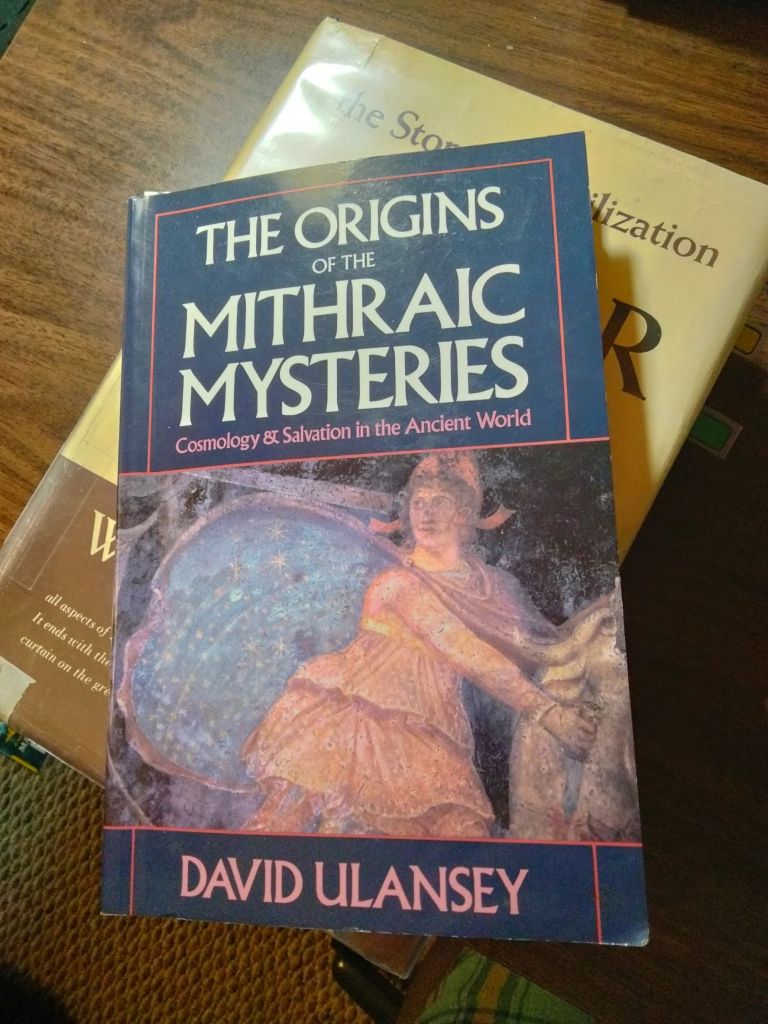
Book Review: The Origins of the Mithraic Mysteries by David Ulansey

I thought you should know that this book exists.

I don’t even remember where I got it. I have a feeling I got it at a used book store or a library sale, or maybe I stole it from my dad’s library. I know it’s been sitting around my study for a few years, waiting for me to get to it. It was published in 1989.

This is a good, accessible piece of scholarly work that first explains what the cult of Mithros was, then traces the history of scholarly thinking about it, and then advances Ulansey’s theory about what was really behind the cult.

What Is Mithraism

Mithraism began to spread throughout the Roman Empire in the first century C.E., reached its peak in the third century, and finally succumbed to Christianity at the end of the fourth century. At the cult’s height mithraea could be found from one end of the empire to the other, “from the banks of the Black Sea to the mountains of Scotland and to the borders of the great Sahara Desert,” as one authority puts it.

ibid, p. 4

As a result, many of the underground Mithraic temples whose iconography Ulansey shows pictures of are found in Germany or in Italy, although this is a cult that had its origins in Tarsus, in southern Turkey.

For a long time, the accepted theory among scholars was that the god Mithras got his start as the Iranian god Mithra, because they happen to share a name. However, the attributes of Mithras don’t line up very well with those of Mithra, which leaves the door open to other explanations.

The cult was apparently based on a story where Mithras slaughters a bull, and from the bull’s body sprang all the plants that man finds useful, such as wheat, grapes, etc. Because it was a mystery cult, nothing was ever written down about the secret meaning of this story, nor of the levels through which the neophyte progresses as he is initiated deeper and deeper into the mysteries. But in all Mithraic temples, there is consistent iconography. This includes a picture of Mithras slaying the bull, with wheat coming out of the wound. Mithras is typically looking away from the bull (though this is “corrected” in some reconstructions), wearing a distinctive hat which was associated with Persia and with Perseus in the ancient world. Around him are placed other figures which will prove to have significance in unravelling the meaning of the cult. Sometimes, the whole scene is placed under an arch or inside a circle that shows the zodiac. Sometimes, Mithras is also portrayed as standing inside a circle or hoop lined with star symbols.

A Brief Tour of the Ancient Mediterranean, Near East, and Europe

In unfolding his theory, Ulansey takes us on a fascinating tour of the ancient world. For example, he spends a lot of time establishing how and why Mithras came to be associated with (based on?) Perseus, who was the founder and hero of the city of Tarsus and, in fact, the local god of that whole region. (Mithras’ hat — a “Phrygian cap” — was originally worn by Perseus, and Ulansey contends that he looks away from the bull as he slaughters it because Perseus looked away from Medusa as he slaughtered her.) He gets into the fact that the cult may have originated with pirates of Cicilia, which lies just off the coast from Tarsus:

[T]he Cicilian pirates were far more than a mere band of thieves. Rather, the pirates, who numbered at least twenty thousand, formed what amounted to a small nation which at its height controlled the entire Mediterranean Sea.

ibid, p. 88

Ulansey then quotes Plutarch from Life of Pompey:

“The power of the pirates had its seat in Cicilia at first … then, while the Romans were embroiled in civil wars, the sea was left unguarded … until they no longer attacked navigators only, but also laid waste islands and maritime cities … There were also fortified roadsteads and signal-stations for piratical craft in many places … more annoying than the fear [the pirate fleets] inspired was the odious extravagance of their equipment, with their gilded sails, and purple awnings, and silvered oars … For you see, the ships of the pirates numbered more than a thousand, and the cities captured by them four hundred … Presently men whose wealth gave them power, and those whose lineage was illustrious, and those who laid claim to superior intelligence, began to embark on piratical craft and share their enterprises.”

ibid, p. 88

There are plenty of other fascinating historical nooks in this edifice, such as the figure of a lion-headed man, entwined by a snake, standing on a sphere; the idea of Mithras being born out of the rock; the exact nature of the Gorgon, and many, many others. Every single one makes sense when it comes up in context. That said, there were certainly some bizarre ideas floating around in the ancient world.

The Zodiac

So, to get right down to it, Ulansey’s case is that the Mithraic mysteries were a way of encoding astronomical knowledge. Because this is the ancient world we are talking about, this knowledge could equally be considered scientific, cosmological, and religious, as will become clear shortly.

Lately, I’ve been studying the zodiac in a desultory fashion. Don’t worry, I am not planning to take up astrology. Astrology is specifically forbidden to faithful Jews, and to children-of-Abraham-by-faith like myself. But it is of interest to me, because it was so important to the people of the ancient world. They worked it into their monuments and their mythology. The signs of the zodiac, and other constellations, were associated with the gods, and a good case could be made that this association started in pre-Flood days.

The other thing that fascinates me about the zodiac is that it’s so hard to observe. Now that I keep chickens and also work outside the home, I’ve been obliged to get up before dawn to let the chickens out. I live in a rural area with relatively dry weather, so you’d think it would be easy for me to take a quick glance at the horizon while I’m out there, and be able to tell which constellation is in the east, right where the sun is going to rise in an hour or two. As it turns out, it’s not so easy as all that. You not only have to know which direction is due east, you also have to have something that helps you sight where the sun is going to rise … and it moves. Then you have to be able to recognize the constellations. To really figure out the whole zodiac, you’d have to be making these observations daily, throughout all the seasons of the year, until you noticed that the constellations of the zodiac make a notional belt around the earth, and that at different times of year, they take turns “housing” the sunrise. This is already difficult enough that you’d have to have a pretty strong motivation to pursue it. (Stronger than mine is right now.) Ancient people thought this was so worthwhile that they managed to master the very difficult science of astronomy. Many ancient monuments, in fact, were built as observatories, from Stonehenge to many structures in the Americas.

Why were they so motivated to study the stars? That’s a discussion for another time.

According to Ulansey, the Mithraic iconography (and probably the whole cult) was designed to encode the secret of Equinoctal Precession. This is a really complicated phenomenon, so if you don’t know what it is, I’ll let you look it up. Basically, because of an irregularity in the earth’s rotation, the zodiac sign that “houses” the sunrise on the equinox will stay the same for 2,160 years, by which time the sunrise has migrated back to the previous zodiacal sign (hence, precession). (Also, incidentally, Polaris has not always been the the pole star.) Precession has been discovered at different times in the past by different civilizations. Graham Hancock makes a pretty good case that it was known by somebody, before conventional history began. But due to the difficulty of observing it, it has not been known at all times by all peoples. Around the time that the cult of Mithras apparently started, it had recently been discovered, and begun to be talked about, in the vicinity of Tarsus, in the same intellectual circles that were also providing aristocratic pirates.

Breaking Hoops and Wheels and Mills

Now, to you and me, equinoctal precession might fall into the category of “Oh, that’s interesting.” Not so for the ancients. For one thing, this cult probably started among pirates, who use the stars to navigate. The idea that the stars were once different and are not the same all the time would be earth-shattering to them. But this news gets even more ominous when we understand ancient cosmology.

(And when I say “ancient” here, I am talking about the cultures of the Mediterranean, Ancient Near East, and parts of Europe. Though, not to keep mentioning Graham Hancock, but in his book Fingerprints of the Gods he finds similar cosmology in ancient India, Central America, and Scandanavia. So a case could be made that this cosmology was once worldwide.)

This ancient cosmology, then, conceived of the heavens as a huge machine, constructed of two or more intersecting hoops (the zodiac, the celestial equator, and, essentially, the prime meridian/international date line projected into the sky). Sometimes the heavenly machinery is portrayed more as a big edifice with four pillars supporting it. Sometimes it’s a “mill” that turns. Probably some ancient people took this more literally than others; some understood it was notional, but represented something real.

Now, imagine that you think of the universe as a big, finely tuned machine, where the constellations always end up in the place they are supposed to be. If the whole hoop has moved out of its place, this could be conceived of as “breaking” the machine. This is why cycles of a certain number of years (not everyone got the precessional intervals right) were thought to bring cataclysms upon the world. So, we get myths worldwide about a mill being broken, and this causing the stars to fall from their places, the sky to become dark, fire and floods to sweep over the earth, etc. Again, read Hancock to find out more about this than you ever wanted to know.

But the point is, whether the Cicilian pirates thought that precession caused a cataclysm, or whether it just meant the universe was less stable than they had imagined, this would have been a revolution in their scientific, cosmological, and religious thought. (Religious because, in ancient times, science and cosmology and religion were really all a part of one system, especially when you consider that the stars and other heavenly bodies were thought to metaphysically influence events on earth.) So, whether you count it as belonging to three, two, or just one unified field of knowledge, this was a big enough discovery to be kept secret (a “mystery”) and passed on to initiates in a whole new cult religion.