Teenaged J.D. goes to see his beloved grandmother, MawMaw, in the hospital where she has pneumonia. J.D. knows that older people often die of pneumonia.
J.D.: Are you going to die?
MawMaw: I don’t know.
[repeat several times]
J.D.: Just tell me. Are you going to die in here?
MawMaw: I don’t goddamn know.
J.D.: People know. Some people do.
MawMaw: No they don’t.
J.D.: Native Americans.
MawMaw: They’re called Indians, like the Cleveland Indians. And they don’t know, any more than other people. They’re not magic, just ’cause they don’t have microwaves.
[I]n these pagan cults there is every shade of sincerity — and insincerity. In what sense exactly did an Athenian really think he had to sacrifice to Pallas Athene? In what sense did Dr. Johnson really think that he had to touch all the posts in the street or that he had to collect orange-peel? In what sense does a child really think that he ought to step on every alternate paving-stone? … [These things] have the sincerity of art as a symbol that expresses very real spiritualities under the surface of life. But they are only sincere in the same sense as art; not sincere in the same sense as morality. The child does not think it is wrong to step on the paving-stone as he thinks it is wrong to step on the dog’s tail.
These are the myths: and he who has no sympathy with myths has no sympathy with men. But he who has most sympathy with myths will most fully realize that they are not and never were a religion…. They satisfy some of the needs satisfied by religion; and notably the need for doing certain things at certain dates; the need of the twin ideas of festivity and formality. But though they provide a man with a calendar they do not provide him with a creed. A man did not stand up and say ‘I believe in Jupiter and Juno and Neptune,’ etc., as he stands up and says ‘I believe in God the Father Almighty’ and the rest of the Apostles Creed.
The crux and crisis is that man found it natural to worship; even natural to worship unnatural things. The posture of the idol might be stiff and strange; but the gesture of the worshipper was generous and beautiful. He not only felt freer when he bent; he actually felt taller when he bowed. Henceforth anything that took away the gesture of worship would stunt and even maim him forever. If man cannot pray he is gagged; if he cannot kneel he is in irons.
When the man makes the gesture of salutation and sacrifice, when he pours out the libation or lifts up the sword, he knows he is doing a worthy and virile thing. He knows he is doing one of the things for which a man was made. His imaginative experiment is therefore justified. But precisely because it began with imagination, there is to the end something of mockery in it, and especially in the object of it.
G.K. Chesteron, The Everlasting Man, excerpts from the argument that runs pages 107 – 112
Hello everyone! To my American readers, I hope your holiday weekend was restful. I hope it went fantastic. (Mine did.)
But perhaps your holiday weekend didn’t “go fantastic.” Perhaps it went horrible.
Thanksgiving has betrayed me just enough times that I get nervous around it. I can think of three or four past Thanksgivings where there emerged, on that very weekend, a crisis of life-and-death proportions. I’m not sure why, but holidays and other non-ordinary times seem to attract these things.
In my upcoming book, The Strange Land, the tribal chief notes ruefully that moving days are subject to the same phenomenon:
Enmer had seen this time and again. If anyone was going to get sick, if anyone was going to get pregnant, if anyone was going to miscarry or commit a petty crime or simply snap under the pressure of survival, they were more likely to do it at the exact moment of transition. These in-between times [when the tribe was getting ready to move] were dangerous.
Enmer had given this a lot of thought and had concluded that though he could — and did — blame his people for their actual actions, he could not blame them for their bad timing. Things happened with horrible timing. That was the way of the world.
The Strange Land, chapter 10
I hope this Thanksgiving was kind to each of you, though. See you next time!
Those who seem to be promising an end to existing group disparities, as a result of whatever policies they advocate, may be promising what cannot be delivered, regardless of those policies. Moreover, the clash between numerical goals, fervently pursued, and the repeatedly frustrated attempts to reach those goals is not without social consequences.
Among the dire consequences for society as a whole are widespread resentments, bitterness, disorder and violence on the part of those who have been told incessantly that they are “entitled” to a demographically defined “fair share” of what is produced, and that this “fair share” is being denied to them by others who are guilty of maliciously keeping them and their loved ones down.
Such consequences of a toxic social vision tend to be especially dire for the less fortunate, who suffer most when social order breaks down and violence is unleashed amid heady crusades.
The actual consequences of a social vision cannot be assessed on the basis of its good intentions or even its plausibility. The real test is what has actually happened when that vision has been applied, and what the implications are of those social consequences.
Thomas Sowell, Discrimination and Disparities, pp. 165-166
The Wyoming Toad lives only in Wyoming. It was once thought to be extinct in the wild, but now it is coming back, thanks to a large number of people who have been working on it for ten years. This team includes the City of Laramie, private landowners, Fish and Game, University of Wyoming, and several zoos and wildlife organizations.
I find it heartwarming that large numbers of people, who are clearly superior in every way to toads, would devote so much time and effort to save this ordinary-looking toad. Some of them have donated land. Others have invested their entire careers in this little animal. Clearly, they love the toad just because it exists, not because it does anything special for them.
They are distinct and should not all be collapsed into the category of Resistance.
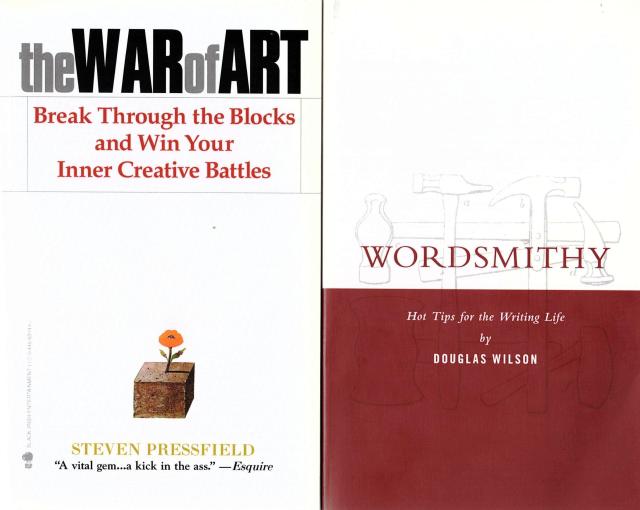
Today, we will be responding to this book: The War of Art, by Steven Pressfield.
It’s the one on the left.
I mentioned TWOA in another post on writing-related books. Later, The Orangutan Librarian hilariously dressed the book down in her review. Today, I will get into the book’s flaws (which bothered me but not as much as they bothered her), and that discussion will lead us to talking about some entities that are definitely scary, namely the three baddies of this post’s title.
The War of Art started out swimmingly
Pressfield starts out discussing how, whenever people go to follow their calling, they experience something called Resistance. He mentions endeavors like starting a business, parenting, charitable work, or “taking any principled stand in the face of adversity” as activities that evoke Resistance, but if you read the rest of the book, it’s clear that the main type of calling he has in mind is becoming a writer or an artist. I frankly think this narrow focus is more helpful, because with some activities (such as parenting or fighting evil), the reasons that people run into difficulties are obvious and expected. This is not the case with, say, landscape painting or novel writing. Those look easy until you try to do them, and there is no obvious reason why a person who has talent in these areas should find life grindingly difficult while pursuing them.
Yet, they do.
Resistance cannot be seen, touched, heard, or smelled. But it can be felt. We experience it as an energy field radiating from work-in-potential. It’s a repelling force. It’s negative. Its aim is to shove us away, distract us, prevent us from doing our work. (p.7)
Resistance is not out to get you personally. It doesn’t know who you are and it doesn’t care. Resistance is a force of nature. It acts objectively. Though it feels malevolent, Resistance in fact operates with the indifference of rain and transits the heavens by the same laws as the stars. (p.11)
Like a magnetized needle floating on a surface of oil, Resistance will unfailingly point to true North — meaning that calling or action it most wants to stop us from doing. Rule of thumb: The more important a call or action is to our soul’s evolution, the more Resistance we will feel toward pursuing it. (p.12)
The danger is greatest when the finish line is in sight. At this point, Resistance knows we’re about to beat it. It hits the panic button. It marshals one last assault and slams us with everything it’s got. The professional must be alert for this counterattack. Be wary at the end. (p.18)
What does Resistance feel like? First, unhappiness. We feel like hell. A low-grade misery pervades everything. We’re bored, we’re restless. There’s guilt but we can’t put our finger on the source. We want to go back to bed; we want to get up and party. We feel unloved and unlovable. We’re disgusted. We hate our lives. We hate ourselves. Unalleviated, Resistance mounts to a pitch that becomes unendurable. At this point the vices kick in. Dope, adultery, web surfing. (p.31)
Resistance is directly proportional to love. If you’re feeling massive Resistance, the good news is, it means there’s tremendous love there too. If you didn’t love the project that is terrifying you, you wouldn’t feel anything. (p.42)
quotes from The War of Art by Steven Pressfield
All of this is perfectly true and I think it’s a fantastic description. I’ll bet that everyone reading has had these experiences a short way in to a new enterprise. Besides writing, people commonly describe this kind of phenomenon coming midway through a weight-loss regimen, or hitting a few weeks in to their attempt to live in another country. If you haven’t experienced this stuff, I guarantee you’ve read a memoir or watched a documentary about someone who has.
Then it starts to trivialize Resistance … and everything else
It isn’t long, however, before TWOA’s diagnosis of our troubles starts to go a little bit off the rails:
Resistance seems to come from outside ourselves. We locate it in spouses, jobs, bosses, kids. “Peripheral opponents,” as Pat Riley used to say when he coached the Los Angeles Lakers. Resistance is not a peripheral opponent. Resistance arises from within. It is self-generated and self-perpetuated. Resistance is the enemy within. (p.8)
Resistance has no strength of its own. Every ounce of juice it possesses comes from us. We feed it with power by our fear of it. Master that fear and conquer Resistance. (p.16)
Ibid
Well, OK, that is partly true. Resistance as fear, self-sabotage, rationalization and procrastination is a very important part of the picture. That even may be its main characteristic in many cases. (More about this in a sec.) But, for someone who appeared to be taking Resistance so seriously as a real force, I’m a little disappointed that Pressfield is locating it entirely inside ourselves. And this problem is going to get worse, when the book goes way off the rails:
We get ourselves into trouble because it’s a cheap way to get attention. Trouble is a faux form of fame. Ill health is a form of trouble, as are alcoholism and drug addiction, all neurosis including compulsive screwing up, jealousy, chronic lateness … (p.24)
Creating soap opera in our lives is a symptom of Resistance. Why put in years of work designing a new software interface when you can get just as much attention by bringing home a boyfriend with a prison record? Sometimes entire families participate unconsciously in a culture of self-dramatization. If the level of drama drops below a certain threshold, someone jumps in to amp it up. Dad gets drunk, Mom gets sick, Janie shows up for church with an Oakland Raiders tattoo. It’s more fun than a movie. And it works: nobody gets a damn thing done. (p.25)
Ibid
OK, this is bad enough. Pressfield has just attributed every one of our character flaws, as well as family drama (which, let me note, is other peoples’ behavior) to Resistance. But, surely, this can’t all be the same thing as the psychological phenomenon where we get scared and antsy when we start to succeed in our creative work, can it? Surely, this is too broad?
But then, he really lost me:
Doctors estimate that seventy to eighty percent of their business is non-health-related. People aren’t sick, they’re self-dramatizing. The acquisition of a condition lends significance to one’s existence. An illness, a cross to bear … Some people go from condition to condition … The condition becomes a work of art in itself … A victim act is a form of passive aggression.
The War of Art. p.27
OK.
This paragraph was obviously written by someone who has never had a real, serious health problem.
“Doctors” estimate this, do they? First of all … I doubt it. Secondly, “doctors” tend to be fairly healthy themselves (or they wouldn’t have made it through medical school). Yes, they can tend to disbelieve people about their own condition. Many people with rare or hard-to-diagnose conditions, such as Lyme Disease, Polycystic Ovary Syndrome, obesity, Irritable Bowel Syndrome, chronic pain, or less-typical forms of any disease, have horror stories of how hard it was to get a diagnosis or even get their complaints taken seriously. I’ll bet you know at least one such person whom you could name right off the top of your head. I’ll bet that with a little thinking, you could come up with more names.
So let’s dispense with this nonsense.
If buckling down to your calling was all it took to cure a host of chronic conditions, I assure you, Mr. Pressfield, people would do it.
So, then, does Resistance mean anything at all?
Pressfield has just completely discredited his own thesis by attributing to Resistance literally every bad thing that happens to anyone, whether or not they caused it. It tempting, at this point, to chuck the book contemptuously over our shoulder and be done with it. That is exactly what The Orangutan Librarian did, and I can’t blame her.
But this created some serious cognitive dissonance in me, because there are passages in this book that I don’t want to chuck out. For the first several pages, it seemed to me that Pressfield was describing a real phenomenon, and describing it better than I’ve heard it described before.
So what’s going on here? How can these two things coexist?
Resistance Means Three Things
The problem, revealed in the second half of the book, is that Pressfield is a Jungian. This means, as far as I can tell, that in his world view, all of the important stuff happens inside the person, in our internal world. In fact, your mind and subconscious might be the location not just of the only important stuff, but of all the stuff. The outside world, basically, doesn’t exist at all.
Any world view that takes this as its postulate is naturally going to lose some explanatory power.
Yes, the mind is real, but it’s not the only real thing. The world exists. Physical stuff exists. Other selves exist. Furthermore, it’s a fallen world, and so, sometimes, bad stuff is going to happen that has its origin in that fallen, hybrid-spiritual-and-physical world, and not on our own almighty psyches.
Christianity, by the way, does a great job of this. Full disclosure, I’m a Christian. One thing that gives the Judeo-Christian world view its awesome explanatory power is that it takes seriously both mind and body. What Pressfield calls Resistance (and is forced, by his world view, to locate entirely inside the sufferer), Christianity breaks out into three things: The World, The Flesh, and The Devil.
The World
You may have noticed that Pressfield starts out by saying that we tend to locate Resistance in our spouses, bosses, etc., but that it’s actually internal. But then later, he mentions that “entire families” will help each other engage in Resistance. Elsewhere he talks about how people will try to sabotage each other’s hard work and success. And he mentions that there are entire industries that make money off distracting people from their duties.
So perhaps other people, and the greater culture, do have some effect on us after all.
Of course they do. This is what theologians call The World. In extreme cases, other people’s sin can stop us in our tracks, completely crushing our ability to focus on anything else, either temporarily or long-term (though not, thankfully, eternally). Examples of this would be an abusive parent, spouse, boss, or (in the ancient world) mistress or master; rape, mobs, warfare, and associated atrocities. All of these things are aspects of the world being fallen. They are not the fault of person they happen to, but they can certainly knock the person off-track from any other calling they might have had, forcing them to deal with the atrocity instead.
Because we live in physical bodies in a physical world, populated by other selves, and because that world is fallen, it is therefore possible (and, indeed, common) that bad things happen to us that do not have their source in us. Go and read the book of Job. It is absolutely not true that “no one can make you feel inferior without your consent.”
The Flesh
The phenomenon that Pressfield does such a great job describing, before he gets off-track, is what used to be called The Flesh. This means our own character, with all its temptations, vices, fears, flaws, and weaknesses. Often, we need nothing more than this to cause us to crash after we have started out doing well. I’m not going to spend as much space on this one, because it is described pretty well above and because it’s the challenge that most of us are probably the most familiar with. The Flesh is, indeed, a formidable foe. Conquering it might not be a sufficient condition for success in our calling, but it’s certainly a necessary one.
The Devil
Now we get to the scariest of the troika, and also the most controversial. This post has already turned into a really long rant, so I’m not going to make a bunch of theological arguments that the devil exists. I’ll just explain the relationship that he bears, in my thinking, to Resistance.
Pressfield describes Resistance as a force that is:
real
malevolent, yet impersonal
dedicated to keeping people from “evolving their soul” – i.e. becoming productive, courageous, and virtuous
spiritual: invisible, non-physical
Clearly, this is an exact description of Satan as he appears in traditional Christianity.
Unfortunately, Pressfield’s world view doesn’t allow for the existence of an invisible, but real, spiritual entity that is not just the artist’s shadow side or something like that. So, having personified Resistance to such vivid effect, he is then forced to back off and explain that it has no reality outside ourselves, really. Because he’s Jungian, this doesn’t register as a problem, because all of the universe is inside ourselves. But, I find it unsatisfying.
I think Pressfield was describing more than he knew.
Why is Resistance “protean,” deceptive, “always lying and always full of shit”? (p.9) Because the devil is a liar.
Why is Resistance always perfectly timed to interfere with our work? We live in a fallen world, where pipes burst, bacon burns, where people get sick and have family drama. But why do these things seem to happen, not at random, but perfectly timed to interfere with us doing good things (shortly after we begin a new enterprise, or when the finish line is in sight)?
Andrew Klavan says that shortly after he finished the first draft of Another Kingdom, his house suffered an invasion of caterpillars. Every time he hit another milestone with the project, something “dreadful” would happen.
You can’t tell me that caterpillars coming into your house is caused by your subconscious desire to create drama. Neither is your toilet flooding, your car breaking down, your aging parent taking a fall, or, say … a plague hitting the nation.
No, I’m not saying that all of these things are the devil directly trying to sabotage you. At least, I don’t think so. Again, we live in a fallen world and sometimes stuff just happens. But sometimes, I have to say, the timing is extremely suspicious. And I am not just making this stuff up. In the New Testament, Satan is clearly credited with sometimes causing sickness. Ironically, believing that comes out sounding a lot more humane than “70 – 80% of people with symptoms aren’t really sick.”
In the video below, Andrew Klavan talks about Another Kingdom. At 7:03 he tells the caterpillar story.
People say that food is the good girl’s drug. But now I realize it was just one particularly cheap and sticky strain of my real drug of choice: distraction.
When I was a little kid, it just meant that I was daydreamy, or imaginative, running around performing whole musicals and movie scenes for the cat. When I grew up into a voracious reader, then great! Who would discourage a twelve-year-old from rereading The Catcher in the Rye? In high school, I was a devoted theater student, and in college I was serious about film study.
All that was true. Then there’s the truer version.
I wasn’t just rereading The Catcher in the Rye. I was rereading everything, constantly: in the car on the way to school, at recess, waiting for Karen to pick me up, and then all the way home. … Those teenaged nights I spent alone in my dorm singing along to CDs weren’t just about musical appreciation. They were about not being there, not being me. I was long gone, deep in my head, buried in the drama of “Someone Else’s Story” (from the original Broadway cast recording of Chess).
Kelsey Miller, Big Girl, pp. 210 – 211
So, guys, this was absolutely me when I was a kid as well, minus the musical talent. I can identify with wanting to immerse yourself in someone else’s story … and I don’t think it’s always a bad thing. Especially for kids, it’s a way to quickly learn a lot about the world. And, frankly, I can’t imagine anyone becoming a voracious reader without this hunger. I strive to make my books an immersive experience for the reader. Surely, without that, reading would be boring?
I do understand that reading can be used as form of escapism. In Miller’s case, her distraction addiction was so extreme that she realized it was becoming a major obstacle to her personal growth. After discovering mindful eating, she began to train herself in mindful walking to the subway without a podcast, and in mindful being in her apartment without the TV on every second. I get that.
But I have two things to say about books as a distraction.
One, sometimes we do need to escape from our troubles. This is true especially when we are kids and have few other outlets or coping mechanisms, but also at other times when we need to rest and re-group. I am reminded of a (possibly apocryphal?) Internet quote about how the author has a responsibility to entertain because readers are people sitting on busses and in hospital waiting rooms.
Secondly. The engrossing book that is an escape from reality, can also be a secret tunnel back into reality. You can “escape” into C.S. Lewis’s Chronicles of Narnia, or his Space Trilogy, but you will come out the other side with a renewed desire to face your own fears and responsibilities. And if you don’t actually emerge with the hope that there is an Aslan who could help you in this process, you will certainly, fervently wish there was one … which, as Lewis would say, is the first stage in Joy.
That’s what I hope my books will be. An immersive, entertaining experience that, while you’re not looking, also opens your eyes to aspects of the world that you had not considered before.
What do you guys think? Is it always wrong to use books and other media as escapism? Do kids have more leeway to do this than adults? At what point does voracious reading become pathological? And who gets to say?
Just so you know up front, this post is going to talk about a Meyers-Briggs personality type, and also rely on the reader having some background knowledge of The Lord of the Rings.
Now that I’ve weeded out 90% of readers, let’s proceed.
The Meyers-Briggs Typology
The Meyers-Briggs (MBTI) is a personality typology that describes people’s preferences on how to process information and make decisions. People can be Extraverted or Introverted (E vs. I); Intuitive or Sensing (N vs. S); Thinking or Feeling (T vs. F), and Perceiving vs. Judging (P vs. J). I’ve discussed elsewhere the limitations of these binaries. Some people fall right in the middle between two of the preferences, for example, and the four MBTI preferences don’t tell everything about a person’s personality. That said, I still find the typology interesting and useful. In an earlier post, I discussed the ESTP, who is often the disruptive force in the story. Today, I’m going to discuss a much more passive type, the INFP, who is almost the ESTP’s opposite.
Frodo as an example of the INFP
When I say the INFP is “passive,” that’s not a slam. I’m an INFP myself.
The INFP is Introverted. This means that he or she has a rich inner life, and draws his/her energy from within. Interacting with the outer world drains him. (Extraverts get their energy from the outer world.) Many of the strongest characters in The Lord of the Rings are Introverted, from which we can guess that J.R.R. Tolkien probably was as well. That’s not surprising, given that he was a professor who created, just for fun, several languages and an elaborate world with its own history and mythology. Introverts are less than 50% of the population, but they are overrepresented in literature because so many authors are Introverts.
As an NF (Intuitive and Feeling), the INFP is very sensitive to the feelings of those around him. He or she cares a lot about all relationships being harmonious at all times. Conflict of any kind stresses the INFP out to a greater degree than other types. This can mean the that INFP will unhealthily say or do anything to avoid conflict. The up side is that the INFP wants to have a good relationship with, and believes that he can reach, anyone. Exhibit A is Frodo’s ability to understand and even win the loyalty of Gollum.
INFPs are not quick to thrust themselves forward, take leadership, or take the initiative. They don’t want to do a task until they feel they understand it and can do it well. Mistakes are an unacceptably high cost when you can’t tolerate any damage to any relationship (read: criticism).
As a not very quick, ambitious, or assertive type, the INFP can often appear to be contributing nothing to the group.
This is really apparent when we look at Frodo’s role in the Ring saga. He delays a long time leaving on his quest and needs a push from his friends. Once he does set out, he spends all three books getting into hot water and getting rescued by people who are more powerful, capable, or (in the case of Sam) harder working. Like the other hobbits (but even more so), for about the first half of the adventure Frodo appears to be almost a pure taker. In fact, some of the most famous scenes in LOTR involve someone literally carrying him: the humans carrying the hobbits down out of the snow drifts on Carhadras. Aragorn running out of Moria with Frodo in his arms after Frodo gets speared by an orc. Sam carrying Frodo up Mt. Doom.
He spends much of the movie looking like this.
What is this guy good for, anyway?
Of course, as we all know, Frodo is weak and passive not just because of his personality but because he is in fact carrying a heavy, but unseen, burden: the Ring. It’s a spiritual burden that occupies his mind, allows him to see what others can’t, and exposes him to terrors. It also, more and more as the story goes on, saps his strength. He may not appear to be contributing anything, but he is doing real work for the group, though that work is hard to quantify.
Tolkien makes it so that the work Frodo does, bearing his burden, is obvious to the reader and is also clear to, and appreciated by, the rest of the Fellowship. Most people don’t read The Lord of the Rings and come away saying, “I don’t see what the big deal was about Frodo. He didn’t do anything.”
Non-Frodo INFPs also bear a burden. They bear the burden of their worry about every single person and relationship they are aware of, and of their ability to take personally everything that happens in the world. Of course, the nature of this burden varies with the maturity of the INFP. When immature, our burden is self-absorbed in nature. We want everyone to like us, we want never to be criticized. But as we mature, this can move on to becoming genuine concern for the well-being of all the people whose existence we know of.
This is a heavy burden indeed. When news travels around the world in seconds, no problem or tragedy can fail to come to the attention of the INFP. An INFP who really takes every human tragedy to heart will be too overwhelmed. Only one Man (who, in my opinion, was the perfect example of all the Meyers-Briggs types) is capable of bearing the sins of the world. As an INFP of a certain age, I have had to master the skill of consciously setting things aside as not my problem to worry about so that I can function.
Still, even if we limit the INFP’s burden to the sins and sorrows of the people in his or her immediate circle, that’s a lot. If you know an INFP (and you are not one), they are probably thinking about all of this stuff a lot more than you are. They are expending a lot of mental energy on it. That may be why they need so much sleep. If they are a Christian INFP, they are no doubt also wrestling in prayer for you and for everyone in their circle.
Apparently, based on the YouTube comments, the following song has been out for six months. I just discovered it last week, playing the country station on my car radio while running errands, and it quickly became my theme song for the week.
It’s just so doggoned unifying.
Also, I like the phrase “one big …”, as in an earlier Andrew Klavan quote, “It was like the whole country was one big series of bad choices.”
And though this song is upbeat, there is a certain insight to calling life “one big country song,” because country as a genre can be pretty tragic. You know what they say: if you play a country song backwards, you get your wife back, you get your truck back, you get your dog back …

 Out of Babel Books