Mind: Blown Book of the Year

Who are the gods?

Over the past several years, my research and reading has led me more and more to the conviction that the entities that people often call the old gods were not “mere mythology.” They were and are real.

Several threads of my thinking have re-enforced each other in coming to this conclusion.

First of all, as a Christian, I reject the Enlightenment-era, materialist notion that there is no spiritual world, that matter is all that really exists. I reject both the strong version of this, in which not even the human mind is real, and the weak version of it, in which we accept that human beings exist as minds, but we try envision as them as “arising” out of matter, and we disbelieve in any other spiritual beings, whether spirits, angels, demons, ghosts, or the one true God. This view, the one I reject, has held sway for most of our lifetimes. Even people such as myself who would not call themselves materialists will lapse into this sort of thinking by default, looking for a physical or mechanical process to explain what is “really” going on behind any claimed spiritual phenomenon.

Another thread in the tapestry has been my interest in the ancient world. Anyone with a passing familiarity with archaeology quickly comes to realize that ancient people were much smarter than they have gotten credit for, at least during the Golden Age of Scientific Triumphalism, the late 1800s and early 1900s. All the good, old-fashioned scientific materialists from this era took it as an axiom that human beings started out as apelike hunter-gatherers, and slowly “ascended,” developing shelter and clothing, “discovering” fire, slowly and painfully inventing various “primitive” tools, and then finally moving on to farming, language, and religion. By hypothesis, ancient people were stupid compared to us now.  

Genesis, my favorite history book, tells a very different story. It shows people being fully human from the get-go, immediately launching into writing, herding, weaving, art, music, and founding cities. And in fact, archaeology confirms this. Every year, we discover a more ancient civilization than the evolutionists told us existed. Some recent examples: the Antikythera mechanism is an ancient computer. The Vinca signs are an alphabet that pre-dates Sumeria. Gobekli Tepe is a temple complex that uses equilateral triangles and pi, and dates to “before agriculture was invented” (as is still being claimed). The Amazon basin turns out to have been once covered in cities.

Evolutionists’ dogmatism about early man being stupid has allowed them to ignore all the data that ancient history presents us about the existence of a spirit world. Why should we believe claims (universally attested) about heavenly beings that come to earth to visit, rule over, and even mate with humans? These are primitive people’s attempts to explain purely scientific phenomena that they didn’t understand. But if, as a Christian, I choose to respect ancient people and take seriously their intelligence, then I also have to grapple with their historical and cosmological claims.

Moving on to the third thread. The Bible itself confirms that there were entities called gods (“elohim”), some of whom, at one point in very ancient times, actually came to earth and reproduced with human women, creating a race of preternatural giants, “the heroes of old, men of renown” (Gen. 6:4).  The story is told in Genesis ch. 6, but it is assumed and referenced throughout the rest of the Bible and in Hebrew cosmology. This idea is also attested in oral and written traditions worldwide, which universally have gods and giants.  A Bible-believing Christian can take seriously the bulk of pagan history, cosmology and myth, whereas a strict materialist evolutionist has to reject it all as primitive superstition.

Two books that have helped me understand Genesis 6 and how it fits into Ancient Near Eastern cosmology were The Unseen Realm by Michael Heiser and Giants: Sons of the Gods by Douglas Van Dorn. I’ve also had conversations with Jason McLean and enjoyed listening to The Haunted Cosmos podcast. The historical record about gods and giants, once forgotten by mainstream Christians in America, is again becoming a topic of interest in the evangelical world.

Part of the Biblical understanding of the gods is that they are created entities who were supposed to help the one true God rule the cosmos. In the course of redemption history, the fallen gods were first banished from appearing physically on earth (in the Flood). At Babel, the gods were each given a nation of men as their “portion” to rule over (Deut. 32:7 – 8), which they did a pretty poor job (Psalm 82). Then God called Abram to make a people for Himself, with the ultimate goal of making all the nations His portion (Ps. 82:8, Ps. 2, Matt. 4:8 – 9). When Christ came, He began to drive the gods out of their long-held territories (Mat. 12:28 – 29). Whenever a region was Christianized, the old gods would first fight back, then become less powerful, and eventually go away altogether. Sometimes, their very names were forgotten. This disappearance of lesser spiritual entities from more and more corners of the earth is the only reason any person could ever seriously have asserted that there is no spirit world.

As a Christian, I am immensely grateful to have grown up in a civilization from which the old gods had been driven. It has been a mostly sane civilization, in which everyday life is not characterized by spooks, curses, possession, temple prostitution or human sacrifice.

This, then, is the background that I brought to Cahn’s book. This mental background helped me to accept many of his premises immediately. If you do not have this background – if you are, for example, a modern evangelical Christian but still a functional materialist – Cahn’s book might be a bit challenging. He dives into the deep end right away. He moves fast and covers a lot of material.

Who is Jonathan Cahn?

In his own words,

Jonathan Cahn caused a worldwide stir with the release of the New York Times best seller The Harbinger and his subsequent New York Times best sellers.

n.b.: I had seen The Harbinger on sale, but I assumed it was fiction in the style of the Left Behind series and avoided it.

He is known as a prophetic voice to our times and for the opening up of the deep mysteries of God. Jonathan leads Hope of the World … and Beth Israel/the Jerusalem Center, his ministry base and worship center in Wayne, New Jersey, just outside New York City.

To get in touch, to receive prophetic updates, to receive free gifts from his ministry (special messages and much more), to find out about his over two thousand messages and mysteries … use the following contacts …

From page 239 of this book

In other words, Jonathan Cahn swims in the dispensational or charismatic stream of Christianity. He calls himself a prophet. That’s a red flag to me, as a Reformed Christian. I believe that the prophetic age ended with John the Baptist (Matt. 11:11 -14). The prophets and apostles were the foundation of the church, and they died out with the first generation of Christians (Eph. 2:19 – 22). This exegesis of Scripture finds confirmation in daily life. I have met Christians who sensed God speaking to them (and have experienced it myself), but I have never met anyone who claimed to be a modern-day prophet, receiving authoritative words from God, who wasn’t a charlatan.

To make matters worse, Cahn asserts that he can “open up the deep mysteries of God” and that we can “find out about his over two thousand messages and mysteries.” This is a direct claim to have exclusive spiritual knowledge that is not available to all in the already-revealed Word of God. If he were just talking about knowledge already found in the Bible, he would call it “exegesis” or “Bible teaching,” not “messages and mysteries.” This claim reveals him to be part of the Gnostic or Hermetic stream of Christianity. Yes, I am using the words “Gnostic” and “Hermetic” loosely. They are big terms with somewhat flexible definitions. However, both are characterized by an emphasis on secret or esoteric knowledge which can only be accessed through a teacher (or, in this case, a prophet) who has been enlightened somehow. To see my posts about Hermeticism and why it is it antithetical to orthodox Christianity, click here, here, here, and here.

What was my approach to this book?

I knew when I picked up this book that Cahn was dispensational, a “prophet,” and therefore fundamentally a false teacher. So, I approached the book not as I would an exegesis by a trusted or mostly trusted, orthodox teacher or scholar like Michael Heiser or Douglas Van Dorn, but rather with curiosity. My interest in the topic of the old gods is such that I can’t ignore what anyone claiming the name of Christ had to say about it. I already knew there was a resurgence of interest in this topic in the Reformed world, and now I wanted to see what the Dispensationalists were saying. I picked it up prepared for anything up to and including rank heresy, but as it turned out, the most heretical thing in the book was the “About Jonathan Cahn” section that I just showed you. The rest was, for someone with my cosmology, mostly pretty hard to disagree with.

The Parable of the Empty House

Cahn spends four very short chapters (Chapters 2 – 5; pages 5 – 22) establishing the ideas I attempted to establish above: that the gods of the ancient world were real spiritual entities who ruled over nations and received their worship. He demonstrates briefly that this was assumed in the Bible and in Hebrew cosmology. He uses the word shedim, a Hebrew word for demon or unclean spirit, which is sometimes used in the Old Testament to describe the gods. He doesn’t get into the idea of elohim, Watchers, or other different names for spiritual entities, or many details of how they fell. Entire books can be (and have been) written about this (see Michael Heiser). However, Cahn wants to move on and see what is going on with these entities in the modern day.  

Moving at treetop level, he reviews how the coming of Christ progressively drove the gods out of more and more regions of the earth, in a process that took centuries. He describes civilizations as being “possessed” by the gods they serve. I don’t think he means that every person in a pagan civilization is demon possessed, but as a group, their thinking and behavior is shaped and to some extent controlled by whatever god they serve. As someone who has studied the Aztecs, I can’t disagree. Cahn also points out that it was common, indeed routine, for priests, priestesses, and prophets of the pagan gods to experience actual possession, such as the Oracle of Delphi, the girl with the “python spirit” in Acts 16, or worshippers going into a “divine frenzy.”

Having introduced the concept of possession, Cahn moves on to a parable Jesus told about the dynamics of possession in an individual.

When an evil spirit comes out of a man, it goes through arid places seeking rest and does not find it. Then it says, “I will return to the house I left.” When it arrives, it finds the house unoccupied, swept clean and put in order. Then it goes and takes with it seven other spirits more wicked than itself, and they go in and live there. And the final condition of that man is worse than the first. That is how it will be with this wicked generation. Matt. 12:43 – 45, NIV

Typically of Jesus, this parable works on three levels. The house which is cleansed, left empty, and then re-occupied stands for a person who has been demon-possessed, has been delivered, and then ends up in a worse state than before. And the person, Jesus says, can stand for “this wicked generation.”

Cahn takes this parable and applies it to entire civilizations. He has already established that pagan civilizations were possessed, sometimes literally, by a variety of old gods, to their sorrow. When the Gospel came to them, Christ showed up in person, delivered and cleansed them, and lived in their house. Now, says Cahn, what might happen if a civilization rejects Christ, drives Him out? The house (the post-Christian civilization) has been “swept clean and put in order” by its centuries of Christianity, but it is now “empty,” having driven out Christ. It is now a very attractive vessel for “seven other spirits more wicked than the last.”

I honestly don’t think this is an abuse of Scripture. Cahn seems to be applying the parable in one of the senses in which Jesus meant it. Furthermore, he is not the first to point out that the many wonderful benefits of modern Western civilization are an aftereffect of about 1500 years of Christianity. Some commentators have said that “we are living off interest.” Others have compared us, as a society, to someone sawing off the branch he is sitting on. Doug Wilson has mourned that “we like apple pie, but we want to get rid of all the apple orchards.”

A post-Christian society, say Cahn and many others, for various reasons is vulnerable to much greater evils than a pre-Christian one. In the rest of the book, Cahn will show how the old gods have indeed come back. His focus is on the United States, because he’s an American, but also because the United States has a been a major exporter of culture to the world, and in recent years that culture has been of the demonic variety. Cahn’s book is so persuasive because he is not, as “prophets” often do, sketching a near-future scenario and trying to convince us of it. Instead, he is describing what has already happened.

Which gods, though?

When Cahn first started talking about “the gods” coming back, it occurred to me to wonder, “Which gods?” When Americans or Europeans become openly neo-pagan, I’ve noticed they often go for the gods their ancestors worshipped. So, many people research the Norse gods and cosplay as Vikings … except it’s not just cosplay. Other people are more attracted to the Celtic pantheon. These are the Wiccans. Interestingly, in S.M. Stirling’s Emberverse series, we have a very literal return of the gods when technology vanishes from modern society.  Creative anachronists suddenly find that their skills are useful.  A Wiccan busker becomes the leader of her own little witch community. Other people get into reviving the Norse religion. It’s a neopagan’s fantasy.

But there are a couple of problems with this. For one thing, neopagans’ version of the ancient religion often looks very different from the actual beliefs of the ancient pagans (many of which have been lost to history). Also, modern neopagans are happy to mix elements of different traditions from opposite sides of the globe: wicca, Tibetan Buddhism, or their kooky version of American Indian religions (probably also not very authentic). I once commented to a neopagan friend of mine (back when we were still friends) that her religion resembled a “personal scrapbook”. And she happily acknowledged this as one of its good points. A DIY paganism, popular with modern individualists, is not the sort of the thing that can become the state religion of a whole society. Finally, actual, hardcore neopagans are not small in number, but they are nowhere near the majority in the United States. Neopaganism does not appear, at this moment, to be the manner in which an entire postChristian society comes under the control of the old gods. And, in fact, that’s not exactly what Cahn has in mind.

America is not made up of any one ethnicity or people group but many, almost all. In many ways America is a composite and summation of Western civilization. So then what gods could relate not to one nation or ethnicity within Western civilization but to all of them or to Western civilization as whole? … The faith of Western civilization come from ancient Israel. The Bible consists of the writings of Israel, the psalms of Israel, the chronicles and histories of Israel, the prophecies of Israel, and the gospel of Israel. The spiritual DNA of Western civilization comes from and, in many ways, is the spiritual DNA of ancient Israel. … The gods, or spirits, that have returned to America and Western civilization are the same gods and spirits that seduced ancient Israel in the days of its apostacy. … If a civilization indwelled by Israel’s faith and word should apostacize from that faith, it would become subject to the same gods and spirits of Israel’s apostacy.

ibid, pp. 34 – 35

The dark trinity

I have a feeling that Cahn, coming from the worldview he does, is setting up this principle as a hard-and-fast rule, and I don’t feel he has really established it as such from Scripture. However, I’m open to it as speculation.  Though it’s not, in my opinion, closely argued, his line of reasoning becomes more convincing when we see the gods that he identifies as having returned to America.

He calls them the “dark trinity”:

  • Baal (“the lord”): the god of rain in the Ancient Near East, he was often portrayed as riding on a bull and brandishing a thunderbolt. Controlling the rain meant that Baal controlled crops, and hence fertility, wealth, and prosperity. Thus, he was the god of power and wealth, and was a ruler.
  • Ishtar/Ashera (Sumerian Inanna): goddess of sex, alehouses, and the occult. Among the Canaanites, Ashera was considered the consort of Baal and “Ashera poles” were the site of orgies.
  • Moloch/Molech: The dark god of human sacrifice, particularly child sacrifice. His name means “king.”

Once these gods are identified, we can see that it does not seem so arbitrary that they should be the ones to return. For one thing, they and the God of the Israelites were personal enemies, as it were, battling for control of the same territory, for many centuries. But secondly, these pagan gods come close to being universal.

Baal is your basic male sky god. His name means “lord,” and his essence is basically that of taking power for oneself, rebelling against the Creator. Once we look at him this way, we can see that every pantheon has a Baal. In Ugarit, an ancient Semitic civilization, Baal was understood to be the Creator’s chief administrator over the earth, head of the divine council (credit: Michael Heiser). Baal was actually translated as Zeus in Greek and Jupiter in Rome.

Ishtar, a dangerous female sex goddess, shows up as Inanna in Sumer, one of the most ancient civilizations whose records we can actually read. Cahn spends much of the book delving into Inanna’s characteristics and history, for reasons that will become clear. But, through a process of cultural exchange, she showed up as Ishtar in ancient Babylon (leading to the words Ostara and Easter), Ashera among the Phoenicians (a.k.a. Canaanites), and Aphrodite among the Greeks (Venus among the Romans).

Molech was called Chemosh in Moab. Greek historian Diodorus Siculus translates his name as Kronos (Saturn), the god who devoured his own children. Many many cultures throughout the world have practiced infant sacrifice.

These three gods, then, not only show up by different names in nearly all the cultures of the Ancient Near East right down to Christian times; they not only are the types of entities that show up in nearly every pantheon worldwide, even in the Americas; they also appear to date back to ancient Sumer, which is still a source that is sought by modern neopagans and Hermetic believers. They are not, unfortunately, out of date or obscure. Suddenly, it no longer seems as if they are irrelevant to modern America.

How it went down

Briefly, Cahn argues that cultures (not just America) first let in Baal, who ushers in Ishtar, who ushers in Molech. And he argues that in our culture, this has already happened.

Baal represents the motivation for rebelling against the one true God that seems reasonable. Human beings want prosperity, they want security, they want to do their own thing. They want a god who can reliably make the rain come, the crops grow, the city flourish. They want to have independent, personal power, and not have to humble themselves before or depend upon the Creator. Baal is the god of prosperity, money, and success. Cahn says that America first welcomed Baal. He points to the actual bronze statue of a bull at Wall Street as a literal, though unintentional, idol to Baal, right in the financial center of arguably the most powerful and influential city in our nation.

Once you have Baal, he ushers in his consort, Ishtar. Ishtar is a much more unstable character. As the prostitute goddess, she likes people to engage in sexual chaos. In her instantiation as Inanna, she is emotionally unstable and vengeful, notorious for taking lovers and then killing them (which is why Gilgamesh tried to turn her down). As the patron of the alehouse, she is also the goddess of beer. And she presides over the occult, and with it, drugs. So, Ishtar’s influence began to surge in the 1960s, with sex, drugs, and rock ‘n’ roll, accompanied by a rising interest in the occult and a rising sense of rage.  Cahn will have more to say about Ishtar.

Finally, Ishtar ushers in Molech. In the early 70s, after the worship of money and immediately after the Sexual Revolution, American’s highest court legalized the killing of infants. This practice has been defended with religious fervor by its followers ever since. Just as with the Phoenician worshippers of Molech, killing babies has been called not just a necessary evil but a moral good, and opposing this killing has been called a moral evil. Just as when Molech reigned in the Ancient Near East, babies have been killed in their thousands and then in their millions.

We started out just wanting to get ahead, and now here we are, in the darkest place imaginable. But unfortunately, with the gods things can always get worse.

Now, here is where it gets weird

So far, Cahn’s claims have presented themselves to me as insightful, not completely new. Adjusting for his dispensational worldview, what he says makes good sense to anyone who has a passing familiarity with the Old Testament and modern American history. To someone who has had a special interest in the ancient world, they make even more sense. Everything that he has said so far has been hard to argue with, though of course it is still a terrible sight.

Now, however, we are moving into the part of the book that caused me to put Mind: Blown in the title of this post. Cahn spends a good half of the book (pages 115 – 207, out of 240 total) delving into Inanna/Ishtar, and how precisely her characteristics map onto the social changes that have recently been taking place in the United States.

I can’t go into detail about this, but quickly, here are some characteristics of the Sumerian goddess Inanna and her cult. I’ll let you make the applications yourself:

  • Inanna had the power to metamorphose and transform: people into animals, men into women and vice versa. (She was obviously not the only old god with this ability.) She liked to blur the boundaries between kinds.
  • As a female goddess, she behaved like a fierce male warrior and could also manifest as a young man. Her female followers carried swords. She was known for being bloodthirsty rather than nurturing.
  • She could curse human beings by making their men behave like women and their women behave like men.
  • But this was sometimes considered a good thing. She had several different kinds of cross-dressing priests, who would curl their hair, tie it up in colorful cloths, dance, and sing in the female dialect.
  • In some places, such as in her cult in Turkey, male worshippers would work themselves up into a frenzy and the castrate themselves in her honor. (My note: this may be what the Apostle Paul, who grew up in Tarsus in modern-day Turkey, had in view when he said he wished the Circumcision fanatics would “go the whole way” [Gal. 5:12].)
  • Inanna was associated with the rainbow, “stretching herself like a rainbow across the sky.”
  • She wanted absolute submission. When spurned or disrespected in any way, she would fly into a rage and seek to destroy the one who had not submitted to her.
  • In the ancient world, it was common for gods to be honored with annual festivals. Inanna’s took place in the month of Tammuz, which roughly corresponds to June. It consisted of a large parade, starting at the gate of the city and proceeding to her temple. These parades would feature music, dancing, multicolored cloths and of course her cross-dressing priests and priestesses.

Mind even blown-er

Cahn spends nine chapters (pp. 143 – 172) arguing that the infamous Stonewall riot was, in many ways, the exact night that Ishtar battered down the gates of America. In June 1969 a crowd outside Stonewall, a gay bar in New York City, turned on the police who had raided the place. The police eventually withdrew into the bar, and the crowd, ironically, was now trying to get inside, battering at the doors and even trying to set it on fire. Symbolically, they were trying to get in, just as Inanna famously insisted on being let in to the gates of the underworld. They threw bricks, just as she stood on the brick wall of the city of Uruk to unleash her fury on the whole city because of Gilgamesh.

Cahn argues that New York City is symbolically the gateway of America. As the gay crowd battered at the door of the Stonewall bar, Inanna was simultaneously battering to be let in. As they felt enraged at not being considered mainstream, Inanna too was enraged at, for many centuries, having been driven out.

“If you do not open the gate for me to come in, I shall smash the door and shatter the bolt, I shall smash the doorpost and overturn the doors.”

Myths from Mesopotamia, quoted in ibid, p. 166

Cahn is trying to cover a lot of ground, so he goes over all this at treetop level. I particularly would like to have heard more about the details of the Sumerian sacred calendar, how it relates to the month of Tammuz celebrated by the Israelites, and how its dates in relation to the modern calendar are calculated. Cahn finds significance, for example, in the date June 26, which was the date of the Supreme Court decisions Lawrence vs. Texas (2003), which legalized homosexual behavior; United States vs. Windsor (2013), which overturned the Defense of Marriage Act, and Obergefell vs. Hodges (2015), when the rainbow was projected onto the Empire State Building, Niagara Falls, the castle at Disney World, and the White House, in a clear statement that our nation had declared it allegiance to Inanna. Cahn asserts that June 26 has significance in the commemoration of Inanna’s lover Tammuz, who was ritually mourned every year.

In 1969 the month of Tammuz, the month of Ishtar’s passion, came to its full moon on the weekend that began on June 27 and ended on June 29. It was the weekend of Stonewall. The riots began just before the full moon and continued just after it. The Stonewall riots centered on the full moon and center point of Tammuz.

ibid., p. 170

The day that sealed Stonewall and all that would come from it was June 26, 1969. It was then that deputy police inspector Seymour Pine obtained search warrant number 578. … On the ancient Mesopotamian and biblical calendar, [the warrant] took place on the tenth day of the month of Tammuz. Is there any significance to that day? There is. An ancient Babylonian text reveals it. The tenth of Tammuz is the day given to perform the spell to cause “a man to love a man.”

ibid, p. 171

This does seem really striking at first blush. Note, though, that in the typical manner of esoteric gurus, if the date June 26 doesn’t fall on exactly the beginning of the Stonewall riots, Cahn takes something significant – or that he asserts is significant – that happened on a date near by the riots, and points to that. Why are we considering the obtaining of the warrant to be the event that “sealed” the riots? Because otherwise, the dates don’t work out quite right.

The timing of the Supreme Court decision had nothing to do with the timing of Stonewall … it was determined by the schedule and functioning of the Supreme Court. And yet every event would converge within days of the others and all at the same time of year ordained for such things in the ancient calendar… So the ruling that legalized homosexuality across the nation happened to fall on the anniversary of the day Stonewall was sealed. The mystery had ordained it.

ibid., p. 203

I must say, if Graham Hancock were covering this subject, he would devote several lengthy chapters to the calendar aspect of it. Whole books have probably been written about this. It did make me want to study in more depth ancient Sumeria, with the same terrible fascination with which I have scratched the surface of studying the Aztecs and the Mayas. I’m not super good at the mathematical thinking required to correlate calendars or unpack ancient astronomy, though I do enjoy reading other people’s work.

Not being a dispensationalist, I am less concerned with exact numbers and dates being the fulfillment of very precise prophecies, and more concerned with the general, overall picture of nations turning toward or away from God. I don’t think we need the repeated date of June 26 to match up with the Sumerian calendar perfectly in order to see that America has rejected heterosexuality, and indeed the whole concept of the normal, in a fit of murderous rebellion against the Creator, and that this is entirely consistent with the spirit of this particular goddess.

Nevertheless, I have only named a few striking parallels between the Stonewall riots and the myths and cult of Inanna. Cahn weaves it into a compelling story, and hence the title of this blog post.

Now, about times and seasons I do not need to write you

I’m also a little concerned with the amount of power that Cahn seems to be granting here to Inanna, and to the whole Sumerian/Babylonian sacred calendar. I have no doubt that this ancient entity would prefer to bring back her worship in the month it used to be conducted, around the summer solstice every year. I realize that every day in the Babylonian calendar was considered auspicious or inauspicious for different activities, due to the labyrinthine astrological bureaucracy that the gods had set up. No doubt, the gods would prefer to bring back as much of that headache-inducing system as possible. However, this does not mean that they are always going to get their way. It is not “ordained” in the same sense that the One God ordains things by His decretive will. He is in charge of days, times, and seasons, and of stars and solstices. He is the one who made these beings, before they went so drastically wrong.

Then Daniel praised the God of heaven and said,

“Praise be to the name of God for ever and ever; wisdom and power are His.

He changes times and seasons; he sets up kings and deposes them.

He gives wisdom to the wise and knowledge to the discerning.

He reveals deep and hidden things; He knows what lies in darkness, and light dwells with Him.”

Daniel 2:19 – 22

To his credit, Cahn, after scaring the pants off anyone who is not on board with bringing back full-on Sumerian paganism, gives a nice, clear Gospel presentation at the end of his book. His last chapter, The Other God, points his readers to Yeshua:

Even two thousand years after His coming, even in the modern world, there was still none like Him among the gods. There was none so feared and hated by them. … He was, in the modern world, as much as He had been in the ancient, the only antidote to the gods — the only answer. As it was in the ancient world, so too in the modern — in Him alone was the power to break their chains, pull down their strongholds, nullify their spells and curses, set their captives free.

ibid, p. 232

Goodbye to the Chubby-Girl Genre

Hi, everyone. I still have a low fever plus the muzzy head and joint aches that go with it, so this post should be … interesting.

Within the last week I finished the book above. If the Shoe Fits is a sort of very loose Cinderella re-telling. The heroine’s name is Cindy. She has a stepmother and stepsisters. They are not hostile to her as in the original story — they are actually quite affectionate — but they are gorgeous, thin Hollywood babes, very much in the T.V. world, and Cindy is plus-sized, so there are some hints that things were a bit rough in high school. The handsome prince is the heir to a fashion empire. Cindy has just graduated from fashion school, with a special interest in shoe design. As you can see on the cover, the author does manage to get her into an outfit that parallel’s Disney’s Cinderella. And yes, there are crystal-covered shoes at one point. (No, she does not lose them, though I was waiting for that.)

O.K., those are the similarities. Now, the differences. This book takes place in the fashion world and in the world of reality T.V. Cindy and Henry must get to know each other while they are both contestants on a show that is obviously The Bachelor (a show whose producer is actually Cindy’s stepmother). So, all of this is pretty different from a fairytale.

A Sensible Story of Chub

If the Shoe Fits was written by Julie Murphy, who is also the author of Dumplin’. I have not read Dumplin’ but I did see the movie. This book, I would say, has the same strengths and weaknesses as the ones I noticed in Dumplin’.

First, the strengths. Both books feature a romantic heroine who is fat. In both cases, the amount of self-pity that gal displays is very low. This is so refreshing. Plus-sized girls need role models who are not whiny and self-obsessed. Dumplin’ is in high school, so she has a few more issues with her weight than Cindy does, and it’s shown how this leads her to be unfair to her naturally thin best friend. Cindy notes that she has gotten catty comments and the like, and it’s hard to find a variety of clothes in her size, especially in the fashion world, but for the most part she’s confident and she displays no envy or hostility to the more Barbie-like women who are also contestants on the T.V. show. Finally, in both books there is an attractive male romantic interest who seems to really like Cindy or Dumplin’, and this is accepted as a matter of course. There’s no insulting discussion along the lines of, “I like you even though you’re fat because …” blah blah blah. Is this unrealistic? Maybe. But remember, this is a romance genre, so it’s a fantasy for women. Also, some guys are attracted to women who would consider themselves fat (correctly or incorrectly). Finally, whenever one person says to another, “I like you even though …,” I would say that’s a red flag. Unless it is Mr. Darcy speaking, it probably means the “even though”-er feels superior to their prospective romantic partner, and expects that they will be able to treat them badly.

The Less Sensible Part

So, those are the strengths of each book. The downside? Both books have a subtext that being fat is just like being gaaay.

In Dumplin’, the heroine has warm memories of “Dolly Parton parties” that she and her beloved aunt used to have. Later, she finds out that her aunt was longtime friends with a whole bunch of drag queens who are also huge fans of Dolly. The drag queens, and their theatre, are a safe space for Dumplin’ and they help her prepare for the beauty pageant. So, a major theme of Dumplin’ seems to be that drag queens are kind, safe people who make great mentors. We have found this not to be true.

In If the Shoe Fits, we have Jay.

“Jay?” Henry calls.

A beautiful person with short, perfectly edged lavender hair, a manicured beard to match, razor-sharp eyeliner, and nude lipstick rounds the corner. Jay wears a flirty skirt with a cropped sweater topped with a trench coat and platform sneakers.

“This is Jay,” says Henry.

“Follow me,” says Jay as Henry helps them down from the stage.

So, Jay is a basically a very lost and confused young man whom the author insists on calling they throughout the entire book.

I realize that what I’m about to point out is well-trodden ground, but I’m going to tread it again.

How do I know Jay is a young man? He has a beard, and he’s “beautiful.” If Jay were a young woman who had been taking testosterone, he would be overweight, balding, with acne, and the beard would be scraggly. So, my instinct is that Jay is a young man. I pictured him that way as soon as the character was introduced, and I continued to think of him as “he” throughout the book.

As a mom, I really feel for Jay. I’d like to just give him a hug and a cup of tea, and introduce him to some genuinely good father figures so he can see there’s nothing wrong with being a man. Jay needs Jesus. And yes, I realize all the real-life Jays out there would howl with indignation if they were to come to this blog and see me say that. They can only interpret “You need Jesus” as a condescending slam, not a genuine expression of love and concern. People have been reacting that way to the name and message of Jesus for 2000 years. I don’t know who needs to hear this, but just because that is your reaction right now, doesn’t mean it has to be that way forever.

Second well-trodden point: go back to the quote above and look at Jay’s outfit. A flirty skirt with a cropped sweater – already sad on a man – but the trench coat and the sneakers take the outfit to a whole new level. That level is chaos. Jay has selected for himself an outfit that screams, “I have no idea what’s going on or what or who I want to be, and I want you to admire this chaos and join me in it.” Yes, this book does take place in the fashion world, which is notoriously in love with the weird … but Cindy describes a number of her own outfits throughout the course of the book, and they all make sense. No matter how creative Cindy gets with her outfits, they are integrated, coordinated, works of art, because Cindy knows what she is: a woman.

Finally (the most well-trodden ground of all) despite the author’s best efforts, it doesn’t really work to use the pronoun they for a character we already know. (They in the singular is fine in English, when it’s referring to an unspecified or unknown individual. When we have already met a character, that person is no longer unspecified.) For example, at one point Jay leads a group of dignitaries into the boutique, and then a little later they hop down from the counter they were sitting on. (Were all the dignitaries sitting on the counter? Or just Jay?)

Just Gotta’ Do It Myself

As someone who wears plus sizes, has a belly, and has in the past been fat, I like the idea of these chubby-heroine books. This is especially true since the majority of women in the U.S. are what the fashion industry considers plus-sized. But sadly, I think I’m done with the genre. The last chubby-heroine book I read tied confidence in a plus sized woman to female empowerment, and female empowerment to abortion, with a side advertisement for “spouse-sharing.” The one before that, a murder mystery, was tame by comparison, but it did include a bunch of little digs at white girls. I’m done.

I guess I will just have to write a chubby heroine into my own books … oh, wait, I already have!

Magya is a short, curvy mother of four who stepped out of the shadows to grab her own romantic subplot in my book The Strange Land. She was pregnant when her husband was tragically killed. Another member of the tribe stepped in to care for Magya and her children, and he found himself falling in love with her as she went through pregnancy and grieving and the hardships of a Siberian winter. He spends the year sitting on his hands so as not to bother her, and by the next year, they are married.

Sari is also a mother of four and a larger lady, but her story, in the same book, is much more tragic.

Don’t go to my novels just for the chubby girls, of course. Go for the survival and the demons and the dinosaurs. But don’t be surprised if you encounter all kinds of women – and men – along the way. That’s what happens when we just write about life.

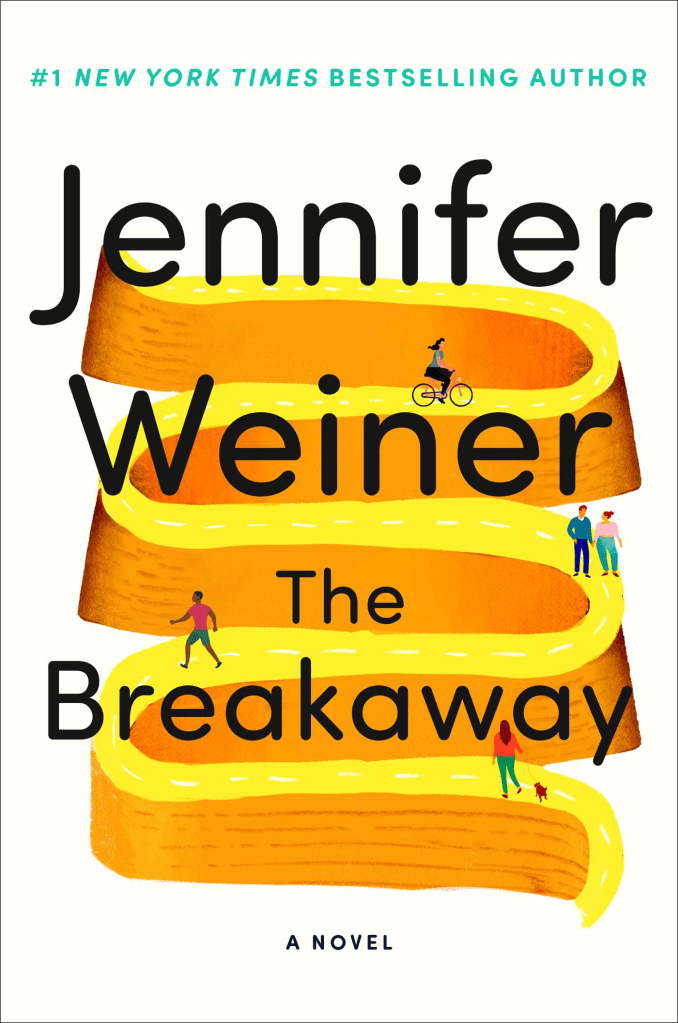
The Breakaway by Jennifer Weiner

Snarky review, cross-posted at GoodReads, incoming!

This is a Message book.

Abortion is good. It doesn’t kill a baby. The baby is not a baby. Or, it is, but if you abort it, its soul goes back to heaven and comes back to you in the next child you have. (Yes, really.)

No one should force a 15-year-old to have a baby. People who help the 15-year-old sneak behind her mom’s back to get an abortion are heroes. People at Planned Parenthood are super nice, professional, and caring, and never put pressure on the 15-year-olds or rush them through. The abortion process itself is super safe.

Blue states good, red states bad. Ohio is a red state. (Actually, it’s purple.) Pastor from red state is, of course, a televangelist and the only reason he preaches against abortion is because he doesn’t sufficiently love his daughter.

Also … we shouldn’t stop sleeping around if we want to. If you are 33 and don’t want kids yet, you can “just freeze your eggs.” Look, here are two elderly couples who have been spouse-sharing for 30 years and it hasn’t wrecked their friendships and no one has gotten jealous and they’re perfectly happy!

This other guy is extremely promiscuous, but that’s only a problem because it’s part of toxic masculinity, and he isn’t being self-reflective enough. This habit in no way damages his ability to want just one woman and be faithful to her when he decides to do so. He also doesn’t have an STD.

Jennifer Weiner always writes spunky, usually plus-sized female heroines who realize they have been wrong about the thinner woman they judged, whether it was their mom or their college roommate or their sister. This might lead you to think her books are cozy or relatable. Or that they actually contain life wisdom of some kind. In fact, they’re extremely radical.

And, when the heroine starts healing and growing as a person, here’s what it sounds like:


She couldn’t stop herself from thinking about him, but she didn’t let herself call or text. For the first month, she crossed each day off her calendar, getting through them hour by hour. She started a gratitude journal and a skin-care routine.

ibid, p. 372

I mean, this is just sad.

I’m giving this three stars because, as always with Weiner, the writing is really good and compulsively readable. I stuck around and finished the book for the romance. Actually, the fact that Weiner’s writing and characterization are so good make this book that much more of a menace. If you read without paying attention, you could come out of this thinking that abortion, spouse sharing, and freezing your eggs are No Big Deal, and that by getting girls secret abortions and starting a gratitude journal you can save your own soul.

Semi-Relatable Rant of the Week

Perhaps no man has ever troubled to imagine how strange his life would appear to himself if it were unrelentingly assessed in terms of his maleness … if he were compelled to regard himself, not as a member of society, but as a virile member of society. … His newspaper would assist him with a “Men’s Corner,” telling him how, by the expenditure of a good deal of money and a couple of hours a day, he could attract the girls and retain his wife’s affection … He would be edified by solemn discussions about “Should Men Serve in Drapery Establishments?” and acrimonious ones about “Tea-Drinking Men”; and by irritable correspondence about men who expose their anatomy on beaches (so masculine of them), conceal it in dressing-gowns (too feminine of them), think about nothing but women, pretend an unnatural indifference to women, exploit their sex to get jobs, lower the tone of the office by their sexless appearance, and generally fail to please a public opinion which demands the incompatible.

Dorothy Sayers, Are Women Human?, 1938

Heh heh heh. Oh my. I have a number of thoughts about this.

Some of this seems to me to reflect a society that was, for the first time, dealing with a big influx of women into the public workplace, and did not quite know how to handle the new workplace dynamics this created. This was a problem unique to Sayers’ age. Now, we tend to fall into the other ditch, insisting that men and women are exactly the same and should be treated as completely interchangeable, which does not prepare us well for those many ways in which we aren’t.

But part of this rant, particularly the part about how women can’t seem to wear anything without attracting criticism from some quarter, remains relevant, because it is an outworking of a human universal, to wit: a grown woman stands out, in public, in a way that a man doesn’t.

It took me an embarrassingly long time to figure this out, so I would go around doing what I thought of as “normal person” activities, not realizing that when I, a woman, did them, it came off looking as if I was (at best) trying to attract attention.

I also could not wear “normal person” clothes.

Deborah Tannen has pointed out that there is no “neutral” outfit for a woman. Whatever she chooses to wear will be seen as a choice, and an image she is trying to cast.

It’s easy to be annoyed this by (Dorothy Sayers was!), but as I put more thought into this, I realize that we might as well be annoyed by the fact that people notice loud noises or color contrasts, or that they get grumpy when they’re hungry. It’s a fact of life, nobody’s fault, that we all have to work with. Us ladies need to realize that, whatever we do (or, especially, wear), we will stand out, and adjust accordingly.

Thanks to my cute little sister for helping me think through this.

Another Great Character Description

In spite of the mask and theatre hat he wore, I could see at once that Kenn Gifford was exceptional-looking; not handsome, quite the opposite in fact, but striking all the same. The skin I could see above the mask was fair, the type that reveals blood vessels beneath it and looks permanently pink after a certain age. He hadn’t reached that age yet, but the theatre was hot and his colour was high. His eyes were small and deep set, hardly visible from a distance and of an indeterminate colour, even close up. They weren’t blue or brown or green or hazel. Dark rather than light; grey perhaps came the closest, and yet I didn’t look at him and think, grey eyes. Large, half-moon shadows lay beneath them.

Sacrifice, by S.J. Bolton, pp. 23 – 24

How to Keep House while Drowning: A Book Review

I picked this up in the new-to-us section of the public library. This is a really well-chosen title, really lets you know what you are getting.

From the back:

If you’re struggling to stay on top of your to-do list, you probably have a good reason: anxiety, fatigue, depression, ADHD, or lack of support. For therapist KC Davis, the birth of her second child triggered a stress-mess cycle: the more behind she felt, the less motivated she was to start. …

Inside, you’ll learn to: See chores as a kindness to your future self, not a as rejection of your self-worth; Start by setting priorities; Stagger tasks so you won’t procrastinate; Clean in quick bursts within your existing daily routines; Use creative shortcuts to transform a room from messy to functional.

With KC’s help, your home will feel like a sanctuary again. It will become a place to rest, even when things aren’t finished.

I really wish that I had written this book, or that it had been written by Allie Beth Stuckey. This book, or a version of it, needs to be written by someone who understands human sin nature, grace, and the freedom that is found in Christ Jesus. It’s so, so close, but because of the author’s wokeness, there are jarring notes.

The Practical

To some, this book might sound as if it was written by a sloppy, disorganized person, to sloppy, disorganized people, to help them justify their sloppiness. On the contrary, it was written by a naturally distractible person, to distractible people, to help them achieve the level of organization that they actually want to, without letting the perfect become the enemy of the good.

KC went through rehab as a teenager. She has ADHD, is married with two small children, and is a therapist, which means that people talk to her about their frustrations with themselves and their inability to get their houses in order.

Consequently, the intended audience for this book is people who are responsible for keeping house, but have some major obstacle such as chronic pain, being in the midst of grieving, ADHD, depression, or having “issues” around cleaning due to the way they were raised … or all of the above. The goal is to help these people develop strategies to get over the mental (and sometimes physical) blocks so they can maintain their houses in basic livability. And I am there for it!

People in these situations might not have the time, energy, or attention span for a long book, so this little gem is written in short chapters, each of which gets right to the point. To accommodate people who might be very literal-minded (such as those on the autism spectrum), KC re-states all figurative language very literally. For example: “We are going to flex our motivation muscle” becomes “We are going to practice this skill until we get good at it.”

While I don’t believe that ADHD is a literal, physical brain disease, nor that it should be treated with drugs, I do believe that what we call ADHD is a good description of how some people’s minds, bodies, and sensory-processing work. And while I’ve never been diagnosed with ADHD (and have no desire to), their descriptions of how their minds work, and the strategies they use to get things done, usually sound so familiar and relatable that I find myself asking, “Doesn’t everyone experience that?” So, I could probably get a diagnosis if I wanted to. I just don’t think it would help me. I’m an older person and I’ve learned how to set up systems that work for me.

With that in mind, many of the aphorisms and strategies that KC presents here, are ones that I’ve come to myself, over years of keeping house, in season and out of season, through small children, international moves, unemployment, depression, the lot. Things like this:

  • “I have a responsibility to make sure my family always have clean clothes. I don’t have a responsibility to make sure that they never have dirty clothes.”
  • Any cleaning is better than no cleaning.
  • Better a less efficient method or system that you can actually do, than a perfect system that never gets done.
  • Doing “closing chores” the night before is a favor to your future self.
  • Most people don’t have a motivation problem (since they do actually want to be able to do the task and enjoy the clean result). Instead, they have a task-initiation problem.
  • And the like.

The Spiritual

Of course, there is not a firm frontier between the practical and the spiritual in our everyday lives. As Solzhenitsyn has said, the line between good and evil runs “through every human heart.” Which means that, even as we face mundane choices like do I do the dishes, the laundry, or take a nap, we are interacting with issues of bondage to sin versus freedom, and grace versus shame. So it’s not really possible to talk about practical things like task initiation without also addressing the spiritual.

KC does a pretty good job of this in her book. She starts out by saying (page 11), and this is in bold, “Care tasks are morally neutral. Being good or bad at them has nothing to do with being a good person, parent, man, woman, spouse, friend. Literally nothing. You are not a failure because you can’t keep up with laundry. Laundry is morally neutral.”

Now, since I can hear howls of objection, let me address this. What she is trying to express here, is that shame does not energize people. It paralyzes them.

Yes, moms do have a duty to keep on top of the laundry cycle and yes, (contra KC Davis), there IS such a thing as laziness, and laziness IS sinful.

But when it comes to “care tasks,” many people (most people?) grew up being shamed not for character flaws such as laziness, but for lack of technical skills in the tasks, for not doing them up to an adult’s standard, for not doing them perfectly, or for not knowing where to start. Consequently, many (most?) people have a huge burden of shame and failure around household tasks. And this burden of shame, and this perfectionism, makes it much, much more difficult to get these tasks accomplished (or in some cases even started). See? KC is not saying, “Let’s get rid of the shame because it is 100% OK to never clean your kitchen.” She is saying, “Let’s get rid of the shame associated with these tasks because only then will you be able to do them.”

In other words, KC in her self-examination and her work as a therapist has stumbled upon that biblical truth: “the law kills, but the Spirit gives life.” The only people who are free to act and move in this world are those who are not paralyzed by shame.

It’s at this point that I wish this book had been written by a Christian, because this point really deserves to be developed further. How does one set others free from shame? Certainly, if people have indeed been shamed over things that are morally neutral (such as being slow at doing chores, or doing the dishes a different way than your parent), then this needs to be clarified. But this is not enough, because not all our shame is spurious. We actually are sinners, and we actually do know it. It is not enough to say, as KC says, “I don’t think there is any such thing as laziness.” Even when we have gotten rid of the spurious shame over morally neutral things like being naturally untidy, even if your particular client is not actually lazy … what about the other shame? What are we going to do about that?

In other words, the only way that people can truly be set free from shame is when they turn to Jesus, the living Christ, who alone has the power to free us from shame, so that we can “do the good works that He prepared in advance for us to do.” I think Allie Beth Stuckey could do a lot with this. In fact, I’d love it if she were to have KC Davis on her podcast.

But then, she proceeds to shoot herself in the foot

The other problem I have with this book is as follows. For the most part, KC does a great job of being gentle with her readers and treating them like responsible human beings. But every so often, she turns around and sucker-punches them with identity politics.

Many self-help gurus overattribute their success to their own hard work without any regard to the physical, mental, or economic privileges they hold. You can see this when a thin, white, rich self-help influencer posts “Choose Joy” on her Instagram with a caption that tells us all joy is a choice. Her belief that the decision to be a positive person was the key to her joyful life reveals she really does not grasp just how much of her success is due to privileges beyond her control.

pp. 14 – 16

It’s hard to know where to start with this paragraph. Does KC really think that a “thin, rich, white influencer” posts “Choose Joy” because she is already joyful? That such people have no insecurities or struggles? That all that is necessary for joy is having circumstances line up in your life such that you avoid three major conditions which the Identity Crowd considers to be disadvantages? This is so dehumanizing as to beggar belief. 

I’m not saying “Choose Joy” is advice that would be helpful to anyone, really, but I at least recognize that most people who say things like “Choose Joy” obviously mean “Choose joy in spite of all the awful things that are happening in your life.” If people are happy, at peace, and free from shame or struggle, they don’t go around saying stuff like “choose joy.” And based on the practical wisdom in the rest of her book, I think KC actually knows this. But, blinded by identity politics, she considers it OK to lay aside what she knows and take a swipe at some of her readers in a misguided attempt to build up others of her readers. Unfortunately, this undercuts her message that she doesn’t want to shame anyone. You see, this book is not for you if you are rich, thin, or especially, white. And as we know, those always go together.

In the very next paragraph, KC says what she was actually trying to say, but in a much more sane and humane way, namely that different things work for different people:

Different people struggle differently — and privilege isn’t the only difference. Someone might find a way to meal plan, or exercise, or organize their pantry that revolutionizes their life. But the solutions that work for them are highly dependent on only their unique barriers but also their strengths, personality, and interests.

p. 16

Really, that paragraph would have been sufficient, excepting the word privilege. I do wish people would stop using the word privilege — which is a legal term — when what they actually mean is “advantage.” But that’s a rant for another day.

A Gnome Love Story

First, I have to explain why we are doing this gimmick with gnomes and not some other creature.

My mom used to have this little pair of porcelain statues that she kept in her china cupboard. You may have seen this type of thing before. They were shaped like a little Dutch boy and girl in stylized traditional costume, and they were both leaning forward adorably with their eyes closed. You were supposed to position them facing each other so that they appeared to be kissing …. which, of course, Mom always did.

I didn’t think much of these figures when I was younger. I took them for granted, as one does. They were readily available in Holland, Michigan, near where we lived.

But this year, as I was reviewing Mary Harrington’s book and thinking about the Prov. 31 woman, it occurred to me that those little figures were teaching us a profound lesson. I thought I would like to photograph them for a blog post.

But alas, the Dutch boy and girl were either in storage, or lost.

The next step was to buy a similar pair of my own. It was around Thanksgiving, so I thought the home decor store might have such a set. Boy and girl Pilgrim? Boy and girl Indian?

Long story short, the closest I could get was football-fan gnomes.

This isn’t a complete disaster. I like gnomes, and Mr. Mugrage and I are now football fans (though these gnomes are not wearing the colors of our sons’ team).

But anyway, if you find kissing boy-and-girl sculptures (especially Dutch ones), please send them to me. In the meantime, Mr. and Mrs. Gnome will do nicely for our illustration of a matching set.

You see … this is not patriarchy. A man by himself cannot be a patriarch.

And this … is not matriarchy. A woman by herself cannot be a matriarch.

You see, term “patriarch” OR “matriarch” implies the existence of a household. It implies that the “-arch” has had children and possibly grandchildren with a member of the opposite sex (hence the patr- or matr- part), to whom they are married, and with whom they are now ruling over this household (hence the -arch part), seeing that it prospers. This situation is simply not possible without either the mom or the dad. If the dad is a patriarch in the true sense of the term, then he has a matriarch beside him, and as the -arch implies, she is receiving just as much honor in her motherly role as is he in his fatherly one.

See, like this:

What those little kissing Dutch figures were trying to tell us is that patriarchs and matriarchs are a matching set.

Happy Valentine’s Day to all you gnomes out there!

How to Date Like a Normal Person

How the train wreck first happened

Once upon a time, in the 1950s, dating just meant “going on a date.” It was a very short-term commitment, lasting only a few hours. You went out for ice cream or whatever, and then you went home. If you couldn’t stand the person, there was a natural limit to how long to you had to spend with them (the length of the date). If you liked each other, you might go on another date some time. But you were not bound to go on date after date with the same person. The idea was to go out with a variety of people, to get a sense of what sort of person might be for you. Eventually, you might “go steady” with a person you really liked, and maybe eventually get married.

But then … the Sexual Revolution happened. The expectation that a date might mean actually having sex was introduced. Suddenly, dating a variety of people made less sense. It clashed with the old-fashioned sexual mores (and with common sense) that said it wasn’t good to sleep around. Now, “going steady” with one person became the norm, and people who dated around were seen in a negative light. After all, if you were going to be sexually involved with somebody, it had better be with just one person at a time.

Futhermore, because this was a big societal shift, now nobody knew what the rules were. On the part of some of the drivers of the sexual revolution, this was intentional. They thought that society, rules, and norms as such were inherently oppressive, and that getting rid of all these things would usher in a hippie, free-love paradise. What it actually ushered in was total confusion. And while total confusion might work to the advantage of a few libertines who want to live completely unrestricted, it stresses out regular people (especially young people) who just want to know what they are supposed to do.

This confusion has persisted from my generation (X) down to the present day. It creates endless amounts of frustration, misunderstanding, and wheel-spinning as generation after generation struggles to re-invent the wheel. It also creates lots of tension and hostility between the sexes, because as it turns out, the way men naturally approach things and the way women do, do not mesh terribly well when completely unguided by any kind of norm.

The secondary car crash, caused by the train wreck

Christians, naturally, had their own reactions to all of this. We looked at modern dating, which could mean getting very sexually involved as a teen, cohabiting as a young adult, and so on, clapped our palms to our cheeks, and went “AAAAAG! This is not right!” Nor were we wrong. When I was growing up, in the 90s, the choice seemed to be between trying to do the highly risky methods of modern dating – but hopefully in such a way that you didn’t have sex before marriage, although that was kind of a crapshoot to be honest – or taking the sensible course and not dating at all. I, and many other Christians, went for the latter, but this left us without any path to get to know the opposite sex or find a suitable spouse.

Some Christian communities decided that the solution to all this confusion was “courtship” — or, as some called it, “biblical courtship.” One of the early advocates of this system was Douglas Wilson, a pastor and writer for whom I still have great deal of respect. Courtship seemed to a lot of people, myself included, like a godly alternative to the train wreck we were witnessing. Unfortunately, in an effort to avoid the train, the courtship car drove directly into the other ditch, into a wreck that was equally fiery. That’s what Thomas Umstattd Jr.’s book is about.

Components of Courtship

As older Gen Xers, my now-husband and I dodged a bullet on this one. We had both read some Douglas Wilson and we both saw the problems with modern dating since the 60s, and so when we met and realized we kinda liked each other, we wanted to do some kind of courtship. However, both of us were adults, out of the house, and living hundreds of miles away from our parents. I had gone to university, then lived with my parents again for a year while working so I could go to missions school. My husband, almost a decade older, had been to university, grad school, and had lived in various countries overseas. So, we were fully launched. Still, we tried to “court.” My husband e-mailed my dad (yes, e-mailed) and asked for permission to date me. I called my dad and said, “Aren’t you going to ask me what I think?” and he said, “Well, I assume you like him?”

In our case, “courtship” ended up meaning little more than meeting each other’s parents, getting to know them, and showing them honor as we prepared for marriage. And that’s certainly not a bad thing. But it’s very different from how it was implemented in some Christian communities, where the parents were hard-core.

When I write about courtship online, defining courtship often becomes the most controversial point in the comments. I believe that the lack of clear definition may be contributing to the crisis.

Each community feels that its form of courtship is superior to the others. Many feel that any problem pointed out in Modern Courtship as a whole doesn’t apply to them.

Umstattd, p. 53

As such, Umstattd describes courtship with a list of common characteristics:

  • Modern Courtship is exclusive (only court one person at a time – not like 1950s dating)
  • Courtship is explicitly “for the purpose of marriage.” “This kind of thinking leads to unintended consequences. Offering to take a girl out for ice cream is tantamount to asking for her hand in marriage. Awkward!” (p. 54)
  • Courtship requires parental approval. “Modern Courtship gives parents the right to veto any relationship. In essence, they have only a very definitive no vote. The more people in the relationship with a no button in front of them, the higher the likelihood that one of them will press it. The result is that fewer people get married.” (p. 56 – 57)
  • Courtship requires high accountability. “The courtship trend of high accountability at the beginning of the relationship and lower accountability as the couple moves towards marriage is exactly backward. First dates are awkward enough without a third wheel sitting there not talking — or worse, not shutting up.” (p. 58)
  • Courtship comes packed with purity rules. “‘The problem,’ [one man] said, ‘was that we were so accountable, we never had a moment to get to know each other. Sure, we didn’t have physical temptation, but we also didn’t have quality social interaction. After we got married, I felt like I’d married a stranger.'” (p. 59)
  • Courtship is intentional and intense. “Greater intensity leads to greater awkwardness. There is a lot to be said for slowing down and reducing the intensity.” (p. 62)
  • Courtship requires marital readiness. Most people do not feel ready to get married when they are young. They worry about finances, or about finding or being the perfect person. But a good model is to get married young. Most people will never feel ready.

These bullet points are taken from pages 53 to 64 of the book.

Uh oh, we turned the dial the wrong way!

Getting too serious too soon is a problem that Modern Dating and Modern Courtship share. Both of these systems result in singles going through one committed, heartbreaking relationship after another. They differ only in frequency and style of intensity. Modern Dating is more physically intense, while Modern Courtship of often more emotionally intense. Going steady too soon is one of the leading causes of unnecessary heartbreak for young people.

ibid, p. 88

In other words, the courtship crowd, in an effort to fix the inappropriate sexual involvement of modern dating, turned the dial in exactly the wrong direction: in the direction of more intensity, not less! This leads to more heartbreak, not less. That, if I had to sum it up, is the thesis of this book. 

Umstattd goes into some detail about additional problems, one of which is the enormous amount of leverage that the courtship system gives to overprotective dads. The result is young men who are never allowed even to take a young woman out for coffee, and consequently feel like failures, and young women who feel unattractive, unaware that there are many young men who would like to date her, but her dad has been screening them out without even telling her.

How to date like a normal person

The [Christian] Baby Boomers created the rules of courtship out of fear. They wanted to protect their children from the mistakes they made during the Sexual Revolution and its aftermath. The rules came from good intentions.

During the 1990s and early 2000s, millions of young people embraced the tenets of courtship in part or in whole. And it’s no wonder why — in a culture where we demonized dating, and divorce ran rampant, Modern Courtship seemed like the only alternative.

Many of those young people are still single today, but they don’t have to be.

If you’re one of the millions of frustrated singles, there’s hope for you: there’s an easier path to marriage that’s more fun and still honors God.

If we want to get back to the marriage rates of our grandparents, we need to learn from them and adopt their approach. It’s my hope that the Traditional Dating practiced by our grandparents will be part of the solution to resolving the Courtship Crisis.

Umstattd, p. 68

In other words, according to Umstattd, the way to date like a normal person is to date the way your grandmother (or maybe now, great-grandmother) would have: don’t go out with the same fellow twice, and be home by ten.

I really wish this had been the system when I was growing up. Courtship wasn’t really a thing in my circles, so we were left, as I said, with Sexual Revolution or Nothing. Or Make It Up As You Go. Consequently, although not scarred by purity culture or courtship, I was one of those women who felt unwanted and never got asked out … and was afraid to say yes on the rare occasions when I was.

I would like my kids to be able to enjoy the practice of Traditional Dating. However, there’s a problem. Traditional Dating, like any society- or community-wide custom, depends upon everybody knowing the rules. Everybody does not know the rules. In my observation, most Zoomers still have the expectation that once a boy and girl go out or hang out once, they are “a couple” until further notice (whether that means they are sexually involved or not), and would have to “break up” if they wanted to go out with someone else. I’d like to take this pressure off our kids. But, as with so many cultural rebuilding tasks, it looks as if we are going to have to do this the hard way. Which means doing it on a case-by-case basis, with parents of Christian young people talking to one another about norms and expectations.

I would really love it if the parents of all the young women my sons know would read this book.

One Last Disclaimer

A major goal of the courtship trend, as well as purity culture (“guard your heart!”) was to avoid heartbreak. And yes, there is a large amount of totally unnecessary heartbreak that the sexual revolution had brought to those who faithfully practices its tenets. (Idols always devour their worshippers.) I absolutely agree that it ought to be possible to live in this world without throwing your heart and body out into the arena, going out and collecting heartbreak after heartbreak, trauma after frustrating and degrading trauma.

However, that doesn’t mean that it’s possible to go from being a kid to being a married adult without ever getting your heart broke.

Being a teenager is rough in every society. You feel things more intensely. Finding a wife or husband is a challenge in every society. Most people are going to have some near misses.

In other words, no system, certainly not courtship but also not Traditional Dating, guarantees protection from living in a fallen world. And no system, however wise, guarantees every person a smooth, easy path to marriage.

When applying Scripture, particularly the Old Testament, we have to differentiate between biblical practice, principle, and command. Just because Jacob had two wives and a seven-year engagement doesn’t mean that God wants all men to have two wives and seven-year engagements.

What we have in the Old Testament are a lot of stories: each one different from the others.

Sometimes a woman is the protagonist in a romance (such as Ruth with Boaz) and at other times the man takes the lead (like Jacob with Rachel). There are arranged marriages (Isaac and Rebekah) and women who entered marriage through a harem (David and Abigail, Michal, and Bathsheba). Some women even chose their own husbands (Zelophehad’s daughters).

The Bible is surprisingly quiet when it comes to laying out a system of courtship. In fact, Jesus even qualified the Old Testament marriage laws when He said the divorce code was written because of the hardness of Israel’s hearts (Matt. 19:8).

The Apostle Paul, who is usually very direct, speaks with all kinds of qualifiers when talking about romantic relationships. He makes a special point to say that not all of his instructions are from the Lord in I Corinthians 7:25 – 28. I can’t think of another topic where Paul is this cautious with his words.

Could it be that God expects courtship systems to reflect the culture of the folks getting married?

What we need is a system to help young people make good decisions.

Umstattd, pp. 65 – 67