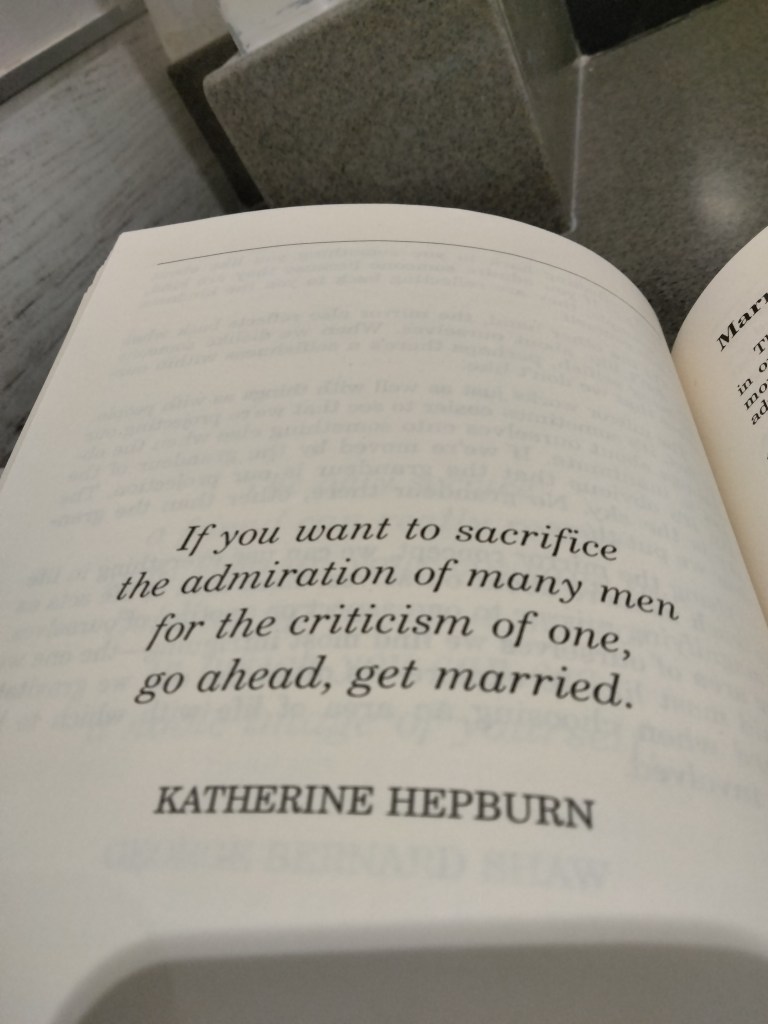
In spite of the mask and theatre hat he wore, I could see at once that Kenn Gifford was exceptional-looking; not handsome, quite the opposite in fact, but striking all the same. The skin I could see above the mask was fair, the type that reveals blood vessels beneath it and looks permanently pink after a certain age. He hadn’t reached that age yet, but the theatre was hot and his colour was high. His eyes were small and deep set, hardly visible from a distance and of an indeterminate colour, even close up. They weren’t blue or brown or green or hazel. Dark rather than light; grey perhaps came the closest, and yet I didn’t look at him and think, grey eyes. Large, half-moon shadows lay beneath them.
Sacrifice, by S.J. Bolton, pp. 23 – 24
Tag: the sexes
How to Keep House while Drowning: A Book Review

I picked this up in the new-to-us section of the public library. This is a really well-chosen title, really lets you know what you are getting.
From the back:
If you’re struggling to stay on top of your to-do list, you probably have a good reason: anxiety, fatigue, depression, ADHD, or lack of support. For therapist KC Davis, the birth of her second child triggered a stress-mess cycle: the more behind she felt, the less motivated she was to start. …
Inside, you’ll learn to: See chores as a kindness to your future self, not a as rejection of your self-worth; Start by setting priorities; Stagger tasks so you won’t procrastinate; Clean in quick bursts within your existing daily routines; Use creative shortcuts to transform a room from messy to functional.
With KC’s help, your home will feel like a sanctuary again. It will become a place to rest, even when things aren’t finished.
I really wish that I had written this book, or that it had been written by Allie Beth Stuckey. This book, or a version of it, needs to be written by someone who understands human sin nature, grace, and the freedom that is found in Christ Jesus. It’s so, so close, but because of the author’s wokeness, there are jarring notes.
The Practical
To some, this book might sound as if it was written by a sloppy, disorganized person, to sloppy, disorganized people, to help them justify their sloppiness. On the contrary, it was written by a naturally distractible person, to distractible people, to help them achieve the level of organization that they actually want to, without letting the perfect become the enemy of the good.
KC went through rehab as a teenager. She has ADHD, is married with two small children, and is a therapist, which means that people talk to her about their frustrations with themselves and their inability to get their houses in order.
Consequently, the intended audience for this book is people who are responsible for keeping house, but have some major obstacle such as chronic pain, being in the midst of grieving, ADHD, depression, or having “issues” around cleaning due to the way they were raised … or all of the above. The goal is to help these people develop strategies to get over the mental (and sometimes physical) blocks so they can maintain their houses in basic livability. And I am there for it!
People in these situations might not have the time, energy, or attention span for a long book, so this little gem is written in short chapters, each of which gets right to the point. To accommodate people who might be very literal-minded (such as those on the autism spectrum), KC re-states all figurative language very literally. For example: “We are going to flex our motivation muscle” becomes “We are going to practice this skill until we get good at it.”
While I don’t believe that ADHD is a literal, physical brain disease, nor that it should be treated with drugs, I do believe that what we call ADHD is a good description of how some people’s minds, bodies, and sensory-processing work. And while I’ve never been diagnosed with ADHD (and have no desire to), their descriptions of how their minds work, and the strategies they use to get things done, usually sound so familiar and relatable that I find myself asking, “Doesn’t everyone experience that?” So, I could probably get a diagnosis if I wanted to. I just don’t think it would help me. I’m an older person and I’ve learned how to set up systems that work for me.
With that in mind, many of the aphorisms and strategies that KC presents here, are ones that I’ve come to myself, over years of keeping house, in season and out of season, through small children, international moves, unemployment, depression, the lot. Things like this:
- “I have a responsibility to make sure my family always have clean clothes. I don’t have a responsibility to make sure that they never have dirty clothes.”
- Any cleaning is better than no cleaning.
- Better a less efficient method or system that you can actually do, than a perfect system that never gets done.
- Doing “closing chores” the night before is a favor to your future self.
- Most people don’t have a motivation problem (since they do actually want to be able to do the task and enjoy the clean result). Instead, they have a task-initiation problem.
- And the like.
The Spiritual
Of course, there is not a firm frontier between the practical and the spiritual in our everyday lives. As Solzhenitsyn has said, the line between good and evil runs “through every human heart.” Which means that, even as we face mundane choices like do I do the dishes, the laundry, or take a nap, we are interacting with issues of bondage to sin versus freedom, and grace versus shame. So it’s not really possible to talk about practical things like task initiation without also addressing the spiritual.
KC does a pretty good job of this in her book. She starts out by saying (page 11), and this is in bold, “Care tasks are morally neutral. Being good or bad at them has nothing to do with being a good person, parent, man, woman, spouse, friend. Literally nothing. You are not a failure because you can’t keep up with laundry. Laundry is morally neutral.”
Now, since I can hear howls of objection, let me address this. What she is trying to express here, is that shame does not energize people. It paralyzes them.
Yes, moms do have a duty to keep on top of the laundry cycle and yes, (contra KC Davis), there IS such a thing as laziness, and laziness IS sinful.
But when it comes to “care tasks,” many people (most people?) grew up being shamed not for character flaws such as laziness, but for lack of technical skills in the tasks, for not doing them up to an adult’s standard, for not doing them perfectly, or for not knowing where to start. Consequently, many (most?) people have a huge burden of shame and failure around household tasks. And this burden of shame, and this perfectionism, makes it much, much more difficult to get these tasks accomplished (or in some cases even started). See? KC is not saying, “Let’s get rid of the shame because it is 100% OK to never clean your kitchen.” She is saying, “Let’s get rid of the shame associated with these tasks because only then will you be able to do them.”
In other words, KC in her self-examination and her work as a therapist has stumbled upon that biblical truth: “the law kills, but the Spirit gives life.” The only people who are free to act and move in this world are those who are not paralyzed by shame.
It’s at this point that I wish this book had been written by a Christian, because this point really deserves to be developed further. How does one set others free from shame? Certainly, if people have indeed been shamed over things that are morally neutral (such as being slow at doing chores, or doing the dishes a different way than your parent), then this needs to be clarified. But this is not enough, because not all our shame is spurious. We actually are sinners, and we actually do know it. It is not enough to say, as KC says, “I don’t think there is any such thing as laziness.” Even when we have gotten rid of the spurious shame over morally neutral things like being naturally untidy, even if your particular client is not actually lazy … what about the other shame? What are we going to do about that?
In other words, the only way that people can truly be set free from shame is when they turn to Jesus, the living Christ, who alone has the power to free us from shame, so that we can “do the good works that He prepared in advance for us to do.” I think Allie Beth Stuckey could do a lot with this. In fact, I’d love it if she were to have KC Davis on her podcast.
But then, she proceeds to shoot herself in the foot
The other problem I have with this book is as follows. For the most part, KC does a great job of being gentle with her readers and treating them like responsible human beings. But every so often, she turns around and sucker-punches them with identity politics.
Many self-help gurus overattribute their success to their own hard work without any regard to the physical, mental, or economic privileges they hold. You can see this when a thin, white, rich self-help influencer posts “Choose Joy” on her Instagram with a caption that tells us all joy is a choice. Her belief that the decision to be a positive person was the key to her joyful life reveals she really does not grasp just how much of her success is due to privileges beyond her control.
pp. 14 – 16
It’s hard to know where to start with this paragraph. Does KC really think that a “thin, rich, white influencer” posts “Choose Joy” because she is already joyful? That such people have no insecurities or struggles? That all that is necessary for joy is having circumstances line up in your life such that you avoid three major conditions which the Identity Crowd considers to be disadvantages? This is so dehumanizing as to beggar belief.
I’m not saying “Choose Joy” is advice that would be helpful to anyone, really, but I at least recognize that most people who say things like “Choose Joy” obviously mean “Choose joy in spite of all the awful things that are happening in your life.” If people are happy, at peace, and free from shame or struggle, they don’t go around saying stuff like “choose joy.” And based on the practical wisdom in the rest of her book, I think KC actually knows this. But, blinded by identity politics, she considers it OK to lay aside what she knows and take a swipe at some of her readers in a misguided attempt to build up others of her readers. Unfortunately, this undercuts her message that she doesn’t want to shame anyone. You see, this book is not for you if you are rich, thin, or especially, white. And as we know, those always go together.
In the very next paragraph, KC says what she was actually trying to say, but in a much more sane and humane way, namely that different things work for different people:
Different people struggle differently — and privilege isn’t the only difference. Someone might find a way to meal plan, or exercise, or organize their pantry that revolutionizes their life. But the solutions that work for them are highly dependent on only their unique barriers but also their strengths, personality, and interests.
p. 16
Really, that paragraph would have been sufficient, excepting the word privilege. I do wish people would stop using the word privilege — which is a legal term — when what they actually mean is “advantage.” But that’s a rant for another day.
A Gnome Love Story

First, I have to explain why we are doing this gimmick with gnomes and not some other creature.
My mom used to have this little pair of porcelain statues that she kept in her china cupboard. You may have seen this type of thing before. They were shaped like a little Dutch boy and girl in stylized traditional costume, and they were both leaning forward adorably with their eyes closed. You were supposed to position them facing each other so that they appeared to be kissing …. which, of course, Mom always did.
I didn’t think much of these figures when I was younger. I took them for granted, as one does. They were readily available in Holland, Michigan, near where we lived.
But this year, as I was reviewing Mary Harrington’s book and thinking about the Prov. 31 woman, it occurred to me that those little figures were teaching us a profound lesson. I thought I would like to photograph them for a blog post.
But alas, the Dutch boy and girl were either in storage, or lost.
The next step was to buy a similar pair of my own. It was around Thanksgiving, so I thought the home decor store might have such a set. Boy and girl Pilgrim? Boy and girl Indian?
Long story short, the closest I could get was football-fan gnomes.
This isn’t a complete disaster. I like gnomes, and Mr. Mugrage and I are now football fans (though these gnomes are not wearing the colors of our sons’ team).
But anyway, if you find kissing boy-and-girl sculptures (especially Dutch ones), please send them to me. In the meantime, Mr. and Mrs. Gnome will do nicely for our illustration of a matching set.

You see … this is not patriarchy. A man by himself cannot be a patriarch.

And this … is not matriarchy. A woman by herself cannot be a matriarch.
You see, term “patriarch” OR “matriarch” implies the existence of a household. It implies that the “-arch” has had children and possibly grandchildren with a member of the opposite sex (hence the patr- or matr- part), to whom they are married, and with whom they are now ruling over this household (hence the -arch part), seeing that it prospers. This situation is simply not possible without either the mom or the dad. If the dad is a patriarch in the true sense of the term, then he has a matriarch beside him, and as the -arch implies, she is receiving just as much honor in her motherly role as is he in his fatherly one.
See, like this:

What those little kissing Dutch figures were trying to tell us is that patriarchs and matriarchs are a matching set.
Happy Valentine’s Day to all you gnomes out there!
How to Date Like a Normal Person

How the train wreck first happened
Once upon a time, in the 1950s, dating just meant “going on a date.” It was a very short-term commitment, lasting only a few hours. You went out for ice cream or whatever, and then you went home. If you couldn’t stand the person, there was a natural limit to how long to you had to spend with them (the length of the date). If you liked each other, you might go on another date some time. But you were not bound to go on date after date with the same person. The idea was to go out with a variety of people, to get a sense of what sort of person might be for you. Eventually, you might “go steady” with a person you really liked, and maybe eventually get married.
But then … the Sexual Revolution happened. The expectation that a date might mean actually having sex was introduced. Suddenly, dating a variety of people made less sense. It clashed with the old-fashioned sexual mores (and with common sense) that said it wasn’t good to sleep around. Now, “going steady” with one person became the norm, and people who dated around were seen in a negative light. After all, if you were going to be sexually involved with somebody, it had better be with just one person at a time.
Futhermore, because this was a big societal shift, now nobody knew what the rules were. On the part of some of the drivers of the sexual revolution, this was intentional. They thought that society, rules, and norms as such were inherently oppressive, and that getting rid of all these things would usher in a hippie, free-love paradise. What it actually ushered in was total confusion. And while total confusion might work to the advantage of a few libertines who want to live completely unrestricted, it stresses out regular people (especially young people) who just want to know what they are supposed to do.
This confusion has persisted from my generation (X) down to the present day. It creates endless amounts of frustration, misunderstanding, and wheel-spinning as generation after generation struggles to re-invent the wheel. It also creates lots of tension and hostility between the sexes, because as it turns out, the way men naturally approach things and the way women do, do not mesh terribly well when completely unguided by any kind of norm.
The secondary car crash, caused by the train wreck
Christians, naturally, had their own reactions to all of this. We looked at modern dating, which could mean getting very sexually involved as a teen, cohabiting as a young adult, and so on, clapped our palms to our cheeks, and went “AAAAAG! This is not right!” Nor were we wrong. When I was growing up, in the 90s, the choice seemed to be between trying to do the highly risky methods of modern dating – but hopefully in such a way that you didn’t have sex before marriage, although that was kind of a crapshoot to be honest – or taking the sensible course and not dating at all. I, and many other Christians, went for the latter, but this left us without any path to get to know the opposite sex or find a suitable spouse.
Some Christian communities decided that the solution to all this confusion was “courtship” — or, as some called it, “biblical courtship.” One of the early advocates of this system was Douglas Wilson, a pastor and writer for whom I still have great deal of respect. Courtship seemed to a lot of people, myself included, like a godly alternative to the train wreck we were witnessing. Unfortunately, in an effort to avoid the train, the courtship car drove directly into the other ditch, into a wreck that was equally fiery. That’s what Thomas Umstattd Jr.’s book is about.
Components of Courtship
As older Gen Xers, my now-husband and I dodged a bullet on this one. We had both read some Douglas Wilson and we both saw the problems with modern dating since the 60s, and so when we met and realized we kinda liked each other, we wanted to do some kind of courtship. However, both of us were adults, out of the house, and living hundreds of miles away from our parents. I had gone to university, then lived with my parents again for a year while working so I could go to missions school. My husband, almost a decade older, had been to university, grad school, and had lived in various countries overseas. So, we were fully launched. Still, we tried to “court.” My husband e-mailed my dad (yes, e-mailed) and asked for permission to date me. I called my dad and said, “Aren’t you going to ask me what I think?” and he said, “Well, I assume you like him?”
In our case, “courtship” ended up meaning little more than meeting each other’s parents, getting to know them, and showing them honor as we prepared for marriage. And that’s certainly not a bad thing. But it’s very different from how it was implemented in some Christian communities, where the parents were hard-core.
When I write about courtship online, defining courtship often becomes the most controversial point in the comments. I believe that the lack of clear definition may be contributing to the crisis.
Each community feels that its form of courtship is superior to the others. Many feel that any problem pointed out in Modern Courtship as a whole doesn’t apply to them.
Umstattd, p. 53
As such, Umstattd describes courtship with a list of common characteristics:
- Modern Courtship is exclusive (only court one person at a time – not like 1950s dating)
- Courtship is explicitly “for the purpose of marriage.” “This kind of thinking leads to unintended consequences. Offering to take a girl out for ice cream is tantamount to asking for her hand in marriage. Awkward!” (p. 54)
- Courtship requires parental approval. “Modern Courtship gives parents the right to veto any relationship. In essence, they have only a very definitive no vote. The more people in the relationship with a no button in front of them, the higher the likelihood that one of them will press it. The result is that fewer people get married.” (p. 56 – 57)
- Courtship requires high accountability. “The courtship trend of high accountability at the beginning of the relationship and lower accountability as the couple moves towards marriage is exactly backward. First dates are awkward enough without a third wheel sitting there not talking — or worse, not shutting up.” (p. 58)
- Courtship comes packed with purity rules. “‘The problem,’ [one man] said, ‘was that we were so accountable, we never had a moment to get to know each other. Sure, we didn’t have physical temptation, but we also didn’t have quality social interaction. After we got married, I felt like I’d married a stranger.'” (p. 59)
- Courtship is intentional and intense. “Greater intensity leads to greater awkwardness. There is a lot to be said for slowing down and reducing the intensity.” (p. 62)
- Courtship requires marital readiness. Most people do not feel ready to get married when they are young. They worry about finances, or about finding or being the perfect person. But a good model is to get married young. Most people will never feel ready.
These bullet points are taken from pages 53 to 64 of the book.
Uh oh, we turned the dial the wrong way!
Getting too serious too soon is a problem that Modern Dating and Modern Courtship share. Both of these systems result in singles going through one committed, heartbreaking relationship after another. They differ only in frequency and style of intensity. Modern Dating is more physically intense, while Modern Courtship of often more emotionally intense. Going steady too soon is one of the leading causes of unnecessary heartbreak for young people.
ibid, p. 88
In other words, the courtship crowd, in an effort to fix the inappropriate sexual involvement of modern dating, turned the dial in exactly the wrong direction: in the direction of more intensity, not less! This leads to more heartbreak, not less. That, if I had to sum it up, is the thesis of this book.
Umstattd goes into some detail about additional problems, one of which is the enormous amount of leverage that the courtship system gives to overprotective dads. The result is young men who are never allowed even to take a young woman out for coffee, and consequently feel like failures, and young women who feel unattractive, unaware that there are many young men who would like to date her, but her dad has been screening them out without even telling her.
How to date like a normal person
The [Christian] Baby Boomers created the rules of courtship out of fear. They wanted to protect their children from the mistakes they made during the Sexual Revolution and its aftermath. The rules came from good intentions.
During the 1990s and early 2000s, millions of young people embraced the tenets of courtship in part or in whole. And it’s no wonder why — in a culture where we demonized dating, and divorce ran rampant, Modern Courtship seemed like the only alternative.
Many of those young people are still single today, but they don’t have to be.
If you’re one of the millions of frustrated singles, there’s hope for you: there’s an easier path to marriage that’s more fun and still honors God.
If we want to get back to the marriage rates of our grandparents, we need to learn from them and adopt their approach. It’s my hope that the Traditional Dating practiced by our grandparents will be part of the solution to resolving the Courtship Crisis.
Umstattd, p. 68
In other words, according to Umstattd, the way to date like a normal person is to date the way your grandmother (or maybe now, great-grandmother) would have: don’t go out with the same fellow twice, and be home by ten.
I really wish this had been the system when I was growing up. Courtship wasn’t really a thing in my circles, so we were left, as I said, with Sexual Revolution or Nothing. Or Make It Up As You Go. Consequently, although not scarred by purity culture or courtship, I was one of those women who felt unwanted and never got asked out … and was afraid to say yes on the rare occasions when I was.
I would like my kids to be able to enjoy the practice of Traditional Dating. However, there’s a problem. Traditional Dating, like any society- or community-wide custom, depends upon everybody knowing the rules. Everybody does not know the rules. In my observation, most Zoomers still have the expectation that once a boy and girl go out or hang out once, they are “a couple” until further notice (whether that means they are sexually involved or not), and would have to “break up” if they wanted to go out with someone else. I’d like to take this pressure off our kids. But, as with so many cultural rebuilding tasks, it looks as if we are going to have to do this the hard way. Which means doing it on a case-by-case basis, with parents of Christian young people talking to one another about norms and expectations.
I would really love it if the parents of all the young women my sons know would read this book.
One Last Disclaimer
A major goal of the courtship trend, as well as purity culture (“guard your heart!”) was to avoid heartbreak. And yes, there is a large amount of totally unnecessary heartbreak that the sexual revolution had brought to those who faithfully practices its tenets. (Idols always devour their worshippers.) I absolutely agree that it ought to be possible to live in this world without throwing your heart and body out into the arena, going out and collecting heartbreak after heartbreak, trauma after frustrating and degrading trauma.
However, that doesn’t mean that it’s possible to go from being a kid to being a married adult without ever getting your heart broke.
Being a teenager is rough in every society. You feel things more intensely. Finding a wife or husband is a challenge in every society. Most people are going to have some near misses.
In other words, no system, certainly not courtship but also not Traditional Dating, guarantees protection from living in a fallen world. And no system, however wise, guarantees every person a smooth, easy path to marriage.
When applying Scripture, particularly the Old Testament, we have to differentiate between biblical practice, principle, and command. Just because Jacob had two wives and a seven-year engagement doesn’t mean that God wants all men to have two wives and seven-year engagements.
What we have in the Old Testament are a lot of stories: each one different from the others.
Sometimes a woman is the protagonist in a romance (such as Ruth with Boaz) and at other times the man takes the lead (like Jacob with Rachel). There are arranged marriages (Isaac and Rebekah) and women who entered marriage through a harem (David and Abigail, Michal, and Bathsheba). Some women even chose their own husbands (Zelophehad’s daughters).
The Bible is surprisingly quiet when it comes to laying out a system of courtship. In fact, Jesus even qualified the Old Testament marriage laws when He said the divorce code was written because of the hardness of Israel’s hearts (Matt. 19:8).
The Apostle Paul, who is usually very direct, speaks with all kinds of qualifiers when talking about romantic relationships. He makes a special point to say that not all of his instructions are from the Lord in I Corinthians 7:25 – 28. I can’t think of another topic where Paul is this cautious with his words.
Could it be that God expects courtship systems to reflect the culture of the folks getting married?
What we need is a system to help young people make good decisions.
Umstattd, pp. 65 – 67
Misanthropic Actress of the Month

She’s not … 100% … wrong.
You Nailed It, Bud
Me: So, the Latin verb mereo means “I earn or deserve …” (heading towards the derivatives merit and meritocracy)
Third grader, way ahead of me: Is that why it’s called “marriage”?
What I Learned from Losing My Voice
Last week, I lost my voice for four days. (Actually, as I write this, it is Day 5 and my voice is coming back occasionally, fading in and out like an AM radio. By the time this post goes up, it will be “last week.”)
I didn’t even feel sick particularly. I had taken a shower, then gone outside with a hat over my wet hair to move my chickens into the garage because the temperatures were in the negatives. Turns out Grandma was right: don’t go outside with wet hair. By about 48 hours later, my voice was getting froggy, and the next day, it was gone.
I’m a Latin teacher. You see my dilemma.
I had always disliked talking to people (nearly always women) who whisper everything they say. Unless there is a baby sleeping in the house, these women always gave the impression that they were so much more elegant, refined and nice that I could never hope to compete. (And I couldn’t. I am naturally blunt, with a rich, resonant, rather loud speaking voice.) Now I was one of them. For the first day or two, I couldn’t make myself heard at all. After that, if I really forced the air out, I would sound like a tracheotomy patient … or like our President when he’s about to make what he considers a really telling point.
The first thing I found out is how terrific my students are. They happily complied with me teaching by mime. They helped read passages out loud to one another. They were far, far more cooperative than usual.
I know that someone is immediately going to make the point that this is why I should lower my voice to a whisper whenever the classroom becomes loud. Yeah, yeah, yeah. The problem with that is that is that you have to keep it up for quite a while before it starts working. Also, I don’t like to inflict a raspy whisper on my interlocutors as a matter of course. It sounds, frankly, unpleasant.
I actually had to whisper a lot more to my family at home than to my students at school. So much of what happens in the classroom is based on routines and chants that they already know. All I had to do was indicate the chant or poem or verse, and they could say it. At home, things are more organic. Needless to say, my family found the whisper unpleasant.
Second point: The instinct to match your interlocutor in tone and volume is really, really, strong. My students tended to whisper back to me, even though they knew they did not need to. Anybody I encountered in public, such as at the library or the diner, tended to do the same. Many of them, by the way, clearly found this annoying, which leads to the third discovery: I’m not the only one who feels shushed by people who whisper.
I hope you all don’t mind this personal-story post. I enjoy reading personal stories by the bloggers I follow from time to time.
Conversion: A Book Review

My vision is crowded with whispers and movement and strange shapes narrowing in. I feel my heart thudding in my chest, the sweat flowing freely in my hair, under my arms.
Something inside me breaks. I close my eyes and open my mouth, and a piercing scream tears out of me. The scream relieves the pressure in my head, and it feels so good that I scream again.
“It’s there!” I jabber, lurching in my seat. “I see it there! Goody Corey’s yellow bird sits on Reverend Lawson’s hat! I see it plain as day, the Devil’s yellow bird sits on the Reverend’s hat!”
Conversion, p. 362 – 363
I picked up this book from the public library, among a few others, to have fiction to read over Christmas break. After one false start (a high-school drama that was unable to hold my attention), I cracked open Conversion, and it was a winner.
Here’s the blurb from Howe’s website:
A chilling mystery based on true events, from New York Times bestselling author Katherine Howe.
It’s senior year, and St. Joan’s Academy is a pressure cooker. Grades, college applications, boys’ texts: Through it all, Colleen Rowley and her friends keep it together. Until the school’s queen bee suddenly falls into uncontrollable tics in the middle of class.The mystery illness spreads to the school’s popular clique, then more students and symptoms follow: seizures, hair loss, violent coughing fits. St. Joan’s buzzes with rumor; rumor erupts into full-blown panic.
Everyone scrambles to find something, or someone, to blame. Pollution? Stress? Are the girls faking? Only Colleen—who’s been reading The Crucible for extra credit—comes to realize what nobody else has: Danvers was once Salem Village, where another group of girls suffered from a similarly bizarre epidemic three centuries ago . . .Inspired by true events—from seventeenth-century colonial life to the halls of a modern-day high school—Conversion casts a spell.
The story goes back and forth between modern St. Joan’s and 17th-century Salem. The excerpts from Salem are fairly long. I would say they take up a quarter to a third of the book. The Salem storyline is told from the perspective of Ann Putnam, one of the “afflicted” girls who, years later, made a public apology which stated that she now thought the people accused of witchcraft had been innocent.
Coming into this, I wasn’t sure I would finish it. Books about the Salem witch frenzy, after all, can easily go sideways into facile Christianity / patriarchy bashing. And at first, it did look like Howe was implying that: It’s suh-sigh-uh-tee! These girls had no pow-er! Some of them were servants! The first person they accused was a slave! However, Howe never veered into caricatures. She painted a fairly complex picture, held the girls also responsible, and the writing was good enough that I ended up finishing the book.
I do think Howe’s interpretation of what went down would be more feminist than my own. In the Salem scenes, the men are, to a person, cold, harsh, and uncaring as fathers. (Also, the women can’t read.) However, in the Danvers scenes, Colleen has loving, involved parents who are still married, a kindly younger brother, an apparently goodhearted boyfriend, and a priest at her school who seems like a good egg. The pressure on the Danvers girls comes more in the form of an academically competitive environment where they are all hoping to get into Ivy League colleges. In fact, the fact that none of the girls’ parents seem to be divorced is striking.
Spoiler Town
Howe’s diagnosis of the St. Joan’s girls – and, apparently, of the Salem girls also – is a medical phenomenon called conversion, whereby intense mental stress is “converted” into bizarre physical symptoms.
In the case of the Salem girls, as Howe tells it, it begins with one little girl who genuinely takes sick with what used to be called a nervous breakdown. It’s implied, but never drawn out, that she has been abused by her father. The phenomenon is then taken up by a servant girl living in the same house who is clearly faking at first, for attention and to get out of being worked hard. She even bites herself on the arm to manifest mysterious wounds. The phenomenon then spreads through a combination of this particular girl enjoying the attention; other girls being unwilling to speak up but just saying what they think the adults want to hear; possible suggestion as the girls work themselves into a genuine state; and simmering resentments in the town, as the girls and their parents use the trials to get revenge on those they envy.
In the case of the St. Joan’s girls, Howe is able to offer medical explanations for even the most bizarre physical phenomena. For example, one girl who has been coughing up pins turns out to have pica (a mineral deficiency that causes a compulsion to eat things that are not food, such as dirt). You see, there is a medical explanation for everything!
This book was published in 2014 and the modern-day story is set in 2012. Now, since the Plandemic, Howe’s trust of the medical establishment struck me as naive and dated. The Department of Public Health is the voice of sanity in the St. Joan’s hysteria, and it’s they who figure out that conversion (not the HPV vaccine or environmental pollution) is what’s causing it. Near the end of the book, when the phenomenon has been taken care of by these experts, Colleen narrates that “We are all on the same antidepressant.” This is a red flag to anyone who’s familiar with the research about how harmful behavioral meds can be to kids and teenagers, and how they have been chronically overprescribed, often for way too long at a time, and what a huge moneymaker they are for pharmaceutical companies. I have only a very basic, passing familiarity with this stuff, and even I was concerned. But Howe seems to believe in The Science just as firmly as the Puritains believed in The Devil.
Nevertheless, Howe draws back from explaining away the strange phenomena completely. There’s an odd scene near the end of the book when Colleen’s best friend’s mother, who is always described as pale blonde, ghostly, suffering from migraines, and almost never leaving her house, pulls Colleen into a dark corner and whispers creepily that her daughter is “like me.”
“She’s prone to spells. But it can be managed. Helps to have the family close by. I’m only telling you so you don’t have to worry.”
My mouth went dry.
“But how did you –” I stopped, because it almost seemed as though her eyes were glowing faintly red.
“Anyhow,” Mrs. Blackburn said, her smile widening, a tooth glinting in the darkness under the stairs, “They said what caused it, in the news. Didn’t they.”
“Y — yes.” I swallowed.
“Good. So there’s no problem.”
The hand released my wrist.
ibid, p. 393
I’m not sure what the purpose of this creepy scene is. Is Howe trying to buy back the “mystery” element of her book, even though by that point in the story, all the explanations have been offered? If she is trying to keep the story somewhat paranormal, I’d say the attempt is not successful. Nothing else that happens in the book, not even the scenes in Salem, hint that any actual paranormal activity might be going on. It is all just the girls’ minds deteriorating. Or is Howe trying to imply that Mrs. Blackburn is displaying Munchhausen by Proxy and is somehow making her own daughter sick? If that’s the theory, it’s way too late in the novel to introduce it, and it never gets further explored. There does seem to be a longer version of this book (“not condensed”) out there. Perhaps the Mystery of Mrs. Blackburn is explained in the longer version, but in the book I read, it just comes off like the author wants to add complexity even though she clearly believes the Harmless Medical/Societal Pressure Explanation.
When Witchcraft Was a Thing
I do not know enough about the Salem witch trials — or witch trials in general — or even the Puritains, although I have read some of them — to speak authoritatively about the degree to which Howe’s explanations are correct. Howe has done a lot of research about the Salem trials, and even includes long excerpts from the transcripts in her novel. It’s not clear, however, whether she has done much research about other witch trials in New England (or Old England), or about Puritan theological beliefs.
Fortunately, I have a book by someone who has.

When you read a lot, serendipities sometimes happen. I bought this book many, many years ago, at a used book shop in Kansas City, when I was there for a vacation with extended family. My dad has Used Bookstore Radar, and he always likes to visit the used bookstores whenever he is in a strange city. So I went with him and bought my own armload. This book was an impulse buy that survived several rounds of elimination, because Salem was one of those historical topics that I “really needed to learn more about.” Well, now the time has come.
John Putnam Demos, interestingly, found out only after he had begun witchcraft research that he is descended from the Putnams, the family who were instrumental in many of the witchcraft convictions in Salem.
I’ve only begun the book, but here is what I can tell you. Although Salem has become famous for cases getting out of hand, witchcraft (“entertaining Satan”) was a recognized crime during the 1600s, on both sides of the Atlantic. As with other crimes under English common law, any accusation had to be first investigated informally, and many of these were settled without going to court, which means we have no official records of them. If the stage of going to court was reached, there were still legal proceedings, evidence presented, and so forth, and the magistrates could and often did acquit the accused or void the case on a technicality. People who had been accused of witchcraft could also sue their accuser for slander. Some countries, and some regions of each country, prosecuted people for witchcraft far more often than others.
It is this background of which Demos wants to draw a detailed picture. He tells us that he is going to look at the biographical details of certain accused and accusers. He is going to look at this from a sociological, psychological, and historical point of view. I am sure I will learn a lot from him. But, when it comes right down it, Demos is still studying witch trials as a sociological phenomenon. He is not examining whether the paranormal may have played an actual role.
The Dominant Narrative
Possibly the most annoying scene in Conversion is when Colleen’s teacher, Ms. Slater, tells Colleen that a good historian should “look beyond the dominant narrative” about Salem. I’m not certain what Slater thinks the “dominant narrative” about the Salem witch trials is. Surely, in modern times, most people see nothing more than a story of injustice and superstition played out in an overly rigid, hierarchical society. That’s certainly not the narrative that was dominating in Salem at the time. The only way I can detect that Slater’s preferred emphasis differs from the dominant modern narrative, is that she wants us to have more sympathy for the teenaged girls who were doing the accusing, for the pressure they were probably under.
This is actually a new thought. If I may speak from my own experience, when we read accounts of the trials, the girls definitely come off as the villains of the piece: screaming accusations, making their adult victims cry. The tendency is to attribute malice. I wouldn’t say that comes from listening to a narrative told by people in power, though; rather, it’s the immediate first impression that we get from just observing their behavior.
By contrast, here’s how Ann Putnam’s experience went down in Conversion:
“Oh, Annie, tell them how we suffer!” Abigail beseeches me.
“I … I …” I stumble over my words, terrified. If I continue the lie, I’m sinning in the eyes of God. A vile, hell-sending sin. If I speak the truth, I’ll be beaten sure, and all the other girls will, too. My mouth goes dry, and bile rises in my throat.
At length, I whisper, “I cannot say whose shape it is.”
page 221
And here:
I’m beginning to panic, and I want to get up and run away [from the courthouse] and hide in the barn behind our house, but everyone is there and everyone is watching me, and my father is there and I have to stay strong and do what they want me to, and so I stay where I am, making myself small on the pew, and soon enough the tears are springing from my eyes, too.
page 258
The picture here is of a girl trapped in a story she knows there is something wrong with, but afraid to out her friends and to displease the adults. This is also very plausible. It reminds me of so-called “trans” children, trapped in an even more harmful delusion foisted upon them by the adults in their lives and by their peers, manipulated into believing this is what they themselves want and have chosen. This could have been one of many factors operating in Salem. This is how social contagions work. There is a big lie; there are vulnerable, confused children or teenagers; there are culpable adults and confused adults; there is social pressure; there is mass deception.
Multiple Causes
So let’s look at some factors, remembering that many things can be true at once.
- Hysterical Teenaged Girls: Teen and pre-teen girls tend to be stressed out in every society. Their bodies are changing, they are noticing boys, hormones are making them nervous and emotional and edgy. No, they don’t have much social power, but we need to consider whether it is actually a good idea to give teen girls a lot of social power. I think most girls hate themselves at thirteen (the age of Ann Putnam when the story takes place). Teen girls are also known to be susceptible to fads, suggestion, and yes, physical symptoms of stress. The fact that they are not very mentally stable is not an indictment of them or even necessarily of their society; it’s more of a fact that we all have to deal with. This is also the age when, unless guided, girls develop an interest in the occult. So yes, it does seem very natural that the accusers at Salem should have been a bunch of teen girls, and it’s very believable that they were not just “faking,” but had worked themselves into an actual altered state. This created a perfect storm at Salem, because the evidence to be examined a witch trial generally consisted of eyewitness testimony. These were not very reliable witnesses. But the fact that teen girls’ testimony was accepted as evidence actually argues against Salem being a sexist hellhole.
- Vengeance / Scapegoating: Already in Demos’ book, it has become evident that people who got accused of witchcraft tended to be those who had annoyed their neighbors in some way. Maybe they were the sort of person who is always arguing with everyone, or maybe they were upper-class or especially pious and so the target of envy. It’s pretty clear, even to someone not deeply familiar with the records, that accusers saw in a witch trial a way to get revenge on someone who they had perceived wronged them. Envy, resentment, and scapegoating are actually very common in human life, especially in village settings (say as opposed to city settings). If the culture in question believes in magic, then people are likely to suspect their enemies of sabotage by magic, in whatever magical idiom is local to the culture. People find it hard to accept that things can just go wrong for them. They prefer to blame someone when something goes wrong.
- Superstition: If by “Superstition” we mean “There’s no such thing as witchcraft,” then we will get to that in a moment. But if by superstition we mean, “If the New Englanders had not believed in witchcraft, the injustice of the Salem witch trials would never have happened,” then that is manifestly untrue. Of course, they would not have happened in the same way. But what scares us about Salem is not the suggestion of the paranormal so much as the purge-like quality of the proceedings, where an accusation is tantamount to a conviction, and it’s impossible for the accused to prove their innocence. Something has gone wrong with way rules of evidence are applied. A moment’s reflection will show that it is completely possible to conduct a purge in the absence of belief in witchcraft. Purges have been conducted on charges of capitalism, communism, being a heretic, being a Christian, sympathizing with the enemy in wartime, abusing children in daycare centers, date rape on college campuses, racism, not taking the government vaccine, and being insufficiently supportive of the trans agenda. If the purge mentality is present, then any superstition will do. That’s why it is foolish for us to feel superior to the Salem townspeople, as if, not being Puritans, we could never be subject to this common human practice.
- Medical Causes: I have heard theories that there may have been some physical factor, such as a particular kind of mold in their diet, that caused the girls to develop delusions and hallucinations. This seems to me like a modern materialist grasping at straws. We don’t want to believe that a bunch of teenaged girls could be so wicked as to deliberately send their neighbors to their deaths, and we certainly don’t want to consider the paranormal as a real possibility, so it must be the mold. It’s true that certain medical conditions can cause irrational behavior (even heat stroke or fever can do it), because we are embodied people. However, in a case like that I wouldn’t expect the affliction to spread like a fad among just the teen girls in a community … the very ones who are vulnerable to delusions and drama for a bunch of other reasons already covered.
- Actual Occult Activity: Not being a strict materialist, I can’t rule this possibility out. Modern Western materialists don’t believe that a spiritual world exists at all, so when it comes to interpreting things that happened in the past, we have some blind spots. We are quick to accuse people who we know to be otherwise intelligent of making ridiculous things up out of whole cloth, or of believing ridiculous things completely without evidence. But it is actually possible that there was a lot more paranormal activity in the past than now. Paranormal activity tends to manifest itself in forms that make sense to the culture where it is manifesting; so, people in Ireland have encounters with fairies, American Indians might encounter the Windigo, and modern Americans are more likely to be abducted by aliens. This doesn’t mean that nothing spiritual is going on, just that malevolent spiritual forces know how to make themselves intelligible to humans. If we accept that there was actual paranormal (dare I say, demonic) activity happening in Salem, this does not mean that we have to accept that every person who was accused – or even every person who confessed – was in fact a witch in league with the devil. There have been cases before where people confessed to things they didn’t do, because they were worn down by interrogation, eager to please, or easily manipulated. However, there could have been some people practicing the occult in Salem. The girls themselves could have gotten involved in some occult practice, which could have left them open to demonization. And in fact, even if their symptoms were entirely faked, the kind of mob/purge mentality that they displayed is always the work of the devil in the sense of being the fruit of envy, deception, and a false ideology. When people get involved in occult practice or philosophy, one tragic result is often that they lose their ability to think clearly. That certainly seems to have happened in Salem, in some form or other. The devil certainly got a lot of publicity during those months, and I’m sure he was loving it.
Reactionary Feminists, Meet Your New Heroine

This is Mary Harrington. She has written a book, and here it is:

Mary is an academic. She describes herself as someone who has “liberalled as hard as it is possible to liberal.” She believed all the lies that were told her by the sexual revolution, and though she has no desire to share the details, says her experience of it was comparable to that of Bridget Phetasy, with her famously heartbreaking article, “I Regret Being A Slut.”
Progressivism is no longer in the interests of women
As you can see from the phrase that makes “liberal” into a verb, Mary has quite the way with words. The basic thesis of her book is that the progressive religion, by making personal autonomy the only definition of the good to which everything else must be sacrificed, has gone way past the point of diminishing returns and is now actually harming women rather than helping them. But since Mary is so articulate and fiery, she can put it far better than I can:
We’re increasingly uncertain about what it means to be [sexually] dimorphic. But when we socialise in disembodied ways online, even as biotech promises total mastery of the bodies we’re trying to leave behind, these efforts to abolish sex dimorphism in the name of ‘human’ will end up abolishing what makes us human men and women, leaving something profoundly post-human in its place. In this vision, our bodies cease to be interdependent, sexed and sentient, and are instead re-imagined as a kind of Meat Lego, built of parts that can be reassembled at will. And this vision in turn legitimises a view of men and women alike as raw resource for commodification, by a market that wears women’s political interests as a skin suit but is ever more inimical to those interests in practice.
What we call ‘feminism’ today … should more accurately be called ‘bio-libertarianism,’ [and it is] taking on increasingly pseudo-religious overtones. This doctrine focuses on extending individual freedom as far as possible, into the realm of the body, stripped alike of physical, cultural or reproductive dimorphism in favour of a self-created ‘human’ autonomy. This protean condition is ostensibly in the name of progress. But its realisation is radically at odds with the political interests of all but the wealthiest women — and especially those women who are mothers.
… nothwithstanding the hopes of ‘radical’ progressives and cyborg feminism, a howlingly dystopian scenario can’t in fact be transformed into a dream future just by looking at it differently.
ibid, p. 17, 18, 19
I mean, I couldn’t agree more. The most obvious people to suffer from the real-life application of what Mary elsewhere calls “Meat-Lego Gnosticism,” are children. Babies and children need their moms. In fact, Mary’s thinking began to really change on this topic of progress when she had a child of her own and was shocked by the instant bond.
But even a little bit of thought shows that women are also suffering, because most women, like Mary, actually want to bear and raise their own children, preferably in a household with the child’s father. And, in fact, men are suffering too, not only because half of those motherless children grow up to be men, but because it turns out that humans were made to be embodied, and so living a disembodied life, alienated from our physicality and from human relationships, makes all humans miserable.
Mary calls herself a “reactionary feminist” because she is reacting against “progress” in favor of the interests of women.
Down with Big Romance
Often, when people reject progressive feminism, the only alternative that they hear presented is “traditional marriage,” by which they mean the 1950s sitcom model. But that model is actually not traditional marriage so much as postindustrial marriage.
Harrington spends a lot of space in the book pointing out how, with industrialization, many of the homesteading tasks that were once the responsibility of the housewife got outsourced to the market. She draws on Dorothy Sayers for this, who pointed it out a long time ago in her essay “Are Women Human?” I wanted to quote Sayers directly, but don’t have a copy of the essay on hand. Essentially, she says that before the industrial revolution, women got to do milking, cheesemaking, beer brewing, baking, spinning, weaving, sewing, mending, and a number of other arts and crafts that took quite a lot of skill and are also fun. Sayers’ main point is that, in the wake of all these trades being moved out of the household, it is no wonder that middle- and upper-class women are bored and would like to do something other than sit around the house. Harrington’s application of this point is a little different. She points out that in economic terms, before industrialization a wife contributed really essential labor to the household. A husband could not get along economically without her. Because both spouses were committed to keeping the same ship afloat, the man was less likely to abandon the woman.
Post- Industrial Revolution, the woman (particularly in upper and middle classes) now contributed much less to the household economically. The man was the sole wage earner, which gave him a lot of economic power. He could treat his wife badly, and she’d have no recourse. It is to this shifting dynamic that Harrington attributes the rise of Big Romance. A husband and wife must like each other, must be madly in love, and then he will treat her kindly despite the imbalance of economic power.
I think Harrington’s analysis has merit, though it doesn’t tell the whole story. For example, I would argue that relations between men and women first got badly messed up at the Fall. Wife abuse was certainly possible before the Industrial Revolution. Also, I would argue that Big Romance owes something to the concept of Courtly Love in the Middle Ages, which in turn owes something to Paul’s exhortation to newly Christianized former pagans: “Husbands, love your wives as Christ loved the church and gave Himself up for her.” But all that said, I do think Harrington is on to something here. Obviously, when we are talking in broad strokes about the relationships between men in general and women in general, over centuries or millennia, there are going to be a ton of cultural and historical and literary and religious and yes, economic factors that go into it, even if we confine our survey to just the West.
Mixed-Economy Households
So, if we don’t like Meat-Lego “feminism” and we don’t like 1950s Big Romance, what’s left? At this point, Mary’s book begins to have the feel of re-inventing the wheel. Metaphors abound that compare modern men and women’s situation to rebuilding, using broken tools, in a postapocalyptic wasteland. Mary doesn’t know a lot about what a life that is good for women, children, and men should look like, but she is pretty sure that for the majority of people, it’s going to be in families built on heterosexual marriage. And she’s aware that, to find a good model, we’ll have to go back before the Industrial Revolution.
Here’s what she comes up with.
The weakness of [proposals to go back to 1950s style marriage] isn’t that they’re unworkable, or even that they’re ‘traditional,’ but that they’re not traditional enough. For most of history, men and women worked together, in a productive household, and this is the model reactionary feminism should aim to retrieve.
Remote work, e-commerce and the ‘portfolio career’ are not without risks … But cyborg developments also offer scope for families to carve out lives where both partners blend family obligations, public-facing economic activity and rewarding local community activities in productive mixed-economy households, where both partners are partly or wholly home-based and work collaboratively on the common tasks of the household, whether money-earning, food production, childcare or housekeeping.
ibid, p. 179, 180
She then profiles two young women who are doing just that. Willow, in Canada, is a writer and mom to a small baby who, when childcare allows, also works with her husband on the family woodworking business. (He does the building, she does the finishing, basically.) Ashley and her husband, in Uruguay, have three children and do a mix of homesteading and language teaching.
In [Ashley’s] view, the romance comes not through the ego-fulfillment of a perfectly congenial partner, but working with someone to build something that will outlast them: ‘It’s much more romantic in the end when you realise this home, this life, these children, if they’re thriving it’s a result of our shared ability to create something greater together through our interdependence and cooperation … We’re working towards something bigger than ourselves. We’re building a legacy.’
Isn’t this a rather bleak and utilitarian view of a long-term relationship, though? To this I can only say that in my own experience, in practice the Big Romance focus on maximum emotional intensity and minimum commitment is bleaker. … A commons is, by definition, not available for consumption by anyone with the freedom to contract, or the money to buy, but only to those who share and sustain it.
ibid, pp. 183 – 184
What’s interesting about this vision of the household is that it has been described, not by “conservatives,” but by Reformed Christians, frequently, even within the past few years. Douglas Wilson, whom Mary Harrington has perhaps never heard of, has by now written a small library’s worth of volumes on this very topic. His daughter, Rebekah Merkle, has a book and a documentary about it, both called Eve in Exile.
And here, in his video Theology of the Household, Alistair Roberts lays out a view that is strikingly similar to the one in Harrington’s book:
Not surprisingly, these Christian thinkers are getting their picture of a household that is good for both men and women from … the Bible. And now I’d like you to meet Reactionary Feminism’s poster girl, and surprise! it’s not Mary Harrington.
The Proverbs 31 Woman

A wife of noble character who can find? She is worth far more than rubies. Her husband has full confidence in her and lacks nothing of value. She brings him good, not harm, all the days of her life. She selects wool and flax and works with eager hands. She is like the merchant ships, bringing her food from afar. She gets up while it is still dark; she provides food for her family and portions for her servant girls. She considers a field and buys it; out of her earnings she plants a vineyard. She sets about her work vigorously; her arms are strong for her tasks. She sees that her trading is profitable, and her lamp does not go out at night. In her hand she holds the distaff and grasps the spindle with her fingers. She opens her arms to the poor and extends her hands to the needy. When it snows, she has no fear for her household, for all of them are clothed in scarlet. She makes coverings for her bed; she is clothed in fine linen and purple. Her husband is respected at the city gate, where he takes his seat among the elders of the land. She makes linen garments and sells them, and supplies the merchants with sashes. She is clothed with strength and dignity; she can laugh at the days to come. She speaks with wisdom, and faithful instruction is on her tongue. She watches over the affairs of her household and does not eat the bread of idleness. Her children arise and call her blessed; her husband also, and he praises her: ‘Many women do noble things, but you surpass them all.’ Charm is deceptive, and beauty is fleeting, but a woman who fears the Lord is to be praised. Give her the reward she has earned, and let her works bring her praise at the city gate.
Proverbs 31:10 – 31, NIV
Wow!
So, this is an older lady, a matriarch. She has children, and she is honored both by her husband, her children, and the public for her role as a matriarch. (Contrast this with Meat Lego feminism, where being a mom means you are dumb and irrelevant.) Perhaps this lady is beautiful, but we are not told that. In any case, she is an older woman, and “beauty is fleeting.” Her beauty has faded. But she has style (clothed in linen, purple, and scarlet). There is a lot of emphasis on her strength and capability. She engages in cottage industry, she has employees (servant girls), and she handles money and gets into real estate. She speaks with wisdom and faithful instruction, which probably primarily is directed at her children, but this could include her mentoring younger women and nowadays it could include being a writer like Willow. Her husband is a pillar of the community, and this is not to the exclusion of his excellent wife, but because of her and because of the kind of household they have built together. She, too, is known in the community and opens her hands to the poor. They are the people you go to if you need advice or help.
And, finally, this lady is not meant to be an outlier. “Many women do noble things, but you surpass them all.” The idea is that there are a lot of amazing women out there, but every husband should feel this way about his wife, that she is the best. The Prov. 31 woman is an older matriarch, so she has had time to build up an impressive portfolio of skills and accomplishments that for many young moms is years away. But this is where they can end up, if they are given support and honor in their role as moms and are shown what is possible.
In other words – I wouldn’t make this a headline without context as it would be misunderstood, but — the Prov. 31 Woman is the original Girl Boss.

Becoming Free Indeed: My story of disentangling faith from fear, by Jinger Duggar Vuolo: A Review

Wow. This was devastating. It shows exactly how, not only the weird Christian subculture created by Bill Gothard, but the patriarchy and Christianity itself, which supports it, create an environment where sexual abuse and cover-ups are rampant.
Just kidding. That’s what the media desperately wanted this book to say. And because it doesn’t, that’s why they are going to call this book just another cover-up. In a moment, I’ll address the claims in the paragraph above. But first, what is this book actually?
A Memoir and A False Teacher
I would say the book has two goals. One, it’s a memoir. Two, it tackles head-on the false teaching offered by Bill Gothard’s Institute in Basic Life Principles, and distinguishes it from the true Gospel. These two purposes are woven together in a very natural way in this book.
In case you didn’t know, Jinger was one of the Duggar family. They were a Christian family who, partly because of the teachings of Bill Gothard, came to the conviction that it is wrong to use birth control of any kind. Now, some families who make this decision only end up with a few children. But the Duggars ended up having nineteen. Later, they were approached about making their family the subject of a reality show, and after praying about it, decided to do it. They did not expect that the show would continue for ten years. Part of their rationale for agreeing to do the show was that they believed their family could be an example to the watching world of how following Gothard’s teachings leads to happiness.
Unfortunately, Gothard was, in retrospect, an obvious false teacher.
In the late 1960s, Gothard started teaching his seminars at churches, Christian schools, camps, and youth programs around the country. His timing could not have been better. For Bible-believing Christians, [the 1960s] were a scary, uncertain time. Parents feared losing their children to sex, drugs, and rock and roll. Bill Gothard offered parents confidence. In his lectures, he claimed that he had discovered the key to a successful Christian life. According to Gothard, to enjoy God’s blessing, a Christian should closely follow the seven principles he laid out in his seminars.
ibid, p. 26
Right away, Gothard displays several marks of a false teacher. The number one red flag is that he made himself indispensable to living the Christian life. He would find secret principles in the Bible that no one else had, and would identify unintentional sins that a person could commit that could wreck their entire life. Like a classic cult leader, he created fear in his followers (in this case, fear of accidentally displeasing God, which could lead to any number of bad consequences including death). Then, he offered himself as the solution to that fear. In other words, he was trying to take the place of Christ, the Bible, and the Holy Spirit.
I shouldn’t need to point this out, but Gothard was teaching what the Apostle Paul would have called “a different gospel.” In this case, it was the hoary old heresy of works righteousness, whereby a person can save themselves simply by following the right rules. Gothard didn’t seem to understand that sin nature is far too powerful to be restrained by rules. Nor did he understand the need for the new birth. It was a new insight to Jinger to realize:
Contrary to what I grew up believing, the ultimate threat to you and me is not the world. Instead, the ultimate threat to me is … me. I need freedom not from the influence of world, not even from a religious system, but from myself. I am born enslaved by my own sin.
ibid, p. 130
(Reformed folks call this idea “total depravity,” and it’s the first of the five theses in the TULIP acronym. Needless to say, Bill Gothard’s teaching was far from Reformed.)
Gothard also didn’t seem to think that God has revealed His plan of salvation clearly in the Bible, implying instead that God was a trickster who hides His will from people. Jinger gives many examples in this book of how Gothard would cherry-pick proof texts to support whatever point he was trying to make, but never taught straight through a long passage of the Bible, following the flow of thought. Finally, Gothard appears to have added a little “health and wealth” heresy to his teaching: follow these rules, and you will be blessed in every way.
Interestingly, Jinger remembers having an overall positive experience as she grew up in the Duggar household. Her parents did actually understand the Gospel and teach it to her, so she got that alongside Gothard’s harmful false teaching. However, Gothard’s false teaching seriously stunted her spiritual growth, causing her to live with an attitude that was simultaneously fearful and Pharisaical. It wasn’t until she met her future husband that she was exposed to better, more solid biblical teaching and was encouraged to study the Bible on her own, looking at what the passages were actually saying, not through the lens of Gothard. She left his false teaching in order to step in to a truer, richer understanding of the Gospel. I think it’s entirely appropriate that she share her story in a memoir that also examines Gothard’s false teachings. Through no choice of her own, as a Duggar she has been made a minor public figure and a representative of Christianity (not to be confused with Gothard’s teachings).
However, not everyone who grew up in a Gothard community was so fortunate. Gothard himself, who never married even though he gave lots of marriage and parenting advice (think that’s a red flag???), for years flirted with and sexually abused young women in his community. And Jinger’s older brother, Josh, became a sexual predator who ended up going to jail for possession of child pornography. As Paul points out about rules like Gothard’s, “Such regulations indeed have an appearance of wisdom, with their self-imposed worship, their false humility, and their harsh treatment of the body, but they lack any value in restraining sensual indulgence.” (Col. 2:23)
However, instead of seeing these sexual sins as an indictment of false teaching like Gothard’s, many people will see them as the natural outcome of Christianity. They will hold Jinger, as it were, responsible for these things unless she also rejects Christ. So, let’s look at the claims in my intro paragraph.
A Series of Theses About Sexual Abuse in the Church
- Claim: Sexual abuse in any church, anywhere, proves that Christianity is harmful and false. Reality: By some estimates, 1 in 4 girls and 1 in 6 boys are sexually molested. Some people think this sounds high, but I have found it to be true. Any time I am in a group of three to five women, it invariably comes out that one of them was molested. This is true in all kinds of different contexts. What this tells me is that the human heart is deceitful and desperately wicked. Another lesson: Any group of, say, twenty or more people is going to have a molester in it, whether that group is a public school, a private school, a camp, a church, or yes, a large family. Every institution that involves people and lasts more than a year or two is going to have to deal with a molester. I’m not happy about this, but it is better to face this reality.
- Claim: Anything short of immediate jail time is a cover-up. Reality: Sadly, most institutions don’t know what to do with cases of abuse, especially with young offenders. This requires a lot of wisdom, which many leaders don’t have. Some institutions do, indeed, cover things up, and protect and keep moving their offenders. Others don’t do this, but nevertheless don’t handle the situation perfectly (which is very hard to do). Even if there is not an actual cover-up, the victims often feel that there has been, or that they have been blamed (often because the abuser has told them they will be blamed). This, too, is a less than ideal situation. Acknowledging reality #1 would help mitigate this somewhat.
- Claim: Sexual abuse is caused by Christianity, because it is sexist, or by the patriarchy, which Christianity supports. Reality: Sexual abuse is caused by the depraved human heart. Not every religion acknowledges that the human heart is “deceitful and desperately wicked.” Christianity does, so Christians at least start out in a better position to tackle this issue. (Note, again, that Gothard’s teaching was subChristian, and did not recognize human depravity or the need for a new birth). Regarding the alleged sexism of Christianity, see Nancy Pearcy’s book Love Thy Body, which points out that the most reliable historical index for the spread of Christianity in the ancient world, was the outlawing of sex slavery. As for “the patriarchy” causing sexual abuse, this is true only if by “the patriarchy” we mean “human sinful nature and a fallen world.” Men are more powerful than women; in a fallen world, men and women are both sinful; therefore, in a fallen world, the powerful sinners tend to exploit the less powerful ones. This the world into which Christ came to redeem it. It is foolish to look only at the exploitation that has happened during Christian history, without looking at the much worse exploitation that happened before Christ came, and still happens in many places that have not been deeply Christianized.
- Claim: Christians are in favor of sexual abuse, because they think women are inferior to men. Reality: Give me a break. That is slander.
- Claim: Cover-ups are more common in religious institutions, because of concern about looking righteous at all times. Reality: Most human institutions are concerned with looking righteous at all times, and therefore are tempted to engage in cover-ups. This is true whether or not they are overtly religious in the sense of talking about a God or gods. I give you Exhibit A: Loudon County School district.
- Claim: Jinger Duggar Vuolo should have written this book denouncing her brother, not telling her own story. Reality: Reader, have you ever been in a workplace, school, church, or family where sexual abuse occurred? Did you therefore condone it? Should you not be allowed to talk about any topic without first mentioning and denouncing that incident?