Hi all! So, cool as they are, I’m a little tired of posting links to archaeology-related articles. So, for the month of Advent, I’ll be posting quotes on Wednesday from an actual ancient document: the Book of Isaiah. That’s right, we are going to have double quotes for the next few weeks.
“Isaiah wrote during the stormy period marking the expansion of the Assyrian empire and the decline of Israel (late 700s B.C.). Although the fall of Jerusalem would not take place until 586 B.C., Isaiah assumes the demise of Judah and proceeds to predict the restoration of the people from captivity. Isaiah predicts the rise of Cyrus the Persian, who would unite the Medes and Persians and conquer Babylon in 539. The decree of Cyrus would allow the Jews to return home in 538, a deliverance that prefigured the greater salvation from sin through Christ.” (my NIV study Bible, p. 1008)
The book of Isaiah sees a lot of traffic around Christmas time, and you will soon see why.
The LORD spoke to me with his strong hand upon me, warning me not to follow the way of this people. He said:
‘Do not call conspiracy everything that these people call conspiracy;/do not fear what they fear, and do not dread it./The LORD Almighty is the one you are to regard as holy,/he is the one you are to fear,/he is the one you are to dread,/and he will be a sanctuary,/but for both houses of Israel he will be/a stone that causes men to stumble/and a rock that makes them fall./And for the people of Jerusalem he will be/a trap and a snare.’
I will wait for the Lord, who is hiding his face from the house of Jacob./I will put my trust in him.
I just finished reading the book of Job. Again. I swear, it is so amazing. Here’s what G.K. Chesterton had to say about it:
The Jews were unpopular … [but] … They had one of the colossal corner-stones of the world: the Book of Job. It obviously stands over against the Iliad and the Greek tragedies; and even more than they it was an early meeting and parting of poetry and philosophy in the morning of the world. … But this mighty monotheistic poem remained unremarked by the whole world of antiquity … It is a sign of the way in which the Jews stood apart and kept their tradition unshaken and unshared, that they should have kept a thing like the Book of Job out of the whole intellectual world of antiquity. It is as if the Egyptians had modestly concealed the Great Pyramid.
G.K. Chesterton, The Everlasting Man, chapter IV: ‘God and Comparative Religion’
Job is Not Just About One Thing
So what makes the book of Job so great? There are so many things, and there is so much going on in it. This makes it kind of difficult to follow, especially on a first reading, especially if you are looking for one overarching theme that is easily discovered. Everybody has their say in Job, and the reader just kind of has to go along for the ride.
And, continuing with the perhaps rather inappropriate metaphor of a long, twisty water-slide, everybody talks about the big waterfall at the end, but maybe this time you almost drowned in the innocent-looking swirly pool, or you thought you were going to tip off when going around that one curve right at the top. Different parts of the book of Job jump-scare you on each separate ride through it.
So what jump-scared me this time?
On Being Gaslighted
Being gaslighted puts people in a terrible spot really. It might not bother a sociopath, because such a person does not have any self-doubt, any respect for the opinions of others, or any sense that it is wise to consider the possibility that we may be wrong. But for a person with a modicum of humility and self-awareness, the natural response to being gaslighted is to turn the spotlight inward and ask yourself, “Am I in fact wrong?”
Then, when careful examination assures you that you are not mistaken, yet the gaslighter is still insisting that you are, you have to betray one of two moral values. You have to either stand up for your own perspective, thus betraying the principle of humble and prudent self-doubt, or you have to betray the idea of truth. The longer the gaslighting goes on, the more frustrating this pinch becomes.
As surely as God lives, who has denied me justice,
the Almighty, who has made me taste bitterness of soul,
as long as I have life within me,
the breath of God in my nostrils,
my lips will not speak wickedness,
and my tongue will utter no deceit.
I will never admit that you are in the right;
till I die, I will not deny my integrity.
I will maintain my righteousness and never let go of it;
my conscience will not reproach me as long as I live.
Job 27:2 – 6
Now, despite the words “righteousness” and “conscience” here, I do not think that Job is making an arrogant claim to be currently sinless and never going to sin as long as he lives. In other verses, he has shown that he is aware he is sinful. For example, in 13:26 he addresses God, “You write down bitter things against me and make me inherit the sins of my youth.” In 14:16 – 17 he says, “Surely then You will count my steps but not keep track of my sin. My offenses will be sealed up in a bag; you will cover over my sin.” He is aware that “no one living can be righteous before God,” and he portrays God as watching him every moment, waiting for him to make a misstep (10:13 – 14), which is technically within God’s rights but, as Job points out, no one can withstand.
In other passages, Job indicates that if his friends were to rightly point out something that he had done wrong, he would submit to it. But what he’s not willing to do is allow them to accuse him of a bunch of things he knows he has not done: oppressing the poor, living a careless, selfish life, defying God, etc., etc. This has not been Job’s lifestyle, and he knows it.
So I think that when Job uses the word integrity in the passage above, he is talking about epistemology. He will not deny his integrity by “admitting they are right,” not because he’s an arrogant blowhard who won’t take correction, but because he has done self-examination — a lot of it — and the things they are saying are just not true. It might be easier in some ways to just go ahead and “admit” to all the things his friends are accusing him of, but that would be to throw out his entire epistemology, which includes the assumption that certain things are true, and that Job is capable of perceiving and remembering them. Giving up the epistemological point that truth is discoverable and that Job is not delusional, would be to betray his integrity. I believe that in the lines below, he is using “righteousness” and “conscience” as synonyms for “integrity” in the sense of epistemological integrity. I believe that in the lines above, when he says he will “speak no wickedness” and “utter no deceit,” he is saying he will not give up on his idea of the truth being a real thing and his own mind being a reliable guide to it, which he would be doing if he were to agree with all that his friends have been saying about him.
Obviously, admitting you are wrong is not a betrayal of the value of truth in every case. In many cases, valuing truth can lead us to admit we are wrong. But Job has examined their claims for 24 chapters now, and he has realized he is being gaslighted. He even realizes that, following their logic, his not being an evil oppressor creates a logical inconsistency with the idea that God is just. He is willing to take the puzzle rather than deny what he knows to be true. He is also not worried about looking like an arrogant blowhard. They have already called him that and worse. He’s just not willing to give up this last shred of dignity, that he knows what his lifestyle has been like and it has not been one of habitual wickedness.
I’ll let you make your own applications of all of this. The words of Jen are ended.
… Following an operation, I am lying in the surgical ward of a camp hospital. I cannot move. I am hot and feverish, but nonetheless my thoughts do not dissolve into delirium — and I am grateful to Dr. Boris Nikolayevich Kornfeld, who is sitting beside my cot and talking to me all evening. The light has been turned out — so it will not hurt my eyes. He and I — and there is no one else in the ward.
Fervently he tells me the long story of his conversion from Judiasm to Christianity. This conversion was accomplished by an educated, cultivated person, one of his cellmates … We know each other very slightly, and [Dr. Kornfeld] was not the one responsible for my treatment, but there was simply no one here with whom he could share his feelings. He was a gentle and well-mannered person.
It is already late. All the hospital is asleep. Kornfeld is ending up his story thus:
“And on the whole, do you know, I have become convinced that there is no punishment that comes to us in this life on earth which is undeserved. Superficially it can have nothing to do with what we are guilty of in actual fact, but if you go over your life with a fine-toothed comb and ponder it deeply, you will always be able to hunt down that transgression of yours for which you have now received this blow.”
I cannot see his face. Through the window come only the scattered reflections of the lights of the perimeter outside. But there is such mystical knowledge in his voice that I shudder. …
And it so happened that Kornfeld’s prophetic words were his last words on earth. And, directed to me, they lay upon me as an inheritance. You cannot brush off that kind of inheritance by shrugging your shoulders.
But by that time I myself had matured to similar thoughts.
I would have been inclined to endow his words with the significance of a universal law of human life. However, one can get all tangled up that way. One would have to admit that on that basis those who had been punished even more cruelly than with prison — those shot, burned at the stake — were some sort of super evil-doers. (And yet … the innocent are those who get punished most zealously of all.) And what would one then have to say about our so evident torturers: Why does not fate punish them? Why do they prosper?
But there was something in Kornfeld’s words that touched a sensitive chord, and that I accept quite completely for myself. And many will accept the same for themselves.
In the seventh year of my imprisonment I had gone over and re-examined my life quite enough and had come to understand why everything had happened to me: both prison and, as an additional piece of ballast, my malignant tumor.
The Gulag Archipelago, by Aleksandr Solzhenitsyn, pp. 309 – 311
For a tag, you are given a series of prompts around a particular theme, and you answer the prompts, usually with the names of books you’ve read.
Para que lo sepas, I had to restrain myself from naming one of my own books for almost every one of these prompts. After all, the Scattering Trilogy is multigenerational; life-affirming; about rebirth; includes a fair amount of food, etc. Anyway, that’s en mi opinion. But I will do this tag like a normal person and name books by other people.
Photo by Chait Goli on Pexels.com
The Day of the Dead is all about remembering and honoring past generations.
Name a book with an intergenerational cast or a strong focus on family.
Pavilion of Women, by Pearl Buck. Buck is a master at sliding seamlessly through time in her stories. In the opening scene, Madame Wu is sitting in her chamber on the morning of her fortieth birthday. Her maidservant comes in to comb her hair, and suddenly we are in this same bedroom twenty-four years ago, on the morning after Madam Wu married Mr. Wu, and the same maidservant has come in, and she is nervous as a cat around her new mistress, because she knows that she just had sex for the first time. Now, twenty-four years later again, the servant is much more at ease with Madam Wu, but she does not know that her mistress has decided that as of her fortieth birthday, she will stop living to keep the Wu household running smoothly, and start living for herself. She just has to get through the party.
Dia de los Muertos is an important Mexican holiday. Name a book that takes place in Mexico or includes Mexican culture.
I’ve been slo-mo bingeing on books about the archaeology of Mesoamerica. Of course, with books like these, which are about as old as I am, you need to supplement them with current articles, since new discoveries and analyses keep being made.
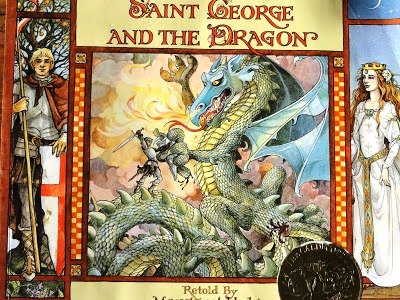
This holiday is often celebrated with vibrant, colorful imagery and sugar skulls. Name a book with a cover as visually-interesting and colorful as a sugar skull.
I will never stop promoting the art of Trina Schart Hyman.
Food is an important part of the Dia de los Muertos celebration. Food is set out on altars for the spirits of departed family members.
Tell us a book where food really makes the story!
The No. Ladies’ Detective Agency books. These are written from multiple perspectives, but arguably the main character is Precious Ramotswe, founder of the No. Ladies’ Detective Agency, the only female-run detective agency in Botswana. Mma Ramotswe is fat (“traditionally built”), and while not unusually greedy, she does enjoy her food and thinks about it fairly often. She always likes to visit the formidable Mma Potokwane, who runs an orphanage, because although Mma Potokwane is sure to ask for some kind of favor for her orphans, she always serves Mma Ramotswe a generous piece of cake, sometimes two.
“Some people very clearly and obviously would like to eat more cake. It might as well be printed on their forehead: Greedy person.” Ah yes, that would be me.
Dia de los Muertos is not only celebrated in Mexico, but also in Central and South America. Name a book that takes place in Central or South America or has a Central or South American author.
I’ve read a lot of missionary stories, but Bruchko is one of the most remarkable. It takes place among the Motilone, who live in the jungle somewhere along the border of Venezuela and Colombia.
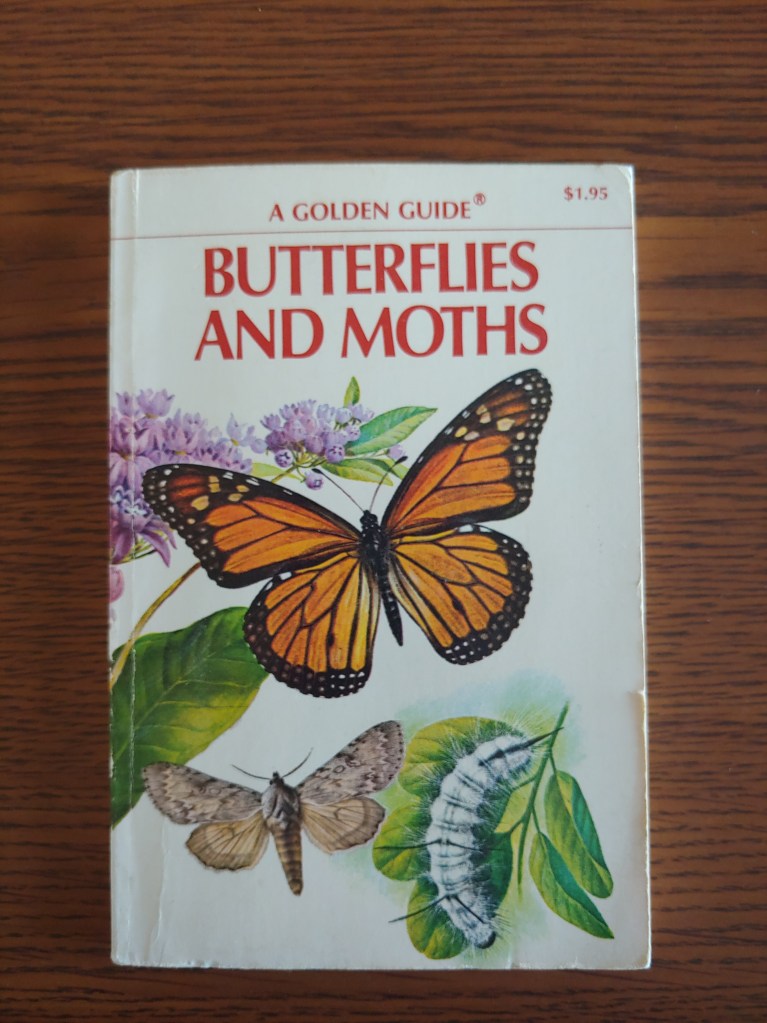
In addition to sugar skulls, flowers and butterflies are also symbols of this holiday. Tell us a book with flowers or butterflies on the cover
Nailed it.
The Day of the Dead is about celebrating life. Name a book that celebrates life.
The book of Job, in the Bible.
You think I’m kidding? No, listen.
Job isn’t about Job patiently putting up with suffering, proving what a good person he is, and then God rewards him. That’s the caricature, but it’s almost the opposite of the real theme of the book.
The consensus in Ancient Near Eastern wisdom literature was that, since God is just, if anything bad happens to anyone, it must be their fault. This is still, by the way, the essence of human wisdom in many parts of the globe, especially in Hinduism. It is also many people’s instinct when we see a horrible disaster befall someone, to find some way that the unfortunate person brought it upon themselves, or “how this could have been avoided.” It makes us feel a little more in control.
The book of Job exists to subvert this universally accepted bit of “wisdom.”
Job starts out as a model of the good person in the Ancient Near East. He has seven sons (the perfect number!), and three daughters; he offers regular animal sacrifices to God. And he’s rich, as he should be. Everything is making sense, see?
Now we take this model Good Person and visit all kinds of punishments on him. And this must be an expose, right? It must be Justice Falling At Last!
Job’s three “friends” show up, and they proceed to preach some very reasonable, theologically sound sermons just like you could hear in any of the wisdom literature of the day. God is just. He rewards the righteous and punishes the wicked. Therefore you must have deserved this somehow. If you say you haven’t, you are defying God! Beat that!
Their logic is flawless. And God sides with Job against them. “You have not spoken of me what is right, as my servant Job has.”
If that’s not life-affirming, I don’t know what is.
It is also a day of remembering loved ones who passed on. Name a book that was either given to you or reminds you of a loved one who passed away.
Let me tell you about Alice.
I can tell you all about her now, because she’s with the Lord. No privacy risk or anything like that. I’d post a picture if I had one, but I don’t.
By the time I knew Alice, she was in her late eighties. (I was in my late teens.) She mentored me for a few years before she got dementia. She was a sweet, little old German-American lady, with a sly sense of humor. She could do impressions, but used this skill judiciously. Once she said to me, “You want to know why I never married?” And then, for an answer, she quoted the King James verse, but with different punctuation: “I would not have thee, ignorant brethren.” Props to you if you get that joke.
The “brethren” that she “would not have” were certainly missing out, because Alice was a treasure. Perhaps they overlooked her good qualities because of a facial deformity. She had been bitten on the cheek by a horse as a child, and it wasn’t until she was an adult that she was able to afford corrective surgery.
Anyway, one day when I was at Alice’s house, I picked up the book The Holiness of God by R.C. Sproul. She encouraged me to borrow it. I expected it to be a dry, academic read, because it was on a lofty theological topic. But no, it was written for the layperson, and was very accessible. A page-turner, in fact. To this day I associate that book with Alice.
El flor del Muerto – The flower of the dead. Marigolds are used in massive quantities on the Day of the Dead. These flowers represent the sun and rebirth. Also believe to guide the spirits back home. Name a book about rebirth.
The Great Good Thing, by Andrew Klavan. Unfortunately, I have lent my copy out, so I can’t show you a picture. This is the story of how Klavan grew up as secular Jew on Long Island, ran away from home, lived as a hobo for several years, became a hard-boiled noir crime writer and a Hollywood success, and then became a Christian at the age of 50. He is now a Christian, Jewish, hard-boiled noir crime writer who also writes YA and fantasy.
If you want to read a novel about rebirth, try Identity Man, also by Andrew Klavan.
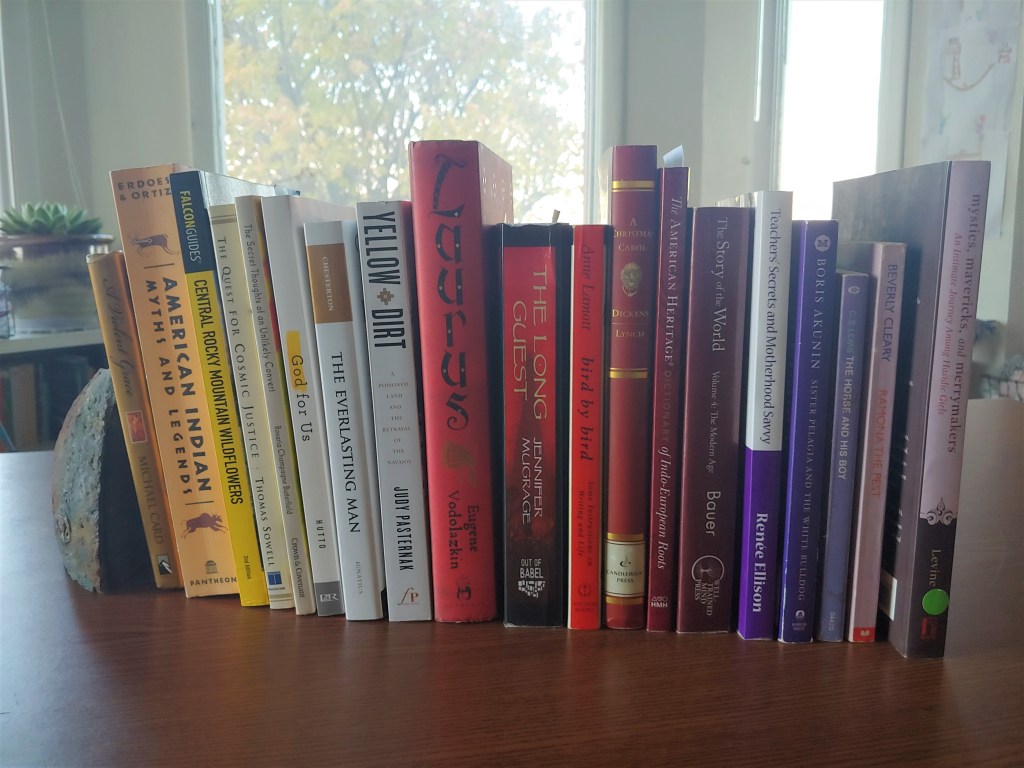
Colors are used as a form of symbolism in the decorations and sugar skulls. Some of the colors used in association with Dia de los Muertos are yellow (unity), white (hope and purity), red (blood and life), purple (mourning), and pink (happiness).
Take a photo of some book spines in the Dia de los Muertos colors!
And a happy Dia de los Muertos to all who celebrate ❤
P.S. Disclaimer about Memorializing Our Dead
If anyone feels uncomfortable with me doing this tag, because, you know, skulls and dead people and paganism, I get it.
Let me reiterate a point I have made before, that pagan practices (especially old ones with deep roots) often fulfill basic human needs that every society needs to fulfill, such as celebration, marking the seasons, etc. In this case, the basic human need is to continue to feel a connection to, and to honor, our loved ones who have died. In a way, it’s part of the mourning process. Modern American society is terrible at this, sorry to say. The only formal time to remember the person is during the funeral and burial, after which the mourners are expected to basically stop talking about the person except to very close friends or relatives. Bringing them up, or continuing to visibly grieve, causes that sin of all sins, social awkwardness. This is pretty harsh, and it does not match well with the way that grieving goes for most people.
There are ways to provide for ongoing grieving, honoring, and remembering that are not ancestor worship. For example, in Indonesia, the Muslims have memorial services at 30 days, 100 days, and a year after the death. The people groups of Kalimantan (pagan and sometimes Christian as well) have a second, larger, funeral ceremony, usually a year later, when they dig up the person’s bones and re-inter them in an ossuary with the bones of the family. The Christians will have about a week or so of viewing services while they wait for people to gather for the funeral; then the graveside service; then that night an additional “comfort” service. Most of these take place at the family’s house, and they mean the house is filled with people, songs, and food. The family is not left alone. The people who attend don’t have to say or do anything special beyond “we share in your grief.” They just have to be physically present. This is also a better social rule than having to come up with something to say.
Christians will also have a vigil at their relatives’ graves on the night before Easter. This might sound creepy – and maybe it is – but sometimes when facing something as awful as death, we have to embrace the creepy and it will actually haunt us less.
So all that to say, while I am not recommending pagan worship, and while Christians are definitely forbidden from trying to contact the dead, I think having something like a Dia de los Muertos is a good idea on a psychological level. And yes, I did get teary-eyed when watching Coco.
It’s been a busy week, so instead of the usual exciting rants about prehistory, I’m forced to cross-post this review from Goodreads.
The Amazon Blurb
Chad Lester’s kingdom is found in the Midwest. His voice crawls over the airwaves, his books are read by millions (before he reads them), and thousands ride the escalators into the sanctuary every Sunday. And Saturday. And Wednesday, too. He is the head pastor of Camel Creek – a CEO of Soul. And souls come cheap, so he has no overhead.
When Lester is (falsely) accused of molesting a young male counselee, his universe begins to crumble. He is a sexual predator, yes. But strictly straight (and deeply offended that anyone would suggest otherwise). Detectives, reporters, assistant pastors, and old lovers and pay-offs all come out to play.
John Mitchell is also a pastor, but he has no kingdom to speak of – only smalltime choir feuds. He is thrilled at the great man’s fall, but his joy quickly fades when the imploding Lester calls him – and a lover or two – for help. How low can grace go? Whores, thieves, and junkies, sure. But pastors?
My Review
This book is sort of like one of those treats from Mexico that are, technically, candy, but they also contain chile powder and a ton of citric acid.
In other words, it’s funny, shrewd, and a quick read, but also super misanthropic.
The narrative voice is Douglas Wilson’s own, which is to say, full of sardonic psychological observations, bon mots, and silly but deep metaphors. The plot is P.G. Wodehouse-esque.
My biggest problem with it, and the reason I gave it only four stars instead of five, is that almost all the characters talk kind of alike, both in the dialogue and in their internal monologues. And the way they talk is also very similar to the narrative voice. This isn’t realistic, and it sometimes makes the characters harder to keep track of in a comedy of errors that has a very large ensemble cast. Also, they sound too educated. What teenaged daughter says to her father that Costco was “a perfect madhouse”?
As for the expose part of it, I have been in the evangelical world my entire life but I have never been in a mega-church — at all, really, but certainly not a mega-church like this one, where the pastor originally wanted to run for governor, has never been to seminary, doesn’t read the Bible, seduces all the women he “counsels” and then pays them off, has bestselling books written by ghost writers and sermons written by same. If this kind of thing is truly widespread, that explains why Wilson is always chiding evangelicals. And why, perhaps, I shouldn’t take his chiding personally, as it is apparently not directed at me.
Left to right: Broken Top, South Sister, North Sister
There is a trio of mountains in Oregon called the Three Sisters. In fact, the town of Sisters, OR, is named for them. In this picture, you can only see two of the them (the third is hiding behind).
I use this picture for my illustration because, while there is a lot of great art portraying the Three Fates, it’s a little hard to find a picture that I can use without copyright infringement.
I recently read, with my kids, The Black Cauldron. My imagination was captured by the three swamp-dwelling little old ladies (if human?) who guard the Cauldron: Orddu, Orwen, and Orgoch. As far as I can tell, Lloyd Alexander made up these ladies and imported them into his story. Though triple goddesses are a recurring feature in Celtic mythology, they are not really the same as the three fates and it’s even a falsehood that they always came in the form of maiden, mother, and crone, as you will see if you read the scathing 1-star reviews of the book The White Goddess by Robert Graves.
The Greek fates are named Clotho, Lachesis, and Atropos. Clotho spins the thread of a mortal’s life, Lachesis measures out its predetermined length, and Atropos cuts it. Norse cosmology also has fates, called the Norns … in some versions three, named Past, Present and Future; in some versions a large but unknown number, according to this article. Evidently the idea of fate personified as three or more women (or woman-like beings) goes way back in Indo-European cosmology. It shows up as late as Macbeth’s three witches.
I had ignored the Fates for some time (as one does); but reading The Black Cauldron made me wonder whether you can write a fantasy that draws on Indo-European cosmology and not at least tip your hat to them.
By their very nature, the Fates are creepy. Lloyd Alexander does a great job of making this feeling come through when he introduces Orddu, Orwen, and Orgoch. The heroes of the book, on first seeing the fates’ house (and by the way, the word ‘fates’ is not used), think it is abandoned because it looks so run-down and blends so well into the swamp shrubberies. There’s a loom set up inside the house, on which is a tangled mess of a weaving. (Don’t touch!) Then the ladies show up. Rather like Tom Bombadil in The Lord of the Rings, they seem cavalier about things that ordinary people regard as matters of life and death. Orddu keeps offering to turn the travelers into toads (“You’ll grow to like it”). Orgoch is excited about this because if they were toads, it’s implied she could eat them. Orgoch, the only one of the three who is clad in a black cowl, seems to want to eat everything. As Orddu says, “It’s hard to keep pets with Orgoch around.”
The three ladies light up when they hear that the travelers know Dallben, who it transpires they discovered as a foundling and raised. They refer to him as “little Dallben.” (Dallben is over 300 years old.)
The travelers stay the night in an outbuilding belonging to the three ladies. Taran, the main character, wakes up in the middle of the night and sneaks up to the window of the dilapidated cottage, which is now alight. He returns, reporting, “They’re not the same ones!” Orwen, Orddu and Orgoch now look young and beautiful, and they spend all night working on their weaving. The next morning, however, they appear looking just as they did before, and with the same apparent disregard for human life.
Lloyd Alexander has set a really high bar with this fictional, Welsh version of the fates, and I’m not even sure I could approach it. Here is an article that dives more deeply into an analysis of the fates and of all of Prydain, the fantasy world in which the book is set. Be warned, the article assumes you are familiar with the whole series.






 Out of Babel Books