
… the thing I propose to take as common ground between myself and any average reader, is this desirability of an active and imaginative life – picturesque and full of poetical curiosity … If a man says that extinction is better than existence or a blank existence better than variety and adventure, then he is not one of the ordinary people to whom I am talking. If a man prefers nothing, I can give him nothing. But nearly all the people I have ever met … would agree to the general proposition that we need this life of practical romance – the combination of something that is strange with something that is secure. We need to so view the world as to combine an idea of wonder and an idea of welcome.
G.K. Chesterton, Orthodoxy, Chapter 1
Tag: theology
Misanthropic Movie Review: Angels and Demons

Reader response is a wonderful style of literary criticism which allows the reviewer to just note down their personal reactions, even if those reactions occurred while watching the show at midnight, when we get sleepy and our inner five-year-old emerges.
This post doesn’t explain the plot step by step, but it does contain all the spoilers and all the sarcasm.
So, my reactions to the movie version of Angels and Demons, in order …
1. Oooh, these Catholics are so mysterious and sinister!
2. Science-y stuff is happening inside the big collider. The people are speaking French. They think the collider might blow everything up, but they press on anyway because it’s Science.
3. Now they have made antimatter.
4. The messenger from the Vatican speaks English with a cool, ominous accent. He seems to be perfectly fluent, but he can’t remember the word formídable. The closest he can get is for-mi-dá-blay. The professor has to translate for him.
5. The professor is really smart. He knows more about Catholic history than the Catholics themselves. Seems legit.
6. The Illuminati were a bunch of honest truth seekers who were absolutely, positively not into the occult. They were just rationalists and scientists who were persecuted by the Catholic Church. Now they want to use the antimatter to blow up a small country (Vatican City), but that is totally justified because the Catholics branded a cross on the chests of five Illuminati back in the 1500s.
7. The Illuminati have kidnapped the four preferiti, a.k.a. Cardinals who are being considered to become the next Pope. The other Cardinals are in conclave. The Great Elector, the leader of these, is obviously the bad guy. He doesn’t want to evacuate St. Peter’s Square, even though it clearly might be a good idea. He has “I WANT TO BE POPE” written on his forehead, and it’s possible he is behind this whole scheme. He either works for the Illuminati, or is more likely using them.
8. The Illuminati assassin is torturing the preferiti one by one and leaving them around Vatican City for the Professor to find.
9. VATICAN CITY SCAVENGER HUNT!!!
10. Wow, I am just learning so much from this movie. I had NO IDEA that the church adopted the symbols and holidays of previous pagan religions, or that Dec. 25 was originally … oh, wait. Yes I did. I wrote an article about it here.
11. Also, English was the language of rebels and mavericks, like Shakespeare and Chaucer. (Chaucer????)
12. Honestly. There are no admirable characters in this movie. Not the Great Elector, not the Komandant of the Swiss guard, not the Illuminati assassin because torture, not the Professor because he always looks like everyone is getting on his last nerve with all this religion stuff … The only admirable character is a young priest who was the Pope’s protégé and who confusingly still loves the church as a place of simple people full of compassion even though he admits the church has “always sought to impede progress.” I’ll bet he apostatizes before the end. Either that or he becomes the next Pope.
13. The Pope was murdered, by the way. Turns out he didn’t really have a stroke. I think we are supposed to feel sorry for him (or for the protégé), but the scene when they open his coffin displays a black, swollen tongue protruding from his mouth and spreading a stain over the rest of his face. Clearly super symbolic.
14. Speaking of symbolism, in one scene the Professor gets trapped in the Vatican Archives. To preserve the ancient books there, oxygen is kept to a low level and the walls are lined with lead. When the power goes off, the electronic doors lock. The professor has to break out of this hall of old books where he cannot breathe or communicate with the outside world, or he will literally die from being stifled. The only way he can break out is to push a heavy bookcase full of priceless artifacts into the re-enforced glass, destroying these precious objects.
Hmm, what ever could all of this symbolize? Let me think …
15. OK, they have saved the one remaining preferitus. And they have found the antimatter. But – oh no! – they can’t replace the battery that will prevent an explosion, without possibly causing an explosion.
16. The protégé is taking the antimatter up in a helicopter so the explosion doesn’t kill anyone! He’s going to be martyred and made a saint!
17. Oh wait, he parachuted out!
18. But the explosion high over St. Peter’s Square is blowing his parachute all around! He’s going to die after all.
19. He survived! Now the cardinals are finding an obscure bylaw that allows them to make him Pope.
20. But the Professor has just found a hidden video that shows the protégé was the one who hired the assassin! He just made it look like an Illuminati plot! It was him all along!
I did not see that coming.
21. But the reasons he did it were the same old tired reasons we have been told all along. He killed the Pope because the Pope was OK with the scientists making antimatter and the protégé thought it was blasphemous.
22. In other words, he did all this in order to impede progress because he thought it might diminish the power of the church.
23. The lady scientist feels guilty about having made antimatter because it was stolen by the assassin and almost used to kill thousands of people. She wonders if they should go on making antimatter.
The professor encourages her to make some more. That’s good advice. After all, what are the odds of something like this happening again?
24. The Great Elector is now allowing the remaining preferitus to become Pope and is acting all nice & humble towards the Professor. “Religion is flawed, but that’s because people are flawed.”
OK, I was wrong about the Great Elector. Still, this feels like Dan Brown is trying to have it both ways. He’s just spent an entire movie showing us that religious zeal is really really bad and destructive, but now he wants to say that it’s also not, with no reasons given.
Verdict: I ended up really enjoying this movie because it was so twisty. But that doesn’t change the fact that it was a hatchet job. Even the twists serve its purpose, because the person behind the evil plot turned out to be the character who seemed the most saintly and was certainly the most zealous. He ends up setting himself on fire, murmuring, “Father, into Your hands I commend my spirit” and then screaming and writhing like a demon as he burns. If that’s not blasphemous I don’t know what is.
An Actual Viking Reacts to Marvel’s Female Thor
Bjorn Andreas Bull-Hansen blogs here about men’s mental health, viking culture and bushcraft (“viking camp”). That’s why I call him an actual Viking.
I realize that not all of you will make the time to watch this 8-minute video, so below are some highlights of the transcript. But you need to watch the video to get the full effect of the Norwegian accent, the poignant eye contact, and especially the emotion in this guy’s voice at 6:55 when he talks about “our gods. Or what we perceive as holy.”
Highlights of Bjorn Andreas Bull-Hansen Talking about Female Thor
“So, you want to make Thor a woman.”
[takes swig from beer bottle]
“… you people.
“Listen. I’m OK with a female Thor. I don’t care! That’s only because I’m a grownup.
“But here’s the thing. Thor is a symbol of masculine power. But I do suspect that … the writers … have a little bit of an agenda and they think it’s interesting to tear down that concept of masculine power. But let me tell you, there is actually such a thing.”
[takes swig of beer]
“My ancestors, they knew how important masculine power is for our society, for the family, and for our culture. And let me just say that you are stepping on something now that means a lot to some of us.
“So go ahead, make Thor a woman. But just know this: if you think it’s OK to make Thor a woman, you should never again criticize anyone for ‘cultural appropriation.’
“Every day, I walk my dog among the grave mounds of my ancestors. And my belief system is no less important than any other belief system.
“We should all lower our shoulders when it comes to our gods. Or what we perceive as holy. I think the world would be a better place if we did. But never again will you cry out about ‘cultural appropriation.’ Because that’s what you’re doing now, making Thor female.”
[swig of beer] [shakes head] “You people.
“So go ahead, go ahead! I don’t care. Thor is still out there. All around us, as a symbol of masculine power. He is present in every healthy society, in every healthy family.
“That’s all for now. Have a wonderful day! Bye-bye.”
Misanthropic Quote of the Week: Proverbs 18:2
A fool finds no pleasure in understanding/but delights in airing his own opinions.
Proverbs 18:2
An Insoluble Puzzle
Sad topic today.
An abusive marriage is a major part of the plot in my second novel, The Strange Land.
I first introduced this problem with a very minor mention in The Long Guest. Wife abuse of some kind (not always the violent physical kind) could occur in a quarter to a half of all relationships, depending on the culture. In The Long Guest I portray a small founding group of not quite 100 people, which means fifteen or twenty families. Given that human nature has not changed throughout the ages, to have a group of this size with no abusive families in it would have been grossly unrealistic.
The Limits of the Options
Abuse within a family is always very difficult to respond to. This is true in every age, but in our modern age there are at least a few options that those who care about the victim can offer. As a last resort, breaking up the family in order to stop the abuse might not be ideal, but it’s at least possible. It is possible for a single mom in our society to survive economically. As for the abuser, it is possible to put him in jail, or failing that to put hundreds of miles between him and his victims.
There are fewer options available to a community when it’s tiny, isolated out in the wilderness, and consisting basically of one big extended family. In this situation, there is no jail, there is no other place to live and it’s much less possible for a woman, especially if she has young children, to physically survive without a man.
So, how can the community handle this? A case of abuse is essentially a case of a stubborn, very hard heart. Rebukes don’t work on such a heart. Threats or pressure might work for a while, but ultimately tend to make the abuse worse. In a small, isolated community with no police force and nowhere else to go, the community has very few options unless they are willing to kill the abuser. They are unlikely to be willing to do this, especially if he is related to them by blood. If they do choose to put him to death, in the best case they must now support his widow and children. In the worst case, it could tear the community apart, resulting in anything from more deaths to the complete end of the tribe.
When I included an abusive marriage purely for realism, I had little idea that I would be handing my community of characters a truly insoluble puzzle.
The Limits of the Law
These very questions, and others like them, are explored in the video below by the always articulate Alistair Roberts. Roberts is answering a question from a viewer about why consent (in cases of arranged marriage, concubinage, etc.) does not seem to feature as a concept in Old Testament law. How can we square this with the idea that the Law is in any sense good?
Roberts talks about the limits of any law to change the society it governs, and about the extremely limited reach of national-level laws to govern what goes on within a household. He mentions cases like that of Hagar, Abraham and Sarah’s Egyptian slave woman, whom Sarah “gives” to Abraham so that Hagar can have a son who will be considered his heir. The way the founding couple treated Hagar was normal in their society at the time, but was certainly exploitative and was arguably rape. Though Hagar’s case was not covered by the law, it is obvious from the story that God noticed the injustice and avenged it. I never noticed that God avenged what happened to Hagar and her son Ishmael until I heard Roberts point it out in other videos, and then it became blindingly obvious. He recaps that here, as well as giving proof that God took seriously King David’s treatment not only of Uriah, but of Bath-Sheba as well (another case that today would be considered at least sexual harassment and probably rape).
The bottom line is that we do what we can to right wrongs, but our varying circumstances constrain what are able to do. These topics, sadly, are relevant to everyone. If you spend long enough in a community of any kind (church, school, team, family) you will eventually be forced to deal with the question of how to confront abuse. This video isn’t going to to give you all the answers (because they don’t exist), but it could help clarify your thinking. If you have time, give it a listen.
Another excellent resource on this topic is the book Why Does He DO That? by Lundy Bancroft.
Why Religion in Fiction is So Hard to Handle
A fellow blogger, Never Not Reading, made this delightful post: More Religious Characters Please. She points out that devout religious characters, particularly Christians, are extremely rare in fiction compared to their distribution in the general population.
I Have my Doubts about the Concept of Representation
She comes at this from the “representation” point of view, which is predicated on the idea that every kind of person ought to be able to find someone like them in fiction, and that if they can’t, this is somehow unfair or discriminatory. I don’t actually buy in to the assumptions behind this view. There are philosophical problems with the concept of “someone who is like me” that, if we parsed them, I suspect we would never get to the bottom of. I also think there are some other faulty assumptions packed in to the idea of representation: assumptions about what fiction means to the author and what fiction is meant to do for the reader. So, I find the whole idea of representation suspect.
Is This Persecution?
However, Never Not Reading is right about one thing. Religion plays a large role in life for very many – perhaps the majority – of people. It does not play any role in the characters’ lives in much of the fiction that is out there. This is even true of fiction set in historical periods such as the Middle Ages.
When religion does play a major role in a story, it is often portrayed as a force for evil. That goes double for Christianity.
What is the reason for this?
Never Not Reading goes out of her way to emphasize that she is not saying this lack of religious characters is a form of persecution. I agree. I think there are many complex reasons for it, which we will explore below.
Possible Reasons Non-Christian Authors Don’t Portray Devout Christian Characters
They don’t know any Christians in real life. Although polls will tell you that the majority of U.S. citizens identify as Christian, there are large pockets of society that are very secular. One of these is New York City, home to the publishing industry in America. Another is L.A., home to Hollywood. If you are an artist or writer, you are likely to move to one of these places to launch your career. There, it is easy to live your life without ever interacting with anyone who is openly Christian. It’s easy to get the impression that most people are secular, at least most normal people. And if your mental image of Christians is some variety of kook, it’s possible that some of your acquaintances are believers and you don’t realize it because they seem so normal.
It’s easier to portray madness than sanity, evil than good. Most people are bored by portrayals of virtue. A story with no evil in it is going to come grinding quickly to a halt. So if you are going to put religion into your story, it is easier to make the religious person the villain. The villain in Stephen King’s Misery, Annie, is a beautifully drawn portrayal of a crazy person who at first seems normal. Nothing beats the creepiness of the moment when, after torturing the hero, she starts to tell him that she has been talking to God.
Religion is also a great way to add punch, depth, and believability to your villain/cult leader. Christian-type religions, when they go bad, go really terrifyingly bad. This is easier to portray than the comparatively sane boring version, especially if you don’t actually know any sane and boring Christian groups.
They may actually hate them. Writing fiction is unavoidably a spiritual practice. Fiction is about how we see the world, people, the problem of evil, the cosmos … in short, about how we see reality. The only instruments we have with which to perceive and portray these things are our own eyes, ears, mind, and heart. These are the tools with which we write fiction.
Fiction will therefore reflect the author’s personal spiritual state as well as his or her unique personality. If a person has rejected God, their heart may actually be at war with God and with His people. This may come out in their writing, particularly if their writing is deep and heartfelt.
Stephen King, again, is a great example of this. He is a brilliant writer. I love his work. I tried to read Insomnia, and I couldn’t get through it because the pro-life character was also a despicable wife-beater (and was showing signs, when I stopped reading, of maybe being possessed by something or other. After all, it’s a Stephen King novel.)
Again, I am not saying this phenomenon is persecution. It is a natural consequence of the nature of fiction. It is always possible, when reading an author, to tell what he or she loves and hates. And some authors do hate Christians.
Possible Reasons Christian Authors Don’t Portray Devout Christian Characters
They wish to have wide appeal. Christian authors are aware that religion of any kind, but particularly Christianity, is Kryptonite to many people. It is enough to make people put down a book. That’s a shame, particularly if the story we are telling can be told without overt Christianity. After all, our first duty is to entertain the reader. We are not preachers, we are storytellers, so the story itself is supposed to be what we bring to the reader.
They fear being defensive. If we do put Christianity in to our book, aware that some readers will be skeptical or hostile, we could fall into making the book an apology or defense of our religion. Good authors don’t want to write a thinly veiled philosophical or political rant. (Hi there, Ayn Rand! Hello, Dan Brown!). They just want to tell a story. This is really, really tricky to do if we are feeling defensive, on account of the whole author’s-spiritual-state-comes-out-in-the-writing thing. So to avoid preachiness, it can be easier simply to avoid the whole topic.
They fear being unoriginal. As an author who grew up in the church, when I first started writing I wanted my writing to be interesting and new. Anything drawing on the Bible would be, I felt, tame and derivative. (Of course, that didn’t stop 12-year-old me from shamelessly ripping off Tolkien.)
Unfortunately, if you want to be wise it does not do to turn away from the font of all wisdom. In the years since, I have discovered that the Old and New Testaments are an incredibly rich source of story, history, myth, emotion, insight and symbolism that literally never runs dry. Some of my favorite pieces of art draw openly from the Bible. But surprisingly, instead of making them tired and derivative, this gives them their power. An example is Johnny Cash’s When the Man Comes Around. The lyrics are literally just a series of random quotes from the Old Testament prophets (plus a few quotes from Jesus), and the song still gives me goose bumps every time.
Religion is just too big to control in our writing.
This, I think, is the #1 problem for both Christian and non-Christian writers. If we are going to write about true religion (as opposed to the fake and hypocritical kind), then we are writing about God. We have just unleashed God into our book. This is sort of like blithely grabbing on to a blasting fire hose. It immediately introduces all these deep, destructive, hard-to-portray realities that are just too much for most writers to corral.
What kind of book we are capable of writing depends on our wisdom and maturity as a writer and as a person. I have made the mistake of trying to write about God when I was an immature writer, and I was not. Ready. For it. Trying to “include” God threw off all the dynamics of the book and basically destroyed it. My writing about the other characters wasn’t deep or wise enough to keep up. I wasn’t yet good enough at writing about the human heart, about suffering, about betrayal. My characters were paper dolls and God was a firehose.
Dostoevsky can do it. Mary Doria Russell did a great job in The Sparrow. But for us ordinary writers, if we choose to stay away from making religion a serious part of our plot, I think it might just be a sign of knowing our limits.
Two Views on the Sons of Noah

For those who take the early chapters of Genesis seriously as a history of the human race (albeit a not very detailed one), here are two different interpretations of the sons of Noah.
The sons of Noah are listed in Genesis 9:18 – 19 as “Shem, Ham and Japheth.” Though they are always listed in that order, this is not necessarily their birth order. Genesis is focused with laser precision on redemptive history. Thus, it foregrounds Shem, from whom the nation of Israel would later be descended. We are given a lot more detail about Shem than about the tribes descended from the other brothers. It’s possible that Ham was actually the oldest son.
It’s also worth noting that the Table of Nations (Genesis chapter 10) gives a list of the tribes known to be descended from each brother as of that writing. This means that some tribes are listed who were later lost to history. Others are mentioned but are not followed all the way to where they eventually settled centuries later. When we are told where they lived, most of the locations are in and around the Ancient Near East, even for tribes that we know later ended up in Africa (for example Mizraim = Egypt and Cush = Ethiopia). If we take the account of Babel as true (which my novels do), then the human race first clustered around the Tigris and Euphrates Rivers and tried to build a centralized civilization. Only later did they end up migrating to the ends of the earth. So, for a time, you had the descendants of Shem, Ham, and Japheth living right on top of each other.
Here are the two theories. I will spend more time on the second one, because it is the more novel and interesting one.
The Traditional Theory: Most of the World is Japhethite
This is the theory that I was taught when I studied Old Testament Backgrounds. It has been the majority interpretation of the Table of Nations (which is, admittedly, hard to interpret). On this view, Shem was the father of all the nations that traditionally speak Semitic languages: basically, the Hebrews and the inhabitants of the Arabian peninsula. (Yes, Arabs and Jews are related.) Ham was the father of all the nations of Africa, including the Egyptians, Ethiopians and all the subSaharan nations. And Japheth was the father of the Indo-Europeans, East Asians, Pacific Islanders and (via the Land Bridge) the Native Americans.
This view isn’t perfect, because no broad explanation of human distribution is perfect. That said, it does make some intuitive sense. This is the interpretation that I used when writing my novels, because it was the only one that I was aware of at the time. So the family that my story follows are, in the novel, all descendants of Japheth. One of them, Hur, has fair skin and hazel eyes, and his mother was blond. The others all have straight dark hair and more or less East Asian features, in some cases shading towards Native American. The books are set during a time that was pre-race. People knew each other by their extended families.
I now kind of regret that I used this theory for my novels, because the one that is coming up is so much cooler.
Arthur C. Custance Says Most of the World is Hamite
Only after I was well committed to my series did I discover the web site of Arthur C. Custance, where you can read a wide selection of essays and booklets by him. Here is his big theory. Like many sweeping, alternative theories of history, it takes some getting used to, but seems to make more sense the longer you look at it, if you are willing to look at it.
Arthur C. Custance believes the Table of Nations should be interpreted as follows. Shem was the father of the Semitic peoples, as above. Japheth, whose name probably means “fair” in Hebrew, was the father of just the Indo-Europeans. Ham was the father of everyone else: not just the African nations, but all the indigenous peoples of Asia, Polynesia, and the Americas. Basically, anyone who doesn’t have a historical tradition of being descended from Shem or else a freakily white complexion like us Indo-Europeans.
The Gifts of the Peoples per Custance
Custance’s theory is not just about physical descent. He also believes that each of these broad groupings of humanity have a gift to give the human race as a whole: some cultural feature that they are especially good at.
For Semites, it’s spiritual insight. Semitic groups have “gods that are gods of righteousness.” The Hebrews, obviously, received the revelations of God and gave an up until then very oppressive world the gift of ethical monotheism. The Arabs, also, have managed to found a monotheistic religion that is focused on righteousness and is a force to be reckoned with. In both cases, their main cultural focus is religion to a much greater degree than in most cultures.
The Japhethites’ gift is intellect. Their gods tend to be “gods of enlightenment.” Japhethite peoples, according to Custance, as a culture are basically the absentminded professor type. They excel at building elaborate intellectual systems of thought that may or may not have any connection to the real world. So, the Greeks gave us philosophy, but their natural sciences consisted of speculating about ideal plants and animals rather than doing fieldwork. The elaborate Hindu systems of philosophy were developed by the Aryans, an Indo-European group that invaded India from the North. The Germanic peoples gave us Freud and Nietzsche. (Thanks, guys.)
Japhethites, per Custance, are not, as a culture, good at practical matters. That is the special gift of the Hamites.
Now, here is where it gets cool. The Hamite gods tend to be “gods of power.” What the Hamite peoples excel at is innovation in the multitude of practical disciplines that make life in this world possible. This includes (to name just a few of them in alphabetical order), administration, agriculture, architecture, arithmetic, arts and crafts, botany, city planning, mechanical engineering, medicine, metal smithing, mining, music, navigation, pottery, stoneworking, textiles, weapons innovations, and basically every other type of technology.
Custance argues that nearly every major urban civilization was founded by Hamites. This includes Egypt, Sumer, Babylon, Assyria, ancient China, and the great cities of the Americas. It also includes the urban civilization of India, which was developed by the dark-skinned Dravidians before India was taken over by the Aryans, at which point, argues Custance, technological innovation in India basically stopped.
Furthermore, on this view the Hamites were the first to colonize the world. With their extreme practical survival skills, they made it all the way across Asia, the Americas, and Polynesia while the Semites were hanging out in the Middle East and the Indo-Europeans were still building kurgans on the plains of the Ukraine. This explains why almost anywhere people have gone in recorded history, they find that there are already dark-skinned people living there (for example, Australia, Papua New Guinea, the Negritos of the Philippines, possibly the Etruscans in Italy, and the dark-haired, pre-Celtic inhabitants of Europe).
Finally, Custance argues that beautiful things happen when the children of the sons of Shem, Ham, and Japheth get together. Semitic spirituality plus Japhethite intellectualism results in theology. Japhethite intellectualism plus Hamitic technical know-how gives us modern science.
The Picture is Complex
Now, I realize this is a broad brush. Obviously, every nation has some kind of tech and some kind of religion (philosophical systems come later and Custance argues that they are the least important of the three). And it’s not as though the nations of the earth have lived hermetically sealed lives. There has been plenty of migration, intermarriage, and spread of ideas, even starting in very ancient times. Custance’s idea is that when we trace the sources of ideas and innovations, we tend to find technological innovation coming from Ham, intellectual systems coming from Japheth, and spiritual insight coming from Shem.
I need hardly say that none of these gifts is “the best.” We need them all.
Custance also notes a pattern where Japhethite peoples tend to take over territory from Hamitic peoples and then adapt, benefit from, and often take credit for Hamite innovations and discoveries. Clearly this has happened in modern times, but there are examples that come from well before the modern age of European colonialism, such as the Aryans taking over India and the Greeks getting elements of their civilization from Egypt and Ethiopia. That said, because of the nature of the case there have necessarily also been many instances of Hamite peoples migrating into other Hamite peoples’ territory, such as the Austronesians migrating into the Philippines to find the Negritos already there. World history is complicated.
If you are intrigued by these ideas, I encourage you to visit Custance’s web site via one of the many links in this article.
If I had followed Custance’s theory when writing my books, Zillah and her children should have been Hamite, and Hur should not have been able to speak their language. He could not have stayed with them or eventually married into their family. So unfortunately, I can’t rewrite my entire series to follow Custance. Bummer.
But here is a song about when all the children of Noah worship together.
A Song Where God is the Actual Hero
A few weeks ago, I posted an awful contemporary Christian song that makes “you” the hero instead of Christ. So I think it only fair to post this one, in which we find out after everything is over that it was he who was calling us. The technical term for this is sovereign grace.
The only problem is, I couldn’t find the version of this song that I like. My first introduction to it was in the form of an arrangement that sounds a bit peppy, like a folk song. In the arrangement, the words of the last verse are used as a fast-moving refrain. But I can’t for the life of me find said arrangement anywhere on YouTube. So, I have posted the original hymn with the lyrics handily printed out. The hymn has a very different sound – almost like plainsong. It’s okay, but I like the energy of the arrangement. So if you can find the arrangement, please post it in a comment.
Behold the Worst Contemporary Christian Song Ever Written!
Ok. I don’t know whether it’s really the worst. It’s the worst one that I know of.
This song has been around since I was a kid. Listen to it, and if you can get through it without throwing up, we will discuss.
“Thank You” by Ray Boltz. Here are the things I hate about the song:
It gives a false impression of heaven.
Heaven is not going to be about finding out how wonderful we are. It is going to be about finding out how wonderful He is.
We already spend way too much time trapped in the world of our own efforts, our own talents, our own flaws, our own accolades. Everyone knows that this self-focus is not in any way heavenly. It is hellish!
Gee whiz. We go to heaven to get away from this stuff. To finally be free to focus on something truly worthwhile. I can’t think of a more depressing lie than being told that heaven will consist of finding out that it’s all about “you.”
It gives a false impression of service.
This is a very minor point compared to the fact that the song makes “you,” instead of Christ, the hero of the story. So please, don’t take this second point as being nearly as important as the first. However, having once engaged in idolatry, the song then compounds the error by making it sound as if it’s easy to earn all this adulation.
What did the hero of the song do in order to create all these wonderful effects? He gave some money to missions when he didn’t have much wiggle room. (Sounds like it was just one time, after a presentation, perhaps – forgive my cynicism – to make himself feel better because the missionary’s “pictures made him cry.”)
And he taught Sunday School. This is admittedly hard, as it involves dealing with kids. But, in the song, the thing that made such a big impact was the simple act of praying an opening prayer. Something that takes less than a minute.
Both of these examples make it sound like you can do an act of service once, at relatively low cost to yourself, and – boom! – lives are changed.
Real service is very different. It consists of years of effort that often feels futile. For example, the act of getting up day after day, providing for your family, sticking with your spouse, staying in relationship with your children, is far more impactful than either of the examples in the song.
As for “giving to the Lord,” as someone who has actually tried it, let me tell you what it is more like. You start out trying to do something good. Then you find out that your motives were all wrong. You repent. Then you find out (maybe years later) that even with right motives, you were undertaking your labors in the wrong way, missing critical bits of information. In many cases, you discover that you have done more harm than good. (For more information about this experience, see the book When Helping Hurts by Steve Corbett et al, and the novels No Graven Image by Elizabeth Elliot and The Sparrow by Mary Doria Russell.)
In my personal version of the scene above, I arrive in heaven and eventually get an opportunity to ask forgiveness for my grievous mistakes from the people I once started out so confidently trying to serve. And I find out to my relief that despite my inadvertent efforts to keep them from entering, they are there anyway. And they are no longer ticked about my mistakes because Jesus got to them directly, without my “help,” and they are just so thrilled to be there.
But none of this would be the first thing that happens. It’s heaven. The Lord is there. I think we will have higher priorities right at first than sorting out who did what to whom.
It gives a false impression of the Christian life.
My worst nightmare would be that someone who does not believe in Christ would hear this song. (And they probably will, now that it’s on my blog.) It paints a repellent picture of what it means to be a Christian. It makes it sound like the life of faith is all about going around patting ourselves on the back, rather than about progressively recognizing and repenting of our faults, and coming to admire and depend on Christ more and more. If we are engaged in back-patting, then we have not yet embarked on the path of Christ. We are still stuck in Pharisaism, with all its attendant miseries. This is already the impression that many people have of Christianity. The last thing we need is a song like this to further obscure the Gospel.
The Grain of Truth in the Song
Having said all this, I have to be fair. There is a grain of truth in this song.
I mentioned that people who attempt a life of service usually find themselves engaged in years of work that seems fruitless and sometimes actually seems to do more harm than good. Human efforts are futile. “Meaningless, meaningless, everything is meaningless.” (Ecclesiastes 1:2, 2:1, 2:11, 2:15, 2:17, etc.) That’s in the Bible too.
It is one of the ironies of the universe that often a person can put in intense labor without achieving the desired result, only to have some small, random thing that they did turn out to make a huge impact. That may be the phenomenon that this song is trying to capture. (I think it does a really lousy job of it. Perhaps we shouldn’t try to capture years of wisdom and experience in a 5-minute song. But there is truth in this insight.)
Jesus said, “When you give to the poor, don’t let your left hand know what your right hand is doing.” There is humor in this statement (Jesus’ humor is under-appreciated). Dallas Willard has pointed out that when our hands do things automatically, without us having to think about it, it is because we are engaged in some routine process such as brushing our teeth. Our hands automatically coordinate themselves, and the whole thing runs on muscle memory. And this only takes place with things that we do often. Jesus was saying that our giving should not be the kind of thing for which we pat ourselves on the back, but rather a completely normal part of life that we hardly notice we are doing.
So perhaps what this odious song is trying so clumsily to capture is the truth that it will be small actions, ones we hardly notice we are doing, that will turn out to have blessed others the most. I could see that would be an encouraging message if it were better expressed. However, there has got to be a more nuanced and less idolatrous way to point this out, so let me go on record as saying that I still hate this song.
God is Multilingual
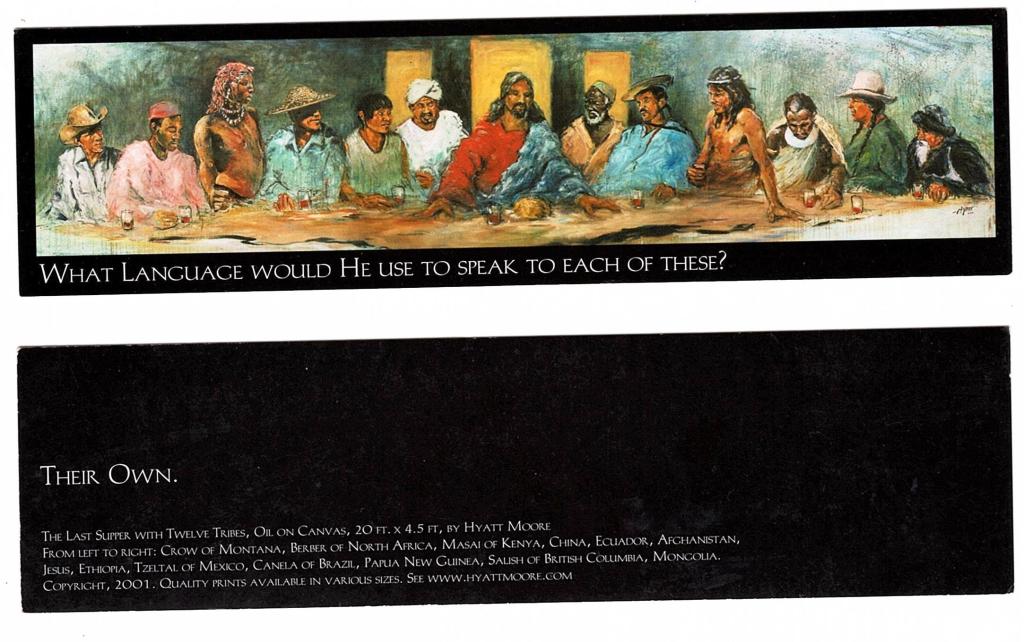
Yesterday was Pentecost. It commemorates the following event, which happened after Jesus’ death and resurrection:
Suddenly a sound like the blowing of a violent wind came from heaven and filled the whole house where they were sitting. They saw what seemed to be tongues of fire that separated and came to rest on each of them. All of them were filled with the Holy Spirit and began to speak in other tongues as the Spirit enabled them. When they heard this sound, a crowd came together in bewilderment. Utterly amazed, they asked, “Are not all these men who are speaking Galileans? Then how is it that each of us hears them in his own native language?”
Acts 2:2 – 4, 6 – 8, NIV
I don’t think the point of this story is that every Christian, down to today, ought to be able to “speak in tongues.” The point is that God does.
Although He first revealed Himself to a very specific people group in a very specific cultural context, God has given humanity His word in linguistic form and it’s capable of being translated into any language and culture. Those who have participated in this process will tell you that it’s delightful to see what each unique culture does with it.
Actually, the fact that translation is possible at all is sort of a miracle in itself.
Occasionally you’ll see an essay by an amateur philosopher of language which will try to argue — usually with a fairly abstract argument — that translation is not possible. Sometimes these arguments are logically perfect and very persuasive. And yet. Translation happens every day. It’s sort of like the (apocryphal?) argument that according to the laws of aerodynamics, the bumblebee should not be able to fly.
Other times, someone will try to tell you that a particular word or concept from another culture is “untranslatable.” They will then proceed to explain to you what this word or concept means. In other words, to translate it. In these cases, what they mean by “untranslatable” is that you cannot translate it into, say, English with a one-word gloss. It requires a paragraph, or sometimes a story or a history lesson to give a full sense of the word. But it is still possible to convey, in another language, what the concept is, and once it has been explained, non-native speakers will understand what is meant even if you just continue to use the original, “untranslatable” word. Their argument that the concept cannot be translated ends up being a demonstration that it actually can.
The image at the top of this post is a scan of the front and back of a bookmark … which contains a tiny print … of a huge painting by artist Hyatt Moore. It shows a version of the Last Supper with the twelve disciples represented by a man from each of twelve different minority language communities. (Or, in some cases, countries. For example, Papua New Guinea is represented by just one man, but it has hundreds of different languages.)
God is the ultimate polyglot, and this painting shows a bit of His heart.
 Out of Babel Books