I am traveling this weekend. I’ll be going to a conference, where I hope to personally connect with the proprietors of Haunted Cosmos Podcast. These guys are (I believe) kindred spirits in that they are Reformed Christians with an interest in paranormal ancient mysteries weird stuff. If I can convince them to re-issue my books under their imprint, maybe I will be free no longer need to promote my own books and all our troubles will be over. Anyway, a lot of things are up in the air just now (at least, in my mind they are), so pray for God’s will to be done there. And in the meantime, definitely check out the Haunted Cosmos podcast.
Secondly, I have finally broken down and become a creator on Patreon. Not much happening over there yet (or maybe ever), but please do visit Out of Babel Art and Novels if you are seized with an inexplicable urge to give me money.
Finally, here is the book I’m currently reading.
Obviously, the chilling topic of the old gods and their ongoing activity in this world is one that’s near and dear to my heart. I bought this book because I wanted to see what the Dispensationalists were saying about it. So far, it’s solid and pretty hard to argue with. Here’s a quote:
Since the house is clean, swept, and in order, the spirit brings in seven other spirits to join in the repossession. The implication is that if the house had not been cleansed and set in order, the spirit would not have brought back the other spirits to occupy it.
And therein lies the warning. The house that is cleansed and put in order but remains empty will be repossessed. And if it should be repossessed, it will end up in a worse state than if it had never been cleansed. What happens when we apply this to an entire civilization? … Should a culture, a society, a nation, or a civilization be cleansed, exorcised of the gods and spirits – but then remain or become empty – it will be repossessed by the gods and spirits that once possessed it, and more. And it will end up in a far worse state than if it had never been cleansed or exorcised at all. …
A post-Christian civilization will end up in a far darker state than a pre-Christian civilization. It is no accident that the modern world and not the ancient has been responsible for unleashing the greatest evils upon the world. A pre-Christian civilization may produce a Caligula or a Nero. But a post-Christian civilization will produce a Stalin or a Hitler. A pre-Christian society may give birth to barbarity. But a post-Christian society will give birth to even darker offspring, Fascism, Communism, and Nazism. A pre-Christian nation may erect an altar of human sacrifice. But a post-Christian nation will build Auschwitz.
Sorry, folks. Life has continued to be busy. So this weekend, I’m re-posting another one of my most-often-viewed essays for your edification.
Discovering the Extent of the Problem
I learned the word Hermeticism recently.
Here’s an extended simile of what my experience was like in doing a deep dive on this word.
Imagine that your drain keeps backing up. You take a look, and discover a root. You have to find at what point the roots are coming into the pipe, so you do the roto-rooter thing. It turns out that the roots are running through the pipe all the way down to the street and across the street and into the vacant lot, where there is a huge tree.
And oh, look, it’s already pulled down the neighbor’s house!
That’s what it was like. (Oh, no! It’s in my George MacDonald pipe too!)
What Methought I Knew
I’ve listened to a number of James Lindsay podcasts, and he talks a lot about Hegel. In discussing what exactly went wrong with the train wreck that is modern education and politics, James has to dive deep into quite a few unpleasant philosophers, among them Herbert Marcuse, Jaques Derrida, Paolo Friere, and the postmodernists. And Hegel.
I had heard James describe before how Hegel saw the world. Hegel had this idea that progress is reached by opposite things colliding and out of them comes a new synthesis, and then that synthesis has to collide with its opposite and so on until perfection is reached. This process is called the dialectic. Marx took these ideas and applied them to society, where there has to be conflict and revolution, but then the new society that emerges isn’t perfect yet and so there has to be another revolution and so on until everything is perfect and/or everyone is dead.
Obviously I am simplifying a lot. James can talk about this stuff for an hour and he is simplifying too, not because these ideas are themselves complicated but because Hegel produced a huge dump of words, and he came up with terminology that tried to combine his ideas with Christian concepts so that they would be accepted in his era. Anyway, the word dialectic is still used by postmodern writers like Kimberle Crenshaw, and it is a clue that they think constant revolution is the way to bring about utopia.
So, I was familiar with Hegel through the podcasts of Lindsay, and I was also familiar enough with Gnostic thought to at least recognize it when it goes by, as it so often does. For one thing, you kind of have to learn a little bit about Gnosticism if you are a serious Christian, because gnostic (or at least pre-gnostic: Platonic, mystery religion) ideas were very much in the air in New Testament times, and many of the letters of the New Testament were written to refute these ideas. Also, Gnosticism, particularly the mind/body duality, has had such an influence on our culture that it’s hard to miss. It’s present in New Age and neopagan thought, and it’s called out in Nancy Pearcey’s book Love Thy Bodyfor the bad effects it has had on the way we conceive of personhood.
So that’s the background.
Several months ago, I was listening to Lindsay give a talk summarizing his recent research to a church group. He was talking about theologies: systems of thought that make metaphysical and cosmological claims, and come with moral imperatives. And he dashed off this summary, something like the following:
“You could have a theology where at first all that exists is God, but He doesn’t know Himself as God, so in order to know Himself he creates all these other beings, and they are all like pieces of God but they don’t know it, and their task is to become enlightened and realize that they, too, are God, and when they realize this, eventually they will all come back together, but now God is self-conscious because of the process of breaking He’s been through.”
And I’m thinking, Sounds like Pantheism, or maybe Gnosticism.
And James says, “That’s the Hermetic theology.”
And I’ve got a new word to research.
Kind of a Weird Name
So, why is it called Hermeticism? Does it have to do with hermits?
My first foray into Internet Hermeticism immediately showed that the school of thought was named for a guy named Hermes, as in this paragraph from wiki:
Hermeticism, or Hermetism, is a label used to designate a philosophical system that is primarily based on the purported teachings of Hermes Trismegistus (a legendary Hellenistic combination of the Greek god Hermes and the Egyptian god Thoth).[1] These teachings are contained in the various writings attributed to Hermes (the Hermetica), which were produced over a period spanning many centuries (c. 300 BCE – 1200 CE), and may be very different in content and scope.[2]
One of my search hits, I can’t remember which one, said that Hermeticism is “often confused with Gnosticism.” O.K., so if it’s not Gnosticism, that means I know less than I thought and it’s all the more reason to research.
I also found avowedly Hermetic web sites like Hermetic World, whose “summary” is actually more of an attempt to draw you into their movement:
Hermeticism – The secret knowledge
Hermeticism is an ancient secret doctrine that dates back to early Egypt and its innermost knowledge has always been passed on only orally. In each generation there have been some faithful souls in different countries of the world who received the light, carefully cultivated it and did not allow it to be extinguished. Thanks to these strong hearts, these fearless spirits, truth has not been lost. It was always passed on from master to disciple, from adept to neophyte from mouth to ear. The terms “hermetically sealed”, “hermetically locked”, and so on, derive from this tradition and indicate that the general public does not have access to these teachings.
Hermeticism is a key that gives people the possibility to achieve everything they desire deep in their hearts, to develop a profound understanding of life, to become capable of decision making and responsibility; and to answer the question of meaning. Hermeticism offers a hidden key to unfolding.
Nobody can teach this knowledge to himself. Even in competent books like Kybalion, the teaching is only passed on in a veiled way. It always requires a master to pass on the wisdom to the able student. Today, as in the past, authentic mystery schools are a way to acquire this knowledge. The Hermetic Academy is one of these authentic schools.
This is certainly the genuine article, but it is perhaps not the first place to go. I wanted to learn about the basic doctrines from a neutral source, simply and clearly described. I didn’t want to have to wade through a bunch of hand-waving to get there, at least not at first. Still, I suppose we shouldn’t be surprised that Hermetic World tries to cast a mysterious, esoteric, yet somewhat self-help-y atmosphere on their first page. After all, it is a mystery religion.
Well, at least now I know why it’s called Hermeticism. It’s basically an accident of history, due to the name of the guy to whom the founding writings were attributed.
Time to move on to a book.
Moving On to a Book
I am fortunate to be descended from a scholar who has a large personal library, heavy on the theology.
I asked my dad.
Serendipitiously, he had just finished reading Michael J. McClymond’s two-volume history of Christian universalism (the doctrine that everyone is going to heaven), and he remembered that Hermeticism entered into the discussion. He was happy to lend it to me. You can see all the places I’ve marked with tabs. Those are just the ones where Hermeticism is directly mentioned. I hope you now understand my dilemma.
In McClymond’s Appendix A: Gnosis and Western Esotericism: Definitions and Lineages, I found at last the succinct, neutral summary I was looking for:
[“Hermetism”] as used by academics refers to persons, texts, ideas, and practices that are directly linked to the Corpus Hermeticum, a relatively small body of texts that appeared most likely in Egypt during the second or third centuries CE. … “Hermeticism” is often used in a wider way to refer to the general style of thinking that one finds in the Corpus Hermeticum and other works of ancient gnosis, alchemy, Kabbalah, and so forth. “Hermeticism” sometimes functions as a synonym for “esotericism.” The adjective “Hermetic” is ambiguous, since it can refer either to “Hermetism” or “Hermeticism.”
McClymond, p. 1072
O.K.
So it isn’t that different from Gnosticism after all.
“Esoteric,” by the way, means an emphasis on hidden or mystical knowledge that is not available to everyone and/or cannot be reduced to words and propositions. “Exoteric” refers to the style of theology that puts emphasis on knowledge that is public in the sense that it is written down somewhere, asserts something concrete, can be debated, etc.
Even though I have literally just found an actual definition of the word that is clear enough to put into a blog post, in the time it took me to find this definition I feel that I have already gotten a pretty good sense of what this philosophy is like. Perhaps it helps that it has pervaded many, many aspects of our culture, so I have encountered it many times before, as no doubt have you.
I began to peruse the tabs in the volumes above and read the sections there, in all their awful glory.
Yep, James Lindsay in fact did a pretty good job of explaining the core metaphysic of Hermeticism. Of course, this philosophy brings a lot of things with it that he didn’t get into. If we and all beings in the universe are all made of the same spiritual stuff as God Himself, it follows that alchemy should work (getting spiritual results with physical processes and the other way round). It follows that astrology should work (everything is connected, and the stars and men and the gods not only all influence each other, but when you get down to it are actually the same thing). It follows that reincarnation should be a thing (the body is just a shell or an illusion that is occupied by the spirit, the spark of God). It follows that there are many paths to God, since we are all manifestations of God and will all eventually return to Him/It. It follows that the body is not that important (in some versions of this philosophy, matter is actually evil). Therefore we should be able to physically heal ourselves with our minds. Our personhood should be unconnected to (some might say unfettered by) our body, such that we can be born in the wrong body, or we can change our sex or our species if we want to. There might also be bodies that don’t have souls yet (such as unborn babies), and so it would be no wrong to destroy them. Also, since matter is not really a real thing, it follows that Jesus was not really incarnated in a real human body and that He only appeared to do things like sleep, eat, suffer, and die. Also, since we are all parts of God like He is, He is not really one with God in any sense that is unique, but just more of an example of a really enlightened person who realized just how one with God He was.
I imagine that about twenty pop culture bells have gone off in your mind as you read that preceding paragraph. You might also have been reminded of the Church of Jesus Christ of the Latter-Day Saints, which teaches that we were all pre-existent souls literally fathered by God out of some sort of spiritual matter before we came to earth to be born.
So, What the Heck Is It?
Hermeticism is not just one thing. It’s a whole human tradition of thought. It had a lot of streams flowing into it, like Plato, first-century mystery religions, Gnosticism, and early attempts to reconcile Christianity with these things. It has a lot of streams flowing out of it, like many Christian mystics of varying degrees of Christian-ness; Origen; Bohme; Hegel; medieval and Renaissance alchemy; the Romantic literary movement; Mormonism; New Age thinking; identity politics; transhumanism; Shirley McLaine; The Secret, and the movie Phenomenon.
Not all of these thinkers hold to the exact same set of doctrines. In a big philosophical movement like this, almost every serious thinker is going to have his or her own specific formulation that differs from everyone else’s in ways that seem really important to people on the inside of the system. So anyone who is an insider or who has made it their life’s work to research any of the things I mention above (and many others besides) could come along and point out errors or overgeneralizations in this article and make me look like I don’t know anything. That’s partly because it’s a huge historical phenomenon and I actually don’t know much of all there is to know. It’s also partly because these mystery religions delight in making things complicated. They love to add rituals and symbols and secret names and to discover new additional deities that are personifications of abstract ideas like Wisdom. It’s supposed to be esoteric. That’s part of the fun.
Another reason it’s difficult to describe Hermeticism accurately is that when all is one, it is really difficult to talk about anything. In this view of the world, when you get right down to it there is no distinction between spirit and matter, creator and creature, man and woman, conscious and inanimate, and the list goes on. I called it Hermeticism at the beginning of this paragraph, but I was tempted to write Hermeticism/Gnosticism, or perhaps Hermeticism/Gnosticism/alchemy/mystery religions/the New Age/Pantheism/postmodernism. If you’ve ever read any New Age writers, you’ll notice that they tend to write important terms with slashes like that (“Sophia/the divine feminine”). That’s because it’s all one. They don’t want you to forget that. They don’t want to forget it. Even if these ideas do not go very well with the human mind, and they tend to break it if you keep trying to think them.
In a sense, Hermeticism and all these other related movements are very diverse and not the same at all. In another sense, it’s all … the same … crap.
Today’s post comes from chapters 4 and 5 of this book.
Originally Posted as, “Writer: The World’s Third Oldest Profession”
Writing is a human practice.
Of course it is possible to have a human society without writing, but the impulse to devise a writing system, looked at historically, may have been the rule rather than the exception.
This is counter-intuitive, of course. “Symbolic logic” seems like it ought to be unnatural to humans, especially if we are thinking of humans as basically advanced animals, rather than as embodied spirits. But if we think of mind as primary, everything changes. It’s telling that reading and writing are one of the learning channels that can come naturally to people, in addition to the visual, the audio, and the kinesthetic. But I’m getting ahead of myself.
Welcome to the third post taken from Lost Civilizations of the Stone Age by Richard Rudgley. Call this the writing edition. This post hits the highlights of Rudgley’s chapters 4 and 5, pages 58 through 85.
Nah, Ancient People Didn’t Write, They were Barbarians!
The idea of writing as an exception in human history has become dogma:
The proposition that Ice Age reindeer hunters invented writing fifteen thousand years ago or more is utterly inadmissible and unthinkable. All the data that archaeologists have amassed during the last one hundred years reinforce the assumption that Sumerians and Egyptians invented true writing during the second half of the fourth millennium. The Palaeolithic-Mesolithic-Neolithic progression to civilisation is almost as fundamental an article of contemporary scientific faith as heliocentrism. Writing is the diagnostic trait … of civilisation. Writing, says I.J. Gelb, ‘distinguishes civilised man from barbarian.’ If the Ice-Age inhabitants of France and Spain invented writing thousands of years before civilisation arose in the Near East, then our most cherished beliefs about the nature of society and the course of human development would be demolished.
Allan Forbes and Thomas Crowder, quoted in Rudgley, p. 75
Of course, the demolishing of our most cherished beliefs about the course of human development is exactly what, Rudgley is arguing, is going to have to happen.
In the last few chapters I have selected only a small number of the complex sign systems that have been preserved from prehistoric times. My concentration on the Near East and more particularly on Europe should not be taken to imply that such systems did not exist elsewhere in the prehistoric world. Far from it; investigations of numerous collections of signs are being undertaken in places as far afield as the Arabian peninsula, China and Australia. Millions of prehistoric signs across the continents have already been recorded, and more and more are being discovered all the time. … It no longer seems sufficient to retain a simplistic evolutionary sequence of events leading up to the Sumerian [writing] breakthrough some 5,000 years ago.
Rudgley, p. 81
Let’s look at these complex sign systems that Rudgley has mentioned.
The Vinca Signs
I was an adult before I ever heard the phrase “Old Europe.” I was doing research for a planned book, and I was surprised to learn that in southeast Europe (between the Balkans and the Black Sea), as early as 4,000 or 5,000 BC, there were not only cities but a writing system (undeciphered) known as the Vinca signs. It turns out that these cities and this writing system were probably part of a culture that obtained over much of Europe before the coming of the Indo-Europeans, which is called Old Europe. This is the culture that Marija Gimbutas believes was “the civilization of the goddess.”
Just as a reminder, these dates for the Vinca culture are before the very first human cities and writing are supposed to have arisen, in Sumeria in Mesopotamia, about 3,000 BC.
Perhaps I didn’t hear about the Vinca signs in school because they were only discovered in Transylvania 1961. (I was born in 1976, but we all know how long it takes new archaeological findings to get interpreted, integrated into the overall system, and eventually make it into school textbooks.) After being discovered, the signs were assumed to be derived from Mesopotamian cultures such as Sumer and Crete, because it was accepted dogma that writing was first invented in Mesopotamia. Later, the tablets on which the Vinca signs were discovered were carbon-dated and found to be older than the Mesopotamian writing systems. This led to a big disagreement between those who wanted to believe the carbon dates, and those who wanted to believe the more recent dates for Old European archaeological sites, which were then conventional.
Then, in 1969, more, similar signs were discovered on a plaque in Bulgaria and dated to be 6,000 – 7,000 years old. By this time, archaeologists were beginning to accept the carbon dating of these Old European sites. But since they still did not want to admit that writing might have been invented before Sumer, most of them decided “[the signs] could not be real writing and their apparent resemblance was simply coincidental.” (Rudgley p. 63)
An archaeologist named Winn analyzed the Vinca signs and while he is not willing to go further than calling them “pre-writing,” he concludes that they are “conventionalised and standardised, and that they represent a corpus of signs known and used over a wide area for several centuries.” (Rudgley 66)
Meanwhile, Marija Gimbutas and also Harald Haarmann of the University of Helsinki both feel the Vinca signs are true writing and that they developed out of religious or magical signs, not out of economic tallies like the Sumerian alphabet.
Haarmann notes that there a number of striking parallels between the various strands of the pre-Indo-European cultural fabric – especially those related to religious symbolism and mythology. Among these common features is the use of the bull and the snake as important religious symbols. In the case of the snake it is a form of the goddess intimately intertwined with the bird goddess motif in both Old European and later Cretan iconography. The bee and the butterfly are also recurrent divine attributes, and the butterfly is represented by … the double ax. Haarmann sees the goddess mythology of Old Europe echoed in these motifs that also feature prominently in the ancient civilisation of Crete. He then traces the links between the Old European script – as found in the Vinca culture – and later systems of writing, particularly those of Crete.
Rudgley, pp. 68 – 69
Rudgley’s Figure 15 (p.70). On the left are the Vinca signs, on the right is Linear A from Crete.
Ice Age Signs
There are quite a number of symbols that appear on artifacts or are associated with paintings from the Neolithic and even the Palaeolithic period. These include crosses, spirals, dots, “lozenges” (ovals), and the zigzag, which is very common and seems to have been used to represent water. (By the way, note the zigzags among the Kachina Bridge petroglyphs.) “The discovery in the early 1970s of a bone fragment from the Mousterian site of Bacho Kiro in Bulgaria suggests that the use of the signs may date back to the time of the Neanderthals. This fragment of bone was engraved with the zigzag motif …” and apparently on purpose, not accidentally in the course of doing some other repetitive task. (Rudgley 73)
“The single V and the chevron (an inverted V) are among the most common of the recurrent motifs in the Stone Age.” (Rudgley p. 74) Gimbutas, of course, interprets the V as a symbol for the female genitals and/or Bird Goddess, but it could be just … you know … a symbol.
Archaeologist André Leroi-Gourhan has interpreted the many signs found at various Palaeolithic cave art sites not as a form of hunting magic (contra previous interpretations), but as a symbolic system. “Leroi-Gourhan admitted to us shortly before his death, ‘At Lascaux I really believed they had come very close to an alphabet.’” (Rudgley p. 77)
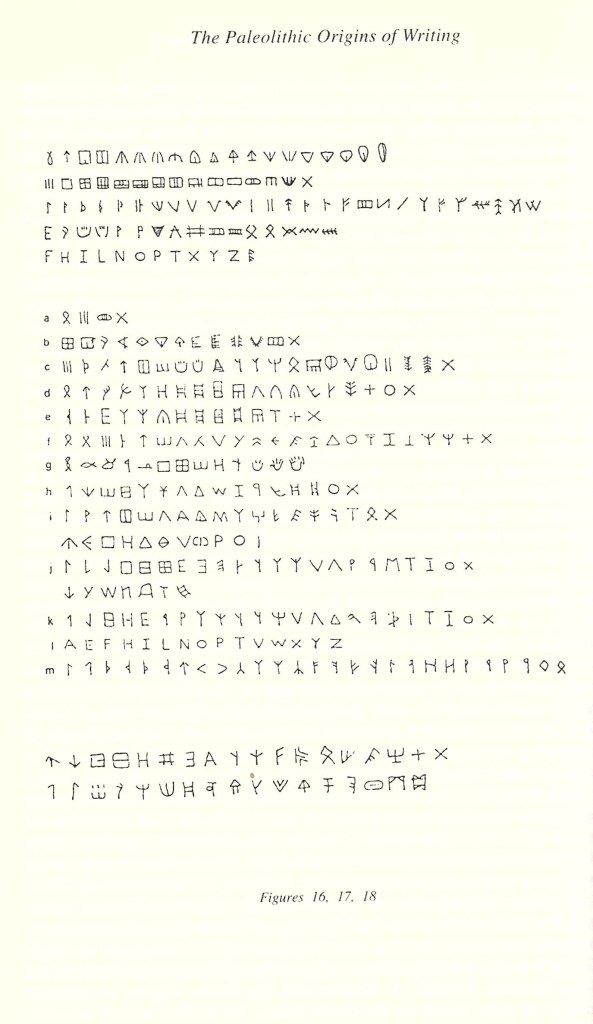
Rudgley’s Figures 16 – 18 (p. 78). Top paragraph: some of the Franco-Cantabrian (Stone Age) signs. Middle paragraph: a – hieroglyphic determinatives; b – Sumerian pictoral writing; c – Indus Valley; d – Linear A; e- Linear B; f – Cypriote; g – Proto-Sinaitic; h- Phoenician; i – Iberian; j – Etruscan; k – Greek (Western Branch); l – Roman; m – Runic. Bottom paragraph: some of the signs found on oracle bones in very ancient China.
But Can You Prove It’s Writing?
Every time some symbols are discovered that are so ancient they strain belief, anyone who doesn’t want to accept them as writing can easily go in to a number of calisthenic moves to cast doubt on this. If the item the signs are found on is in poor condition, they can question whether the marks were even intentional. Perhaps they were accidental scratches, the product of some other activity. If the marks are undeniably made by people, they can be dismissed as doodles. The Vinca signs, when first found, were speculated to have been copied randomly from Mediterranean signs by people who believed these things had mysterious power, but did not understand their meaning. Rudgley also notes that the Old European signs have been interpreted as purely magic symbols, as if a magical intent were to make them non-writing.
In short, any time we are presented with a complex system, there are always a million ways to get out of attributing it to a mind. This is doubly true if we aren’t able to interpret its meaning, but you will even see people do this with messages that they ought to be able to understand. Of course, it can also work the other way, where people see meaning in complex patterns where it wasn’t intended. Often what it comes down to is whether we want there to be a meaning there. Do we, or do we not, want to be in contact with another mind? If for whatever reason we don’t, we can always find a logical way to avoid that contact.
So in the case of apparent writing systems that we haven’t cracked and probably never will, our attitude towards them is going to depend heavily on what we believe about ancient people’s minds. Were they basically like ours, or were they different, animal? We will see more writing systems if we are expecting that they came from people. If we are not expecting to encounter people, then nothing is going to convince us that these are writing systems.
Was Adam a Writer?
My mind was blown, while taking an Old Testament Backgrounds course years ago, when I read an essay that asserted that Adam was able to write and in fact had left a written record for his descendants.
This idea seems completely loony on the face of it … until you realize that the only reason it seems loony is that we are assuming that writing is a recent, unnatural development, the product of tens of millennia of human cultural evolution, and not a characteristic human activity that is, so to speak, wired in.
The essay interpreted the early chapters of Genesis in this way. There will be a short historical record, followed by the phrase “the book of [name],” indicating that the passage immediately preceding was by that author.
Passage
Recounts
Closes with
Genesis 1:1 – 4:26
Creation (in poetry), fall, Cain and Abel, some of Cain’s descendants, Seth
Gen. 5:1 “the book of Adam”
Gen. 5:1b – 6:8
Recap of creation of Adam, Seth’s descendants up to Noah and his sons, Nephilim, God’s resolve to wipe out mankind, God’s favor on Noah
Gen. 6:9a “the book of Noah”
Gen. 6:9b – 11:9
Building of the ark, the Flood, emerging from the ark, the Table of Nations, the Tower of Babel
Gen. 11:10 “the book of Shem”
Gen. 11: 10b – 11:26
Genealogy from Shem to Terah and his son Abram
Gen. 11:27 “the book of Terah”
Gen. 11:27b – 25:18
Terah moves his family to Haran, Terah dies, a whole bunch of stuff happens to Abram, death of Sarah, Isaac finds a wife, Abraham dies, genealogy of the Ishmaelites
Gen. 25:19 “the book of Abraham’s son Isaac”
Gen. 25:19b – 37:1
Jacob’s entire life, death of Isaac, genealogy of Esau
Gen. 37:2 “the book of Jacob”
In Genesis, the author’s name comes after the notes he left.
I realize this might be a lot to accept. It’s just food for thought. It does explain why it says “the book of _________” (or, in my NIV, “this is the account of __________”), after the bulk of that person’s story.
Get it? Get it?
(By the way … for those wondering about the title of this post … prostitution is referred to as “the world’s oldest profession.” Erma Bombeck, mother and humorist, has published a book hilariously titled Motherhood: The Second Oldest Profession. The title of this post references those two, because the post is about the fact that writing is very, very old. I don’t mean to imply that a writer’s life has any necessary connection to the other two professions, although of course this does invite all kinds of clever remarks.)
Once upon a time, in the 1950s, dating just meant “going on a date.” It was a very short-term commitment, lasting only a few hours. You went out for ice cream or whatever, and then you went home. If you couldn’t stand the person, there was a natural limit to how long to you had to spend with them (the length of the date). If you liked each other, you might go on another date some time. But you were not bound to go on date after date with the same person. The idea was to go out with a variety of people, to get a sense of what sort of person might be for you. Eventually, you might “go steady” with a person you really liked, and maybe eventually get married.
But then … the Sexual Revolution happened. The expectation that a date might mean actually having sex was introduced. Suddenly, dating a variety of people made less sense. It clashed with the old-fashioned sexual mores (and with common sense) that said it wasn’t good to sleep around. Now, “going steady” with one person became the norm, and people who dated around were seen in a negative light. After all, if you were going to be sexually involved with somebody, it had better be with just one person at a time.
Futhermore, because this was a big societal shift, now nobody knew what the rules were. On the part of some of the drivers of the sexual revolution, this was intentional. They thought that society, rules, and norms as such were inherently oppressive, and that getting rid of all these things would usher in a hippie, free-love paradise. What it actually ushered in was total confusion. And while total confusion might work to the advantage of a few libertines who want to live completely unrestricted, it stresses out regular people (especially young people) who just want to know what they are supposed to do.
This confusion has persisted from my generation (X) down to the present day. It creates endless amounts of frustration, misunderstanding, and wheel-spinning as generation after generation struggles to re-invent the wheel. It also creates lots of tension and hostility between the sexes, because as it turns out, the way men naturally approach things and the way women do, do not mesh terribly well when completely unguided by any kind of norm.
The secondary car crash, caused by the train wreck
Christians, naturally, had their own reactions to all of this. We looked at modern dating, which could mean getting very sexually involved as a teen, cohabiting as a young adult, and so on, clapped our palms to our cheeks, and went “AAAAAG! This is not right!” Nor were we wrong. When I was growing up, in the 90s, the choice seemed to be between trying to do the highly risky methods of modern dating – but hopefully in such a way that you didn’t have sex before marriage, although that was kind of a crapshoot to be honest – or taking the sensible course and not dating at all. I, and many other Christians, went for the latter, but this left us without any path to get to know the opposite sex or find a suitable spouse.
Some Christian communities decided that the solution to all this confusion was “courtship” — or, as some called it, “biblical courtship.” One of the early advocates of this system was Douglas Wilson, a pastor and writer for whom I still have great deal of respect. Courtship seemed to a lot of people, myself included, like a godly alternative to the train wreck we were witnessing. Unfortunately, in an effort to avoid the train, the courtship car drove directly into the other ditch, into a wreck that was equally fiery. That’s what Thomas Umstattd Jr.’s book is about.
Components of Courtship
As older Gen Xers, my now-husband and I dodged a bullet on this one. We had both read some Douglas Wilson and we both saw the problems with modern dating since the 60s, and so when we met and realized we kinda liked each other, we wanted to do some kind of courtship. However, both of us were adults, out of the house, and living hundreds of miles away from our parents. I had gone to university, then lived with my parents again for a year while working so I could go to missions school. My husband, almost a decade older, had been to university, grad school, and had lived in various countries overseas. So, we were fully launched. Still, we tried to “court.” My husband e-mailed my dad (yes, e-mailed) and asked for permission to date me. I called my dad and said, “Aren’t you going to ask me what I think?” and he said, “Well, I assume you like him?”
In our case, “courtship” ended up meaning little more than meeting each other’s parents, getting to know them, and showing them honor as we prepared for marriage. And that’s certainly not a bad thing. But it’s very different from how it was implemented in some Christian communities, where the parents were hard-core.
When I write about courtship online, defining courtship often becomes the most controversial point in the comments. I believe that the lack of clear definition may be contributing to the crisis.
Each community feels that its form of courtship is superior to the others. Many feel that any problem pointed out in Modern Courtship as a whole doesn’t apply to them.
Umstattd, p. 53
As such, Umstattd describes courtship with a list of common characteristics:
Modern Courtship is exclusive (only court one person at a time – not like 1950s dating)
Courtship is explicitly “for the purpose of marriage.” “This kind of thinking leads to unintended consequences. Offering to take a girl out for ice cream is tantamount to asking for her hand in marriage. Awkward!” (p. 54)
Courtship requires parental approval. “Modern Courtship gives parents the right to veto any relationship. In essence, they have only a very definitive no vote. The more people in the relationship with a no button in front of them, the higher the likelihood that one of them will press it. The result is that fewer people get married.” (p. 56 – 57)
Courtship requires high accountability. “The courtship trend of high accountability at the beginning of the relationship and lower accountability as the couple moves towards marriage is exactly backward. First dates are awkward enough without a third wheel sitting there not talking — or worse, not shutting up.” (p. 58)
Courtship comes packed with purity rules. “‘The problem,’ [one man] said, ‘was that we were so accountable, we never had a moment to get to know each other. Sure, we didn’t have physical temptation, but we also didn’t have quality social interaction. After we got married, I felt like I’d married a stranger.'” (p. 59)
Courtship is intentional and intense. “Greater intensity leads to greater awkwardness. There is a lot to be said for slowing down and reducing the intensity.” (p. 62)
Courtship requires marital readiness. Most people do not feel ready to get married when they are young. They worry about finances, or about finding or being the perfect person. But a good model is to get married young. Most people will never feel ready.
These bullet points are taken from pages 53 to 64 of the book.
Uh oh, we turned the dial the wrong way!
Getting too serious too soon is a problem that Modern Dating and Modern Courtship share. Both of these systems result in singles going through one committed, heartbreaking relationship after another. They differ only in frequency and style of intensity. Modern Dating is more physically intense, while Modern Courtship of often more emotionally intense. Going steady too soon is one of the leading causes of unnecessary heartbreak for young people.
ibid, p. 88
In other words, the courtship crowd, in an effort to fix the inappropriate sexual involvement of modern dating, turned the dial in exactly the wrong direction: in the direction of more intensity, not less! This leads to more heartbreak, not less. That, if I had to sum it up, is the thesis of this book.
Umstattd goes into some detail about additional problems, one of which is the enormous amount of leverage that the courtship system gives to overprotective dads. The result is young men who are never allowed even to take a young woman out for coffee, and consequently feel like failures, and young women who feel unattractive, unaware that there are many young men who would like to date her, but her dad has been screening them out without even telling her.
How to date like a normal person
The [Christian] Baby Boomers created the rules of courtship out of fear. They wanted to protect their children from the mistakes they made during the Sexual Revolution and its aftermath. The rules came from good intentions.
During the 1990s and early 2000s, millions of young people embraced the tenets of courtship in part or in whole. And it’s no wonder why — in a culture where we demonized dating, and divorce ran rampant, Modern Courtship seemed like the only alternative.
Many of those young people are still single today, but they don’t have to be.
If you’re one of the millions of frustrated singles, there’s hope for you: there’s an easier path to marriage that’s more fun and still honors God.
If we want to get back to the marriage rates of our grandparents, we need to learn from them and adopt their approach. It’s my hope that the Traditional Dating practiced by our grandparents will be part of the solution to resolving the Courtship Crisis.
Umstattd, p. 68
In other words, according to Umstattd, the way to date like a normal person is to date the way your grandmother (or maybe now, great-grandmother) would have: don’t go out with the same fellow twice, and be home by ten.
I really wish this had been the system when I was growing up. Courtship wasn’t really a thing in my circles, so we were left, as I said, with Sexual Revolution or Nothing. Or Make It Up As You Go. Consequently, although not scarred by purity culture or courtship, I was one of those women who felt unwanted and never got asked out … and was afraid to say yes on the rare occasions when I was.
I would like my kids to be able to enjoy the practice of Traditional Dating. However, there’s a problem. Traditional Dating, like any society- or community-wide custom, depends upon everybody knowing the rules. Everybody does not know the rules. In my observation, most Zoomers still have the expectation that once a boy and girl go out or hang out once, they are “a couple” until further notice (whether that means they are sexually involved or not), and would have to “break up” if they wanted to go out with someone else. I’d like to take this pressure off our kids. But, as with so many cultural rebuilding tasks, it looks as if we are going to have to do this the hard way. Which means doing it on a case-by-case basis, with parents of Christian young people talking to one another about norms and expectations.
I would really love it if the parents of all the young women my sons know would read this book.
One Last Disclaimer
A major goal of the courtship trend, as well as purity culture (“guard your heart!”) was to avoid heartbreak. And yes, there is a large amount of totally unnecessary heartbreak that the sexual revolution had brought to those who faithfully practices its tenets. (Idols always devour their worshippers.) I absolutely agree that it ought to be possible to live in this world without throwing your heart and body out into the arena, going out and collecting heartbreak after heartbreak, trauma after frustrating and degrading trauma.
However, that doesn’t mean that it’s possible to go from being a kid to being a married adult without ever getting your heart broke.
Being a teenager is rough in every society. You feel things more intensely. Finding a wife or husband is a challenge in every society. Most people are going to have some near misses.
In other words, no system, certainly not courtship but also not Traditional Dating, guarantees protection from living in a fallen world. And no system, however wise, guarantees every person a smooth, easy path to marriage.
When applying Scripture, particularly the Old Testament, we have to differentiate between biblical practice, principle, and command. Just because Jacob had two wives and a seven-year engagement doesn’t mean that God wants all men to have two wives and seven-year engagements.
What we have in the Old Testament are a lot of stories: each one different from the others.
Sometimes a woman is the protagonist in a romance (such as Ruth with Boaz) and at other times the man takes the lead (like Jacob with Rachel). There are arranged marriages (Isaac and Rebekah) and women who entered marriage through a harem (David and Abigail, Michal, and Bathsheba). Some women even chose their own husbands (Zelophehad’s daughters).
The Bible is surprisingly quiet when it comes to laying out a system of courtship. In fact, Jesus even qualified the Old Testament marriage laws when He said the divorce code was written because of the hardness of Israel’s hearts (Matt. 19:8).
The Apostle Paul, who is usually very direct, speaks with all kinds of qualifiers when talking about romantic relationships. He makes a special point to say that not all of his instructions are from the Lord in I Corinthians 7:25 – 28. I can’t think of another topic where Paul is this cautious with his words.
Could it be that God expects courtship systems to reflect the culture of the folks getting married?
What we need is a system to help young people make good decisions.
There was a detour sign on [Calvin’s] road from Paris to Strasbourg. Francis I and Charles V were in the opening stages of their third major war. Armies sprawled across the roads forbade passage. Calvin bent his way southward by Geneva … He went to an inn, planning to spend one restful night and be gone. But … there was knock on the door of Calvin’s chamber, and an importunate caller entered, who felt himself commissioned to remake the scholar into a leader. This was, of course, Guillaume Farel, the venturesome, big-voiced, red-haired little evangelist and controversialist … Farel and his associates were intent on reconstruction [in Geneva] and had taken some significant steps in the ordering of discipline, worship, and education. [W]hen [he found out] that Calvin had come for the night, Farel eagerly sought him out, resolved in to enlist him in the Geneva work.
The interview was both dramatic and historically momentous. Farel was twenty years Calvin’s senior, and a man of flaming zeal. Calvin longed for the library and the study; to Farel this would be a desertion of the cause of the Lord.
“If you refuse,” he thundered, “to devote yourself with us to the work … God will condemn you.”
Calvin later testified that he had been terrified and shaken by Farel’s dreadful adjuration, and had felt as if God from on high had laid His hand upon him.
John T. McNeill, The History and Character of Calvinism, pp. 131 – 136
Happy New Year! Don’t let anybody guilt you into any historically significant moves!
This post is about how we got our Christmas trees. For the record, I would probably still have a Christmas tree in the house even if it they were pagan in origin. (I’ll explain why in a different post, drawing on G.K. Chesterton.) But Christmas trees aren’t pagan. At least, not entirely.
My Barbarian Ancestors
Yes, I had barbarian ancestors, in Ireland, England, Friesland, and probably among the other Germanic tribes as well. Some of them were headhunters, if you go back far enough. (For example, pre-Roman Celts were.) All of us had barbarian ancestors, right? And we love them.
St. Boniface was a missionary during the 700s to pagan Germanic tribes such as the Hessians. At that time, oak trees were an important part of pagan worship all across Europe. You can trace this among the Greeks, for example, and, on the other side of the continent, among the Druids. These trees were felt to be mystical, were sacred to the more important local gods, whichever those were, and were the site of animal and in some cases human sacrifice.
God versus the false gods
St. Boniface famously cut down a huge oak tree on Mt. Gudenberg, which the Hessians held as sacred to Thor.
Now, I would like to note that marching in and destroying a culture’s most sacred symbol is not commonly accepted as good missionary practice. It is not generally the way to win hearts and minds, you might say.
The more preferred method is the one Paul took in the Areopagus, where he noticed that the Athenians had an altar “to an unknown god,” and began to talk to them about this unknown god as someone he could make known, even quoting their own poets to them (Acts 17:16 – 34). In other words, he understood the culture, knew how to speak to people in their own terms, and in these terms was able to explain the Gospel. In fact, a city clerk was able to testify, “These men have neither robbed temples nor blasphemed our goddess” (Acts 19:37). Later (for example, in Ephesus) we see pagan Greeks voluntarily burning their own spellbooks and magic charms when they convert to Christ (Acts 19:17 – 20). This is, in general, a much better way. (Although note that later in the chapter, it causes pushback from those who were losing money in the charm-and-idol trade.)
However, occasionally it is appropriate for a representative of the living God to challenge a local god directly. This is called a power encounter. Elijah, a prophet of ancient Israel, staged a power encounter when he challenged 450 priests of the pagan god Baal to get Baal to bring down fire on an animal sacrifice that had been prepared for him. When no fire came after they had chanted, prayed, and cut themselves all day, Elijah prayed to the God of Israel, who immediately sent fire that burned up not only the sacrifice that had been prepared for Him, but also the stones of the altar (I Kings chapter 18). So, there are times when a power encounter is called for.
A wise missionary who had traveled and talked to Christians all over the world once told me, during a class on the subject, that power encounters tend to be successful in the sense of winning people’s hearts only when they arise naturally. If an outsider comes in and tries to force a power encounter, “It usually just damages relationships.” But people are ready when, say, there had been disagreement in the village or nation about which god to follow, and someone in authority says, “O.K. We are going to settle this once and for all.”
That appears to be the kind of power encounter that Elijah had. Israel was ostensibly supposed to be serving their God, but the king, Ahab, had married a pagan princess and was serving her gods as well. In fact, Ahab had been waffling for years. There had been a drought (which Ahab knew that Elijah — read God — was causing). Everyone was sick of the starvation and the uncertainty. Before calling down the fire, Elijah prays, “Answer me, O LORD, answer me, so these people will know that you, O LORD, are God, and that you are turning their hearts back again.” (I Kings 18:37)
Similar circumstances appear to have been behind Boniface’s decision to cut down the great oak tree. In one of the sources I cite below, Boniface is surrounded by a crowd of bearded, long-haired Hessian chiefs and warriors, who are watching him cut down the oak and waiting for Thor to strike him down. When he is able successfully to cut down the oak, they are shaken. “If our gods are powerless to protect their own holy places, then they are nothing” (Hannula p. 62). Clearly, Boniface had been among them for some time, and the Hessians were already beginning to have doubts and questions, before the oak was felled.
Also note that, just as with Elijah, Boniface was not a colonizer coming in with superior technological power to bulldoze the Hessians’ culture. They could have killed him, just as Ahab could have had Elijah killed. A colonizer coming in with gunboats to destroy a sacred site is not a good look, and it’s not really a power encounter either, because what is being brought to bear in such a case is man’s power and not God’s.
And, Voila! a Christmas Tree
In some versions of this story, Boniface “gives” the Hessians a fir tree to replace the oak he cut down. (In some versions, it miraculously sprouts from the spot.) Instead of celebrating Winter Solstice at the oak tree, they would now celebrate Christ-mass (during Winter Solstice, because everyone needs a holiday around that time) at the fir tree. So, yes, it’s a Christian symbol.
Now, every holiday tradition, laden with symbols and accretions, draws from all kinds of streams. So let me hasten to say that St. Boniface was not the only contributor to the Christmas tree. People have been using trees as objects of decoration, celebration, and well-placed or mis-placed worship, all through history. Some of our Christmas traditions, such as decorating our houses with evergreen and holly boughs, giving gifts, and even pointed red caps, come from the Roman festival of Saturnalia. This is what holidays are like. This is what symbols are like. This is what it is like to be human.
Still, I’d like to say thanks to St. Boniface for getting some of my ancestors started on the tradition of the Christmas tree.
Bonus rant, adapted from a discussion I had …
... in a YouTube comments section with a Hebraic-roots Christian who was insisting that Christmas is a “pagan” holiday:
So, as we can see, the evergreen tree is a Christian symbol, not a pagan one, and has been from the very beginning of its usage. St. Boniface cut down the tree that was sacred to Thor, and that was an oak tree, not a Christmas tree. Sacred oaks are pagan. Christmas trees, which incidentally are not actually considered sacred, are Christian.
Yes, I am aware, as are most Christians, that Jesus was probably not actually born on Dec. 25th. Yes, I am aware that Yule was originally a pagan feast time.
But let’s look at the symbolism, shall we?
For those of us who live in northern climes, and especially before the industrial revolution, the winter solstice is the scariest time of the year. The light is getting less and less, and the weather is getting worse and worse, and all in all, this is the time of year when winter officially declares war on humanity. Winter comes around every year. It kills the sick and weak. It makes important activities like travel and agriculture impossible. It makes even basic activities, like getting water, washing things, bathing, and going to the bathroom anywhere from inconvenient to actually dangerous to do without freezing to death. If winter never went away, then we would all surely die. That is a grim but undeniable fact. Read To Build A Fire by Jack London, and tremble.
Thus, people’s vulnerability before winter is both an instance and a symbol of our vulnerable position before all the hardships and dangers in this fallen world, including the biggie, death. And including, because of death, grief and sorrow.
Yule is a time of dealing with these realities and of waiting for them to back off for another year. After the solstice, the days slowly start getting longer again. The light is coming back. Eventually, it will bring warmth with it. Eventually, life.
Thus, it is entirely appropriate that when the Germanic tribes became Christians, they picked the winter solstice as the time to celebrate Jesus’ birth. He is, after all, the light of the world. A little, tiny light – a small beginning – had come into the bitter winter of the sad, dark world, and it was the promise of life to come. The light shines in the darkness, and the darkness has not overcome it. All this biblical, very Hebrew symbolism answers beautifully the question raised by the European pagans’ concern with the sun coming back.
Our ancestors were not “worshipping pagan gods” at Christmas. They were welcoming Christ (who is the God of Abraham, Isaac, and Jacob) into the heart of their culture. They were recognizing that He was the light, using terms they knew, which were Germanic terms, and this is not surprising because they were Germans.
So, if you want to make the case that no holidays are lawful for Christians except those prescribed in the Old Testament for Israel, be my guest. Try to find some Scriptures to back that up. And maybe you can. But you cannot make that case by accusing people who put up a Christmas tree of worshipping pagan gods. All you’ll do then is reveal yourself to be historically ignorant.
As yet, most excellent Spalatin, you have only asked me things that were in my power. But to direct you in the study of Holy Scriptures is beyond my ability. If, however, you absolutely wish to know my method, I will not conceal it from you.
It is very certain that we cannot attain to the understanding of Scripture either by study or by intellect. Your first duty is to begin by prayer. Entreat the Lord to grant you, of His great mercy, the true understanding of His Word. There is no other interpreter of the Word of God than the author of this Word, as He Himself has said: “They shall be taught by God.” Hope for nothing from your own labors, from your own understanding: trust solely in God and in the influence of His Spirit. Believe this on the word of a man who has experience.
Martin Luther, quoted in The Triumph of Truth by Jean Henri Merle D’Aubigne , p. 96
(I was going to include a picture of our angel Christmas cookies, but … we ate them all.)
Angels are scary beings that usually inspire terror whenever they appear. We don’t really understand what they are. We know they have a different kind of body, one that exists in the heavenly realms, and is probably unpicturable to us as it actually is. We know they were created by God and serve Him (the unfallen ones, anyway), but we don’t know how many kinds there are or much at all about what they actually do. We do know that they are very dangerous.
And we make … cookies of them.
I just love that.
I think it’s hilarious.
I’m sure that being made into a cookie is very insulting to the dignity of angels … those that care the most about their own dignity, anyway, which would be the fallen ones.
The unfallen ones probably just get a smile out of it, because they know that the reason for their cooki-fication, the reason humans refer to them at all, is that they played a minor but striking role in announcing the birth of Jesus … that is, in God’s dealings with humanity. And being unfallen, they probably know that since this was part of God’s plan, it was in fact very good, so it follows that having cookies made of them is actually to the glory of God. So I suppose they don’t mind.




 Out of Babel Books