
Taking up your cross and carrying it is always going to be uncomfortable. We can say clearly that this current ideology of comfort is anti-Christian in its very essence. But we should point out the fact that the church, not once, ever called its followers to look for suffering, and even made it clear that they are warned not to do that. But if a person finds himself in a situation where he’s suffering, then he should bear it with courage.
Father Kirill Kaleda, quoted in Live Not by Lies by Rod Dreher, pp. 194 – 195
Tag: theology
Quote: “Your suffering is like a seal”
Suffering is a part of every human’s life. We don’t know why we suffer. But your suffering is like a seal. If you put that seal on your actions, interestingly enough, people start to wonder about your truth — that maybe you are right about God. In one sense, it’s a mystery, because the Evil One wants to persuade us that there is a life without suffering. First you have to live through it, and then you try to pass on the value of suffering, because suffering has a value.
Maria Komaromi, quoted in Live Not by Lies by Rod Dreher, pp. 186 – 187
You’re Not Enough and That’s Okay
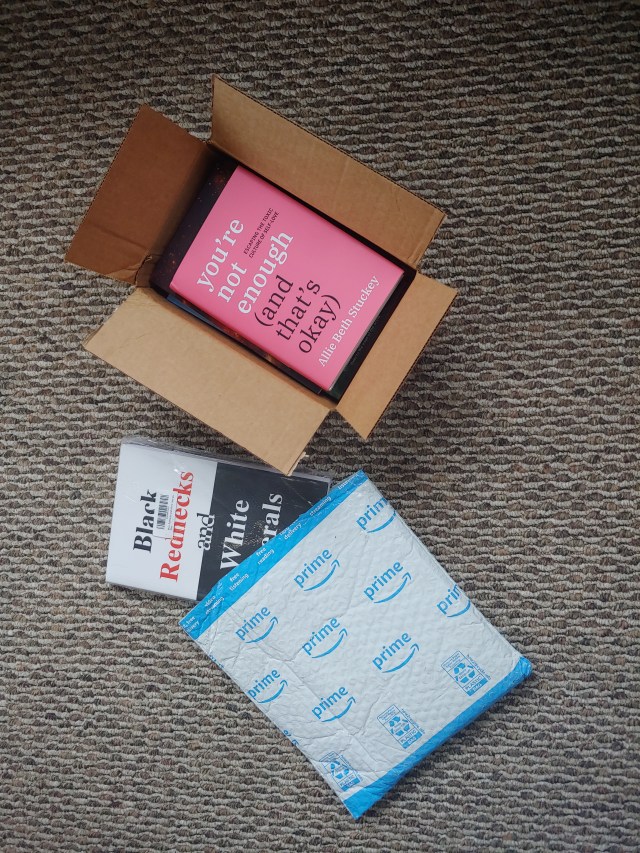
“If your self is the problem, how can your self also be the solution?”
Allie Beth Stuckey is a podcaster who speaks mostly to Millennial and Gen-Z aged women from a reformed Baptist perspective. She wrote this book to counteract the essentially Gnostic messages that are constantly being sent from all quarters to this demographic.
When Allie became a mom, it became obvious to her that young moms struggle with feeling inadequate as mothers and as people. There are a lot of reasons for this. One is that in our culture, motherhood is denigrated as a calling. Simply being a mother is not considered enough to make you an interesting, capable, intelligent person. Mothers are criticized no matter what they do. Another reason is that they are, in fact, inadequate. No one is really adequate to care for small children well while also maintaining a good relationship with a husband, and this problem is made worse by the fact that young women rarely receive any training in the domestic arts. Finally, we tend to feel overwhelmed when we are hormonal and sleep-deprived.
In response to this, a cottage industry has arisen that exists to affirm moms as follows: You are already doing great! This message comes from both secular and Christian sources. (Nominally Christian, though of course their theology leaves something to be desired.) Obviously, it’s a good business model to tell people they are already doing great. People like to hear that, and when the dopamine hit from the message inevitably wears off in the face of reality, they will come back for more, sometimes several times a day.
Allie uses her own experiences (being a mom, before that struggling with bulemia, and talking with hundreds of women) to apply some good Reformed theology to the following five myths. (She calls them myths, which is sort of polite. I would call them lies.)
- “You Are Enough”
- “You Determine Your Truth”
- “You’re Pefect the Way You Are”
- “You’re Entitled to Your Dreams”
- “You Can’t Love Others Until You Love Yourself”
Obviously, these lies are not directed only at young women in our culture, and it’s not only young women that they are damaging.
Allie systematically shows how each of these creedal statements promises comfort and power, but ultimately, if we buy into it and try to implement it, delivers despair. She does so in her signature kind, personable way that is perfectly suited to her target audience. She quotes pertinent passages of Scripture (of which there are many) and shows us how the belief that we are enough in ourselves will trap us in an endless cycle of self-improvement and prevent us from turning to the one who is enough and who has the power to save and transform us, namely Christ.
Puddleglum is a Scottish Presbyterian
“Why the dickens couldn’t you have held her feet?” said Eustace.
“I don’t know, Scrubb,” groaned Puddleglum. “Born to be a misfit, I shouldn’t wonder. Fated. Fated to be Pole’s death, just as I was fated to eat Talking Stag at Harfang. Not that it isn’t my own fault as well, of course.”
The Silver Chair, by C.S. Lewis, chapter 15
Video: Christians Talk Aliens, Bigfoot
In this video, I am keeping company with Jason McLean, a Christian paranormal researcher. That moniker should tell you a lot about the nature of this video. We discuss Bigfoot, the flood, and ancient alien theory. Our interests have a lot of overlap, but I must confess that even so, I was exposed to some ideas in the course of this conversation that (even) I found startling.
We were hosted by the lovely podcaster Chris K.
If you want to forget your troubles and bury yourself in Christian paranormal weirdness, please enjoy this 2+-hour conversation.
(N.B.: At one point, Chris asks, “Have you ever heard of Michael Heiser?” and I start squealing that I am right now reading one of Heiser’s books. Then the three of us jump into a discussion of beings called the elohim, without giving any background about what these things are. What they are, is created beings who dwell in a different realm (for convenience let’s call it “the heavens”), and are called “gods” relative to human beings. They are referred to as elohim in the Old Testament, although confusingly the same word is used to refer to the Most High God. If you want to see both uses in a single verse, see Psalm 82:1, “God [Elohim] stands in the divine council; He gives judgement among the gods [elohim].” This is an Ancient Near Eastern world view that is endorsed, with some caveats, by both the Old and New Testaments. If you’re curious how this could possibly be good theology, I encourage you to read Michael Heiser’s book The Unseen Realm.)
Um, No
Another word for poverty of choice is innocence.
The Brides of Maracoor, by Gregory Maguire, p. 12
Though I disagree, it’s still an interesting quote from an interesting book.
Bad Idea of the Week
Investigating the “well of hell” in Yemen.
Fun fact: I once read a Frank Peretti kids’ book in which this well actually is the literal entrance to hell. There was a whole explanation and back story and everything.
In general, if locals tell you a hole leads to hell — or has demons imprisoned within it — I would say stay away.
Some Much-Needed Encouragement
My son, if you accept my words and store up my commands within you,
turning your ear to wisdom and applying your heart to understanding,
and if you call out for insight and cry aloud for understanding,
and if you look for it as for silver and search for it as for hidden treasure,
then you will understand the fear of the LORD
and find the knowledge of God.
For the LORD gives wisdom, and from his mouth come knowledge and understanding.
He holds victory in store for the upright,
he is a shield to those whose walk is blameless,
for he guards the course of the just and protects the way of his faithful ones.
Proverbs 2:1 – 8
Ask, and it will be given to you;
seek and you will find;
knock and the door will be opened to you.
For everyone who asks receives;
he who seeks finds;
and to him who knocks, the door will be opened.
Jesus, in Matthew 7:7 – 8
If any of you lacks wisdom, he should ask God, who gives generously to all without finding fault, and it will be given to him.
James 1:5
And Now for My Much Lesser Words
Friends, we certainly do not have wisdom. It is equally certain that we desperately need it. The stakes are high.
These passages tell us that God is not playing mind games.
They tell us that He wants to give us wisdom, that He enjoys giving it to anyone who asks Him for it, not basing His response on whether they are already wise or good.
They tell us that despite how things may appear, if we ask, we will receive.
This Makes It All Worthwhile

Charm is deceptive and beauty is fleeting, but a woman who fears the LORD is to be praised.
Proverbs 31:30
How to Get Dressed
For the ladies
This article is a letter to my self of 25 years ago, with the hope that it might also prove helpful to my little sisters in Christ who might be struggling with some of the same issues that I was then. It’s for young Christian women who want to dress modestly, but know that being told “dress modestly” gives you close to zero guidance as to how to proceed. It builds on this article by venerable pastor and father Douglas Wilson, which gives a man’s perspective. His article lays out some excellent general principles, but I felt there was quite a bit more to be said.
So, guys, you can probably stop reading now. Read on if you wish to find out all the sartorial complexity that women have to deal with. But be warned: the passage below contains the word “bra.”
I will now address my fellow ladies directly.
Ahem
Surprise! You’re a woman. You have a brand-new, woman’s body. If you are in your late teens or early twenties, the body you have now is not the same as the one you had just a few years ago. It comes with new aches and pains. It moves differently. It attracts more attention. It’s harder to dress.
Unfortunately, there is no Standard Modest Outfit out there that all women can just pluck off the rack and don. Some societies in the past have had “traditional garb” or even actual laws about what people of different social classes could wear. Modern America is the opposite. Clothing, especially for women, is viewed as a matter of personal expression. On the plus side, this means we have almost infinite choices. On the down side, this means we have almost infinite choices. So, like it or not, if we want to wear anything at all, we have just been thrown into the wild and crazy world of women’s fashion.
But first, mindset.
You Are Probably Beautiful
You may feel unattractive in your new body. You may even feel grotesque. You may, then, be tempted to reason that it doesn’t matter whether you dress modestly or put any thought into your ensemble. No one is looking; or you can’t “get away with” a classy look; or no matter what you wear, the effect will still be one of the orcs from Lord of the Rings, but with lipstick.
This is probably not true.
The odds are overwhelming, if you are a young woman, that men find you attractive. Even if not every man does, there are probably many, many out there who do, on a daily basis.
It’s not good to motivate yourself to modesty with shame over some aspect (or all aspects) of your appearance. This can backfire in so many ways. So, regardless of how you may feel about yourself, for the purposes of getting dressed, think of yourself as a beautiful woman who wants to be modest and dignified and classy, and who can get away with any look she desires to attempt, no matter how formal, rather than as an ugly woman who has to use her clothing to either conceal or compensate for her ugliness.
You Are Going to Have to Spend Some Money
You may also be hampered in your quest to dress classy by a reluctance to spend more than $20 on any one item at any one time.
The eleventh commandment in some Christian families is, “Thou shalt be frugal.” Perhaps you were raised wearing hand-me-downs, and that worked fine when you were a kid, but now you have this new body that you have to clothe.
You may also have received the impression that spending – not just money, but time, effort, and worry – on your appearance is vain and shallow. You don’t want to be a Barbie doll. You don’t want to be “high maintenance.”
Let me tell you, putting together a modest, classy wardrobe is worth the effort. I’m not saying you have to be dressed like an executive every day and apply makeup with a trowel. Depending upon your current calling in life, your wardrobe might be different. But whatever job or role you are dressing for, you’re allowed to put some thought into it. Lumberjacks are allowed to buy steel-toed boots and suspenders and hard hats or whatever it is that lumberjacks wear, and grown women are allowed to invest in some good bras, slacks, dresses, dress boots. You are going to be donning some kind of clothes every day. They might as well be nice-looking clothes that fit you right now, not stuff left over from your middle school days, or stuff you bought on clearance but it didn’t fit but you continue to wear it because you don’t want to throw it away.
In short, by spending some time, effort, and money on this, you are not being wasteful or shallow or vain. You are being responsible.
Building up a good wardrobe might cost more or less depending upon how difficult it is to shop for your particular build.
Special Problems
If you happen to be very curvy, it’s worth pointing out that this is a special problem. When it comes to getting dressed, being very curvy is a handicap. As you have probably already noticed, most clothes are not designed for you. It’s going to be harder to find clothes that fit, and of those that do fit, clothes that look modest when they go on. You may need to go through a grieving process until you can accept that this is what you look like now, and proceed with the interesting challenge of dressing the body that has been given to you.
Get yourself fitted for a bra. It’s possible that you have been wearing ones that don’t really fit, just because that’s all that was available in stores. Because of your special problem, you are going to have to spend more money and effort than most women, but luckily, there are companies out there that specialize in making bras and clothes for the very curvy woman.
When possible, use dressing rooms. I hate dressing rooms as much as the next gal: they are gross, the lighting is always ugly, and just being in there drains the energy out of you. But it is better to spend a few minutes crying with frustration in the dressing room, than to buy a top that almost fits.
Don’t worry about sizes. Sizes are not consistent from one clothing brand to another. Many many women wear XL or XXL and do not appear fat. Buy whatever fits you.
Ponchos are your friend.
Get Your Colors Done
You could find the perfect garment, one that is modest but attractive, fits you perfectly, etc., and drop a lot of money on it … but if you hate it, you just won’t wear it.
A big part of whether you hate the garment, and whether it actually looks good on you, is color. No matter what your favorite color is, there is probably a version of it that flatters you and a version that doesn’t. Getting your colors done is a cheat code to help you find the shades that will look best on you.
The basic idea behind getting your colors done is that someone helps you determine whether you are a “Spring, Summer, Fall, or Winter” based upon your natural coloring. These aren’t personality types or anything like that … they purely describe different types of skin tone, and to a lesser degree eye and hair color. There are also YouTube videos that can help walk you through this process at home.
On the related issue of figuring out what looks good on you, I recommend finding an older fashion book from the library (not a magazine, which will just try to sell you the latest looks). I stumbled upon one in the local library which had a bunch of ordinary-looking women for models, with pictures, and it was incredibly helpful. It was a revelation, for instance, to discover that if you have a lot of color contrast between your skin and hair, you will look good in patterns with a lot of contrast such as black and white, whereas if you don’t have a lot of contrast, you will look good in softer tones. Seeing this illustrated with a variety of models was invaluable.
Pick A Few Looks You Like
Why “pick a few looks”? Why not just individual pieces? Having a look in mind will help you determine what pieces you need, how they best go together, and which ones you can and can’t combine when you get dressed in the morning. (Also, of course, every look comes with its attendant hairstyles, makeup, and accessories, but that is beyond the scope of this post.)
Why looks “you like”? Do this mean that it is all down to individual taste, and you are a modern liberated woman who can wear whatever you want? No, I am not saying that. Coming from a Christian world view, we know that no one can do whatever they want, with no limits, in any area. You have to consider modesty, being appropriate to the occasion, and what kind of image you are projecting when you go outside.
But this does not mean that individual taste is entirely irrelevant. As discussed, we live in a society where clothing is not prescribed. There are a great variety of ways to get dressed, and the choices among these are thrown back onto the individual. This is especially true for women, for whom in most situations there is no “neutral” outfit. (I owe this point to Deborah Tannen.) In this kind of social environment, you have no choice but to make choices. And that means that one factor you need to consider – you must consider – is your own taste. If you like the look you have put together, you will wear it. If you don’t, you will just keep reaching for the old t-shirt you loved when you were 15.
What look(s) you select will depend upon what region of the country you live in; whether you live urban or rural; and what kinds of social circles you move in. Perhaps you live in a city environment where you have to dress rather formally just to be taken seriously. Perhaps you are in a Christian community where the consensus is that women should always wear skirts and dresses. Perhaps you’re a farm girl who looks perfectly fine in jeans, flannel or fleece tops, work boots, and a baseball cap or maybe even a cowboy hat.
You also have to consider whether your typical day involves frequently climbing in and out of a vehicle, and if so, what vehicle. I love skirts and dresses, but if I am going to be running errands, I opt for pants instead because they are more convenient and modest when getting in and out of my car. Also, pockets.
Now we are getting into opinion territory. I’ll give you my opinions about some looks and whether they can be adapted by a Christian woman to look dignified and wholesome. This will not be comprehensive. New looks, and new variations on old looks, keep popping up all the time. I am not an expert, and have made my share of sartorial mistakes. (Oh, so many mistakes!) I am an artistic person who always secretly kind of wants to wear a costume. So take this for what it’s worth.
Some looks, in my opinion, cannot be adapted by a Christian woman because it’s integral to the look to appear very sexy, very edgy or very rebellious. Here are a few:
- 80s rocker
- 70s dance party
- Punk
- Goth/Vampire
- Steampunk
- Rockabilly (but see 50s housewife below)
- Lady rapper
- Anything pirate (Sorry, fellow costume afficionados!)
- Motorcycle gang
- Viking-inspired
Other looks can be made modest, classy, or at least sweet without doing violence to the look. Here are a few:
- Hippie (there are variations on this – beachy hippie, hippie chic)
- Preppy (also formal preppie/Audrey Hepburn/Jackie O)
- Academic (corduroy, sweaters, blazers, sensible shoes, neutral tones)
- Sporty
- 90s Grunge (baggy jeans, flannel shirts, beanies)
- 50s housewife, like Lucille Ball. Believe it or not, this is a look that is coming back. The thing that distinguishes it from Rockabilly is that the Rockabilly look combines 1950s clothes and hairstyles with an intentionally rebellious attitude, shows more skin, and features lots of tattoos.
All of these looks also have immodest versions featuring very short skirts, crop tops, and the like. They also have rebellious versions. For example, the hippie look can go in the direction of a ton of beads, peace signs, and not taking a shower. But it doesn’t need to. For preppy, you could wear a tennis skirt. For 90s grunge, some people would do their makeup to make themselves look like a heroin addict. But none of these things are integral to the look and you don’t need them. You can get the look by picking its distinctive fabrics, patterns, and colors.
Of course, you can also, if you so desire, go in the direction of Amish/Little House on the Prairie/Anne of Green Gables/Cottagecore. I love that look on other people, but it makes me look like a grandmother and I’m not ready for that yet. Also, though modest, this look is actually more conspicuous in the modern world than the looks listed above.
Good Luck, Sisters
Finally, realize that you are not locked in. You won’t be buying new clothes as often as when you were a growing child, but you will switch out your wardrobe every few years as your stage of life changes and as you get older and (probably) gain some weight. The good news is that clothing marketed to older women tends to be more modest and dignified than clothing marketed to younger women. Also, you will know yourself better when you are older, and will probably have a husband whose tastes have influenced your own, and probably more income to spend on clothes. So, feel free to take the time and money required to look classy in a way that fits your body and personality right now, realizing that this will probably change and that’s fine.
And when you have done all this, you will be a dazzling Proverbs 31 woman, “Clothed with strength and dignity.”
 Out of Babel Books