Gardy was essentially convicted the day he was arrested, and his trial is only a formality. The dumb and desperate cops trumped up the charges and fabricated the evidence. The prosecutor knows this but has no spine and is up for reelection next year. The judge is asleep. The jurors are basically nice, simple people, wide-eyed at the process and ever so anxious to believe the lies their proud authorities are producing on the witness stand.
-from Rogue Lawyer, 2016, by a very lazy version of John Grisham
I’m thinking of having a little contest. Who can find a paragraph crammed with the greatest number of offensive, lazy cliches? This is my submission. This is only the second half of the paragraph, but even if I had included the first two sentences, I still think you’d be hard-pressed to find another piece of writing where not a single word is wasted on any original thought.
… Of course, there’s a whole lot of this book to go, and so you already know that means that either Royce is wrong [about who the murderer is], or he’ll be killed before he can tell me. I will refrain from stating my preference on this particular matter.
-Benjamin Stevenson, Everyone on this Train is a Suspect, pp. 130 – 131
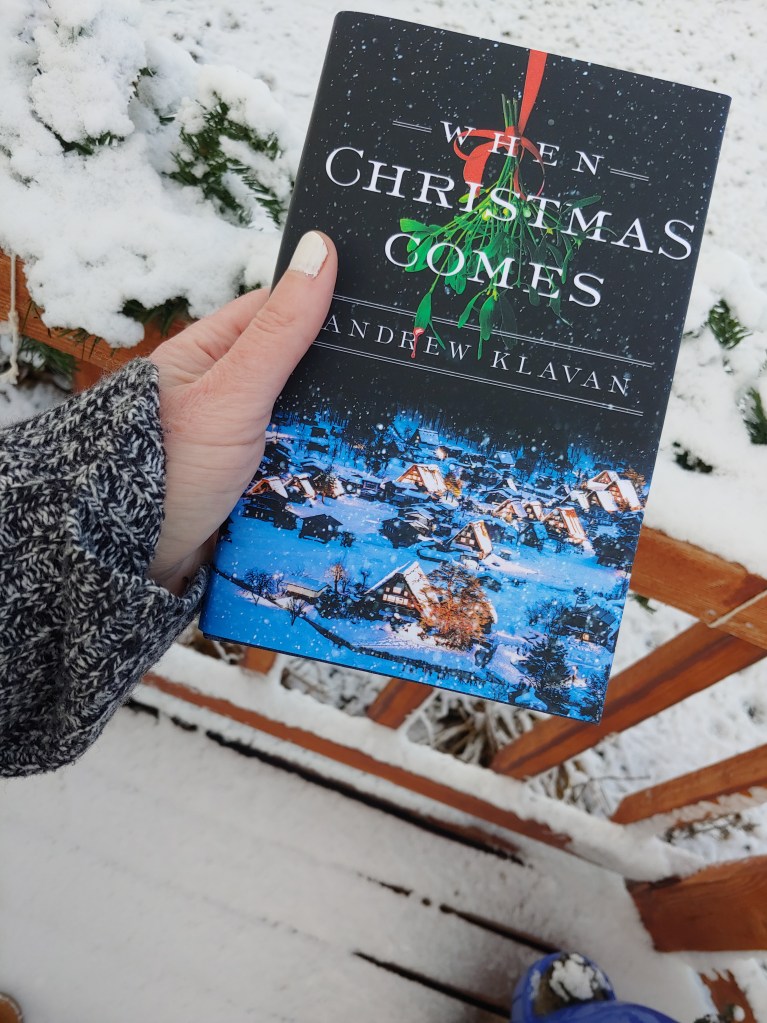
Andrew Klavan brought this novel out in time for Christmas. I got it for a loved one, and of course I had to pre-read it.
The first thing I noticed was the texture. The jacket, and the book cover beneath it, both have a unique velvety feel that makes you want to pet them. I refrained from petting, and in fact tried to touch the book as little as possible. It is supposed to be a gift, after all.
On to the contents.
This is not the best Andrew Klavan novel I’ve read, but it is still very professional … and very Christmassy.
Klavan introduces a new sleuth, Cameron Winter: handsome, lonely, etc., etc., with a tragic back story that is only partly revealed in this book. Winter is a former (spy?), now an English Lit professor. Is Klavan trying to push the buttons on the female reading population or what? On the plus side, it does allow him to put in as many literary references as he wants, without straining credibility. I also learned some new words, like “homunculus.”
I get the impression Klavan is planning to turn out a Winter series. Also, I might have heard him hint at something like this on air. He’s said that he never before invented a sleuth who seemed to have enough depth to carry a series, but now he thinks he has one.
Of course, Winter’s name makes for many thematic puns in this volume. It was a little hard for me to relate to Winter (too perfect?). He does have that intuitive, beneath-the-surface-of-the-mind method of solving crimes that I love because it’s similar to my own thought processes, and that some of Klavan’s other sleuths have also had. But it’s hard to believe of him, because the rest of him seems too Tortured Golden Boy. For example, one of Klavan’s other sleuths who had this intuitive method was a portly, aging, kindhearted private detective with vices. Lots and lots of vices. His shambling presence made his intuitive methods seem more believable, and also made his sharp mind gleam out like a bright jewel in a dark setting. Not so with Winter. But perhaps Winter will grow on me as the series progresses. Yes, I will give him at least one more book to do so.
I also think that I figured out the setting for this book! Sweet Haven is a little town surrounded by wooded hills, set near a large lake. It is within driving distance of the Big City, which is ALSO set near a large lake … which is, in turn, within driving distance of “the capitol,” which is where the university is where Winter teaches English Lit. At one point, Winter goes to Chicago, so Chicago must be sort of nearby but can’t be the Big City. Throughout the book, the skies are dull and grey, the temps are low, and there is plenty of snow, so we’re probably not in the South.
So, after getting about a quarter of the way through the book, I decided that it is set in Michigan. I think the Big City is Detroit. I pictured Sweet Haven set some way up the coast from Detroit, on the shores of Lake Huron. That would make the capitol Lansing. So naturally I assumed that Winter is a professor at MSU, and the MSU campus is where I pictured him going, including having the awesome fight scene in his tiny on-campus office. Setting this book in Michigan, and especially at MSU, will make it even more of a personal gift for its intended recipient.
First of all, the tongue twister. Shaman’s snake stick. Say that five times fast! The stick was a carved wooden snake, found in a lake (stop me before I rhyme again!) or swamp, so … possibly released there on purpose?
Secondly, an adorable picture of Finns digging in the mud. They look so happy. (As anyone should when they get to dig in the mud and find archaeological artifacts.)
Thirdly, this quote: “[S]nakes are loaded with symbolic meaning in both Finno-Ugric and Sámi cosmology, and shamans were believed to be able to transform into snakes.” Add these remote people, living at the far northern edge of the world, to the long long list of the world’s peoples who find spiritual and/or cosmological significance in snakes.
This link even has a book tie-in for me! Yes, it does! The upcoming third book in my trilogy will be called The Great Snake. And yes, ithas snake cosmology. And no, this is not very original, but it is based in research. TGS is not available for pre-order yet, but you can get ready for it by buying and reading The Strange Land if you haven’t already done so. TSL is where the serpent makes its debut, at least in my books.
Left to right: Broken Top, South Sister, North Sister
There is a trio of mountains in Oregon called the Three Sisters. In fact, the town of Sisters, OR, is named for them. In this picture, you can only see two of the them (the third is hiding behind).
I use this picture for my illustration because, while there is a lot of great art portraying the Three Fates, it’s a little hard to find a picture that I can use without copyright infringement.
I recently read, with my kids, The Black Cauldron. My imagination was captured by the three swamp-dwelling little old ladies (if human?) who guard the Cauldron: Orddu, Orwen, and Orgoch. As far as I can tell, Lloyd Alexander made up these ladies and imported them into his story. Though triple goddesses are a recurring feature in Celtic mythology, they are not really the same as the three fates and it’s even a falsehood that they always came in the form of maiden, mother, and crone, as you will see if you read the scathing 1-star reviews of the book The White Goddess by Robert Graves.
The Greek fates are named Clotho, Lachesis, and Atropos. Clotho spins the thread of a mortal’s life, Lachesis measures out its predetermined length, and Atropos cuts it. Norse cosmology also has fates, called the Norns … in some versions three, named Past, Present and Future; in some versions a large but unknown number, according to this article. Evidently the idea of fate personified as three or more women (or woman-like beings) goes way back in Indo-European cosmology. It shows up as late as Macbeth’s three witches.
I had ignored the Fates for some time (as one does); but reading The Black Cauldron made me wonder whether you can write a fantasy that draws on Indo-European cosmology and not at least tip your hat to them.
By their very nature, the Fates are creepy. Lloyd Alexander does a great job of making this feeling come through when he introduces Orddu, Orwen, and Orgoch. The heroes of the book, on first seeing the fates’ house (and by the way, the word ‘fates’ is not used), think it is abandoned because it looks so run-down and blends so well into the swamp shrubberies. There’s a loom set up inside the house, on which is a tangled mess of a weaving. (Don’t touch!) Then the ladies show up. Rather like Tom Bombadil in The Lord of the Rings, they seem cavalier about things that ordinary people regard as matters of life and death. Orddu keeps offering to turn the travelers into toads (“You’ll grow to like it”). Orgoch is excited about this because if they were toads, it’s implied she could eat them. Orgoch, the only one of the three who is clad in a black cowl, seems to want to eat everything. As Orddu says, “It’s hard to keep pets with Orgoch around.”
The three ladies light up when they hear that the travelers know Dallben, who it transpires they discovered as a foundling and raised. They refer to him as “little Dallben.” (Dallben is over 300 years old.)
The travelers stay the night in an outbuilding belonging to the three ladies. Taran, the main character, wakes up in the middle of the night and sneaks up to the window of the dilapidated cottage, which is now alight. He returns, reporting, “They’re not the same ones!” Orwen, Orddu and Orgoch now look young and beautiful, and they spend all night working on their weaving. The next morning, however, they appear looking just as they did before, and with the same apparent disregard for human life.
Lloyd Alexander has set a really high bar with this fictional, Welsh version of the fates, and I’m not even sure I could approach it. Here is an article that dives more deeply into an analysis of the fates and of all of Prydain, the fantasy world in which the book is set. Be warned, the article assumes you are familiar with the whole series.
If you are a father of daughters, and you are in a Mugrage novel, just be warned you might find yourself in this situation.
* * *
Hur grinned as he saw out of the corner of his eye his daughter Amal slipping away with some young man. Then he took a sharp second look at the man’s tall, lean silhouette. He darted into the dark and seized his daughter’s wrist.
She jerked back, pulled for a second between the two of them. The man realized what was happening and came to a halt. He approached, and Hur’s face fell.
It was as he had feared. Amal had her eye on Jai, Endu’s eldest son.
“Absolutely not,” said Hur.
Now it was Amal’s face that fell. “But, Papa!” She looked at him in dismay. Her face was round and pale in the twilight; her black hair was falling loose around it. She looked on the verge of tears.
Jai was not on the verge of tears. He was, as always, master of the situation. He took a step closer, looming over Hur without letting go of Hur’s daughter’s hand.
“Do you have something to say to me, Uncle?”
“I do,” said Hur. “No daughter of mine is going to marry a son of Endu. That is final.”
“Oh, Papa!”
“It has happened before,” said Jai.
“I am ending it now,” said Hur.
Jai shrugged as if to say that his heart was not broken. “I will take this up with the chief,” he said. He let go of Amal’s hand. Then he walked away, trying to appear nonchalant, off into the darkness.
He stood head and shoulders taller than Hur. Hur could remember when Jai was born.
He could remember when Amal was born, very vividly at this moment.
“I am nineteen years old, Papa,” she snapped.
“I held you nineteen years ago,” he replied, dragging her back towards their hut. “I made a covenant then to protect you. And I still intend to.”
There was no further confrontation when they reached home. Amal hid herself in her bunk, white-faced and crying.
Hur’s wife looked at him with a question in her eyes. Hur cast up his hands and sank to a seat, elbows on knees. He felt weak and dismayed.
He did not say to himself, What was my daughter thinking? She was a nineteen-year-old girl; he did not expect her to think clearly. It was his job to think for her.
And he had failed, or at least left it a bit too late. “It has happened before.” Had Jai been lying, trying to rattle him, or had he told the truth? Hur thought it was the truth. He could think of a few times recently when Amal had been unaccounted for. Well, now she would hate Hur when he forbade the match. She would just have to hate him. Better that she should hate her father for a little while than that she should suffer an abusive fate.
* * *
“How could they make a match without asking … The Papa? Tradition!”
How do you handle expresssions of time when writing about a preindustrial culture that does not use our time divisons?
Not that Preindusrial People Are Unaware of Time …
I’m not meaning to imply that people in preindustrial cultures take no notice of time. This is a notion, sometimes asserted, that goes with the romantic “noble savage” idea that because hunter-gatherers live closer to the earth, they necessarily live a “simpler” life, comparatively free from worries, cares, and conflict. See The Gods Must Be Crazy, the Wild Yam Question, and many others.
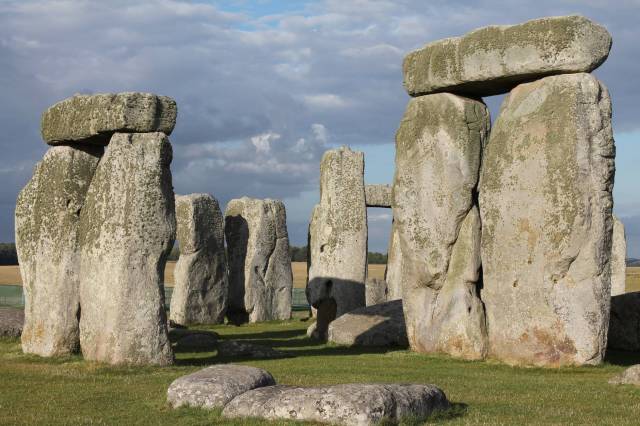
In fact, the earth is trying to kill you, so people who live close to the earth have plenty of survival-related worries (besides the usual human sin problem that did not first arise with industrialization). Farmers have to pay detailed attention to months and seasons, as do hunters, who also have to be concerned with times of day. So, no, there are no “time-free” people. In fact, there have been many ancient cultures that were very, very concerned with calendars. See Stonehenge, above, which was apparently a computer for predicting eclipses, and the Maya, who could be fairly said to be obsessed with dates.
But, Seriously, How Do You Deal with Time?
But, of course, it makes no sense to have a hunter-gatherer culture going around talking about the months by the names we give them. Let alone the days of the week, although if you follow Genesis, people have always known that days come in sevens and one day is for rest. Talk of seconds and minutes is even more of an atmosphere killer when it comes to verisimilitude.
Sci-fi writers can make up their own time divisions or draw on terms from sci-fi convention: clicks, parsecs, light-years, cycles, and no, I don’t know what most of these words mean really. They are fun, though. Perhaps in the comments you can enlighten me.
Anyway, here is how I deal with time. I didn’t spend a lot of … you-know-what … thinking about this when I first started drafting. I became more aware of it as my characters moved more into a hunter-gatherer lifestyle. You will still occasionally see the word, for example, “hours” crop up in my books. But when it would not take too much rewriting to get rid of modern time-words, here is what I use:
I don’t talk about specific months by name. Rather, I talk about seasons. (Early spring, midwinter, etc.) (However, if you are interested, my character Ikash’s birthday is in April and Hyuna’s birthday is right around Christmas.)
I do sometimes mention months in a generic sense, because everyone is aware of lunar months. I don’t say “moons,” because that sounds … well, I just feel like saying “moons” is a minefield.
It has never been necessary for me to mention weeks, either.
For “minute,” I try to use “moment,” which is less specific and technical sounding.
To-day all our novels and newspapers will be found swarming with allusions to a popular character called a Cave-Man. So far as I can understand, his chief occupation in life was knocking his wife about …
In fact, people have been interested in everything about the cave-man except what he did in the cave. Now there does happen to be some real evidence of what he did in the cave. What was found in the cave was not the horrible, gory club notched with the number of women it had knocked on the head. [It was] drawings or paintings of animals; and they were drawn or painted not only by a man but by an artist. They showed the experimental and adventurous spirit of the artist, the spirit that does not avoid but attempts difficult things; as where the draughtsman had represented the action of the stag when he swings his head clean round and noses towards his tail. In this and twenty other details it is clear that the artist had watched animals with a certain interest and presumably a certain pleasure. [I]t would seem that he was not only an artist but a naturalist.
When novelists and educationists and psychologists of all sorts talk about the cave-man, they never conceive him in connection with anything that is really in the cave. When the realist of the sex novel writes, ‘Red sparks danced in Dagmar Doubledick’s brain; he felt the spirit of the cave-man rising within him,’ the novelist’s readers would be very much disappointed if Dagmar only went off and drew large pictures of cows on the drawing-room wall.
G.K. Chesterton, The Everlasting Man (orig. ed. published 1925), pp. 27 – 30


 Out of Babel Books