Scary Thing: Bears

A Terrifying Bear Attack

So, this month I finally watched The Revenant. (It’s been out since 2015.)

The way the movie usually gets summarized is, “Leonardo DiCaprio’s character gets mauled by a bear, and his companions leave him for dead.”

Well, they don’t exactly leave him for dead. There is a lot of back and forth. There is money involved, and racial tensions, plus the difficulty of carrying a grievously injured man through rough country on a litter. But yes, basically, he does end up getting left for dead at some point, after efforts have been made to save him (and other efforts to finish him off).

Anyway, after watching, the big question in my mind was the same as in everyone else’s after seeing the movie: How in the world did they film the scene where he gets mauled by a bear?

It looks really real. I have embedded a YouTube clip of it at the end of this section, which you can watch if you have the stomach for it. At one point, the bear steps on the supine man’s head, stretches its neck forward, and snuffles directly at the camera. The glass fogs up from its breath.

Please tell me they didn’t use a real bear.

The first step, of course, was to study the credits carefully. Let’s see … Native American and First Nations acting agency … thanks to the Pawnee and Arikara nations … cultural consultants …. this stuff is fascinating. (One thing I loved about the movie was that subtitles, not dubbing, were used whenever characters were speaking Arikara, Pawnee, or French.) Oh, here it is. Animal wranglers. Wolves supplied by. Horses supplied by. Eagle supplied by. Hmm. There were no actual bears mentioned, but there were “animal puppeteers” and tons of animators.

It looks like it wasn’t a real bear.

Next step: Google. I found this article, where I learned that no, it wasn’t a real bear. It was a man in a blue suit. Even so, it took them four days just to shoot the six-minute scene, and then the bear’s muscles, skin, and fur had to be animated in separate layers.

The other disturbing thing was this: the only reason they didn’t use a real bear, was that captive bears nowadays are all too fat to be realistic.

I think that was a good move on their part.

Watch it if you dare.

Yes, in some ways the violent and unscrupulous humans are scarier, but actually … no. They are not. The scariest thing is the bear.

Euphemisms for Bear

It may surprise you to learn that the English word bear is not actually the original Indo-European word. It is a euphemism. The word used by the Indo-European ancestors, on the Ukrainian plains, was something like hrtko. My Indo-European dictionary explains in a sidebar:

The Proto-Indo-European word for “bear,” rtko-, was inherited in Hittite hartaggash, Sanskrit rksah, Greek arktos, Latin ursus, and Old Irish art.

But in the northern branches [of the Indo-European language family], the word has undergone taboo replacement. The names of wild animals are often taboo to hunters … Among the new expressions for “bear” were “the good calf” in Irish, “honey pig” in Welsh, “honey eater” in Russian, and “the licker” in Lithuanian. English “bear” and its other German cognates are also the result of taboo replacement, as etymologically they mean “the brown one.” (see bher-)

The American Heritage dictionary of Indo-European Roots, p. 74

(In case any linguistics purists are reading this, I should note that important diacritic marks are missing from the Indo-European, Hittite, and Sanskrit words in this quote.)

We can imagine that there were a number of terrifying attacks behind this taboo replacement. Or perhaps there was just one, well- (or horribly-) timed one, early in the northern Indo-Europeans’ journey towards their eventual homelands.

So, here are some euphemisms for bear:

  • bear/bruin (“the brown one”)
  • Beowulf (“bee-wolf”)
  • Medved (“honey eater”) (honey = mead)

In my books, the family ends up calling bears “the bad one.”

I like bears. But only as an idea. As actual creatures, they have earned their place on this October’s list of … Scary Things.

PSA: In case you didn’t know, Andrew Klavan has a YA series out

PSA … Public Service Announcement

YA … Young Adult

Andrew Klavan is a hard-boiled crime novelist who became a Christian around the age of 50. He is a master storyteller who gets what literature is supposed to do for a person. Consequently, he is not afraid of the dark, so to speak. His characters, particularly in his adult novels, often have major flaws. Some Christian readers don’t like the fact that Klavan’s novels often include sex scenes and a lot of language.

Well, if you want to enjoy Andrew Klavan minus all the adult stuff, look no farther than this series.

Main character Charlie goes to bed in his room one night and inexplicably wakes up strapped to a metal chair in an enclosed room, surrounded by instruments of torture. He remembers who is he (a high schooler with a black belt in karate), but he has no idea how he got here.

That’s the opening to the first book in the series, aptly titled The Last Thing I Remember. Klavan has long been fascinated with characters who have trouble remembering things, distinguishing fantasy from reality, or trusting their own thinking. Charlie is no exception. It will take him a good bit of the first book to realize that he’s forgotten an entire year of his life … and it will take nearly the whole series before he can trust himself again.

I can imagine someone will object: “Wait, because these are YA novels, there is no sex … but the very first scene includes torture?” Yes, there is plenty of violence in the Homelander novels. They are thrillers, after all. But a couple of factors mitigate this. First, sex and violence are not the same in the contexts in which they occur, what their purpose is, or the effect they have on the human mind. So I don’t think it’s necessarily hypocritical if a supposedly “clean” book excludes sex but includes some violence.

Secondly, the way the violence is handled is not exploitative. Charlie wakes up sore, in a torture room, and has obviously been through some stuff, but we don’t actually see him getting tortured. And the violence throughout the rest of the series is handled in a similarly dignified way. Klavan gives us plenty of blow-by-blow descriptions of fight scenes, chase scenes, and escape scenes, in some of which Charlie (or other characters) get hurt pretty bad. He does not give us any detailed blow-by-blows of helpless people being brutalized. And, though there are probably some deeper issues here that I haven’t thought out, this feels like an important distinction. It’s as if he allows the characters to have their choices and their dignity.

The titles of the books are:

  • The Last Thing I Remember
  • The Way Home
  • The Truth of the Matter
  • The Final Hour

Papa Eagle and Mama Eagle

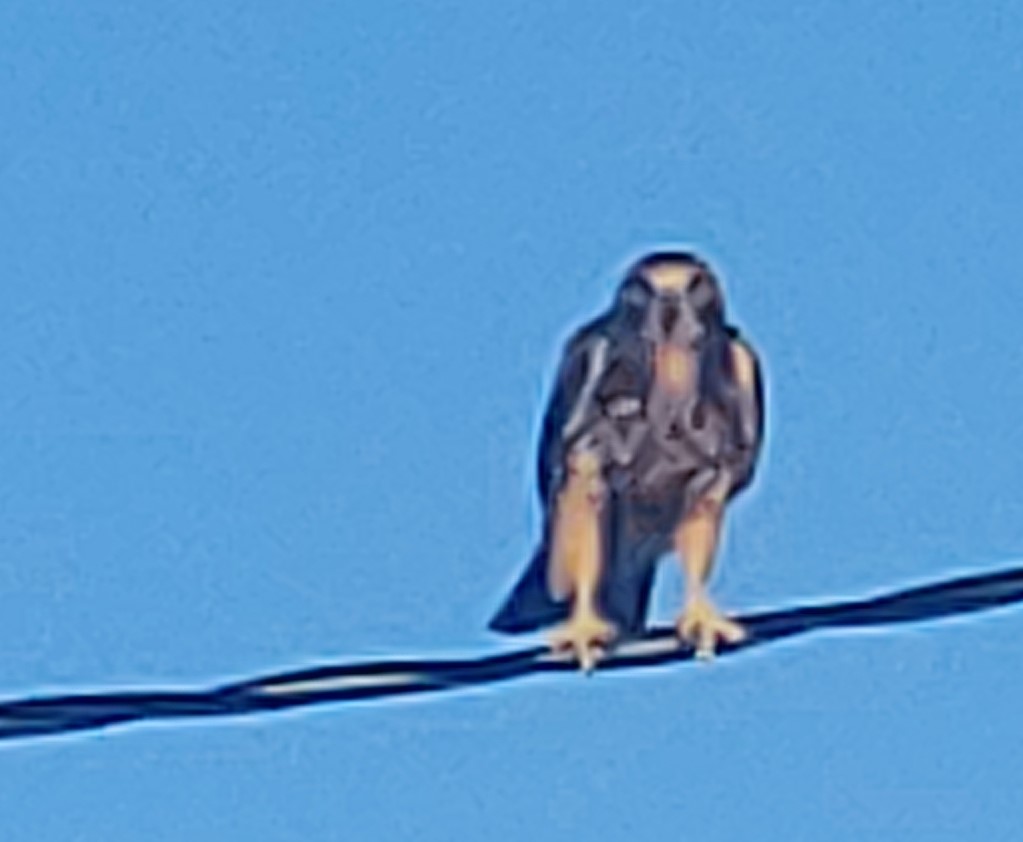
This pair lives near our house. Like, in our yard somewhere I think (possibly in the surviving spruce tree?). This photo was taken from my dining room window.

I kid you not … we move to the West, and in the very first year, a pair of eagles moves in? How lucky are we?

They are not shy. Earlier in the summer, about once a day one of them would swoop across our yard, screaming. I even saw one sitting on a telephone pole (as above), screaming, notice me, and calmly go back to screaming. I get no respect.

Watch, Papa Eagle is about to give you eye contact …

What do you mean, smile? He is smiling.

I’m Late to This Party

Apparently, based on the YouTube comments, the following song has been out for six months. I just discovered it last week, playing the country station on my car radio while running errands, and it quickly became my theme song for the week.

It’s just so doggoned unifying.

Also, I like the phrase “one big …”, as in an earlier Andrew Klavan quote, “It was like the whole country was one big series of bad choices.”

And though this song is upbeat, there is a certain insight to calling life “one big country song,” because country as a genre can be pretty tragic. You know what they say: if you play a country song backwards, you get your wife back, you get your truck back, you get your dog back …

Anyway, enjoy!

Cover Draft for The Strange Land

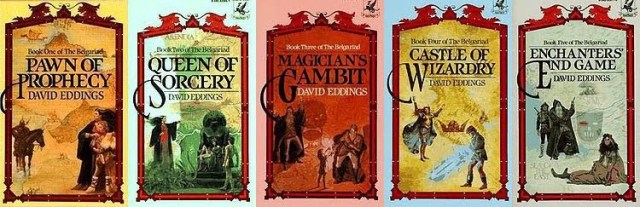
One early fantasy series that I read was The Belgariad by David Eddings. Here are the covers as they looked on the series when I had it.

As you can see, the titles are all on theme by being about chess (“pawn,” “queen,” “gambit,” etc.). The covers are all similar, but each cover has a slightly different color scheme to vary your reading experience: mustard, green, rust, blue (harder to see in this image), grey. After all, you’re going to be looking at that cover for a while, as long as you are reading the book and carrying it around. It will form part of the visual landscape of your life. Also, and this isn’t obvious unless you’ve read the series, the color and general look of each cover matches the country to which the adventurers travel in that volume.

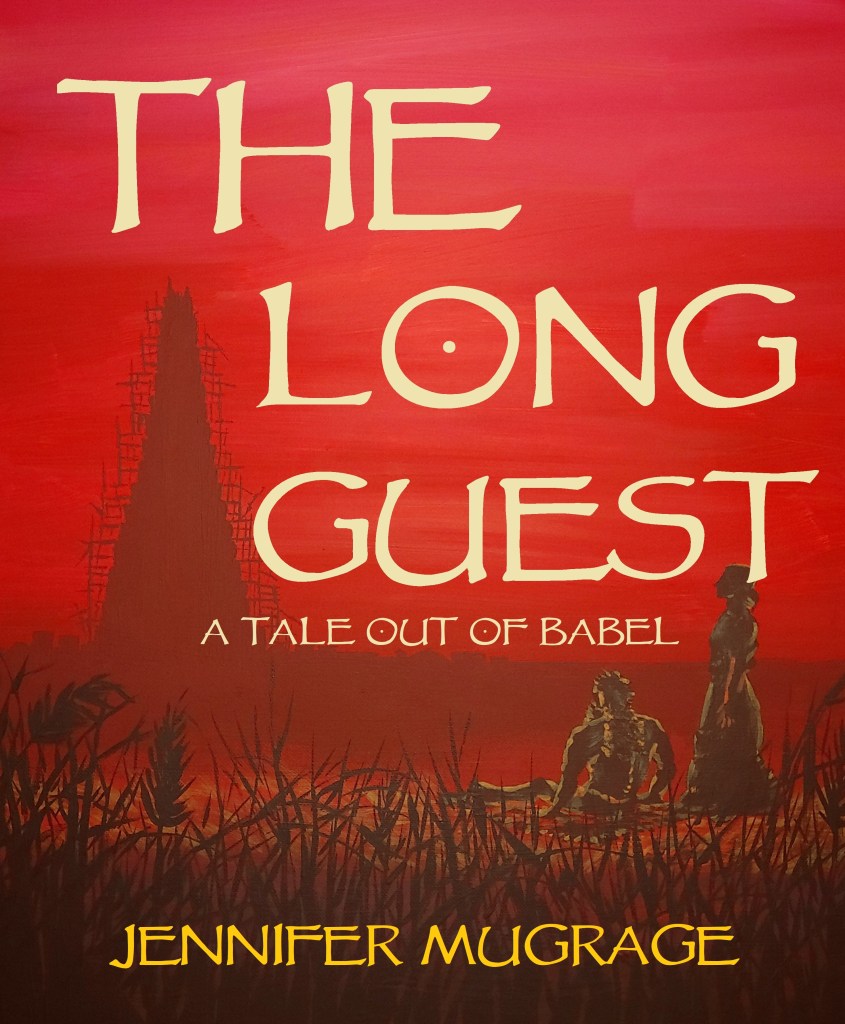
Last week, I unveiled my draft for the cover of my book The Long Guest. With the help of blog commenters, the font that we settled on for the title (at least for now) was Goblin Hand:

Now here is the draft for the second book in the series. I’ve kept the font and general title layout, but the color scheme is colder because, after all, we are going to Alaska.

Feedback please.

Writing about the Afterlife

Writing about the afterlife is tricky. It does not always go well.

Bookstooge recently reviewed a book that was set entirely in the afterlife, and it failed (at least, based on his review, it failed) because writing about the afterlife immediately brings out the limitations of the author’s understanding of: God, eternity, human nature, human embodiment, space, time, etc.

Some of these limitations on our understanding can be fixed with better theology. (For example, the TV show The Good Place could have benefitted from an understanding that the human heart is deceitful and desperately wicked, and who can know it?). Others of these limitations can’t be fixed because they are a consequence of our inability to imagine an existence that transcends space and time. New Age accounts of “out of the body” experiences immediately lose me when they describe things like “a cord coming out from between my shoulder blades that connected me to my body.” (Pro tip: if you are out of the body, you do not have shoulder blades.)

But despite these pitfalls, I find it irresistibly attractive to follow my characters just a step or two beyond death. Perhaps it’s because the moment of death is so poignant in a story, or because there is an opportunity to address unfinished business. “Wrong will be right/when Aslan comes in sight.” We are all longing for that wrong will be right moment.

The 11-minute song below is a ballad that successfully (I think) follows a character slightly past death. I find it very moving. I hope you do as well.

For the comments: when an author attempts to write about the afterlife, do you start rolling your eyes or do you go with it? What are some of your favorite post-death scenes in books or movies?

Words to Live By

“I’m telling you this mostly so you won’t try to hang any murders on Kingsley that don’t belong on him. If there is one that does, let it hang.”

“Is that why you’re telling me?” he asked.

“Yeah.”

“I thought maybe it was because you hated my guts,” he said.

“I’m all done with hating you,” I said. “It’s all washed out of me. I hate people hard, but I don’t hate them very long.”

from The Lady in the Lake, 1943, by Raymond Chandler

Cover Draft for The Long Guest

It’s Monday! Time for some art!

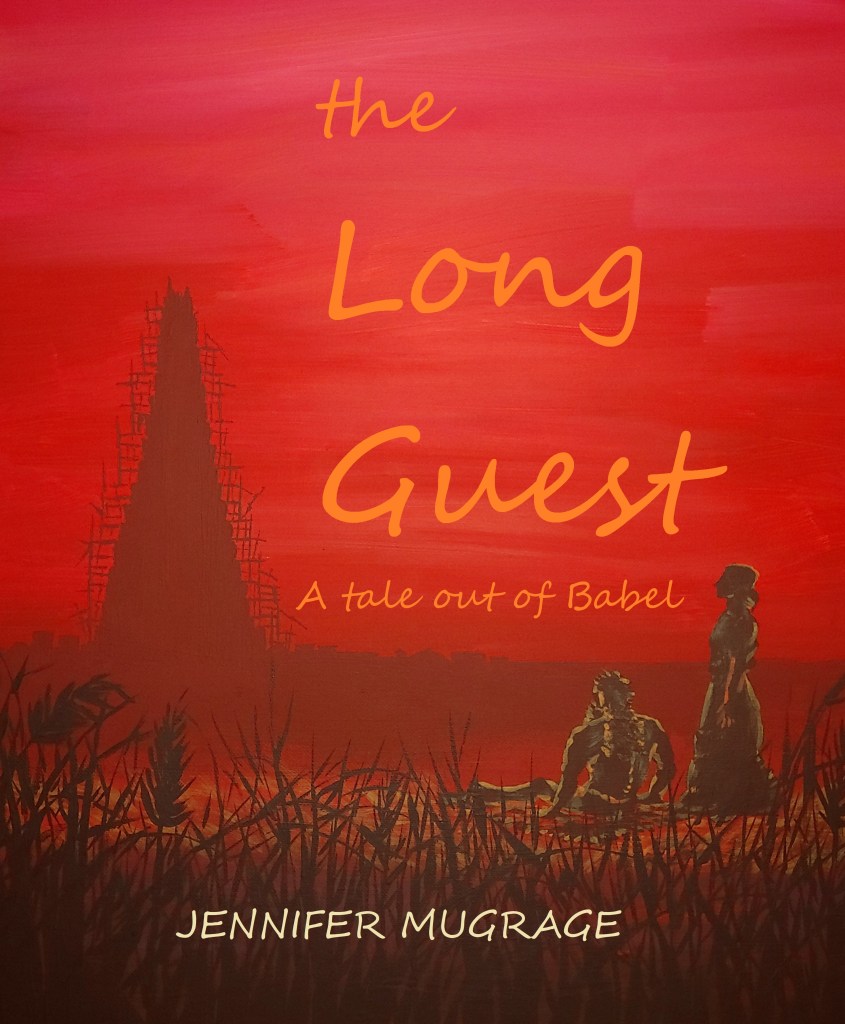
Today I present my mock-up for the cover of The Long Guest.

What is Normal for the Genre

TLG is in a genre of epic sci-fi/fantasy that is light on magic. Often books in this genre have an evocative landscape on the cover, to draw you into the world of the book. For example, this copy of Ursula Le Guin’s Left Hand of Darkness shows the icy landscape through which her characters travel …

On this cover for S.M. Stirling’s A Meeting at Corvallis, there is a lot of detail to show exactly what sort of world is contained in the covers. The broken asphalt and the ruined skyscrapers in the background show that this is a post-apocalyptic world. Meanwhile the horse and buggy, and the main character’s battle axe and chain mail, show that in this world, we use medieval technology. Finally, the man’s battle gear leads you to expect combat.

Often books in this genre will show one or more main characters, usually in only a semi-active pose. This particular one, unlike some of Stirling’s other books, shows the character face-on. I don’t prefer this as a reader, because I prefer to form my own mental picture of the character.

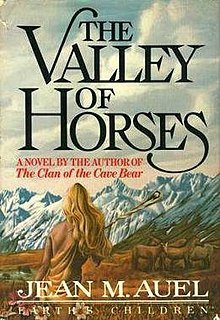
A good example is this copy of Jean M. Auel’s The Valley of Horses, which shows Ayla from behind. We’ve already been told that Ayla is tall and blond, so this doesn’t do too much damage to our mental picture of her. Notice the other hints at the important parts of the plot: the wild horses, the rugged mountains, and Ayla’s sling.

So I would like the cover of The Long Guest to look something like this. Nimri (sitting on the ground) and Zillah look at the unfinished, scaffolding-covered Tower. Grasses in the foreground hint at the steppes they will soon traverse. You get a general sense of what they look like (Nimri’s beard, Zillah’s bun), but are left to imagine their faces.

Obviously, my painting has less detail than the two examples above.

Here it is with a different title font …

And here, courtesy of photoshop tools, is a version with duller colors. I kind of like this one, but am concerned that it makes the book look like a horror story, which it isn’t.

The spine would look something like this.

What do you guys think? What kinds of covers do you expect on your fantasy books?

Postscript: Quick & Dirty Mock-Ups with Other Fonts

with Film Cryptic
with Goblin Hand