
“I’m telling you this mostly so you won’t try to hang any murders on Kingsley that don’t belong on him. If there is one that does, let it hang.”
“Is that why you’re telling me?” he asked.
“Yeah.”
“I thought maybe it was because you hated my guts,” he said.
“I’m all done with hating you,” I said. “It’s all washed out of me. I hate people hard, but I don’t hate them very long.”
from The Lady in the Lake, 1943, by Raymond Chandler
Tag: tropes
Cover Draft for The Long Guest
It’s Monday! Time for some art!
Today I present my mock-up for the cover of The Long Guest.
What is Normal for the Genre
TLG is in a genre of epic sci-fi/fantasy that is light on magic. Often books in this genre have an evocative landscape on the cover, to draw you into the world of the book. For example, this copy of Ursula Le Guin’s Left Hand of Darkness shows the icy landscape through which her characters travel …

On this cover for S.M. Stirling’s A Meeting at Corvallis, there is a lot of detail to show exactly what sort of world is contained in the covers. The broken asphalt and the ruined skyscrapers in the background show that this is a post-apocalyptic world. Meanwhile the horse and buggy, and the main character’s battle axe and chain mail, show that in this world, we use medieval technology. Finally, the man’s battle gear leads you to expect combat.

Often books in this genre will show one or more main characters, usually in only a semi-active pose. This particular one, unlike some of Stirling’s other books, shows the character face-on. I don’t prefer this as a reader, because I prefer to form my own mental picture of the character.
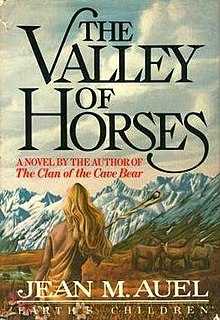
A good example is this copy of Jean M. Auel’s The Valley of Horses, which shows Ayla from behind. We’ve already been told that Ayla is tall and blond, so this doesn’t do too much damage to our mental picture of her. Notice the other hints at the important parts of the plot: the wild horses, the rugged mountains, and Ayla’s sling.

So I would like the cover of The Long Guest to look something like this. Nimri (sitting on the ground) and Zillah look at the unfinished, scaffolding-covered Tower. Grasses in the foreground hint at the steppes they will soon traverse. You get a general sense of what they look like (Nimri’s beard, Zillah’s bun), but are left to imagine their faces.
Obviously, my painting has less detail than the two examples above.
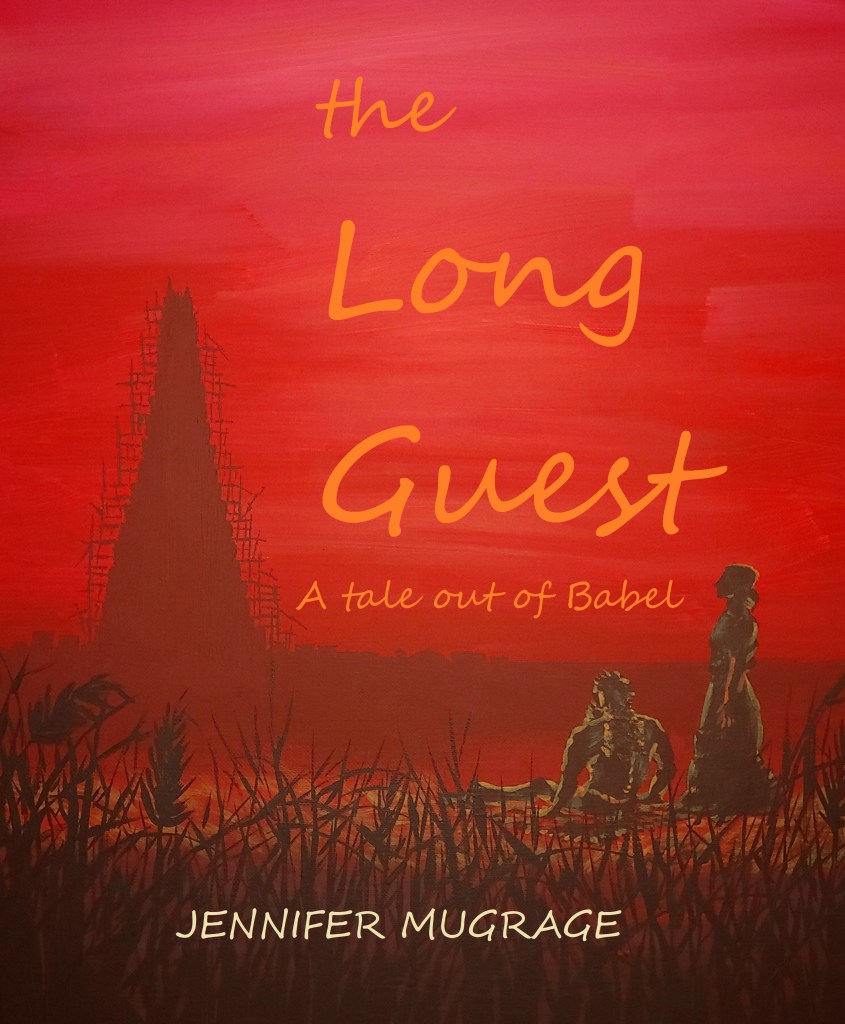
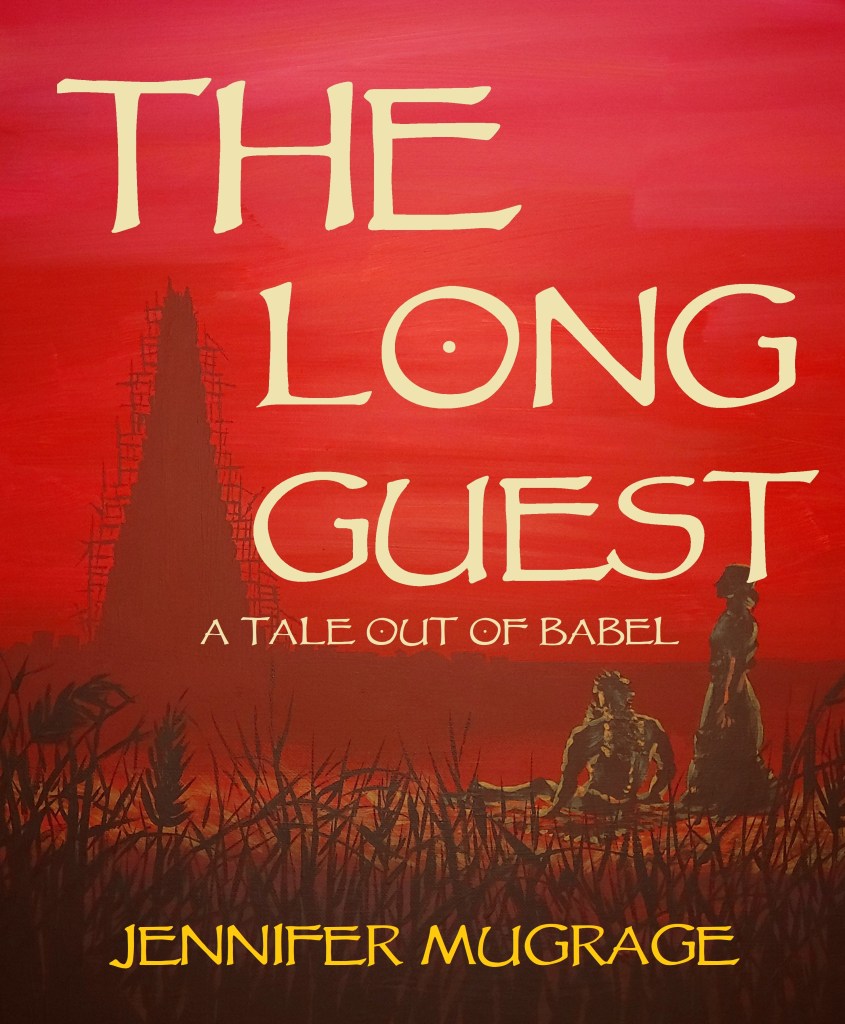
Here it is with a different title font …

And here, courtesy of photoshop tools, is a version with duller colors. I kind of like this one, but am concerned that it makes the book look like a horror story, which it isn’t.

The spine would look something like this.
What do you guys think? What kinds of covers do you expect on your fantasy books?
Postscript: Quick & Dirty Mock-Ups with Other Fonts

Hard-Boiled Quote of the Week
It didn’t bother me none. I don’t bother at all easy.
from The Lady in the Lake, 1943, by Raymond Chandler
Quote of the Week: No Good Choices
“Except it wasn’t your cheek to turn, was it?”
“What do you mean?”
“I mean, if you hadn’t shot that guy — with his wife and his kids and his mom who loved him — he’d have thrown that grenade and killed every single one of us. Nicki. Jim. And your girlfriend Lady Liberty too.”
I looked away from him so he wouldn’t see me blushing. “Yeah,” I said. “I know.”
“I bet if you asked them, you’d find out they have moms too. Nicki and Jim. Meredith. They maybe all have moms.”
“Maybe even you,” I said.
“Well, let’s not jump to conclusions,” Palmer drawled.
I walked another moment in silence. It was a pretty miserable choice, you know. You either kill a guy or he kills your friends. Either the murderous rebels win or the murderous government. It was like the whole country was just one big series of bad choices.
If We Survive, YA novel by Andrew Klavan, p. 229
Video: the Author of Ender’s Game Dispenses Writer’s Wisdom
Ben Shapiro interviews an eclectic grab bag of people each week on his Sunday Special. (Their main common factor is that they were willing to come on and be interviewed by him.) The interview embedded below is my favorite of all the ones he’s done so far. It’s super long, but if you are interested in the fiction industry or the writing process or the sci-fi and fantasy genres or identity politics or religion, then it will be worth your while.
Orson Scott Card is the author of the super popular sci-fi novel Ender’s Game. I tried to read this novel when I was way too young and I did not get all the way through it. It was hard for me to keep in mind that Ender and his co-trainees were kids when in some ways they acted like geniuses.
Card is also a Mormon, or LDS (Latter-Day Saint) as many of them prefer to be called. This gives him a unique perspective on religion, specifically on what it’s like to be misunderstood as a religious person.
Highlights:
AT 4:18, Card clears up what exactly counts as sci-fi versus fantasy: “The usual is that science fiction is stuff that has not happened but is possible, and fantasy is stuff that doesn’t happen and isn’t actually possible but we can imagine it. And that almost works except for the fact that it’s considered science fiction if you do things like faster-than-light travel or time travel. And those can’t happen. Time travel especially, because the string of causality is unbreakable. … So it’s arguable. But I learned the practical definition right away. The covers of fantasy books have trees. The covers of science fiction books have sheet metal with rivets. So it’s rivets versus trees. If your story is illustratable with rivets then it’s sci-fi, and if it needs trees to be effective, then it’s fantasy.” (N.b.: This is why my books are fantasy even though they feature no wizards.)
11:35 On the fact that fantasy magic systems have rules too: “You can’t just throw magic on the page and make it fantasy. You have to make it fantasy that would pass muster with a science fiction writer, because that’s who’s writing fantasy now.”
At 15:00, he addresses Pantsing versus Plotting: “I try to think ahead. Mostly milieu development. Then I’ll think of obligatory scenes, things that have to happen. And I’ll have to then set up those scenes so that they mean something. So there’s some planning that goes into it. I know writers who think like screenwriters, and their thought is all on the [outline]. I can’t do that, because anything I wrote for anything after chapter two is going to be discarded as soon as I find out what’s going on in chapter one. The process is pretty flexible, because by the time I’m nearing the end of any novel, the outline is now a relic … And I’ve seen, for example, an early novel by Dean Koontz, where it was obvious to me that after developing an amazing cast of characters that readers cared about, he caught up with the point in the outline where they all go into an alien spaceship together, and at that point he was just following the outline and it didn’t matter who any of the characters were.” (N.b.: Card’s method is plantsing, and it is the method I use as well. )
At 37:00, he starts talking about religions in fiction: “If you are going to create a character that has an existing religion, you have a responsibility to make it plausible. In America, we have two generic religions. If you need a hierarchical religion, you use Catholic. If you need a congregational religion, you use generic-Protestant-but-really-Baptist. Those religions are available and we all have some experience with them by watching movies. Jewish, not so much. I would feel a great deal of trepidation making a character of mine Jewish, especially orthodox, because I’ve known enough orthodox Jews to know how rigorous the demands are, what has to be kept in your head all the time. And I do that as a Mormon. I know all of our rules by heart, I don’t even have to think about them any more. But whenever I watch somebody’s fictional treatment of Mormonism, no one ever gets it right. No one even comes close. Getting somebody else’s religion wrong is a terrible faux pas.”
41:56: “That’s one of my minor messages: people have religion, and the fiction writer who retreats from that is cheating himself and his readers.”
43:51: “There are smart people in Hollywood. There are good people in Hollywood. They just don’t have the power to greenlight a film.”
At 52:00, he starts talking about the move towards identity politics in sci-fi: “And many of them, whom I know, are people who are simply writing their conscience. But their conscience is ill-informed.”
55:20 and following, on race: “When every white person in America knows that they are labelled as racist, that means why keep trying? Because no matter what you do, you are going to be labelled as white privileged and as racist. … But I know that now, all white people are getting more and more nervous that no matter what they say, it’s going to be turned on them and used to call them the ugly name racist. And that is pretty much the ugliest name that we have in our vocabulary right now. If you’re looking for your Tourette’s list of words that you should not speak, words which will wound, the f-word is way way low on the list. We are used to the f-word, we hear it all the time. Compared to racist. Wow! That’s serious. That’s savage.”
A Disaster Movie that Has Everything
Welcome to Maya week! Believe it or not, today’s post is going to tie in both to Mayan archaeology, and our recent theme of disaster preparedness.
About a month ago, I got a fever for a few days. (I don’t know. Thanks for asking. Hope it was. I’m fine now.) Of course, one of the perfect things to do while feverish is lie on the sofa and watch disaster movies that are nearly 3 hours long. Perhaps the fever was the reason I enjoyed this one so much, I don’t know. You be the judge …
As you can see, this movie has every disaster movie trope ever. Cities falling into huge cracks in the ground? Check. Tsunamis and volcanoes? Check. Evil powerful people refusing to save or warn the masses? Also check. Also, vehicles jumping over gaps, cars driving just ahead of the dust cloud, planes flying just ahead of the falling building, and the dog not dying. Also, Woody Harrelson as the crazy conspiracy theorist who turns out to be right.
I guess the only disaster movie trope that doesn’t make itself known is zombies.
Do you remember that in the years before 2012, there was a lot of talk about the Mayan calendar predicting that that year would bring a world-ending disaster? The Mayans were mathematical geniuses who had these really elaborate calendars and they would calculate dates into the extremely distant past and future. They also, like many cultures worldwide, had a cosmology that involved cataclysmic disasters recurring in a cycle. This movie imagines how it would have been if they were right, not just about recurring disasters but about the exact dates.
But it gets better. The type of disaster the movie envisions is earth crust slippage, a geological disturbance so vast that it would cause massive earthquakes, volcanic eruptions, and – as an indirect result – massive tsunamis worldwide.
Graham Hancock, in his book Fingerprints of the Gods, speculated that just such a slippage occurred between about 14,500 and 12,500 BC, and that this gave rise to the many disaster myths that are found worldwide, and to the obsession with astronomy and with predicting future disasters that we find in some ancient cultures including the Maya. This theory was originally floated by Charles Hapgood. I was really tickled that the movie even mentioned Hapgood by name.
My post about Graham Hancock’s theory of earth crust slippage here.
My post about the problems with Hapgood’s theory here.
If you are a disaster movie buff, you have probably already seen this one. If you aren’t, perhaps you wouldn’t enjoy 2012. If, like me, you are in the sweet spot – or have a fever – I highly recommend 2012 as a solid few hours of entertainment.
Spear vs. Grindstone

Another post in the series on The Lost Civilizations of the Stone Age by Richard Rudgley. (You don’t really need to see another image of the book cover, do you?)
A great deal of emphasis has been placed on the role of hunting in the Old Stone Age … Hunting has been given an inordinate status both by archaeologists and by hunting peoples themselves. In the latter case this is largely due to the fact that it is the men who do most of the hunting and they therefore pride themselves on their own achievements and tend to play down the considerable contribution of women. Prehistorians are presented with an archaeological record that contains far more information on hunting than on gathering activities … owing to the poor survival of botanical specimens.
Rudgley, p. 158
Of course, hunting is also more glamorous, riskier, and it generates better stories than “that time we found all those berries.”
According to Rudgley, in the case of modern hunter-gatherers, up to 80% of a community’s diet can consist of “gathered foods,” which includes edible plants but also such things as eggs and shellfish. We can’t assume that ancient people’s diets were exactly the same. The world has changed quite a bit (there is less big game, for example). Still, this is suggestive that people were processing and eating plants long before the supposed advent of agriculture.
The Noble Savage Myth and the Wild Yam Question
Speaking of modern hunter-gatherers, there is actually some question as to whether it is possible for people to survive on pure hunting and gathering. It is extremely difficult to find a modern hunter-gatherer group that does not get some of their calories from trade with nearby agricultural peoples, and/or “paracultivation.” Paracultivation is practiced by the Central African Pygmies, who re-plant the tops of rain forest yams (a main source of starch for them) after they harvest them, and by people in Central Borneo who depend on the sago palm for starch, who will cultivate patches of palms that they can return to and “gather” later. The so-called Wild Yam Question, first raised by Thomas Headland, postulates that in tropical rain forests there is not enough naturally occurring food for people ever to have survived there without at least paracultivation. This has been hotly debated among anthropologists. You can read an overview of the debate here: “Could ‘Pure’ Hunter-Gatherers Live in a Rainforest? : A 1999 review of the current status of The Wild Yam Question”
Was Agriculture Really a Revolution?
Implements normally associated with agriculture – mortar and pestles, sickles, grain storage – are found in the Natufian culture of the Levant (c. 10,500 to 8000 BC). I can’t resist pointing out that this is the exact time period which, in my books, comes right after the Tower of Babel and only a few hundred years after the Flood. In that, possibly true, alternate universe, these “first farmers” could have been people to whom the knowledge of agriculture was not new, but who were having to resettle the earth after a series of society-shattering disasters.
Could there have been farming before the Flood and before the Neolithic “agricultural revolution”? Mortars and pestles have been found that are at least (with the usual caveats about dates) 80,000 years old (California); 43,000 to 49,000 years old (South Africa); 30,000 years old (Australia); 44,000 years old (Ukraine); and 40,000 years old (Spain). Various stone artifacts from even farther back (Lower Palaeolithic sites, including Olduvai Gorge) have been speculated to be pounding stones, also used to process seeds or grains. (Rudgley p. 159 – 160)
The Oft-Under-Appreciated Grindstone
The grindstone may not be as glamorous as the spear and spear-thrower, but it can be used as a weapon in a pinch:
Abimelech son of Jerub-Baal went to his mother’s brothers in Shechem and said to mother’s clan, “Ask all the citizens of Shechem, ‘Which is better for you: to have all seventy of Jerub-Baal’s sons rule over you, or just one man?'”
The citizens of Shechem were inclined to follow Abimelech. They gave him seventy shekels of silver, and Abimelech used it to hire reckless adventurers, who became his followers. He went to his father’s home in Ophrah and on one stone murdered his seventy brothers. Then all the citizens of Shechem and Beth Millo gathered beside the great tree at the pillar in Shechem to crown Abimelech king.
[Things go bad between Abimelech and the people of Shechem, and he ends up razing their city.]
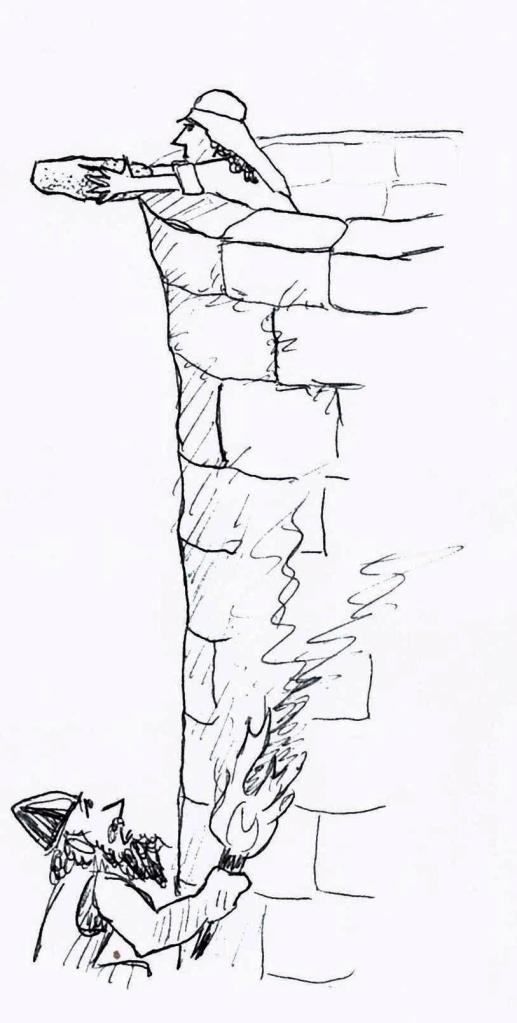
Next Abimelelch went to Thebez and besieged it and captured it. Inside the city, however, was a strong tower, to which all the men and women – all the people of the city – fled. They locked themselves in and climbed up on the tower roof. Abimelech went to the tower and stormed it. But as he approached the entrance to the tower to set it on fire, a woman dropped an upper millstone on his head and cracked his skull.
Hurriedly he called to his armor bearer, “Draw your sword and kill me, so that they can’t say, ‘A woman killed him.'” So his servant ran him through, and he died.
Judges 9:1 – 6 and 50 – 55
But we all know she did.
The Big Five and the Odd Couple
A month ago, I wrote a post about the Big Five personality traits (Extraversion, Neuroticism, Conscientiousness, Agreeableness, Openness). In the comments, Katie Jane Gallagher suggested that an author could use the Big Five to plan out their characters’ personalities. I replied that this might work for some people, but I was doubtful my characters would co-operate with being assigned a personality beforehand.
I still think it would be difficult to assign, in a fixed way, all five of your character’s traits before you begin writing. But I have thought of a trope that relies heavily on the use of character traits: the odd couple.
The Source of the phrase “The Odd Couple”
The Odd Couple was a 1968 movie starring Jack Lemmon and Walter Matthau.
Then there was a 1970 – 1975 TV series starring Tony Randall and Jack Klugman.
Also, Nathan Lane and Matthew Broderick played the same odd couple in a Broadway revival of Neil Simon’s original play.
In all of the versions, the premise is that two men are living together because each has been kicked out by their wives: one for being such a perfectionist, the other for being such a slob. High jinks follow.
How odd couple stories use Big Five traits
As you can immediately see, the odd couple trope relies on selecting one Big Five personality trait (in this case, Conscientiousness) and throwing together two people who are on opposite ends of the spectrum with regard to that trait.
This is much more manageable than trying to run down all five traits for each of your characters before beginning to plot.
Of course, when you start to develop the story, other traits will come along too. In this story, the conscientious character (Lemmon/Randall/Broderick) is also high on Neuroticism. Interestingly, it is he, with his extreme conscientiousness, who is portrayed as being the harder person to live with. The slobby person is portrayed as more normal. That is not what I expected when I set out to research the show, because in real life, slobby people can be just as hard to live with, especially if they are low in Agreeableness, for example.
In fact, some shows will dispense with the “couple” part of the odd couple and just have the gimmick revolve around one person’s extreme traits. Monk springs to mind, in which the detective’s OCD about cleanliness is so incapacitating that he must have a handler with him at all times … but his attention to detail also makes him an excellent detective.
Odd Couples Everywhere!
Once you start looking for odd couples in film and literature, it seems to be a trope that is used to enrich all kinds of stories. You find odd couple cop partners, odd couple road trips, and (ubiquitously) odd couples in rom-coms. Often odd-couple stories are funny, but they can appear in dramas as well, such as Thelma and Louise, or Charlie and Raymond in Rain Man. Whether comedy or drama (but especially in drama), one or both characters are supposed to be transformed in some way by their forced relationship with their polar opposite.
In my own first book, The Long Guest, there is a bit of an odd couple dynamic going on between Enmer and Nimri. Enmer reacts to the demise of civilization by becoming hyper-responsible as he tries to care for his extended family. Nimri, who at the beginning of the book is selfish and has no one to care for, honestly doesn’t care if he himself lives or dies. The two are forced into proximity by the dynamics of the survival situation (and by Enmer’s mother, Zillah), and while they never resolve their differences, the inherent conflict between them drives much of the action in the book.
So … what do you think? Do you like odd couple stories?
Are you a member of an odd couple? Perhaps more intensely, now during quarantine? Have odd couple stories lost their appeal? What are some of your favorite odd couples from film or literature?
The Massacre that Wasn’t
By 1768, one out of every ten people in Boston was a redcoat, a lobsterback … a British soldier. These soldiers took American colonists’ jobs at the docks, pressed them into service in the British Navy, and had the power to send them back to Britain for trial. Although the colonists were also British, it no longer felt like the soldiers were their countrymen. The soldiers didn’t like being there either. Colonists would openly insult and even assault them, and the soldiers, aware that they could be punished for doing so, did not use force to defend themselves against unarmed civilians. Until.
On a snowy night in March 1770, some kids started throwing snowballs at some redcoats. When one of them poked a redcoat, the soldier hit him with the butt of his gun. This looked like police brutality, and the soldiers quickly found themselves surrounded by an angry mob of adult colonists. Henry Knox, a bookseller who would later be in charge of munitions in the Continental Army, was there and tried to calm the mob down. He also warned the British captain not to let his men fire. The captain was saying “hold your fire” and yelling at the mob to disperse. The mob, meanwhile, was yelling, “Fire! Fire! Fire if you dare!” When the captain got hit in the face with a brick, he also yelled “fire.” Five colonists were killed (those that were standing toe to toe with the soldiers). Three died on the spot, and two died later.
As far as Samuel Adams was concerned, British soldiers had deliberately shot down innocent people in the streets. He wanted them hung. He went to silversmith Paul Revere and had him make an engraving of what he called “The Boston Massacre.” Here is copy of the engraving. As you can see, it shows the British soldiers lined up in formation, firing at the civilians (who, in the picture, are just standing there) as if on a field of battle. That is not the way things went down, but this image was circulated to stir up outrage against the British. It was an early political meme, and it was successful. The event is called The Boston Massacre to this day.

John Adams, second cousin to Samuel, believed in due process. “You know, Sam, facts are stubborn things. Regardless of our wishes, we cannot change the facts or the evidence. The law commands what is good and punishes what is evil in all, whether rich or poor, high or low. We dare not bend it to suit our opinions or the demands of the people.”
John Adams agree to serve as defense attorney for the redcoats who had been at the “massacre.” Two of them, charged with manslaughter, had their thumbs branded, but none were hung. John Adams was aware that defending the soldiers would make him unpopular, but he thought it was the right thing to do. This despite the fact that a few years later, in his measured way, he would conclude that the colonies needed to break away from Britain. Perhaps it was the presence of people like John Adams that kept our revolution from going the way that revolutions usually do, descending into purges and mob rule.
Sources

Description of the details of the Boston Massacre and the statistic about redcoats in Boston are taken from the children’s graphic novel Nathan Hale’s Hazardous Tales: One Dead Spy, Amulet Books 2012, pp. 120 – 127, where it is narrated by Crispus Attucks, who was shot directly in the chest at the massacre.
Material about Samuel Adams and Paul Revere, and the image of the engraving, is taken from George Washington’s World by Genevieve Foster, expanded edition 1997, Beautiful Feet Books, pp. 169 – 170.
Material about John Adams, including quotations, is taken from In God We Trust: Stories of Faith in American History by Timothy Crater and Ranelda Hunsicker, My Father’s World, 1997, pp. 64 – 65.
Books I Want to Have Read, but Don’t Want to Read
For those uninitiated to book blogging, a tag is when another book blogger assigns you a series of questions or prompts. For each one, you name the book that it makes you think of. And rant about it, if you so desire.
The blogger and author who tagged me was Katie Jane Gallagher.
The Rules:
- Link back to the original tag (this post, and Jami!)
- Complete the questions with books you want to have read but don’t want to read
- Tag some people at the end to do the tag next
OK? OK. Let’s get to the prompts …
The Prompts
A book that you feel you need to read because everyone talks about it
Twelve Years A Slave. Obviously that is going to be a heavy read.
Also, the Federalist Papers. Maybe “everyone” doesn’t talk about them, but people who seem to know what they are talking about keep mentioning them. Obviously there is some very important stuff in there that I need to know.
A book that’s really long

I mean, look at it.
I think there are seven of them now.
But I really need to get to these some time, if only because readers of George R.R. Martin might also be interested in my series some day. And I won’t make you wait decades either!
A book you’ve owned / had on your TBR for too long
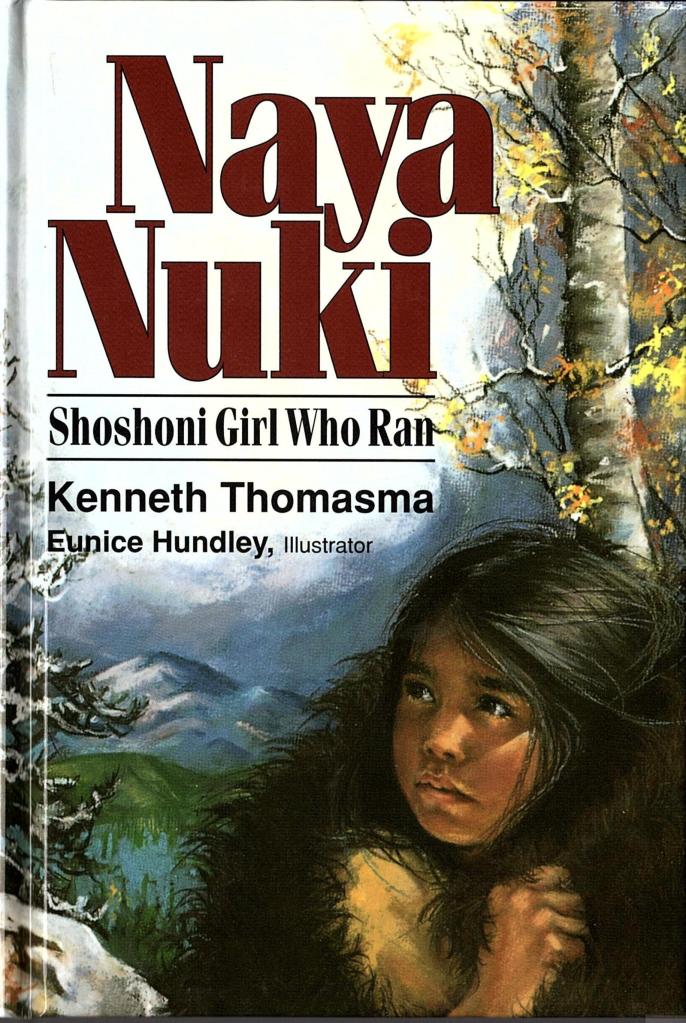
A few years ago, when my boys and I were studying American History, this novel was recommended as supplemental reading. I had all the more reason to want to read it, because Naya Nuki is Shoshone and when I lived in Idaho for a few years during my teens, it was near the Shoshone/Bannock Indian reservation. Our local library didn’t have it. I ordered it through interlibrary loan, but it never came! Must have been a long waiting list.
Fast forward three years. We have now moved back to Shoshone/Bannock country. I go to the local library here, and not only do they have Naya Nuki, they have the entire series by this author! Only problem is, the kids and I now have other required supplemental reading, and we’re working through that. I figure I’ll just zip through it by myself and return it to the library. But the due date approacheth, and I never do.
While still in this uncomfortable situation, my husband brings me home a surprise gift from his travels. It’s my very own copy of Naya Nuki! He thought it looked like something that would interest me. I’ve gone from not being able to get my hands on a copy, to an embarrassment of riches.
So I was free to return the library copy … but you guessed it, my gift copy is still sitting there unread. Why? Why???
A book that is ‘required’ reading (eg, school text, really popular classic – something you feel obligated to read!)
Everything by Freud and Nietzsche.
A book that intimidates you
Maps of Meaning by Jordan Peterson. He spent, what, decades on it? Rewrote every sentence at least 50 times? It sounds like it would be heavy going. A really thorough student of archetypes would read it, but I feel like this was the book where he developed his ideas, and now we can get the highlights of those through his class lectures on YouTube and through Twelve Rules for Life.
A book that you think might be slow

I know this one is slow, because I started it. I still think I might end up really liking it. Actually, I hope I do, because it’s sort of the same genre that I write in. But it requires a lot of attention during the first several chapters, as you have to learn a lot of different characters and figure out to who root for. It’s not the kind of book you can pick up and dive into for 20 minutes while eating your lunch, which is what I need right now.
A book you need to be in the right mood for

Circe. The main reason I haven’t read this is that it hasn’t shown up at the library yet, and I am too cheap to order it online. But there’s another reason as well.
I love the heroic age of Greece. As a teen I spent several years, off and on, immersed in this milieu. At one point I was going around telling people, “The Iliad is taking over my life!” (I also, when reading The Odyssey, had a crush on Odysseus. *blushes* Because who wouldn’t? I mean, the man can shoot an arrow through the centers of 12 ax heads lined up in a row!)
So I’m frankly super jealous of the author for having immersed herself in these books and written what everyone agrees is a fantastic novel that is true to the tradition. If I’m going to read it, it will put my head right back in that space, and I have to be ready for that.
Call, and raise you The Song of Achilles.
A book you’re unsure if you will like
Oh, so many. Pick any YA fantasy with a mermaid, vampire, or young woman on the front. I “ought” to be reading more of these, because they are fantasy and we are supposed to Read Widely In the Genre … but I just don’t find them appealing usually. Especially if the back cover copy deals with how mean everyone is to the young woman, or how she’s a member of an ostracized group.
And lest you misunderstand, I don’t say this dismissively. Probably some of these books are as meh as I expect, but no doubt others are gems. Maybe it’s even half and half. I’m not being superior. I just … can’t … get … interested …
People I Want to Tag but Also Don’t Want to Tag
Honestly, tagging activates my social anxiety. What if you’ve already been tagged for this? What if you don’t want to be tagged? What if I leave someone out? Gaaah!
I’m tagging you anyway. Don’t take it personally. If you hate the tag but want to please me, just do a super perfunctory and sarcastic tag like Bookstooge did that one time.
I’m tagging people who post frequently, because if you want something done, ask a busy person. So, if you post infrequently and didn’t get tagged and want to do this, go for it!

