Gardy was essentially convicted the day he was arrested, and his trial is only a formality. The dumb and desperate cops trumped up the charges and fabricated the evidence. The prosecutor knows this but has no spine and is up for reelection next year. The judge is asleep. The jurors are basically nice, simple people, wide-eyed at the process and ever so anxious to believe the lies their proud authorities are producing on the witness stand.
-from Rogue Lawyer, 2016, by a very lazy version of John Grisham
I’m thinking of having a little contest. Who can find a paragraph crammed with the greatest number of offensive, lazy cliches? This is my submission. This is only the second half of the paragraph, but even if I had included the first two sentences, I still think you’d be hard-pressed to find another piece of writing where not a single word is wasted on any original thought.
In summary, the typical educated Roman of this age was orderly, conservative, loyal, sober, reverent, tenacious, severe, practical. He enjoyed discipline, and would have no nonsense about liberty. He distrusted individuality and genius. He had none of the charm, vivacity, and unstable fluency of the Attic Greek. He admired character and will as the Greek admired freedom and intellect; and organization was his forte. He lacked imagination, even to make a mythology of his own. He could with some effort love beauty, but he could seldom create it. He had no use for pure science, and was suspicious of philosophy as a devilish dissolvent of ancient beliefs and ways. He could not, for the life of him, understand Plato, or Archimedes, or Christ. He could only rule the world.
I am not a person who eagerly awaits the latest release in a series, and pre-orders books as soon as they become available. Usually, I am the one who discovers the series 20 years after it came out. In fact, this series by Klavan is the only exception I can think of. I pre-ordered After That, and it came, as promised, on Halloween.
Mini reviews of the whole Cameron Winter series
This is the fifth book in the Cameron Winter series. The other books are:
When Christmas Comes (O.K. Sets up Winter’s history, shrink, and issues.)
A Strange Habit of Mind (I like it because my mind is also strange.)
The House of Love and Death (Tragic!)
A Woman Underground (Also tragic, but satisfying. Wraps up Charlotte)
After That, the Dark takes Winter on the next stage of his journey. It’s designed to be readable as a stand-alone, but you will find it more satisfying if you’ve been with him all along.
The Basic Review
Like every Winter book, this one deals with Winter’s psychological journey, and on a parallel track there is an equally devastating crime that he is trying to solve and, inevitably, prevent. Subplots include Winter’s love life and his battles with the leftie professors at the university where he is an English professor.
The title for this book is taken from a poem by English Romantic poet Tennyson:
… Who imagined that his death would be like sailing over the sandbar near the coast and out into the greater ocean.
Twilight and evening bell,
And after that the dark!
And may there be no sadness of farewell,
When I embark;
For tho’ from out our bourne of Time and Place
The flood may bear me far,
I hope to see my Pilot face to face
When I have crost the bar.
ibid, p. 160
Cameron Winter’s academic specialty is English Romantic poetry (about which Klavan recently published a book, himself). Throughout this series, it’s sort of felt as if Klavan wants to have the best of both worlds with his hero. Winter is a former government operative, a dangerous man, and also a soft, spiritual guy who just wants everyone to appreciate poetry. Sort of like a medieval knight. I haven’t felt that this tension was 100% successful in past books, although it does lead to the Superman dynamic where the nerdy guy takes off his glasses and messes up the bad guys good, which is always fun. But in this volume, Winter starts to integrate these two different sides of his personality.
The crimes in this book deal with transhumanism. The victims and potential victims are mothers and babies. One potential victim is an expectant mother who has noticed changes in her husband and can’t articulate them well enough to get anyone to believe her. It’s the kind of thing I wouldn’t have been able to handle a few years ago, when my kids were smaller. I kept reading only because this is Klavan, and I know he doesn’t like stories where women get butchered gratuitously. “Look, when there’s a killer chasing a girl with a knife, I’m on the side of the girl!”
So, if you like poetry, action scenes, demonic possession, or personal growth, you will get all of that here. It’s not exactly like any other action/crime book I’ve read. The hero is usually wrestling with his own demons, but in other books he doesn’t spend so much time talking to his shrink. It’s a bold move on Klavan’s part to allow the hero to actually start beating the personal demons. I don’t know how he’s going to continue a noir-type series once his hero becomes psychologically healthy, but I’m sure he’ll find a way.
As you can see, I’m a little conflicted about Cameron Winter. But I still wholeheartedly give this book five stars, and if you want to find out why, read on for some major spoilers.
Spoilers … and Jesus
I have mentioned before that what I live for in books is when the characters’ concrete experience and myth coalesce, so they are walking the specific path in front of them, but also enacting a mythological scene at the same time. This is a little hard to describe, but you know it when you see it. It’s what makes great art.
This fusion of the everyday and the eternal is most often found in the fantasy or sci-fi genres, because to be honest, it’s easiest to set up there. But to my delight, Klavan has here pulled it off in a modern thriller/true-crime type novel.
Let’s go back to the pregnant woman who starts to suspect her husband. Her name is Tilda, a name probably chosen for how vulnerable it makes her sound. Tilda used to be a “bar girl,” one of the town’s easy marks. Then, her husband Martin picked her up with the line, “Do you have a minute to talk about Jesus Christ?” Tilda thought that was a pretty good joke, but then Martin actually did. He actually did talk to her about Jesus Christ. And he was a perfect gentleman. Tilda married him, and she became a Christian and her life completely changed. But now, the man who led her to this change seems to have become a completely different person and Tilda, understandably, doubts herself. Sometimes, she secretly wonders whether she’s really faking this whole Jesus thing.
Winter, meanwhile, is on the track of a man he knows is out there. He knows this man will have undergone a dramatic personality change recently, and that if not found he will begin to commit gruesome crimes. Winter, though an atheist, is dating a Christian girl and she has given him a cross for his spiritual protection. Winter keeps the cross in the coin pocket of his jeans. When the bad guys, after beating him rather severely, have him handcuffed to a chair, he is able to get the cross out and use it to pick the locks on the cuffs. There follows an action scene wherein Winter, still holding the cross, manages to escape the bad guys and run barefoot into a cornfield. As he runs, a cornstalk punctures his foot. When he finally stops running and wonders why his hand hurts, he looks down and finds that the cross has pierced the inside of his fist. He has to dig it out.
When I read that, I looked up and said to my husband, “The hero just received stigmata.”
But Klavan isn’t done with Winter yet.
Tilda, meanwhile, is tied up in the crawlspace in a house her husband has been working on. She knows her husband is about to come and finish her off. Her mind is a hurricane of incoherent prayers for Jesus to spare her unborn baby.
Then Winter shows up, having already decommissioned the husband outside. Because he has been beaten so badly, his face is a swollen mess, “like a monster.” And the first thing he says to Tilda is exactly what I knew he would say:
“Don’t be afraid.”
This is how Jesus comes to us. “His appearance was so disfigured beyond that of any human being, and his form marred beyond human likeness.” (Isaiah 52:14) He shows up looking like that, and He says to us, “Fear not.”
As Winter strives to calm Tilda down enough to rescue her, he keeps saying the sorts of things that Jesus says:
“Listen to me,” the man said. “I’m going to use a knife. No, no, it’s all right, don’t be afraid. I’m going to use a knife to cut you free. It will look scary, but I will not hurt you. Nothing will hurt you now, but I have to cut you free. Don’t be afraid.”
… The man had climbed out of the space. He was above her again, reaching down for her with both hands.
“[Your husband] is not here. Let me get hold of you. Don’t you hold on to me,” he said. “I’m stronger. Let me hold on to you.”
… Tilda was crying hard now. “I prayed to Jesus and you came,” she explained.
“Oh. Well, good,” said the man. “It’s nice when things happen that way.”
ibid, pp. 305 – 307
That last line, by the way, shows that Klavan is not trying too hard with Winter. Nor is he writing an allegory. This kind of double vision in a book is all the harder to do when you let it grow naturally out of the story and don’t force it. Kudos.
You Don’t Own Me, by Mary Higgins Clark but actually by Alafair Burke, 2018
I reached for a Mary Higgins Clark because it’s autumn and I wanted me some New York City. I would never want to live there, mind, but a certain version of NYC gives autumn vibes that can’t be beat. I wanted wet leaves, Burberry plaid, private schools, brownstones, Italian restaurants, snobbery, and houses in the Hamptons. (Don’t even know where the Hamptons are, but I know they come with the package.) This book delivered those vibes adequately. It even had me turning to DuckDuckGo to look up some hole-in-the-wall restaurant in the art district that has been a NYC fixture for years apparently. Or I don’t know if New Yorkers would consider it a hole in the wall. The pictures make it look like one, to my West-of-the-Mississippi eyes, where everything is spread out from everything else.
Anyway. This was very New York-y. The protagonist’s dad is a retired NYC cop. There are Italian restaurants. There are nannies. The fiance has a live-in butler. The couple spend most of the book looking for an apartment that has to be in a certain part of the city. In fact, their realtor was so pushy that I started to wonder whether she would turn out to be in on the crime-spiracy. For NYC vibes, it was second only to a Mary Higgins Clark that I read years ago, where the protag’s mother was in the fashion industry and was killed in Central Park by being strangled with a high-fashion scarf.
As with every Mary Higgins Clark, the plotting is very good, very intricate, and the dialogue not so much. Every person who talks is very smooth, articulate, and sounds like a news anchor or else like the narrator. Oh well. I didn’t come here for Chaucer. This book went down easy.
Sweetgirl, by Travis Mulhauser, 2016
This is a Michigan gothic, which is like a Southern gothic, but with blizzards and rude people instead of polite people.
It veers very close to being a horror story, but my overwhelming impression is that of heartbreaking sorrow, but sorrow with a lot of human sweetness in it too.
The very first line sets up the whole plot by outlining the problem and introducing the principle characters in one fell swoop:
Nine days after Mama disappeared I heard she was throwing down with Shelton Potter.
Percy James is a sixteen-year-old girl who is an adult before her time. She has quit school and taken a job so that she can support herself and her druggie mother. Shelton Potter is sort of the opposite: he’s twenty-five, but his mental life is more like that of an immature teen.
The chapters alternate between Percy’s point of view, told in the first person, and Shelton’s, told in limited third. Although Percy goes through a lot of horrible stuff, which I won’t share because of spoilers, the parts that really broke my heart were Shelton’s internal monologue. Although Shelton spends the entire book high–making one horrible decision after another–a danger to himself and others–he still has thoughts and feelings. Quite a lot of feelings, actually. Mulhauser does an amazing job making us follow Shelton’s train of thought, feel his sorrow, and see his naive good intentions. Shelton really does have a good heart. It’s just that he doesn’t have any self-control or common sense. Oh, and he’s high all the time. Many books will give us an antagonist who’s a drug dealer/addict, may be violent and touchy, and may not be too bright, and often at or near the end of the book we get a tiny, poignant glimpse into this person’s sad back story. It’s a rare book that has us in that person’s mind from the very beginning, sympathizing with him to a degree but also hoping something stops him before he does major damage.
One more thing I will say in praise of this book: the prose is top shelf. To take just one example, the last paragraph of the book has Percy going through a variety of complex, poignant emotions. It does not have a single sentence telling us what Percy was thinking or feeling. Instead, every sentence in that paragraph describes something she can hear from where she’s standing. It’s all entirely concrete, and it will rip your heart out. That, my friends, is showing-not-telling. I learn at Travis Mulhauser’s feet.
The mountain feels different. The fields should have the dreamy ease of evening, but instead they’re swollen with a strange bruised glow, under a thickening haze of cloud. Closer around Trey, shadows flick silently among the underbrush, and branches twitch in no wind.
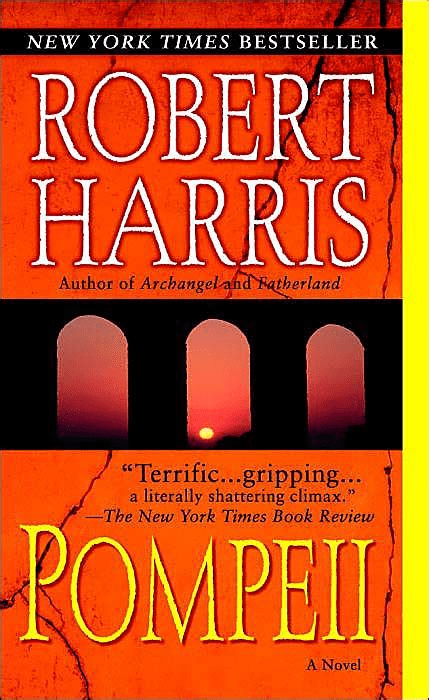
I am sorry. I am sorry that I left your book, Pompeii, moldering on my bedside bookshelf for … I don’t know … several years after I got it … I don’t know … from my husband’s trucker friend, from the library sale shelf, somewhere like that. I should have picked it up and read it immediately. I thought it was going to be demanding and … you know … educational. I didn’t know it was going to be educational. Or gripping. Or The Perfect Historical Novel.
Spoiler: Vesuvius Blows
I don’t know, reader, whether you would pick up a novel about Pompeii. Perhaps you would worry that the tension would be somewhat lacking, given how everyone knows that the mountain explodes and buries the town. It would be, you might think, sort of like reading a novel called John Dies at the End.
Harris, of course, uses the volcanic eruption’s very fame to his advantage. The people in Pompeii, and Herculaneum, and in the other towns around the bay of Neapolis, don’t know what is about to happen to them. This gives the opportunity for an infinite number of ironic quotes and thematic moments, such as the line, “I ought to die and come back to life more often,” when a narrow escape from death causes a character to be met with newfound respect. You spend much of the book wondering which, if any, of these people are going to survive.
The Historical Background
No, I am not going to sketch all the historical background here. I’ll just tell you that an awful lot is known about Roman society of this period, both general things about the culture, diet, and technology, and specific things about individuals like Pliny the Elder. (And Nero. Nero had a favorite moray eel, did you know that?) Harris makes excellent use of all this research to build a story that grows organically out of the who the characters are and what they value.
At the beginning of the book is a nice clear map of the Bay of Neapolis and surrounding regions, which is critical to visualizing the action of the book. Special attention is given to the Aqua Agusta, an aqueduct which runs from the Apenine Mountains, past all the towns in the region, with spurs providing water to Pompeii, Herculaneum, and so on, until it terminates at the naval base of Misenum, in a reservoir called the Piscina Mirabilis, “Miracle Pool.” When you see how close the Aqua Agusta runs to Vesuvius, you can see that an imminent eruption might well cause problems for the region’s water system.
The Hero
Marcus Attilius, the “aquarius,” comes from a family of men who build and maintain the empire’s aqueducts (which, by the way, like the Aqua Agusta, are often not elevated but rather are underground pipes). He was sent from Rome to Misenum two weeks ago after his predecessor, Exomnius, mysteriously disappeared. When the water running into Misenum first turns sulfurous and then starts to lose pressure, everyone is ready to blame Attilius for not having foreseen or prevented this.
Attilius, realizing the gravity of the situation, orders the city’s water supply to be shut off. There is enough in the Piscina Mirabilis to last Misenum two days with rationing. Attilius, based on which towns have lost water and which haven’t, thinks he knows approximately where the break in the aqueduct is. By pressing very hard, he hopes in two days to sail to Pompeii, send a team inland to find the exact source of the leak, send another team to re-direct the water farther upstream, buy supplies, and work through the night with a team of slaves to fix the blockage. In this way, he hopes to prevent riots and death in the towns without water. The reader knows that Attilius is also racing against time to find the reason the aqueduct broke.
We learn a lot about the Romans’ amazing aqueduct system. All the cities had, essentially, free water as a gift from the Empire. The underground pipe was six feet in diameter, with a three-foot thickness on either side made of the famous Roman cement, made with seawater, which could dry underwater and which got harder with time. There are maintenance manholes at regular intervals, and water sinks along the route which allow the water to drop rocks and silt it’s been carrying. These are then used for gravel.
The great Roman roads went crashing through nature in a straight line, brooking no opposition. But the aqueducts, which had to drop the width of a finger every hundred yards–any more and the flow would rupture the walls; any less and the water would lie stagnant–they were obliged to follow the contours of the ground. Their greatest glories, such as the triple-tiered bridge in southern Gaul, the highest in the world, that carried the aqueduct of Nemausus, were frequently far from human view.
page 181
The Villain
Ampliatus is a former slave. His master, who used him as a toy (yes, the Romans were horrible people), set him free in his will at the age of twenty. Ampliatus, by this time a ruthless social climber, began to amass wealth by buying real estate around Pompeii. Several years before the book opens, the city suffered an earthquake. Most of the aristocrats fled, but Ampliatus is unendingly proud of himself because he stayed, bought up a bunch of buildings on the cheap, fixed them up, and became the nouveau riche. By the time the book opens, he has bought his former master’s estate. His bedroom is the one where he used to be molested. He has gotten his former master’s son in debt to him, and is persuading him to marry Ampliatus’s daughter. He is building an ambitious bathhouse in the middle of the city. As Ampliatus says to the aquarius when he’s trying to corrupt him, water is key to civilization.
As a former slave, Ampliatus outdoes the aristocrats he imitates in both cruelty and ostentatiousness. There is a memorable scene of a feast Ampliatus gives, of the kind that historians would probably call sumptuous. It’s held in Ampliatus’ triclinium (dining room) on a swelteringly hot August night, and no one but Ampliatus wants to be there.
And the food! Did Ampliatus not understand that hot weather called for simple, cold dishes … then had come lobster, sea urchins, and, finally, mice rolled in honey and poppy seeds. … Sow’s udder stuffed with kidneys, with the sow’s vulva served as a side dish … Roast wild boar filled with live thrushes that flapped helplessly across the table as the belly was carved open … Then the delicacies: the tongues of storks and flamingoes (not too bad), but the tongue of a talking parrot had always looked to Popidius like nothing so much as a maggot. Then a stew of nightingales’ livers …
pp. 146 – 147
Reader, I have spared you the most disgusting parts of this dinner.
Ampliatus has commissioned a positive prophecy about the city of Pompeii from a sybil–an older female seer–and is keeping it in readiness for the next time he needs to get the people all excited … probably in order to ensure the election to public office of an aristocrat he has in his pocket. And here is what the sybil has said: Pompeii is going to be famous all over the world. Long after the Caesars’ power has faded, people from all over the world will walk Pompeii’s streets and marvel at its buildings. Ampliatus takes this as a very good sign.
The Scholar
Pliny the Elder, an actual historical person, makes an appearance as a prominent side character. Pliny was stationed as a peacetime admiral at Misenum. When Vesuvius started erupting, it was clearly visible across the bay. Pliny, who had written a whole encyclopedia about the natural world, received a message from an older female aristocrat in Herculaneum, begging him to come and save her library. (In Pompeii, this message is delivered by Attilius.) Pliny launched the navy without imperial permission, intending to save the library and also evacuate the towns near the eruption. But pumice falling from the sky, floating on the water, and clogging the bay prevented the ships from approaching the coast. Pliny and his crew were forced to take refuge belowdecks, and their ship was driven across the bay to Stabiae, where they took refuge overnight. Eventually, they had to evacuate on foot, but Pliny, who was fat and was perhaps suffering from congestive heart failure, chose to stay, and ended up dying in the gaseous cloud that swept along the coast.
The remarkable thing is that during this entire time, Pliny had his scribe with him, and he was dictating his observations about the “manifestation.” His notes were saved. It occurs to me that the stereotype of the British absentminded professor who is never rattled by anything, and always keeps his cool and approaches everything with perfect manners and scientific curiosity (and is an incurable snob), may have roots deeper than England itself.
Go read this book right now!
Despite the large amount of detail in this review, I assure you that I have merely scratched the surface and that this review contains very few spoilers for the novel. I really can’t say anything better about it than that it is, in my estimation, the perfect historical novel. Please go read it if you have any interest at all in the genre.
So, this post may only apply to those of you who have read and/or enjoyed my books … or to fellow fiction-writers who like to talk about the writing process. Others can bow out now, no hard feelings.
I’ve heard that some writers create a “mood board” or a collection of images or media that give a feel for how they want their book to be, when they are building their world. I don’t do that, because I kind of do worldbuilding and plot discovery more or less at the same time, as an iterative process. It’s usually not until I am deep into the draft (or at the end) that the theme of the book emerges.
Nevertheless, with all three of the books in my trilogy, as I neared the end of the drafting, a song or a poem floated up to the surface that seemed perfectly to capture the emotional tone of the book or the experience of a main character. Here they are:
For The Long Guest, it was this poem by Emily Dickinson:
My life closed twice before its close–
It yet remains to see
If immortality unveil
A third event to me
So huge, so hopeless to conceive
As these that twice befell.
Parting is all we know of heaven,
And all we need of hell.
This poem, obviously, represents Zillah’s experience in a much more succinct way.
For The Strange Land, as I wrote about Ikash’s difficult child and teen years and eventual redemption, I was haunted by this hymn:
“She hath suffered many a day / Now her griefs have passed away.”
Ikash is not unique. His story in some sense happens to everyone.
As I wrote The Great Snake, I realized that the dilemma Klee finds herself in was perfectly captured by this Bryan Duncan song:
And … as for the book I am currently drafting … no data
Update: The official mind-worm for The Bright World is Why Not Me? by the Judds.
How about you, fellow writers? How does your mind work? Do you often have media serendipitously match your book as you are writing it?
Readers, do you get a relevant song or quote stuck in your head as you are reading?
The [journalism] instructor stressed his formula for writing the ideal headline to describe the story below it–a job in which every letter in every word counts (and W’s and M’s, being fat, count double …). You look for the specific word first. Use the specific “pistol” and switch to the general “gun” only if pistol is too long for the line.
I took this dogma with me to the newsroom of The Daily Oklahoman … The slot man … handed to me [a trivial story] that reported a woman filing suit against a doctor who had operated on her eleven years earlier. A subsequent surgery had revealed that the first surgeon hadn’t extracted one of his forceps before stitching up the abdomen.
I wrote: SURGEON’S FORCEPS / LEFT IN WOMAN / ELEVEN YEARS.
The slot man told me the line was too long and tossed it back to me to revise. Forceps is specific of what? It’s a tool, right? The first line became Surgeon’s Tool. That fit. Hours pass with more headlines written. The bulldog edition comes up from the printing plant. The night city editor scans it. Reaches page 27. Shouts: Stop the press, glowers at the slot man, and says, “Who wrote this!” I am identified as the culprit …
That Stop the press shout is often heard in old movies, but that was the only time I ever heard it in real life. Professor Herbert called me in, and … seemed perfectly satisfied that I could be blamed only for innocence in a world full of night city editors with dirty minds. I got a “B” in the course.
The following review was posted on GoodReads on June 27.
I love Tony Hillerman’s Navajo police procedurals. A few years ago, I got to travel through Navajo country (Dinetah), which was amazing because for fans of Hillerman it’s like getting to visit Middle Earth. At the Navajo Cultural Center gift shop, they displayed many of Hillerman’s books, and this memoir. I picked it up, but it took me several years to get around to reading it.
Once I did, it went fast because this is a page-turner. Hillerman’s writing is understated and vivid (he started his writing career as a journalist).
It turns out that Hillerman is closer to the age of my grandparents. He grew up in the Dust Bowl during the Depression, fought in the Battle of the Bulge. Quite a lot of the book is devoted to his memories of France during WWII. He was then injured (legs, and eyes), spent some time in the hospital, and was sent home with crutches and an eye patch. He discovered that “Military Intelligence is usually neither.” He doesn’t dwell on it, but he had PTSD before that was a word. Nightmares, unable to keep his breakfast down. He recounts, in the 1950s, seeing a grisly car accident that made the police officer on the scene vomit, but Hillerman stood there unaffected.
Hillerman and his wife also adopted a number of children, and raised a big, happy family.
All of this is related with almost no self-pity, and it’s often very funny.
This book contained less about the Navajo than I expected. I guess Hillerman has poured his learning about them into his novels rather than into his memoir. But by the time the book reached his later years, when the Navajo became a big theme, I was not disappointed about this because the book itself had already been such an entertaining ride.
There is an appendix which lists a number of Hillerman’s books and sketches out the process that led to each one. They presented different kinds of problems that will be reassuringly familiar to other authors.
All in all, Tony Hillerman is a total mensch, a good egg, and it’s been an honor to get to know him.





 Out of Babel Books