
The mountain feels different. The fields should have the dreamy ease of evening, but instead they’re swollen with a strange bruised glow, under a thickening haze of cloud. Closer around Trey, shadows flick silently among the underbrush, and branches twitch in no wind.
Tana French, The Hunter, p. 439
Tag: writing process
Pompeii: A Masterclass in How to Write Historical Fiction

Pompeii by Robert Harris, pub. 2003
Dear Robert Harris,
I am sorry. I am sorry that I left your book, Pompeii, moldering on my bedside bookshelf for … I don’t know … several years after I got it … I don’t know … from my husband’s trucker friend, from the library sale shelf, somewhere like that. I should have picked it up and read it immediately. I thought it was going to be demanding and … you know … educational. I didn’t know it was going to be educational. Or gripping. Or The Perfect Historical Novel.
Spoiler: Vesuvius Blows
I don’t know, reader, whether you would pick up a novel about Pompeii. Perhaps you would worry that the tension would be somewhat lacking, given how everyone knows that the mountain explodes and buries the town. It would be, you might think, sort of like reading a novel called John Dies at the End.
Harris, of course, uses the volcanic eruption’s very fame to his advantage. The people in Pompeii, and Herculaneum, and in the other towns around the bay of Neapolis, don’t know what is about to happen to them. This gives the opportunity for an infinite number of ironic quotes and thematic moments, such as the line, “I ought to die and come back to life more often,” when a narrow escape from death causes a character to be met with newfound respect. You spend much of the book wondering which, if any, of these people are going to survive.
The Historical Background
No, I am not going to sketch all the historical background here. I’ll just tell you that an awful lot is known about Roman society of this period, both general things about the culture, diet, and technology, and specific things about individuals like Pliny the Elder. (And Nero. Nero had a favorite moray eel, did you know that?) Harris makes excellent use of all this research to build a story that grows organically out of the who the characters are and what they value.
At the beginning of the book is a nice clear map of the Bay of Neapolis and surrounding regions, which is critical to visualizing the action of the book. Special attention is given to the Aqua Agusta, an aqueduct which runs from the Apenine Mountains, past all the towns in the region, with spurs providing water to Pompeii, Herculaneum, and so on, until it terminates at the naval base of Misenum, in a reservoir called the Piscina Mirabilis, “Miracle Pool.” When you see how close the Aqua Agusta runs to Vesuvius, you can see that an imminent eruption might well cause problems for the region’s water system.
The Hero
Marcus Attilius, the “aquarius,” comes from a family of men who build and maintain the empire’s aqueducts (which, by the way, like the Aqua Agusta, are often not elevated but rather are underground pipes). He was sent from Rome to Misenum two weeks ago after his predecessor, Exomnius, mysteriously disappeared. When the water running into Misenum first turns sulfurous and then starts to lose pressure, everyone is ready to blame Attilius for not having foreseen or prevented this.
Attilius, realizing the gravity of the situation, orders the city’s water supply to be shut off. There is enough in the Piscina Mirabilis to last Misenum two days with rationing. Attilius, based on which towns have lost water and which haven’t, thinks he knows approximately where the break in the aqueduct is. By pressing very hard, he hopes in two days to sail to Pompeii, send a team inland to find the exact source of the leak, send another team to re-direct the water farther upstream, buy supplies, and work through the night with a team of slaves to fix the blockage. In this way, he hopes to prevent riots and death in the towns without water. The reader knows that Attilius is also racing against time to find the reason the aqueduct broke.
We learn a lot about the Romans’ amazing aqueduct system. All the cities had, essentially, free water as a gift from the Empire. The underground pipe was six feet in diameter, with a three-foot thickness on either side made of the famous Roman cement, made with seawater, which could dry underwater and which got harder with time. There are maintenance manholes at regular intervals, and water sinks along the route which allow the water to drop rocks and silt it’s been carrying. These are then used for gravel.
The great Roman roads went crashing through nature in a straight line, brooking no opposition. But the aqueducts, which had to drop the width of a finger every hundred yards–any more and the flow would rupture the walls; any less and the water would lie stagnant–they were obliged to follow the contours of the ground. Their greatest glories, such as the triple-tiered bridge in southern Gaul, the highest in the world, that carried the aqueduct of Nemausus, were frequently far from human view.
page 181
The Villain
Ampliatus is a former slave. His master, who used him as a toy (yes, the Romans were horrible people), set him free in his will at the age of twenty. Ampliatus, by this time a ruthless social climber, began to amass wealth by buying real estate around Pompeii. Several years before the book opens, the city suffered an earthquake. Most of the aristocrats fled, but Ampliatus is unendingly proud of himself because he stayed, bought up a bunch of buildings on the cheap, fixed them up, and became the nouveau riche. By the time the book opens, he has bought his former master’s estate. His bedroom is the one where he used to be molested. He has gotten his former master’s son in debt to him, and is persuading him to marry Ampliatus’s daughter. He is building an ambitious bathhouse in the middle of the city. As Ampliatus says to the aquarius when he’s trying to corrupt him, water is key to civilization.
As a former slave, Ampliatus outdoes the aristocrats he imitates in both cruelty and ostentatiousness. There is a memorable scene of a feast Ampliatus gives, of the kind that historians would probably call sumptuous. It’s held in Ampliatus’ triclinium (dining room) on a swelteringly hot August night, and no one but Ampliatus wants to be there.
And the food! Did Ampliatus not understand that hot weather called for simple, cold dishes … then had come lobster, sea urchins, and, finally, mice rolled in honey and poppy seeds. … Sow’s udder stuffed with kidneys, with the sow’s vulva served as a side dish … Roast wild boar filled with live thrushes that flapped helplessly across the table as the belly was carved open … Then the delicacies: the tongues of storks and flamingoes (not too bad), but the tongue of a talking parrot had always looked to Popidius like nothing so much as a maggot. Then a stew of nightingales’ livers …
pp. 146 – 147
Reader, I have spared you the most disgusting parts of this dinner.
Ampliatus has commissioned a positive prophecy about the city of Pompeii from a sybil–an older female seer–and is keeping it in readiness for the next time he needs to get the people all excited … probably in order to ensure the election to public office of an aristocrat he has in his pocket. And here is what the sybil has said: Pompeii is going to be famous all over the world. Long after the Caesars’ power has faded, people from all over the world will walk Pompeii’s streets and marvel at its buildings. Ampliatus takes this as a very good sign.
The Scholar
Pliny the Elder, an actual historical person, makes an appearance as a prominent side character. Pliny was stationed as a peacetime admiral at Misenum. When Vesuvius started erupting, it was clearly visible across the bay. Pliny, who had written a whole encyclopedia about the natural world, received a message from an older female aristocrat in Herculaneum, begging him to come and save her library. (In Pompeii, this message is delivered by Attilius.) Pliny launched the navy without imperial permission, intending to save the library and also evacuate the towns near the eruption. But pumice falling from the sky, floating on the water, and clogging the bay prevented the ships from approaching the coast. Pliny and his crew were forced to take refuge belowdecks, and their ship was driven across the bay to Stabiae, where they took refuge overnight. Eventually, they had to evacuate on foot, but Pliny, who was fat and was perhaps suffering from congestive heart failure, chose to stay, and ended up dying in the gaseous cloud that swept along the coast.
The remarkable thing is that during this entire time, Pliny had his scribe with him, and he was dictating his observations about the “manifestation.” His notes were saved. It occurs to me that the stereotype of the British absentminded professor who is never rattled by anything, and always keeps his cool and approaches everything with perfect manners and scientific curiosity (and is an incurable snob), may have roots deeper than England itself.
Go read this book right now!
Despite the large amount of detail in this review, I assure you that I have merely scratched the surface and that this review contains very few spoilers for the novel. I really can’t say anything better about it than that it is, in my estimation, the perfect historical novel. Please go read it if you have any interest at all in the genre.
A Peek Inside the Author’s Mind
So, this post may only apply to those of you who have read and/or enjoyed my books … or to fellow fiction-writers who like to talk about the writing process. Others can bow out now, no hard feelings.
I’ve heard that some writers create a “mood board” or a collection of images or media that give a feel for how they want their book to be, when they are building their world. I don’t do that, because I kind of do worldbuilding and plot discovery more or less at the same time, as an iterative process. It’s usually not until I am deep into the draft (or at the end) that the theme of the book emerges.
Nevertheless, with all three of the books in my trilogy, as I neared the end of the drafting, a song or a poem floated up to the surface that seemed perfectly to capture the emotional tone of the book or the experience of a main character. Here they are:
For The Long Guest, it was this poem by Emily Dickinson:
My life closed twice before its close–
It yet remains to see
If immortality unveil
A third event to me
So huge, so hopeless to conceive
As these that twice befell.
Parting is all we know of heaven,
And all we need of hell.
This poem, obviously, represents Zillah’s experience in a much more succinct way.
For The Strange Land, as I wrote about Ikash’s difficult child and teen years and eventual redemption, I was haunted by this hymn:

“She hath suffered many a day / Now her griefs have passed away.”
Ikash is not unique. His story in some sense happens to everyone.
As I wrote The Great Snake, I realized that the dilemma Klee finds herself in was perfectly captured by this Bryan Duncan song:
And … as for the book I am currently drafting … no data
Update: The official mind-worm for The Bright World is Why Not Me? by the Judds.
How about you, fellow writers? How does your mind work? Do you often have media serendipitously match your book as you are writing it?
Readers, do you get a relevant song or quote stuck in your head as you are reading?
Quote: Stop the Presses!
The [journalism] instructor stressed his formula for writing the ideal headline to describe the story below it–a job in which every letter in every word counts (and W’s and M’s, being fat, count double …). You look for the specific word first. Use the specific “pistol” and switch to the general “gun” only if pistol is too long for the line.
I took this dogma with me to the newsroom of The Daily Oklahoman … The slot man … handed to me [a trivial story] that reported a woman filing suit against a doctor who had operated on her eleven years earlier. A subsequent surgery had revealed that the first surgeon hadn’t extracted one of his forceps before stitching up the abdomen.
I wrote: SURGEON’S FORCEPS / LEFT IN WOMAN / ELEVEN YEARS.
The slot man told me the line was too long and tossed it back to me to revise. Forceps is specific of what? It’s a tool, right? The first line became Surgeon’s Tool. That fit. Hours pass with more headlines written. The bulldog edition comes up from the printing plant. The night city editor scans it. Reaches page 27. Shouts: Stop the press, glowers at the slot man, and says, “Who wrote this!” I am identified as the culprit …
That Stop the press shout is often heard in old movies, but that was the only time I ever heard it in real life. Professor Herbert called me in, and … seemed perfectly satisfied that I could be blamed only for innocence in a world full of night city editors with dirty minds. I got a “B” in the course.
Tony Hillerman, Seldom Disppointed, pp. 172 – 173
I was Seldom Disappointed with this funny memoir

The following review was posted on GoodReads on June 27.
I love Tony Hillerman’s Navajo police procedurals. A few years ago, I got to travel through Navajo country (Dinetah), which was amazing because for fans of Hillerman it’s like getting to visit Middle Earth. At the Navajo Cultural Center gift shop, they displayed many of Hillerman’s books, and this memoir. I picked it up, but it took me several years to get around to reading it.
Once I did, it went fast because this is a page-turner. Hillerman’s writing is understated and vivid (he started his writing career as a journalist).
It turns out that Hillerman is closer to the age of my grandparents. He grew up in the Dust Bowl during the Depression, fought in the Battle of the Bulge. Quite a lot of the book is devoted to his memories of France during WWII. He was then injured (legs, and eyes), spent some time in the hospital, and was sent home with crutches and an eye patch. He discovered that “Military Intelligence is usually neither.” He doesn’t dwell on it, but he had PTSD before that was a word. Nightmares, unable to keep his breakfast down. He recounts, in the 1950s, seeing a grisly car accident that made the police officer on the scene vomit, but Hillerman stood there unaffected.
Hillerman and his wife also adopted a number of children, and raised a big, happy family.
All of this is related with almost no self-pity, and it’s often very funny.
This book contained less about the Navajo than I expected. I guess Hillerman has poured his learning about them into his novels rather than into his memoir. But by the time the book reached his later years, when the Navajo became a big theme, I was not disappointed about this because the book itself had already been such an entertaining ride.
There is an appendix which lists a number of Hillerman’s books and sketches out the process that led to each one. They presented different kinds of problems that will be reassuringly familiar to other authors.
All in all, Tony Hillerman is a total mensch, a good egg, and it’s been an honor to get to know him.
The Strange Land gets reviewed by an MFA in Fiction Writing

Click through to the Amazon review for the traffic, or enjoy this excerpt:
Many potentially interesting things are going on in this story, but it is unclear who or what it is about. Endu has the most significant character flaw to overcome, but even he does not create the thin red line necessary to create a cohesive plot line, nor does he have a character arc. None of the characters do. Instead, it’s a series of events tend to ramble too much about mundane things.
…
Luckily, as the story progresses, it becomes very visual. However, it still lacks the emotional connection needed to captivate the reader’s mind because the author tells us some of the dramatic beats, which lessen the impact.
The author is on the cusp of developing a writer’s voice. I found some treasures that express that voice: “Wildflowers rose up like an army.” “Knowing the hidden rocks in the sea.” They are not only vivid, they express the theme and help set up the events.
I’m kind of tickled with this 3-star review. I’m also impressed, because it appears the person read the book over the weekend and then wrote this review to post on Monday.
Just Some Amazing Prose about Rooks
Simon scoffed the lot [of cookies] on the trek back to the vicarage, throwing the crumbs to the rooks that trailed him everywhere knowing he always fed them at some point during the day. They had an astonishing collective memory and got quite aggressive with him if he didn’t provide for them. They had been exiled from the East Wing of Burton Makepeace when it was converted into a hotel and seemed to hold him personally responsible for their diaspora.
Kate Atkinson, Death at the Sign of the Rook, p. 186
Becoming, and then Being, Elisabeth Elliot: a review

Quick! Who do we know who’s a linguist, a former missionary, a gifted writer, and wants to capture in novel form the human condition and God’s grace to us in it?
Who is awkward, reserved, and can come off as rude and abrupt, but actually has passionate emotions, a deep love for others, and a rich inner life?
Who loves nature? Crosses cultures happily, but doesn’t fit in so well in the American evangelical context? Who has a secret desire to be admired, but also suffers from poor judgement about the opposite sex?
Why, Elisabeth Elliot, of course!
Me and Elisabeth Elliot
When I was college and just discovering the things I ranted about last Friday, like the fact that we as a culture could use some guidelines about the how the sexes ought to relate to each other, I came across Elisabeth Elliot’s book Passion and Purity. I devoured it.

This book was exactly suited for me at the time. I was just starting to grow in Christ. I really wanted to do God’s will. I also, unbeknownst to me, had a lot in the common with the author of Passion and Purity: socially awkward, ascetic tendencies, perfectionistic, a longing for old-fashioned values. This book is basically about the lessons Betty, as she was called at that time, learned during her five years (!) of waiting for Jim Elliot to make up his mind that God had given him the go-ahead to marry her. Their courtship story strikes many Christian young people as really spiritual upon first hearing, and then on a second look, it starts to look as if he didn’t treat her very well possibly. But I bought into it fully.
Anyway. Full of missionary zeal to win other young people over to the idea of an extremely awkward, chaste, long courtship, I gave this book to a friend. She read it, and her reaction was, “There are the Elisabeth Elliots of this world, but I am not one of them.”
That annoyed me at the time (someone had rejected my idealistic ideal!), but from my perspective now, that friend of mine didn’t know how right she was. In fact, not even Elisabeth Elliot herself was one of the Elisabeth Elliots of the world, at least not in the sense of having perfect wisdom and self-control. At the time she was writing this (early 1980s), Elisabeth was enduring an extremely controlling marriage with a man she married because she didn’t want to be lonely. She stayed with him for the rest of her life, despite an intervention by her family. It’s chilling to realize that the woman who wrote Passion and Purity could make such a foolish decision.
Before Passion and Purity, I remember as kid seeing black-and-white photos of Elisabeth toting her small daughter Valerie into the jungle to serve the Waorani people (then called the Auca), a few years after her husband Jim was killed by them. These were the photos taken by Hungarian photographer Cornell Capa. They, and the books Elisabeth wrote about the Waorani, had made her and her martyred husband Jim famous throughout the evangelical world.
Both greater and lesser than I thought
When you think you know a story, you expect it to be boring. I put off for some time reading this duology by Ellen Vaughn, until it finally floated to the top of my reading list. Once I opened the books, I found that I couldn’t put them down. Vaughn is an excellent researcher and a vivid and sympathetic writer, and though I had read a number of books by and about the Elliots, I certainly didn’t know as much of their story as I thought.
Vaughn, aware that she is telling a story the outlines of which are familiar to readers, moves skillfully back and forth through time, as in a novel (though in rough outline, the first book deals with Betty’s early life and the second book with her post-Ecuador years). Vaughn doesn’t try to tell every story–there are too many, many of which have been told elsewhere, and others of which are apparently too private and will stay hidden forever in Elisabeth’s prolific journals. In fact, as I read these books, I felt I was getting to know two fellow woman writers: Elliot and Vaughn.
When you are a former missionary, it’s difficult to read other missionaries’ stories without comparing them to your own. Usually, this means you are reading about people who were far ahead of you in dedication, selflessness, toughness, and in what they suffered. This is certainly true of the Elliots. At the same time, so much of their personalities and stories seemed shockingly familiar. For example, young Jim Elliot was, besides being a great guy, an insufferable holier-than-thou know-it-all, of the “I’m going to go read my Bible” type. Betty, as Elisabeth was then called, was quiet and reserved and often didn’t realize that she was coming off as standoffish. Jim’s family verbally eviscerated her after her first visit to their home in Portland, and foolish young Jim passed all these criticisms on to Betty in a letter. She was devasted, but thought and prayed over the things they had said, and then concluded that none of them were things she could actually change. Later, Jim couldn’t believe he had shared his family’s words with Betty. As Bugs Bunny would say, “What a maroon. What an imBAYsill.”
They were just people, you see. Not angels. Which means that “just people” can always serve God.

Jim Elliot, you beautiful dunce.
The things they suffered also rang poignantly familiar. They suffered setbacks that lost them a year of their work–for her, language work; for him, building a mission station. Neat and tidy Elisabeth at some points had to live in squalor, and felt guilty for the fact that it bothered her. Fellow missionaries (not all) and Waorani Christians alike (not all) proved manipulative and controlling. In fact, it was relationship difficulties that caused Elisabeth eventually to leave the Waorani, after spending only a few years with them. This was not Elisbeth’s fault: person after person found it impossible to work with Rachel Saint, her fellow translator. But she took on as much of the responsibility for it as she possibly could, agonizing before God in her journals, because that was the kind of person she was.
Elisabeth the Novelist
Now we are getting into events of the second book, Being Elisabeth Elliot. Elisabeth knew that she had a gift of writing. She had made so much money from her books Through Gates of Splendor and The Shadow of the Almighty that she was able to build a house for herself and her daughter near the White Mountains of New Hampshire (talk about living the dream!) and settled down to become a writer. She really wanted to write great literature, the kind that would elevate people’s hearts and give them fresh eyes to see the great work of God all around them in the world.
If I were writing a novel about Elisabeth Elliot, I would end it there, and let her have a period of rest, in the beautiful mountains, with her daughter, writing her books, for the rest of her days. I wish that was how it had gone. I kept hoping, as I read this duology, for there to come a point when Vaughn could write, “And then, she rested.” Alas, that moment never came.
Elliot was indeed a really good writer. Sometime in the twenty-teens, when I was a young mom who had come back from the mission field hanging my head over my many failures, and had unpacked my books and settled into a rented house to minister to my small children, I found on an upstairs shelf a slim volume that looked as if it had been published in the 1960s or 70s, called No Graven Image. This was the novel that Elliot wrote when she first settled down in New Hampshire. She wished, through fiction, to give her readers a more powerful, truer picture of missionary life than her biographies had done.
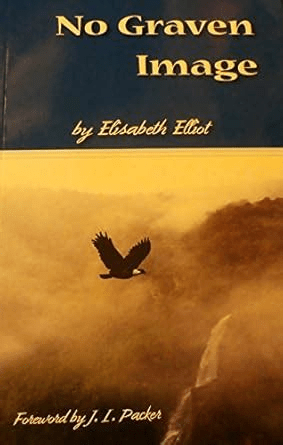
This is not the cover my copy of the book had, though it also had an image of a condor.
No Graven Image was not well received when it came out. It was the old problem of marketing. To what audience do you market a genre-bending book? The people who liked to read tragic, worldly novels were not interested in a so-called “novel” about a young missionary woman, probably expecting that it would be preachy. The Christians who liked to read missionary stories were shocked and dismayed by a novel in which the protagonist flounders around, makes mistakes, and ultimately, accidently kills her language informant when he has a bad reaction to a shot of penicillin. And then decides that her desire to have a successful language project had been a form of idolatry.
Some readers appreciated the novel (particularly overseas missionaries), but most found it shocking, even blasphemous. They wanted a triumphant novel, not the story of Job. They wondered whether Elisabeth had lost her faith.
When I picked it up, in the twenty-teens, it made me feel extremely understood.
One thing that killed me as I read of Elisabeth’s later years is that this was the only novel she wrote. She very much wanted to write others, and she got as far as making notes for another novel. But life (read: men) intervened, and she was in demand for speaking and for writing nonfiction books such as Passion and Purity. She wasn’t able ever again to get the extended periods of time to concentrate that it would have taken to gestate a novel. She convinced herself that she just didn’t have what it took to write actual good fiction (and perhaps, that it was selfish to try). I am so sad to watch this dream die. I believe that she would have been a good novelist. I don’t know whether her publisher would have kept publishing her books if she had turned to fiction, or whether she would have had trouble finding another publisher. Spiritual non-fiction was what she had already become known for. She probably would have made less money, perhaps found it difficult to support herself. But still … you know … it’s hard to watch. So many things about the second volume of her biography are hard to watch. At the same time, because of Vaugh’s amazing research and writing, it’s hard not to sit back and just stare at this major accomplishment.
A Tale of Two Lost Boys: Perry Smith vs. Ikash son of Endu


Left to right: Dick Hickcock and Perry Smith, killers of the Clutter family; In Cold Blood by Truman Capote; The Strange Land by Jennifer Mugrage; “Don’t Eat My Family” by Jennifer Mugrage.
I hope this image gallery shows up right. I’ve never tried to make one before.
It’s unfortunate that I couldn’t find an image of either Perry or Ikash alone, but in some ways it’s fitting that the image I found for Perry features a mugshot and the image of Ikash shows him protecting his family.
This post will contain spoilers for The Strange Land, which has been out since 2021, and In Cold Blood, which has been out since 1966. This will be a rambling comparison between two character studies. Come along if you like that sort of thing.
It may seem — and O.K., it is — pretentious to compare a book of my own to Truman Capote’s masterpiece. My reasons for comparing the two characters will become clear, but to belabor the obvious, I am not comparing myself to Capote as a writer. It’s my blog, so I can be a little bit pretentious if I want, right? Shall we?
What the two lost boys have in common
The character of Perry Smith has a great deal in common, on a superficial level, with Ikash, the focus of my coming-of-age story The Strange Land. The similarities were strong enough to disturb me when I read Capote’s classic. After all, Perry drifts through the world aimlessly and then commits a senseless murder, whereas Ikash remains kind and courageous and goes on to become the shaman of his people. Perry is real, Ikash is fictional. Does this mean that I had fatally romanticized my character Ikash, a person who would not be nearly so noble in real life?
I do have a tendency to romanticize the sensitive, artistic guys, and ladies, if you share this tendency, it is something you need to watch. Just because a guy is not harsh, does not necessarily mean he is kind. As Jordan Peterson has said, “If you think strong men do a lot of damage, wait ’til you see the damage weak men will do!”
To start at the most superficial level, Smith and Ikash kind of look alike. Both are short and stocky (Smith had underdeveloped legs and feet), with wide faces, fine features, and dark eyes and hair. In fact, both are American Indian, though they are so far removed in time that this fact has no relevance for anything except their appearance. Smith’s father was John “Tex” Smith, an Irishman, and his mother was Florence Buckskin, a Cherokee. Ikash is a fictional character but was supposed to come from a tribe that was ancestral to the American Indians.
Both grew up in rough circumstances and eventually suffered the breakup of their families. Smith’s parents were both drunks. His mother left his father when he was small, and he turned to crime, lived in a series of orphanages, then on the Alaskan frontier with his father as a teenager. He eventually joined the Navy, then proceeded to drift from friend’s house to friend’s house to park bench to jail, not really having a place to go home to. His shrimpy stature was probably from malnutrition as a young child.
Ikash (again, fictional) had it slightly better. He did not suffer from hunger, because the tribe’s Beringian environment provided for them abundantly. However, his father was abusive to mother, leading eventually to her suicide, and periodically to his sons as well. After his mother’s suicide, Ikash’s family essentially broke up, and he and his brother lived together as bachelors. He was a bit of a pariah in the tribe because of his family’s reputation.
Both men are quiet, sensitive types. Both play the guitar (lute, in Ikash’s case) and sing. Both think of themselves as spiritual. In Perry’s case, he has occasional premonitions, visions, and, as he gets more beat up by the world, what appear to be dissociative episodes.
“I could give you a hundred examples. I don’t care if you believe me or not. For instance, right before I had my motorcycle accident I saw the whole thing happen: saw it in my mind–the rain, the skid tracks, me lying there bleeding and my legs broken. That’s what I’ve got now. A premonition.”
… “About that premonition stuff. Tell me this: If you were so damn sure you were gonna crack up, why didn’t you call it quits? It wouldn’t have happened if you’d stayed off your bike–right?”
That was a riddle that Perry had pondered. He felt he’d solved it, but the solution, while simple, was also somewhat hazy: “No. Because once a thing is set to happen, all you can do is hope it won’t. Or will–depending. As long as you live, there’s always something waiting, and even if it’s bad, and you know it’s bad, what can you do? You can’t stop living. Like my dream. Since I was a kid, I’ve had this same dream … What it comes down to is, [in my dream] I want the diamonds more than I’m afraid of the snake. So I go to pick one, I have the diamond in my hand, I’m pulling at it, when the snake lands on top of me… he starts to swallow me. Feet first. Like going down in quicksand.”
Perry hesitated. He could not help noticing that Dick was uninterested in his dream.
Dick said, “So? The snake swallows you? Or what?”
“Never mind. It’s not important.” (But it was! The finale was of great importance, a source of private joy. [It was a] towering bird, the yellow “sort of parrot” … which had first flown into his dreams when he was seven years old, a hated, hating half-breed child living in the California orphanage run by nuns–shrouded disciplinarians who whipped him for wetting his bed. It was after one of these beatings, one he could never forget, that the parrot appeared, arrived while he slept, a bird “taller than Jesus, yellow like a sunflower,” a warrior-angel who blinded the nuns with its beak, fed upon their eyes, slaughtered them as they “pleaded for mercy,” then so gently lifted him, enfolded him, winged him away to “paradise.”
As the years went by, the particular torments from which the bird delivered him altered, but the parrot remained, a hovering avenger.
pp. 90, 92 – 93
Perry has no outlet for his artistic nature and believes that no one appreciates his depth and intelligence.
Ikash, for his part, wants to have visions like his cousin Ki-Ki who is the tribal shaman, and eventually does have visions, but then worries that they are endangering his loved ones.
Ikash can spend a lot of time alone, thinking or praying. Smith travels with a box full of books, papers, maps, and magazines, even when homeless, which is a habit that endeared him to me before I heard more details about the murder he committed.
Ikash, as has been mentioned, moves into a protective role towards members of his tribe. Smith, despite being an unstable character in some other ways, several times protects girls and young women from the predations of his partner in crime, Dick Hickcock.
he had “no respect for people who can’t control themselves sexually,” especially when the lack of control involved what he called “pervertiness”–“bothering kids,” “queer stuff,” rape. And he had thought he had made his views obvious to Dick; indeed, hadn’t they almost had a fist fight when quite recently he had prevented Dick from raping a terrified young girl?
page 202
Finally, another burden these two young men have in common is chronic, or recurring, pain. Smith’s legs were smashed up in his motorcycle crash and appear not to have healed properly. There’s a memorable scene in In Cold Blood where the two criminals, on the way to their heist, stop at a gas station. Perry goes into the bathroom and stays in there for so long that both Dick and the gas station attendant are filled with disgust and impatience. In fact, Perry is first sitting on the toilet, then trying to rise to a standing position, with his legs hurting so badly that he’s holding onto the sink, sweating, and shaking. Ikash has periodic recurring pain from some old broken bones (collarbone, ribs), and also suffers periodic “phantom” pains in other parts of his body, that while short-lived, are severe enough to be temporarily debilitating. Ikash believes that these episodes represent instances of his “bearing” the actual sufferings of other members of his tribe, for them. They can also be understood as the lingering effects of trauma and grief, stored in the body. As can Smith’s health problems.
So what accounts for the different outcomes between these two lost boys?
Easy, you might say. You made Ikash up, so you can make him turn out however you like. Perry Smith lived in the real world, where there are no happy endings.
Well, O.K. I did not write a nihilistic book where characters are trapped by their abusive pasts, character flaws, and poor decisions by themselves and others, because I don’t believe that the world is, ultimately, a nihilistic place. But if you’re going to write hope into a book, it has to come from somewhere. It can’t be deus ex machina hope; it has to be Deus ex caelo, or should I say credo in unum Deum, Patrem Omnipotentem, Factorem caeli et terrae.
Some reviewers of my book said they found the scenes of domestic abuse difficult to read. Actually, I kept them as minimal as I could and still convey the problem, and there is much that I spared Ikash, as can be seen when we compare him to Perry Smith, who had it much worse.
Smith was the youngest in his family, so he was very small when things got chaotic between his mother and father. His mother would bring strange men home and fornicate with them in view of the children, something Ikash’s mother Sari definitely would not do. One of these episodes led to a fight “in which a bullwhip, hot water, and gas lamp were used as weapons.” After the breakup of the family, Perry ended up in orphanages where the nuns would shame and beat him for bedwetting. Ikash was also a bedwetter, as is not uncommon among little boys. Perry Smith had even more reason for it given the instability in his home. This problem continued into adulthood. He believed that his kidneys had been ruined by a childhood diet of bread dipped in sweetened condensed milk, which during the Smith family’s nomadic days was often all they had for supper.
Ikash’s family, though unhappy, remained intact until he was fifteen.
When Smith joined the Merchant Marine, Capote strongly implies that he had another horrible experience which Ikash escaped.
“But I never would have joined [the Merchant Marine] if I’d known what I was going up against,” Perry once said. “I never minded the work, and I liked being a sailor–seaports, and all that. But the queens on the ship wouldn’t leave me alone. A sixteen-year-old kid, and a small kid. I could handle myself, sure. But a lot of queens aren’t effeminate, you know. Hell, I’ve known queens could toss a pool table out a window. And the piano after it. Those kind of girls, they can give you an evil time, especially when there’s a couple of them, they get together and gang up on you, and you’re just a kid. It can make you practically want to kill yourself.”
pp. 133 – 134
Apparently, Smith was the victim of homosexual predators while he was at sea. This kind of violation, arguably the ultimate in horror, is not something I’ve ever felt up to subjecting my characters to. It is, sadly, quite common in the world (especially the ancient world), and I am not saying it’s something that a person cannot come back from. The grace of God is enough to redeem and restore anyone, no matter what they have been through (see The Sparrow.) But I have never had the slightest ability nor desire to put my male characters through this. Real life, on the other hand, is not so merciful.
Ultimately, though, it’s not Perry’s additional bad experiences that left his character to turn sour; instead, it’s relationships that he lacked and Ikash had.
Like Perry, Ikash’s immediate family was not great. His father and his older brothers bullied him. Unlike Perry, Ikash lived in a tribal situation where there were, close at hand, uncles and aunts, cousins, and a grandmother. This kind of situation is not automatically good, of course; tribes can be hotbeds of gossip and social pressure. And indeed, Ikash’s early experiences do cause him to mistrust older relatives who might otherwise be helpful to him. But he is fortunate to have quite a number of kind people in his life who wish to aid him and his mother. Grandmother Zillah does her best to provide breaks for Sari; cousin Ki-Ki mentors Ikash, and a model of a healthy marriage is provided by his father’s sister Ninna and her husband. Even with all these good helpers and models, it is barely enough.
Perry does not seem to have had anything like this kind of potentially beneficial community. His father and mother were itinerant, having met on the rodeo circuit. They don’t seem to live near any extended family. Perry does form connections with friends who he believes understand him, but because of his vagrant lifestyle, the connections are not lasting. At one point, he travels across the entire United States hoping to stay with an old Army buddy, only to find to his dismay that the buddy has moved and left no forwarding address. These kinds of near misses are the story of Perry Smith’s life. What might be called his last friend, Dick Hickock, is a cellmate who wants to use him to pull off a heist, and ultimately puts him in a situation that leads to the moral ruination, and then the death, of both of them. Dick does not understand Perry, nor does he have any concern for the best interests of Perry, the Clutter family–or anyone but himself.
In a counterintuitive dynamic, Perry’s very isolation tends to make him not only lonely, but also increasingly conceited. Having no long-term relationships means there is no check on his delusions. With no one to praise, appreciate and love him properly, there is also no one whose critiques he can take to heart. He’s left to his own assessment of himself, and not able to develop strength of character or clarity of mind. Ultimately, when he cuts Mr. Clutter’s throat, he does it without intending to. “I didn’t want to harm the man. I thought he was a very nice gentleman. Soft-spoken. I thought so right up to the moment I cut his throat.” (p. 244)
Ikash, on the other hand, is surrounded by judgmental relatives who have known him since he was small, who can love on, scold, praise, and criticize him.
Without Hope and Without God in the World
At fourteen, Ikash begs his older cousin Ki-Ki, the tribal shaman, to teach him how to have a vision.
Ki-Ki, the shaman, seemed to be in love with the world and with the many specific things in it. He was in love with his dogs, for example, with the horses, with the wild animals, in love with his wife, in love with God. It was this quality that drew Ikash to him. Ikash would love to approach the world like that. But he had never felt such love for anything, except when it was stirred in him for a few moments by some story or song of Ki-Ki’s. He longed to live in the world of the stories, but he had never been able to manufacture such love inside himself.
p. 93
Ki-Ki is uncertain this will work, or that is even viable (as he says, “visions are dangerous“), but he is willing to give it a try.
They sat, cross-legged, each with his back against a tree. Upstream, there was a view of the grey top of a mountain.
The atmosphere seemed somewhat lacking to Ikash. He looked at his older cousin and muttered, “Aren’t you going to beat a drum or something?”
Ki-Ki grinned whitely. “Then you wouldn’t be sure it was real,” he said. “Besides, God is everywhere. We need no drum to talk to God.”
As soon as he said the word “God” for the second time, a presence was felt in the gully. It was so palpable that Ikash actually gasped.
Ki-Ki apparently felt it too, for he reached out a large, hard hand and grasped Ikash firmly around the wrist as if to keep him from being swept away.
Immediately Ikash knew what his cousin had meant about danger that was not a physical danger. He felt no threat, nor any hostility, such as he had often felt from his father. But the presence was overwhelming, crowding, as of something too huge for the valley to contain.
This was not the sort of vision he had hoped for.
He heard Ki-Ki speak. “It’s too much for him,” he said, and for a second it was as if some great face had turned its terrible eyes towards Ikash … and then, oh thank goodness, the presence was gone suddenly.
pp. 100 – 102
In other words, Ki-Ki, without really trying to, functions as an intermediary to introduce Ikash to God. Later, when quite a few other tragedies have happened and Ki-Ki has been taken from Ikash, the young man has a vision of his own that he can only describe as “a father.”
“A father?” [his brother] Sha blinked, completely thrown.
“A good father.” Ikash was staring earnestly at his brother, as if willing him to grasp this difficult concept. “It gave me a sense of a really good father, the kind we’ve always wanted but never known.”
“What did it look like?” asked [cousin] Mut. He was picturing a bigger, two-eyed version of his own father.
“I told you, it wasn’t visual. I didn’t see anything except the cloud. But I felt the Father. … We have a father.” He made a slight sweeping gesture with his hand that took in himself and, somehow, the entire camp as well. “That’s what makes us able to bear the loss of all the others.”
pp. 512 – 514
A perceptive reader has pointed out that the definition of a horror story is all the bad stuff in the world that happens, minus God. God is what keeps Ikash’s story from remaining one of unremitting horror. This was the horror–the horror of other people’s sins against him, the horror of a complete lack of adequate love, the horror of his own increasingly weak mind, and eventually, his own grievous sins against others–that Perry Smith lived.
Before Smith and Hickock committed their planned robbery, to which Hickock insisted they leave “no witnesses,” they stopped by a Catholic hospital. Perry Smith knew that nuns were guaranteed to have black nylons, and he wanted Hickock to obtain some so the two could cover their faces when they went to rob the Clutter family. Perhaps, if the two had managed to do this, they would not have ended up killing the Clutters. Dick, however, came out of the hospital without having tried to get any nylons (“it was a pukey idea”). Perry was not willing to go in. He believed that nuns were bad luck.
After Smith and Hickock’s arrest, Perry Smith was kept in a cell in the home of the town undersheriff and his wife, a cell that until then had been reserved for female prisoners. (The reason was a desire to keep the two culprits separated.) Sherriff and Mrs. Meier were “deeply Catholic.”
Mrs. Meier had been rebuffed by Perry when she had suggested a consultation with Father Goubeaux, a local priest. (Perry said, “Priests and nuns have had their chance with me. I’m still wearing the scars to prove it.”)
pp. 288 – 289
Now, of course, “nuns and priests” are not necessarily the only way to find out about the redemption offered to us by the God who gives life to the dead, and calls things that are not as though they were. They might not even be the best way. My only point is that unfortunately, for Perry Smith, the only people in his life whom he associated with God, were also people who were abusive to him. He never had a chance to be introduced to the concept of God by anyone he loved and trusted. This is the opposite of the case with Ikash.
Later, in jail, Perry did make friends with a former pastor, now a fellow inmate, who was mystical and simpatico with Perry. This man, however, seemed to be a bit of an apostate, and by that time Smith had already hardened against the whole idea of God. God, certainly, can overcome stories this sad and sadder, but in this case, for whatever reason, He didn’t.
We don’t know whether Perry Smith had a deathbed conversion in the last few seconds before being hung, but tragically, from all appearances, it doesn’t appear so. Neither did Dick Hickcock. That, plus the apparent senselessness of the fate of the Clutters, is what makes In Cold Blood such a tragedy. It underlines how much Smith and Hickock–and indeed all of us–need Jesus, and that is what makes this unedifying event such an appropriate topic for this Easter season.
The Murderer’s Mother
She doesn’t know her son is suspected of murder, at this point. She just thinks he has been passing bad cheques again.
“That gun cost over a hundred dollars. Dick bought it on credit, and now the store won’t have it back, even though it’s not hardly a month old and only been used the one time–the start of November, when him and David when to Grinnell on a pheasant shoot. He used our names to buy it–his daddy let him–so here we are, liable for the payments, and when you think of Walter, sick as he is, and all the things we need, all we do without …” She held her breath, as though trying to halt an attack of hiccups. “Are you sure you won’t have a cup of coffee, Mr. Nye? It’s no trouble.”
Truman Capote, In Cold Blood, p. 171
Just look at that masterful dialog, how it breaks your heart!

