
In spite of the mask and theatre hat he wore, I could see at once that Kenn Gifford was exceptional-looking; not handsome, quite the opposite in fact, but striking all the same. The skin I could see above the mask was fair, the type that reveals blood vessels beneath it and looks permanently pink after a certain age. He hadn’t reached that age yet, but the theatre was hot and his colour was high. His eyes were small and deep set, hardly visible from a distance and of an indeterminate colour, even close up. They weren’t blue or brown or green or hazel. Dark rather than light; grey perhaps came the closest, and yet I didn’t look at him and think, grey eyes. Large, half-moon shadows lay beneath them.
Sacrifice, by S.J. Bolton, pp. 23 – 24
Tag: writing process
Death of the Mentor

I chose this photo off Pexels, and now I almost can’t stand to post it, because it could be my dad in 20 years.
I’ve been thinking lately about how the death of the mentor, in fiction, is often more poignant than the death of the Significant Other. Maybe it’s because the former happens more often. In a normal quest-type story, the mentor gets killed at some point, often kind of early in the action, and the S.O. doesn’t get killed at all, or often even threatened until later in the story. The exception would be crime-fighting superhero tragic back stories, where having a beloved wife killed off to serve as motivation is so common that it has been given a derogatory name (“fridging”).
Anyway, the above paragraph is, of course, just about stories that follow very conventional models. Stories in the wild are quite individual and they go all over the place. Here are some mentor deaths that spring to mind, from stories good, bad, and ugly:
- In Star Wars: Obi-Wan, Qui-Gon Jin, Darth Vader
- In Dr. Strange, which I just watched last night: The Ancient One
- In Harry Potter: Sirius Black, Dumbledore (not to mention Harry’s parents)
- In Narnia: Aslan
- In The Hobbit: Gandalf doesn’t exactly get killed, but he leaves the party right before they enter Mirkwood
- In LOTR: Gandalf
- In Genesis: Jacob, Joseph, Moses, Samuel (I am thinking of mentors who had a chance to give final curses and blessings and instructions before they died. Of course they all die, good and bad, IRL)
In the comments, please add your own.
Perhaps another reason that the mentor’s death is more poignant than the S.O.’s is that the relationship has gone on longer and has been, in a sense, more important to the young protagonist. It is, of course, in a sense the mentor’s job to die. He or she will have to take a less prominent role in the young hero’s life as the latter matures. And, older people tend to die. Joseph, on his deathbed, says, “I am about to go the way of all the earth.” But a tragic mentor death, like the ones above, seems to happen too soon, when we still need them, when we’re not ready.
I myself have ruthlessly killed off my characters’ mentors, sometimes more than one in the same book. I did not plan to do this in order to torture my young protags; it was just the way the story unfolded. One or two deaths even took me by surprise. However, some of my older men and women managed to survive the story long enough in order to be a rock for the rising generation.
Story Deaths and Stages of Life
Some people, sadly, have really tragic childhoods and are faced with death, loss, and betrayal well before they should have been. For young readers not in this position, I find that the type of story death that they find most poignant (and that therefore is most likely to appear in their literature) changes with stage of life:
- for a kid: the stuffed animal or pet
- for a teen: the mentor
- for a young adult: the Significant Other
- for a middle adult: the baby or child
- for an older adult: ??? I don’t know yet, since I haven’t really hit this stage. But my mother-in-law is certainly going through it! Spouse? Best friend? Sister? Everyone your own age who remembers you when you were younger?
So, when I was a kid, it was stories of animals (including toys — I’m looking at you, The Velveteen Rabbit) that really got me. Now that I’m a parent, it’s stories where the baby or toddler dies that I really can’t stand to read.
It’s as if our hearts are pieces of leather that just keep getting softer and more tattered and beat up the more they experience.
I’ve been busy lately, so this post was written in one sitting. I apologize that it’s sort of a mind dump. I’m sure all these things have been articulated before, and much better than this, probably by Jordan Peterson.
Share your thoughts in the comments.
My gosh, Dickens is such a brilliant writer
Waste forces within him, and a desert all around, this man stood still on his way across a silent terrace, and saw for a moment, lying in the wilderness before him, a mirage of honorable ambition, self-denial, and perseverance. In the fair city of this vision, there were airy galleries from which the loves and graces looked upon him, gardens in which the fruits of life hung ripening, waters of Hope that sparkled in his sight. A moment, and it was gone. Climbing to a high chamber in a well of houses, he threw himself down in his clothes on a neglected bed, and its pillow was wet with wasted tears.
Sadly, sadly, the sun rose.
A Tale of Two Cities, Book II, Ch. V, “The Jackal”
Goals
Many other book bloggers did “2024 Goals” posts in January. That seems like a nice way to generate a blog post, even if this goal post (haha) is a little late.
TBR/TBF
Books to be read or, if already begun, finished:
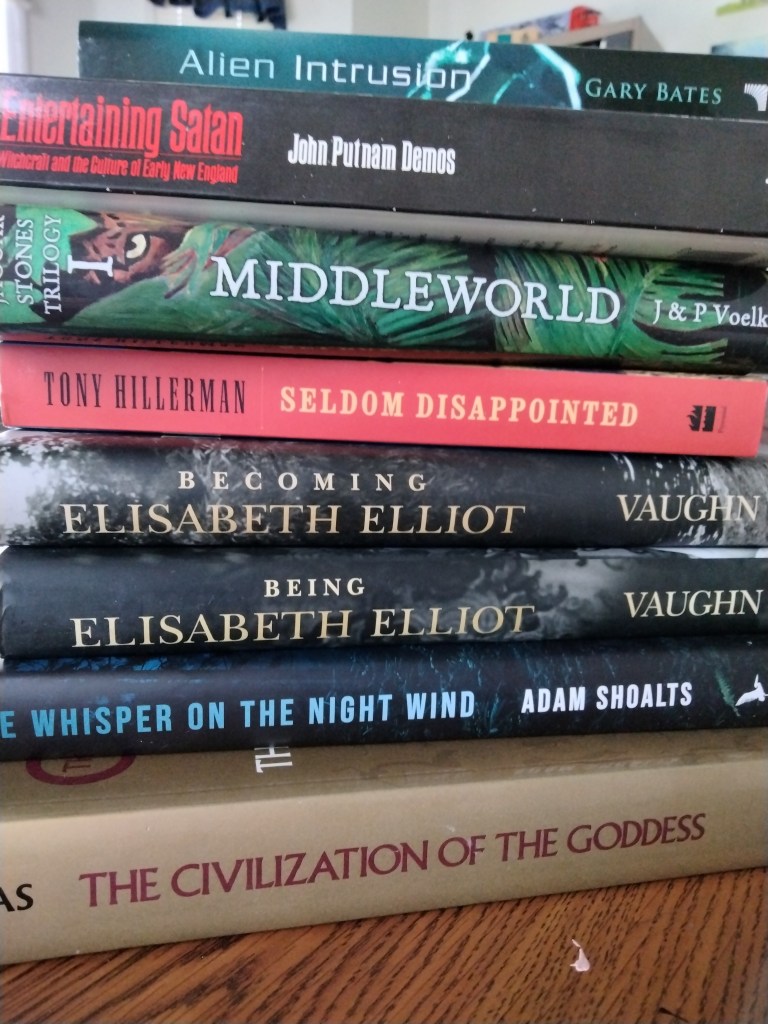
TBA
Events to be attended:
https://mysticrealmsfantas.wixsite.com/mysticrealmsfair
https://www.newchristendompress.com/conference
TBK
Items to be knitted:
- Finish woolen knee socks, to be worn with trousers, before Spring (for self)
- Wanderer shawl: bias-knit chevron patterns to show off the beautiful striped yarn my sister gave me for Christmas (for self)
- Brioche hat: continue to make different editions of this brioche hat, in different color combinations (gifts for various others)
- Maybe try to ad lib a brioche bonnet (for sister in law?)
- as the Spirit moves
TBSE
To be set up: My classroom in the new school building, which we hope to be moved into by Fall.
TBW
To be wrote: The book that goes with this map:
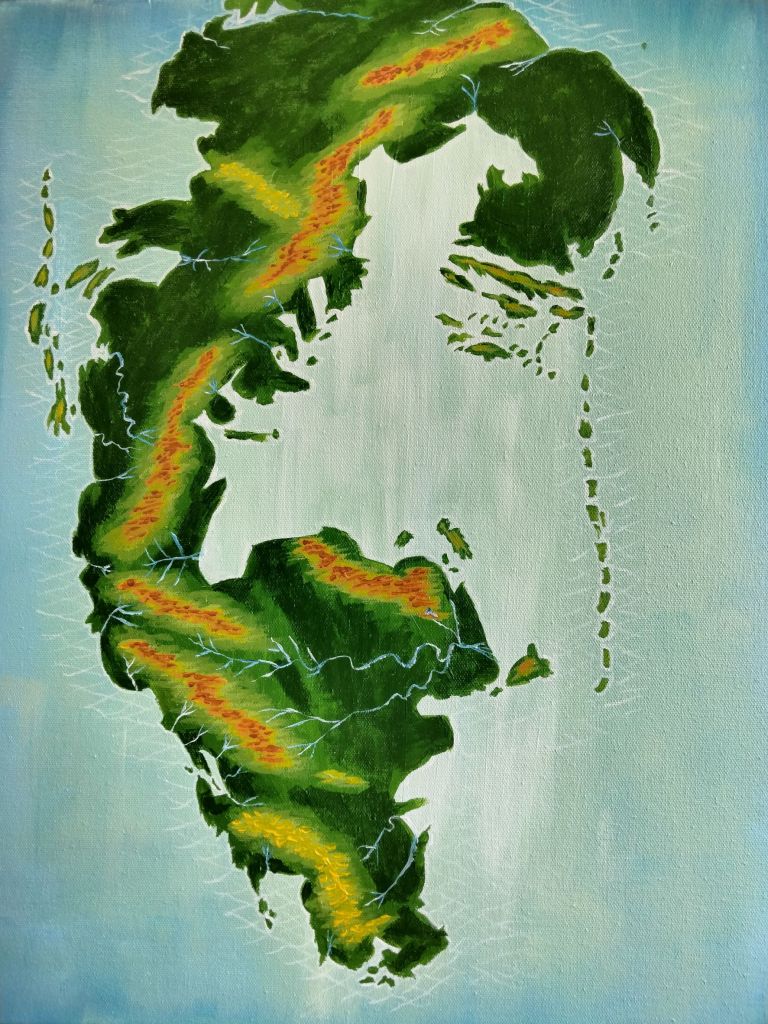
Last year, I went on a writing retreat in order to make some progress on the draft. At this rate, it looks as if I may have to do the same thing again.
TBC/P
To be cleaned/planted: Clean chicken coop (add more space for hens?), maybe actually plant a garden this year???
TB Top Secret
Various family events with loved ones, which privacy forbids blogging about.
A Caveat
Now listen, you who say, “Today or tomorrow we will go to this or that city, spend a year there, carry on business and make money.” Why, you do not even know what will happen tomorrow. What is your life? You are a mist that appears for a little while and then vanishes. Instead, you ought to say, “If it is the Lord’s will, we will live and do this or that.”
James 4:11 – 15
Mesa Falls, Idaho
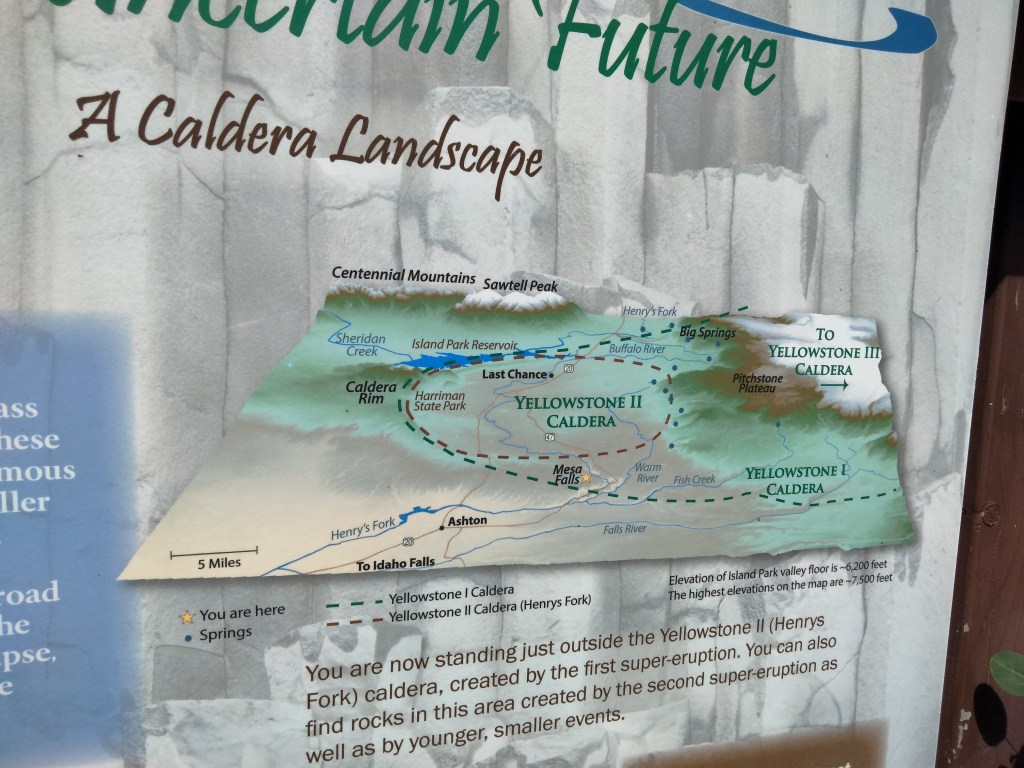
Mesa Falls is located up in the northeastern area of Idaho. If you head due east from there, you’ll find yourself crossing the border into Wyoming and into Yellowstone National Park. It’s also near popular campsite Island Park, as well as near lots of hunting and fly fishing, well-positioned to attract people who are enjoying all the beauties of the region.
As you can see from the map above, Mesa Falls lies in part of an old caldera. The earth’s crust has moved, putting the fresh caldera under Yellowstone National Park. Hence the geysers that can be found in Yellowstone, and the eerie, sulfur-scented, brightly colored, deadly hot springs (which incidentally play a cameo role in my book The Strange Land).
This summer, I went up to Ashton, Idaho for a writing retreat. (What was I writing? That is for me to know and for you to find out!) Ashton is a relatively small, relatively remote town, but it’s touristy because of its proximity to hunting, fishing, and the Yellowstone area. I stayed in a mom ‘n’ pop motel consisting of camping cabins that have been there for ages.
On the way back from Ashton to my home stompin’ grounds, it would have made sense for me just to get on the highway and go south. But my husband has hike radar, which lets him know whenever he is within twelve hours’ drive of a good hike. This radar also works remotely, when someone he knows is in range of a good hike. So he let me know that I should go north instead, view Mesa Falls, and then head back. As it was a Sunday afternoon, I did so.
Mesa Falls is on a forest service road or something like that, so my paper map actually showed the road ending well before I got there. Thankfully, in real life it continued.

Here is proof I was there.
The hike was not at all demanding. There’s a capacious parking lot ($5 entry, envelope system), and then a series of well-maintained steps and boardwalks that bring you down to the very top of the falls, with many specially designed niches for selfies.
I did not bother to photograph the other falls-goers, but place was packed.
Now I’ll post some short videos I took of the falls.
The cliff opposite the falls was lush and green due to the permanent plume of mist that hits it.
Agatha Christie knows how it go
“I do wish you wouldn’t read that horrid paper [The Daily Worker], Edmund. Mrs. Finch doesn’t like it at all.”
“I don’t see what my political views have to do with Mrs. Finch.”
“And it isn’t,” pursued Mrs. Swettenham, “as though you were a worker. You don’t do any work at all.”
“That’s not in the least true,” said Edmund indignantly. “I’m writing a book.”
“I meant real work,” said Mrs. Swettenham.
A Murder is Announced, by Agatha Christie, p. 4
This Is Why I Read — And Write
I’ve just surfaced from spending several days in a state of rapture — with a book. I loved this book. I was transported into its world. I composed a dozen imaginary letters to the author, letters I’ll never write, much less send. I wrote letters of praise. I wrote letters relating entirely inappropriate personal information about my own experiences with the author’s subject matter. I even wrote a letter of recrimination when one of the characters died and I was grief-stricken. But mostly I wrote letters of gratitude …
Litte Sara Crewe in Frances Hodgson Burnett’s classic A Little Princess was my alter ego. Oh, how I wanted to be an orphan! I read The Nun’s Story, and oh, how I wanted to be a nun! I wanted to be shipwrecked on a desert island and stranded in Krakatoa! … Cut to a few years later. I’m reading The Godfather by Mario Puso, a divine book that sweeps me off into a wave of romantic delirium. I want to be a mafioso! No, that’s not quite right. Okay then, I want to be a mafioso’s wife!
Each minute I spend away from the book pretending to be interested in everyday life is a misery. How could I have waited so long to read this book? When can I get back to it? Halfway through, I return to New York to work, to finish a movie, and I sit in the mix studio unable to focus on anything but whether my favorite character in the book will survive. Every so often I look up from the book and see a roomful of people waiting for me to make a decision … and I can’t believe they don’t understand that what I’m doing is Much More Important.
Nora Ephron, excerpts from the essay On Rapture, in I Feel Bad About My Neck, pp. 117 – 121
Word of the Week: Gracile
gracile (adj) — graceful, but spoken by a scientist
Example:
The robust Cro-Magnons in this region were either replaced by the gracile Mediterraneans coming from the south or progressively merged with the newcomers.
Marija Gimbutas, The Civilization of the Goddess, p. 4
Another, Sort of Interesting, Personality Typology Book

I saw this at my local library.
I like reading personality typology books — as long as they aren’t too dumb — because I’m interested in stories and people. And people within stories. I am aware of the limitations of personality typologies. I don’t think I’ve ever seen one that can capture all the nuances of a person; and, in fact, it would be surprising if we could. I have a made a few previous posts about the MBTI, but I know that it has been criticized and has been woodenly applied in a business context.
The MBTI yields sixteen basic types, and even it is not perfect. So of course, any typology that only has four types is going to be even less of a fit, unless you apply it generously and with some fluidity. (Which is different from making your typing of people unfalsifiable by always having an explanation for features that contradict your theory.) Carol Tuttle’s typology is a four-typer. Her four types correspond roughly to the ancient four types of Sanguine, Choleric, Phlegmatic, and Melancholic.
The book is somewhat woo-woo. (And whoo boy — I mean, hoo boy, her web site is even more woo-woo!) The way Tuttle explains her philosophy is that there are four types of energy present in nature, and while all people use all of these four types, each of us “expresses” one of the types of energy in particular. When she writes about people who have attended her seminars, she tends to describe them as “a woman who expresses Type 3 energy” instead of saying “a woman who is a Type 3.” I feel like there’s wisdom in that. Other woo-woo aspects: she explains how each type handles its energy in terms of yin and yang, and in the profiles of each type, she even includes a description of physical features that people with that sort of energy are likely to have. It was the physical descriptions that lost me. That seems like way too much of a claim. I have a much easier time accepting a typology that is just based on the way you approach life and the effect you have on other people, not just with things you explicitly do, but with the energy you bring into a room (about which more in a minute).
And yes, people do attend her seminars. Each chapter in this book has testimonials from people whose lives were improved once they were able to recognize and accept their type.
And yes, she did name the Types 1, 2, 3, and 4, which I think shows admirable restraint. Here they are:
- Energy that is light, lively, cheerful, and vertical, like the movement of an aspen tree.
- Energy that is smooth and down-ward flowing, like the Mississippi River.
- Energy that explodes outward, getting things done, like the sun or the appearance of the Grand Canyon.
- Energy that is constant, still and stable, like a rugged mountain reflected in a glassy lake.
(Notice: Air, Water, Fire, Earth.)
One thing that caused me to actually read this book (and then even go so far as to review it!) was that, as soon as I started skimming it, I began recognizing family members in the descriptions. One of my children, for example, clearly has Type 1 energy, and even loves rabbits, which because they move by hopping are cited as a Type 1 sort of animal.
Of course, not everything applies perfectly. Not everything said about Type 2 express-ers is true of me, for example. (No, I am not diplomatic nor am I good with numbers.) And some people don’t immediately seem to embody these types. So, despite the testimonials, I am recommending this book as an item of interest, not as something that is going to change your life.
What it really teaches you is how to dress.
Apparently, Tuttle has an entire seminar called “Dress Your Type.” The idea is that, when you dress in a way that matches the type of energy you bring, people know what to expect from you and they are more likely to respond to you in a way that’s in keeping with your general approach to life. I am all in favor of letting people know what to expect. I relied heavily on this principle when naming my children, for example.
Tuttle recommends that only people with Type 4 energy wear black. These people tend to be striking and somewhat forbidding in their aspect, and serious in their approach. Other types, she says, will be made to look tired or older by black. I’m not sure I’m ready to give it up, but OK.
Her approach does explain an awful lot about my sartorial preferences. I love flowy things: long belts, fringes, shawls, ponchos, bell sleeves, long hair, medieval historical dress, and all of these things are totally impractical for everyday work around the house, but apparently they express my flowy, Type 2 energy, so you have been forewarned. (I also write long, rambling novels.)
According to Tuttle, Type 2 is “a double yin” whereas Type 3 is “a double yang,” which might explain the following story.
My husband and I had just come through an extremely stressful period at work. We then had to travel for some meetings. The site where we were staying was sort of a vacation site, but it was a working trip too. We were trying to do a good job in the meetings, but also sort of relax and process all the stress we’d just been through. It was also a place where many people were coming and going, including a very energetic gentleman whom we had first met about a month earlier. This guy was one of those types who do an amazing job at their own role, and also insist that “everyone can do it!”
I was supposed to be taking notes at the meetings, but one morning, I woke up feeling awful. I dragged myself down to the kitchenette area and was just trying to force down some breakfast, hoping it would make me feel better, when the door burst open and in rushed Type 3 Energy Man. He didn’t even speak to me, but his presence was all it took. I dashed outside and threw up in the flower bed.
Article by a Smart Person
Sorry about my radio silence, friends. It’s been a busy week.
Please enjoy this article by a friend of mine about songwriting as a liminal process.
 Out of Babel Books