Mesa Falls is located up in the northeastern area of Idaho. If you head due east from there, you’ll find yourself crossing the border into Wyoming and into Yellowstone National Park. It’s also near popular campsite Island Park, as well as near lots of hunting and fly fishing, well-positioned to attract people who are enjoying all the beauties of the region.
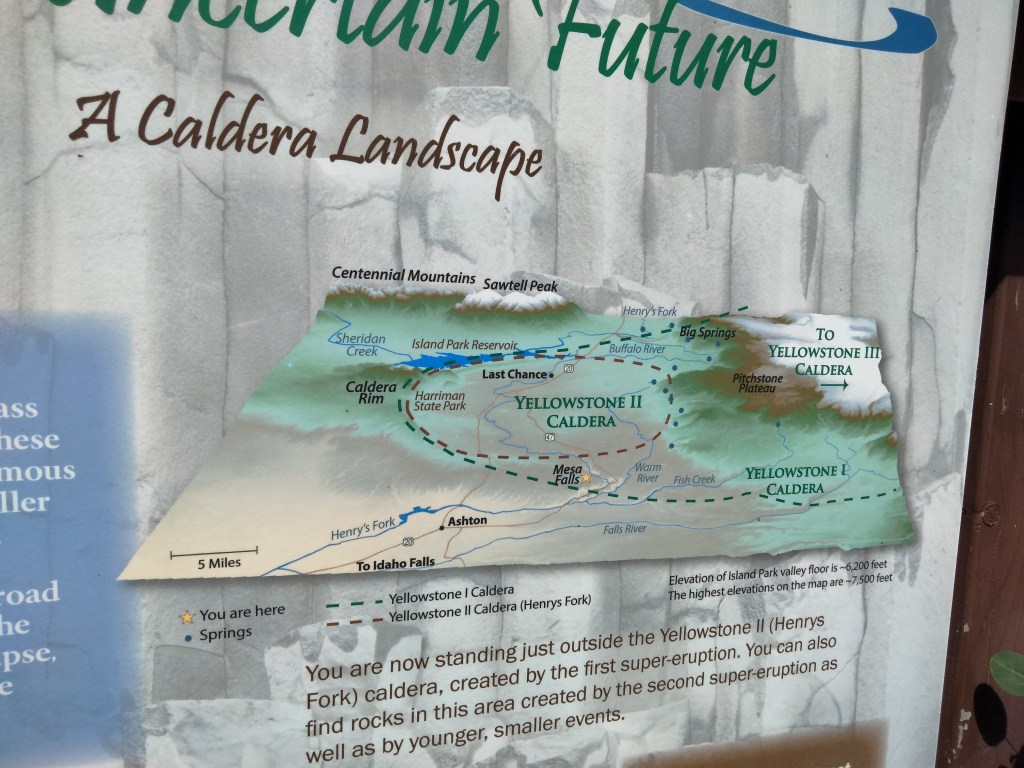
As you can see from the map above, Mesa Falls lies in part of an old caldera. The earth’s crust has moved, putting the fresh caldera under Yellowstone National Park. Hence the geysers that can be found in Yellowstone, and the eerie, sulfur-scented, brightly colored, deadly hot springs (which incidentally play a cameo role in my book The Strange Land).
This summer, I went up to Ashton, Idaho for a writing retreat. (What was I writing? That is for me to know and for you to find out!) Ashton is a relatively small, relatively remote town, but it’s touristy because of its proximity to hunting, fishing, and the Yellowstone area. I stayed in a mom ‘n’ pop motel consisting of camping cabins that have been there for ages.
On the way back from Ashton to my home stompin’ grounds, it would have made sense for me just to get on the highway and go south. But my husband has hike radar, which lets him know whenever he is within twelve hours’ drive of a good hike. This radar also works remotely, when someone he knows is in range of a good hike. So he let me know that I should go north instead, view Mesa Falls, and then head back. As it was a Sunday afternoon, I did so.
Mesa Falls is on a forest service road or something like that, so my paper map actually showed the road ending well before I got there. Thankfully, in real life it continued.
Here is proof I was there.
The hike was not at all demanding. There’s a capacious parking lot ($5 entry, envelope system), and then a series of well-maintained steps and boardwalks that bring you down to the very top of the falls, with many specially designed niches for selfies.
I did not bother to photograph the other falls-goers, but place was packed.
Now I’ll post some short videos I took of the falls.
The cliff opposite the falls was lush and green due to the permanent plume of mist that hits it.
I’ve just surfaced from spending several days in a state of rapture — with a book. I loved this book. I was transported into its world. I composed a dozen imaginary letters to the author, letters I’ll never write, much less send. I wrote letters of praise. I wrote letters relating entirely inappropriate personal information about my own experiences with the author’s subject matter. I even wrote a letter of recrimination when one of the characters died and I was grief-stricken. But mostly I wrote letters of gratitude …
Litte Sara Crewe in Frances Hodgson Burnett’s classic A Little Princess was my alter ego. Oh, how I wanted to be an orphan! I read The Nun’s Story, and oh, how I wanted to be a nun! I wanted to be shipwrecked on a desert island and stranded in Krakatoa! … Cut to a few years later. I’m reading The Godfather by Mario Puso, a divine book that sweeps me off into a wave of romantic delirium. I want to be a mafioso! No, that’s not quite right. Okay then, I want to be a mafioso’s wife!
Each minute I spend away from the book pretending to be interested in everyday life is a misery. How could I have waited so long to read this book? When can I get back to it? Halfway through, I return to New York to work, to finish a movie, and I sit in the mix studio unable to focus on anything but whether my favorite character in the book will survive. Every so often I look up from the book and see a roomful of people waiting for me to make a decision … and I can’t believe they don’t understand that what I’m doing is Much More Important.
Nora Ephron, excerpts from the essay On Rapture, in I Feel Bad About My Neck, pp. 117 – 121
gracile (adj) — graceful, but spoken by a scientist
Example:
The robust Cro-Magnons in this region were either replaced by the gracile Mediterraneans coming from the south or progressively merged with the newcomers.
Marija Gimbutas, The Civilization of the Goddess, p. 4
I like reading personality typology books — as long as they aren’t too dumb — because I’m interested in stories and people. And people within stories. I am aware of the limitations of personality typologies. I don’t think I’ve ever seen one that can capture all the nuances of a person; and, in fact, it would be surprising if we could. I have a made a few previous posts about the MBTI, but I know that it has been criticized and has been woodenly applied in a business context.
The MBTI yields sixteen basic types, and even it is not perfect. So of course, any typology that only has four types is going to be even less of a fit, unless you apply it generously and with some fluidity. (Which is different from making your typing of people unfalsifiable by always having an explanation for features that contradict your theory.) Carol Tuttle’s typology is a four-typer. Her four types correspond roughly to the ancient four types of Sanguine, Choleric, Phlegmatic, and Melancholic.
The book is somewhat woo-woo. (And whoo boy — I mean, hoo boy, her web site is even more woo-woo!) The way Tuttle explains her philosophy is that there are four types of energy present in nature, and while all people use all of these four types, each of us “expresses” one of the types of energy in particular. When she writes about people who have attended her seminars, she tends to describe them as “a woman who expresses Type 3 energy” instead of saying “a woman who is a Type 3.” I feel like there’s wisdom in that. Other woo-woo aspects: she explains how each type handles its energy in terms of yin and yang, and in the profiles of each type, she even includes a description of physical features that people with that sort of energy are likely to have. It was the physical descriptions that lost me. That seems like way too much of a claim. I have a much easier time accepting a typology that is just based on the way you approach life and the effect you have on other people, not just with things you explicitly do, but with the energy you bring into a room (about which more in a minute).
And yes, people do attend her seminars. Each chapter in this book has testimonials from people whose lives were improved once they were able to recognize and accept their type.
And yes, she did name the Types 1, 2, 3, and 4, which I think shows admirable restraint. Here they are:
Energy that is light, lively, cheerful, and vertical, like the movement of an aspen tree.
Energy that is smooth and down-ward flowing, like the Mississippi River.
Energy that explodes outward, getting things done, like the sun or the appearance of the Grand Canyon.
Energy that is constant, still and stable, like a rugged mountain reflected in a glassy lake.
(Notice: Air, Water, Fire, Earth.)
One thing that caused me to actually read this book (and then even go so far as to review it!) was that, as soon as I started skimming it, I began recognizing family members in the descriptions. One of my children, for example, clearly has Type 1 energy, and even loves rabbits, which because they move by hopping are cited as a Type 1 sort of animal.
Of course, not everything applies perfectly. Not everything said about Type 2 express-ers is true of me, for example. (No, I am not diplomatic nor am I good with numbers.) And some people don’t immediately seem to embody these types. So, despite the testimonials, I am recommending this book as an item of interest, not as something that is going to change your life.
What it really teaches you is how to dress.
Apparently, Tuttle has an entire seminar called “Dress Your Type.” The idea is that, when you dress in a way that matches the type of energy you bring, people know what to expect from you and they are more likely to respond to you in a way that’s in keeping with your general approach to life. I am all in favor of letting people know what to expect. I relied heavily on this principle when naming my children, for example.
Tuttle recommends that only people with Type 4 energy wear black. These people tend to be striking and somewhat forbidding in their aspect, and serious in their approach. Other types, she says, will be made to look tired or older by black. I’m not sure I’m ready to give it up, but OK.
Her approach does explain an awful lot about my sartorial preferences. I love flowy things: long belts, fringes, shawls, ponchos, bell sleeves, long hair, medieval historical dress, and all of these things are totally impractical for everyday work around the house, but apparently they express my flowy, Type 2 energy, so you have been forewarned. (I also write long, rambling novels.)
According to Tuttle, Type 2 is “a double yin” whereas Type 3 is “a double yang,” which might explain the following story.
My husband and I had just come through an extremely stressful period at work. We then had to travel for some meetings. The site where we were staying was sort of a vacation site, but it was a working trip too. We were trying to do a good job in the meetings, but also sort of relax and process all the stress we’d just been through. It was also a place where many people were coming and going, including a very energetic gentleman whom we had first met about a month earlier. This guy was one of those types who do an amazing job at their own role, and also insist that “everyone can do it!”
I was supposed to be taking notes at the meetings, but one morning, I woke up feeling awful. I dragged myself down to the kitchenette area and was just trying to force down some breakfast, hoping it would make me feel better, when the door burst open and in rushed Type 3 Energy Man. He didn’t even speak to me, but his presence was all it took. I dashed outside and threw up in the flower bed.
Ray Kentzler turned to look at Spade. He had a square Germanic head and a pleasant broad-mouthed face with pale, smart, watchful eyes under blond brows.
Spade & Archer: The Prequel to Dashiell Hammett’s The Maltese Falcon, by Joe Gores, p. 112
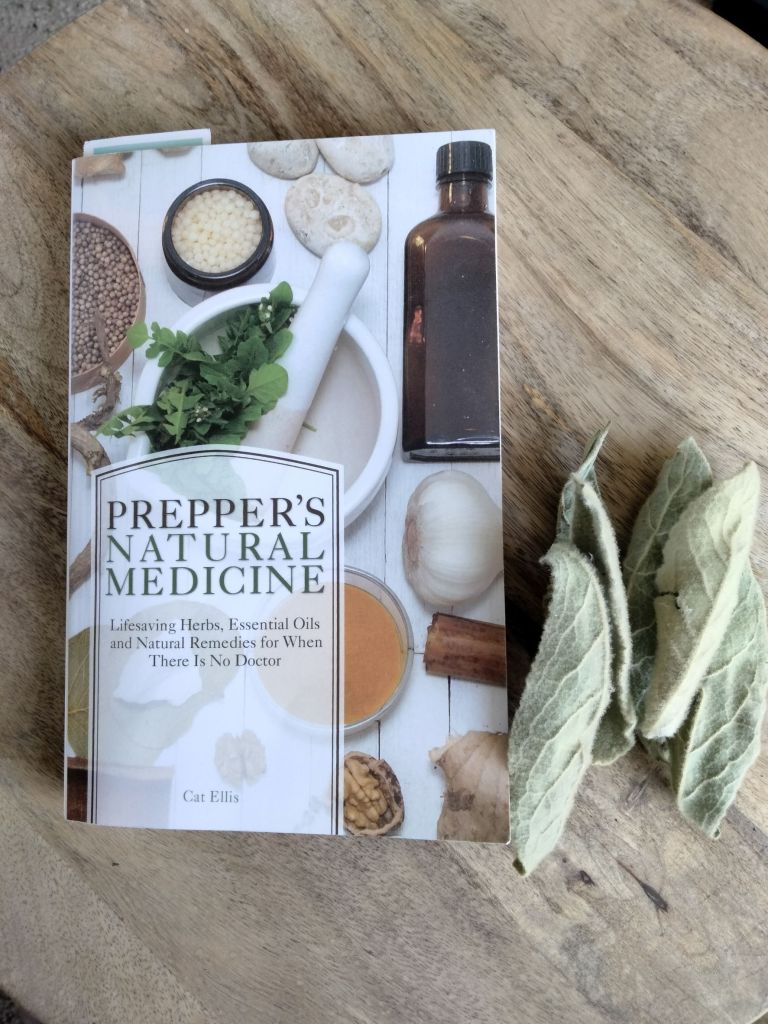
pictured here with leaves of Mullein, which the books says is an analgesic, antibacterial, anti-inflammatory, astringent, demulcent, emollient, expectorant, and mild sedative (page 100)
I bought this book to use a reference for my character Zillah. She has a built-up knowledge of herbal medicines and of emergency field medical procedures, but I don’t. I used this book to make sure that when she was using a remedy, I had the right plant. (I also had to look up whether the plant in question was native to the region of the world in which she was traveling.)
It turns out that, for almost any over-the-counter medicine and many prescription ones as well, there is a plant that will help with the symptom. God put this stuff in the world for us to find and use. He’s smart that way.
The book is great as a quick look-up reference, but as it turns out, there is also a benefit from reading it front to back. Then you will learn about the methods of collection, storage, and preparation, such as the difference between a tisane (used medicinally) and a tea (just for drinking); an infusion (made by steeping the delicate parts of the plant) and a decoction (made by boiling the hard parts of the plant). There is also basic medical and first-aid information, though obviously, to really know your stuff about that, you will need a much longer volume (such as Where There Is No Doctor), and ideally years of experience and a ton of luck as well.
I am already regretting not reading it front to back before using it as a resource in writing my novels. (It turns out that to make a tincture, you need to steep the herb in alcohol. Where on earth did Zillah get alcohol? She’s full of surprises.)
Speaking of surprises, it might be best not to wait until the apocalypse and then just go out and grab an herb for medicine (although in some cases that might be better than nothing). You’ve got to collect, dry, label, store, and refresh your collection, and also of course you’ve got to know what you’re doing. So, this is a very useful book for understanding the steepness of the learning curve.
Hi everyone! Welcome back to Out of Babel! My particular off-the-grid August brought a lot of changes: I’m starting a new job.
This new calling is one that should blend well with my other job of being a (still partly home schooling) mom and all-around housekeeper. I’m not sure what impact it’s going to have on blogging, since blogging is down on the priority list, below momming, Christianing, and supposedly below novel writing.
I’m well on my way to having posts scheduled for September and October, so that will be taken care of at least for a few months while I learn the ropes at New Job and how to integrate that with taking care of Old Jobs. There’s just one exception … I don’t have links lined up for Wednesdays.
Heretofore, I have posted a link on Wednesday. Usually they have to do with archaeology, but sometimes it’s psychology, theology, or humor. Well, no more. Something has to give, and this it. I might still throw you guys a bonus Wednesday link if I stumble upon one, but for the most part, all you’re going to get is regional or art pics on Monday, quotes on Thursday, and rants/writing updates/book reviews on Friday.
I’ll still check Out of Babel and respond to comments, and I still demand that you guys go out and buy my books. That’s it for now! Love you all … bye!
“Why the dickens couldn’t you have held her feet?” said Eustace.
“I don’t know, Scrubb,” groaned Puddleglum. “Born to be a misfit, I shouldn’t wonder. Fated. Fated to be Pole’s death, just as I was fated to eat Talking Stag at Harfang. Not that it isn’t my own fault as well, of course.”



 Out of Babel Books