
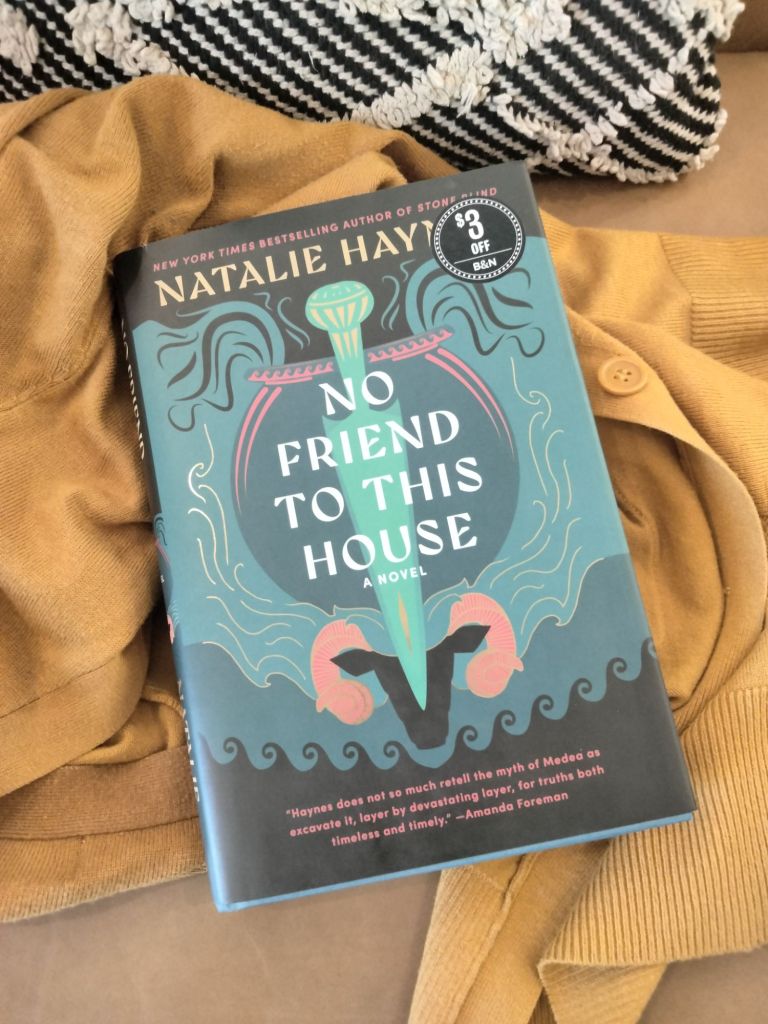
Like anybody who has ever encountered it, I have “issues” with the story of Jason and Medea.
In case you missed it, he sails off on the Argo to get the Golden Fleece. She is a witch, daughter of the king of Colchis, descendent of Helios, the sun god. Struck by Eros with an inordinate crush on Jason, she helps him accomplish all the tasks necessary to get the fleece and escape alive. He takes her with him on the Argo, and they crash around Greece, leaving a trail of bodies in their wake. Eventually, he throws her over for a younger model, a native Greek gal who is daughter of the king of Corinth. Medea takes a bloody and spectacular revenge, which I won’t spoil (look it up).
I first heard all this from my ninth-grade Lit teacher. She presented it in a very feminist way, but to be fair, this particular story sort of begs for that. I remember, in university, arguing rather incoherently with a male classmate about who was the real villain in this story. Later, when I was home schooling and read a simplified version of the legend to my kids, we decided we didn’t like the story, and we didn’t like Jason or Medea either, and they were both horrible people and they deserved each other.
So, hopefully, this book will be the nadir of my year of reading Greco-fiction: facing the story of Jason and Medea square on, by reading an entire novel about them.
The reason I liked the title of this novel is that it sounded like a phrase taken directly from the Greek — and so it was. The author, Natalie Haynes, has really done her homework.
Euripides’ Medea was the first Greek tragedy I saw performed, and it was the first or second play I read in Greek. … I wrote my dissertation on the heroics of infanticide in Euripides (I don’t have children, before you think about composing your sternly worded letter). … I’ve been reading and thinking about this play for the best part of thirty years, and I have probably seen it performed twenty-five times … I decided that the thing I needed to do [before writing the novel] was translate the Euripides, longhand. This is–in case you are wondering–weapons-grade procrastination. It took me a few weeks …
Haynes, in the Afterword, pp. 359 – 360
Haynes’ treatment of this story has been called feminist. And O.K. … sort of? But it’s not “feminist” in the sense of someone who understands the literature poorly who then reacts against the ancient heroic-age value system and sets out to undermine it. It is, rather, the work of someone who has marinated themselves in the ancient heroic-age mileu, which inherently presented a very broken relationship between men and women (especially husbands and wives). This story, and also the story of Agamemnon and Clytemnestra, bring a lot of tension with them and almost demand that you take what might be called a “feminist” perspective, at least in part, unless you want to take a very simplified view of the whole thing and not really analyze it much at all.
It’s not just me saying this. Apparently, everyone has been arguing about Medea for … well, ever since she came to their attention.
Diodorious Siculus says that the reason we have so many contradictory versions of her story is because tragic poets are drawn to talking about marvels. It’s also worth mentioning that any character who prompts different versions of their story is one who was popular in antiquity. If you want to read more about Medea, I spent many happy hours with “Medea,” a collection of essays edited by James J. Clauss …
ibid, pp. 365 – 366
Apparently, my and my children’s feeling that the whole story is regrettable is echoed by the Nurse of Jason and Medea’s two sons. Here is her opening monologue to the play (translated by Haynes):
If only the Argos had sunk to the bottom of the sea rather than winging its way towards the land of Colchis … For then my mistress Medea would not have sailed to the towers of Iolcus, stricken with love for Jason … and she wouldn’t live here, in Corinth, with her husband and children, pleasing the citizens to whose land she came in flight, helping Jason in everything. That is the greatest help: whenever a wife doesn’t disagree with her husband. But now, everything is hostile .. For Jason–betraying his own children and my mistress–is sharing his bed with royalty … Medea is wretched, dishonored like this. She cries out about the oaths he swore to her .. I’m afraid she is planning something. She’s a strange woman. No one starts a fight with her and takes an easy victory.
ibid, pp. 272 – 273
Successive phrases from this speech are used as chapter headings for the first 3/4 of the book.
I give this book 3 out of 4 stars. (Or 4 out of 5, take your pick.) The research, storytelling and psychology are spectacular. It gets tenser and more tragic towards the end. It is, of course, very hard to read, because this is a tragedy. The hardest parts to read, for me, were the parts where the Nurse speaks to the children. Even though it’s set in the ancient world, this is fundamentally a story about a home that gets broken when the children are very small. That’s hard to bear.
The one missing star? I needed more description.
This book consists almost entirely in monologues by the different characters (except for Jason), punctuated occasionally by dialogue. I guess that makes sense for a novel that is a re-telling of a play. But if I’m going to read a book set in the ancient Mediterranean, which includes a tour of the cities of Iolcus, Colchis, Aeaea (Circe’s island), and Corinth, not to mention the Aegean, Adriatic, and Black Seas, I want more than little hints and scraps about what these places look, sound, and smell like. I want to see the terrain, the buildings, and the clothes people wear. Haynes gives us almost none of that. We only get a little bit of description when it is directly relevant to a plot point, like the Symplegades (giant clashing rocks), or the golden dress that Medea gifts to Glauke. This is where Haynes falls short of Renault, who describes buildings, clothing, and artifacts in detail.
Also, there is almost zero description of how the people look. That’s important to me.
As for Jason, we are only told that he is “good-looking” until he meets Medea, when we find out that he has dark, curly hair and golden skin. This means that we have to go through the Argo’s entire outbound journey making up our own mental image of Jason, and then modify it when we find out what is canon in the novel. In the case of Jason, that may be intentional. Part of his characterization is that he is a chameleon, able to be the figure that people want in order to get what he wants; or, as Haynes puts it, “a blank space where a man ought to be.”
But there are plenty of other characters that Haynes could describe when we first meet them, and she doesn’t. What do the Colchians look like? They are “not Greek.” Do they look Asian? Or is Medea made of gold, like the children of Helios in the novel Circe? What do the different Argonauts look like? The Tutor? The Nurse? Haynes does a better job describing the various goddesses, women, nymphs, and the golden ram whose lives are also busted up by this story … but still, I could use more.
Gentle reader, you have survived the harrowing journey of the Argo with me. What horrible ancient Greek story should we read about next?


The cover looks the same as some other book. It had me confuse.
When was this book published?
I notice that recently published books are not very descriptive. It as if author are scare of falling into purple pose or maybe it shorter attention spans.
LikeLiked by 1 person
Published in 2025. I found it this year on the New Books shelf at Barnes & Noble. You are right, avoiding description like the plague seems to be a convention of modern books. I believe that some of it is coming from agents and editors, who want books that “draw you in” (read: have dramatic action) right away.
LikeLiked by 1 person