
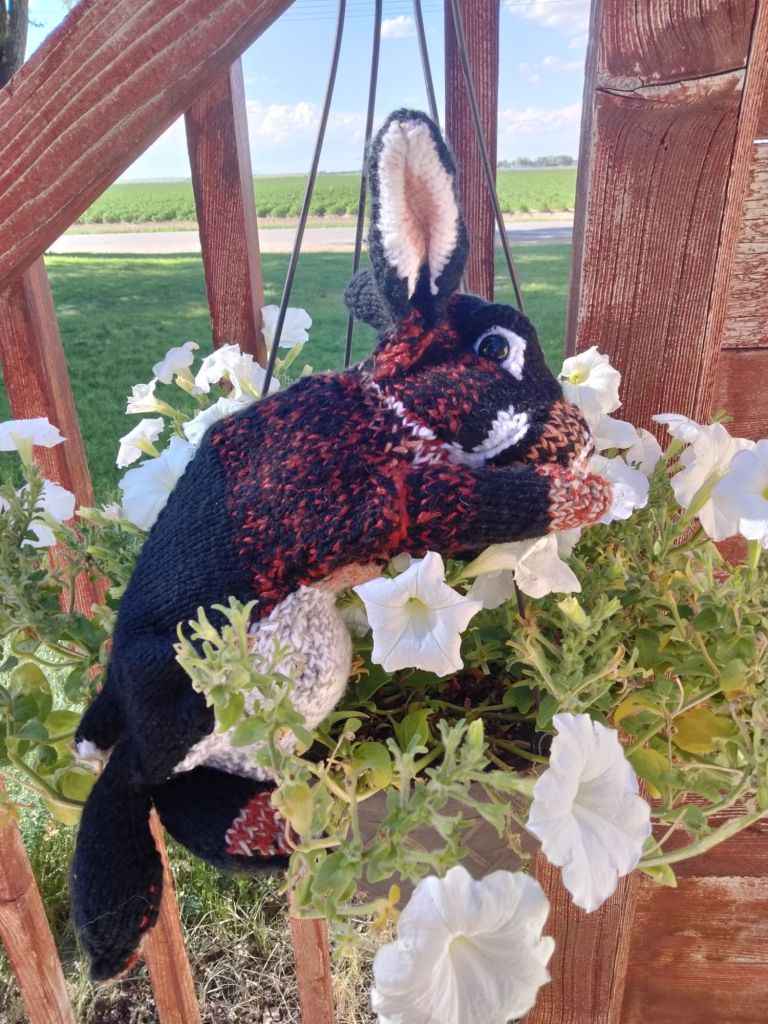
They say, “If someone knits you something, they like you. If it’s made of black yarn, they love you.”
I love my teenaged son. He’s been asking me to make this knitted Black Otter Rex rabbit for years, ever since he was a rabbit-crazy little boy.
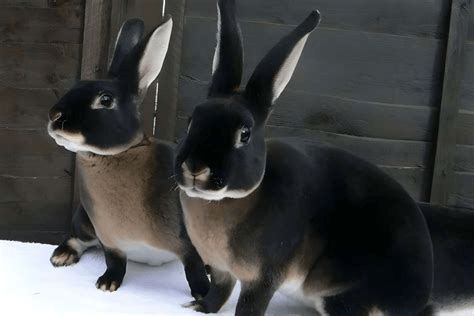
By the way, Black Otter Rex rabbits are almost unbelievably sharp-looking. Here’s what they look like in real life.
My son owned a black (not Black Otter) rex rabbit.
To make this rabbit, I used a pattern purchased from Claire Garland on Etsy. For the most part, it’s a really great knitting pattern. It starts at the rabbit’s nose and works back over its head, adding the ears as you go. Then, we do the black portions of the rabbit … down the back (with forearms attached but not stuffed yet), tail (stuffed and sewn on the spot). Then, we change colors and work back up the belly, to the neck and chin. Only the hind feet are knitted separately and then sewn on. Pretty ingenious! The pattern instructs you how to do so-called “short rows” for shaping in the face, upper hind legs, and belly. Then, you essentially just attach the front to the back, and stuff. The pattern includes plenty of pictures of the developing rabbit, with instructional dotted lines and so forth, so you can visualize what you’re doing. It also has multiple pictures of the finished rabbit, so you know what you are aiming for.
Now, about the few hiccups I had.
To get that beautiful color gradient, nearly all the pattern calls for you to hold up to four different colors of yarn together while knitting (for example, black, black mohair, petrol, and copper). These yarns that you are meant to be using are generally very fine (4-ply or mohair). Since I was working from my stash, I adapted this aspect of the pattern. I didn’t have “petrol,” but I assumed it was pretty close to black, so I just used my thicker black yarn on the sections that call for “black, petrol, and black mohair.” I did have white, grey, copper, ochre, and black, mostly in worsted or sport weight, though my black yarn was chunky. So, my end result was a little stiffer and a little less fuzzy probably than the original. Sometimes, having multiple yarns on the needles became a challenge when, for example, I was occasionally told to “knit three together.”
Making up, the part where you sew the contoured belly onto the contoured back & legs, presented a few confusing moments. I don’t know whether I mistakenly skipped or added rows in various parts of the pattern (it’s’ quite possible), but I seemed to have a lot more material on the back/hind legs than on the corresponding belly part, and I had to do some finessing to make it work. If I make this pattern again, I’ll pay special attention when I am knitting those parts.
Still, I’m pleased with the result, and so is my son. This rabbit has been at his side since yesterday, when I completed it.
 Out of Babel Books
Wow!
LikeLiked by 1 person
Nice job!!!
I’ve also done a Claire Garland rabbit pattern in the past, but with a much simpler color scheme than yours. I like her ingenious construction.
LikeLiked by 1 person
Oh neat!
LikeLike