
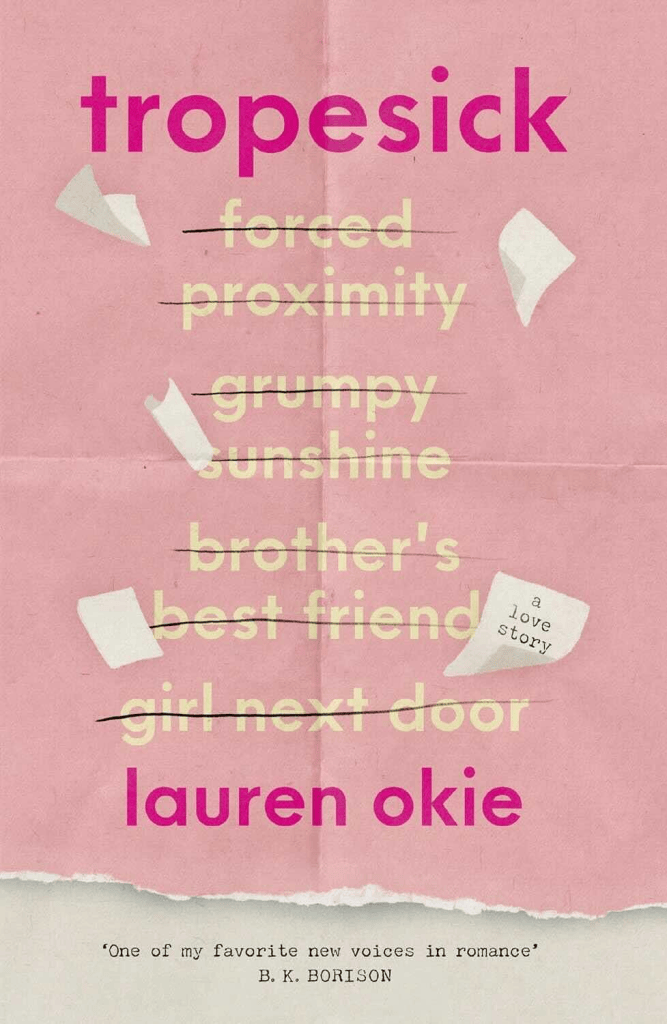
During the month of October, I like to post about scary things. I guess this book qualifies.
Through a comical series of events, I found myself drafting a contemporary romance novel. I don’t read much in the genre, but I thought it might be a smart idea to try. And where better to start than here, a romance that features a pair of young writers, working on a romance novel together, and every time they write a trope into their novel, it happens in their lives?
I mean, that’s kind of clever.
Also, like a suspiciously large number of contemporary novels out there, this one offers an inside glimpse of the publishing industry. That’s a double-edged sword, of course. I can’t help but be interested in what the industry is like (at least in Okie’s experience), just as I can’t help but be intimidated and repelled by it when I find out.
Anyway.
Tropes, in case you didn’t know, are also known as cliches, things that frequently happen in any given genre. There are so many tropes that, if you have written any fiction at all, I guarantee you have used a few, with or without meaning to. This is not a bad thing. Some tropes, like “not enough beds,” are super contrived, but others have become tropes because they represent common and powerful human experiences. For example, the fact that Absent Father is a trope doesn’t make the experience any less painful for the person experiencing it.
The strength of this book is that the premise allows the author to use a great many common tropes without flinching.
My feelings about this book are deeply mixed, and I’m going to express them in the manner of Tevye in Fiddler on the Roof: “On the one hand … but on the other hand …” There will be some spoilers here.
A pro is that the book takes place in and around New York City.
A con is that this means both the main characters are New Yorkers.
A pro is that both MCs are sweet, likeable people.
A con is that they are both hoes.
A pro is that the story is truly emotional.
A con is that several of the emotional turning points are expressed in pages-long sex scenes.
Another con is that these scenes take place before the characters are truly in love.
Con: not to mention married.
A pro is that the tragic backstory is revealed, little by little, in flashbacks.
A con is that, after a ton of foreshadowing and minimal revelation, there are a bunch of this-changes-everything twists packed into the last few pages. (Wait … is that a trope, too?)
(Spoiler): a pro is the truly unexpected appearance of the Meddlesome Ghost trope right near the end.
Con: (at least, it’s a con to me): Though in retrospect, there were clues about the ghost thing, the atmosphere of the story in no way prepared me for it. I feel this was a missed opportunity to get some chills out of this story. But perhaps this is how ghosts are handled in romances.
I must rant a little bit more about the hoe problem. Katie, the heroine, is presented as sweet, someone who “loves big” even when she has been hurt. She is “bright,” in the sense that her virtue causes a glow that is perceptible to the senses. (She also wears face and body glitter.) She has suffered, but she is not hardened and bitter. And yet, when we first meet her, she is sleeping with a guy she does not even consider her boyfriend, simply because she is a young, successful writer living in NYC and she wants to “have a fun summer.” I’m sorry, but this is really clunky psychology. If you are sleeping around just for fun, you are doing serious mental damage to yourself and to everyone around you.
In fact, both the main characters are presented like this. They are Broken in Some Way (as per the trope), but their brokenness is neither the cause of, nor exacerbated by, their promiscuous behavior. This seems to be a blind spot on the author’s part. It’s not true to life, and it throws off the emotional tone of the book. Rant over.


Rant away.
The entertainment industry has made sex to be on the same level as eating a hamburger. But when you see the real world thing, then you see the real consequences. but people turn away from reality towards the fantasy.
It is stuff like this that wears down my spirit.
LikeLike
I looked this up on Goodreads and noticed a couple of interesting things in the reviews. First, that even the people who disliked it had nothing to say about the subject of your rant and second, that there was a lot of praise for the love story, indicating (in effect) total acceptance of this behavior as a valid path to love and happiness.
But of course I have no idea what was considered acceptable in the steamier romances of the past, so that’s not necessarily a blanket condemnation. Could it just be contemporary titillation while readers see through it to a purer core?
(One thing that kind of scared me in many of the reviews was the praise for its depiction of addiction and its consequences, as if the readers were all too familiar with that subject.)
LikeLike