
Disclaimer about the Intended Audience
I’m posting this review in the spooky month of October, a long time after the movie came out. People who are big Backrooms fans have already seen the movie, watched or listened to reviews, and written or uploaded their own reviews. This essay is not for them. It’s for readers of my blog, who, unless I miss my guess, are not familiar with Backrooms lore and perhaps have not seen the movie.
Teens, and Liminal Spaces
The Backrooms was an independent horror movie made by a young director, but the director did not originate the idea of the backrooms (which I will now stop capitalizing). I happen to know a little bit about where the backrooms originally arose as a mythology. The reason is that I am a mother of teenagers.
Well before the movie came out, my teens had acquainted me with backrooms images and lore. Apparently, the phenomenon began with Internet accounts such as Creepypasta posting images of liminal spaces.
Liminal spaces, which always figure big in mythology, are “in between” spaces. They may be the beach (neither sea nor land), the threshold of a doorway, the wilderness between the borders of kingdoms, or the like. There are also liminal times–dawn and dusk. Humans have long had the uneasy feeling that liminal spaces and times are where we are vulnerable to encountering entities that we do not meet in everyday life. It’s when you go over the moors in the mist that you meet the fairies.
The Internet liminal spaces were generally of two kinds. One, indoor spaces that are actually liminal, such as hallways and stairwells. They are part of a building, but only marginally. They are not the areas where people live or work, but rather passages to get to those areas. Often, their very design makes them disorienting, like a hotel hallway with low light and an endless succession of identical doors. Typically, these spaces do not have windows whereby the viewer might be able to tell the time of day or where the building is located.
The second kind of Internet liminal space is an indoor space, usually for public use, that has been abandoned. This includes empty malls, empty hospitals, empty parking garages, and the like.
After a number of these images had been posted, the young people of the Internet collectively decided that they constituted a realm or dimension of their own, dubbed “the backrooms.” Commenters began to make up their own lore about the backrooms. You could “no-clip” into them by accidentally falling into the backrooms dimension. (No-clipping is something that happens in a video game when your avatar falls out of the useable area of the game.) People began to make up stories about teams that would go into the backrooms with a backpack of snacks and try to film and map them. The backrooms developed different “levels,” each more unsettling than the last. One level was nothing but an endless succession of hotel pools.
The deeper a person went into the backrooms, the more dangerous they became. The realm became less and less picky about adhering to the laws of physics. Also, although ostensibly empty, explorers would begin to glimpse movements and shadows out of the corners of their eyes. Eventually, the lore developed elusive monsters that inhabit the backrooms.
Given all this, you can imagine that my sons, particularly my youngest, were pretty excited when they heard a Backrooms movie was coming out. There was enough lore by this time to having the makings of a paranormal mystery/thriller.
Not Everyone Can See The Backrooms
One day, my youngest and I were in nearby Big City with enough time and money on our hands that we could see a movie. I was a little bit interested in Disclosure Day, but I was flexible to watch something else too. We drove through the movie theater parking lot and glanced at the posters. There were three or four posters for current movies, including Disclosure Day, and one poster frame that was just filled with brown paper. So, Disclosure Day it was! We parked, and approached the theater.
Whereupon we found that the “brown paper” was actually a poster for The Backrooms. It was patterned like the dingy yellow wallpaper that features in many of the backrooms hallways. It did have the title and so forth, but everything was in such low contrast and we hadn’t been able to see it from afar.
Naturally, we changed our plans and watched The Backrooms instead.
Quick Spoilery Summary
The plot of the movie was not at all what my son expected based on the lore, nor was it what the first five or so minutes of the movie lead you to expect. However, it has been praised as being well-crafted and character-driven, and not without reason.
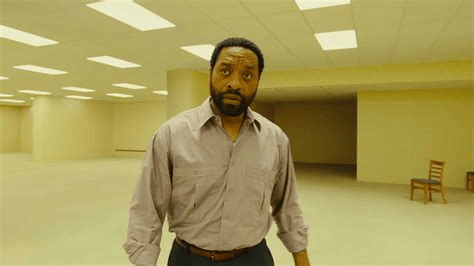
After an intro in which we see people in hazmat suits exploring the backrooms and coming to grief, we meet the man who is going to be the main character, Clark. You can see him in the image at the top of this post, wearing on his face the look that all people wear when they first get into the backrooms.
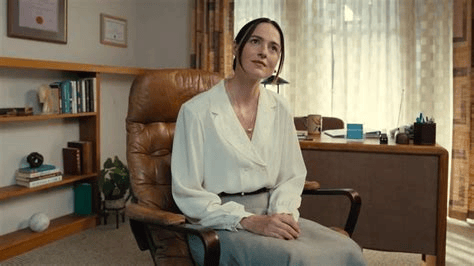
In an important early scene, Clark is sitting in the small office of his therapist, Mary. As you can see from the image above, Mary’s office–and in fact all the “real life” scenes in the movie–are decorated in a sort of late 70s/early 80s style that is heavy on fabrics and abstract patterns. People’s clothing is the same way, so that even the “normal” scenes in the movie are slightly suffocating.
Mary, who is a self-help guru, walks Clark through the last argument he had with his wife, right before his wife kicked him out of the house. They role-play, and soon Clark is fully re-living the fight, yelling at “his wife” that she is lazy, that he is working his butt off for her, and so forth.
Right in the middle of this, Mary says quietly, “What are you feeling right now?”
Clark, confused, says, “Are you being yourself — or –?”
“I’m asking you. What are you feeling?”
Clark is unable to give an answer — at least, an honest answer, because what he is feeling is selfish rage. Mary, for her part, though she has just uncovered an ugly, sinful attitude from Clark toward his wife, does not have any other tool in her toolbox than “You’ve got to feel your feelings.” She is not equipped, for example, to call him to repent or point him to Christ.
Clark, since his wife kicked him out (“of my house!”), is living in his place of work, which is a furniture warehouse. He sleeps on the showroom bed and watches the showroom TV. His whole life is in a liminal space.
To advertise his furniture, Clark has his two twentysomething employees film him in the character of a pirate with a peg leg. He hobbles around the furniture showroom, trips over something, and cusses them out as they film him.
The electricity in the furniture showroom keeps glitching. This necessitates Clark going down to the lower level of the furniture store, which is even more backrooms-like, to the fuse box. Eventually, on the blank wall next to the fuse box which should lead to nothing, he sees the lighted outline of a door. He steps through this “door” and finds himself in a large, featureless, yellow room with fluorescent lighting and a large pile of furniture that resembles his furniture in the middle of the floor, with some of it merging into the floor. He has found the backrooms.
The next time Clark goes back to Mary’s office, he tries to tell her about these rooms he has found. He shows her the map he has started drawing. He’s very excited, and somewhat incoherent, and Mary assumes he has been drinking again.
Clark then bribes his two part-time employees to go into the scary realm with him, bringing an old hand-held video camera. Things don’t go well, and he returns without them.
Weeks later, Mary notices that Clark has disappeared. She drives over to the furniture warehouse, where she finds mail piled up at the front door. She lets herself in. There is the furniture, there is a cardboard cutout of Pirate Clark, but the lights are low and the place seems abandoned. She wanders down into the basement and discovers the door to the backrooms.
In the backrooms, she finds a large, disturbing graffito on the wall that shows a pirate monster eating people. She wanders on, gets herself into a dead end, and hears the approach of something large. Just when she is starting to panic, Clark appears. He says that he will save her. Instead, he chokes her until she passes out.
Mary wakes up in a small, dark backrooms facsimile of a kitchen, tied to a chair. Clark is sitting across the table from her. Also in the room are three other entities. They are human-looking figures similar to mannequins, but with their faces distorted as if from a blurred photograph. One of them is a facsimile of Clark’s wife.
Clark is eager to tell Mary all that he has discovered about the backrooms. His theory is that the realm produces imperfect copies of things that exist in real life, both places and people. He says he prefers the mannequins to real people, and demonstrates that he can stab one with a kitchen knife and there are no bad consequences. He says he likes the backrooms better than the outside world, feels that he belongs here, and intends to stay.
“That’s fine,” says Mary, “but could you please let me out?”
She asks what he wants. He says he wants to hear her say that he was right.
“Oh, you were so right, Clark, about this realm existing. I was so wrong! I didn’t believe you.”
“No, not like this,” says Clark. “I want to do the role-play.”
Clark takes the wig off wife-mannequin’s head and puts it on Mary. Now he wants to re-enact the fight scene, with Mary saying what he wishes his wife had said.
Mary tries, but she can’t bring herself to do it. Eventually, she starts telling Clark what she really thinks.
“You know why your wife left you? It wasn’t the drinking. It wasn’t the fighting. It was the whining! It was the self-pity!”
“I don’t want to change,” says Clark.
“Then don’t!” says Mary. At this point, she has given up on helping Clark through therapy and has admitted, despite her best-selling book and seminars, “I can’t help anybody.”
“I want to stay here.”
“Then stay! Just let me go home … please?”
Clark unties one of Mary’s wrists. Then a sound is heard approaching that causes the mannequins to startle in fear. The wife-mannequin runs to an acute corner of the kitchen and seems to be trying to climb out.
In through the narrow door squeezes a monster. It’s an 8-foot version of Pirate Clark, with a real peg leg and a distorted face with big teeth.
Clark greets the pirate. “This is my therapist,” he says. “She says we don’t have to change!”
The pirate picks up Clark and takes a big, gory bite of his neck.
While the pirate is killing Clark, Mary has untied her other wrist. She squeezes past the horror, through the very narrow passage, and out into the rest of the backrooms. Soon, the pirate is following her, dragging the body of Clark behind him.
Mary runs and runs, totally lost. At one point, she thinks she has escaped into Clark’s furniture showroom, but it’s just the backrooms version. The pirate catches her and is about to maul her, but Mary spots on the floor an item that represents what might be her only happy childhood memory. It’s a chunk of cement into which she and her mother once pressed their handprints. Mary picks up the memory and bludgeons the pirate’s face with it until he is temporarily incapacitated.
My Son’s Worldview Analysis of the Movie
The drive home from Big City was forty-five minutes, and it was not enough time for my son and me to settle all of our questions about The Backrooms. For example, we agreed in a general way that Clark’s mind and the backrooms got into a sort of feedback loop where it manifested his thoughts and desires. But there were hints of Pirate Clark earlier in the sequence of events, before Clark moved into the backrooms. What is the relationship between Captain Clark and the other monsters of backrooms lore? The jury is still out. I couldn’t quite follow some of the metaphysical distinctions my son was making.
What we did agree on was this. The role the backrooms play in Clark’s life are a picture of the progression of sin. At first, he’s scared to go in. He’s very cautious. Then, he tries to bring some other people into it (the employees), which results in their destruction. But eventually, he realizes the backrooms offer him a way to live however he wants, be in control of things, and escape consequences. When he finally admits to someone else that he doesn’t want to repent, and they give him “permission” not to, that’s when the sin shows up in full strength and eats him. After that, there is no Clark left, only his big, ugly sin.
My son came to these insights so quickly that I was really proud of him. It appears that several years of training in theology, literature, and worldview analysis from his classical Christian school have not been wasted.
The Lingering Effects of The Backrooms
The end of the movie is ambiguous about whether Mary ever gets out. She is “rescued’ by a team of people in hazmat suits. This is the team from the original lore. A man interviews her in a room that looks like a police interrogation room. It becomes obvious in a few minutes of conversation that he doesn’t know much about the backrooms either, and in fact he’s rather incoherent when he tries to explain to Mary what his organization even wants. The implication in the interview is that the “rescuers” are never going to let Mary go back to the real world, because she has seen too much. It’s also not clear whether their facility is located inside of, or outside of, the backrooms. It’s like when we “wake up” from a dream only to find ourselves in a second dream about waking up.
Though my son was somewhat disappointed by The Backrooms, he says that in the weeks since we’ve seen it, it has been growing on him. It was actually kind of a powerful story, and “it generates a lot of good memes.”
Would You Go?
Now that I have spoiled the major parts, would you see this movie? I did leave out a lot of important, tense, and horrifying details, so you could still get good and scared if you wanted to.

