
“Did you fall down the mountainside too, didja?”
“Nope,” Cal says. “Slipped in the shower. I musta been drunker than I thought, too.”
“The shower’s a terrible man,” Mart agrees obligingly. “My cousin up in Gorteen, he slipped in the shower and smacked his head. It does be fierce hard work talking to him; you wouldn’t know which eye to look at.”
“Guess I got lucky,” Cal says.
“So far,” Mart points out. “I’d watch that shower if I was you. Once they get a taste of blood, there’s no holding them.”
Tana French, The Hunter, p. 242
Author: Jennifer Mugrage
I'm a wife, mother, Christian, closet Luddite, Neanderthal advocate, incurable book hound.
I'm also the author of The Scattering Trilogy, which is set in 10,000 B.C. Buy, read, pass it on!
Leave comments. Let's talk!
Lard is the Best for Pie Crust
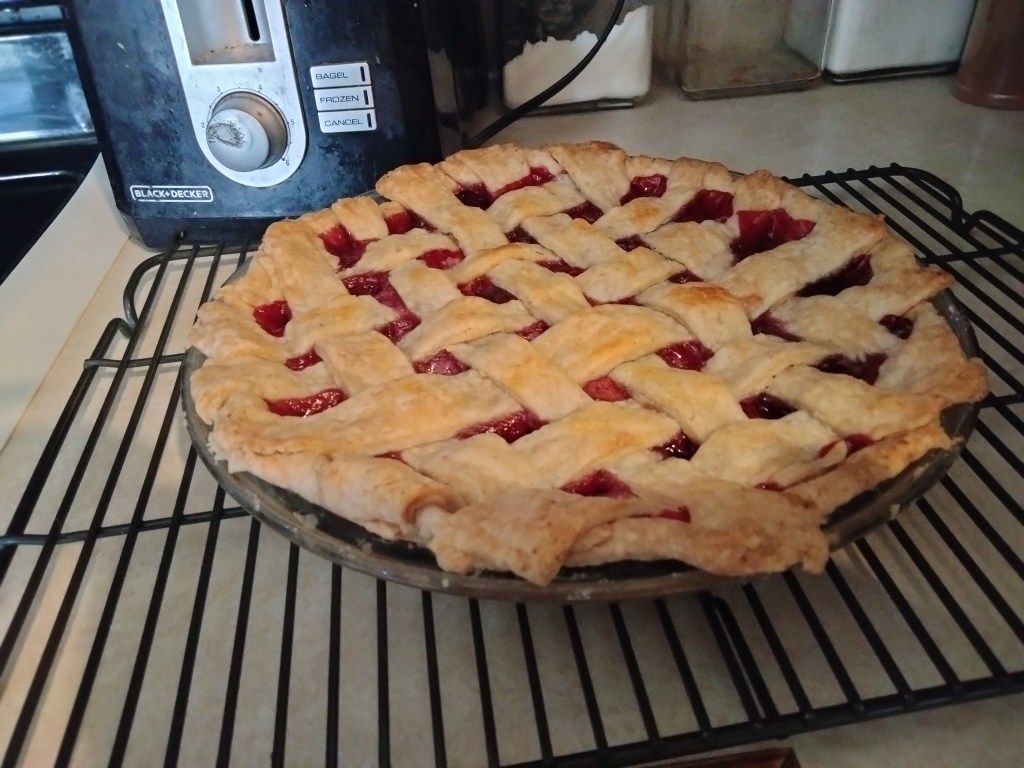
See how it puffs up a little? More so than with vegetable shortening.
In making this–though I say it myself–dazzling lattice raspberry pie, I am standing on the shoulders (metaphorically) of a long line of matriarchs. Here are three.
My mother-in-law (and actually my father-in-law too) always made pies with lard instead of with shortening. I can remember going to the grocery store and having to hunt around for lard for them to make their pies, because for many years it was not popular. Now, people are starting to realize that emulsified seed oils may actually be as bad or worse for us than animal fat, and so people like me are starting to use lard for the first time in our lives. It gives the pie crust dough a bit more of a taste than shortening, which is a tiny bit off-putting to someone who is used to shortening pies … but in the finished product, the taste is more buttery.
While I tell you about the matriarchs, here are the steps for making a lattice pie, learned long ago from the Better Homes & Gardens cookbook.
First, cut the lard into the flour and then slowly mix in cold water, enough to make a double-crust pie.
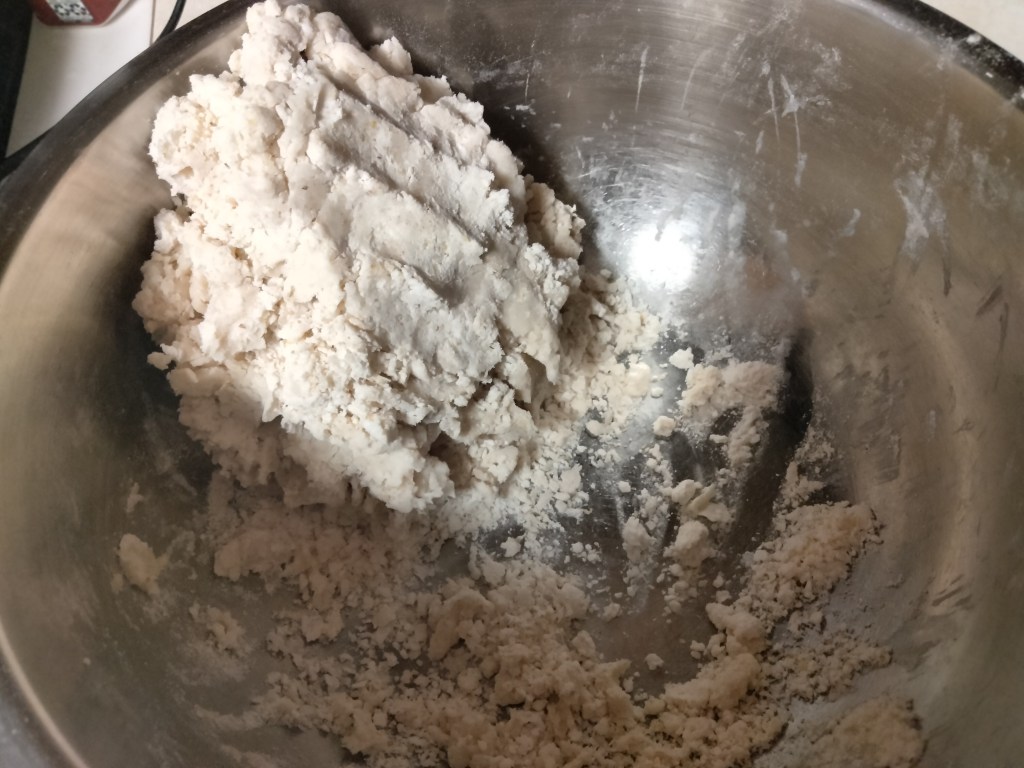
Roll out the bottom crust, transfer to the pie pan by loosely wrapping it around the rolling pin, patch cracks, and fill it with whatever fruit you are using. In my case, it’s raspberries picked from our patch, tossed with sugar, cornstarch and a dash of cinnamon.
Next matriarch: A cheerful saint at my church in Ohio, who had home schooled five children. Once I went to Sunday dinner at her house. She referred to her ability to get a full dinner on the table within an hour of getting home from church as “the forty-minute miracle.” She also told me this:
“When I first got married and started cooking meals, I thought that over time, I would become a gourmet cook. That didn’t happen, but what happened was that I got faster.”
Me too, Ruth. Me too. You get faster, which makes things easier, but unfortunately you only get faster at the things you actually practice.
On to the lattice.
Roll out the second half of the pie crust dough and cut it into strips, like this:
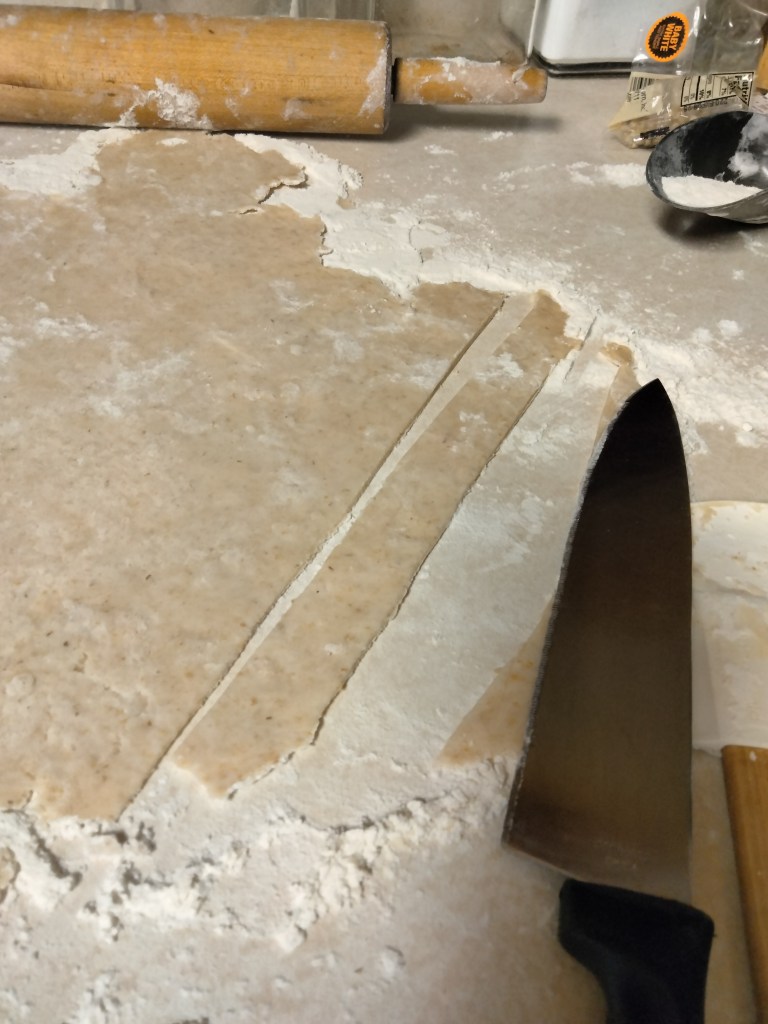
I don’t cut all my strips beforehand. I just make them as I go.
Take a shorter strip and put it across one side of the pie. Take another short strip and put it down at a right angle, so they cross.
And now, the magic happens.
As you add strips, you will need to gently fold back the ones that you want to go over the new strip. Here I am lifting one, to illustrate.

As you add new strips going at right angles to each other, keep folding back every other strip when you place a new one. Then put them back after the new strip has been placed. That’s how you get a weaving effect.

Like this.

The last matriarch I have to thank is whoever planted the large raspberry patch in the yard of the farmhouse we rent. It was probably the older farmer and his wife we rent from. By the time we got here, the bushes were already producing, keeping me busy picking throughout July.

All ready! Scatter small pieces of butter over the crust and put aluminum foil around the edge for the first 25 minutes of baking. Don’t forget to put a baking sheet on the rack underneath the pie. If you have done this right, molten raspberry juice will bubble out, and your smoke alarm will go off. You want the raspberry napalm to fall and burn onto the baking sheet, not the bottom of your oven.
Enjoy!
When Did We Stop Marrying Our Siblings?
… and why do I care?
I might be in the process of drafting a book that takes place before the Flood. So that is forcing me to tackle this issue. Besides needing to get it settled in my own mind, this post is meant to test the waters and see how you, my readers, react to this concept. If I even bring it up, will I be kicked out of polite society?
So, this post is a historical survey of sister-marrying. And it starts in Egypt.
Royals did it
Marrying one’s sister, or half-sister, was not unheard of in the royal families of Ancient Near Eastern cultures. See the following two links for some hair-raising proof that it happened in ancient Egypt:
https://www.historyskills.com/classroom/ancient-history/egypt-brother-sister-marriage/
The practice of royal inbreeding continued so long in Egypt that, by the time we get to Tut-ankh-amen, he has a myriad of health problems and is rather strange-looking.
This was such an established part of married love, at least among royals, in the Ancient Near East that calling someone “my sister” became a conventional endearment. Here, for example, is Solomon:
You have stolen my heart, my sister, my bride,
you have stolen my heart with one glance of your eyes,
with one jewel of your necklace.
Song of Solomon 4:9
And why did they do it? The obvious answer is to keep the royal bloodline pure. Most ANE cultures tended to believe that their royal family was descended from the gods (see my post Genetic Engineering in the Ancient World), and to add another layer to this, their myths about the gods also often featured sibling-marriage. Typically, you’d have gods and goddesses all being descended from the same being (Father Sky and Mother Earth, say), and then reproducing with each other to produce all the typically observed features of the cosmos. (Please, for the love of God, take my word for this and don’t read the Sumerian creation myths. I’m begging you–don’t!)
Speaking of Sumerians, here is an article that argues that Abram married his half-sister Sarai (whose name means princess) for the same reason: because their family was some kind of royalty in Mesopotamia before he left on his journey.
https://biblicalanthropology.blogspot.com/2011/03/sister-wives-and-cousin-wives.html
My question, however, is this. Did this practice of royals marrying their sisters represent breaking an established taboo for a “good” reason, or was it a case of carrying on a common practice a little longer than most people? My contention is that it’s the latter.
Let’s Go to Genesis
Genesis is, as I have often said, my favorite ancient history book. The more I study all of this, the more I realize that it is by far the most accurate written record we have of really ancient history, and of course it’s the only written record we have for some events that are, nevertheless, corroborated indirectly by archaeology, genetics, and historical traditions from around the world.
So, in Genesis, we have humanity starting out with one single couple. If we take this seriously, we have to conclude that the first generation would have had to marry their brothers and sisters, because there was nobody else around.
Nowadays, this would be an impossible genetic problem, besides being taboo. However, clearly it wasn’t taboo at the time. By producing families, people were obeying God’s command to “be fruitful and multiply, fill the earth, and subdue it.” (Gen. 1:28) Based on the extremely long lifespans recorded in Genesis, we can infer that the newly created people were much healthier than we are, with a much more varied and robust genetic code. They would have had few diseases as yet, and almost no harmful mutations to inherit. Adam and Eve, who didn’t die until they were into their 900s, could have had literally a hundred or more children in that first generation. Furthermore, these children need not all have looked alike, except in the sense of being human. We have to remember that Adam and Eve had within them the potential to produce every genetic variation we see today (and actually more, since most of the variety was lost during the Flood).
By the time Cain kills Abel, there are enough people in the earth that Cain can complain, “I will be a restless wanderer on the earth, and whoever finds me will kill me.” These other people that he is worried about would have been his siblings, nephews and nieces, grandnephews and -nieces, and so forth. If we figure that Seth was born not long after the murder of Abel, then the murder of Abel took place just under 130 years after the Fall. (Genesis 4:25 – 5:3) Apparently, that was enough time for the world to be populated.
In this video, starting at about 20:00, geneticist Nathaniel T. Jeansen discusses how our ancestors had to have been more closely related “than we are usually comfortable with.”
A Detour into Evolutionary Theory
“But wait!” you may say. “All this is nonsense. People didn’t all come from one founding couple, we evolved from several different but related species of hominids.”
Actually, if you think that way, you probably stopped reading this article before you got to this section. But let’s dip a toe into natural selection, just in case there is anyone hate-reading or any readers who are intrigued by what I’m saying about history, but are bothered by the science side of things.
Natural selection, in order to work as a mechanism, has to have a population of creatures already in place, with some genetic variation already in their genome. And–this is critical–they have to be already reproducing. That way, natural selection can operate on the subsequent generations of the population, encouraging variety here, stamping it out there, etc.
This creates a big problem if you want to argue that people evolved from (ultimately) one-celled animals. Now, how one-celled animals reproduce is itself a beautiful, complex mystery, but it’s basically by subdividing, producing clones of themselves. In other words, it’s not sexual reproduction.
How did sexual reproduction come about through natural selection? It would call for a wildly improbable series of (already vanishingly rare) beneficial mutations to the genetic code of two different creatures of the same species, such that one ended up male and one ended up female, with their systems perfectly corresponding to each other for reproduction. And it would have to work perfectly the first time.
If you want several different populations of human species, then you need this miracle to happen not once but several times, in different places. If it only happens once, then you’re back to what Genesis describes, which is just one founding couple.
What I’m saying is that introducing evolutionary theory doesn’t make the believability problem smaller, it makes it bigger.
Stephen Meyer explains why beneficial mutations are mathematically impossible.
Back to Genesis Again
We’ve established that in the pre-Flood world, there was no taboo on marrying one’s sibling (or probably, cousin or niece either), and also no health cost to doing so. Also (probably) it would not necessarily mean marrying someone you had grown up in close proximity with, given the size of the families we are talking about.
Then we get the Flood, in Genesis 6 – 9 and also attested in numerous local histories worldwide. At the Flood, the human population of the earth, previously vast in genetic diversity, gets culled down to just four couples, and the men of these couples are all related to each other. It’s from these four couples (perhaps just three of them?) that all of us today are descended. (We are literally just one big family!)
Think about the implications of this. The most distant relationship that any of Noah’s grandchildren would have had to each other would have been cousin during that first generation. Perhaps they married their cousins, and then their second cousins and so forth, but there is nothing to indicate that the possibility of marrying siblings had been closed to them. In Gen. 9:1 -17, God makes a new covenant with Noah and his sons. He reiterates the command to increase in number and fill the earth. He gives them the animals to eat, institutes the death penalty for murder of humans, and promises never to send another worldwide flood. He does not mention any new rules about not marrying your sister.
Next, in Genesis 11 and 10 respectively, we get the Tower of Babel and the Table of Nations. Though the Table of Nations comes before the account of Babel, the fact that we are told which geographical areas these nations settled in hints that the Table of Nations is at least a partial elaboration of where people went when “the LORD scattered them over the face of the earth.”
In the Table of Nations, the peoples are sorted by father. We see the descendants of Shem, Ham, and Japeth listed by a paternal line, and we see them scattering to found cities, kingdoms, and peoples. This implies, though it does not directly say, that they were having a lot of children per family, and that they were practicing in-group marriage.
Now we get to Abram, who was a Sumerian basically, or was living in that region of the world and in that culture area. As has been covered, he married his half-sister Sarai, whether because theirs was an aristocratic family or because it was still common practice in Mesopotamia at the time. Later, on two separate occasions (Gen. 12:10 – 20 and 20:1 – 18), he “lies” by telling a local ruler that Sarai is his sister. On both occasions, the local king understands this to mean that Sarai is not Abram’s wife and is fair game for his harem. This shows that, probably, most wives were not sisters at the time, at least in Egypt (Gen. 12) and southern Palestine (Gen. 20).
This would be about 2,000 B.C.
In Genesis 24, Abraham asks his servant to get a wife for Isaac from among “my own relatives.” The servant, guided by the LORD (!), finds Rebekah, the daughter of Abraham’s niece (Gen. 24:15). One generation later, Rebekah herself encourages Jacob to marry one of his cousins, daughters of her brother Laban. So by this time, we are practicing in-group marriage, but with cousins, not siblings.
Some groups still do this. See my post on The Iroquois Kinship System.
Finally, A Taboo in Leviticus 18!
Finally, in Leviticus 18, we get an explicit prohibition on marrying your sister.
Leviticus comprises the details of the giving of the Law, right after the exodus from Egypt, so about 1400 B.C. If you plop your finger onto Leviticus, it looks really early in the Bible. However, it’s 600 years after Abraham and a couple of thousand years after the Flood, so it is coming rather late from this blog’s perspective on ancient history.
The intended recipients of Leviticus are a large population of tribes who have just spent 400 years becoming culturally Egyptian. Since Moses’ parents were both from the tribe of Levi (Exodus 2:1), we can infer that they are still practicing in-group marriage.
Leviticus chapter 18 begins this way:
The LORD said to Moses: “Speak to the Israelites and say to them: ‘I am the LORD your God. You must not do as they do in Egypt, where you used to live, and you must not do as they do in the land of Canaan, where I am bringing you. Do not follow their practices. You must obey my laws and be careful to follow my decrees. I am the LORD your God. Keep my decrees and laws, for the man who obeys them will live [i.e. find life] by them. I am the LORD.
“No one is to approach any close relative to have sexual relations. I am the LORD.”
Lev. 18:1 – 6
There follows a very comprehensive list of close relatives who are off-limits. This list includes everything you can think of, and some things that you perhaps haven’t. It ranges from very sick perversions, to this:
“‘Do not have sexual relations with your sister, either your father’s daughter or your mother’s daughter, whether she was born in the same home or elsewhere. (v. 9)
“‘Do not take your wife’s sister as a rival wife and have sexual relations with her while your wife is living.'” (v. 17)
Verse 9 gives us a clue of what types of family arrangements were possible among the Israelites of 1400 B.C. You might have a half-sister who was raised in a separate household. Verse 17 describes a behavior that Jacob famously engaged in with Rachael and Leah (additionally, both women were his cousins). In fact, the two women’s rivalry was how we got the twelve tribes of Israel. Marrying two sisters at the same time (not to mention their respective maidservants) was apparently something that was normal in the age of the patriarchs, but now, giving the Law 600 years later, God forbids it.
Leviticus 18:24 – 29 makes it clear that “all these things were done by the people who lived in the land before you,” but God considers them to be things that defile a land. I gather that this means the wide variety of disordered sexual relationships described in Leviticus 18 were not unheard-of, probably not just among the Egyptians and Canaanites, but among many or all of the many tribes in the surrounding areas.
We have God to thank for this taboo
So, now we know approximately when marrying your sister became taboo. 1400 B.C. And people didn’t come up with this on their own; God had to enforce it.
The overall picture is one where we start off with is marriages taking place among close family, in sort of a wholesome way, before and immediately after the Flood. Then, instead of branching out and marrying more and more distantly related people as the earth’s population increases, we see cultures in the Ancient Near East curving back in on themselves and coming up with more and more perverse ways to approach this. I gather from Lev. 18 that, once an ANE man had bagged a wife, he seemed to feel entitled, or at least have an eye out for the opportunity, for sexual rights to everyone related to her.
The time of the Israelite patriarchs, enslavement in Egypt, and Exodus also overlaps with the Minoan civilization on Crete, which gave us the legend (?) of the Minotaur, the offspring (allegedly) of Queen Pasiphae and a white bull. That gives us a clue that such horrifying practices were not confined to the Levant. “Do not defile yourselves in any of these ways, because this is how that nations that I am going to drive out before you became defiled.”
Quote: Talking to Women
“What would you be talking about, the two of ye?” he asks.
The question startles Cal. “Like what?”
“That’s what I’m asking you. One way or t’other, I’ve never had much opportunity for conversation with women … What would a man be talking about with a woman?”
“Jeez, man,” Cal says. “I dunno.”
“I’m not asking you what sweet nothings you go whispering in her ear. I’m asking about conversation. What kind chats you’d be having over a cuppa tea, like.”
“Stuff,” says Cal. “Like I’d talk about with anyone. What do you talk about with the guys in the pub?”
“Stuff,” Mart acknowledges. “Fair point there, bucko.”
Tana French, The Hunter, p. 241

The Hunter, by Tana French: a book review

recently posted on my GoodReads account:
Another funny and poignant book by Tana French, set in the Irish village of Ardnakelty.
The humor comes from the way the residents, especially a certain older man named Mart, use the language. Mart is a talker. He and his friends at the pub love to roast each other, and especially Cal, the American ex-cop who has lived there two years now. For example, when they hear Cal is getting married, they try to convince him that there’s a local custom that the prospective bridegroom needs to carry a torch from his house, through the village, around his intended’s house, and then back to his own house … in his underwear.
The poignancy comes from the plot, which I won’t reveal, but suffice it to say that there is plenty of human tragedy.
French has done an amazing job of portraying a close-knit, gossipy, stifling, eccentric small community where communication is indirect, and becomes even more indirect when the stakes become high. Cal is pretty good at reading, and engaging in, this kind of 4D chess that’s played at one remove, but it gets to even him after a while. “The amount of subtlety around here was pretty near to giving him hives.” I have always wanted to write a story set in such a community, but have been unable to because I am woefully literal minded and don’t pick up on cues. I would never survive in Ardnakelty.
There is a small amount of preaching about climate change, but it’s only mentioned directly once that I remember and does not overwhelm the story. This tale takes place during an unusually hot and dry summer in Ardnakelty, which puts everyone on edge. In this way, the weather contributes to the theme and even drives the plot a little bit.
Finally, one thing I forgot to mention on my GoodReads review is that French deserves props for being able to capture the way men think and talk. Cal is the main POV character, and he’s just the quintessential male, both in the way he thinks, how he handles and solves things, and how he banters with the people in the village and deflect questions and comments and barbs when he needs to. This book kind of reminds me of She’s Come Undone, which was the opposite in that it was a well-written book with a female POV character, written by a man.
Quote: Lying by Volume
Cal has professional experience with shitbirds like this, whose lies take up so much space that people believe them just because disbelieving all of that would be too much work.
Tana French, The Hunter, p. 212
Idaho Wildflowers: This Stuff

I photographed this stuff growing, as you see, in/near a stream near the Hiawatha Bike Trail in northern Idaho. N.b.: the taller, thicker plants in the immediate foreground are not the same ones I am talking about. I am focused on the feathery, jointed ones near the stream.
Using my Central Rocky Mountain Wildflowers guidebook and the Internet, here is a list of possible identifications I considered:
- star gentian
- red mountain heather or yellow mountain heather. One problem with these two is they seem to prefer dry, sunny spots. Another problem is that their leaves are likely too thick to match.
- swamp laurel. This is still a good candidate, as it prefers wet spots and, though native to eastern North America, also is said to live in “Montana.”
- perhaps the young version of some variety of Indian Paintbrush plant. The problem, again, is that they seem to prefer dry, sunny areas.
- rough wallflower. Problem: “found on open, lightly wooded slopes.”
Then I broke down and asked Google to examine the photo, which means, like it or not, I was enlisting the help of AI. Here were Google’s two suggestions:
- Amsonia hubruchtii or
- Bassia scoparia a.k.a. Summer Cyprus or Burning Bush.
Bassia scoparia is our best candidate, and here’s why. It can be found in “riparian areas,” according to the article that I linked. “It naturalizes and self-seed easily.” “This plant is a noxious weed in several states.”
Edit: Beth has suggested it may be “horsetail,” Equisetum arvense. I looked it up, and Horsetail is the most likely candidate yet! According to Wikipedia,
Equisetum arvense, the field horsetail or common horsetail, is an herbaceous perennial plant in the Equisetidae (horsetails) sub-class, native throughout the arctic and temperate regions of the Northern Hemisphere. … Many species of horsetail have been described and subsequently synonymized with E. arvense. One of these is E. calderi, a small form described from Arctic North America.
Northern Idaho isn’t exactly Arctic, but it’s gettin’ close.
A Peek Inside the Author’s Mind
So, this post may only apply to those of you who have read and/or enjoyed my books … or to fellow fiction-writers who like to talk about the writing process. Others can bow out now, no hard feelings.
I’ve heard that some writers create a “mood board” or a collection of images or media that give a feel for how they want their book to be, when they are building their world. I don’t do that, because I kind of do worldbuilding and plot discovery more or less at the same time, as an iterative process. It’s usually not until I am deep into the draft (or at the end) that the theme of the book emerges.
Nevertheless, with all three of the books in my trilogy, as I neared the end of the drafting, a song or a poem floated up to the surface that seemed perfectly to capture the emotional tone of the book or the experience of a main character. Here they are:
For The Long Guest, it was this poem by Emily Dickinson:
My life closed twice before its close–
It yet remains to see
If immortality unveil
A third event to me
So huge, so hopeless to conceive
As these that twice befell.
Parting is all we know of heaven,
And all we need of hell.
This poem, obviously, represents Zillah’s experience in a much more succinct way.
For The Strange Land, as I wrote about Ikash’s difficult child and teen years and eventual redemption, I was haunted by this hymn:

“She hath suffered many a day / Now her griefs have passed away.”
Ikash is not unique. His story in some sense happens to everyone.
As I wrote The Great Snake, I realized that the dilemma Klee finds herself in was perfectly captured by this Bryan Duncan song:
And … as for the book I am currently drafting … no data
Update: The official mind-worm for The Bright World is Why Not Me? by the Judds.
How about you, fellow writers? How does your mind work? Do you often have media serendipitously match your book as you are writing it?
Readers, do you get a relevant song or quote stuck in your head as you are reading?
Quote: Conflicting Goals
Cal knows he needs to make nice with Johnny, but this plan is undermined somewhat by his urge to kick the guy’s ass.
Tana French, The Hunter, p. 29
 Out of Babel Books