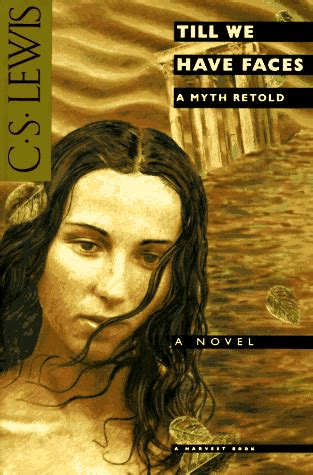
Till We Have Faces: A Book Review

Friends, I have had a harrowing experience.

I read Till We Have Faces.

Again.

That’s right, this wasn’t even a first-time read, and it destroyed me. Again. Maybe worse this time.

It’s tempting to do a super detailed book review, including an analysis of all the ancient customs, the Bible Easter eggs, and the symbolism. (My God, the symbolism!) But I’m not going to do that, because I really think you should read it if at all possible. And, even though this book is possibly more powerful on re-reads, I still don’t want to ruin your first read with spoilers.

Any analysis I gave, would be less of an immersive experience than the story itself, because that is the power of fiction.

I will just say a few things about the setting and genre, so you can decide whether to subject yourself to it.

I read TWHF as part of my 2026 “Greco-fiction” project, where I read books set in and/or inspired by the Heroic Age of Greece. When I mentioned this project to someone, they suggested Till We Have Faces. They were right, of course, though I hadn’t put it in the same category in my mind as, say, The Song of Achilles.

The action takes place in a fictional country called Glome. Based upon hints in the text, Glome is located somewhere just south or just north of the Caucasus Mountains, between the Black and Caspian seas. Georgia, Azerbaijan, perhaps southern Russia. Glome is not a mountainous kingdom, but it is near mountains. In the distance, they can see “what we call the sea, though it is nowhere nearly as great as the Great Sea of the Greeks.” This would probably be the Caspian. They are far from Greece, but near enough that they occasionally encounter a Greek captive taken in war. They are near enough to “Phars” (Persia) for that country to present a problem. At one point, the narrative makes a passing mention of “the wagon people, who live beyond the Grey Mountain.” These “wagon people” are probably steppe-dwellers related to the Scythians or Kazaks.

The people of Glome worship a fertility goddess called Ungit, who is embodied in a large irregular black stone that is said to have pushed its way up from the earth. Ungit’s “house” is a group of megaliths joined together with walls. Her worship involves temple prostitution, animal sacrifice, and sometimes human sacrifice, all the usual things that you expect with a fertility religion. Her priest wears a large bird mask on his chest, and dangles with amulets and animal bladders.

The narrator, a little girl named Orual, is frightened of the priest and of Ungit. The story will go on to focus on this fear. Orual very much hopes that the gods are, as her Greek tutor has told her, merely “lies of poets, lies of poets, child.” But are they? Or is there a power in Ungit (and in her son, who dwells on the Grey Mountain) that will leave Orual quite outmatched?

C.S. Lewis is an underrated horror writer. In this story he draws back the curtain on the horror of paganism. We also see, I think, hints of how he himself felt when he was an atheist: desperately hoping there is no spiritual world; uneasily worried that there might be. Relieved, but unsatisfied, by the “clear, shallow” Greek explanations.

So, I’ve said enough. Read it if you dare. I doubt that this year will bring me a better book in the category of Greco-Fiction.
Misanthropic Quote: Appreciation or Appropriation?

We must lay it to the credit side of Rome that some of its generals could understand Polycleitus and Pheidias, Scopas and Praxiteles, even if they carried their appreciation to the point of robbery. Of all the spoils that Aemilius Paulus brought back from his victories over Perseus, he kept for himself only the library of the King, as a heritage for his children.

–Caesar and Christ, by Will Durant, p. 96

In other words, he didn’t just pick up on ideas, he literally stole the physical books.

Socks with Frozen yarn

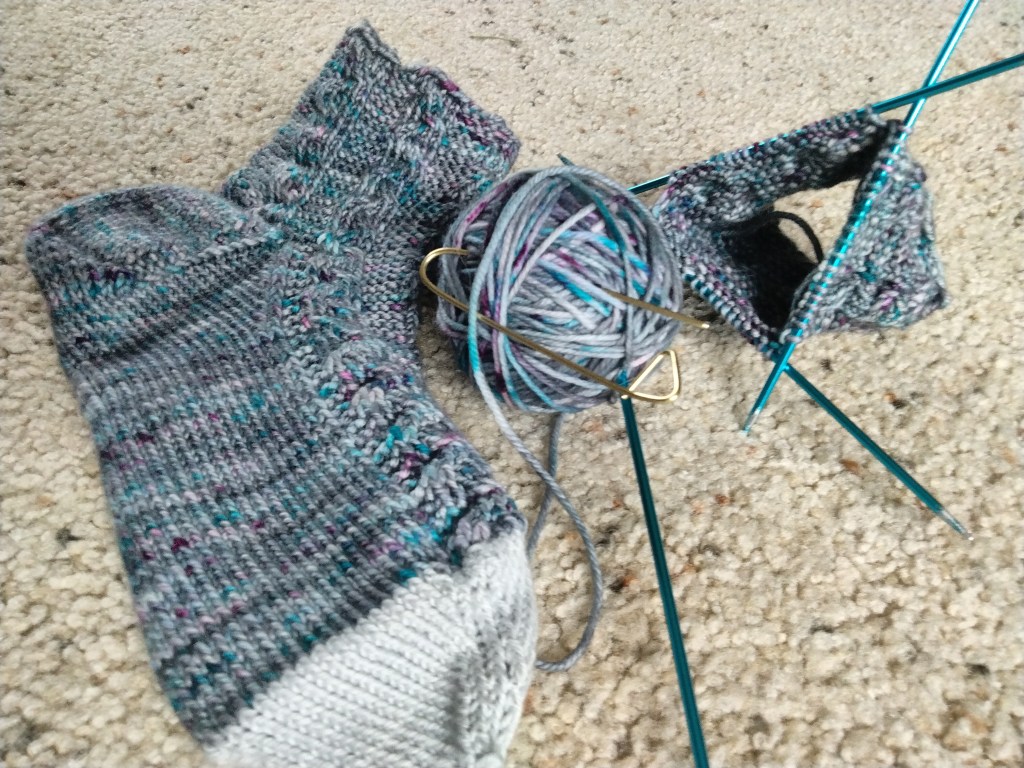
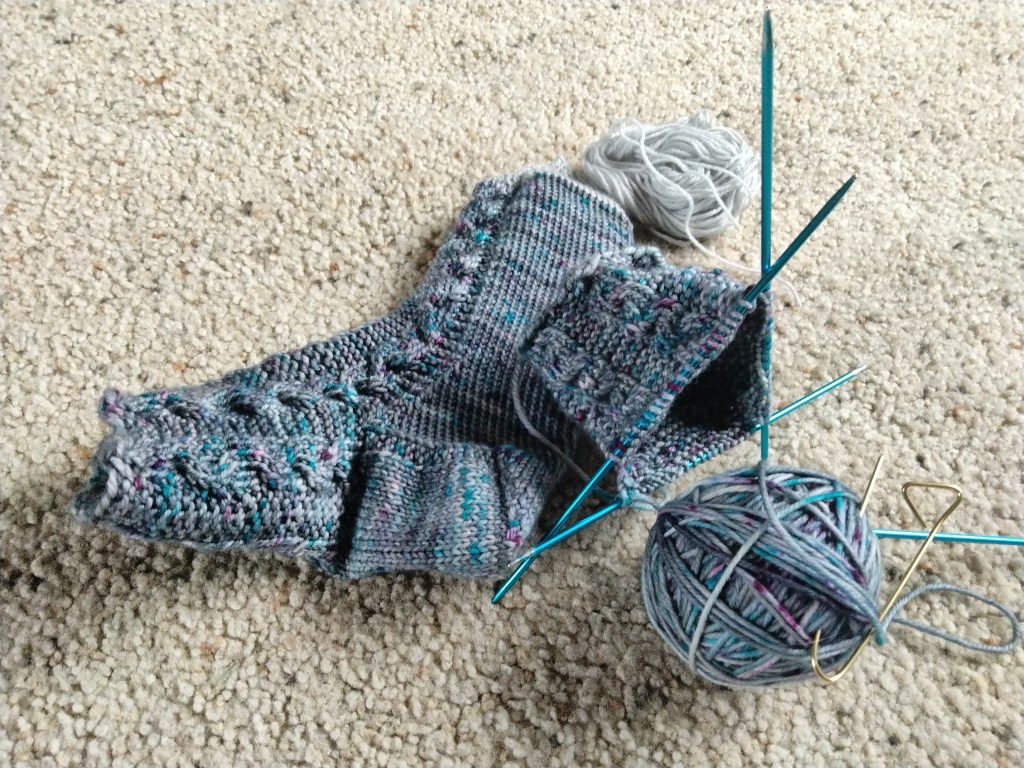
I’ve made a number of iterations of this pattern, “Braided Cable Socks,” that comes in a small book of sock patterns that I picked up in a craft store.

The socks call for superfine yarn, 2 skeins at 230 yards per skein. Previously, I have made them with a fine cotton yarn. I’ve liked the results. Surprisingly, these socks don’t sag even though they contain no elastic. After making and wearing a few pair, I’ve become convinced that hand-knitted socks are the gold standard in luxury.

The one minor problem with this pattern is that the socks tend to develop a slight gap in the middle of sole of the foot, where we are doing stocking stitch shared across two needles. In the past, I have dealt with this by varying the number of stitches on each needle.

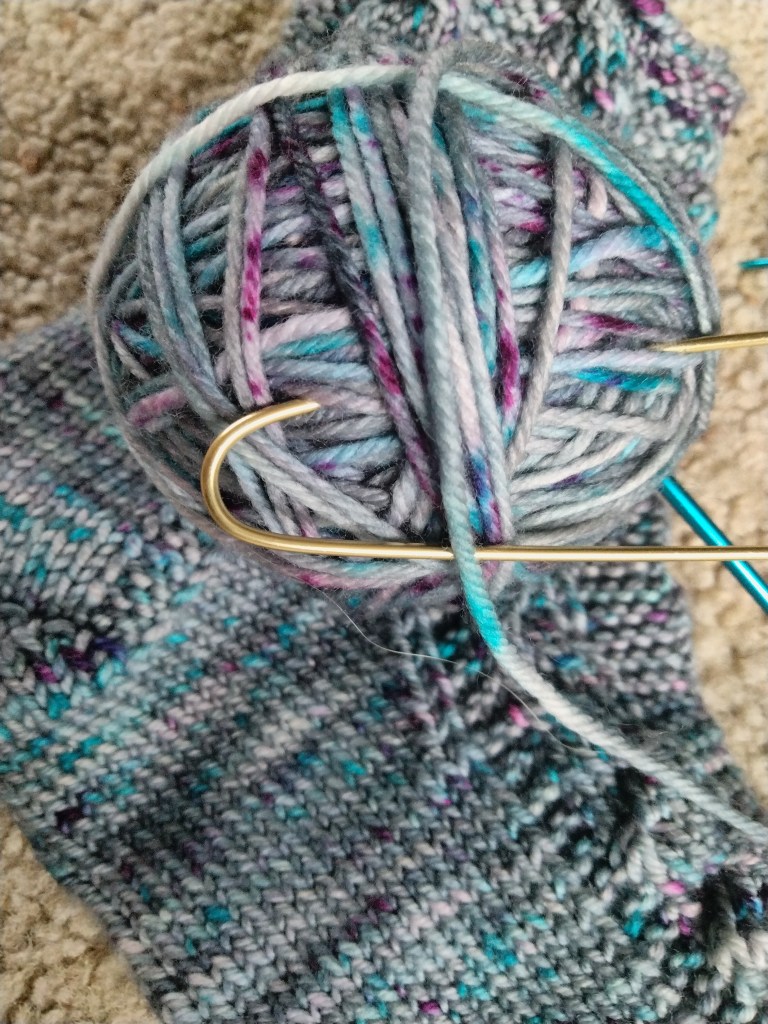
This time, though, I wanted to use a wool yarn to make this pattern. I had bought a hank of superwash merino wool, hand-dyed, from someone I know socially, via her etsy shop https://www.etsy.com/shop/SarahLizFiberArts . (When I went back to the shop, intending to post a review of the yarn accompanied by one of these pictures, it appears that she no longer sells yarn. Anyway.)

The hank I purchased, with a color pattern she had named Frozen, was less than 300 yards long. I feared that it would only furnish enough to make one sock, so I shortened the ankle part of the socks from 6″ to 3.5″. I also substituted some light grey yarn from my stash for the toe. My reasoning was that, even if I ran out of Frozen yarn partway down the second sock, at least they would look similar when I had shoes on.

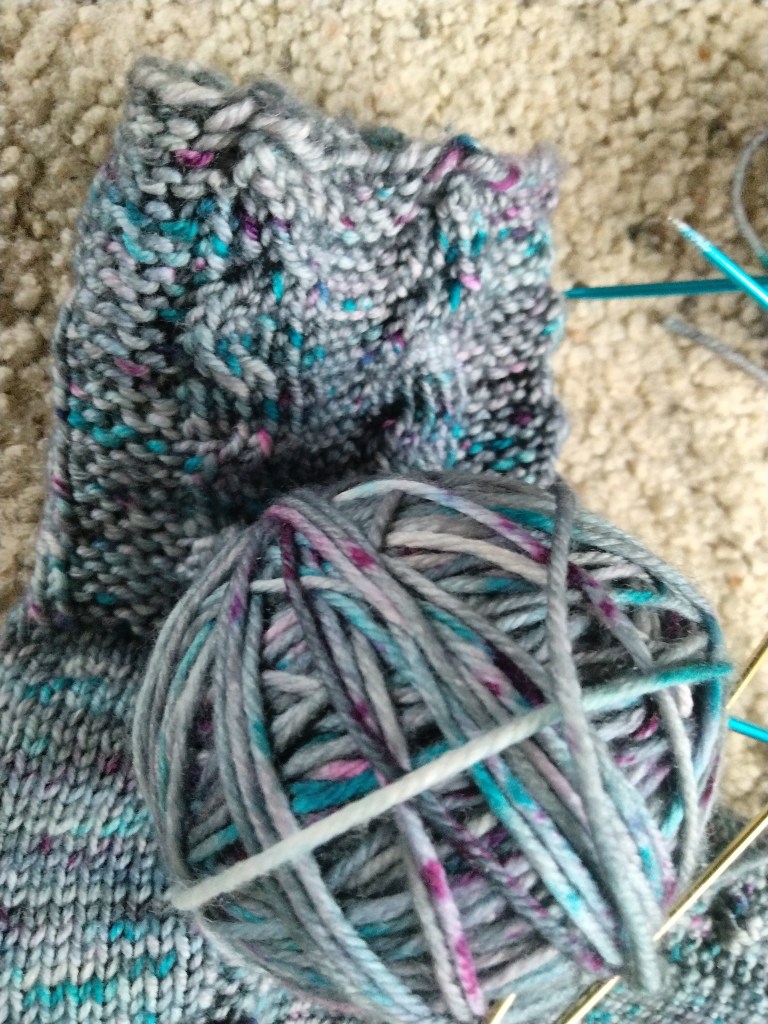
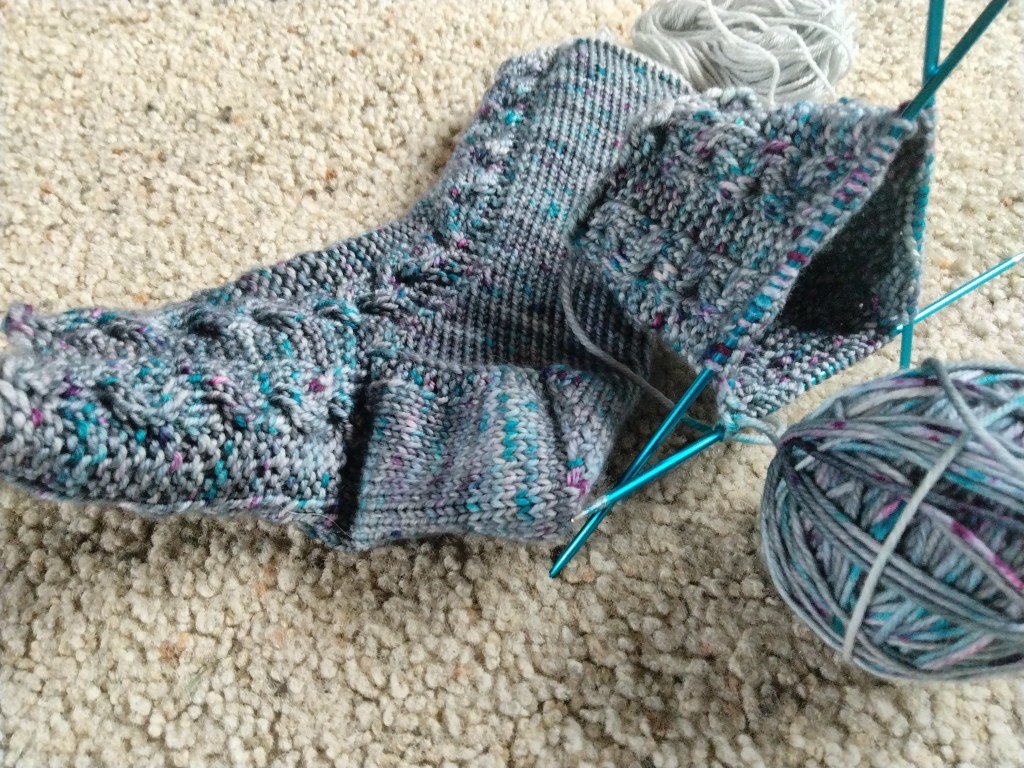
Now, I’m into the heel flap of the second sock, and the ball of Frozen still has not run out. Either because it’s merino wool or because it’s slightly heavier than superfine, Frozen has been more forgiving than the cotton yarn I usually knit with. The sole-of-the-foot gap did not show up, and the stitches even out better and are stretchier than with cotton.

Here’s one more close-up of the yarn ball, taken for the review that never happened. The yarn came in a hank, so I had to unwind it and roll it into a ball before I could begin.

After knitting the Indian blanket, these socks seem to be knitting up incredibly fast.

Which reminds me of a story. One my students, using a vocabulary word, described his grandmother as “adept.” I asked what she was adept at, thinking knitting or else pies. Turns out, she’s a ninja.

Why Should Your Heart Not Dance?

In my Greco-Fiction project, I have briefly set aside The King Must Die in order to re-read Till We Have Faces. I have to read TWHF for a book club, but I can’t complain, really, because I was one who convinced the book club to read it for our February discussion.

If you have never heard of it, Till We Have Faces is one of C.S. Lewis’s lesser-known novels. The point of view character is a young woman, a princess in the ancient, fictional kingdom of Glome, who is cursed with an ugly face, an abusive father, and a horrible fertility goddess for a religion. Her name is Orual. The first bright spot in Orual’s life is a Greek slave her father captured in war, who becomes her tutor. The second, and much brighter, spot is her younger half-sister Psyche.

The back of the book describes it as a “timeless tale of two princesses–one beautiful and one unattractive.” Naturally, when I first picked it up, then in my late teens, I thought, “Well, I know which one of these I will identify with!” Like probably every young woman, I expected to have a grand time wallowing in self-pity on behalf of the ugly princess. However, this is not that kind of story. Orual is not envious of Psyche’s beauty. The jealousy she feels is of a very different kind.

I don’t want to give away the events of the story, because you should definitely read it. However, I do want to post a long passage from the book. This passage is very important thematically, and in terms of Orual’s character development, even though it is not an action scene.

When we topped [the ridge], and stood for a while to let the horse breathe, everything was changed. And my struggle began.

We had come into the sunlight now, too bright to look into, and warm (I threw back my cloak). Heavy dew made the grass jewel-bright. The Mountain, far greater yet also far further off than I expected, seen with the sun hanging a hand-breadth above its topmost crags, did not look like a solid thing. Between us and it was a vast tumble of valley and hill, woods and cliffs, and more little lakes than I could count. To the left and right, and behind us, the whole coloured world with all its hills was heaped up and up to the sky, with, far away, a gleam of what we call the sea. There was a lark singing; but for that, huge and ancient stillness.

And my struggle was this. You may well believe that I had set out sad enough; I came on a sad errand. Now, flung at me like frolic or insolence, there came as if it were a voice–no words–but if you made it into words it would be, “Why should your heart not dance?” It’s the measure of my folly that my heart almost answered, “Why not?” I had to tell myself over and over like a lesson the infinite reasons it had not to dance. My heart to dance? Mine whose love was taken from me, I, the ugly princess who must never look for other love, the drudge of the King, perhaps to be murdered or turned out as a beggar when my father died? And yet, it was a lesson I could hardly keep in my mind. The sight of the huge world put mad ideas into me, as if I could wander away, wander forever, see strange and beautiful things, one after the other to the world’s end. The freshness and wetness all about me made me feel that I had misjudged the world; it seemed kind, and laughing, as if its heart also danced. Even my ugliness I could not quite believe in. Who can feel ugly when the heart meets delight? It is as if, somewhere inside, within the hideous face and bony limbs, one is soft, fresh, lissom and desirable.

Was I not right to struggle against this fool-happy mood? What woman can have patience with the man who can be yet again deceived by his doxy’s fawning after he has thrice proved her false? I should be just like such a man if a mere burst of fair weather, and fresh grass after a long drought, and health after sickness, could make me friends again with this god-haunted, plague-breeding, decaying, tyrannous world.

pp. 95 – 97

When the Blond Gauls Got Colonized

Spain, rewon from Carthage, had to be kept under control lest Carthage should win it again; besides, it was rich in iron, silver and gold. The Senate exacted from it a heavy annual tribute, and the Romans governors reimbursed themselves liberally for spending a year away from home … Tiberius Sempronius Gracchus (179) adjusted his rule sympathetically to the character and civilization of the native population, made friends of the tribal chieftains, and distributed land among the poor. But one of his successors, Lucius Lucullus (150) lured 7000 natives to his camp by a treaty promising them land; when they arrived he had them surrounded and enslaved or massacred. … The rebellious Celtiberians of central Spain bore a siege of fifteen months in Numantia, living on their dead; at last (133) Scipio Aemilianus starved them into surrender. In general the policy of the Roman Republic in Spain was so brutal and dishonest that it cost more than it paid. “Never,” said Mommsen, “had war been waged with so much perfidgy, cruelty, and avarice.”

–Caesar and Christ, by Will Durant, pp. 87 – 88

Misanthropic Quote: Most Cliches in One Paragraph

Gardy was essentially convicted the day he was arrested, and his trial is only a formality. The dumb and desperate cops trumped up the charges and fabricated the evidence. The prosecutor knows this but has no spine and is up for reelection next year. The judge is asleep. The jurors are basically nice, simple people, wide-eyed at the process and ever so anxious to believe the lies their proud authorities are producing on the witness stand.

-from Rogue Lawyer, 2016, by a very lazy version of John Grisham

I’m thinking of having a little contest. Who can find a paragraph crammed with the greatest number of offensive, lazy cliches? This is my submission. This is only the second half of the paragraph, but even if I had included the first two sentences, I still think you’d be hard-pressed to find another piece of writing where not a single word is wasted on any original thought.

The Horse and Humanity: A Short Love Story

Behold, the following reconstructed Proto-Indo-European words:

  • ekwo- … “horse” equus (Latin), equestrian (English) Perhaps from Proto-Indo-European ōku-, “swift.”
  • demə- … “to force,” especially in the sense of “to tame horses.”
    • Derivatives: daunt, indomitable, tame
  • kwel– … “to revolve, move around; herd stock.”
    • Derivatives: Latin colere, to till, cultivate, inhabit; colonus, farmer. Hence, cult, cultivate, culture, colony, colonize.
    • Greek telos (from the suffixed form kwel–es), completion of a cycle, consummation, end result. Hence, talisman, teleology, leutospore.
  • kw(e)-kwl-o (suffixed reduplicated form of kwel) … “wheel, circle.”
    • Derivatives: Old English hwēol, hweogol. Hence, wheel.
    • Greek kuklos “wheel” and Latin circulus, “circle.” Hence, circle, cycle, cyclone, etc.
    • Sanskrit chakram, “circle or wheel.” Hence, chakra.
  • wegh- … “to go or transport in a vehicle” Derivative: wagon

“Chariot racing for sport and ritual purposes was prominent in the culture of many early Indo-European peoples, such as the Indo-Iranians, Greeks, and Irish.”

source: The American Heritage Dictionary of Indo-European Roots, rev. & ed. by Calvert Watkins, pp. xxviii – xxix and 46

Yes indeed, the Indo-Europeans loved their horses.

But they are not the only ones.

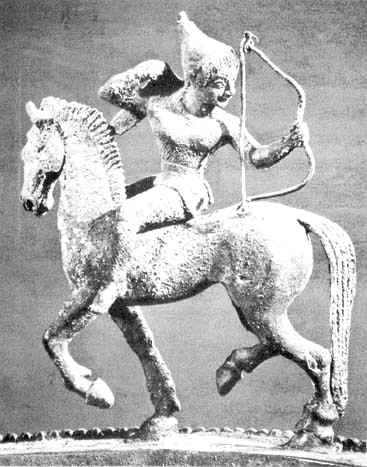
The Mongolians love their horses too. And let’s not forget the American Plains Indians. As soon as horses became available to them, some of them (notably the Lakota) re-structured their entire society around them, and began doing amazing things that the Europeans had never dreamt of (at least, not for many generations), such as hanging by their legs off the side of the horse to shoot a moving target with a bow.

Basically, horses are cool and beautiful, and also extremely demanding and high-maintenance. People tend to like them, but bear in mind that you do have to make them the focus of your entire life if you are going to do anything at all with them.

source: https://external-content.duckduckgo.com/iu/?u=https%3A%2F%2Fi.pinimg.com%2F736x%2Fc5%2F8f%2Fbd%2Fc58fbde89d3a2d06c744f36f225ee961–amazon-warriors-ancient-art.jpg&f=1&nofb=1&ipt=c354c6f07bb684c13e883874b543b3b104a0db28df392ffeeef8404f8ab4f9ac

The “Parthian shot.” The Parthians were a people related to the Scythians and other horse-riding groups of Central Asia. That conical hat, too, is found among the Scythians, a people who live in what is presumed to be the Indo-European homeland.

… and that is how revolution usually ends (Misanthropic Quote of the Week)

In 146 the cities of the Achaean League [in Greece] announced a war of liberation [from Rome]. Leaders of the poor seized control of the movement, freed and armed the slaves, declared a moratorium on debts, promised a redistribution of land, and added revolution to war. When the Romans under Mummius entered Greece they found a divided people and easily overcame the undisciplined Greek troops. Mummius burned Corinth, slew its males, sold its women and children into bondage, and carried nearly all its movable wealth and art to Rome. Greece and Macedon were made into a Roman province under a Roman governor; only Athens and Sparta were allowed to remain under their own laws. Greece disappeared from political history for two thousand years.

–Caesar and Christ, by Will Durant, pp. 86 – 87