
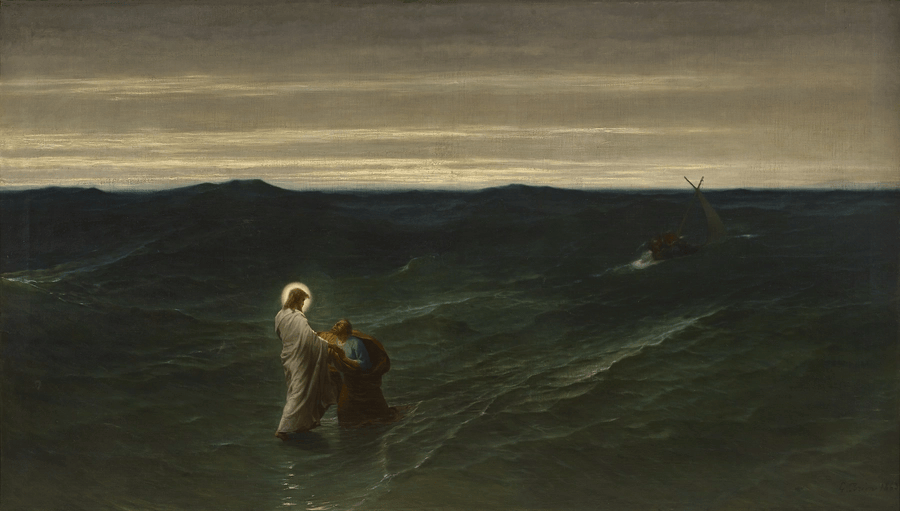
JESUS AND PETER ON THE WATER (JESUS ET PIERRE SUR LES EAUX ), 1863
signed G. Brion and dated 1863 (lower right corner)
oil on canvas
44 1/8 by 72 1/2 in.
112.1 by 184 cm.
(… I mean, among so many other things.)
The following thoughts were inspired by being read the 14th chapter of Matthew. It contains the episode where Jesus walks on water, then calls Peter to come to Him, and then Peter briefly walks on water as well.
This episode is so well-known that nearly everyone has heard of it, even if they have never read Matthew. There are paintings of it, songs about it, and so forth. It is so iconic that we tend to think of walking on water as one of Jesus’ characteristic moves. It’s as if He came to earth with a checklist, and on that list, a few items above “die and rise again,” was “walk on water.”
However, that is not the way it comes off if you read the entire chapter. Jesus has spent most of Matthew ch. 14 reacting to things.
First, He hears that His cousin and friend John was just executed by Herod, for the most arbitrary reason. He tries to “withdraw by boat to a solitary place,” presumably to do some praying and grieving over John. But when He gets there, a large crowd has followed Him. So He adjusts His plans and spends some time healing their sick. Then, it transpires that they are out in the middle of nowhere and there are families who haven’t brought anything to eat, so Jesus multiplies the loaves and fish in a very low-key way, again apparently in response to the need of the crowd.
Then, finally, He sends the disciples away in the boat and He goes and has a private prayer-and-grieving time until about 2 a.m. And then, his friends are out on the boat in the middle of the lake, and He needs to get to them. So for whatever reason, He decides to walk out to them on the water. Again, it seems more like a problem-solving move than a planned demonstration of His power.
When being read this chapter recently, for the very first time it occurred to me to wonder, “Why did He take it into His head to do that?” I mean, what a funny thing to do. Walk on water.
We don’t usually see Jesus using His divine powers just for fun. I mean, in theory, He could have flown if He’d wanted to. But we never see Him flying. We never see Him do any number of miracles that He could have done just to amuse Himself.
That’s what tickles me about His decision to walk on water. It comes off as unnecessary, creative, even playful. Jesus knew how to respond to changing circumstances and go with the flow.
Now, to be clear, Jesus was also capable of planning. I have mentioned before that, as the prototype human, I believe He perfectly embodied all the personality types. So while capable of responding creatively to contingencies, He also knew how to stay on-mission and work the plan. There are many examples of this. He knew that He would eventually be killed in Jerusalem, but we see Him saying “my time has not yet come” to go public. He says at one point, “I was sent to the lost sheep of Israel,” meaning that His primary teaching was for the Jews, though He was fully aware that the changes He would work in the world would soon encompass the Gentiles too.
Closer to our theme, some of Jesus’ miracles do seem to be done intentionally to make a point, either about who He is, or what His Father actually meant by the Law. He would sometimes intentionally heal people on the Sabbath, even in a synagogue, in order to open the discussion about what Sabbath regulations were actually legit. He delayed going to visit Lazarus until Lazarus had died, because He knew the time had come to a do a big, public resurrection right near Jerusalem. That was a case of “Look, everybody, I’m about to do a miracle.” But at the same time, He couldn’t be baited into “giving a sign” by people who were never going to accept any sign.
But others of His miracles–and these are my favorites–are a response to people and circumstances. He turned water into wine at Cana (again, in a really low-key way) because … well, because they had run out of wine. He healed the Canaanite woman’s demon-possessed daughter because she charmed Him with the way she asked. And I think this walking-on-water thing is in the same category. He needed to get to the boat, so He walked to the boat. Peter said, “If it’s really you, tell me to come to you on the water” … so Jesus told him to come. It was only later that this incident became super iconic and super spiritually symbolic and all that. At the time, it was just Jesus making a decision that this was the quickest and easiest way to get back to His friends. And I love Him for it.


