200+ visitors on Thursday.
On the one hand, thanks for the attention. I guess?
On the other hand … stop messing up my stats!

200+ visitors on Thursday.
On the one hand, thanks for the attention. I guess?
On the other hand … stop messing up my stats!
This year, I decided that my fiction focus would be novels inspired by ancient Greek myths. I don’t always pick a fiction focus, but this year, things just coalesced.
In the classical Christian school where I teach, we follow a 4-year “history cycle.” Ancient World, Medieval World, Exploration/Renaissance, Modern World. This year, we are cycling through Ancient, so I have been immersed in the Flood, the Sumerians, Abraham, Egypt, and the Iliad and Odyssey. (Somewhat immersed, of course. We could always immerse ourselves more.)
Revisiting Mycenae and Crete, I remembered that back in university (in the last millennium!) I read what I thought was a fantastic book that was a re-telling of Theseus. Looked it up, and it turns out it was The King Must Die by Mary Renault. And it turns out that Renault has a bunch of other books that I’ve never read. (Back in the last millennium, the way we found books was we stumbled upon them in the library.) So, onto the list went at least a re-read of The King Must Die and its sequel, The Bull from the Sea. I bought myself copies of these for Christmas using my husband’s money, so technically he bought me the copies for Christmas.
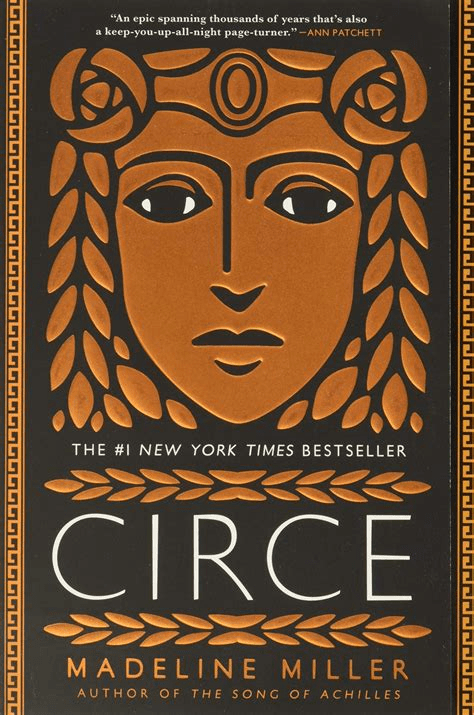
Meanwhile, years ago I had won a copy of Circe, and had been waiting to read it until I was ready to stick my head back in the ancient Mediterranean. I’m also aware that Madeline Miller has at least one more book, The Song of Achilles, which is from Patroclos’s point of view. Gay, of course (and that is historically accurate). I decided I might read that, depending upon how I enjoyed or didn’t enjoy Circe. You can write about ancient Greek events from a hard-core feminist/queer perspective, or you can not. I wanted to know first what approach Miller was taking.
Finally, some of my students have been reading Percy Jackson, with the result that they are already quite familiar with the Greek pantheon. I’d known that the Jackson books were out there, so perhaps now is the year when I read at least a few of them. Jackson went onto the list.
Then there are the rereads. Til We Have Faces is C.S. Lewis’s masterpiece, set probably in Scythia or the Caucasus, near the Greeks but not too near. Moving farther from Greece, we have Taliesin, Merlin, and Arthur by Steven R. Lawhead. I read Taliesin in high school. It’s Celtic, not Greek, except that about half the book takes place on Atlantis, with bull dancing and stuff, so I figure that counts. Now, the Daily Wire has made a TV series based on these books. The events of Taliesin take up about an episode and a half. So, if I have time, I’ll reread/read Steven R. Lawhead.
So, here is the list as it stands …
This should fulfill the twelve books that I told Goodreads I’m planning on, this year.
In the course of my teaching year, I have already read The Cat of Bubastes with my students, and am now reading Hittite Warrior, which is also very good. Also on the docket is The Young Carthaginian.
I loved this book. It is exactly the genre I like. Miller did a fantastic job keeping track of all the gods, titans, and nymphs, their little feuds, and their family relations to one another.
Circe, in The Odyssey, is a “witch” whom Odysseus and his men encounter on the island of Aiaia (Corsica or Sardinia … I was imagining Corsica). She turns some of them into pigs, but Odysseus convinces her to change them back. She becomes a sort of ambiguous ally, giving him advice about how to handle the Moving Rocks, the Sirens, and Charybdis and Scylla.
Of course, there is always more detail to the story. Miller has researched this deeply, and I appreciate her portrait of where Circe came from. Circe is the daughter of the sun, Helios, who is a titan, and his one legitimate wife. This makes her the sister of Pasiphaë, wife of King Minos (ahem), and also of Aeetes, father of the witch Madea.
Given that she is divine, Circe gets a front-row seat to nearly all the earliest myths. She meets Prometheus in person. She watches the whole ugly episode with Minotaur go down (this is centuries before Odysseus). Time passes quickly for her. At the same time, she is sort of fascinated by mortals. On the plus side, this means she does not view them as disposable, as most of her relatives do. On the down side, she at first fails to see them as a threat.
Near the end of the book, she has this to say.
I thought once that gods are the opposite of death, but I see now they are more dead than anything, for they are unchanging, and can hold nothing in their hands.
p. 385
Though a page-turner, Circe was a heavy read emotionally. As you might expect, it really stinks to be an ancient Greek god or Titan. You are likely to have horrible parents, for example. The hardest part for me was finding out what we might have suspected by reading between the lines: that Odysseus was actually a real [censored], and that things did not go happily after he made it home to Ithaka. Thankfully, Miller does not leave us there but introduces at least one good man and gives the book’s ending a faint note of redemption.
Based on this read, I think I will try The Song of Achilles if I come across it. Miller’s writing is not ideological. It is extremely tragic, with heartbreaking near misses and so forth, but that is actually how these ancient stories go.
Juno Regina was the queen of heaven, the protective genius of womanhood, marriage, and maternity; her month of June was recommended as the luckiest for weddings.
–Caesar and Christ, by Will Durant, p. 61
Nota bene: I planned this post and uploaded these photos before the big snowstorm hit the southern & eastern United States. Here in the West, we have had an unseasonably mild and un-snowy winter. So these are not disaster pictures, just the wonders of Nature. Enjoy!







Behold! A so-called “Indian blanket” that it took me about a year to complete.
Real “Indian blankets,” of course, –at least, the Navajo kind– are woven, not knitted. But this type of pattern is very popular in the United States, and has been for more than a century. You find it on clothing, bedspreads, purses … and knitting patterns like this one. You see, when the Europeans conquered the American Indians, all groups immediately started both intermarrying and borrowing each other’s ideas.

As an aside, this type of pattern also sort of resembles some traditional weaving patterns in Indonesia. Because all folk art, when you get right down to it, looks sort of alike. Having been made by humans and that.
So about a year ago, I bought this pattern, called “Mohawk Valley,” from the Vintage Pattern Store on etsy. Then it was time to acquire the yarn. This blanket is a mix of different colors from my stash; high-quality wool and wool-blend yarns bought both online and at a specialty knitting store; and cheap cotton yarns in the appropriate colors, bought wherever I saw them on sale. So the color variations are my own. This pattern would look really good in just two colors. Perhaps, one day, I’ll do one with a bit more color discipline … if I live that long haha!
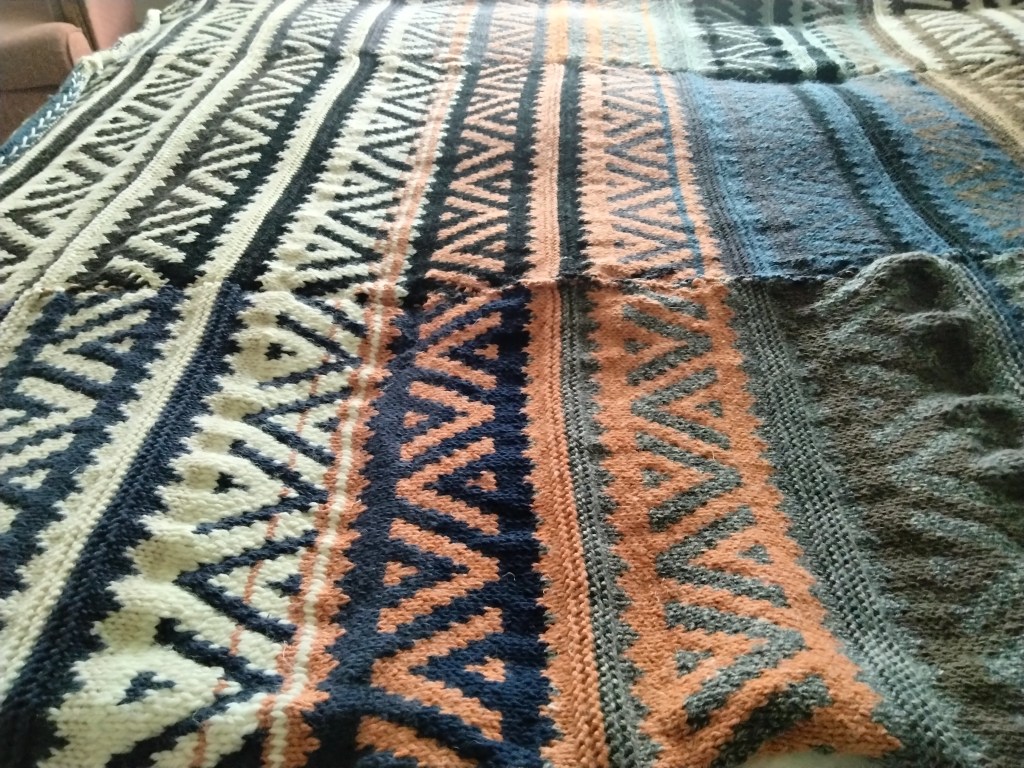
You knit it in three strips, then sew the strips together. I started Strip #1 with scraps, and then I tried to roughly echo the color changes that resulted, in subsequent strips. I even made a mistake on Strip #1, forgetting to add a garter-stitch border between iterations of the pattern, and I faithfully repeated this mistake on the other two strips so that the length would come out the same.

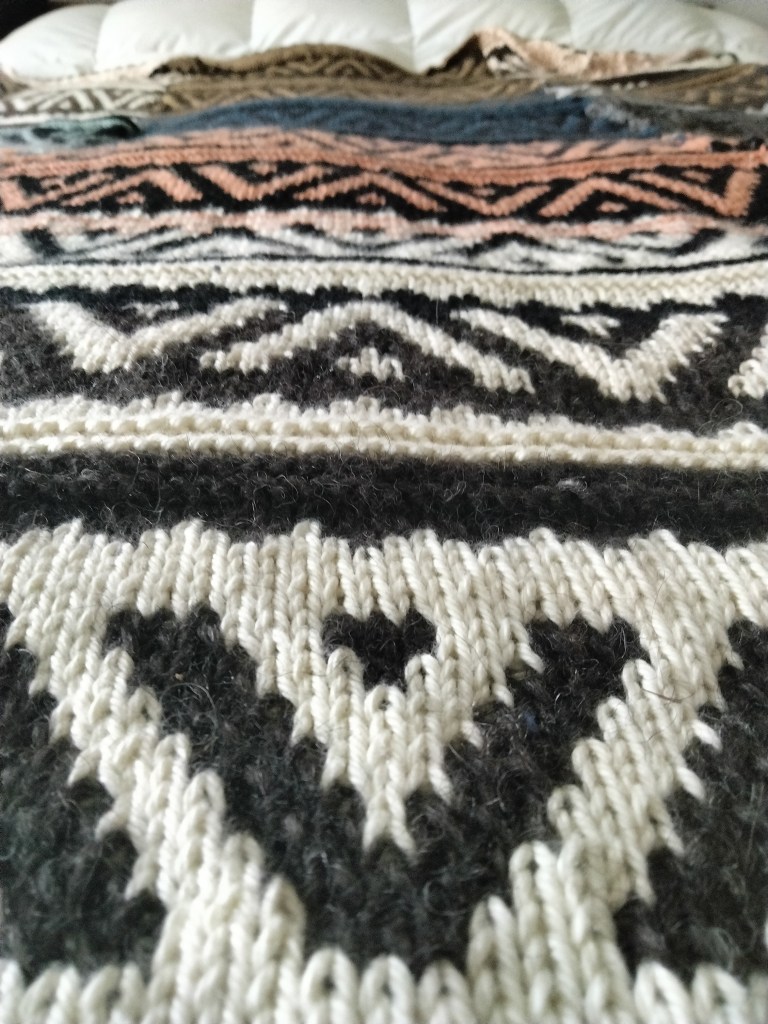
Here is the blanket being “blocked.” I pinned it wrong-side-up on my bedspread, misted it with water, and let it dry. After this, I added a border consisting of five rows of moss stitch, because the edge tended to roll.
Despite its flaws, this blanket is basically priceless. I knew it would take me about a year to complete it in time for the recipient’s birthday, and it did. Here’s another close-up.
Among these original national gods Jupiter or Jove was the favorite … In the early centuries of Rome he was still a half-impersonal force–the bright expanse of the sky, the light of the sun and moon, a bolt of thunder, or (as Jupiter Pluvius) a shower of fertilizing rain; even Virgil and Horace occasionally use “Jove” as a synonym for rain or sky. In time of drought the richest ladies of Rome walked in barefoot procession up the Capitoline hill to the Temple of Jupiter Tonans–Jove the Thunderer–to pray for rain. Probably his name was a corruption of Diuspater, or Diespiter, Father of the Sky.
–Caesar and Christ, by Will Durant, p. 61
… and when the Romans encountered Zeus, they said, “Hmm, seems to be Jupiter.”
You can read the incident that this is a reference to, in I Samuel chapters 4 – 6.
The Philistines were a culturally Aegean/Mycenaean people who had settled along the coast of Canaan. Though culturally Greek, they spoke a Semitic language. Their god, Dagon, was a man/fish god who had antecedents going all the way back to Sumeria.
The genre of these particular chapters of Scripture might be described as dark comedy. It’s a unique story, because it presents the reaction of an Aegean people when confronted with the God of Israel. The story is told in a Hebrew historical record, but the amount of detail means that the Hebrew chronicler must have had spies or eyewitness accounts.
The Philistines, though, or perhaps because, they are pagans, are pretty canny. They start out thinking they have won a victory over the Israelites by capturing their god, but it doesn’t take them too long to figure out that this God is trouble, and to ascertain, by process of elimination, what He wants.
Or you could say that God is very adept at communicating with the Philistines.
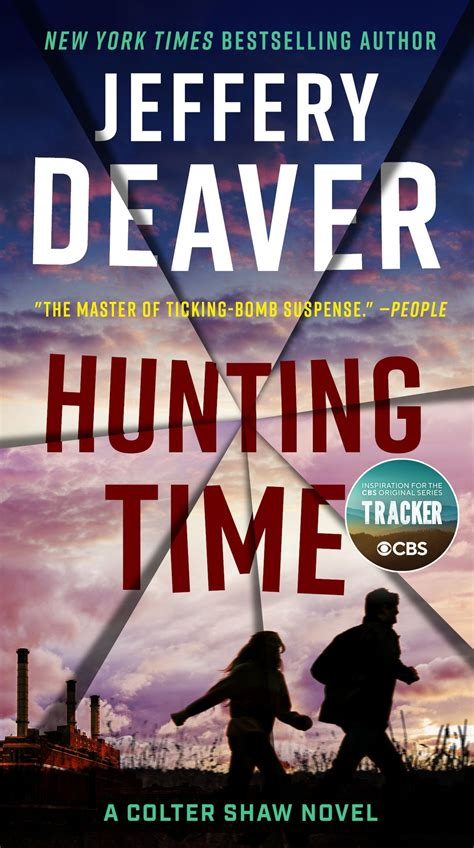
By the way, it’s “hunting TIME,” not “HUNTing time.” The sense is not “time to hunt,” but “we don’t just save time, we hunt it down.”
This is a very professional modern thriller and the author has tons of blurbs on the back from other modern thriller writers. The plot was intricate, the pacing tense, and the characters were distinctive enough to keep them straight and give some emotional momentum to the story. There was also at least one major twist that I did not see coming, and that I really thought was clever.
Possibly the best-drawn “character” is the Midwestern city of Ferrington, the picture of urban blight but without the glamour of a big coastal city. Ferrington used to be an industrial capital, but then many industries left the city, leaving people out of work. Now the place seems to be nothing but drugs, crime, and despair. There are lot of chain-link-fence-surrounded empty lots filled with trash, long streets full of abandoned warehouses, and there is a badly polluted river. The ugliness of the scenes described rises to the level of beauty. The cops are corrupt in some cases and spread too thin in others. I think the name Ferrington is supposed to remind us of Ferguson, Missouri, and this is where we start to get into the book’s flaws.
Though Deaver mostly sticks to the story, when laying his scenes he makes sure to get in occasional digs at the reader. Bigots are everywhere. Trans is good, gay is good. We capitalize Black but not white. Stuff like that. Oh, and of course, capitalists are the one who ruined Ferrington in the first place.
My other issue with this book is the female characters. They’re not terrible, but … but … well. They are just missing a certain je-ne-sais-quois. For example, one of the point of view characters is a woman, Allison Parker. Deaver uses third person limited with her and with Colter Shaw, the sleuth. When we are inside Allison’s point of view, he frequently calls her Parker. That is just a bit confusing. It makes it sound like there is another person in the room. I am pretty sure that most women don’t think of themselves by their last name. Although maybe men do. Which is really the problem: All Deaver’s “female” characters (he has three main ones in this book) think more like men. Allison Parker is an engineering genius, very organized, very no-nonsense. Her daughter Hannah is a math genius, also no-nonsense. Sonja Nilsson is a former military operative (you guessed it, no-nonsense!) who is willing to sleep with Shaw after having known him for a day or two.
This is not a problem with Deaver alone. Many, many female authors write “male” characters who think and talk like women. It’s just awfully difficult to get into the head of the opposite sex.
Finally, there are occasional little things that made me scratch my head. “Seahorses can be sensuous.” (They can?) “Five-high.” (It’s high-five.) Nilsson lost forty pounds, and kept it off, in order to go into witness protection. (Oh, I didn’t realize it was that easy. Especially since she left the military at the same time! But, as we all know, the only thing keeping fat people from losing weight is the want-to. Eye roll)
Due to all these little flaws, and because the reveal of the villain was less satisfying than I had hoped, I give this book three out of five stars.
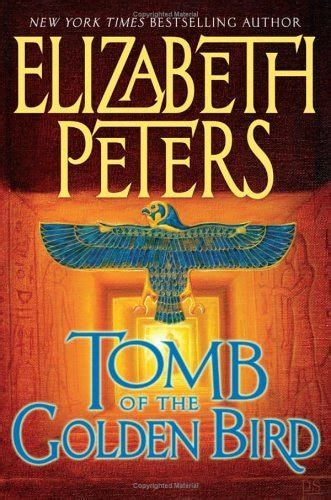
This was pure fun.
The Emersons are a family of British Egyptologists. Emerson, “Father of Curses,” the paterfamilias, is married to Amelia Peabody, whom he calls “Peabody.” This hot couple began their Egyptian adventures back in the Victorian era, but now it is 1922. Their grown son, nicknamed Ramses, is married and has children, and the Emersons have a large, motley household of employees, longtime family friends, relatives, and adoptees, both Egyptian and British. They have returned to Luxor, Egypt, for yet another season of digging. Of course, there are going to be capers, skullduggery, and so forth, and all the Emersons will be involved up to their elbows. Will they be deceived by Emerson’s half-brother Sethos? Will they foil an international plot? Most importantly, will they ever get a peek into the intact tomb that was discovered–technically, by Emerson–and is now being opened by the odious Carter?
This series is exquisitely researched. About 60% of the story is told in the first person by Amelia Peabody, in near-perfect late Victorian/Edwardian language. Scattered everywhere are gems like this one:
… I identified several other [party] guests as journalists. I can always spot them by the bulges in their coat pockets which indicate the presence of notebooks, and by their predatory looks. Messieurs Bradstreet of the New York Times and Bancroft of the Daily Mail were known to me personally (through no fault of mine).
p. 241
The other 40% of the story is told in third person from the point of view of Ramses, who is a quieter character than his colorful parents, but it also includes gems:
He had thought of several innocent explanations for David’s behavior, including the one he had given. It was understandable that [David] might feel the need to be alone; the family en masse or individually could be wearing.
p. 254
I originally came to this series hoping for ancient Egyptian mystical mysteries. It’s not that. It’s more of a romp. Much of this book felt like following the Keystone Cops, but eventually there did turn out to be some twists that gave the whole plot shape and direction. Four out of five stars.
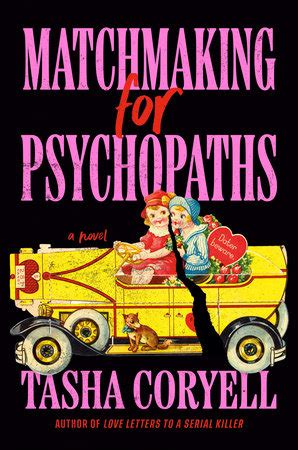
Matchingmaking for Psychopaths, by Tasha Coryell
I picked this up off the New Books shelf at the library. Perhaps I should have left it there, based on the title, but I had read the first few pages and found them engaging. Alas, I returned the book without finishing it. I would have liked there to be at least one main character who I was sure wasn’t a psychopath. A little psychopathology goes a long way.
When I returned the book, the librarian giggled and said, “Oh, that one was silly.” It was indeed silly. But silly and serial murder don’t mix well. At least not for me.
Before [the Twelve Tables of the Decemvirs], Roman law had been a mixture of tribal customs, royal edicts, and priestly commands. “Mos maiorum“–the way of the ancients–remained the exemplar of morals and a source of law … early Roman law was a priestly rule, a branch of religion, surrounded with sacred sanctions and solemn rites. The priests declared what was right and wrong (“fas et nefas“), on what days the courts might open and assemblies meet. All questions regarding marriage or divorce, celibacy or incest, wills or transfers, or the rights of children, required the priest as now so many of them require the lawyer. Only the priests knew the formulas without which hardly anything could be legally done. The laws were recorded in their books, and these volumes were so securely guarded from the plebs that suspicion charged the priests with altering the texts, on occasion, to suit ecclesiastical or aristocratic ends.
The Twelve Tables effected a double juristic revolution: the publication and secularization of Roman law.
–Caesar and Christ, by Will Durant, p. 31

Look, he even took a bite out of that tree already!
 Out of Babel Books