

Alert readers may notice that in my second novel, The Strange Land, my main character’s love interest is also his cousin.
Ewww.
In my defense, I painted myself into a corner by writing about a small group of people who flee from a disaster in ancient history. They are founders. Some of them are going to have to marry their cousins. By hypothesis, their genetic code is richer and less deteriorated than is ours today. So cousin marriage is not going to have the same bad effects that we see today from years of inbreeding.
Nowadays we have gotten rid of almost all of our sexual taboos. But one we have kept is: don’t marry your cousin! In the group I am writing about, it is almost the opposite. They have a lot of common-sense taboos, but cousin-marriage is not one of them.
But wait.
Even they can’t marry just any cousin.
Let’s do some anthropology.
One thing anthropologists do when they are studying a culture is make a kinship chart. This is like a family tree with, by convention, triangles representing males and circles representing females. We make this kinship chart, we identify the Ego (the person whose relatives we are naming), and then we can discover and fill in words for all these relationships. When I did this in Borneo, I discovered that the language I was studying had, for example, a unique word for the woman who is married to my husband’s brother. (Duoi.) Fun stuff.
As you might expect, different cultures have different ways to slice up the kinship universe and these ways tend to cluster with other cultural traits. The chart I am about to show you is called the Iroquois kinship system, but it is also found in many other cultures around the world. It tends to be found in cultures that have a patrilineal inheritance system. My source for this is found here. (I also found the chart there, but I re-copied it by hand to simplify it a bit and to avoid image copyright issues. If my handwriting makes your eyes bleed, I encourage you to follow the link and take a look at the original chart.)

As you can see, “Uncle” or “Aunt” means someone who is married to a relative of your parents’ generation, such as the man married to your mother’s sister. There are unique words for “Father’s Sister” and “Mother’s Brother.” And – this is key – a parent’s sibling of the same sex is also considered your parent.
So, in the Iroquois kinship system you would call your mother’s sister “Mother.” Her kids would be considered your brothers and sisters. They are parallel cousins. You do not get to marry them. (You see, we still have marriage taboos, just not the same ones!)
On the other hand, the children of your mother’s brother are not called brothers and sisters. They are called cousins. They are your cross cousins. You are encouraged to marry them. The same is true for the children of your father’s sister.
This may seem strange to us, whose extended families are small and who have a wide world of non-relatives from which to select a spouse. But you can see that it would become important to anyone living in a small, isolated community.
Luckily for my character Ikash, the cousin on whom he gets a crush is the daughter of his father’s … sister. She is not just his cousin, she is his cross cousin. She is fair game, at least as far as the kinship system is concerned. Of course, he still has to overcome her father’s grave doubts about him, but that’s another story …
But fear no more! I would not take this thing, if it lay by the highway.
–Faramir son of Denethor, The Two Towers, p. 280

In this post I attempt to summarize Graham Hancock’s book Fingerprints of the Gods: The Evidence of Earth’s Lost Civilization (1995). This book influenced the background for my novels. It also, in my mind, dovetails with Douglas Van Dorn’s biblical/archaeological research on giants in ways that I am sure Hancock never intended or imagined.
This post is only a summary. It will naturally be much less convincing than the book itself. My copy of Fingerprints runs 578 pages counting the bibliography and index. Hancock builds up to his thesis slowly, presenting many different lines of evidence and dropping mysterious hints to keep the reader intrigued. He also has to get into some fairly technical topics, particularly when talking about astronomy. I can’t do any of that in a 1,000-word post. So, like a bucket of cold water in the face, you will be treated to Hancock’s thesis in all its bizarre and fascinating glory.
Hancock’s first two chapters are dedicated to the details of a number of old maps drawn up during the 1500s which show parts of South America that were undiscovered by Europeans at that time. More intriguingly, they show the coast of Antarctica as it appears under the ice. (This was before modern man’s discovery of Antarctica, and before seismic surveys revealed what lay beneath the ice.) The best-known of these is the Piri Reis map (drawn up in A.D. 1513), but there are others, such as the Orontes Finaeus map, the Mercator map, and the Buache map. All these mapmakers drew on older maps, which they compiled. Piri Reis, for example, had access to the Imperial Library at Constantinople, which is probably where he got the sources for his map.
The other amazing thing about these old maps is they often show locations in South America, for example, at accurate longitude and latitude.
The lesson that Hancock draws from these maps is this. Whatever source maps Piri Reis and others used, must themselves have been drawn up by an advanced seafaring civilization that had explored the world and knew how to project longitude and latitude. Amazingly, these seafarer/mathematicians apparently charted Antarctica at a time when it was not yet completely covered in ice. That makes their civilization, how do you say? Very, very old.
And then there is ancient Egypt. Seventeen chapters are dedicated to it. There are many things to notice. Here are just a few: ancient Egyptian civilization seems to have appeared suddenly as a high civilization, complete with myths, history, engineering, and an obsession with boats. Overall, its history is one of slow decline and loss of knowledge, rather than slow buildup. (Interestingly, the same point has been made about ancient Sumer.)
Hancock writes, “Robert Bauval’s evidence showed that the three pyramids [at Giza] were an unbelievably precise terrestrial map of the three stars of Orion’s belt, accurately reflecting the angles between each of them and even (by their respective sizes) providing some indication of their individual magnitudes. Moreover, this map extended outwards to the north and south to encompass several other structures on the Giza plateau … the Giza monuments were so arranged as to provide a picture of the skies … as they had looked – and only as they had looked – around the year 10,450 BC.” (page 356)
The Great Pyramid at Giza has a ratio of 2pi between its original height and the circumference of its base. This strengthens the argument that it was meant to represent a star (a circle). The Pyramid of the Sun at Teotihuacan has a ratio of 4pi between height and base circumference. Both of these pyramids had to have an odd angle of slope to accomplish this (52 degrees for Giza; 43.5 degrees for Teotihuacan), so it seems to have been intentional. Pi was supposedly not calculated correctly until it was done by Archimedes in the third century BC, but apparently the ancient Egyptians and the ancient Mexicans were familiar with it.
Where Hancock is going with all this is that people on both sides of the Atlantic got their amazing engineering, mathematical, and astronomical knowledge from an older “source” civilization. He thinks it was the same seafaring civilization that apparently charted Antarctica. This impression is strengthened by the Egyptian obsession with boats and by the Incan legends that say all this knowledge came from over the sea.
Not in this book.
He has written several books about ancient mysteries. I have not read them all. He has now started writing fiction, and in the one novel of his that I have read, it becomes apparent that his interest in all this is decidedly New Age in character. The novel features an angelic/earth mother spirit guide, telepathic Neanderthals, the whole nine yards. So, I can’t swear that aliens won’t show up at some point. But that is not the thesis of Fingerprints. Hancock is arguing that there was a very advanced civilization of people well before 10,000 BC. Whether these people were taught by aliens, spirits, or some other stuff like that, he does not say, thankfully. Because, luckily, this book relies heavily on evidence.
So the ancient cartographers were not aliens, not even according to Hancock. But still we have a problem: Where was this civilization located? You don’t normally get an advanced civilization until you have a critical mass of arable land. In short, a continent. Hancock believes he has solved this problem. He believes there was such a mass of land, but that it has since undergone a cataclysm. And now we come to the really wild part of his thesis.
Mythology about a period of cataclysms in ancient times is universal. Hancock dedicates four chapters to this alone. Flood myths, for example, are very common. But most cultures also record things like earthquakes, fire falling from the sky, the sun not rising for some long period of time, or an endless winter. Hancock discusses myths like this in some detail from the following cultures: Aztec, Sumerian, Greek, Inuit, Chinese, Southeast Asian, Pacific, Indian, Egyptian, Mayan, and Norse. It should not be hard for the reader to track down these myths. Some cultures (the Aztecs and the Hopi, for example) believe that disasters come at regular intervals and that each one ushers in a new age of the world.
Hancock believes that these myths are actually historical records (with all the usual caveats about them becoming garbled, etc.) of a period of geologic upheaval that happened within human history. I’ll put it in his own words:
“This geological theory was formulated by Professor Charles Hapgood and supported by Albert Einstein. What it suggests is a complete slippage of our planet’s thirty-mile-thick lithosphere over its nearly 8000-mile-thick central core, forcing large parts of the western hemisphere southward towards the equator and thence to the Antarctic Circle. This movement is not seen as taking place along a due north-south meridian but on a swivelling course – pivoting, as it were, around the central plains of what is now the United States. The result is that the north-eastern segment of North America (in which the North Pole was formerly located in Hudson’s Bay) was dragged southwards out of the Arctic Circle along with large parts of Siberia [which were dragged into the Arctic Circle].
“In the southern hemisphere, Hapgood’s model shows the landmass that we now call Antarctica, much of which was previously at temperate or even warm latitudes, being shifted in its entirety inside the Antarctic Circle. The overall movement is seen as having been in the region of 30 degrees (approximately 2000 miles) and as having been concentrated, in the main, between the years 14,500 BC and 12,500 BC – but with massive aftershocks on a planetary scale continuing at widely-separated intervals down to about 9500 BC.” (page 471)
So that’s the thesis. Here are the things it explains:
Furthermore:
First of all, it is not possible to integrate everything. It just isn’t.
To take just one example from above, if the earth’s crust took 2,000 years to slip, how did mammoths come to be flash frozen? I have no idea. I don’t think anybody does, whatever their theory.
To take another example, Hancock’s thesis requires that after the age of cataclysms, there were human survivors in scattered parts of the world. These were then visited by refugees from the mother civilization, who taught them things, and they remember these culture-bringers in their mythology. You cannot make this work perfectly with the idea that at one point there was a universal flood that wiped out all humankind except four couples, and that the flood myths are memories of that.
Every culture has stories of culture-bringers (human or divine) who taught them to do things that are basic to that culture. Most cultures with a flood myth have the survivors of the flood landing right in that culture’s homeland and becoming the direct ancestors of that culture. Most of them don’t have a section in there where the survivors land somewhere very far away, and then their descendants travel a really long way to get to the current homeland. Most peoples believe that they live at the mythic center of the world. So you have to take these things into account. Every origin myth cannot be true in all its details.
That said, here is what I, as a Christian, have attempted to do with Hancock’s thesis and more importantly with the evidence that inspired it.
What I appreciate about Hancock is his attempt to take seriously the many lines of evidence that human beings were familiar with advanced mathematics, engineering, and astronomy long ages before we are told that human civilization started. This fits in, far better than the received “cave man” picture, with the ancient world as it is hinted at in the early chapters of Genesis. There we see civilization taking off like rocket, apparently with writing and record-keeping, and flourishing until it is destroyed by the flood.
Hancock’s theory of earth crust slippage does not contradict the Genesis account either. It is not hard to imagine an age of cataclysms leading up to the great flood. We are not told that this happened, but then Genesis, with its laser focus on redemptive history, does not tell us a great many of the things we would like to know. If we imagine earth crust slippage culminating in a worldwide flood, we end up with almost the same picture as that painted in Fingerprints. The only difference is that the amazing monuments at Giza and other places could not have been built by refugees from a mother civilization. They would have to have been built by Noah’s descendants trying to recover lost knowledge … or by the almost-unknown-to-us civilizations before the flood.
Genesis does not give us a complete picture of the antediluvian world. It tells us only a few major names and events with very little explanation or context. We are not told how long the antediluvian period lasted; what the world population was before the flood; what the people or animals looked like or their relative sizes; what kind of technology existed; whether there were cities. As a result, we tend to picture Noah and his family, almost all alone, out in the middle of a desert (inspired by the way the Middle East appears today), with a bunch of modern-day animals. But we aren’t told that’s how it was. We aren’t told much at all. In fact, we don’t have – anywhere – any reliable sources that can tell us much about the very ancient world.
Genesis does, however, tell us one very weird thing which fits in well with worldwide myths but which Hancock’s thesis basically ignores.
Interesting as I find Fingerprints of the Gods, it is of course not perfect. Among other problems, it fails to take seriously the universal testimony of human culture that there used to be “gods.” Hancock falls prey (at least in this book) to the materialist notion that anything attributed to gods must be explainable by smarter people with higher technology. Of course, this smuggles in the idea that most ancient humans were stupid and gullible and would apply the “gods” label to anything they didn’t understand. This kind of snobbery dogs Hancock. For example, he quotes with approval a source that wonders how the Mayans could have had such advanced calendars when they hadn’t even invented the wheel.
Genesis, on the other hand, does not patronize ancient humans. Shockingly, it vindicates their myths. It is recorded in Genesis chapter 6 that the “sons of God” (some kind of heavenly beings, members of the divine council) came down to earth and intermarried with human women, and that their offspring were giants.
Obviously, that is a stunning claim. I can’t blame you if you’re not convinced of it on first hearing. Some day I will deal with it in more detail in another post (one that summarizes Douglas Van Dorn’s book). For now, I just want to say a few things about this idea as it relates to Hancock’s thesis.
Every culture, worldwide, has myths about gods and giants. There is a huge body of mythology about this stuff, and it usually shows up in the form of origin stories and tales that purport to be about historical rulers. No doubt the ideas of gods and giants, and many other themes from mythology, are a deep part of the human mental furniture. But this does not necessarily mean they are not also memories of historical events. How and why did this particular furniture get in our particular living room? Perhaps people did not get these ideas just from plumbing the depths of the human psyche. We might want to take these stories seriously as memories of historical events, since we are taking seriously the stories of floods and cataclysms that show up in the same cultures, and often in the very same narratives.
And, if you are still with me, taking seriously the idea of gods and giants might also give us our answer as to how people managed to build incredibly sophisticated monuments out of megaliths. Imagine a world in which people typically live almost a thousand years (per the ages given in Genesis) … in which ten or twelve generations can be alive at the same time, so knowledge is not lost … in which people are smarter and healthier than we are now, since there has been less genetic decay … and in which some of these people are actual giants. All of a sudden it starts to sound … maybe … almost possible. Maybe you and I could build the Giza pyramids too, if we had a thousand years to do it in and if we had intelligent giants helping (even directing?) us.
Now it’s your turn. I am posting this 24 hours late (I usually post on Friday, not Saturday), and even with the extra time, I realize this post is loosely written. This is such a big topic, worthy of an essay weeks or months in the making … not to say years. I did not spend years, months or even weeks on this post (although I have spent a few years thinking about all this stuff). My goal is not to make a watertight argument, just to sketch out some intriguing possibilities. Still, if you find problems with the post, point them out in the comments section (alongside your laudatory comments, of course) and I’ll do my best to tighten and polish it.
The saeculum provides this same opportunity. Regardless of generation, every person who lives into deep old age experiences each of the four seasons of life once–and each of the four turnings of history once. The intersection of these two quaternities does more than just make our own generation unique among the living: It bonds us with every fourth generation that came before or will come after.
Tactius disagreed with moralists who argued that the civic virtue of a great society can only change in one direction. “Indeed, it may well be that there is a kind of cycle in human affairs,” he wrote, “and that morals alternate as do the seasons. Ancient times were not always better. Our generation too has produced many examples of honorable and civilized behavior for posterity to copy. One must hope this praise-worthy competition with our ancestors may long endure.”
–The Fourth Turning, by Strauss & Howe, p. 333
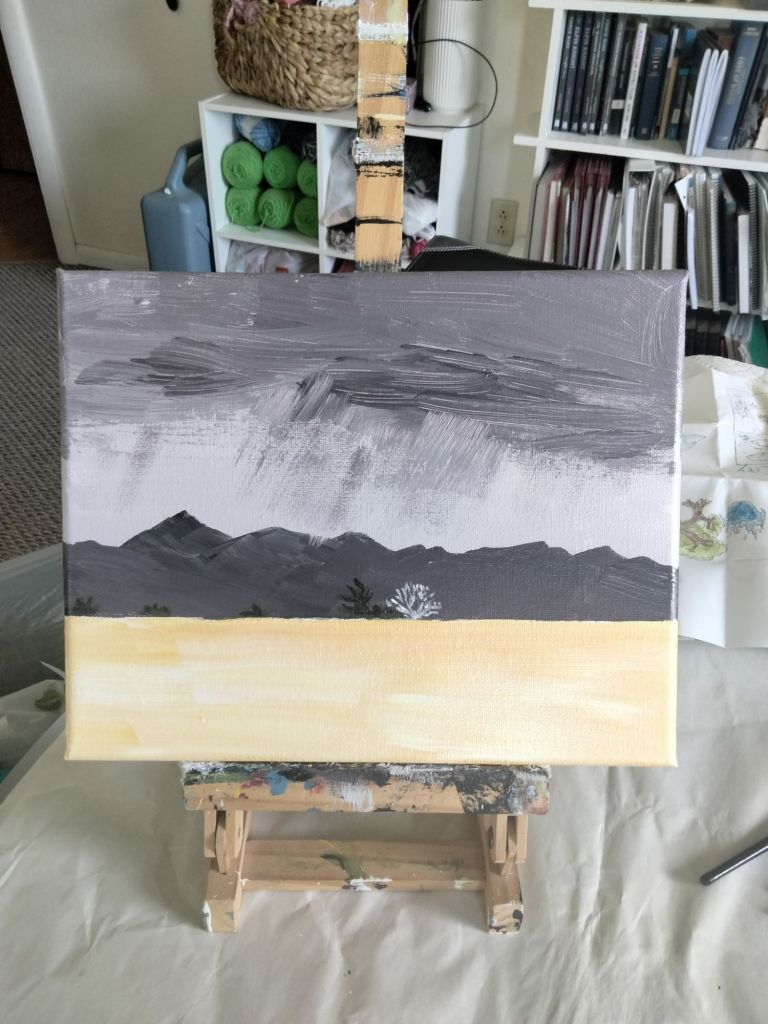
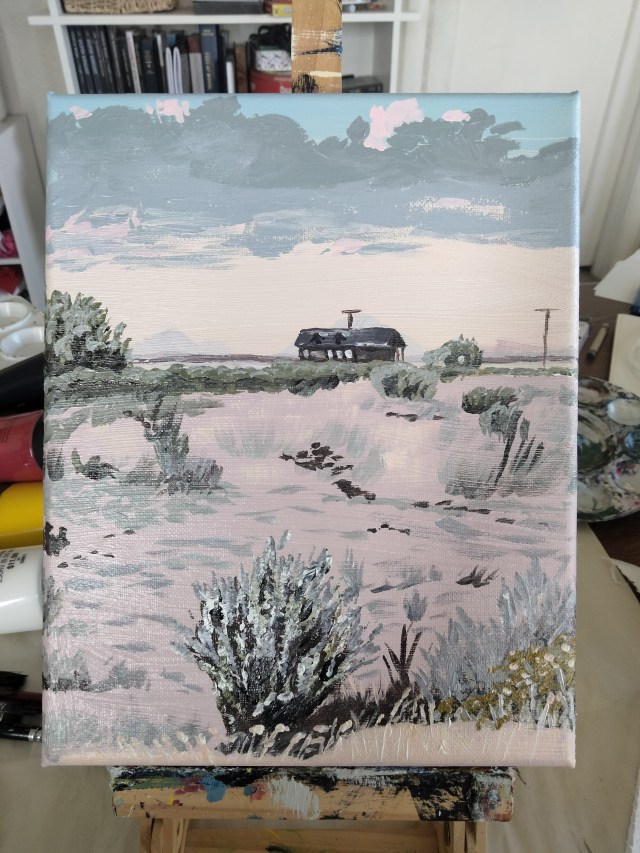
I have previously posted both paintings and photographs of sagebrush, which can be found just a short walk from my home.
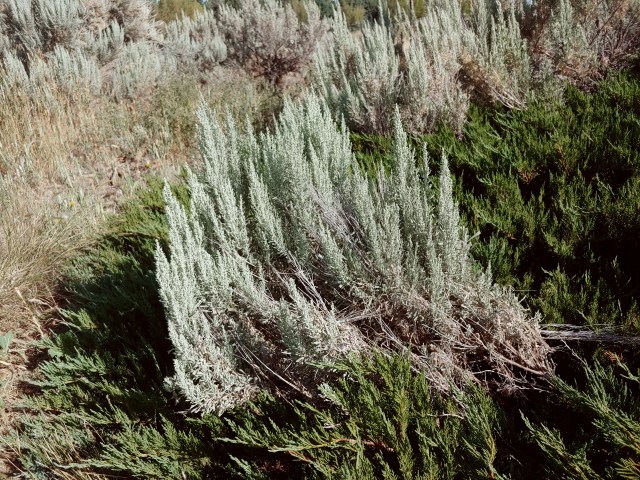
And here’s a random sagebrush, growing out of a juniper in my neighbor’s yard, not too far from the site where that picture was painted.
Out here, sagebrush tends to grow on any patch of land that’s not developed, either with crops or sod.
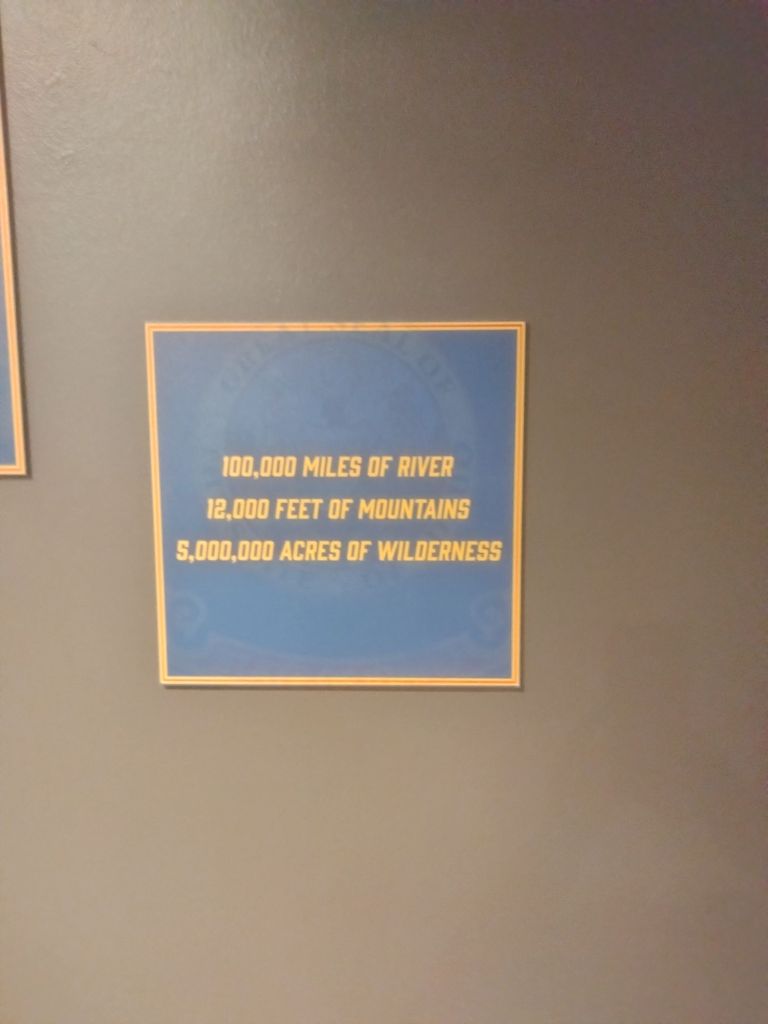
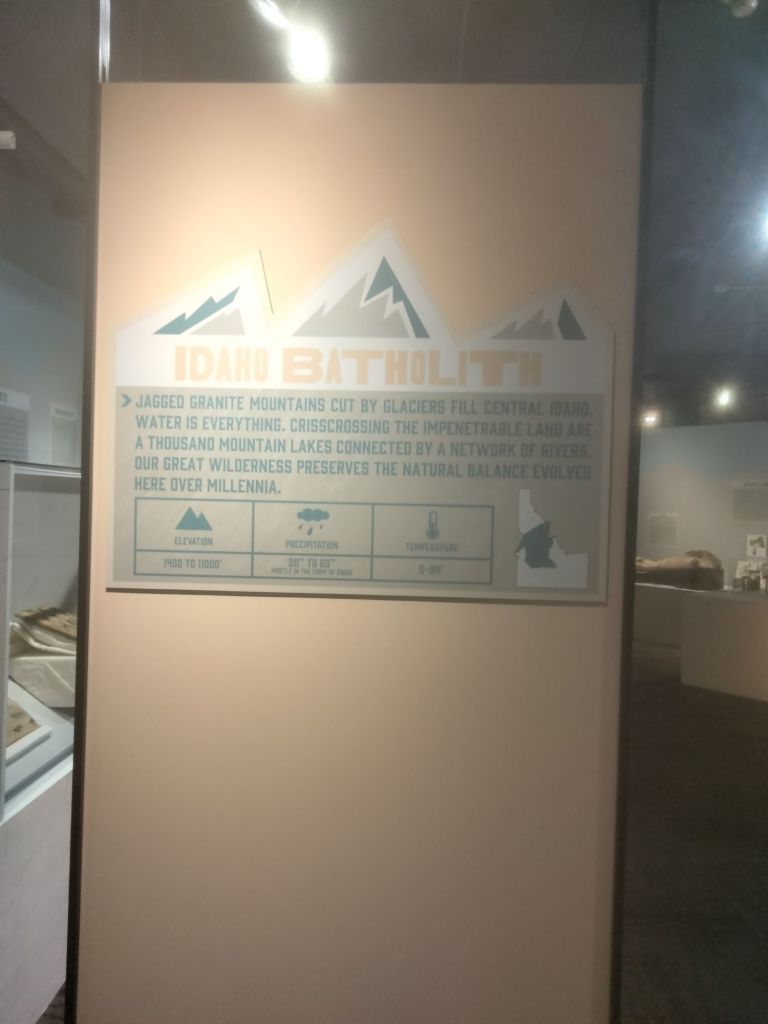
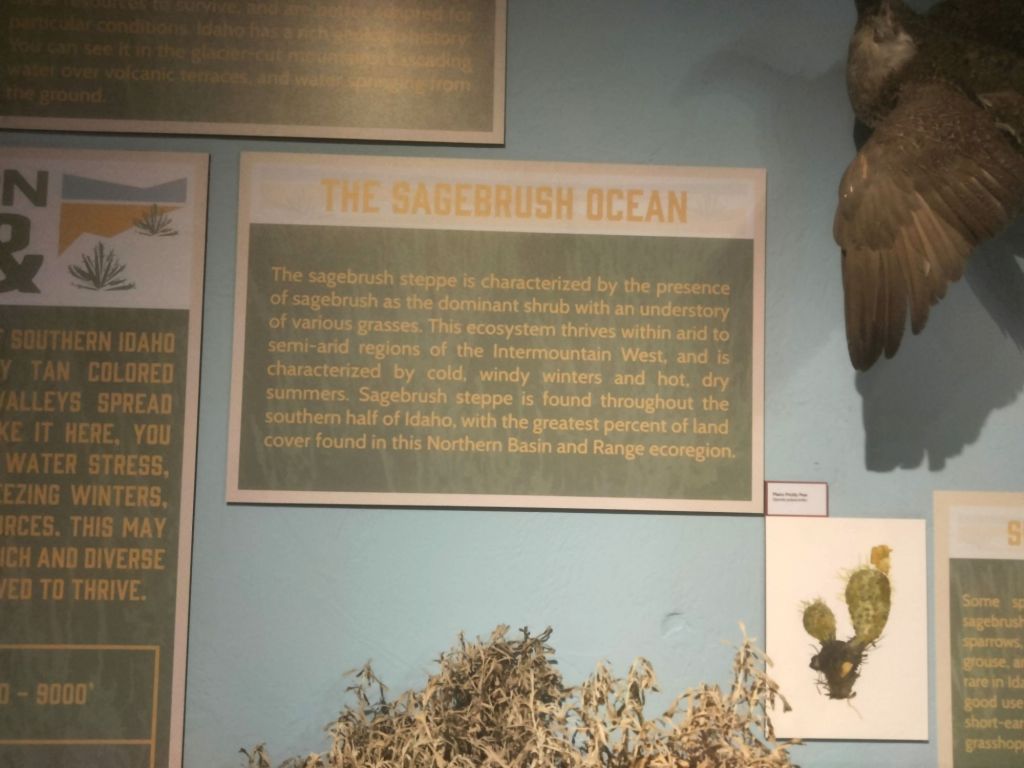
Now for your viewing pleasure, here is proof from the Idaho Museum of Natural History that a “sagebrush steppe” is a unique ecosystem.
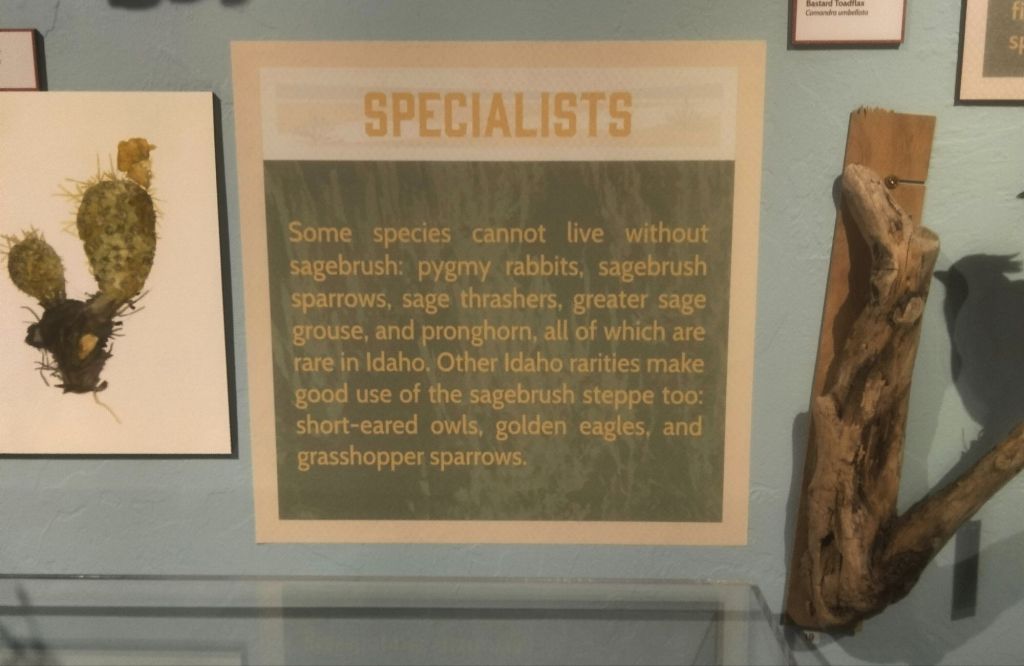
This is not to say that sagebrush is a monoculture. It tends to grow interspersed with Rabbit Bush, which looks like this:

Anyway, here are some pictures from the museum of a woman’s shirt and skirt woven mostly from sagebrush.

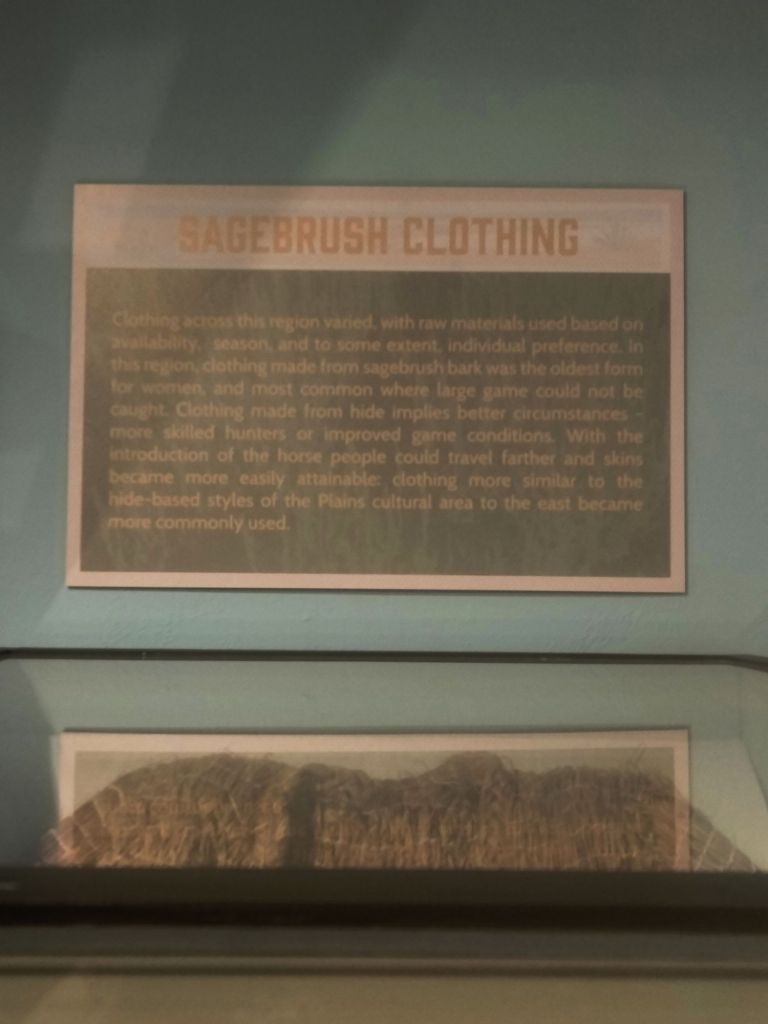
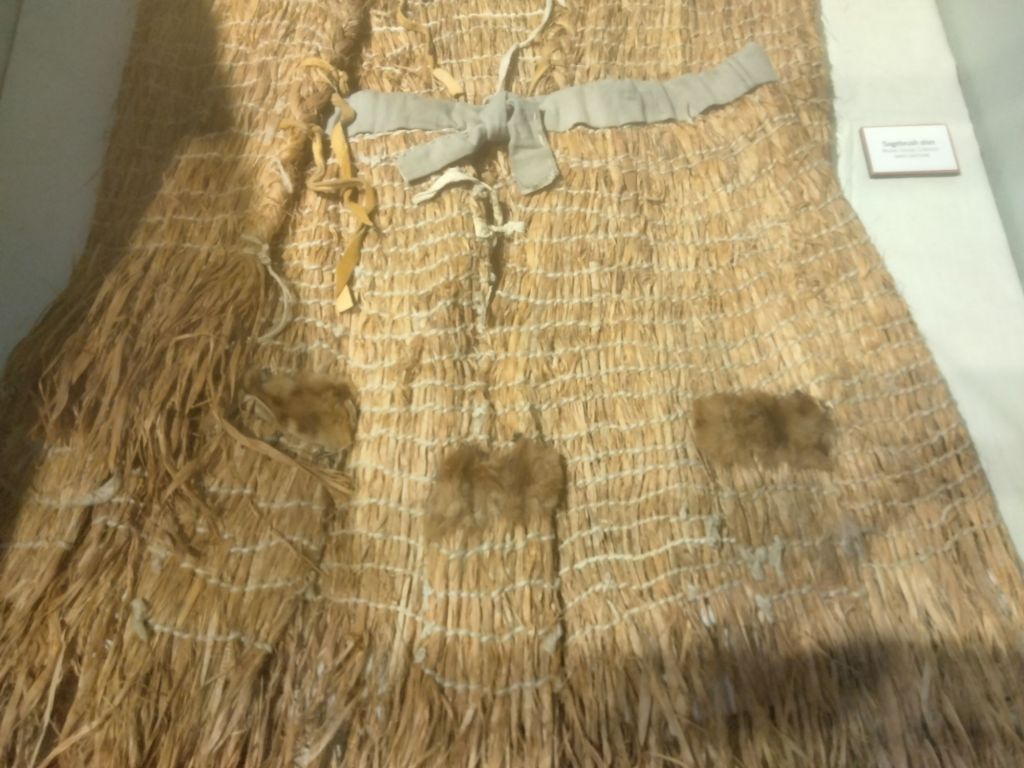
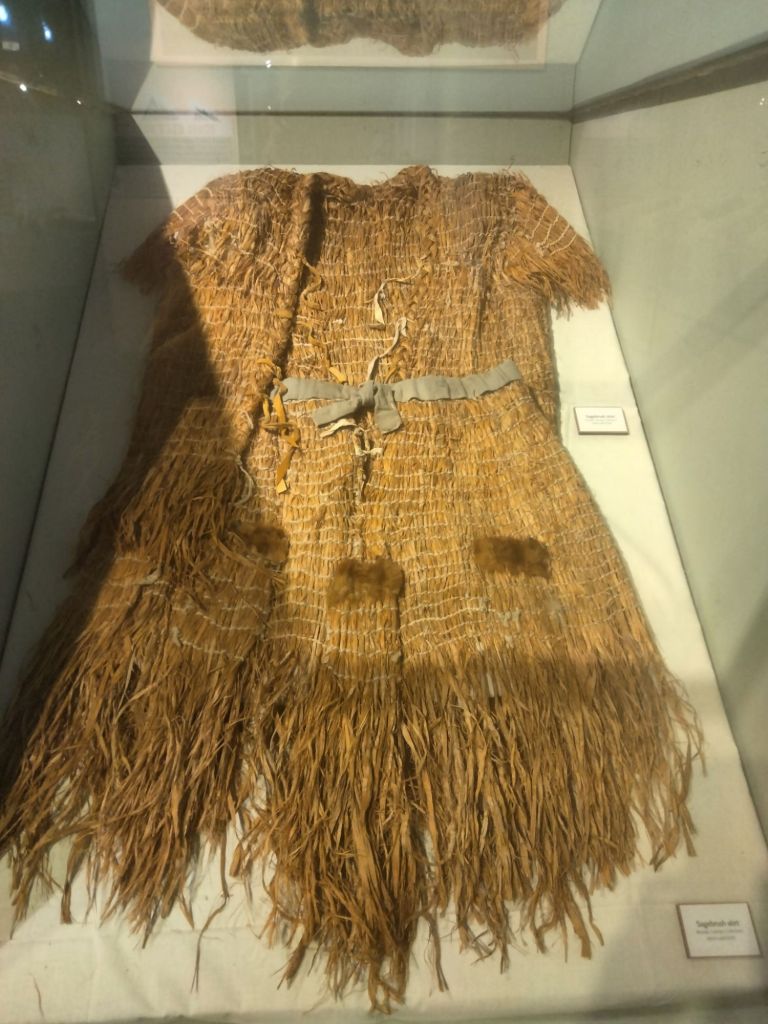
Very uncomfortable looking, and I don’t blame them for switching to hide clothing as soon as they could!
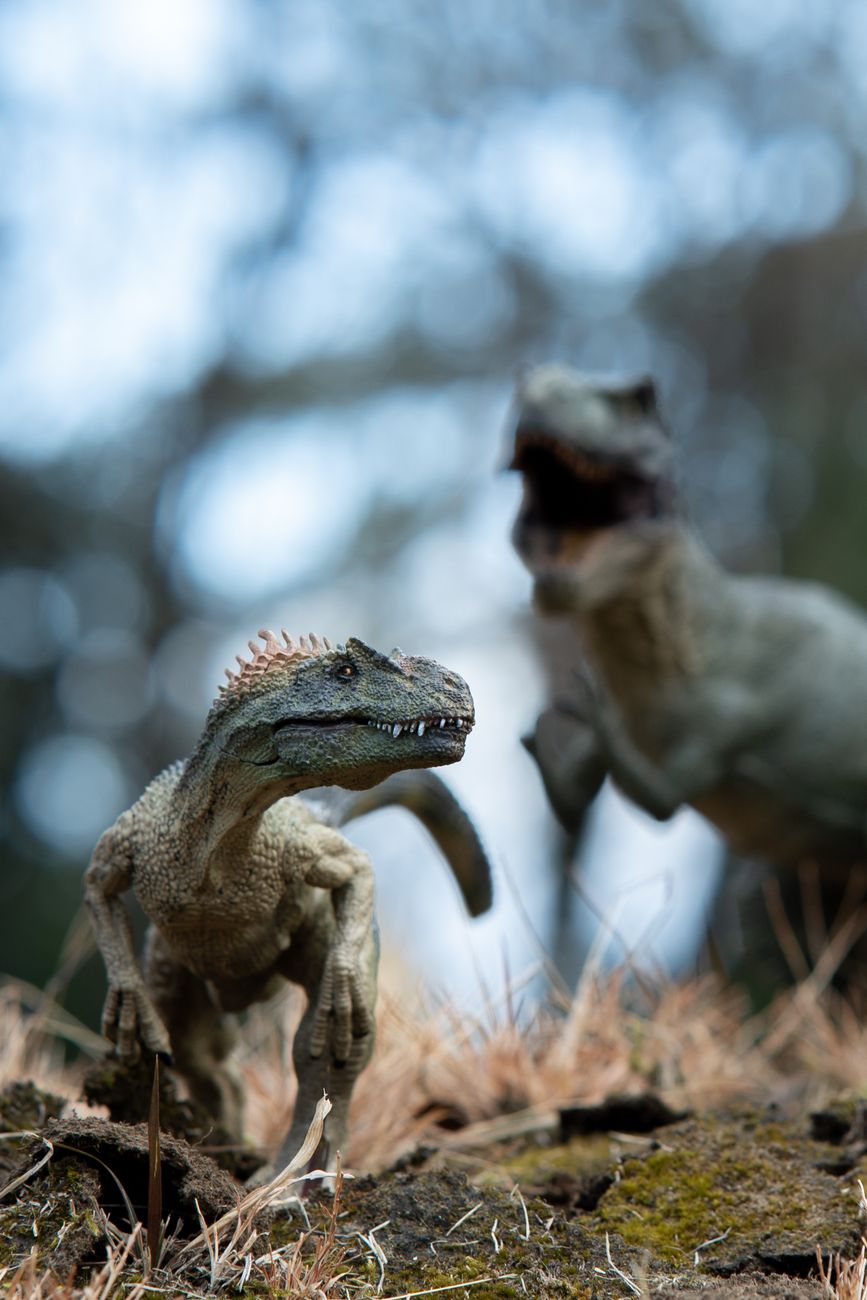
Readers of The Long Guest have noticed that it features some “dragons.”
These are not the kind that breathe fire, collect treasure, talk in riddles, and sail through the sky on golden wings. Lord knows, I’ve got nothing against that kind. But The Long Guest is not that sort of story. It’s a speculative novel about what life might have been like in the very ancient world. Its “dragons” are basically animals, part of the milieu through which the characters move as they leave Babel.
They are, of course, dinosaurs. Below is some of the research that prompted me to include them.
The evidence from paleontology is complex, incomplete, hotly debated and far, far beyond the scope of this article. But there is plenty of historical evidence that human beings occasionally saw, and even might have interacted with, various kinds of dinosaur. Often they called them “dragons.”
Dragon ‘legends’ exist all over the world. For example, when my husband and I lived in Borneo, there were stories of a long, skinny water dragon (‘naga’) that lived in the rivers. This dragon was part of the local mythology, but it was also believed to be an actual animal. After all, the other prominent animal in the local mythology was the hornbill (a bird similar to a toucan), which still lives in the interior of Borneo in great numbers.
Let’s start with depictions of dinosaurs in premodern art. All the examples I am going to give below appear in the context of art that features many other animals found in the natural world.
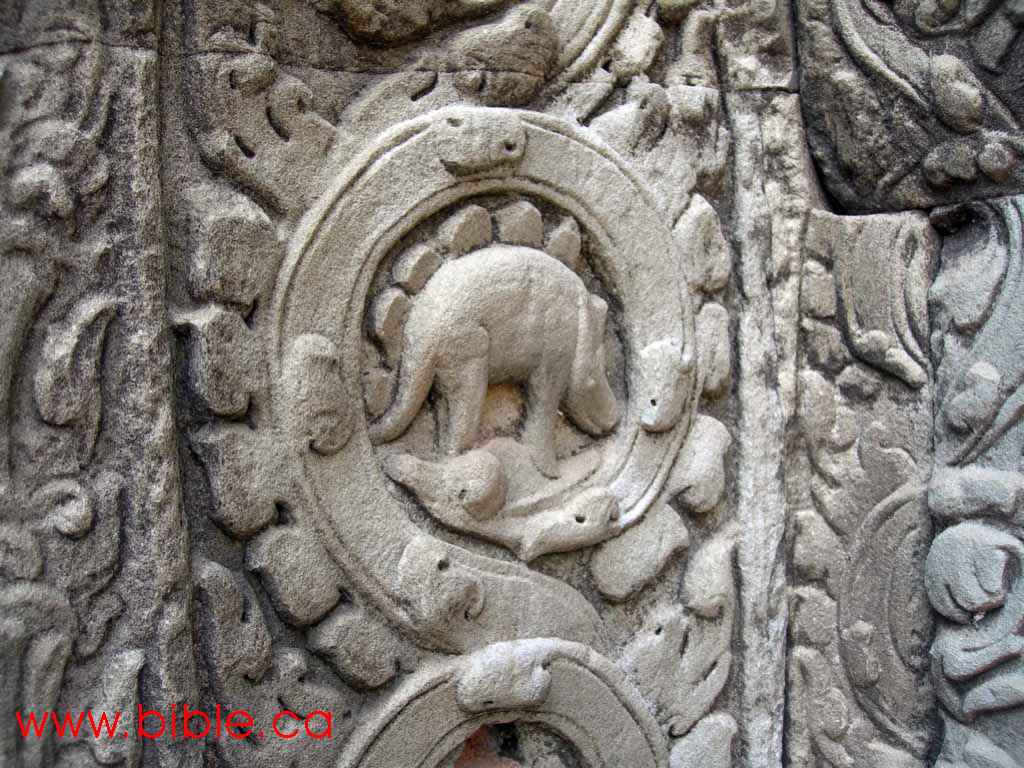
On Ta Prohm temple in Cambodia, there is an image that appears to be a stegosaurus alongside depictions of a monkey, deer, and parrots. On Kachina Bridge in Utah, the Anasazi petroglyphs include an animal that looks like an Apatosaurus. Among the petroglyphs at Havai Supai Canyon, near the Grand Canyon, is an image that appears to be a dinosaur with a long neck, standing upright and balancing on its tail.
Then there are the tens of thousands of small handmade clay sculptures that have been dug out of the ground near the foot of El Toro mountain in Acambaro, Mexico. Besides sculptures of people, musical instruments, idols, and so on, there are – you guessed it – hundreds of recognizable dinosaurs.
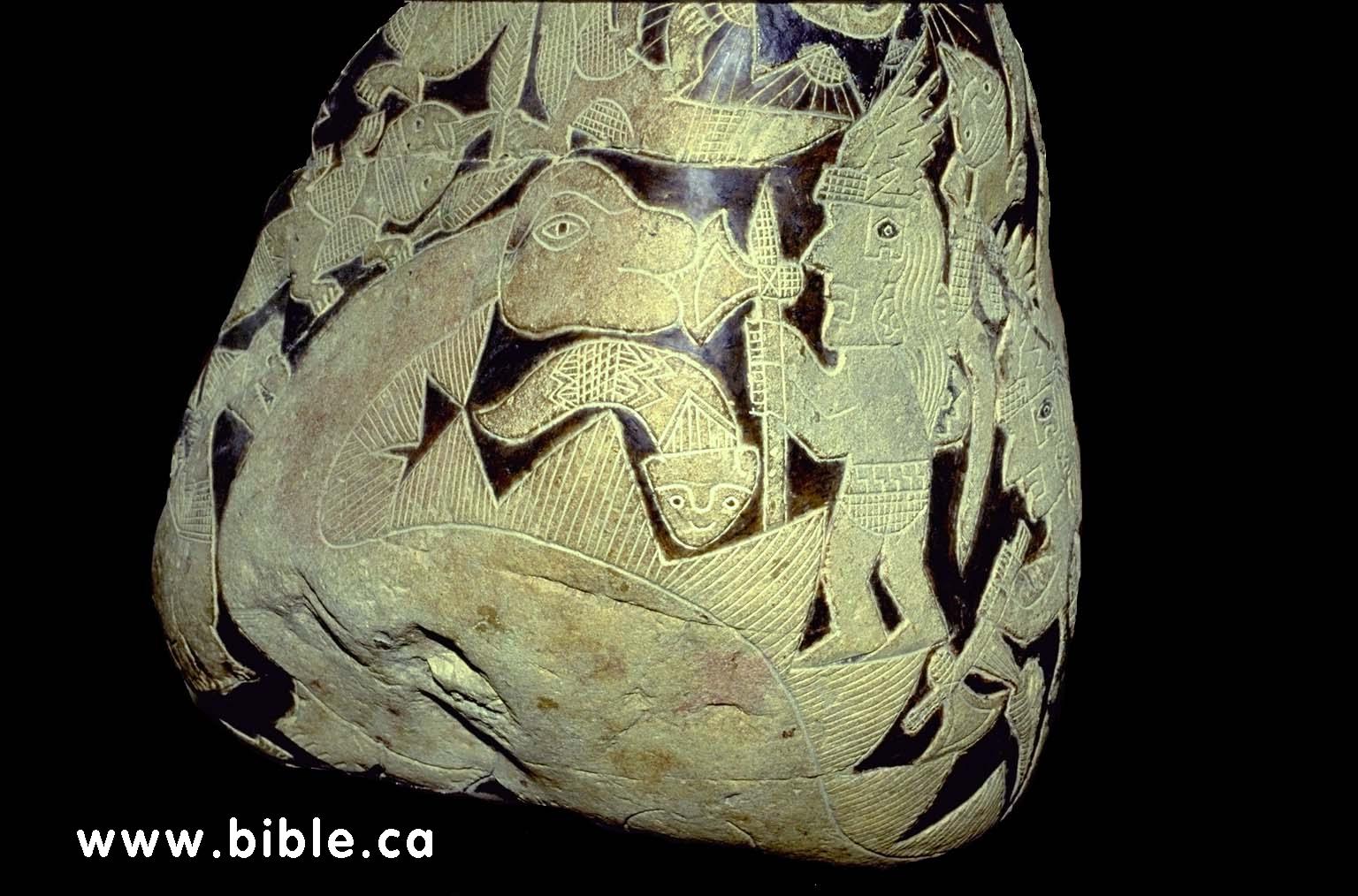
Finally, we have the Ica burial stones of Peru. These have images incised on them, including lots of dinosaur images. Interestingly, they show sauropod-like creatures with spikes on their backs. When I was a kid, sauropods were shown as large, grey, slow, and reptilian, with smooth backs. But apparently, in 1992 we moderns figured out that sauropods had “dermal spines.”
Visual images, especially petroglyphs, can be hard to interpret. As you might expect, the sculptures and images above are beloved of creation scientists and have been the subject of debunking by those who hold that dinosaurs did not survive to overlap with people. Sometimes the debunking takes the form of “That’s not really a dinosaur”; other times, as in the case of the Acambaro sculptures, the refrain is, “It must be a recent hoax.”
In the links above, I have tried to include a mix of both sympathetic and skeptical sources. I wanted you to be able to see the images; when possible, I took you to a skeptical source so that you can verify that the image in fact exists. Using the links above, the curious can find out more about the controversies (and with prehistory, the controversies never end).
But now we turn from visual images to less ambiguous accounts in the form of writing.
Once we start taking dragon ‘legends’ seriously as possible historical accounts of dinosaurs, we start seeing that there are a lot of accounts to consider. Here are just four:
The ancient Chinese, of course, had a whole cosmology built around different kinds of dragons. So much could be said, but I just want to note two things here. First, Chinese dragons are strongly associated with the Emperor because, among other reasons, of a legend of an early emperor, Xia Yu, who was helped by a wise dragon. (Note in the link above that Xia Yu’s story has other features common to the early chapters of Genesis. He lives hundreds of years; he is a founder and a culture bringer; he helps tame the dangerous floods. He is also an ancestor and founder who is later worshiped as a deity, as seems to have been the case with Nimrod.)
Secondly, Chinese dragons differ from Western dragons because they tend to be bearded. Some depictions even have a mane similar to a lion’s. This could be a case of combining characteristics of different animals, which is explicitly done in Chinese dragon mythology, but — just a thought — it could also be a depiction of hair-like feathers. “Hairy” dragons made no sense as dinosaurs until a few years ago, when we started discovering that many dinosaurs had quills or even feathers. See the following links: First Dinosaur Tail Found Preserved in Amber; Top 10 Dinosaurs that Aren’t What They Were; Fossils found in Siberia suggest all Dinosaurs had feathers.
Speaking of feathered dinosaurs: myths about, and worship of, a feathered serpent go way back in a variety of Mesoamerican cultures. This feathered serpent is called Kukulkan in Mayan, but is better known by his Nahuatl name of Quetzalcoatl. He even has a pterosaur named after him, though in reconstructions it looks more like a big bird than like a winged snake. (But compare this myth to the Hebrew “seraph serpents.”)
Continuing with the ancient Hebrew, here is a passage from the book of Job: “Look at the behemoth, which I [God] made along with you [Job] and which feeds on grass like an ox. What strength he has in his loins, what power in the muscles of his belly! His tail sways like a cedar (!); the sinews of his thighs are close-knit. His bones are tubes of bronze, his limbs like rods of iron. … Under the lotus plants he lies, hidden among the reeds in the marsh. … When the river rages, he is not alarmed …” (Job 40:15-23)
This description, particularly the tail swaying like a cedar, sounds like some kind of sauropod. For comparison, in the chapter before this God has given some poetic, but accurate, descriptions of the behavior of mountain goats; does; wild donkeys; wild oxen; ostriches; war horses, hawks, and eagles.
Job, by the way, apparently lived in the Ancient Near East not too long after Babel, if we go by his lifespan. According to the book of Job, he lived another 140 years after the events he is famous for. In Genesis 11, we see life spans of roughly 200 years becoming commonplace some time between Babel and Abraham. This is also the time period in which my book is set.
And now, we come to my favorite: dinosaurs in Beowulf. For this analysis, I owe Bill Cooper, author of After the Flood (1995). His book has an entire chapter devoted to zoological terms in Beowulf. Among many other rich ethnological and linguistic details, Cooper points out that in the original Anglo-Saxon, Grendel is nowhere referred to as a “troll.” In fact, ‘Grendel’ appears to be not a personal name but a name for a species: there are place-names in England such as “Grendeles Mere” (Grendel’s Lake), Grindles Bec, and Grendeles Pyt. There is even Grindelwald (“Grendelwood”) in Switzerland. (!)
Looking at the characteristics of Grendel as described in Beowulf:
After offering all this evidence, Cooper doesn’t even bother to name the dinosaur. “Is there a predatory animal from the fossil record known to us, who had two massive hindlegs and two comparatively puny forelimbs? There are several such species.” (page 159)
Thus, four different streams of historical record that I think may be more than myth.
I am not suggesting that every story of a dragon is to be taken seriously as a sober historical record of a dinosaur encounter. Fables have been invented about dragons, just as fables have been invented about other animals that have captured the human imagination (i.e., nearly all of them). But this does not invalidate every historical account. No one thinks that foxes do not exist because of Aesop’s story of the fox and the grapes. No one thinks that whales do not exist because of Moby Dick or Pinocchio.
The “dragons” in my books do not breathe fire. However, I have nothing in principle against the idea of an animal that could. After all, this world of ours contains the electric eel, the bombardier beetle, bat radar, bio-luminescent beaches, and the platypus, which apparently is able with its bill to detect electric fields put off by living things and so home in on its prey. Since all these things are possible, surely an animal could have existed that could expel superheated liquid, gas, or even – who knows? – actual fire. The process that allowed it to do this would likely be chemically based and so perhaps not visible in a fossil.
Dragons in my first book appear as part of the milieu, not as characters. Since they do not play a major role, I can mention them without spoilers.
Early in the book, two of the men go on a hunting/scouting trip. They observe a duckbill-type dragon with a crest with pink coloring. On the way back, they have an encounter with another dragon of the raptor type, which is hunting a wild boar that they are also hunting.
Much later in the book, the tribe has crossed Mongolia and has almost reached what is now the Liao River (home of the “pig dragon” artifacts). There they have a friendly encounter with a group of strangers who are capturing a dragon to take home to their king. The “dragon” in this scene is a Triceratops-like creature that sports dermal spines, blue-and-gold feathers on its crest (because why not?), and smooth feathers over the rest of its body. (My day was made, once about ten years ago, when I read in a newspaper that a Triceratops had been found covered in feathers. I now can’t track down the source … but it’s too late. Feathered triceratops/Chinese pig dragon has already made it into the book.)
A long time ago, Antarctica had a temperate or tropical climate, lots of animal life, and this cute little reptile.
Butt, Kyle and Eric Lyons. Dinosaurs Unleashed: The True Story About Dinosaurs and Humans. Apologetics Press, Inc., 230 Landmark Drive, Montgomery, Alabama, 1st ed. 2004, 2nd ed. 2008.
Cooper, Bill. After the Flood: The early post-flood history of Europe traced back to Noah. New Wine Press, PO Box 17, Chichester, West Sussex, England, 1995. The creatures in Beowulf are discussed in Chapter 11, p.146 ff.
Kleeman, Terry & Barrett, Tracey. The Ancient Chinese World. New York: Oxford University Press, 2005.
The governor of California … was truly a strange mix–he was canny when it came to his personal options and the main chance, and he was a superb politician, and this was welded onto–in an uneasy seam–the fact that he was an economic nincompoop.
Not only was he personally shrewd with his own money, and clueless with regard to finances at whatever transition point it turns from “money” to “economics,” but he was also an ugly man. But this ugliness–of the plain kind, not the grotesque freak show kind–was combined with uncanny amounts of personal charisma. He could talk virtually anybody into virtually anything, and this was a function of that charisma sloshing out of him whenever he made any sudden moves whatever.
He knew how to add and subtract. But, to underline it again, when it came to money on the loose, money in the pockets of others, and particularly when it came to money that corporations had mysteriously obtained, or the smaller reserves of the upper-middle-class taxpayer, he hadn’t a clue. He thought of public money as coming from a limitless aquifer of funds deep beneath their feet. Those who opposed him were obstinate and stiff-necked people who inexplicably did not want to pay a modest amount to install a new well and pump.
The ventures that remained in California kept going bust for some reason, and this was invariably attributed to “bad luck.” His ignorance of how this kept happening to the same kind of people was sincere, although it was also culpable. He should have known better. He had gotten through college. He had also had a driver’s license for decades.
–from Ride, Sally, Ride by Douglas Wilson, taken from pp. 107 – 111
On the campus of Idaho State University, in Pocatello, is the Idaho Natural History Museum. My husband and I visited recently. I’ll be posting pictures from it throughout this month, so you can enjoy the unique environment that we live in .
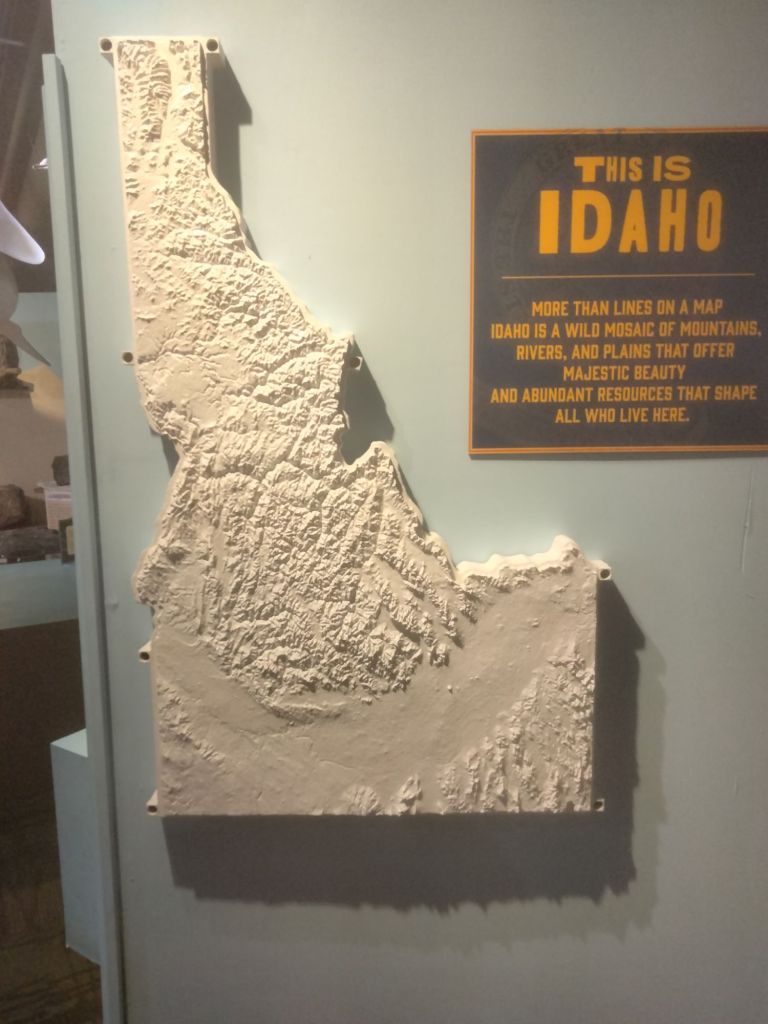
Ahh, a topographic map of Idaho. I never get tired of stuff like this.
The smooth u-shaped area in the southern part of the state is the Snake River Plain. I live on the lower right side of the U. The air is usually so clear that I can look north from my house and see the beginnings of the Pioneer mountains fifty miles away.