I turned out of the introductions and took my first proper look at McTavish. The main thing that struck me was that he didn’t look how I’d expected. Of course, writers can look like anybody … but writers do have a look. … It’s all in the eyes … A writer’s eyes are wide and curious, taking the world and flipping it over, interrogating and interpreting it, regardless of whether it’s for vanity or creativity. But McTavish had none of that: his eyes were giving off the petulant clock-watching of a student waiting out a detention. It was jarring to see my favorite writer in this light.
-Benjamin Stevenson, Everyone on this Train is a Suspect, p. 68
Not sure I agree with this, but it’s a flattering thought.
It becomes funnier when you realize, as the book progresses, that the narrator is not really an experienced writer.
This is a repost. These past weeks have been busy, what with wrapping up the school year, many family events, and illness. (I have a fever right now, and it’s making my online comments amazing.) So I give you this, one of my most-often-viewed posts of all time.
Disclaimer
Like most sane people, I hate Internet debates. Love/hate, that is. Even in real life, I’ve always found it hard to let a debate go. I’ve sometimes stubbornly backed positions that later turned out to be false, and on the other end of the spectrum I’ve gotten scared by ad hominems and conceded stuff I didn’t need to concede. Almost no matter how the debate goes, I end up feeling like an idiot.
I don’t want this site to become a debating site. But a few weeks ago, I posted a wild historical theory and invited you guys to critique it. Benjamin did, in the comments, here. So, for the integrity of this site, I’ve got to respond to the critique found in the link. If you don’t like Internet debates, please please skip this post.
The link that Benjamin posted to is
to a site called Bad Archaeology. The
site has two guys’ names on it, but at appears to be mostly written by one guy.
(At least, he is the one who responds to comments.) Let’s call him KFM. I am not posting his full name here nor am I
linking to his web site, because I don’t want to attract his attention because
I hate Internet debates! However, you can easily find his site by
Googling it.
The site exists to debunk “Bad Archaeology” (caps in the original), which mostly means various wild theories like the ones we’ve been discussing about lost civilizations, aliens, etc. It calls proponents of these theories Bad Archaeologists and it fights them with facts, with mischaracterization of their positions, and sometimes with mockery. And by capitalizing its references to them. Always fun.
Summary of the Refutation
KFM’s main arguments against
Hancock’s idea that the Piri Reis, Orontius Finaeus, and Buache maps come from
an older source are as follows:
-Piri Reis SAID he got his data for
the New World part of his map from Columbus. This is confirmed because he faithfully
reproduces some of Columbus’s errors, such as
showing Cuba
as part of the mainland.
-Most Bad Archaeologists
consistently spell Orontius Finaeus’s name wrong. (Oronteus.)
This shows they don’t know what they’re talking about.
-There are major errors in Reis’s
and Finaeus’s depictions of Antarctica. So we cannot claim that a supposed older
source map was accurate. (More on this
in a second.)
-Only one version of Buache’s famous map exists that shows Antarctica. It is in the Library of Congress. Other versions of the same map just show a big blank space there.
-Buache was an accomplished geographer who had a theory that there must be a landmass at the bottom of the world. He also theorized that within it, there must be a large inland sea that was the source of icebergs. So, if the map he supposedly drew is not a hoax and was in fact drawn by him, then he just made it up out of pure speculation. In fact, he wrote “supposed” and “conjectured” all over it.
-He also shows ice and icebergs all
over it. This renders ridiculous the
idea that it is a map of Antarctica before the
continent was covered in ice.
-Buache’s and Finaeus’s maps don’t match Reis’s or each other, so clearly they cannot have come from a single source map, let alone an accurate one.
The Strong
KFM’s arguments look, at first glance, super convincing. Some of them are dead on.
The strongest part of KFM’s argument is this:
“[Charles]
Hapgood, [Hancock’s source for this theory], assumed that the original source
maps, which he believed derived from an ancient survey of Antarctica at a time
when it was free from ice, were extremely accurate. Because of this, he also
assumed that any difference between the Piri Re‘is map and modern maps were the
result of copying errors made by Piri. Starting from this position, it mattered
little to Hapgood if he adjusted the scales between stretches of coastline,
redrew ‘missing’ sections of coastline and altered the orientation of
landmasses to ‘correct errors’ on Piri’s map to match the hypothesised source
maps …. Hapgood found it necessary to redraw the map using four separate
grids, two of which are parallel, but offset by a few degrees and drawn on
different scales; a third has to be turned clockwise nearly 79 degrees from
these two, while the fourth is turned counterclockwise almost 40 degrees and drawn
on about half the scale of the main grid. Using this method, Hapgood identified
five separate equators.”
This is pretty damning to the theory. It’s not necessarily fatal to the idea that Reis used an obscure ancient source among the 20 that went into his map. After all, copying errors do happen, especially when we are trying to compile a bunch of maps from different eras of places we have never surveyed ourselves. But that’s an unfalsifiable claim, so let’s leave it. Regardless, Hapgood’s shenanigans certainly are fatal to the idea that this ancient map, if it existed, was astonishingly accurate in latitude and longitude.
The Not So Strong
But
alongside this excellent argument, KFM also includes a bunch of inconsistent
ones:
“All
in all, the Piri Re‘is map of 1513 is easily explained. It shows no unknown
lands, least of all Antarctica, and contained errors (such as Columbus’s
belief that Cuba
was an Asian peninsula) that ought not to have been present if it derived from
extremely accurate ancient originals. It also conforms to the prevalent
geographical theories of the early sixteenth century, including ideas about the
necessity of balancing landmasses in the north with others in the south to
prevent the earth from tipping over.”
So, the map does not show Antarctica, but one sentence
later it does show Antarctica, but Antarctica was only put there because contemporary
geographical theory demanded it. Also,
note the assumption that the ‘extremely accurate originals’ are supposed to
have included all of the Americas
as well as Antarctica. That’s not my understanding of Hancock’s
claim.
It’s also not clear whether KFM is claiming that all the data for Reis’s map came from Columbus. If he is, this inconsistent with both Hancock’s claim (and KFM’s own showing) that Reis said the map was compiled from 20 others, including among them a map whose source was Columbus.
Similarly, KFM shows errors on Orontius Finaeus’s map, although he admits that “There are fairly obvious similarities between the general depiction of the southern continent by Orontius Finaeus and modern maps of Antarctica.”
The Buache Map Shows an Archipelago
For the Buache map, KFM contends that Buache essentially made up the entire map to satisfy a geographical theory he had, namely that there must be a land mass at the bottom of the world to balance the land at the top (this was a popular theory at the time), and that it probably had a large inland lake in it with two major outlets leading to the sea (this was Buache’s own brilliant guess, and he thought this lake must be the source of the icebergs that navigators encountered in the southern sea).
I
take KFM’s word that Buache had this theory, and that his map shows ice and
icebergs on Antarctica, which KFM says “makes the claims that Buache’s map
shows an ice-free Antarctica all the more
bizarre.”
Well,
sort of. But actually, Hancock’s claim
is that the source map Buache used shows Antarctica
early in the process of icing over. Also, given Buache’s theory, it would not be
surprising if he had added ice and icebergs to any other data that he may have
had.
“Over several parts of the southern continent, Buache writes conjecturée (conjectured) and soupçonnée (suspected).” KFM thinks this is conclusive proof that Buache basically invented the interior of Antarctica on his map, based purely on his own theory. That could be. But I have to say, if it is, he did a great job! He does not just draw a round mass, attach the few islands and promontories that he knows about (New Zealand, which he took for a peninsula, and the Cape of the Circumcision), and then draw a lake in the middle. Instead, he has a waterway offset between two unequal land masses. It corresponds surprisingly well to the shapes of the ranges of mountains and low areas that we now know Antarctica has.
The “Well, I’ll Bet You Didn’t Know About … This!” Argument
Besides these arguments, KFM includes a lot of interesting history about the biographies of these cartographers. Almost half his page about Finaeus is taken up with the cartographer’s biography, even though it has little to do with claims about his map (beyond boosting his credentials, which I would think Hancock would also want to do). Similarly, with Buache we are given: “The claims of Bad Archaeologists about Buache’s map ignore a crucial fact: he was the foremost theoretical geographer of his generation, whose published works include hypotheses about the Antarctic continent.” I’m not sure why Buache’s eminence is supposed to be a devastating blow to any claims about his map, but again we are treated to a long and interesting biography before KFM finally gets to Buache’s theories about a southern continent.
This style of argument reminds me of people
who think they have shown the Bible is not divinely inspired merely because
they can show that it happened in a particular historical context and is
expressed in a particular historical idiom.
They will trot out some tidbit of historical context that they assume is
complete news to some Bible scholar who has been studying ANE history his whole
life. Their line of argument is based on
a misunderstanding of what divine inspiration is claimed to be. They assume that if something is claimed to
be the Word of God, it must have come to humanity in an abstract, context-free,
propositional and not literary or historical form. (They also assume that it must cover all
knowledge in the world, e.g. so that the discovery of North
America was supposed to somehow shake our faith in the Bible.)
KFM’s argument about these maps is exactly the same kind of argument. He gives a bunch of historical context about these cartographers and thinks that refutes Hancock’s claims. It’s as if Hancock had been arguing that Piri Reis, Finaeus, and Buache were born of virgins, went through life without interacting with anyone, and then one day, without any context whatsoever, this complete, easy-to-interpret map from an ancient civilization dropped out of the sky into their hands. Well, that certainly isn’t the argument that Hancock makes in his book. His argument is (or was; he has apparently retracted it) that there were several source maps, made over centuries or millienia, which traced the progressive growth of the Antarctic ice cap. He does not claim that these were complete, accurate world maps or even that they showed the Americas. “Someone who knew what they were doing once mapped Antarctica.” That’s the basic claim.
When We Think We Don’t Have Preconceptions
It turns out that there is a more than
coincidental similarity between the way KFM caricatures Hancock’s claims and
the way that some people caricature claims about the Bible. KFM, in fact, classes Biblical Archaeology as
a subset of Bad Archaeology. The
following quotes should give you a sense of his general attitude:
“Some Bad
Archaeology is just so outrageously Bad that it can only be examined charitably
by assuming that its proponents are slightly confused. How else can you explain
the complete lack of critical judgment, the belief in ancient fairy stories,
the utter absence of logical thought they display? Either that, or they have a
particular agenda, usually driven by a religious viewpoint.
Biblical Archaeology, which has
been described as excavation with a trowel in one hand and a Bible in the
other, is a specialised branch of archaeology that often seems to ignore the
rules and standards required of real archaeology. Conducted for the most part,
by people with an explicitly religious agenda (usually Christian or Jewish), it
is a battleground between fundamentalist zeal and evidence-based scholarship … If we can’t find evidence for Solomon’s
glorious empire, it must be that we’re not interpreting the archaeological data
correctly and that a big discovery is just around the corner (the ‘Jehoash
inscription’ leaps to mind in this context). If contemporary Roman documents
don’t mention Jesus of Nazareth, why here’s an ossuary that belongs to James,
his brother… It’s all very much centred around contentious objects,
poorly-dated sites and great interpretative leaps that the non-religious may
find astounding.”
Got that? If you believe in a historical Solomon or
even a historical Jesus, you’ve just been dubbed a Bad Archaeologist. Welcome to the club, friends.
I mention this attitude not because it’s off-putting, but because it tells us something about KFM’s mindset and about what it would take to convince him that something is “good” archaeology. I’m guessing that any evidence of advanced civilizations older than about 4,000 BC is going to be dismissed out of hand. As will any evidence showing that humanity might have declined, rather than slowly progressed, over our history.
Conclusion: Inconclusive
Going back to the maps, what has been shown here? I would say it’s inconclusive. The maps are less accurate than Hancock claims and far less accurate than I made them sound in my original post, because I was going over Hancock’s theory at treetop level and didn’t bother to get off into the weeds when he discusses the details of the maps. (As I still haven’t done in this post. I would like to, but my time is limited.)
On the other hand, I think the Finaeus and Buache maps especially are more accurate than we would expect of maps that had been drawn out of pure conjecture, without any source at all. It looks like more was known about Antarctica in the 16th century than we previously assumed, whatever the source of that knowledge.
So it’s not a case of “Lost civilization proven!” but neither is it “Nothing to see here.” The most we can say is that something strange is going on, but we don’t know what. To paraphrase Andrew Klavan, KFM isn’t wrong to think Hancock and Hapgood are wrong; but he is wrong to think that he himself is right.
About the theory of earth crust slippage, I feel the same way. On the one hand, it’s a pretty hard theory to swallow on geological grounds. (For example: if a big section of the earth’s crust pivoted around the North American plains – even granted that this could happen – shouldn’t there be some kind of seam where the edge was?) On the other hand, clearly something weird happened, or we wouldn’t have Siberia being ice-free when Canada was ice-covered. Nor would we have flash-frozen tropical plants and baby mammoths.
So, in conclusion, nobody knows
anything, boys and girls. Let us eat,
drink and be merry.
Why don’t you need the apostrophe-s? Because English has a category for showing possessives without it … and it’s a rather large category.
fairy dust
bear claws
tiger tracks
baby poo
chicken feathers
lettuce leaves
castle battlements
Lady Chapel
Loch Ness Monster
angel wings
devil horns
cow horns
deer antlers
child care
Jerusalem stone
Christian ethics
dandelion fluff
mustard seed
computer screen
… O.K., o.k., … maybe it’s only allowable when the person or entity possessing the thing is acting as an adjective describing what type of thing it is.
On Oct. 17, Live Science published an article describing a highly unusual type of site – called gates in the Harret Khaybar area, that my colleagues and I had systematically catalogued and mapped and were to publish in the scientific literature in November. That sparked immediate and extensive international media coverage, including features in The New York Times, Newsweek and the National Geographic Education Blog. Four days after the article was published on Live Science, I got an invitation from publication from the Royal Commission for Al-Ula, in northwest Saudi Arabia, to visit that town. The Al-Ula oasis is famous for hosting the remains of a succession of early cultures and more recent civilizations, all strewn thickly among its 2 million-plus date palms. As a Roman archaeologist, I had known this oasis for over 40 years as the location of Madain Salih, Al-Hijr — ancient Hegra, a world-class Nabataean site adopted by UNESCO.
Four days after the invitation from the Royal Commission, my colleague Don Boyer, a geologist who now works in archaeology, and I were on our way to Riyadh. Almost immediately, on Oct. 27 to Oct. 29, we began three days of flying in the helicopter of the Royal Commission. In total, we flew for 15 hours and took almost 6,000 photographs of about 200 sites of all kinds — but mainly the stone structures in the two harrat.
Though we didn’t have much notice, Boyer and I spent three days before our visit looking over the sites we had “pinned” and catalogued using Google Earth over several years. We then, relatively easily, planned where we wanted to fly in order to capture several thousand structures in these two lava fields. Our helicopter survey was probably the first systematic aerial reconnaissance for archaeology ever carried out in Saudi Arabia. It was possible only because of the publication of the Live Science feature article describing my research on the gate structures, and the resulting international media coverage, which caught the attention of the Royal Commission.
I am just so excited about this, people. Just so excited.
I had heard that there were large stone structures, called “gates,” in Saudi Arabia. I’d evenblogged about it before. But I had no idea that there were hundreds of thousands. Hundreds of thousands. Saudi Arabia must be simply covered in these things.
It gets better. Guesses are that they date back 7,000 years (pre-Flood? Immediately post-Flood?). We know because many of them have been covered by lava flows in the interim. The Bedouins say they are “the works of the old men.”
It gets better. Why was the extent of these structures previously unknown? Must be racism, right? Evil European archaeologists didn’t expect the ancient inhabitants of Saudi Arabia to have built stuff like this?
Why, no. These structures are waaay out in the desert, known only to the locals. Almost impossible to find on foot. They are best surveyed from the air. Well, shortly after the last two World Wars (when small planes first came into general use), the Arab states started to achieve their independence from Britain and France. And they became closed states. They didn’t want anybody flying over their land. So, these amazing structures have been unknown and underappreciated, because those archaeologists who were interested, weren’t allowed to observe them.
So, let’s review. This story simply has everything guaranteed to make Out of Babel squirm with joy. Old, mysterious structures, really old, pre-dating even the amazing Nabatean civilization (the folks who built Petra), HUNDREDS OF THOUSANDS of them, purpose unknown, not generally known to exist because of remote location and closed country. Not only would this make a great movie, but it is the kind of thing that is continually popping up all over the world. Apparently, there is literally tons of evidence of smart humans building advanced civilizations, in just about every country on earth, yet we moderns have been unaware of this for a variety of reasons. Some of these reasons weren’t our fault (how were we supposed to know?), some were (we were blinded by the evolutionary narrative that says prehistoric people weren’t “advanced”).
When I say “advanced civilizations,” I mean a variety of different things by that. I mean cities with sophisticated water systems like Teohihuacan, observatory/computers like Stonehenge, observatory/cities like Poverty Point, temples using advanced geometry like Gobekli Tepe, pyramids like the ones in Bosnia, giant geoglyphs like the Nazca Lines and Serpent Mound and, apparently, these Saudi Arabian gate things. I also mean stones that appear to have been drilled, or precisely molded like the ones at Puma Punku.
If you have time, please follow the link and look up the LiveScience article. It’s worth reading the whole thing, and includes a video with views of the structures from an airplane.
Lisa Fulton: Lisa Fulton’s best-selling debut novel The Balance of Justice shook the foundations of crime fiction on release twenty-one years ago with its white-hot rage and brutal truth, and was long-listed for the Justice in Fiction Award, Women’s Prize, 2003. She is currently working on her long-awaited second novel.
Wait, what? Why the 21-year gap? What happened in the interim?
S.F. Majors: S.F. Majors’s gripping thrillers have captivated the world with their psychological complexity and hair-raising twists and turns. Her books include the New York Times bestselling Twists and Turns …
OMG …
Wolfgang: Winner, Commonwealth Book Prize 2012; short-listed, Bookseller’s Favorites Award 2012; short-listed, Goodreads Reader’s Choice, Literary Fiction, 2012; short-listed, Best of Amazon, 2012; [font becomes smaller] short-listed, Justice in Fiction Award, Women’s Prize (special exemption granted), 2003 …
All these fictional author blurbs are from Benjamin Stevenson’s Everyone on This Train is a Suspect.
Today’s post comes from chapters 4 and 5 of this book.
Originally Posted as, “Writer: The World’s Third Oldest Profession”
Writing is a human practice.
Of course it is possible to have a human society without writing, but the impulse to devise a writing system, looked at historically, may have been the rule rather than the exception.
This is counter-intuitive, of course. “Symbolic logic” seems like it ought to be unnatural to humans, especially if we are thinking of humans as basically advanced animals, rather than as embodied spirits. But if we think of mind as primary, everything changes. It’s telling that reading and writing are one of the learning channels that can come naturally to people, in addition to the visual, the audio, and the kinesthetic. But I’m getting ahead of myself.
Welcome to the third post taken from Lost Civilizations of the Stone Age by Richard Rudgley. Call this the writing edition. This post hits the highlights of Rudgley’s chapters 4 and 5, pages 58 through 85.
Nah, Ancient People Didn’t Write, They were Barbarians!
The idea of writing as an exception in human history has become dogma:
The proposition that Ice Age reindeer hunters invented writing fifteen thousand years ago or more is utterly inadmissible and unthinkable. All the data that archaeologists have amassed during the last one hundred years reinforce the assumption that Sumerians and Egyptians invented true writing during the second half of the fourth millennium. The Palaeolithic-Mesolithic-Neolithic progression to civilisation is almost as fundamental an article of contemporary scientific faith as heliocentrism. Writing is the diagnostic trait … of civilisation. Writing, says I.J. Gelb, ‘distinguishes civilised man from barbarian.’ If the Ice-Age inhabitants of France and Spain invented writing thousands of years before civilisation arose in the Near East, then our most cherished beliefs about the nature of society and the course of human development would be demolished.
Allan Forbes and Thomas Crowder, quoted in Rudgley, p. 75
Of course, the demolishing of our most cherished beliefs about the course of human development is exactly what, Rudgley is arguing, is going to have to happen.
In the last few chapters I have selected only a small number of the complex sign systems that have been preserved from prehistoric times. My concentration on the Near East and more particularly on Europe should not be taken to imply that such systems did not exist elsewhere in the prehistoric world. Far from it; investigations of numerous collections of signs are being undertaken in places as far afield as the Arabian peninsula, China and Australia. Millions of prehistoric signs across the continents have already been recorded, and more and more are being discovered all the time. … It no longer seems sufficient to retain a simplistic evolutionary sequence of events leading up to the Sumerian [writing] breakthrough some 5,000 years ago.
Rudgley, p. 81
Let’s look at these complex sign systems that Rudgley has mentioned.
The Vinca Signs
I was an adult before I ever heard the phrase “Old Europe.” I was doing research for a planned book, and I was surprised to learn that in southeast Europe (between the Balkans and the Black Sea), as early as 4,000 or 5,000 BC, there were not only cities but a writing system (undeciphered) known as the Vinca signs. It turns out that these cities and this writing system were probably part of a culture that obtained over much of Europe before the coming of the Indo-Europeans, which is called Old Europe. This is the culture that Marija Gimbutas believes was “the civilization of the goddess.”
Just as a reminder, these dates for the Vinca culture are before the very first human cities and writing are supposed to have arisen, in Sumeria in Mesopotamia, about 3,000 BC.
Perhaps I didn’t hear about the Vinca signs in school because they were only discovered in Transylvania 1961. (I was born in 1976, but we all know how long it takes new archaeological findings to get interpreted, integrated into the overall system, and eventually make it into school textbooks.) After being discovered, the signs were assumed to be derived from Mesopotamian cultures such as Sumer and Crete, because it was accepted dogma that writing was first invented in Mesopotamia. Later, the tablets on which the Vinca signs were discovered were carbon-dated and found to be older than the Mesopotamian writing systems. This led to a big disagreement between those who wanted to believe the carbon dates, and those who wanted to believe the more recent dates for Old European archaeological sites, which were then conventional.
Then, in 1969, more, similar signs were discovered on a plaque in Bulgaria and dated to be 6,000 – 7,000 years old. By this time, archaeologists were beginning to accept the carbon dating of these Old European sites. But since they still did not want to admit that writing might have been invented before Sumer, most of them decided “[the signs] could not be real writing and their apparent resemblance was simply coincidental.” (Rudgley p. 63)
An archaeologist named Winn analyzed the Vinca signs and while he is not willing to go further than calling them “pre-writing,” he concludes that they are “conventionalised and standardised, and that they represent a corpus of signs known and used over a wide area for several centuries.” (Rudgley 66)
Meanwhile, Marija Gimbutas and also Harald Haarmann of the University of Helsinki both feel the Vinca signs are true writing and that they developed out of religious or magical signs, not out of economic tallies like the Sumerian alphabet.
Haarmann notes that there a number of striking parallels between the various strands of the pre-Indo-European cultural fabric – especially those related to religious symbolism and mythology. Among these common features is the use of the bull and the snake as important religious symbols. In the case of the snake it is a form of the goddess intimately intertwined with the bird goddess motif in both Old European and later Cretan iconography. The bee and the butterfly are also recurrent divine attributes, and the butterfly is represented by … the double ax. Haarmann sees the goddess mythology of Old Europe echoed in these motifs that also feature prominently in the ancient civilisation of Crete. He then traces the links between the Old European script – as found in the Vinca culture – and later systems of writing, particularly those of Crete.
Rudgley, pp. 68 – 69
Rudgley’s Figure 15 (p.70). On the left are the Vinca signs, on the right is Linear A from Crete.
Ice Age Signs
There are quite a number of symbols that appear on artifacts or are associated with paintings from the Neolithic and even the Palaeolithic period. These include crosses, spirals, dots, “lozenges” (ovals), and the zigzag, which is very common and seems to have been used to represent water. (By the way, note the zigzags among the Kachina Bridge petroglyphs.) “The discovery in the early 1970s of a bone fragment from the Mousterian site of Bacho Kiro in Bulgaria suggests that the use of the signs may date back to the time of the Neanderthals. This fragment of bone was engraved with the zigzag motif …” and apparently on purpose, not accidentally in the course of doing some other repetitive task. (Rudgley 73)
“The single V and the chevron (an inverted V) are among the most common of the recurrent motifs in the Stone Age.” (Rudgley p. 74) Gimbutas, of course, interprets the V as a symbol for the female genitals and/or Bird Goddess, but it could be just … you know … a symbol.
Archaeologist André Leroi-Gourhan has interpreted the many signs found at various Palaeolithic cave art sites not as a form of hunting magic (contra previous interpretations), but as a symbolic system. “Leroi-Gourhan admitted to us shortly before his death, ‘At Lascaux I really believed they had come very close to an alphabet.’” (Rudgley p. 77)
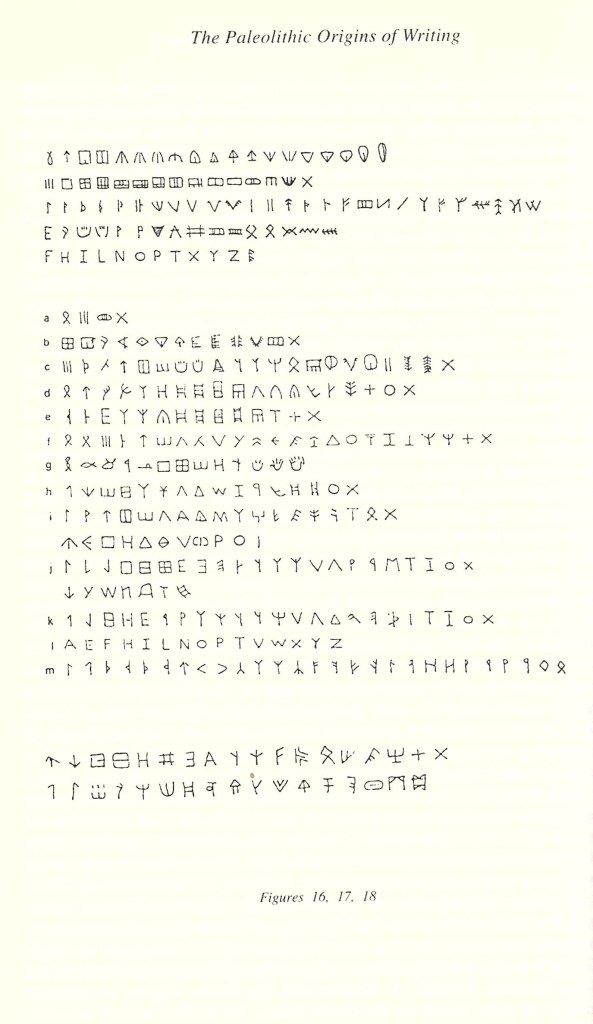
Rudgley’s Figures 16 – 18 (p. 78). Top paragraph: some of the Franco-Cantabrian (Stone Age) signs. Middle paragraph: a – hieroglyphic determinatives; b – Sumerian pictoral writing; c – Indus Valley; d – Linear A; e- Linear B; f – Cypriote; g – Proto-Sinaitic; h- Phoenician; i – Iberian; j – Etruscan; k – Greek (Western Branch); l – Roman; m – Runic. Bottom paragraph: some of the signs found on oracle bones in very ancient China.
But Can You Prove It’s Writing?
Every time some symbols are discovered that are so ancient they strain belief, anyone who doesn’t want to accept them as writing can easily go in to a number of calisthenic moves to cast doubt on this. If the item the signs are found on is in poor condition, they can question whether the marks were even intentional. Perhaps they were accidental scratches, the product of some other activity. If the marks are undeniably made by people, they can be dismissed as doodles. The Vinca signs, when first found, were speculated to have been copied randomly from Mediterranean signs by people who believed these things had mysterious power, but did not understand their meaning. Rudgley also notes that the Old European signs have been interpreted as purely magic symbols, as if a magical intent were to make them non-writing.
In short, any time we are presented with a complex system, there are always a million ways to get out of attributing it to a mind. This is doubly true if we aren’t able to interpret its meaning, but you will even see people do this with messages that they ought to be able to understand. Of course, it can also work the other way, where people see meaning in complex patterns where it wasn’t intended. Often what it comes down to is whether we want there to be a meaning there. Do we, or do we not, want to be in contact with another mind? If for whatever reason we don’t, we can always find a logical way to avoid that contact.
So in the case of apparent writing systems that we haven’t cracked and probably never will, our attitude towards them is going to depend heavily on what we believe about ancient people’s minds. Were they basically like ours, or were they different, animal? We will see more writing systems if we are expecting that they came from people. If we are not expecting to encounter people, then nothing is going to convince us that these are writing systems.
Was Adam a Writer?
My mind was blown, while taking an Old Testament Backgrounds course years ago, when I read an essay that asserted that Adam was able to write and in fact had left a written record for his descendants.
This idea seems completely loony on the face of it … until you realize that the only reason it seems loony is that we are assuming that writing is a recent, unnatural development, the product of tens of millennia of human cultural evolution, and not a characteristic human activity that is, so to speak, wired in.
The essay interpreted the early chapters of Genesis in this way. There will be a short historical record, followed by the phrase “the book of [name],” indicating that the passage immediately preceding was by that author.
Passage
Recounts
Closes with
Genesis 1:1 – 4:26
Creation (in poetry), fall, Cain and Abel, some of Cain’s descendants, Seth
Gen. 5:1 “the book of Adam”
Gen. 5:1b – 6:8
Recap of creation of Adam, Seth’s descendants up to Noah and his sons, Nephilim, God’s resolve to wipe out mankind, God’s favor on Noah
Gen. 6:9a “the book of Noah”
Gen. 6:9b – 11:9
Building of the ark, the Flood, emerging from the ark, the Table of Nations, the Tower of Babel
Gen. 11:10 “the book of Shem”
Gen. 11: 10b – 11:26
Genealogy from Shem to Terah and his son Abram
Gen. 11:27 “the book of Terah”
Gen. 11:27b – 25:18
Terah moves his family to Haran, Terah dies, a whole bunch of stuff happens to Abram, death of Sarah, Isaac finds a wife, Abraham dies, genealogy of the Ishmaelites
Gen. 25:19 “the book of Abraham’s son Isaac”
Gen. 25:19b – 37:1
Jacob’s entire life, death of Isaac, genealogy of Esau
Gen. 37:2 “the book of Jacob”
In Genesis, the author’s name comes after the notes he left.
I realize this might be a lot to accept. It’s just food for thought. It does explain why it says “the book of _________” (or, in my NIV, “this is the account of __________”), after the bulk of that person’s story.
Get it? Get it?
(By the way … for those wondering about the title of this post … prostitution is referred to as “the world’s oldest profession.” Erma Bombeck, mother and humorist, has published a book hilariously titled Motherhood: The Second Oldest Profession. The title of this post references those two, because the post is about the fact that writing is very, very old. I don’t mean to imply that a writer’s life has any necessary connection to the other two professions, although of course this does invite all kinds of clever remarks.)
This spring also [1634], those Indians that lived about their [the Plymouth settlement’s] trading house there, fell sick of the small pox and died most miserably; for a sorer disease cannot befall them, they fear it more than the plague. For usually they that have this disease have them in abundance, and for want of bedding and linen and other helps they fall into a lamentable condition as they lie on their hard mats, and pox breaking and mattering and running one into another, their skin cleaving by reason thereof to the mats they lie on. When they turn them, a whole side will flay off at once as it were, and they will be all of a gore blood, most fearful to behold. And then being very sore, what with cold and other distempers, they die like rotten sheep. The condition of this people was so lamentable and they fell down so generally of this disease as they were in the end not able to help one another, no not to make a fire nor to fetch a little water to drink, nor any to bury the dead. But would strive as long as they could, and when they could procure no other means to make a fire, they could burn the wooden trays and dishes they ate their meat in, and their very bows and arrows. And some would crawl on all fours to get a little water, and sometimes die by the way and not be able to get in again. But of those of the English house, though at first they were afraid of the infection, yet seeing their woeful and sad condition and hearing their pitiful cries and lamentations, they had compassion of them, and daily fetched them wood and water and made them fires, got them victuals whilst they lived; and buried them when they died. For very few of them escaped, notwithstanding they did what they could for them to hazard of themselves. The chief sachem himself now died and almost all his friends and kindred. But by the marvelous goodness and providence of God, not one of the English was so much as sick or in the least measure tainted with this disease, though they daily did these offices for them for many weeks together. And this mercy which they showed them was kindly taken and thankfully acknowledged of all the Indians that knew or heard of the same.
William Bradford, Of Plymouth Plantation, pp. 302 – 303




 Out of Babel Books