Stone Age Surgery

Photo by Renato Danyi on Pexels.com

Trigger warning: Stone Age surgery!

This post is the first in a series I have planned about prehistory. Each post will draw on one or more chapters from the book The Lost Civilizations of the Stone Age, by Richard Rudgley, Touchstone, 2000. From the front flap:

Our long-held myths are exploding. Recent discoveries of astonishing accomplishments from the Neolithic Age – in art, technology, writing, math, science, religion, and medicine, and exploration – demand a fundamental rethinking of human history before the dawn of civilization.

Lost Civilizations, inside flap

So, Rudgley’s thesis is basically that there was, in fact, civilization long before there was civilization. That is, of course, also a theme of this blog. “Ancient people were smarter than we think,” or that art, literature, science and civilization are the natural state of human beings and have been present (ebbing and flowing of course) as long as there has been humanity.

A near-universal theme in the mythologies of the world is that the present state of the world, and more specifically the social world, is in decline — a fall from the Garden of Eden or from a Golden Age. Modern civilization has turned these traditional mythological assumptions on their head and written a new script, one based on the idea of social progress and evolution. In this new mythology the notion of civilization (as it is generally understood) replaces Eden and this novel paradise exists not at the beginning of time but, if not right now, then just around the corner. Civilization is … presented as the final flowering of human achievement born out of a long and interminable struggle against the powers of darkness and ignorance that are represented by the Stone Age.

Lost Civilizations, Introduction, page 1

I have come to believe in the ancientness of civilization because I take ancient documents seriously as historical records: Genesis, primarily, but also the other legends and myths from around the world which Rudgley mentions in his intro. This suspicion that ancient people were much smarter than we give them credit for was further strengthened as I learned about some of their building projects. Now Rudgley is presenting archaeological evidence that they knew far more than we suspect about art, mathematics, the natural sciences, and medicine.

Disclaimer about Dates

By the way, I don’t have a coherent way to sort out which archaeological dates to accept and which ones to doubt. As far as I can tell from my reading, all methods of dating archaeological sites are based on some form of dead reckoning.

Carbon dating depends on certain assumptions about rates of molecular decay, which can’t be proven in the first place and can also be thrown off universally or locally by events such as a comet strike. Carbon dating also seems to be less reliable the farther we go back in time.

Dating by archaeological layers also depends on assumptions about different historical periods and what might be diagnostic of each, except in cases where a site can be reliably linked to a known historical event (which is obviously only the case for relatively recent sites). Other than that, it’s all dead reckoning.

Dating events in human history by the use of genetics depends upon assuming that all genetic differences evolved and assuming certain rates of change. Historical linguistics has the same problem.

Finally, historical records such as the genealogies found in Genesis and in the oral traditions of other peoples worldwide hit only the highlights of a family line and don’t give us any idea how many generations were skipped.

Each of these methods can be pretty convincing in specific cases. It is even more convincing when one or more methods converge, yielding the same date range. But even when that happens, it’s still just one method of dead reckoning appearing to validate another. And most often, different dating methods contradict each other. If a plurality of them converged on one timeline for human history, maybe we could accept that. But they don’t. It’s complete chaos.

I would love to present a clever, coherent, data-grounded rubric for sorting all this stuff out. But I’m not a professional in any of these fields. Even if I were, the pros don’t all agree with one another. It’s starting to look like, in order to have a sorting method that makes sense, I would have to do full-time research for several years. Maybe for a lifetime. So I got nothin’.

My working theory is that humanity, and hence human civilization, is tens of thousands but not hundreds of thousands and certainly not millions of years old. I can’t prove this. No one can.

So, in these posts about Rudgley’s book, I’ll just present the dates as he gives them. I won’t try to integrate them with the picture of ancient human history that I have been piecing together in my books and in other posts on this site, all of which could be invalidated at any time by a new historical or archaeological discovery. Sometimes Rudgley gives dates that are hundreds of thousands or even millions of years old (though not in this chapter). I might be skeptical that they are really that old, but can still accept that these people were living long before mainstream archaeology tells us that there was “civilization.”

On to the Icky Stuff!

So. Stone Age Surgery.

Undoubtedly the widest-known major surgical operation in tribal cultures is trepanation … which, as will become clear, was also known in the Stone Age. This operation involves the removing of one or more parts of the skull without damaging the blood vessels, the three membranes that envelop the brain … or the actual brain.

Lost Civilizations, p 126

That’s right, removing parts of the skull. There are three methods by which this can be done: scraping, “a mixture of boring and sawing,” and “the push-plough method,” which involves creating an oval groove in the skull (basically another method of scraping).

Thomas Wilson Parry, MD (1866 – 1945), became fascinated by trepanation and practiced various methods of it on human skulls (not on live patients), “using implements made of obsidian, flint, slate, glass, shell and shark teeth.” “Parry records that the average time it took him to perform a trepanation by the scraping method on a fresh adult skull was half an hour. He found both flint and obsidian excellent materials to work with surgically, and also expressed the opinion that shells — which were used in Oceania to perform such operations — were highly effective too.” (page 128)

Trepanation appears to be less painful than it sounds. It has been used at various times and places to treat epilepsy, mental illness, head injuries, severe headaches, vertigo and deafness (129). It is “still regularly practised among the Gusii of Kenya, a Bantu people with a population of about one million, and theirs is perhaps the last surviving traditional practice of its kind.” (130) Trepanation was also practiced by the Incas and the pre-Inca peoples; in Neolithic Europe; in 6th-century BC Palestine; and now, trepanned skulls a few thousand years old have also been found in Australia.

Rudgley points out that “as it is usually only the bones of Stone Age people that survive to be discovered … any operation that was performed on the soft parts of the body cannot be detected.” (136) If Neolithic people were willing and able occasionally to practice trepanation, it seems likely that they were able to perform less risky kinds of surgery too. There is some evidence from Neolithic Europe of various kinds of dentistry, including toothpick grooves, birch bark chewing gum, and even a skull with a tooth that has been drilled. (136)

Rudgley’s chapter on trepanation (“Stone Age Surgery”) comes after a chapter called “Under the Knife” (pp 116 – 125), which discusses medical procedures in “tribal” cultures that are known from history and ethnography. This includes everything from circumcision in the Ancient Near East, to amputation among the Australian aborigines, to very detailed anatomical knowledge among the Aleutian islanders. The chapter concludes with two horrifying yet impressive accounts of successful surgeries in a tribal context. There is a c-section performed in Uganda in 1879, and various tumor removals performed in the Ellice [sic] Islands in the 1920s. The message is clear: modern, “civilized” people don’t have a corner on medical knowledge.

Antiseptics and Painkillers

We don’t know whether Stone Age people had germ theory. Nor, if they had it, do we know how they referred to germs. In one of Ursula le Guin’s novels, a wound getting infected is called “the evil of the blade.” That’s hardly less scientific than calling it an “infection,” as long as you know how to prevent or treat it.

Studies of both the trepanned skulls of the Incas and some of those found in Neolithic Europe indicate that healing seems to have been the norm in both cases. It is hard to explain the Stone Age success rate without concluding that some kind of effective antiseptic agent must have been used. Furthermore, the surgeons of the time must have understood the need for it.

Lost Civilizations, p 131

If germ theory was ever explicitly known, it was obviously forgotten at some point in human history, only to be re-discovered much later. But even if people were operating on a different theory, it would be possible for them to know the importance of cleanliness and to know how to treat a patient using any of a large number of natural substances that have antiseptic properties. The words “Stone Age” naturally evoke the image of a cave man, and the idea of a cave man naturally includes an individual who never takes a bath. But it ain’t necessarily so.

It is also possible that people’s immune systems were much stronger many years ago, if we are willing to entertain the idea that the human race has declined over time rather than evolving upwards.

Now, I am sure you want to know about painkillers. Here, gleaned from Rudgley’s Stone Age Surgery chapter, is a short list of substances that have been used as painkillers at different times and places:

  • cocaine (in coca leaves — South America)
  • wine mixed with extract of mandrake (first-century Greece)
  • mandrake beer (ancient Egypt)
  • possibly just beer
  • the opium poppy (starting in the Mediterranean around 6000 BC and spreading west from there)
  • cannabis (native to Central Asia, but quickly spread to Old Europe and China)
  • betel nut (Southeast Asia)
  • tobacco (in the Americas)
  • pituri (a nicotine-bearing plant used by the Australian Aborigines)

Clearly, although we might prefer modern anesthesia, ancient peoples were not completely without recourse when it came to pain. Most of the substances on this list are attested not only in history but also in ancient burials.

This has been a repost from January 2020, which by now is … ancient history.

Easy There, G.K.C.

It is not demonstrably unchristian to kill the rich as violators of definable justice. It is not demonstrably unchristian to crown the rich as convenient rulers of society. It is not certainly unchristian to rebel against the rich or to submit to the rich. But it is quite certainly unchristian to trust the rich, to regard the rich as more morally safe than the poor.

G.K. Chesterton, Orthodoxy, chapter 7: The Eternal Revolution

Making a Baby Blanket for a Doll

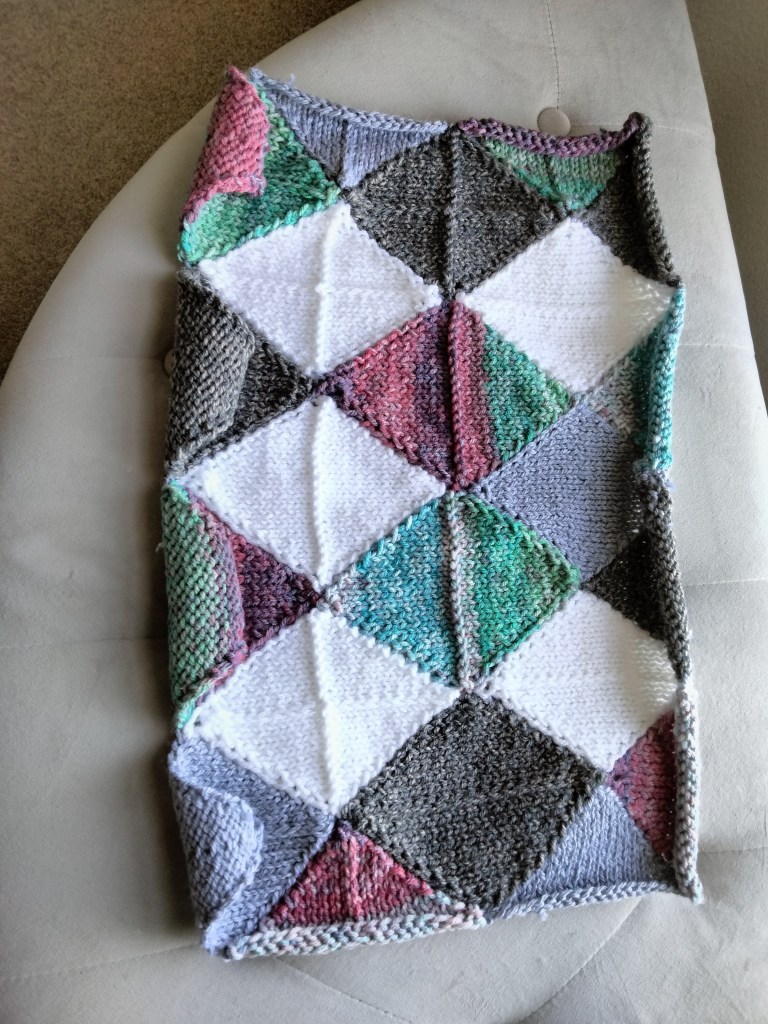
I heard my baby niece was going to receive a baby doll (and really, who loves babies more than babies?) and that I could make a blanket for same. I had some yarns in my stash that would look pretty together, so I started making diamond shapes and grafting them together using the ladder stitch.

I wanted there to be more visual interest, so I added ridges on some of the diamonds, using a row of garter stitches when horizontal and a column of slipped stitches when vertical. The result was a random windowpane type pattern overlaying the harlequin pattern.

The blanket took longer than I expected, but it was a big hit.

A Roundup of Atlantis Theories

Photo by Pixabay on Pexels.com

Too many Atlantises. An embarrassment of Atlantises. One Atlantis, two Atlantis, red Atlantis, blue Atlantis …

Atlantis is Now Off the Coast of Cuba

This article describes an intact granite city, with pyramids, discovered off the West coast of Cuba, about 2,000 feet down, in December of 2001. As our old friend KFM, of Bad Archaeology, points out, the city would be unlikely to survive intact like this if it actually dropped dramatically from what is now sea level, as Plato seems to describe. The article points out that there is another city, the Yonaguni Monument, off the coast of Japan, and Graham Hancock in his book, Underworld, points out that there are submerged megalithic cities in many places around the world, including off the coast of India. (Hancock has cycled through seriously advancing a number of different Atlantis theories, so he will be sort of the workhorse of this post.)

It seems to me that the city off the coast of Cuba is part of a worldwide phenomenon where sea levels were once much lower. We can include in this phenomenon Doggerland (which will make another appearance later in this post), and the land bridges known to have once connected Asia to the Americas and the Indonesian islands to the mainland.

If you are an old-earth believer and have to juggle millions of years, multiple cooling and warming periods, slow but somehow effective continental drift, and some confusing archeological indications that humans were perhaps around well before they should have been … good luck. As someone who believes that the history of the earth is measured in thousands or tens of thousands, but not millions or billions of years, my guess is that this period of low sea levels plus advanced civilization came right after the Great Flood.

You would have a much colder, rainier climate as the earth adjusted to the recent cataclysm (about this more in a minute). You would have had frequent snow and rain storms, with all this precipitation getting frozen in the rapidly forming ice sheets, causing Earth’s water supply to be greatly reduced. Meanwhile, you would have Noah’s children and grandchildren branching out as quickly as possible, building megalithic cities wherever they went, still remembering the techniques and technology (and possibly still assisted by the giants and gods) that they had seen pre-Flood. This period of low sea levels would have had to last long enough for people to disperse and to build, but it need not have been very long. It could have a been a matter of a few hundred to a thousand years. As the climate stabilized, you would have had floods covering settlements and civilizations in different parts of the world. This, I believe, is the reason we have an embarrassment of Atlantises.

There have also been assertions that the reason for the Bermuda Triangle phenomenon is that Atlantis lies underneath it. (Note that the west coast of Cuba is outside of the Bermuda Triangle.) This theory certainly appeals to those who are interested in the potential paranormal effects of the lost city, but I do not know of any actual submerged city found in the Bermuda Triangle area. (If you do, please enlighten me in the comments. I’m always looking for another Atlantis to add to my collection.) This article discusses how ocean-floor mapping technology can create lines that look like city streets.

Atlantis as Antarctica

Graham Hancock makes the case for this in his book Fingerprints of the Gods. He posits that the evidence points to an ancient, advanced civilization which was destroyed by a cataclysm, and asserts that the refugees from it seeded their scientific knowledge, in code form, by creating new religious cults all around the world that featured certain sacred numbers.

If you’ve been reading Out of Babel for a while, you know my assessment of all of this is that it’s right, but not in the way that Hancock thinks it is. Among other things, his scientific materialism and evolutionary beliefs make it impossible for him to imagine that people groups like the Maya, for example, would have come up with advanced mathematics on their own, so he needs to posit a more “advanced” civilization bringing these things from without.

Anyway. For his advanced ancient civilization, Hancock realizes he needs a continent-sized homeland (because, again, his evolutionary beliefs about man require that such a civilization develop gradually, over millennia, from hunter-gatherers to farmers and so on). Antarctica is a good candidate because it’s an entire continent; there is some evidence that it was mapped before it was quite so covered in ice; its general pre-ice outline corresponds roughly to Plato’s description of Atlantis; and there is a theory available for how it could have gone from being in a temperate part of the Atlantic, to being at the South Pole, in a relatively short amount of time. Hancock calls this “earth crust slippage” and posits that it happened about 20,000 B.C.

Now for the version I find more plausible: Creation scientist Dr. Kurt Wise presents his team’s model for “continental sprint” in this video. I find Dr. Wise’s model persuasive as a model of the Great Flood, and as we will discuss, it could explain the Atlantis legend wherever in the world Atlantis proves to have been. However, even if you buy into “continental sprint,” it does not follow that Plato was describing Antarctica when he wrote about Atlantis. If all the land on the earth were breaking up, the ultimate fate of that portion that later became Antarctica would seem like a minor detail.

Atlantis as North America

This one was put forward by Graham Hancock, after he abandoned his Antarctica theory, in his book America Before, a review of which I react to here. Although weak, the theory relies on the fact that there are large structures, either megalithic or earthworks, which align to different astronomical features and/or function as observatories, all around the world, including in North America. For example, the pyramid complex at Teotihuacan appears to be a model of the solar system; the Giza Plateau appears to be a model of Orion, and Serpent Mound in Ohio, which sites towards the sunrise at solstices, may be according to Hancock a model of the constellation Draco.

All that to say, anywhere you can find a large astronomical structure, you can make a case for Atlantis, and Hancock has made that case for North America.

Atlantis as the Cyclades Plateau in the Aegean

This article, which I posted last summer, asserts that Plato’s descriptions of Atlantis are admirably matched by the Cyclades Plateau (now the Cyclades islands), which would have existed when sea levels were 400 feet lower than they are now. The Cyclades Plateau is a rather large formation right in the middle of the Aegean. (If we consider that lower sea levels would have also expanded the coastlines of the rest of Greece, then it would have been even closer to the mainland.) This is an attractive theory in terms of its being what Plato was actually talking about (since he makes Atlantis contemporary with Athens), but it does depend upon this:

Recently, a four year study that included a thorough analysis of Plato’s work established that serious errors by early translators allowed for the mixed messages in the translated document.

Atlantis as Part of Doggerland

Yet another underwater location that used to be inhabited when sea levels were lower, Doggerland was a vast region that stretched between England, France, Holland, and Scandanavia, and is now the relatively shallow southern part of the North Sea. Archaeological discoveries have handily established that this area was once inhabited, here and here among others. As with other now-submerged human habitations, the reader’s preconceptions will determine how long ago you believe it was inhabited, and for how long.

This article describes an entire book which puts forth a detailed theory Plato was describing Doggerland. Apparently, Atlantis had a large, roughly rectangular plain surrounded by “ditches,” which the author thinks could also be translated “dikes.” He imagines the inhabitants of AtlantiDoggerland using these dikes to keep the sea back from a certain region of Doggerland for a period of time. Without some very expensive underwater archeological expeditions (in a notoriously dangerous sea), there is no way to confirm whether the ruins of a large city lie where this theory would predict. The maps are well worth looking at.

Atlantis as the Richat Structure

The Richat Structure, of the “Eye of the Sahara,” is a large (c. 40 km) formation of concentric rings of stone located in present-day Mauritania. Because of its size and remote location, it is hard to spot except from orbit.

Depending upon how you calculate, the structure matches the recorded dimensions of Atlantis quite well. There are also, of course, explanations about how this structure could have formed geologically. I’m not enough of an expert to assess these, but I am more skeptical of geological explanations than I used to be, now that I’ve seen “mountains” that turned out to be pyramids with insides, and geologists’ attempts to explain how a single fossilized tree could cross-cut millions of years’ worth of sedimentary rock layers. In other words, could go either way.

For the Richat structure to be Atlantis, we have to imagine that it was once nearer to coast and was inundated by a tsunami or something of that nature. This theory actually works fairly well with the geological model that Dr. Kurt Wise presents above. “Continental sprint” would have included many earthquakes and resultant tsunamis. Africa, in the model, does not move as much as the other pieces of Pangea, but it would still have undergone earthquakes and, possibly, some uplift.

On this theory, with his tale of Atlantis Plato somehow retained a memory of a pre-Flood incident (and read Athens back into it?). Below is a video of Pastor Joel Webbon discussing the theory with Brian Suave and Ben Garrett of Haunted Cosmos. They get into local lore around the Richat structure, how this dovetails with Greek legends about Atlantis, and how this all could have been plausible in a pre-Flood world haunted by gods and nephilim.

Conclusion

When I first started composing this post, I thought I was going to come out in support of the Richat Structure. Now, I just don’t know. The Haunted Cosmos guys make it sound very plausible, but a few of the other candidates are also plausible (some less so). There does not seem to be any way to “find” Atlantis without sacrificing at least some of what Plato has to say about it. (For example, Athens existed before the Flood? Before there was a Europe?) This makes it really difficult to favor any one theory (although we can probably discard others). What is clear, is that the prehistoric world had many sophisticated cities, lots of things built with megaliths, pyramids on almost every continent, and that there was a period when many human settlements were submerged as sea levels rose. The details are a matter of speculation, of the kind suitable for someone writing a novel.

The Breakaway by Jennifer Weiner

Snarky review, cross-posted at GoodReads, incoming!

This is a Message book.

Abortion is good. It doesn’t kill a baby. The baby is not a baby. Or, it is, but if you abort it, its soul goes back to heaven and comes back to you in the next child you have. (Yes, really.)

No one should force a 15-year-old to have a baby. People who help the 15-year-old sneak behind her mom’s back to get an abortion are heroes. People at Planned Parenthood are super nice, professional, and caring, and never put pressure on the 15-year-olds or rush them through. The abortion process itself is super safe.

Blue states good, red states bad. Ohio is a red state. (Actually, it’s purple.) Pastor from red state is, of course, a televangelist and the only reason he preaches against abortion is because he doesn’t sufficiently love his daughter.

Also … we shouldn’t stop sleeping around if we want to. If you are 33 and don’t want kids yet, you can “just freeze your eggs.” Look, here are two elderly couples who have been spouse-sharing for 30 years and it hasn’t wrecked their friendships and no one has gotten jealous and they’re perfectly happy!

This other guy is extremely promiscuous, but that’s only a problem because it’s part of toxic masculinity, and he isn’t being self-reflective enough. This habit in no way damages his ability to want just one woman and be faithful to her when he decides to do so. He also doesn’t have an STD.

Jennifer Weiner always writes spunky, usually plus-sized female heroines who realize they have been wrong about the thinner woman they judged, whether it was their mom or their college roommate or their sister. This might lead you to think her books are cozy or relatable. Or that they actually contain life wisdom of some kind. In fact, they’re extremely radical.

And, when the heroine starts healing and growing as a person, here’s what it sounds like:


She couldn’t stop herself from thinking about him, but she didn’t let herself call or text. For the first month, she crossed each day off her calendar, getting through them hour by hour. She started a gratitude journal and a skin-care routine.

ibid, p. 372

I mean, this is just sad.

I’m giving this three stars because, as always with Weiner, the writing is really good and compulsively readable. I stuck around and finished the book for the romance. Actually, the fact that Weiner’s writing and characterization are so good make this book that much more of a menace. If you read without paying attention, you could come out of this thinking that abortion, spouse sharing, and freezing your eggs are No Big Deal, and that by getting girls secret abortions and starting a gratitude journal you can save your own soul.

Semi-Relatable Rant of the Week

Perhaps no man has ever troubled to imagine how strange his life would appear to himself if it were unrelentingly assessed in terms of his maleness … if he were compelled to regard himself, not as a member of society, but as a virile member of society. … His newspaper would assist him with a “Men’s Corner,” telling him how, by the expenditure of a good deal of money and a couple of hours a day, he could attract the girls and retain his wife’s affection … He would be edified by solemn discussions about “Should Men Serve in Drapery Establishments?” and acrimonious ones about “Tea-Drinking Men”; and by irritable correspondence about men who expose their anatomy on beaches (so masculine of them), conceal it in dressing-gowns (too feminine of them), think about nothing but women, pretend an unnatural indifference to women, exploit their sex to get jobs, lower the tone of the office by their sexless appearance, and generally fail to please a public opinion which demands the incompatible.

Dorothy Sayers, Are Women Human?, 1938

Heh heh heh. Oh my. I have a number of thoughts about this.

Some of this seems to me to reflect a society that was, for the first time, dealing with a big influx of women into the public workplace, and did not quite know how to handle the new workplace dynamics this created. This was a problem unique to Sayers’ age. Now, we tend to fall into the other ditch, insisting that men and women are exactly the same and should be treated as completely interchangeable, which does not prepare us well for those many ways in which we aren’t.

But part of this rant, particularly the part about how women can’t seem to wear anything without attracting criticism from some quarter, remains relevant, because it is an outworking of a human universal, to wit: a grown woman stands out, in public, in a way that a man doesn’t.

It took me an embarrassingly long time to figure this out, so I would go around doing what I thought of as “normal person” activities, not realizing that when I, a woman, did them, it came off looking as if I was (at best) trying to attract attention.

I also could not wear “normal person” clothes.

Deborah Tannen has pointed out that there is no “neutral” outfit for a woman. Whatever she chooses to wear will be seen as a choice, and an image she is trying to cast.

It’s easy to be annoyed this by (Dorothy Sayers was!), but as I put more thought into this, I realize that we might as well be annoyed by the fact that people notice loud noises or color contrasts, or that they get grumpy when they’re hungry. It’s a fact of life, nobody’s fault, that we all have to work with. Us ladies need to realize that, whatever we do (or, especially, wear), we will stand out, and adjust accordingly.

Thanks to my cute little sister for helping me think through this.

A Retired French Mining CEO and His Theory that Doggerland was Atlantis

Some day, we are going to have to do a long post about Doggerland. Right now is a busy time of year, so I don’t have the time for that at the moment, but long story short, Doggerland has everything.

Doggerland was an area that you probably know as “the bottom of the North Sea.” Apparently, there is a shallow area there, with evidence that when sea levels were lower, it was once not only exposed but inhabited. This vast area of land would have joined England and Ireland to what is now Holland and Denmark. The proximity to Holland, plus the theory that Doggerland is the setting for The Lord of the Rings, are what I mean when I say this place has everything.

For now, let’s put a pin in this article. Jean Deruelle, the French guy with the theory, has detailed ideas about exactly what the inhabitants of Doggerland got up to. He assumes (reasonably, I think) that they were part of the Old European megalithic culture. The article also includes lots of cool speculative maps of Doggerland in various stages of submersion by the sea. We can argue about the exact timing of it all, later.