
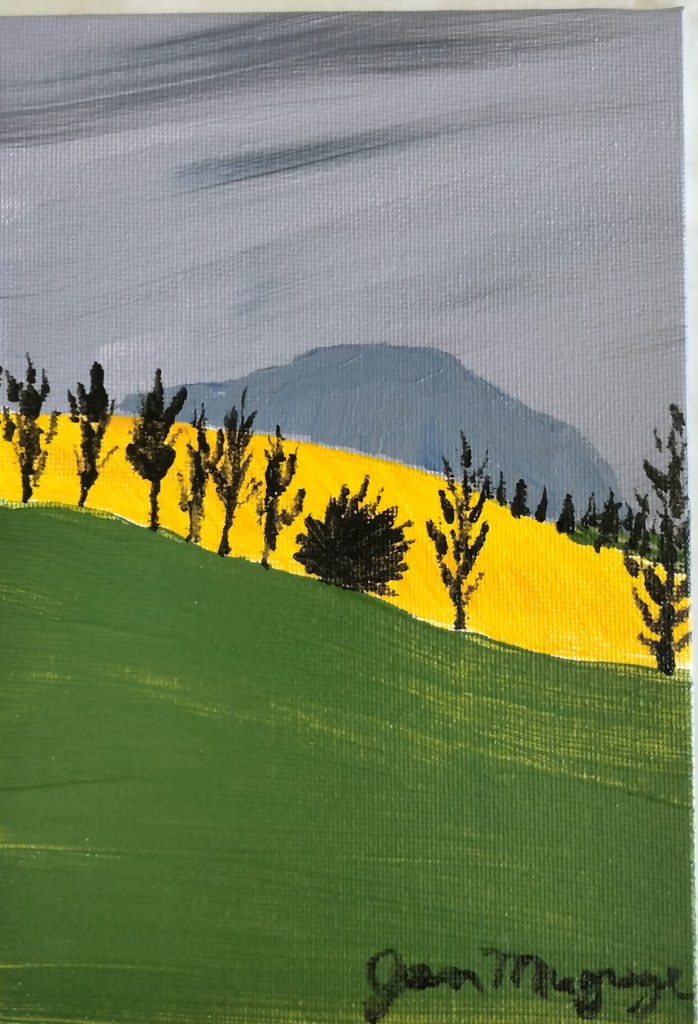
Off-the-Grid August Starts Now
I won’t actually be living away from electricity. I just a need a moment to catch my breath.
Review of Breath

Five stars. Would keep breathing.
Just kidding.
My sister gave me this book. I don’t know how she knew it, but I’m a horrible mouth-breather. I also have a habit of holding my breath when: in pain, concentrating, doing a delicate task, listening to someone talk. (I exhale when they finish the sentence. So don’t pause.) Turns out, breath-holding throughout the day might be causing a lot of people chronic anxiety and also causing them to “overbreathe.” Since reading, I’ve been at work to change my ways.
It’s rather shocking to realize the extent to which breathing through the nose affects nearly all other aspects of our health, even aspects that you wouldn’t expect, such as biochemistry and bone structure. But on reflection, it makes sense. We were designed to nose breathe; there is a reason for the way the air is routed through our sinuses; there is even a reason we have two nostrils. (Did you know that air taken in through the right nostril has a different effect than the left … and that your nostrils naturally tag-team throughout the day? Wild!) It makes sense that the more restricted supply of air coming in through our nose compared to our mouth is not only adequate but optimal, even though it doesn’t feel that way for recovering mouth-breathers.
It also makes sense that we were designed spend many hours a day chewing on tough foods (fruit, nuts, wild game), and that this regular daily workout of our jaw muscles would result in wider facial bones, flatter palates, and wider nose-breathing passages. It also explains why so many people in the modern age have crooked teeth: it’s not bad genetic design, it’s that we aren’t chewing enough and our face bones are literally atrophying, making our mouths too narrow. So those cave people who didn’t have orthodontists, also didn’t need them. (Shoutout to my characters! Keep eating game, guys!)
Ahem. Back to the book …
You have to watch out for the usual non sequiters that we have come to expect from Darwinian materialists. Almost any place that Nestor writes, “We evolved to …”, you can safely substitute, “We were designed to …” and come up with the same conclusion. There are a few long paragraphs about how “early life” was anaerobic and how “we” started using oxygen in “our” metabolizing. I skipped those; you can read them if you want to find out how bacteria do things differently from human beings.
Then there is the section on prayer, which finds that the repetitive prayers from all around the world get their practitioners breathing at the ideal rate for humans, which to Nestor’s mind can account for all the health, mind clarity, and relaxation benefits of prayer. (I have long been aware that my breathing changes when I pray – even silently – but this is not to say that there is nothing else going on during prayer or meditation, or that it matters not to whom or to what you pray.)
As someone who doesn’t believe that the spiritual world is a thing, Nestor is free to try – and qualifiedly endorse – all the yoga practices that, he says, are merely applied medical knowledge about breathing and posture. They certainly include some of that, but yoga is also a serious attempt to commune with spiritual entities, and we ignore that at our peril.
There is a helpful appendix that catalogs all the breathing techniques Nestor encountered on his ten-year journey. My big takeaway: breathe through your nose. Tape your mouth shut at night if you have to. Breathe a little slower … you won’t choke. Exhale completely before inhaling. See how many health and emotional problems that clears up for you. I’ll check back in and let you guys know whether I lost any weight.
Misanthropic Quote of the Week from P.D. James
He knew even better than she did that you could never predict, any more than you could completely understand, what human beings were capable of. Before an overwhelming temptation everything went down, all the moral and legal sanctions, the privileged education, even religious belief. The act of murder could surprise even the murderer. She had seen, in the faces of men and women, astonishment at what they had done.
The Murder Room, by P.D. James, p. 219
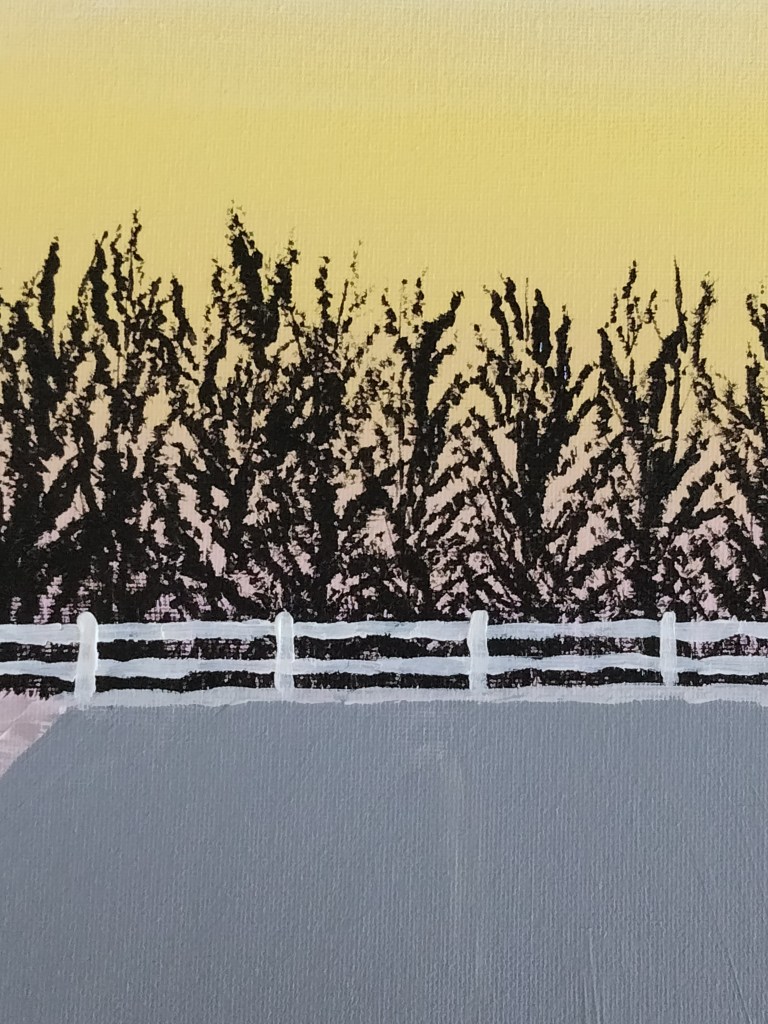

Welcome to my Art Show
I call it, “The Many Moods of Big Southern Butte.”
These are all 12×12 paintings, and they will all be for sale at American Falls Days in early August.


These two sunset ones are already claimed.


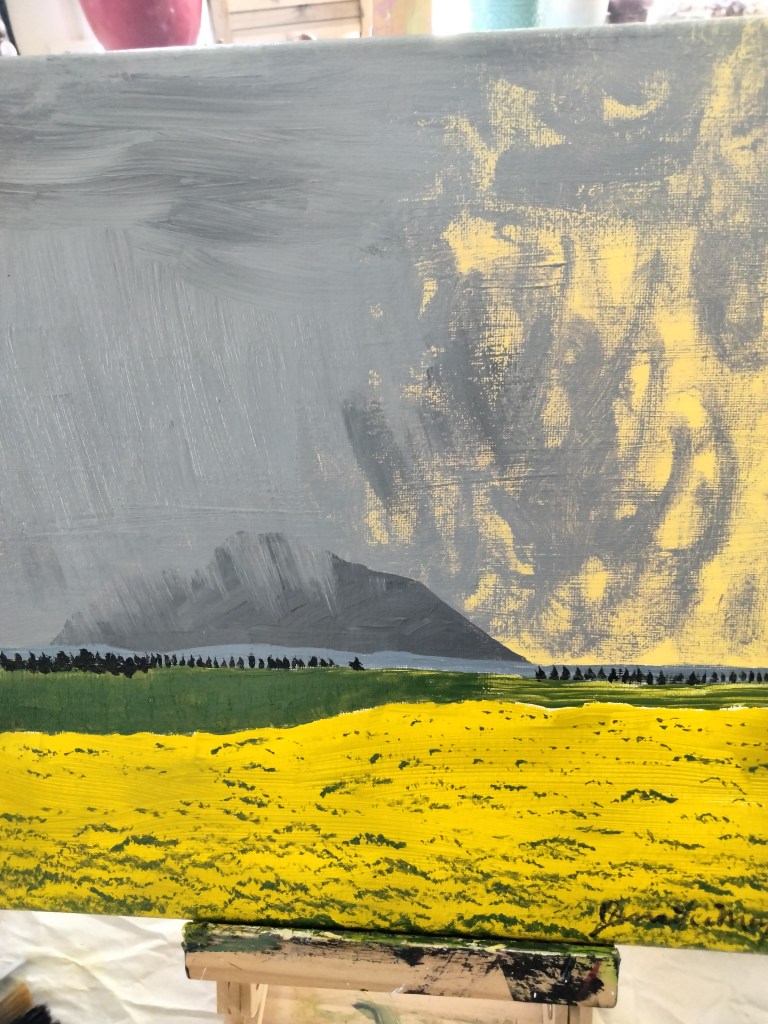
Plus, a bonus farm painting…

“He’s learnt better”
[Tally needs to pick up her young handman, Ryan, who might be in trouble. She is giving him directions on the phone.]
“There’s a church, Ryan, All Saints, Margaret Street. Walk up Great Portland Street towards the BBC and Margaret Street is on the right. You can sit quietly in the church until I come. No one will worry or interfere with you. Or you can kneel. No one will speak to you then.”
“Like I’m praying? God’ll strike me dead!”
“Of course He won’t, Ryan. He doesn’t do things like that.”
“He does! Terry — my mum’s last bloke — he told me. It’s in the Bible.”
“Well He doesn’t do things like that now.”
Oh dear, she thought. I’ve made it sound as if He’s learnt better.
The Murder Room, by P.D. James, pp. 237 – 238
Best Rhyme of the Summer
There’s just some things that leave a man no choice
Like a compass needle needin’ its true No-o-orth
some country song
I didn’t know that choice rhymed with North, did you?
But they do! Once you have heard them in this song, you cannot deny that they do!
And those words will rhyme for you forever after.
This is my favorite kind of rhyme — unexpected, gutsy even, but once you hear it, it clicks into place and feels so natural.
Here’s my professional, I-used-to-be-a-linguist analysis of why choice and North do, in fact, rhyme.
Both have an /o/ followed by a sound that narrows the vocal cavity but doesn’t stop the air (/i/ or /r/, which is a liquid), followed by a voiceless fricative articulated near the front of the mouth (/s/, or theta).
In case you are wondering, the country song in question is Love You Anyway by Luke Combs, which is in the subgenre of Self-Pity (Male Singer).
The Adventures of Jane Wayne

Jane Wayne, the sole survivor of the Great Chicken Massacre of 2023, did not appear outwardly traumatized. She hung out in the cool darkness under the lilac bushes just as she used to do when her sisters were alive, taking a dust bath and watching the humans dash around cleaning up blood and feathers. She remained in the yard all day, making periodic forays to her usual haunts, scratching in the pile of grass clippings, hiding under the camper. But when night fell and it was time to put Jane in the coop (and make it secure this time!), she suddenly was nowhere to be found.
My son and I wandered all around looking for her: first our yard, then the farm and machine yard, then as far as the bridge over the irrigation canal. Our hearts were sinking. We figured that the predator had probably returned and dragged Jane off as well. We were still raw from the massacre, but had been taking comfort in the fact that we still had one chicken to care for. Now, with heavy hearts and against the background of a brilliant red Idaho sunset, we trudged home.
The next morning, clinging to some faint hope, we wandered to the back to see whether Jane had reappeared. And there she was! Roosting in the upper branches of the lilac bush by the wood pile! Jane had apparently spent the night in the bush. This is normal wild chicken behavior. We are not sure whether Jane found the coop too full of distressing memories, or whether, without the crowd to remind her, she has forgotten that her normal routine is to go into the coop at night and rest on its upper rafters. (Another theory is that she had already been spending the night in the lilac bushes, and this is what enabled her to survive the massacre. This theory is disfavored, because we would usually do a visual check that the Barred Rocks were in the coop, and there were always four black butts faintly visible, perched up in the peak of the structure.)
Since her newly acquired status as Only Chicken, Jane has continued retiring to the lilacs on a nightly basis. Ordinarily, the humans will pluck her down from there, put her in the coop, and close the doors. (The small human is particularly good at this.) We want her to get used to spending the night in the coop, so that she will lay eggs there when she starts laying, and as an example to the next batch of chickens we already plan to buy. Once or twice, she has evaded us of an evening. There was a second vanishing, and a second despairing walk to the bridge and back along the canal. She may have a hiding place that we still haven’t discovered. Jane has unexpected depths. But so far, she can still be counted on to show up when a human emerges from the house bearing something tempting, like yoghurt.
Misanthropic Quote of the Week from Garrison Keillor
In the Sanctified Brethren church, a tiny fundamentalist bunch who we were in, there was a spirit of self-righteous pissery and B.S.ification among certain elders that defied peacemaking. They were given to disputing small points of doctrine that to them seemed the very fulcrum of the faith. We were cursed with a surplus of scholars and a deficit of peacemakers, and so we tended to be divisive and split into factions. One dispute when I was a boy had to do with the question of hospitality towards those in error, whether kindness shown to one who holds false doctrine implicates you in his wrongdoing.
Uncle Al had family and friends on both sides of the so-called Cup of Cold Water debate, and it broke his heart.
Leaving Home, Garrison Keillor, p. 155
Good thing this never happens outside of tiny fundamentalist Christian churches.
 Out of Babel Books