Now that I no longer have to get up early to teach, I like to sleep in a little bit in the mornings. In the summertime, this means that I am getting up well after it is light outside.
I didn’t want the chickens to be trapped in their tiny run for two hours between 6 and 8 when I finally got out there.
I thought they would be overcrowded and start pecking each other.
So I left the door to the run open, allowing them to let themselves out in the morning.
*deep sigh*
That worked great for a few weeks. Then, disaster struck! A raccoon, a raider, a being of violence, came in the dark of the night, in the wee hours of the morning, probably around 5 a.m. He slaughtered my poor girls in their beds. I feel the worst about my three sweet silky bantams. Their heads were bitten off literally in the coop where they sleep. They were the only ones who had started laying, and who would crouch down when they saw a human, in case the human wanted to pick them up.
The Barred Rocks put up a fight. One, either Ginny Cash or Andrea, was dragged away without a trace (possibly she had been taken the day before). Another was found, partially eaten, near the lilac bushes.
But the rooster — ah, the rooster. Meriadoc Brandybuck. He seems to have fought the predator. His carcass was found, mostly eaten, in the small tunnel-like pass-through between house and garage. Damp raccoon tracks led away from it towards the front of the house. And … still alive, hiding under the lilac bushes, was the smallest of the Barred Rocks, Jane Wayne.
We don’t know, but we imagine that he gave his life for her. “You go! I’ll hold him off!” he cried, dashing into the gap while Jane, clucking and shedding feathers, fled. Merry, as we call him, had previously shown signs of behaving like a rooster in the sense of pushing the hens around a bit and being selfish about the food, but he had never yet displayed any protective behavior. But in the darkest hour, Meriadoc rose to the occasion – so we imagine – and showed his quality: the very best.
Tears were shed. Carcasses were gathered up. Blood was cleaned from the inside of the coop, which looked like a crime scene, which in fact it was. Certain members of the family wanted to give the chickens a “Viking” funeral, where we would put them on a small, flammable boat, push it out into the irrigation canal, and then shoot an arrow (this step was unclear) to set the boat on fire. This was felt to be impractical, so we settled for a pyre in the burn barrel that involved firewood and a little bit of gasoline. A funeral was held. Prayers were said. The brave deeds of Meriadoc were recited (this is how stories help us make sense of tragedy). We also recalled the endearing little habits of the dead, particularly Jasmine, the black bantam silky, who was our sweetest, the most reliable layer, and will always remain “the bestest of chaekens.”
And, lesson learned. Just because a predator hasn’t come so far, does not mean that one never will. I will make the coop more secure, and will lock it in the future.
I’m a Luddite, all right. A really, really bad one.
Fun story about how I discovered this book: I was at a Fantasy Faire as a vendor. A fantasy faire is sort of a like a RenFaire, but calling it “fantasy” opens it up to more time periods and more imaginative costumes. This Faire took place in southeast Idaho, so quite a few of the booths were from Utah. As I wandered the booths on the first morning, a banner on one of them caught my eye: “Strangely uplifting LDS horror.” In case you don’t know, LDS stands for Latter-Day Saints, which is the more respectful term for Mormon and what the Mormons usually call themselves. I am not Mormon, but I could not help but be intrigued by this advertising phrase. Horror, written by someone from a community that is mostly known for wanting to keep everything in life PG if not G? That’s going to be some interesting horror. Also, I do like my horror uplifting.
So, long story short, I missed meeting the author, but I bought the book. He has a lot of others, but I went for this one because it was a stand-alone.
The LDS horror did not disappoint. The opening scene takes place at fantasy convention, very similar to the event I was at when I started reading. (Nice.) The main character is LDS, and she is a tall, big-boned, plain-faced 30-year-old woman who has a secret crush on her handsome, also LDS, coworker. In short, a very relatable female lead. Being a lonely, not conventionally attractive 30-year-old woman is tough for everyone, but it’s even worse in the LDS community where there is so much emphasis on marriage.
So, the contemporary main characters are Peggy, whom you met above, and Derek, her crush, who is happy to go to conventions and watch fantasy and sci-fi movies with Peggy, but doesn’t like her “that way” and does not see her worth.
But very soon, we get into the spooky stuff. This is not exactly a time-traveling book, but it has characters who move through time by spending decades in a state of suspended animation brought about by eating an apple-like fruit from a magical tree. So, the mysterious, princess-like young woman on whom Derek gets a hopeless crush really is a woman from millennia ago who doesn’t quite know how to function in the modern world because she has been skipping through time.
I don’t want to give more spoilers than that, but let me just say that the research on this book impressed the heck out of me. The author has taken a deep dive into Celtic mythology, Arthurian legends, British/Roman history, and fairy tales, and he ties it all together. Although the main characters do not travel back in time, the story takes jaunts into the past to reveal to us the sleeping princess’s back story. We see how she gave rise to the “sleeping maiden” fairy tales like Sleeping Beauty and Snow White, but what actually happened was … much creepier. These reveals are tantalizingly done. They are not info dumps, and the whole story is not revealed until the very end.
This author takes a unique approach to paganism, one that I really appreciate. As a Mormon (which he understands to be a version of Christianity), Belt does not endorse the ancient Celtic religion and he doesn’t whitewash it either. He is perfectly willing to portray the darkness and terror and human sacrifice that come with Cernunnos and Morrigan. This is very different from most modern fictional treatments of Celtic paganism, which tend to portray the pagans as harmless, live-and-let-live, nature-loving types whose religion has no down side. However, although Belt mines paganism for horror, he passes the “love test” (the author must love the culture he’s writing about). He writes about the ancient pagans with sympathy and seems to understand their point of view. They are real human beings to him, and their gods are real entities.
And that’s why this horror is “strangely uplifting.” Unlike some horror writers I could name (ahem Stephen King), there are actually good, admirable characters in this book alongside the horror.
If you like fairy tale re-tellings, Arthurian legends, Celtic paganism, or modern-day horror, you might like this book. If you like all four, this book is definitely for you!
The sky was turning dark with clouds as they drove north. She put her foot on the brake and veered left onto the turnoff toward Lake Wobegone. The turnoff is just before a sharp bend in the highway and when you brake for the turn, you think of the speeding truck that might leap from the bend and roll you flat as a pancake. This turn might be your last. You brake and at the last moment you hit the gas and swerve left, as if crossing a forbidden border. Where the county road leaves the highway, there’s a dip in the road and a bump that lets you know you’re back in the land of where you come from. You hit the bump and see George Washington’s face on the schoolroom wall and hear the Nicene Creed, “I believe in one God the Father Almighty, Maker of heaven and earth, and of all things visible and invisible,” and smell tunafish casserole.
Some late Spring evenings really do look like this, from our house, looking north.
This is a view of Big Southern Butte at the moment long after sunset when the entire sky is pink and the ground is mostly too dark to see, other than that it is dark green.
Behind Big Southern Butte, you can see the beginnings of the Pioneer Mountains.
I did this quickly, using blocks of color, similar to my farm painting last year. That one portrayed a wheat field just beginning to turn yellow; this field is much younger, still green.
Wow. This was devastating. It shows exactly how, not only the weird Christian subculture created by Bill Gothard, but the patriarchy and Christianity itself, which supports it, create an environment where sexual abuse and cover-ups are rampant.
Just kidding. That’s what the media desperately wanted this book to say. And because it doesn’t, that’s why they are going to call this book just another cover-up. In a moment, I’ll address the claims in the paragraph above. But first, what is this book actually?
A Memoir and A False Teacher
I would say the book has two goals. One, it’s a memoir. Two, it tackles head-on the false teaching offered by Bill Gothard’s Institute in Basic Life Principles, and distinguishes it from the true Gospel. These two purposes are woven together in a very natural way in this book.
In case you didn’t know, Jinger was one of the Duggar family. They were a Christian family who, partly because of the teachings of Bill Gothard, came to the conviction that it is wrong to use birth control of any kind. Now, some families who make this decision only end up with a few children. But the Duggars ended up having nineteen. Later, they were approached about making their family the subject of a reality show, and after praying about it, decided to do it. They did not expect that the show would continue for ten years. Part of their rationale for agreeing to do the show was that they believed their family could be an example to the watching world of how following Gothard’s teachings leads to happiness.
Unfortunately, Gothard was, in retrospect, an obvious false teacher.
In the late 1960s, Gothard started teaching his seminars at churches, Christian schools, camps, and youth programs around the country. His timing could not have been better. For Bible-believing Christians, [the 1960s] were a scary, uncertain time. Parents feared losing their children to sex, drugs, and rock and roll. Bill Gothard offered parents confidence. In his lectures, he claimed that he had discovered the key to a successful Christian life. According to Gothard, to enjoy God’s blessing, a Christian should closely follow the seven principles he laid out in his seminars.
ibid, p. 26
Right away, Gothard displays several marks of a false teacher. The number one red flag is that he made himself indispensable to living the Christian life. He would find secret principles in the Bible that no one else had, and would identify unintentional sins that a person could commit that could wreck their entire life. Like a classic cult leader, he created fear in his followers (in this case, fear of accidentally displeasing God, which could lead to any number of bad consequences including death). Then, he offered himself as the solution to that fear. In other words, he was trying to take the place of Christ, the Bible, and the Holy Spirit.
I shouldn’t need to point this out, but Gothard was teaching what the Apostle Paul would have called “a different gospel.” In this case, it was the hoary old heresy of works righteousness, whereby a person can save themselves simply by following the right rules. Gothard didn’t seem to understand that sin nature is far too powerful to be restrained by rules. Nor did he understand the need for the new birth. It was a new insight to Jinger to realize:
Contrary to what I grew up believing, the ultimate threat to you and me is not the world. Instead, the ultimate threat to me is … me. I need freedom not from the influence of world, not even from a religious system, but from myself. I am born enslaved by my own sin.
ibid, p. 130
(Reformed folks call this idea “total depravity,” and it’s the first of the five theses in the TULIP acronym. Needless to say, Bill Gothard’s teaching was far from Reformed.)
Gothard also didn’t seem to think that God has revealed His plan of salvation clearly in the Bible, implying instead that God was a trickster who hides His will from people. Jinger gives many examples in this book of how Gothard would cherry-pick proof texts to support whatever point he was trying to make, but never taught straight through a long passage of the Bible, following the flow of thought. Finally, Gothard appears to have added a little “health and wealth” heresy to his teaching: follow these rules, and you will be blessed in every way.
Interestingly, Jinger remembers having an overall positive experience as she grew up in the Duggar household. Her parents did actually understand the Gospel and teach it to her, so she got that alongside Gothard’s harmful false teaching. However, Gothard’s false teaching seriously stunted her spiritual growth, causing her to live with an attitude that was simultaneously fearful and Pharisaical. It wasn’t until she met her future husband that she was exposed to better, more solid biblical teaching and was encouraged to study the Bible on her own, looking at what the passages were actually saying, not through the lens of Gothard. She left his false teaching in order to step in to a truer, richer understanding of the Gospel. I think it’s entirely appropriate that she share her story in a memoir that also examines Gothard’s false teachings. Through no choice of her own, as a Duggar she has been made a minor public figure and a representative of Christianity (not to be confused with Gothard’s teachings).
However, not everyone who grew up in a Gothard community was so fortunate. Gothard himself, who never married even though he gave lots of marriage and parenting advice (think that’s a red flag???), for years flirted with and sexually abused young women in his community. And Jinger’s older brother, Josh, became a sexual predator who ended up going to jail for possession of child pornography. As Paul points out about rules like Gothard’s, “Such regulations indeed have an appearance of wisdom, with their self-imposed worship, their false humility, and their harsh treatment of the body, but they lack any value in restraining sensual indulgence.” (Col. 2:23)
However, instead of seeing these sexual sins as an indictment of false teaching like Gothard’s, many people will see them as the natural outcome of Christianity. They will hold Jinger, as it were, responsible for these things unless she also rejects Christ. So, let’s look at the claims in my intro paragraph.
A Series of Theses About Sexual Abuse in the Church
Claim:Sexual abuse in any church, anywhere, proves that Christianity is harmful and false.Reality: By some estimates, 1 in 4 girls and 1 in 6 boys are sexually molested. Some people think this sounds high, but I have found it to be true. Any time I am in a group of three to five women, it invariably comes out that one of them was molested. This is true in all kinds of different contexts. What this tells me is that the human heart is deceitful and desperately wicked. Another lesson: Any group of, say, twenty or more people is going to have a molester in it, whether that group is a public school, a private school, a camp, a church, or yes, a large family. Every institution that involves people and lasts more than a year or two is going to have to deal with a molester. I’m not happy about this, but it is better to face this reality.
Claim: Anything short of immediate jail time is a cover-up.Reality: Sadly, most institutions don’t know what to do with cases of abuse, especially with young offenders. This requires a lot of wisdom, which many leaders don’t have. Some institutions do, indeed, cover things up, and protect and keep moving their offenders. Others don’t do this, but nevertheless don’t handle the situation perfectly (which is very hard to do). Even if there is not an actual cover-up, the victims often feel that there has been, or that they have been blamed (often because the abuser has told them they will be blamed). This, too, is a less than ideal situation. Acknowledging reality #1 would help mitigate this somewhat.
Claim: Sexual abuse is caused by Christianity, because it is sexist, or by the patriarchy, which Christianity supports.Reality: Sexual abuse is caused by the depraved human heart. Not every religion acknowledges that the human heart is “deceitful and desperately wicked.” Christianity does, so Christians at least start out in a better position to tackle this issue. (Note, again, that Gothard’s teaching was subChristian, and did not recognize human depravity or the need for a new birth). Regarding the alleged sexism of Christianity, see Nancy Pearcy’s book Love Thy Body, which points out that the most reliable historical index for the spread of Christianity in the ancient world, was the outlawing of sex slavery. As for “the patriarchy” causing sexual abuse, this is true only if by “the patriarchy” we mean “human sinful nature and a fallen world.” Men are more powerful than women; in a fallen world, men and women are both sinful; therefore, in a fallen world, the powerful sinners tend to exploit the less powerful ones. This the world into which Christ came to redeem it. It is foolish to look only at the exploitation that has happened during Christian history, without looking at the much worse exploitation that happened before Christ came, and still happens in many places that have not been deeply Christianized.
Claim: Christians are in favor of sexual abuse, because they think women are inferior to men.Reality: Give me a break. That is slander.
Claim:Cover-ups are more common in religious institutions, because of concern about looking righteous at all times.Reality: Most human institutions are concerned with looking righteous at all times, and therefore are tempted to engage in cover-ups. This is true whether or not they are overtly religious in the sense of talking about a God or gods. I give you Exhibit A: Loudon County School district.
Claim:Jinger Duggar Vuolo should have written this book denouncing her brother, not telling her own story.Reality: Reader, have you ever been in a workplace, school, church, or family where sexual abuse occurred? Did you therefore condone it? Should you not be allowed to talk about any topic without first mentioning and denouncing that incident?
After a minute or two, while [the two men] stood watching Lombard’s progress [climbing down the cliff on a rope], Blore said:
“Climbs like a cat, doesn’t he?”
There was something odd in his voice.
Dr. Armstrong said:
“I should think he must have done some mountaineering in his time.”
“Maybe.”
There was a silence and then the ex-Inspector said:
“Funny sort of cove altogether. D’you know what I think?”
“What?”
“He’s a wrong ‘un!”
Armstrong said doubtfully:
“In what way?”
Blore grunted. Then he said:
“I don’t know — exactly. But I wouldn’t trust him a yard.”
And Then There Were None, by Agatha Christie, pp. 107 – 108
This is a very tense book. I was planning to dedicate an entire Friday post to it, but being short on time, I’m just using this quote from it on Quote Wednesday.
This bit of dialogue really shows the atmosphere of the book, and how the atmosphere is coming from the theme. In most Christie murder mysteries, there is one murderer among a group of people who are not murderers (even if they are not innocent in other ways). In this book, ten people are trapped together on a small island. None of them knows the others very well, and so they don’t trust each other either. As the book unfolds, it becomes clear that this lack of trust is well founded. Every single guest on the island has committed a murder in the past. They are all capable of killing. As Christie says in her other books, once a murderer has killed, they will do it again. So, any one of them could be “the murderer” who is picking off the guests one by one. In a sense, they are all “the murderer.” They are all a “wrong ‘un.”
I didn’t much enjoy this book the first time I read it, because it so disorienting (one point of the book was to create “an impossible puzzle”). The second time through, I was of course less confused, but I also didn’t enjoy it much because there is no character we can sympathize with. The one who comes closest, Vera, turns out to have been responsible for the death of a child. She, too, is a wrong ‘un.
The third time, this summer, I appreciate that this book is a sort of exaggerated picture of our predicament as human beings. We are trapped in this world (the island) surrounded by people, including ourselves, who are all totally depraved, who are all “wrong ‘uns.”
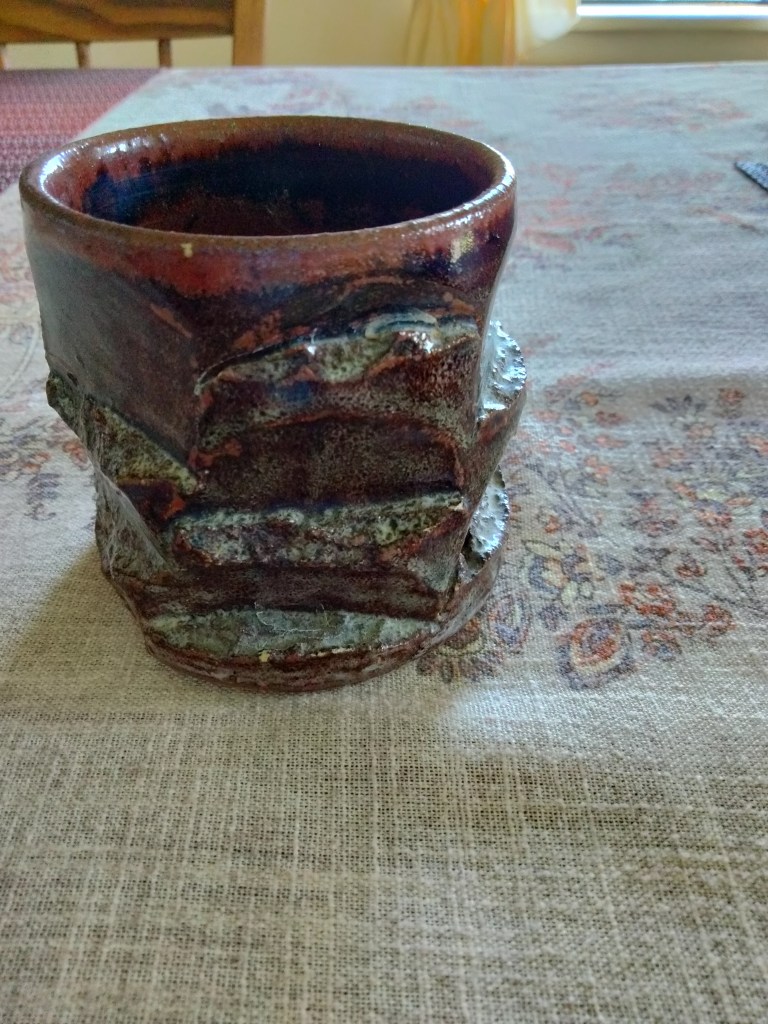
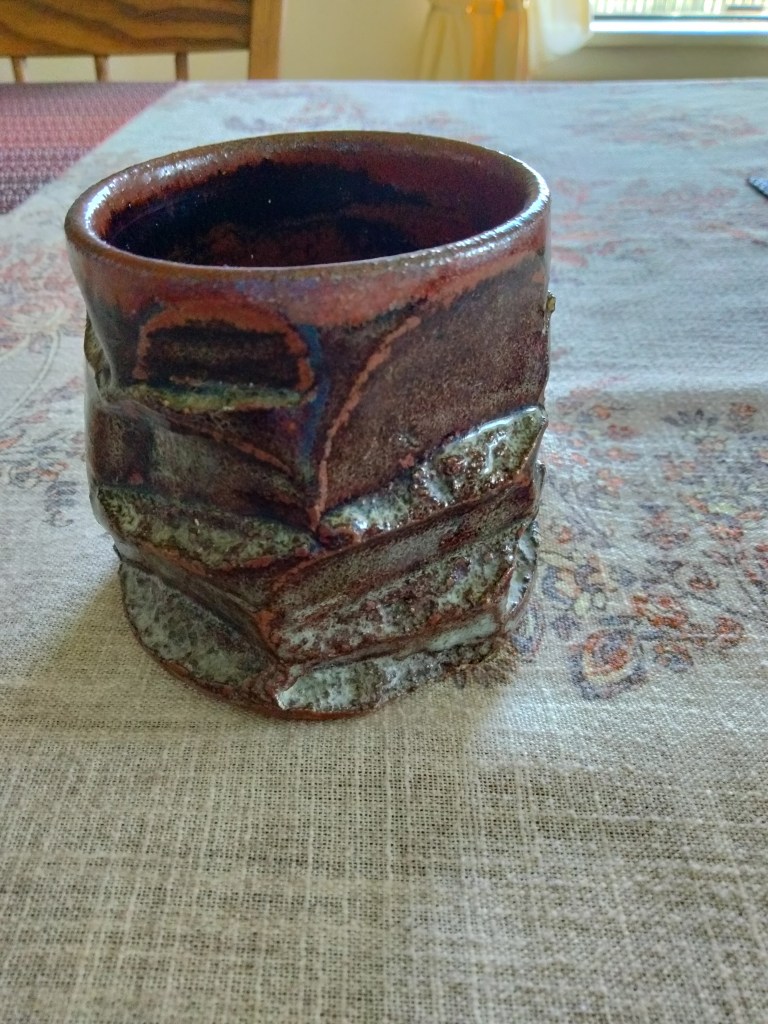
I got this fantastic mug at university. I bought it from a sale the Art Dept students were having. Back then, buying anything at all was a big decision that I had to justify. When my Japanese roommate saw it, she got all excited and said the mug looked Japanese. I probably should have given it to her (sorry, Makiko!), but I didn’t. I am still treasuring it all these years later.
Faithful OOB readers have seen this mug before, in my “I Like Bears” post. I think my husband got it for me during a trip to Yellowstone years ago, then it spent several years in storage, then I re-discovered it, with new appreciation, after our most recent move. I use it now because my book The Strange Land features a Bear of Justice.
This lovely thing was purchased at the Fantasy Faire, from a stonewear booth (advertising slogan: “Get Stoned”). I asked the potter, an older lady, about her process, and she said, “I take some clay. I throw it on the wheel. I make a cup. I glaze it, and then I fire it.”
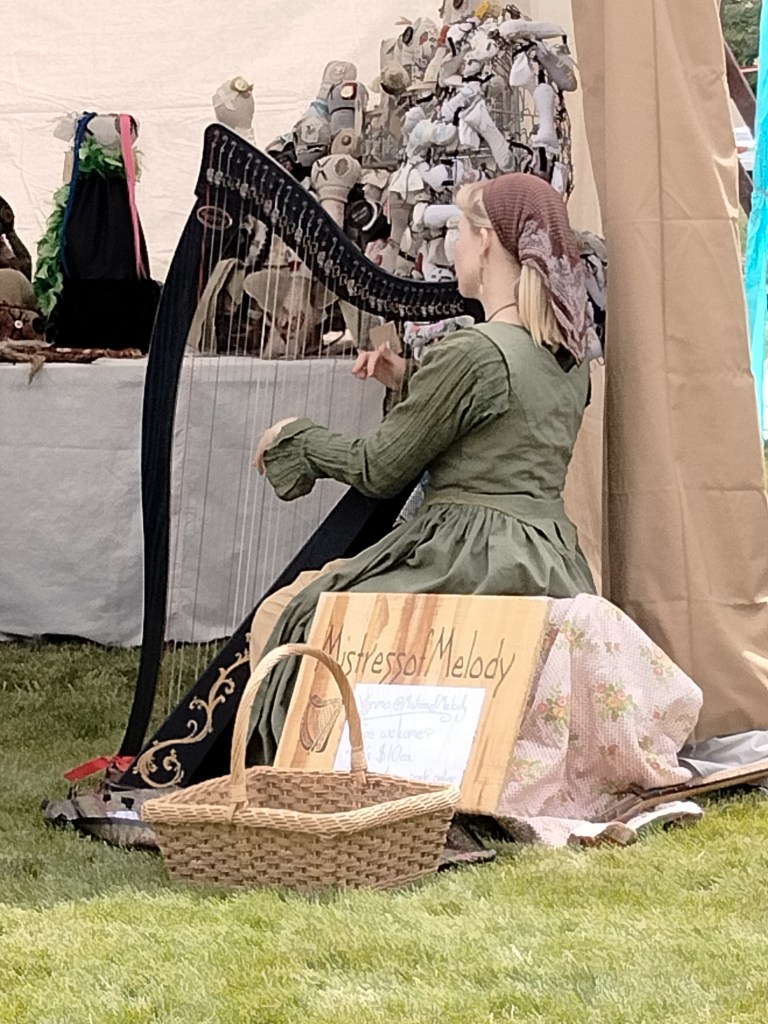
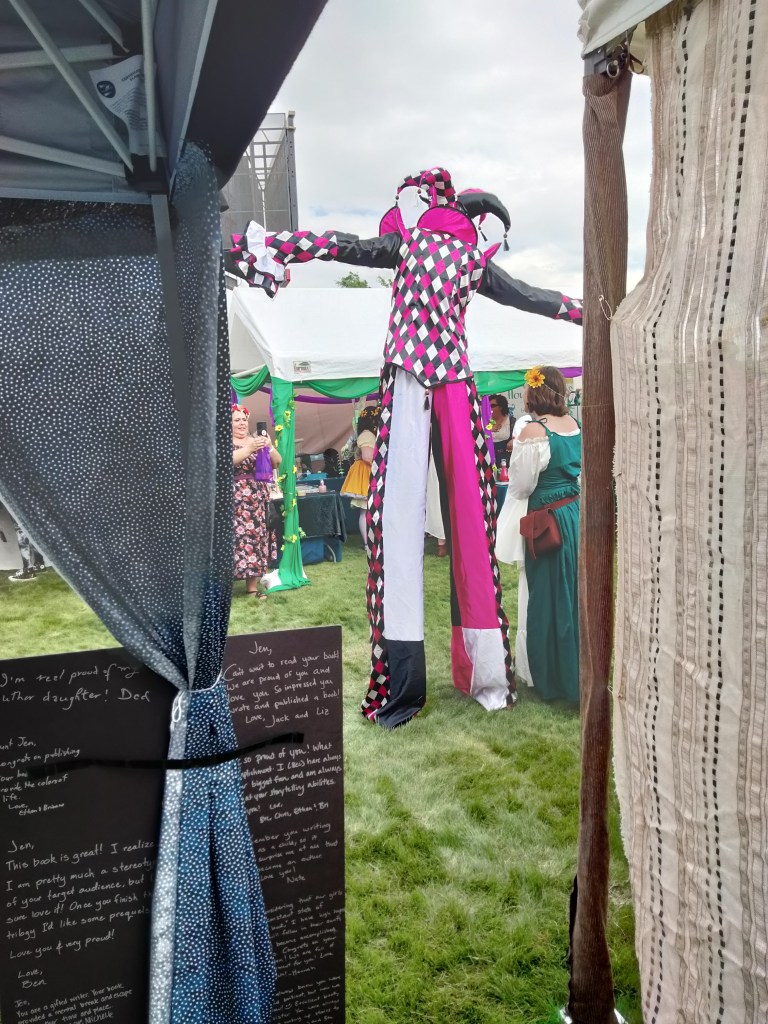
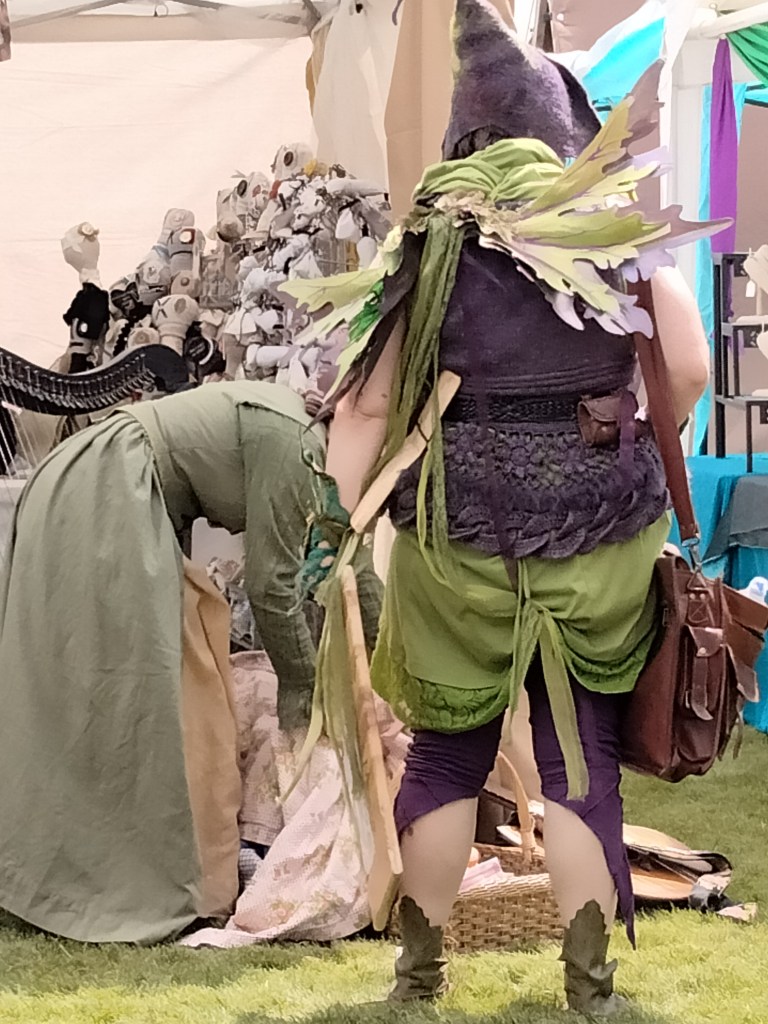
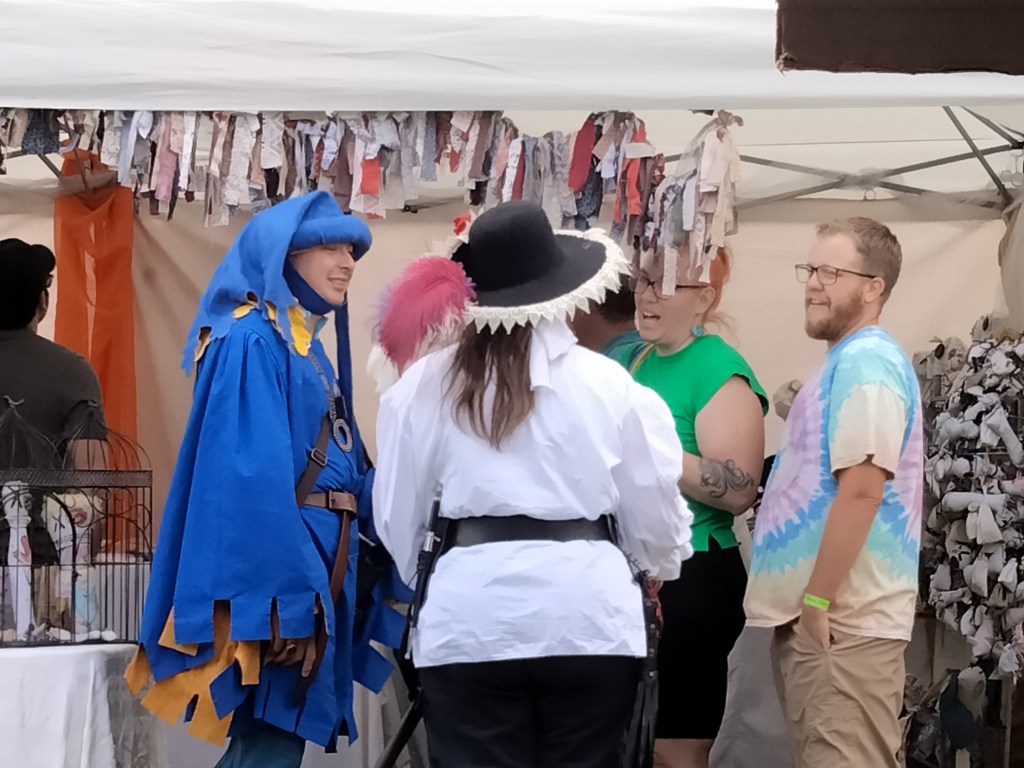
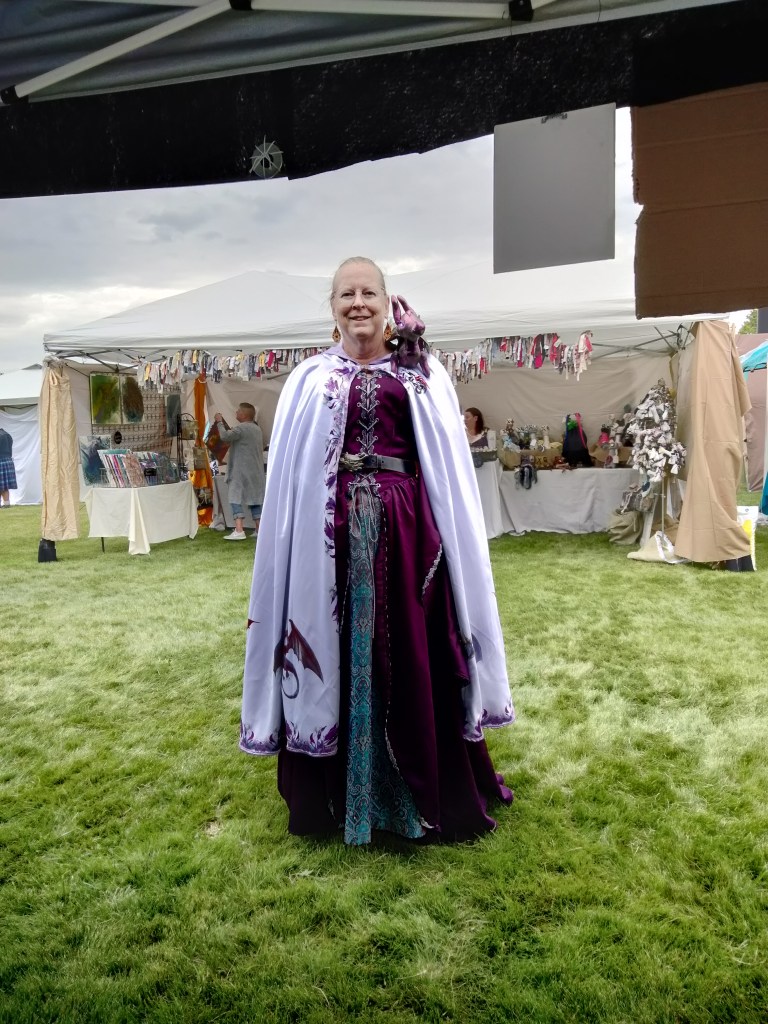
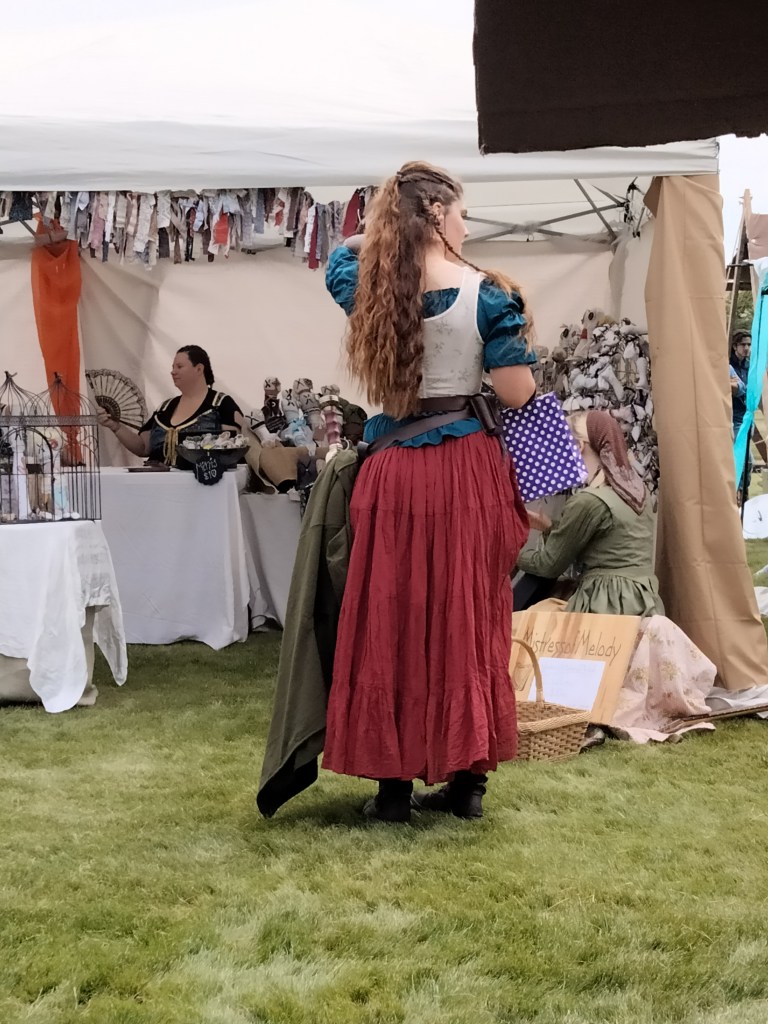
Literally every person who passed by our booth was worthy of a photo essay, so these are just a few highlights.
Here’s the alley behind the booths on Saturday. My son said, “It’s beautiful the way everyone shows up and sets up their own booth, and instantly there is a city where there was none before.” He’s eleven.
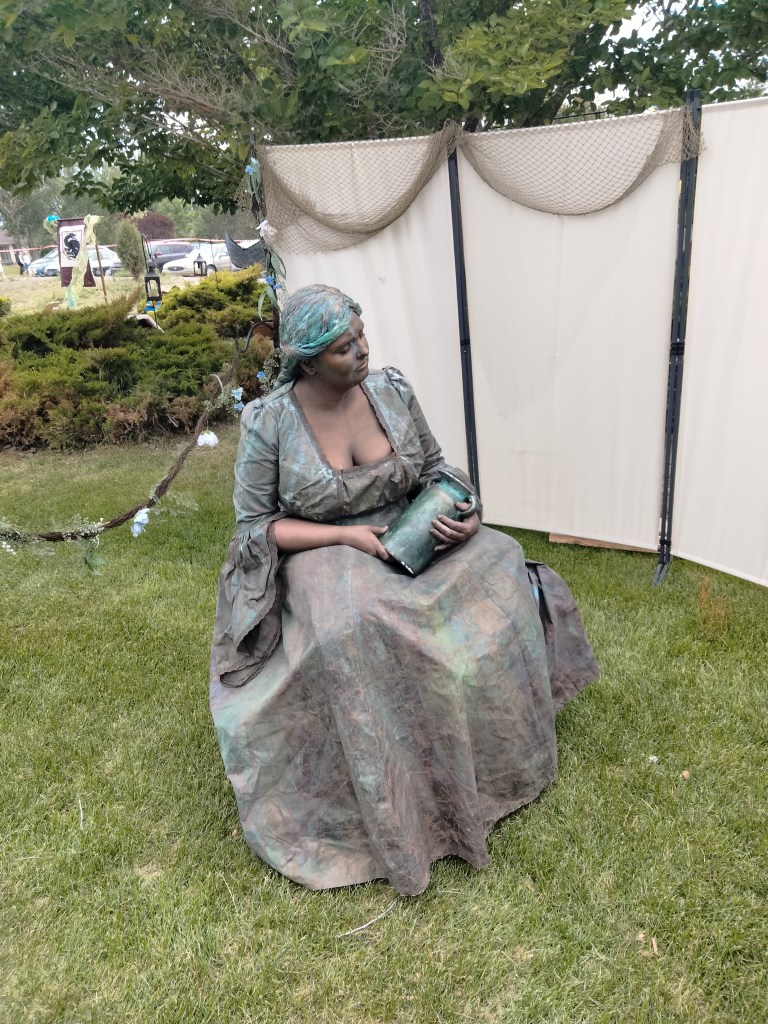
There was this “Enchanted Statue” who, when given a tip, would wink at you.
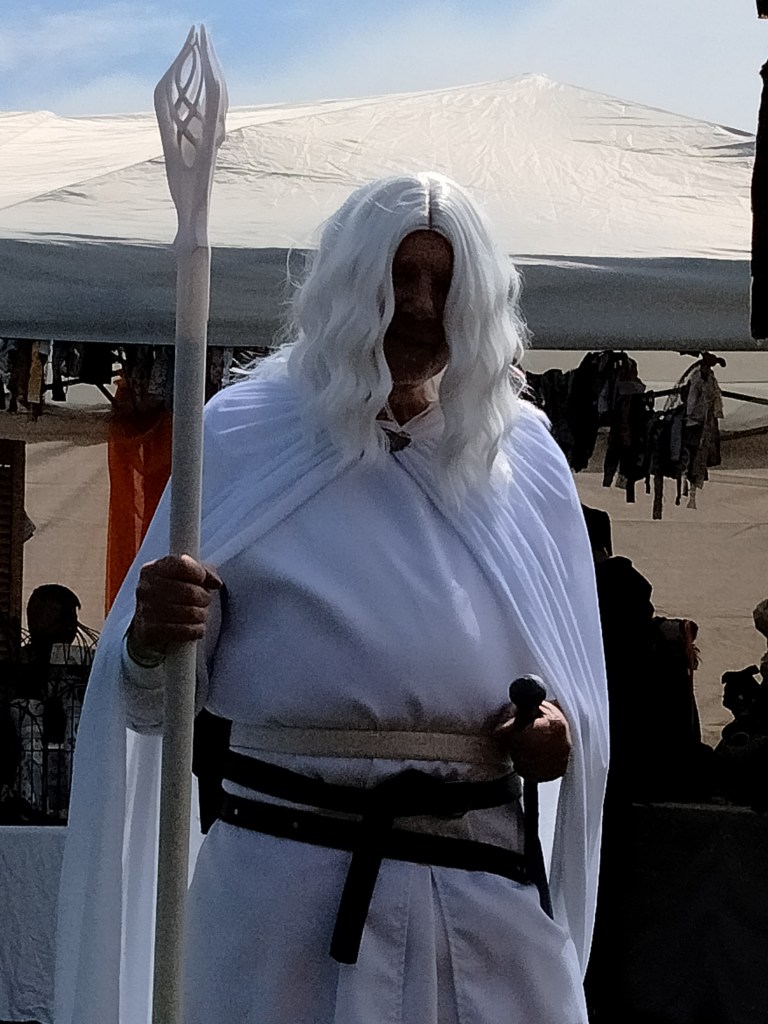
Gandalf the White showed up first thing on Saturday morning.
There were many Scotsmen and a few Scots women.
… one ogre …
… musicians …
… jesters …
… mushrooms …
… elves …
And quite a few pirates. The pirate with her back to the camera would, for $5, “arrest” a victim of your choice and parade them throughout the Faire, calling out “Shame the prisoner!” as they wore a placard stating their crime.
Here she is arresting a lady merchant whose crime was running out of fudge at her booth. The person who put her up to this was my son, who wanted to do everything.
Ensuring that we became friends.
Here’s another friend, from the Pocatello Writers’ Group.
And some more people worth looking at.
One thing I regretfully realized after putting together this post was that I do not have a single picture of a knight or warrior. In fact, there were many of these fellows at the Fantasy Faire. A tall, portly warrior in Viking-style armor bought one of my son’s paintings. Also prominent were the Salt Lake City Crusaders, whose motto is “Real Armor. Real Weapons. Real Athletes.” They had a ring set up in which, twice a day, men in authentic armor battled it out. (I swear that, as I wandered by, I saw one armored guy hitting another armored guy on the helmet with a frying pan.) These warriors would periodically come striding through the Faire, but they always walked so fast that I never got a picture. Plus, I guess, there were so many armored men about that I just took them for granted. But, let the record show that they were there.
She kept my features as-is, but exaggerated the clothing – the hairiness of the fur, the size of the bone in the hair. I was thinking of using the results of her work as a profile picture, but … whaddaya think? Too good? To loose? I do love the style.
























 Out of Babel Books