
“People make fun of pushy mothers,” Isabel once observed to Jamie. “But if we didn’t have pushy mothers, we wouldn’t have anybody–anybody at all– who could play the piano.”
The Sweet Remnants of Summer, by Alexander McCall Smith, p. 109
It’s Official
There has been much debate about what is the Best Meal in the Universe, but I am here to settle it, now, today.
It’s fish and chips.
Jesus almost served this meal when He fed the 5,000. That was fish and bread — fish and a starch. It was close. But as potatoes had not yet been brought over from the New World, the meal eaten by the 5,000 did not yet reach the height of perfection.
Similarly, in other parts of the world you might eat fish with other starches: rice, pounded taro, breadfruit. Even corn (see Shrimp and Grits). These meals are close, so close. But after many millennia of the development of human cuisines, the word is finally in on the perfect meal.
And it’s fish and chips.
If you need a vegetable (you know, so as not to get bound up), please feel free to add coleslaw. Also, malt vinegar is definitely part of the meal.
Fish and chips.
You’re welcome.
Side-Eye Quote of the Week
Jamie thought for a moment. “Couldn’t we all say that about ourselves? As nations, too? ‘We shouldn’t have done what we did.’ Isn’t that what we all now feel about our past?”
“You mean Britain shouldn’t have done what it did? Or America? Or Spain?”
“Yes,” said Jamie. “But not just them. Not just the obvious targets. Pretty much everybody. Russia. Turkey. China. The past is pretty shameful once you start to look at it more closely.”
The Sweet Remnants of Summer, by Alexander McCall Smith, p. 8
Spring in the North
We were visited by these Snow Geese on their way north. I took this video out my bedroom window on the third day of spring.
Farm Shoes
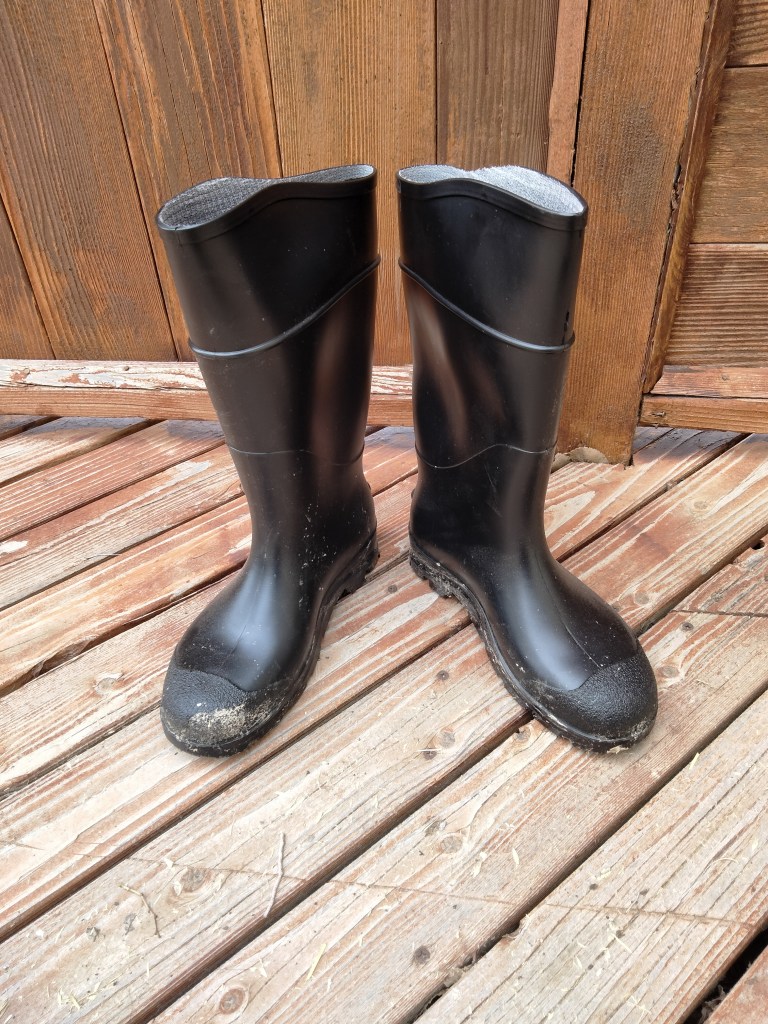
So, this week I bought these farm shoes. I know that some people call them “wellies,” but I don’t know what they’re called around here. Just “rubber boots” maybe.
I need them not because I am a real farmer in any way, but because Spring has sprung (sort of … we are also still getting snow), and even if a person only has 3 chickens, their run is still surrounded by mud. With these boots, I feel that I have leveled up in some small way.
As a person who romanticizes the past, the boots naturally got me thinking about what people did for mud shoes (in Europe, say) before they had access to rubber. The answer, of course, was clogs or wooden shoes. You can see them on French peasants in Millet’s paintings sometimes.

“The Gleaners,” by Millet. You can’t really tell what the shoes are made of, but you can see that they’re sort of in the clog family.
But I’m Dutch (actually, Frisian) by ancestry, and we have our own iconic version of the wooden shoe. I don’t know about other peasant clogs, but Dutch wooden shoes have to fit rather large and be worn with several layers of socks. They float, which is important in Holland.

Here is me in a partially authentic “Dutch costume” that my mom made, displaying the klompen. (That’s what the wooden shoes are called, for obvious reasons.) She did not make the klompen. We got those at De Klomp Wooden Shoe factory in Holland, Michigan, which is still in operation to this day. There, you can buy everything from tiny souvenir klompen to ones that fit you to huge painted klompen to put on your porch. You can watch the shoes being carved and hollowed out. You can have your name woodburned onto a pair if you wish. The whole place smells really good, like fresh wood shavings and woodburning smoke.

Here is someone I know (also of Frisian blood), modeling the klompen and the milk maid buckets. I know the blurring, and the basket in the foreground, make it look like this picture was taken in a studio, but it was actually snapped outdoors. The roses are real and those are real, fake Dutch farmer accoutrements.
If you, Reader, work outdoors (whether it’s farming or forestry or plein-air paintings), what do you prefer for spring mud shoes?
Jesus Is Brave
Now my heart is troubled, and what shall I say? ‘Father, save me from this hour’? No, it was for this very reason I came to this hour. Father, glorify your Name!
John 12:27 – 28a
I’m a D— Fine Latin Teacher!

This is from an old Doonesbury comic by Gary Trudeau. My dad used to be a big Trudeau fan and had a large collection of his books. I devoured them as a kid, which I didn’t realize was giving me a very leftie view of modern American history. But it’s funny little human moments like the one above that make Trudeau (at least his older work) so appealing.
Interestingly, “Herbert” looks a bit like one of my Linguistics professors in college, except for the cigarette.
And now … I actually am a Latin teacher. And d— fine one.
I’d be snapped up in a minute.
What Is A Tell?
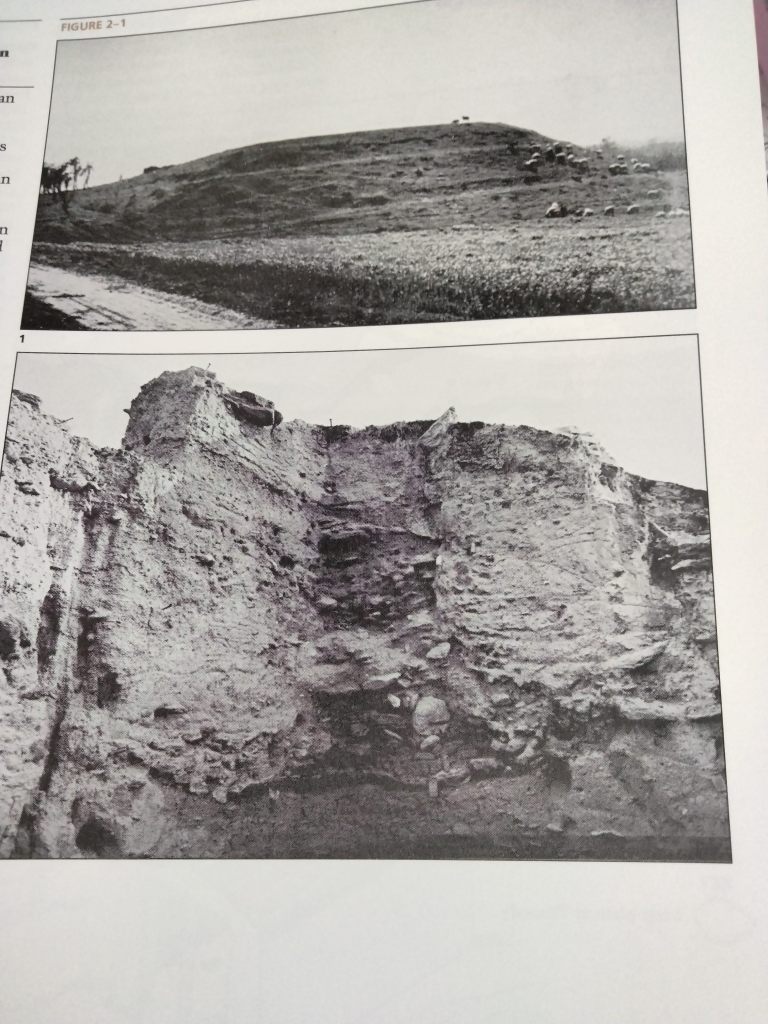
A tell is, essentially, a man-made hill that consists of layers upon layers of ancient ruins.
I first heard about tells in a Biblical Archaeology context. The Levant is filled with tells. Often, the original city was built on a high spot to begin with. Then, as successive generations of the city were destroyed and rebuilt, the tell got higher and higher. In the Levant, you often find a current city still thriving on top of the tell. So there is a modern city on top of a medieval city on top of a Greco-Roman city top of an Israelite city on top of a Canaanite city on top of a city from the time of Sumer. If you dig down carefully through these tells, you will find mosaics, pots, coins, garbage, all kinds of good stuff. Tells are different from grave mounds because they don’t usually contain grave goods carefully selected, but rather the debris of everyday life, and often the ash layers of past battles.
Well, it turns out, the Levant ain’t the only place that gots tells! I am currently reading The Civilization of the Goddess: The World of Old Europe, by Marija Gimbutas, published in 1991. As you can tell (haha!) from the title, Gimbutas has her own spin on the history of Old Europe, about which I will no doubt post later. But today, I am just here to talk about tells. There are many tells in Thessaly, Macedonia, Bulgaria, Yugoslavia, Romania, western Ukraine and southern Hungary (as we call them today) which show that in the 6,000 to 4,000s B.C., the Balkans were a happenin’ place. They revealed tidy planned cities, sometimes of a few thousand people, with hearths, idols, loom weights, and “exquisite” pots. (I love it when archeologists call something like a pot “exquisite.” It means they are really excited about it.)
I have previously posted about the Vinca Signs, which came from this culture area and may have been an alphabet, though Gimbutas looks like she’s gearing up to treat them as primarily religious symbols. The settlements in this area are all fairly uniform, especially in their earlier stages, which says to me that people spread out quickly, probably from the Levant via Turkey and Macedonia. The climate at the time was rainier than now, which made farming easier. The sea levels were probably also lower, which might have facilitated travel.
Take a look at the photo at the top of this post. It comes from page 13 of Gimbutas’ book. The upper image is labeled “Argisa tell, west of Larisa, Thessaly.” The lower one: “Profile of Sesklo tell, c. 12 m of cultural deposits, with Early Neolithic (Early Ceramic) at the base and classical Sesklo on the top, c. 65th – 57th cents. B.C.”
Twelve meters of cultural deposits! Imagine the riches.
At the time this book was published, a few tells in the Balkan area had been excavated (Sesklo by Gimbutas herself), but most had not. I expect that is still true today. There have been some “hills” in Bosnia that turned out to be pyramids and to have tunnels inside, but really, even archeologists like Gimbutas who realize that Old Europe was much more advanced than previously thought are just getting started. I doubt that everything will be excavated, or the ancient story fully told, in this life. But if you have any interest in such things at all, it’s amazing to think of all the wealth of all those tells sitting there with their meters and meters of secrets.
Exquisite.
Jesus Is Funny
I tell you the truth, no one who has left home or brothers or sisters or mother or father or children or fields for me and the gospel will fail to receive a hundred times as much in this present age: homes, brothers, sisters, mothers, children and fields — and with them, persecutions.
Mark 10: 29 – 30
 Out of Babel Books